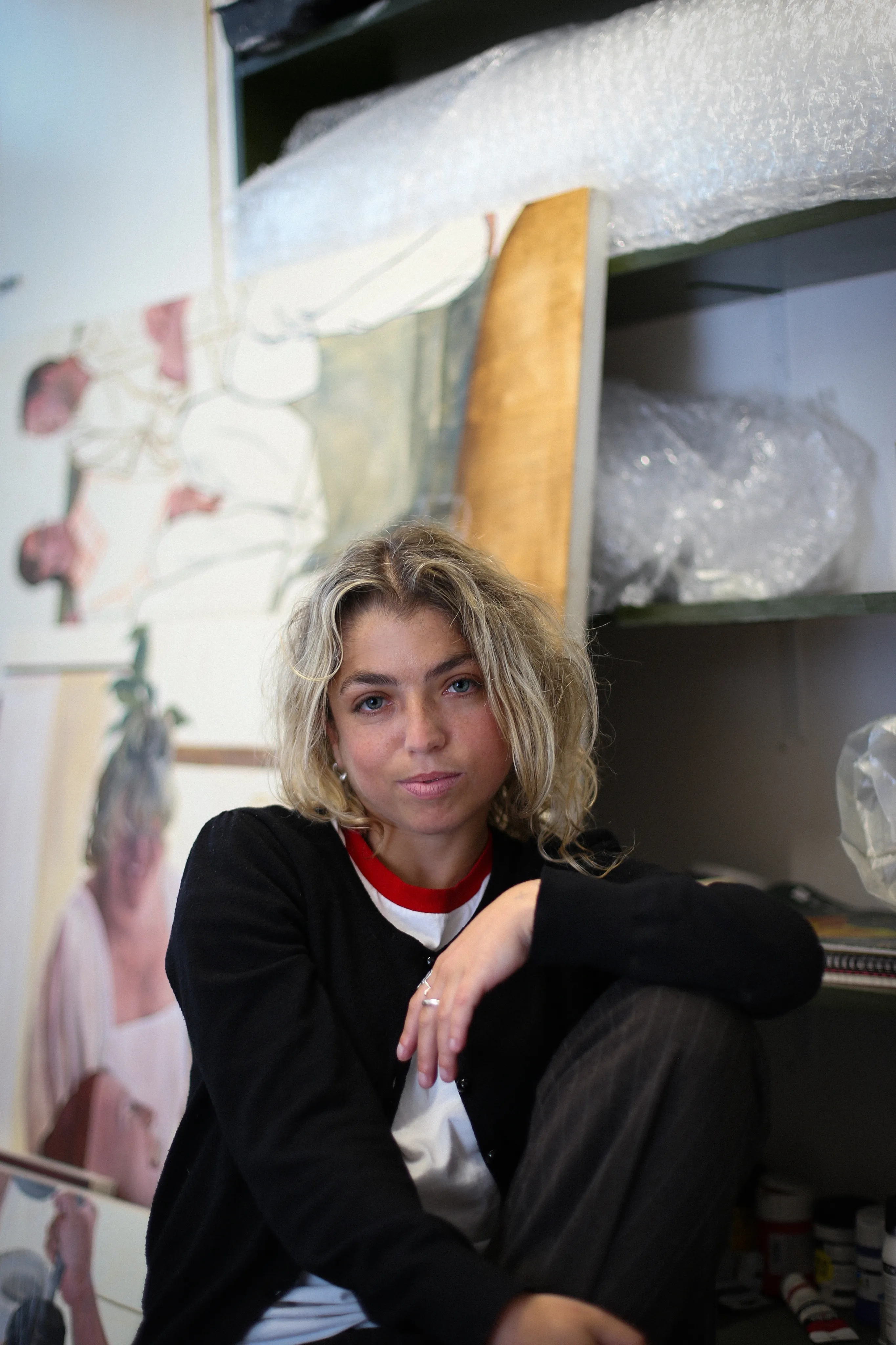
Welcome to 15 Questions With…, an interview series in which art writer Gary Grimes picks the brains of artists, curators and other creatives to understand what makes them tick through a series of quick fire questions. This series aims to showcase the varying approaches creatives take to making art and how their relationships to the so-called art world differ, but also reveal what unifies those responsible for the art we love.
Lorena Levi is a narrative painter based in London, whose research-led practice merges traditional oil painting with contemporary digital sources. In her practice, she collages found imagery to explore relationships and identity. A graduate of Edinburgh University, she has exhibited at Marlborough Gallery, South London Gallery, and the Royal Scottish Academy, and is a winner of the Jackson’s Painting Prize and the Astaire Prize.
Last month, Levi held an exhibition titled Cold Hard Plastic at Incubator in London. The show was inspired by her recent experiences undergoing cancer treatment, using Barbie as a motif through which to comment on societal expectations of women’s bodies.
What is your earliest memory of a work of art?
The first portrait I saw was of my mother, done by an artist she was friends with, Artin Demirci, who wanted to explore portraiture after working mainly in landscape and still life. I remember being quite scared of it because it was somewhat recognisable, but he used such rich paint and contrast that the face was pale and would almost glow in the dark. So, at nighttime, I would avoid looking at it.
Where do you turn to when you're in need of inspiration?
I look at books and films a lot of the time because I think my work has a narrative quality where I hope to tell a story through a snapshot. I look at things in media and pop culture as well to see what interests people and certain niches that I could delve deeper into for research purposes.
What do you like to do when you need to take a break from your practice?
That’s quite tricky because I rarely like to take breaks, which is not very healthy! But I like to watch films, read, and I’ve been knitting a bit, but very badly - I just like the process of it and find it super relaxing.
Who is your favourite artist?
Paula Rego is my ultimate favourite. I remember first discovering her work in my last year of A-levels and being so drawn into her difficult subjects that are presented in such a digestible but also thought-provoking way. Other artists in the same vein, like Frida Kahlo, Alice Kneel, Marlene Dumas, early Lucian Freud in terms of portrait style, Egon Schiele and John Currin.
What's the biggest crime an artist can commit?
Comparison. Comparing your work with others the whole time and trying to see what makes another artist work likeable, and trying to implement that into your own work. It will no longer be authentic, and then it will be so frustrating to execute. Admire other artists for sure and see what themes you find interesting that they use, but then think about themes you are interested in, rather than what collectors, galleries, and viewers will prefer.
Which gallery or museum should everyone try to visit at least once in their life?
Neue Gallery in NYC, firstly, the building’s architecture itself is a delight to the eyes. The exhibitions I’ve seen there – the German Expressionist collections are so incredibly curated in the space, and I really do recommend it. It might be quite basic to say, but I think the Tate Modern is unmissable. There is always at least one show among the few they put on at certain times that’s exceptional.
Whose opinions on art do you actually care about?
My sister’s is an opinion I always seek out. She is younger than me by seven years, but has such an astute eye. Also, when I’m working with a gallery on a particular project, I really want to get a feeling of what they think about the work, not just that they like it, but the issues that can be fixed or what they want to see more of.
What trend in art makes you roll your eyes?
Coquette, close-up oil paintings. So, for example, I’ve seen a huge rise in this baby girl, schoolgirl, pious girl aesthetic, but with the paintings being of sections of the body or ribbons and shoes. When I first saw them, I thought it was visually really pleasing, but seeing it from multiple artists, it’s a bit like, once you’ve seen one, you’ve seen them all. I don’t find them thought-provoking or conversation-inducing.
Who are the last three musical artists you listened to?
Nina Simone, Jamiroquai and OutKast.
What's your favourite colour and why?
Green, I find it to be mesmerising in all its tones and gives a totally different feeling to an image if it’s a rich emerald tone versus a pale sage green. It’s quite versatile, and I don’t think there’s a green tone I dislike.
What three items would you grab if your house was burning down?
Cliché but my sketch pad, this faux fur coat I very recently got from my mum, and my extremely trusty massage gun.
Is there an artistic skill you wish you were better at, and why?
Yes! Stretching canvas. I never learnt it properly, we did a quick course on it in art foundation, but when I tried it myself, I was rubbish, and now I have no confidence to stretch them myself.
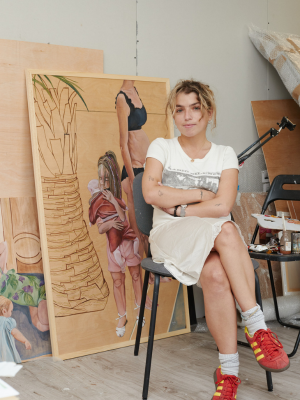
What can you tell us about your recent show, Cold Hard Plastic at Incubator?
Angelica [Jopling, founding director of Incubator] and I decided to do a show last year, but I really didn’t have a concept in mind back then. In the new year, I was diagnosed with cancer, and the first two months were quite bleak, and I did not have much motivation to work, but then I felt a need for release. For me, that’s always been through painting.
I had this idea of comparing the grim realities of illness with the perfect fantasy of Barbie and just started pouring my notes with ideas for paintings. I spoke to Angelica and she was very much on board, so I started working from April. It was different to past processes with projects because there would be weeks of interruption due to medical reasons. Once those medical problems were solved, I could reflect on them and paint inspired by that. I thought the concept of cancer is tough for people to engage with, and a lot of my works have elements of humour with an undertone of disturbing realities, so I thought the Barbie aspect could do that.
Which piece in the show took the longest to perfect, and why?
‘Locks’ took the longest to perfect for a few reasons. It was the first one I did, and I wanted the hair to be meticulous, so I was using tiny brushes for strands and just had to be patient with building it all up. My aunt came to my studio one day to see me work. She said it was interesting to see my process with ‘Locks’ because it required care and patience, and would seem extremely tedious to someone who was watching it be done, which reminded her of how I have dealt with medical problems my whole life, but especially this new chapter with my cancer medical care. I thought that was quite special to hear.
What impression do you hope people get after seeing your show?
I think I want people to feel my personality through the work. I haven’t really done many autobiographical series of paintings, so I was a bit nervous to put it out raw like this. I think I want people to enjoy my painting style while also learning about my personal story with this treatment, which is different for every cancer patient, but this is my individual take on how it has been. I’d like the work to increase conversation about the reality of illness but also how it is shown in the history of art and contemporary art.


Welcome to 15 Questions With…, an interview series in which art writer Gary Grimes picks the brains of artists, curators and other creatives to understand what makes them tick through a series of quick fire questions. This series aims to showcase the varying approaches creatives take to making art and how their relationships to the so-called art world differ, but also reveal what unifies those responsible for the art we love.
Lorena Levi is a narrative painter based in London, whose research-led practice merges traditional oil painting with contemporary digital sources. In her practice, she collages found imagery to explore relationships and identity. A graduate of Edinburgh University, she has exhibited at Marlborough Gallery, South London Gallery, and the Royal Scottish Academy, and is a winner of the Jackson’s Painting Prize and the Astaire Prize.
Last month, Levi held an exhibition titled Cold Hard Plastic at Incubator in London. The show was inspired by her recent experiences undergoing cancer treatment, using Barbie as a motif through which to comment on societal expectations of women’s bodies.
What is your earliest memory of a work of art?
The first portrait I saw was of my mother, done by an artist she was friends with, Artin Demirci, who wanted to explore portraiture after working mainly in landscape and still life. I remember being quite scared of it because it was somewhat recognisable, but he used such rich paint and contrast that the face was pale and would almost glow in the dark. So, at nighttime, I would avoid looking at it.
Where do you turn to when you're in need of inspiration?
I look at books and films a lot of the time because I think my work has a narrative quality where I hope to tell a story through a snapshot. I look at things in media and pop culture as well to see what interests people and certain niches that I could delve deeper into for research purposes.
What do you like to do when you need to take a break from your practice?
That’s quite tricky because I rarely like to take breaks, which is not very healthy! But I like to watch films, read, and I’ve been knitting a bit, but very badly - I just like the process of it and find it super relaxing.
Who is your favourite artist?
Paula Rego is my ultimate favourite. I remember first discovering her work in my last year of A-levels and being so drawn into her difficult subjects that are presented in such a digestible but also thought-provoking way. Other artists in the same vein, like Frida Kahlo, Alice Kneel, Marlene Dumas, early Lucian Freud in terms of portrait style, Egon Schiele and John Currin.
What's the biggest crime an artist can commit?
Comparison. Comparing your work with others the whole time and trying to see what makes another artist work likeable, and trying to implement that into your own work. It will no longer be authentic, and then it will be so frustrating to execute. Admire other artists for sure and see what themes you find interesting that they use, but then think about themes you are interested in, rather than what collectors, galleries, and viewers will prefer.
Which gallery or museum should everyone try to visit at least once in their life?
Neue Gallery in NYC, firstly, the building’s architecture itself is a delight to the eyes. The exhibitions I’ve seen there – the German Expressionist collections are so incredibly curated in the space, and I really do recommend it. It might be quite basic to say, but I think the Tate Modern is unmissable. There is always at least one show among the few they put on at certain times that’s exceptional.
Whose opinions on art do you actually care about?
My sister’s is an opinion I always seek out. She is younger than me by seven years, but has such an astute eye. Also, when I’m working with a gallery on a particular project, I really want to get a feeling of what they think about the work, not just that they like it, but the issues that can be fixed or what they want to see more of.
What trend in art makes you roll your eyes?
Coquette, close-up oil paintings. So, for example, I’ve seen a huge rise in this baby girl, schoolgirl, pious girl aesthetic, but with the paintings being of sections of the body or ribbons and shoes. When I first saw them, I thought it was visually really pleasing, but seeing it from multiple artists, it’s a bit like, once you’ve seen one, you’ve seen them all. I don’t find them thought-provoking or conversation-inducing.
Who are the last three musical artists you listened to?
Nina Simone, Jamiroquai and OutKast.
What's your favourite colour and why?
Green, I find it to be mesmerising in all its tones and gives a totally different feeling to an image if it’s a rich emerald tone versus a pale sage green. It’s quite versatile, and I don’t think there’s a green tone I dislike.
What three items would you grab if your house was burning down?
Cliché but my sketch pad, this faux fur coat I very recently got from my mum, and my extremely trusty massage gun.
Is there an artistic skill you wish you were better at, and why?
Yes! Stretching canvas. I never learnt it properly, we did a quick course on it in art foundation, but when I tried it myself, I was rubbish, and now I have no confidence to stretch them myself.
What can you tell us about your recent show, Cold Hard Plastic at Incubator?
Angelica [Jopling, founding director of Incubator] and I decided to do a show last year, but I really didn’t have a concept in mind back then. In the new year, I was diagnosed with cancer, and the first two months were quite bleak, and I did not have much motivation to work, but then I felt a need for release. For me, that’s always been through painting.
I had this idea of comparing the grim realities of illness with the perfect fantasy of Barbie and just started pouring my notes with ideas for paintings. I spoke to Angelica and she was very much on board, so I started working from April. It was different to past processes with projects because there would be weeks of interruption due to medical reasons. Once those medical problems were solved, I could reflect on them and paint inspired by that. I thought the concept of cancer is tough for people to engage with, and a lot of my works have elements of humour with an undertone of disturbing realities, so I thought the Barbie aspect could do that.
Which piece in the show took the longest to perfect, and why?
‘Locks’ took the longest to perfect for a few reasons. It was the first one I did, and I wanted the hair to be meticulous, so I was using tiny brushes for strands and just had to be patient with building it all up. My aunt came to my studio one day to see me work. She said it was interesting to see my process with ‘Locks’ because it required care and patience, and would seem extremely tedious to someone who was watching it be done, which reminded her of how I have dealt with medical problems my whole life, but especially this new chapter with my cancer medical care. I thought that was quite special to hear.
What impression do you hope people get after seeing your show?
I think I want people to feel my personality through the work. I haven’t really done many autobiographical series of paintings, so I was a bit nervous to put it out raw like this. I think I want people to enjoy my painting style while also learning about my personal story with this treatment, which is different for every cancer patient, but this is my individual take on how it has been. I’d like the work to increase conversation about the reality of illness but also how it is shown in the history of art and contemporary art.
Welcome to 15 Questions With…, an interview series in which art writer Gary Grimes picks the brains of artists, curators and other creatives to understand what makes them tick through a series of quick fire questions. This series aims to showcase the varying approaches creatives take to making art and how their relationships to the so-called art world differ, but also reveal what unifies those responsible for the art we love.
Lorena Levi is a narrative painter based in London, whose research-led practice merges traditional oil painting with contemporary digital sources. In her practice, she collages found imagery to explore relationships and identity. A graduate of Edinburgh University, she has exhibited at Marlborough Gallery, South London Gallery, and the Royal Scottish Academy, and is a winner of the Jackson’s Painting Prize and the Astaire Prize.
Last month, Levi held an exhibition titled Cold Hard Plastic at Incubator in London. The show was inspired by her recent experiences undergoing cancer treatment, using Barbie as a motif through which to comment on societal expectations of women’s bodies.
What is your earliest memory of a work of art?
The first portrait I saw was of my mother, done by an artist she was friends with, Artin Demirci, who wanted to explore portraiture after working mainly in landscape and still life. I remember being quite scared of it because it was somewhat recognisable, but he used such rich paint and contrast that the face was pale and would almost glow in the dark. So, at nighttime, I would avoid looking at it.
Where do you turn to when you're in need of inspiration?
I look at books and films a lot of the time because I think my work has a narrative quality where I hope to tell a story through a snapshot. I look at things in media and pop culture as well to see what interests people and certain niches that I could delve deeper into for research purposes.
What do you like to do when you need to take a break from your practice?
That’s quite tricky because I rarely like to take breaks, which is not very healthy! But I like to watch films, read, and I’ve been knitting a bit, but very badly - I just like the process of it and find it super relaxing.
Who is your favourite artist?
Paula Rego is my ultimate favourite. I remember first discovering her work in my last year of A-levels and being so drawn into her difficult subjects that are presented in such a digestible but also thought-provoking way. Other artists in the same vein, like Frida Kahlo, Alice Kneel, Marlene Dumas, early Lucian Freud in terms of portrait style, Egon Schiele and John Currin.
What's the biggest crime an artist can commit?
Comparison. Comparing your work with others the whole time and trying to see what makes another artist work likeable, and trying to implement that into your own work. It will no longer be authentic, and then it will be so frustrating to execute. Admire other artists for sure and see what themes you find interesting that they use, but then think about themes you are interested in, rather than what collectors, galleries, and viewers will prefer.
Which gallery or museum should everyone try to visit at least once in their life?
Neue Gallery in NYC, firstly, the building’s architecture itself is a delight to the eyes. The exhibitions I’ve seen there – the German Expressionist collections are so incredibly curated in the space, and I really do recommend it. It might be quite basic to say, but I think the Tate Modern is unmissable. There is always at least one show among the few they put on at certain times that’s exceptional.
Whose opinions on art do you actually care about?
My sister’s is an opinion I always seek out. She is younger than me by seven years, but has such an astute eye. Also, when I’m working with a gallery on a particular project, I really want to get a feeling of what they think about the work, not just that they like it, but the issues that can be fixed or what they want to see more of.
What trend in art makes you roll your eyes?
Coquette, close-up oil paintings. So, for example, I’ve seen a huge rise in this baby girl, schoolgirl, pious girl aesthetic, but with the paintings being of sections of the body or ribbons and shoes. When I first saw them, I thought it was visually really pleasing, but seeing it from multiple artists, it’s a bit like, once you’ve seen one, you’ve seen them all. I don’t find them thought-provoking or conversation-inducing.
Who are the last three musical artists you listened to?
Nina Simone, Jamiroquai and OutKast.
What's your favourite colour and why?
Green, I find it to be mesmerising in all its tones and gives a totally different feeling to an image if it’s a rich emerald tone versus a pale sage green. It’s quite versatile, and I don’t think there’s a green tone I dislike.
What three items would you grab if your house was burning down?
Cliché but my sketch pad, this faux fur coat I very recently got from my mum, and my extremely trusty massage gun.
Is there an artistic skill you wish you were better at, and why?
Yes! Stretching canvas. I never learnt it properly, we did a quick course on it in art foundation, but when I tried it myself, I was rubbish, and now I have no confidence to stretch them myself.
What can you tell us about your recent show, Cold Hard Plastic at Incubator?
Angelica [Jopling, founding director of Incubator] and I decided to do a show last year, but I really didn’t have a concept in mind back then. In the new year, I was diagnosed with cancer, and the first two months were quite bleak, and I did not have much motivation to work, but then I felt a need for release. For me, that’s always been through painting.
I had this idea of comparing the grim realities of illness with the perfect fantasy of Barbie and just started pouring my notes with ideas for paintings. I spoke to Angelica and she was very much on board, so I started working from April. It was different to past processes with projects because there would be weeks of interruption due to medical reasons. Once those medical problems were solved, I could reflect on them and paint inspired by that. I thought the concept of cancer is tough for people to engage with, and a lot of my works have elements of humour with an undertone of disturbing realities, so I thought the Barbie aspect could do that.
Which piece in the show took the longest to perfect, and why?
‘Locks’ took the longest to perfect for a few reasons. It was the first one I did, and I wanted the hair to be meticulous, so I was using tiny brushes for strands and just had to be patient with building it all up. My aunt came to my studio one day to see me work. She said it was interesting to see my process with ‘Locks’ because it required care and patience, and would seem extremely tedious to someone who was watching it be done, which reminded her of how I have dealt with medical problems my whole life, but especially this new chapter with my cancer medical care. I thought that was quite special to hear.
What impression do you hope people get after seeing your show?
I think I want people to feel my personality through the work. I haven’t really done many autobiographical series of paintings, so I was a bit nervous to put it out raw like this. I think I want people to enjoy my painting style while also learning about my personal story with this treatment, which is different for every cancer patient, but this is my individual take on how it has been. I’d like the work to increase conversation about the reality of illness but also how it is shown in the history of art and contemporary art.
Welcome to 15 Questions With…, an interview series in which art writer Gary Grimes picks the brains of artists, curators and other creatives to understand what makes them tick through a series of quick fire questions. This series aims to showcase the varying approaches creatives take to making art and how their relationships to the so-called art world differ, but also reveal what unifies those responsible for the art we love.
Lorena Levi is a narrative painter based in London, whose research-led practice merges traditional oil painting with contemporary digital sources. In her practice, she collages found imagery to explore relationships and identity. A graduate of Edinburgh University, she has exhibited at Marlborough Gallery, South London Gallery, and the Royal Scottish Academy, and is a winner of the Jackson’s Painting Prize and the Astaire Prize.
Last month, Levi held an exhibition titled Cold Hard Plastic at Incubator in London. The show was inspired by her recent experiences undergoing cancer treatment, using Barbie as a motif through which to comment on societal expectations of women’s bodies.
What is your earliest memory of a work of art?
The first portrait I saw was of my mother, done by an artist she was friends with, Artin Demirci, who wanted to explore portraiture after working mainly in landscape and still life. I remember being quite scared of it because it was somewhat recognisable, but he used such rich paint and contrast that the face was pale and would almost glow in the dark. So, at nighttime, I would avoid looking at it.
Where do you turn to when you're in need of inspiration?
I look at books and films a lot of the time because I think my work has a narrative quality where I hope to tell a story through a snapshot. I look at things in media and pop culture as well to see what interests people and certain niches that I could delve deeper into for research purposes.
What do you like to do when you need to take a break from your practice?
That’s quite tricky because I rarely like to take breaks, which is not very healthy! But I like to watch films, read, and I’ve been knitting a bit, but very badly - I just like the process of it and find it super relaxing.
Who is your favourite artist?
Paula Rego is my ultimate favourite. I remember first discovering her work in my last year of A-levels and being so drawn into her difficult subjects that are presented in such a digestible but also thought-provoking way. Other artists in the same vein, like Frida Kahlo, Alice Kneel, Marlene Dumas, early Lucian Freud in terms of portrait style, Egon Schiele and John Currin.
What's the biggest crime an artist can commit?
Comparison. Comparing your work with others the whole time and trying to see what makes another artist work likeable, and trying to implement that into your own work. It will no longer be authentic, and then it will be so frustrating to execute. Admire other artists for sure and see what themes you find interesting that they use, but then think about themes you are interested in, rather than what collectors, galleries, and viewers will prefer.
Which gallery or museum should everyone try to visit at least once in their life?
Neue Gallery in NYC, firstly, the building’s architecture itself is a delight to the eyes. The exhibitions I’ve seen there – the German Expressionist collections are so incredibly curated in the space, and I really do recommend it. It might be quite basic to say, but I think the Tate Modern is unmissable. There is always at least one show among the few they put on at certain times that’s exceptional.
Whose opinions on art do you actually care about?
My sister’s is an opinion I always seek out. She is younger than me by seven years, but has such an astute eye. Also, when I’m working with a gallery on a particular project, I really want to get a feeling of what they think about the work, not just that they like it, but the issues that can be fixed or what they want to see more of.
What trend in art makes you roll your eyes?
Coquette, close-up oil paintings. So, for example, I’ve seen a huge rise in this baby girl, schoolgirl, pious girl aesthetic, but with the paintings being of sections of the body or ribbons and shoes. When I first saw them, I thought it was visually really pleasing, but seeing it from multiple artists, it’s a bit like, once you’ve seen one, you’ve seen them all. I don’t find them thought-provoking or conversation-inducing.
Who are the last three musical artists you listened to?
Nina Simone, Jamiroquai and OutKast.
What's your favourite colour and why?
Green, I find it to be mesmerising in all its tones and gives a totally different feeling to an image if it’s a rich emerald tone versus a pale sage green. It’s quite versatile, and I don’t think there’s a green tone I dislike.
What three items would you grab if your house was burning down?
Cliché but my sketch pad, this faux fur coat I very recently got from my mum, and my extremely trusty massage gun.
Is there an artistic skill you wish you were better at, and why?
Yes! Stretching canvas. I never learnt it properly, we did a quick course on it in art foundation, but when I tried it myself, I was rubbish, and now I have no confidence to stretch them myself.
What can you tell us about your recent show, Cold Hard Plastic at Incubator?
Angelica [Jopling, founding director of Incubator] and I decided to do a show last year, but I really didn’t have a concept in mind back then. In the new year, I was diagnosed with cancer, and the first two months were quite bleak, and I did not have much motivation to work, but then I felt a need for release. For me, that’s always been through painting.
I had this idea of comparing the grim realities of illness with the perfect fantasy of Barbie and just started pouring my notes with ideas for paintings. I spoke to Angelica and she was very much on board, so I started working from April. It was different to past processes with projects because there would be weeks of interruption due to medical reasons. Once those medical problems were solved, I could reflect on them and paint inspired by that. I thought the concept of cancer is tough for people to engage with, and a lot of my works have elements of humour with an undertone of disturbing realities, so I thought the Barbie aspect could do that.
Which piece in the show took the longest to perfect, and why?
‘Locks’ took the longest to perfect for a few reasons. It was the first one I did, and I wanted the hair to be meticulous, so I was using tiny brushes for strands and just had to be patient with building it all up. My aunt came to my studio one day to see me work. She said it was interesting to see my process with ‘Locks’ because it required care and patience, and would seem extremely tedious to someone who was watching it be done, which reminded her of how I have dealt with medical problems my whole life, but especially this new chapter with my cancer medical care. I thought that was quite special to hear.
What impression do you hope people get after seeing your show?
I think I want people to feel my personality through the work. I haven’t really done many autobiographical series of paintings, so I was a bit nervous to put it out raw like this. I think I want people to enjoy my painting style while also learning about my personal story with this treatment, which is different for every cancer patient, but this is my individual take on how it has been. I’d like the work to increase conversation about the reality of illness but also how it is shown in the history of art and contemporary art.
Welcome to 15 Questions With…, an interview series in which art writer Gary Grimes picks the brains of artists, curators and other creatives to understand what makes them tick through a series of quick fire questions. This series aims to showcase the varying approaches creatives take to making art and how their relationships to the so-called art world differ, but also reveal what unifies those responsible for the art we love.
Lorena Levi is a narrative painter based in London, whose research-led practice merges traditional oil painting with contemporary digital sources. In her practice, she collages found imagery to explore relationships and identity. A graduate of Edinburgh University, she has exhibited at Marlborough Gallery, South London Gallery, and the Royal Scottish Academy, and is a winner of the Jackson’s Painting Prize and the Astaire Prize.
Last month, Levi held an exhibition titled Cold Hard Plastic at Incubator in London. The show was inspired by her recent experiences undergoing cancer treatment, using Barbie as a motif through which to comment on societal expectations of women’s bodies.
What is your earliest memory of a work of art?
The first portrait I saw was of my mother, done by an artist she was friends with, Artin Demirci, who wanted to explore portraiture after working mainly in landscape and still life. I remember being quite scared of it because it was somewhat recognisable, but he used such rich paint and contrast that the face was pale and would almost glow in the dark. So, at nighttime, I would avoid looking at it.
Where do you turn to when you're in need of inspiration?
I look at books and films a lot of the time because I think my work has a narrative quality where I hope to tell a story through a snapshot. I look at things in media and pop culture as well to see what interests people and certain niches that I could delve deeper into for research purposes.
What do you like to do when you need to take a break from your practice?
That’s quite tricky because I rarely like to take breaks, which is not very healthy! But I like to watch films, read, and I’ve been knitting a bit, but very badly - I just like the process of it and find it super relaxing.
Who is your favourite artist?
Paula Rego is my ultimate favourite. I remember first discovering her work in my last year of A-levels and being so drawn into her difficult subjects that are presented in such a digestible but also thought-provoking way. Other artists in the same vein, like Frida Kahlo, Alice Kneel, Marlene Dumas, early Lucian Freud in terms of portrait style, Egon Schiele and John Currin.
What's the biggest crime an artist can commit?
Comparison. Comparing your work with others the whole time and trying to see what makes another artist work likeable, and trying to implement that into your own work. It will no longer be authentic, and then it will be so frustrating to execute. Admire other artists for sure and see what themes you find interesting that they use, but then think about themes you are interested in, rather than what collectors, galleries, and viewers will prefer.
Which gallery or museum should everyone try to visit at least once in their life?
Neue Gallery in NYC, firstly, the building’s architecture itself is a delight to the eyes. The exhibitions I’ve seen there – the German Expressionist collections are so incredibly curated in the space, and I really do recommend it. It might be quite basic to say, but I think the Tate Modern is unmissable. There is always at least one show among the few they put on at certain times that’s exceptional.
Whose opinions on art do you actually care about?
My sister’s is an opinion I always seek out. She is younger than me by seven years, but has such an astute eye. Also, when I’m working with a gallery on a particular project, I really want to get a feeling of what they think about the work, not just that they like it, but the issues that can be fixed or what they want to see more of.
What trend in art makes you roll your eyes?
Coquette, close-up oil paintings. So, for example, I’ve seen a huge rise in this baby girl, schoolgirl, pious girl aesthetic, but with the paintings being of sections of the body or ribbons and shoes. When I first saw them, I thought it was visually really pleasing, but seeing it from multiple artists, it’s a bit like, once you’ve seen one, you’ve seen them all. I don’t find them thought-provoking or conversation-inducing.
Who are the last three musical artists you listened to?
Nina Simone, Jamiroquai and OutKast.
What's your favourite colour and why?
Green, I find it to be mesmerising in all its tones and gives a totally different feeling to an image if it’s a rich emerald tone versus a pale sage green. It’s quite versatile, and I don’t think there’s a green tone I dislike.
What three items would you grab if your house was burning down?
Cliché but my sketch pad, this faux fur coat I very recently got from my mum, and my extremely trusty massage gun.
Is there an artistic skill you wish you were better at, and why?
Yes! Stretching canvas. I never learnt it properly, we did a quick course on it in art foundation, but when I tried it myself, I was rubbish, and now I have no confidence to stretch them myself.
What can you tell us about your recent show, Cold Hard Plastic at Incubator?
Angelica [Jopling, founding director of Incubator] and I decided to do a show last year, but I really didn’t have a concept in mind back then. In the new year, I was diagnosed with cancer, and the first two months were quite bleak, and I did not have much motivation to work, but then I felt a need for release. For me, that’s always been through painting.
I had this idea of comparing the grim realities of illness with the perfect fantasy of Barbie and just started pouring my notes with ideas for paintings. I spoke to Angelica and she was very much on board, so I started working from April. It was different to past processes with projects because there would be weeks of interruption due to medical reasons. Once those medical problems were solved, I could reflect on them and paint inspired by that. I thought the concept of cancer is tough for people to engage with, and a lot of my works have elements of humour with an undertone of disturbing realities, so I thought the Barbie aspect could do that.
Which piece in the show took the longest to perfect, and why?
‘Locks’ took the longest to perfect for a few reasons. It was the first one I did, and I wanted the hair to be meticulous, so I was using tiny brushes for strands and just had to be patient with building it all up. My aunt came to my studio one day to see me work. She said it was interesting to see my process with ‘Locks’ because it required care and patience, and would seem extremely tedious to someone who was watching it be done, which reminded her of how I have dealt with medical problems my whole life, but especially this new chapter with my cancer medical care. I thought that was quite special to hear.
What impression do you hope people get after seeing your show?
I think I want people to feel my personality through the work. I haven’t really done many autobiographical series of paintings, so I was a bit nervous to put it out raw like this. I think I want people to enjoy my painting style while also learning about my personal story with this treatment, which is different for every cancer patient, but this is my individual take on how it has been. I’d like the work to increase conversation about the reality of illness but also how it is shown in the history of art and contemporary art.
Welcome to 15 Questions With…, an interview series in which art writer Gary Grimes picks the brains of artists, curators and other creatives to understand what makes them tick through a series of quick fire questions. This series aims to showcase the varying approaches creatives take to making art and how their relationships to the so-called art world differ, but also reveal what unifies those responsible for the art we love.
Lorena Levi is a narrative painter based in London, whose research-led practice merges traditional oil painting with contemporary digital sources. In her practice, she collages found imagery to explore relationships and identity. A graduate of Edinburgh University, she has exhibited at Marlborough Gallery, South London Gallery, and the Royal Scottish Academy, and is a winner of the Jackson’s Painting Prize and the Astaire Prize.
Last month, Levi held an exhibition titled Cold Hard Plastic at Incubator in London. The show was inspired by her recent experiences undergoing cancer treatment, using Barbie as a motif through which to comment on societal expectations of women’s bodies.
What is your earliest memory of a work of art?
The first portrait I saw was of my mother, done by an artist she was friends with, Artin Demirci, who wanted to explore portraiture after working mainly in landscape and still life. I remember being quite scared of it because it was somewhat recognisable, but he used such rich paint and contrast that the face was pale and would almost glow in the dark. So, at nighttime, I would avoid looking at it.
Where do you turn to when you're in need of inspiration?
I look at books and films a lot of the time because I think my work has a narrative quality where I hope to tell a story through a snapshot. I look at things in media and pop culture as well to see what interests people and certain niches that I could delve deeper into for research purposes.
What do you like to do when you need to take a break from your practice?
That’s quite tricky because I rarely like to take breaks, which is not very healthy! But I like to watch films, read, and I’ve been knitting a bit, but very badly - I just like the process of it and find it super relaxing.
Who is your favourite artist?
Paula Rego is my ultimate favourite. I remember first discovering her work in my last year of A-levels and being so drawn into her difficult subjects that are presented in such a digestible but also thought-provoking way. Other artists in the same vein, like Frida Kahlo, Alice Kneel, Marlene Dumas, early Lucian Freud in terms of portrait style, Egon Schiele and John Currin.
What's the biggest crime an artist can commit?
Comparison. Comparing your work with others the whole time and trying to see what makes another artist work likeable, and trying to implement that into your own work. It will no longer be authentic, and then it will be so frustrating to execute. Admire other artists for sure and see what themes you find interesting that they use, but then think about themes you are interested in, rather than what collectors, galleries, and viewers will prefer.
Which gallery or museum should everyone try to visit at least once in their life?
Neue Gallery in NYC, firstly, the building’s architecture itself is a delight to the eyes. The exhibitions I’ve seen there – the German Expressionist collections are so incredibly curated in the space, and I really do recommend it. It might be quite basic to say, but I think the Tate Modern is unmissable. There is always at least one show among the few they put on at certain times that’s exceptional.
Whose opinions on art do you actually care about?
My sister’s is an opinion I always seek out. She is younger than me by seven years, but has such an astute eye. Also, when I’m working with a gallery on a particular project, I really want to get a feeling of what they think about the work, not just that they like it, but the issues that can be fixed or what they want to see more of.
What trend in art makes you roll your eyes?
Coquette, close-up oil paintings. So, for example, I’ve seen a huge rise in this baby girl, schoolgirl, pious girl aesthetic, but with the paintings being of sections of the body or ribbons and shoes. When I first saw them, I thought it was visually really pleasing, but seeing it from multiple artists, it’s a bit like, once you’ve seen one, you’ve seen them all. I don’t find them thought-provoking or conversation-inducing.
Who are the last three musical artists you listened to?
Nina Simone, Jamiroquai and OutKast.
What's your favourite colour and why?
Green, I find it to be mesmerising in all its tones and gives a totally different feeling to an image if it’s a rich emerald tone versus a pale sage green. It’s quite versatile, and I don’t think there’s a green tone I dislike.
What three items would you grab if your house was burning down?
Cliché but my sketch pad, this faux fur coat I very recently got from my mum, and my extremely trusty massage gun.
Is there an artistic skill you wish you were better at, and why?
Yes! Stretching canvas. I never learnt it properly, we did a quick course on it in art foundation, but when I tried it myself, I was rubbish, and now I have no confidence to stretch them myself.
What can you tell us about your recent show, Cold Hard Plastic at Incubator?
Angelica [Jopling, founding director of Incubator] and I decided to do a show last year, but I really didn’t have a concept in mind back then. In the new year, I was diagnosed with cancer, and the first two months were quite bleak, and I did not have much motivation to work, but then I felt a need for release. For me, that’s always been through painting.
I had this idea of comparing the grim realities of illness with the perfect fantasy of Barbie and just started pouring my notes with ideas for paintings. I spoke to Angelica and she was very much on board, so I started working from April. It was different to past processes with projects because there would be weeks of interruption due to medical reasons. Once those medical problems were solved, I could reflect on them and paint inspired by that. I thought the concept of cancer is tough for people to engage with, and a lot of my works have elements of humour with an undertone of disturbing realities, so I thought the Barbie aspect could do that.
Which piece in the show took the longest to perfect, and why?
‘Locks’ took the longest to perfect for a few reasons. It was the first one I did, and I wanted the hair to be meticulous, so I was using tiny brushes for strands and just had to be patient with building it all up. My aunt came to my studio one day to see me work. She said it was interesting to see my process with ‘Locks’ because it required care and patience, and would seem extremely tedious to someone who was watching it be done, which reminded her of how I have dealt with medical problems my whole life, but especially this new chapter with my cancer medical care. I thought that was quite special to hear.
What impression do you hope people get after seeing your show?
I think I want people to feel my personality through the work. I haven’t really done many autobiographical series of paintings, so I was a bit nervous to put it out raw like this. I think I want people to enjoy my painting style while also learning about my personal story with this treatment, which is different for every cancer patient, but this is my individual take on how it has been. I’d like the work to increase conversation about the reality of illness but also how it is shown in the history of art and contemporary art.
Welcome to 15 Questions With…, an interview series in which art writer Gary Grimes picks the brains of artists, curators and other creatives to understand what makes them tick through a series of quick fire questions. This series aims to showcase the varying approaches creatives take to making art and how their relationships to the so-called art world differ, but also reveal what unifies those responsible for the art we love.
Lorena Levi is a narrative painter based in London, whose research-led practice merges traditional oil painting with contemporary digital sources. In her practice, she collages found imagery to explore relationships and identity. A graduate of Edinburgh University, she has exhibited at Marlborough Gallery, South London Gallery, and the Royal Scottish Academy, and is a winner of the Jackson’s Painting Prize and the Astaire Prize.
Last month, Levi held an exhibition titled Cold Hard Plastic at Incubator in London. The show was inspired by her recent experiences undergoing cancer treatment, using Barbie as a motif through which to comment on societal expectations of women’s bodies.
What is your earliest memory of a work of art?
The first portrait I saw was of my mother, done by an artist she was friends with, Artin Demirci, who wanted to explore portraiture after working mainly in landscape and still life. I remember being quite scared of it because it was somewhat recognisable, but he used such rich paint and contrast that the face was pale and would almost glow in the dark. So, at nighttime, I would avoid looking at it.
Where do you turn to when you're in need of inspiration?
I look at books and films a lot of the time because I think my work has a narrative quality where I hope to tell a story through a snapshot. I look at things in media and pop culture as well to see what interests people and certain niches that I could delve deeper into for research purposes.
What do you like to do when you need to take a break from your practice?
That’s quite tricky because I rarely like to take breaks, which is not very healthy! But I like to watch films, read, and I’ve been knitting a bit, but very badly - I just like the process of it and find it super relaxing.
Who is your favourite artist?
Paula Rego is my ultimate favourite. I remember first discovering her work in my last year of A-levels and being so drawn into her difficult subjects that are presented in such a digestible but also thought-provoking way. Other artists in the same vein, like Frida Kahlo, Alice Kneel, Marlene Dumas, early Lucian Freud in terms of portrait style, Egon Schiele and John Currin.
What's the biggest crime an artist can commit?
Comparison. Comparing your work with others the whole time and trying to see what makes another artist work likeable, and trying to implement that into your own work. It will no longer be authentic, and then it will be so frustrating to execute. Admire other artists for sure and see what themes you find interesting that they use, but then think about themes you are interested in, rather than what collectors, galleries, and viewers will prefer.
Which gallery or museum should everyone try to visit at least once in their life?
Neue Gallery in NYC, firstly, the building’s architecture itself is a delight to the eyes. The exhibitions I’ve seen there – the German Expressionist collections are so incredibly curated in the space, and I really do recommend it. It might be quite basic to say, but I think the Tate Modern is unmissable. There is always at least one show among the few they put on at certain times that’s exceptional.
Whose opinions on art do you actually care about?
My sister’s is an opinion I always seek out. She is younger than me by seven years, but has such an astute eye. Also, when I’m working with a gallery on a particular project, I really want to get a feeling of what they think about the work, not just that they like it, but the issues that can be fixed or what they want to see more of.
What trend in art makes you roll your eyes?
Coquette, close-up oil paintings. So, for example, I’ve seen a huge rise in this baby girl, schoolgirl, pious girl aesthetic, but with the paintings being of sections of the body or ribbons and shoes. When I first saw them, I thought it was visually really pleasing, but seeing it from multiple artists, it’s a bit like, once you’ve seen one, you’ve seen them all. I don’t find them thought-provoking or conversation-inducing.
Who are the last three musical artists you listened to?
Nina Simone, Jamiroquai and OutKast.
What's your favourite colour and why?
Green, I find it to be mesmerising in all its tones and gives a totally different feeling to an image if it’s a rich emerald tone versus a pale sage green. It’s quite versatile, and I don’t think there’s a green tone I dislike.
What three items would you grab if your house was burning down?
Cliché but my sketch pad, this faux fur coat I very recently got from my mum, and my extremely trusty massage gun.
Is there an artistic skill you wish you were better at, and why?
Yes! Stretching canvas. I never learnt it properly, we did a quick course on it in art foundation, but when I tried it myself, I was rubbish, and now I have no confidence to stretch them myself.
What can you tell us about your recent show, Cold Hard Plastic at Incubator?
Angelica [Jopling, founding director of Incubator] and I decided to do a show last year, but I really didn’t have a concept in mind back then. In the new year, I was diagnosed with cancer, and the first two months were quite bleak, and I did not have much motivation to work, but then I felt a need for release. For me, that’s always been through painting.
I had this idea of comparing the grim realities of illness with the perfect fantasy of Barbie and just started pouring my notes with ideas for paintings. I spoke to Angelica and she was very much on board, so I started working from April. It was different to past processes with projects because there would be weeks of interruption due to medical reasons. Once those medical problems were solved, I could reflect on them and paint inspired by that. I thought the concept of cancer is tough for people to engage with, and a lot of my works have elements of humour with an undertone of disturbing realities, so I thought the Barbie aspect could do that.
Which piece in the show took the longest to perfect, and why?
‘Locks’ took the longest to perfect for a few reasons. It was the first one I did, and I wanted the hair to be meticulous, so I was using tiny brushes for strands and just had to be patient with building it all up. My aunt came to my studio one day to see me work. She said it was interesting to see my process with ‘Locks’ because it required care and patience, and would seem extremely tedious to someone who was watching it be done, which reminded her of how I have dealt with medical problems my whole life, but especially this new chapter with my cancer medical care. I thought that was quite special to hear.
What impression do you hope people get after seeing your show?
I think I want people to feel my personality through the work. I haven’t really done many autobiographical series of paintings, so I was a bit nervous to put it out raw like this. I think I want people to enjoy my painting style while also learning about my personal story with this treatment, which is different for every cancer patient, but this is my individual take on how it has been. I’d like the work to increase conversation about the reality of illness but also how it is shown in the history of art and contemporary art.
Welcome to 15 Questions With…, an interview series in which art writer Gary Grimes picks the brains of artists, curators and other creatives to understand what makes them tick through a series of quick fire questions. This series aims to showcase the varying approaches creatives take to making art and how their relationships to the so-called art world differ, but also reveal what unifies those responsible for the art we love.
Lorena Levi is a narrative painter based in London, whose research-led practice merges traditional oil painting with contemporary digital sources. In her practice, she collages found imagery to explore relationships and identity. A graduate of Edinburgh University, she has exhibited at Marlborough Gallery, South London Gallery, and the Royal Scottish Academy, and is a winner of the Jackson’s Painting Prize and the Astaire Prize.
Last month, Levi held an exhibition titled Cold Hard Plastic at Incubator in London. The show was inspired by her recent experiences undergoing cancer treatment, using Barbie as a motif through which to comment on societal expectations of women’s bodies.
What is your earliest memory of a work of art?
The first portrait I saw was of my mother, done by an artist she was friends with, Artin Demirci, who wanted to explore portraiture after working mainly in landscape and still life. I remember being quite scared of it because it was somewhat recognisable, but he used such rich paint and contrast that the face was pale and would almost glow in the dark. So, at nighttime, I would avoid looking at it.
Where do you turn to when you're in need of inspiration?
I look at books and films a lot of the time because I think my work has a narrative quality where I hope to tell a story through a snapshot. I look at things in media and pop culture as well to see what interests people and certain niches that I could delve deeper into for research purposes.
What do you like to do when you need to take a break from your practice?
That’s quite tricky because I rarely like to take breaks, which is not very healthy! But I like to watch films, read, and I’ve been knitting a bit, but very badly - I just like the process of it and find it super relaxing.
Who is your favourite artist?
Paula Rego is my ultimate favourite. I remember first discovering her work in my last year of A-levels and being so drawn into her difficult subjects that are presented in such a digestible but also thought-provoking way. Other artists in the same vein, like Frida Kahlo, Alice Kneel, Marlene Dumas, early Lucian Freud in terms of portrait style, Egon Schiele and John Currin.
What's the biggest crime an artist can commit?
Comparison. Comparing your work with others the whole time and trying to see what makes another artist work likeable, and trying to implement that into your own work. It will no longer be authentic, and then it will be so frustrating to execute. Admire other artists for sure and see what themes you find interesting that they use, but then think about themes you are interested in, rather than what collectors, galleries, and viewers will prefer.
Which gallery or museum should everyone try to visit at least once in their life?
Neue Gallery in NYC, firstly, the building’s architecture itself is a delight to the eyes. The exhibitions I’ve seen there – the German Expressionist collections are so incredibly curated in the space, and I really do recommend it. It might be quite basic to say, but I think the Tate Modern is unmissable. There is always at least one show among the few they put on at certain times that’s exceptional.
Whose opinions on art do you actually care about?
My sister’s is an opinion I always seek out. She is younger than me by seven years, but has such an astute eye. Also, when I’m working with a gallery on a particular project, I really want to get a feeling of what they think about the work, not just that they like it, but the issues that can be fixed or what they want to see more of.
What trend in art makes you roll your eyes?
Coquette, close-up oil paintings. So, for example, I’ve seen a huge rise in this baby girl, schoolgirl, pious girl aesthetic, but with the paintings being of sections of the body or ribbons and shoes. When I first saw them, I thought it was visually really pleasing, but seeing it from multiple artists, it’s a bit like, once you’ve seen one, you’ve seen them all. I don’t find them thought-provoking or conversation-inducing.
Who are the last three musical artists you listened to?
Nina Simone, Jamiroquai and OutKast.
What's your favourite colour and why?
Green, I find it to be mesmerising in all its tones and gives a totally different feeling to an image if it’s a rich emerald tone versus a pale sage green. It’s quite versatile, and I don’t think there’s a green tone I dislike.
What three items would you grab if your house was burning down?
Cliché but my sketch pad, this faux fur coat I very recently got from my mum, and my extremely trusty massage gun.
Is there an artistic skill you wish you were better at, and why?
Yes! Stretching canvas. I never learnt it properly, we did a quick course on it in art foundation, but when I tried it myself, I was rubbish, and now I have no confidence to stretch them myself.
What can you tell us about your recent show, Cold Hard Plastic at Incubator?
Angelica [Jopling, founding director of Incubator] and I decided to do a show last year, but I really didn’t have a concept in mind back then. In the new year, I was diagnosed with cancer, and the first two months were quite bleak, and I did not have much motivation to work, but then I felt a need for release. For me, that’s always been through painting.
I had this idea of comparing the grim realities of illness with the perfect fantasy of Barbie and just started pouring my notes with ideas for paintings. I spoke to Angelica and she was very much on board, so I started working from April. It was different to past processes with projects because there would be weeks of interruption due to medical reasons. Once those medical problems were solved, I could reflect on them and paint inspired by that. I thought the concept of cancer is tough for people to engage with, and a lot of my works have elements of humour with an undertone of disturbing realities, so I thought the Barbie aspect could do that.
Which piece in the show took the longest to perfect, and why?
‘Locks’ took the longest to perfect for a few reasons. It was the first one I did, and I wanted the hair to be meticulous, so I was using tiny brushes for strands and just had to be patient with building it all up. My aunt came to my studio one day to see me work. She said it was interesting to see my process with ‘Locks’ because it required care and patience, and would seem extremely tedious to someone who was watching it be done, which reminded her of how I have dealt with medical problems my whole life, but especially this new chapter with my cancer medical care. I thought that was quite special to hear.
What impression do you hope people get after seeing your show?
I think I want people to feel my personality through the work. I haven’t really done many autobiographical series of paintings, so I was a bit nervous to put it out raw like this. I think I want people to enjoy my painting style while also learning about my personal story with this treatment, which is different for every cancer patient, but this is my individual take on how it has been. I’d like the work to increase conversation about the reality of illness but also how it is shown in the history of art and contemporary art.
Welcome to 15 Questions With…, an interview series in which art writer Gary Grimes picks the brains of artists, curators and other creatives to understand what makes them tick through a series of quick fire questions. This series aims to showcase the varying approaches creatives take to making art and how their relationships to the so-called art world differ, but also reveal what unifies those responsible for the art we love.
Lorena Levi is a narrative painter based in London, whose research-led practice merges traditional oil painting with contemporary digital sources. In her practice, she collages found imagery to explore relationships and identity. A graduate of Edinburgh University, she has exhibited at Marlborough Gallery, South London Gallery, and the Royal Scottish Academy, and is a winner of the Jackson’s Painting Prize and the Astaire Prize.
Last month, Levi held an exhibition titled Cold Hard Plastic at Incubator in London. The show was inspired by her recent experiences undergoing cancer treatment, using Barbie as a motif through which to comment on societal expectations of women’s bodies.
What is your earliest memory of a work of art?
The first portrait I saw was of my mother, done by an artist she was friends with, Artin Demirci, who wanted to explore portraiture after working mainly in landscape and still life. I remember being quite scared of it because it was somewhat recognisable, but he used such rich paint and contrast that the face was pale and would almost glow in the dark. So, at nighttime, I would avoid looking at it.
Where do you turn to when you're in need of inspiration?
I look at books and films a lot of the time because I think my work has a narrative quality where I hope to tell a story through a snapshot. I look at things in media and pop culture as well to see what interests people and certain niches that I could delve deeper into for research purposes.
What do you like to do when you need to take a break from your practice?
That’s quite tricky because I rarely like to take breaks, which is not very healthy! But I like to watch films, read, and I’ve been knitting a bit, but very badly - I just like the process of it and find it super relaxing.
Who is your favourite artist?
Paula Rego is my ultimate favourite. I remember first discovering her work in my last year of A-levels and being so drawn into her difficult subjects that are presented in such a digestible but also thought-provoking way. Other artists in the same vein, like Frida Kahlo, Alice Kneel, Marlene Dumas, early Lucian Freud in terms of portrait style, Egon Schiele and John Currin.
What's the biggest crime an artist can commit?
Comparison. Comparing your work with others the whole time and trying to see what makes another artist work likeable, and trying to implement that into your own work. It will no longer be authentic, and then it will be so frustrating to execute. Admire other artists for sure and see what themes you find interesting that they use, but then think about themes you are interested in, rather than what collectors, galleries, and viewers will prefer.
Which gallery or museum should everyone try to visit at least once in their life?
Neue Gallery in NYC, firstly, the building’s architecture itself is a delight to the eyes. The exhibitions I’ve seen there – the German Expressionist collections are so incredibly curated in the space, and I really do recommend it. It might be quite basic to say, but I think the Tate Modern is unmissable. There is always at least one show among the few they put on at certain times that’s exceptional.
Whose opinions on art do you actually care about?
My sister’s is an opinion I always seek out. She is younger than me by seven years, but has such an astute eye. Also, when I’m working with a gallery on a particular project, I really want to get a feeling of what they think about the work, not just that they like it, but the issues that can be fixed or what they want to see more of.
What trend in art makes you roll your eyes?
Coquette, close-up oil paintings. So, for example, I’ve seen a huge rise in this baby girl, schoolgirl, pious girl aesthetic, but with the paintings being of sections of the body or ribbons and shoes. When I first saw them, I thought it was visually really pleasing, but seeing it from multiple artists, it’s a bit like, once you’ve seen one, you’ve seen them all. I don’t find them thought-provoking or conversation-inducing.
Who are the last three musical artists you listened to?
Nina Simone, Jamiroquai and OutKast.
What's your favourite colour and why?
Green, I find it to be mesmerising in all its tones and gives a totally different feeling to an image if it’s a rich emerald tone versus a pale sage green. It’s quite versatile, and I don’t think there’s a green tone I dislike.
What three items would you grab if your house was burning down?
Cliché but my sketch pad, this faux fur coat I very recently got from my mum, and my extremely trusty massage gun.
Is there an artistic skill you wish you were better at, and why?
Yes! Stretching canvas. I never learnt it properly, we did a quick course on it in art foundation, but when I tried it myself, I was rubbish, and now I have no confidence to stretch them myself.
What can you tell us about your recent show, Cold Hard Plastic at Incubator?
Angelica [Jopling, founding director of Incubator] and I decided to do a show last year, but I really didn’t have a concept in mind back then. In the new year, I was diagnosed with cancer, and the first two months were quite bleak, and I did not have much motivation to work, but then I felt a need for release. For me, that’s always been through painting.
I had this idea of comparing the grim realities of illness with the perfect fantasy of Barbie and just started pouring my notes with ideas for paintings. I spoke to Angelica and she was very much on board, so I started working from April. It was different to past processes with projects because there would be weeks of interruption due to medical reasons. Once those medical problems were solved, I could reflect on them and paint inspired by that. I thought the concept of cancer is tough for people to engage with, and a lot of my works have elements of humour with an undertone of disturbing realities, so I thought the Barbie aspect could do that.
Which piece in the show took the longest to perfect, and why?
‘Locks’ took the longest to perfect for a few reasons. It was the first one I did, and I wanted the hair to be meticulous, so I was using tiny brushes for strands and just had to be patient with building it all up. My aunt came to my studio one day to see me work. She said it was interesting to see my process with ‘Locks’ because it required care and patience, and would seem extremely tedious to someone who was watching it be done, which reminded her of how I have dealt with medical problems my whole life, but especially this new chapter with my cancer medical care. I thought that was quite special to hear.
What impression do you hope people get after seeing your show?
I think I want people to feel my personality through the work. I haven’t really done many autobiographical series of paintings, so I was a bit nervous to put it out raw like this. I think I want people to enjoy my painting style while also learning about my personal story with this treatment, which is different for every cancer patient, but this is my individual take on how it has been. I’d like the work to increase conversation about the reality of illness but also how it is shown in the history of art and contemporary art.
Welcome to 15 Questions With…, an interview series in which art writer Gary Grimes picks the brains of artists, curators and other creatives to understand what makes them tick through a series of quick fire questions. This series aims to showcase the varying approaches creatives take to making art and how their relationships to the so-called art world differ, but also reveal what unifies those responsible for the art we love.
Lorena Levi is a narrative painter based in London, whose research-led practice merges traditional oil painting with contemporary digital sources. In her practice, she collages found imagery to explore relationships and identity. A graduate of Edinburgh University, she has exhibited at Marlborough Gallery, South London Gallery, and the Royal Scottish Academy, and is a winner of the Jackson’s Painting Prize and the Astaire Prize.
Last month, Levi held an exhibition titled Cold Hard Plastic at Incubator in London. The show was inspired by her recent experiences undergoing cancer treatment, using Barbie as a motif through which to comment on societal expectations of women’s bodies.
What is your earliest memory of a work of art?
The first portrait I saw was of my mother, done by an artist she was friends with, Artin Demirci, who wanted to explore portraiture after working mainly in landscape and still life. I remember being quite scared of it because it was somewhat recognisable, but he used such rich paint and contrast that the face was pale and would almost glow in the dark. So, at nighttime, I would avoid looking at it.
Where do you turn to when you're in need of inspiration?
I look at books and films a lot of the time because I think my work has a narrative quality where I hope to tell a story through a snapshot. I look at things in media and pop culture as well to see what interests people and certain niches that I could delve deeper into for research purposes.
What do you like to do when you need to take a break from your practice?
That’s quite tricky because I rarely like to take breaks, which is not very healthy! But I like to watch films, read, and I’ve been knitting a bit, but very badly - I just like the process of it and find it super relaxing.
Who is your favourite artist?
Paula Rego is my ultimate favourite. I remember first discovering her work in my last year of A-levels and being so drawn into her difficult subjects that are presented in such a digestible but also thought-provoking way. Other artists in the same vein, like Frida Kahlo, Alice Kneel, Marlene Dumas, early Lucian Freud in terms of portrait style, Egon Schiele and John Currin.
What's the biggest crime an artist can commit?
Comparison. Comparing your work with others the whole time and trying to see what makes another artist work likeable, and trying to implement that into your own work. It will no longer be authentic, and then it will be so frustrating to execute. Admire other artists for sure and see what themes you find interesting that they use, but then think about themes you are interested in, rather than what collectors, galleries, and viewers will prefer.
Which gallery or museum should everyone try to visit at least once in their life?
Neue Gallery in NYC, firstly, the building’s architecture itself is a delight to the eyes. The exhibitions I’ve seen there – the German Expressionist collections are so incredibly curated in the space, and I really do recommend it. It might be quite basic to say, but I think the Tate Modern is unmissable. There is always at least one show among the few they put on at certain times that’s exceptional.
Whose opinions on art do you actually care about?
My sister’s is an opinion I always seek out. She is younger than me by seven years, but has such an astute eye. Also, when I’m working with a gallery on a particular project, I really want to get a feeling of what they think about the work, not just that they like it, but the issues that can be fixed or what they want to see more of.
What trend in art makes you roll your eyes?
Coquette, close-up oil paintings. So, for example, I’ve seen a huge rise in this baby girl, schoolgirl, pious girl aesthetic, but with the paintings being of sections of the body or ribbons and shoes. When I first saw them, I thought it was visually really pleasing, but seeing it from multiple artists, it’s a bit like, once you’ve seen one, you’ve seen them all. I don’t find them thought-provoking or conversation-inducing.
Who are the last three musical artists you listened to?
Nina Simone, Jamiroquai and OutKast.
What's your favourite colour and why?
Green, I find it to be mesmerising in all its tones and gives a totally different feeling to an image if it’s a rich emerald tone versus a pale sage green. It’s quite versatile, and I don’t think there’s a green tone I dislike.
What three items would you grab if your house was burning down?
Cliché but my sketch pad, this faux fur coat I very recently got from my mum, and my extremely trusty massage gun.
Is there an artistic skill you wish you were better at, and why?
Yes! Stretching canvas. I never learnt it properly, we did a quick course on it in art foundation, but when I tried it myself, I was rubbish, and now I have no confidence to stretch them myself.
What can you tell us about your recent show, Cold Hard Plastic at Incubator?
Angelica [Jopling, founding director of Incubator] and I decided to do a show last year, but I really didn’t have a concept in mind back then. In the new year, I was diagnosed with cancer, and the first two months were quite bleak, and I did not have much motivation to work, but then I felt a need for release. For me, that’s always been through painting.
I had this idea of comparing the grim realities of illness with the perfect fantasy of Barbie and just started pouring my notes with ideas for paintings. I spoke to Angelica and she was very much on board, so I started working from April. It was different to past processes with projects because there would be weeks of interruption due to medical reasons. Once those medical problems were solved, I could reflect on them and paint inspired by that. I thought the concept of cancer is tough for people to engage with, and a lot of my works have elements of humour with an undertone of disturbing realities, so I thought the Barbie aspect could do that.
Which piece in the show took the longest to perfect, and why?
‘Locks’ took the longest to perfect for a few reasons. It was the first one I did, and I wanted the hair to be meticulous, so I was using tiny brushes for strands and just had to be patient with building it all up. My aunt came to my studio one day to see me work. She said it was interesting to see my process with ‘Locks’ because it required care and patience, and would seem extremely tedious to someone who was watching it be done, which reminded her of how I have dealt with medical problems my whole life, but especially this new chapter with my cancer medical care. I thought that was quite special to hear.
What impression do you hope people get after seeing your show?
I think I want people to feel my personality through the work. I haven’t really done many autobiographical series of paintings, so I was a bit nervous to put it out raw like this. I think I want people to enjoy my painting style while also learning about my personal story with this treatment, which is different for every cancer patient, but this is my individual take on how it has been. I’d like the work to increase conversation about the reality of illness but also how it is shown in the history of art and contemporary art.
Welcome to 15 Questions With…, an interview series in which art writer Gary Grimes picks the brains of artists, curators and other creatives to understand what makes them tick through a series of quick fire questions. This series aims to showcase the varying approaches creatives take to making art and how their relationships to the so-called art world differ, but also reveal what unifies those responsible for the art we love.
Lorena Levi is a narrative painter based in London, whose research-led practice merges traditional oil painting with contemporary digital sources. In her practice, she collages found imagery to explore relationships and identity. A graduate of Edinburgh University, she has exhibited at Marlborough Gallery, South London Gallery, and the Royal Scottish Academy, and is a winner of the Jackson’s Painting Prize and the Astaire Prize.
Last month, Levi held an exhibition titled Cold Hard Plastic at Incubator in London. The show was inspired by her recent experiences undergoing cancer treatment, using Barbie as a motif through which to comment on societal expectations of women’s bodies.
What is your earliest memory of a work of art?
The first portrait I saw was of my mother, done by an artist she was friends with, Artin Demirci, who wanted to explore portraiture after working mainly in landscape and still life. I remember being quite scared of it because it was somewhat recognisable, but he used such rich paint and contrast that the face was pale and would almost glow in the dark. So, at nighttime, I would avoid looking at it.
Where do you turn to when you're in need of inspiration?
I look at books and films a lot of the time because I think my work has a narrative quality where I hope to tell a story through a snapshot. I look at things in media and pop culture as well to see what interests people and certain niches that I could delve deeper into for research purposes.
What do you like to do when you need to take a break from your practice?
That’s quite tricky because I rarely like to take breaks, which is not very healthy! But I like to watch films, read, and I’ve been knitting a bit, but very badly - I just like the process of it and find it super relaxing.
Who is your favourite artist?
Paula Rego is my ultimate favourite. I remember first discovering her work in my last year of A-levels and being so drawn into her difficult subjects that are presented in such a digestible but also thought-provoking way. Other artists in the same vein, like Frida Kahlo, Alice Kneel, Marlene Dumas, early Lucian Freud in terms of portrait style, Egon Schiele and John Currin.
What's the biggest crime an artist can commit?
Comparison. Comparing your work with others the whole time and trying to see what makes another artist work likeable, and trying to implement that into your own work. It will no longer be authentic, and then it will be so frustrating to execute. Admire other artists for sure and see what themes you find interesting that they use, but then think about themes you are interested in, rather than what collectors, galleries, and viewers will prefer.
Which gallery or museum should everyone try to visit at least once in their life?
Neue Gallery in NYC, firstly, the building’s architecture itself is a delight to the eyes. The exhibitions I’ve seen there – the German Expressionist collections are so incredibly curated in the space, and I really do recommend it. It might be quite basic to say, but I think the Tate Modern is unmissable. There is always at least one show among the few they put on at certain times that’s exceptional.
Whose opinions on art do you actually care about?
My sister’s is an opinion I always seek out. She is younger than me by seven years, but has such an astute eye. Also, when I’m working with a gallery on a particular project, I really want to get a feeling of what they think about the work, not just that they like it, but the issues that can be fixed or what they want to see more of.
What trend in art makes you roll your eyes?
Coquette, close-up oil paintings. So, for example, I’ve seen a huge rise in this baby girl, schoolgirl, pious girl aesthetic, but with the paintings being of sections of the body or ribbons and shoes. When I first saw them, I thought it was visually really pleasing, but seeing it from multiple artists, it’s a bit like, once you’ve seen one, you’ve seen them all. I don’t find them thought-provoking or conversation-inducing.
Who are the last three musical artists you listened to?
Nina Simone, Jamiroquai and OutKast.
What's your favourite colour and why?
Green, I find it to be mesmerising in all its tones and gives a totally different feeling to an image if it’s a rich emerald tone versus a pale sage green. It’s quite versatile, and I don’t think there’s a green tone I dislike.
What three items would you grab if your house was burning down?
Cliché but my sketch pad, this faux fur coat I very recently got from my mum, and my extremely trusty massage gun.
Is there an artistic skill you wish you were better at, and why?
Yes! Stretching canvas. I never learnt it properly, we did a quick course on it in art foundation, but when I tried it myself, I was rubbish, and now I have no confidence to stretch them myself.
What can you tell us about your recent show, Cold Hard Plastic at Incubator?
Angelica [Jopling, founding director of Incubator] and I decided to do a show last year, but I really didn’t have a concept in mind back then. In the new year, I was diagnosed with cancer, and the first two months were quite bleak, and I did not have much motivation to work, but then I felt a need for release. For me, that’s always been through painting.
I had this idea of comparing the grim realities of illness with the perfect fantasy of Barbie and just started pouring my notes with ideas for paintings. I spoke to Angelica and she was very much on board, so I started working from April. It was different to past processes with projects because there would be weeks of interruption due to medical reasons. Once those medical problems were solved, I could reflect on them and paint inspired by that. I thought the concept of cancer is tough for people to engage with, and a lot of my works have elements of humour with an undertone of disturbing realities, so I thought the Barbie aspect could do that.
Which piece in the show took the longest to perfect, and why?
‘Locks’ took the longest to perfect for a few reasons. It was the first one I did, and I wanted the hair to be meticulous, so I was using tiny brushes for strands and just had to be patient with building it all up. My aunt came to my studio one day to see me work. She said it was interesting to see my process with ‘Locks’ because it required care and patience, and would seem extremely tedious to someone who was watching it be done, which reminded her of how I have dealt with medical problems my whole life, but especially this new chapter with my cancer medical care. I thought that was quite special to hear.
What impression do you hope people get after seeing your show?
I think I want people to feel my personality through the work. I haven’t really done many autobiographical series of paintings, so I was a bit nervous to put it out raw like this. I think I want people to enjoy my painting style while also learning about my personal story with this treatment, which is different for every cancer patient, but this is my individual take on how it has been. I’d like the work to increase conversation about the reality of illness but also how it is shown in the history of art and contemporary art.


.png)


.svg)


