Chronically Online with Filip Kostic
Interfaces, online subcultures, hyperinformation, surveillance, algorithmic culture: How are artists responding to our hyper-mediated reality?
February 4, 2026
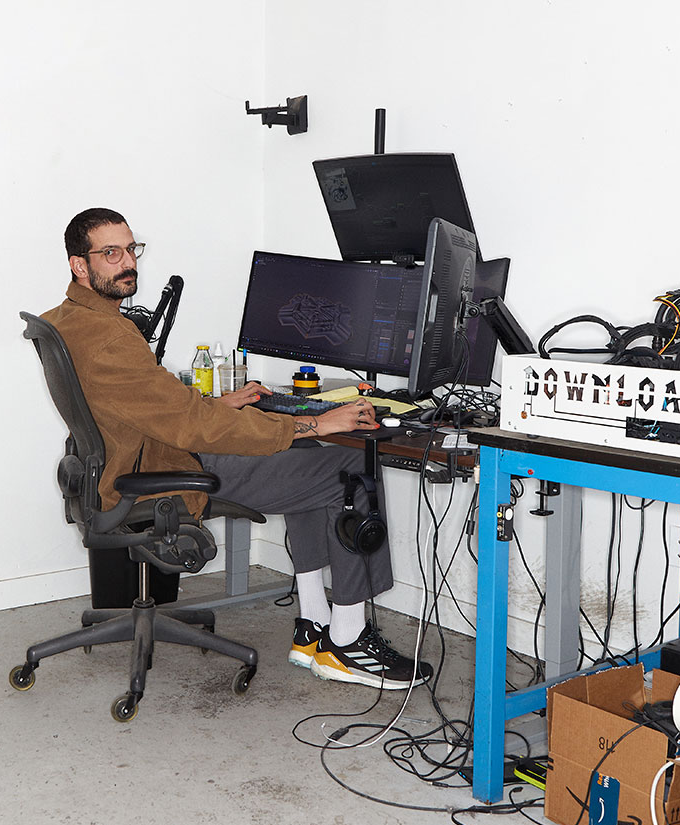
In Chronically Online, we present the artists who are narrating what it means to inhabit today's online landscape, reflecting on this very present and imagining new alternatives. In this second chapter, we talk to LA-based artist Filip Kostic, who perfectly incarnates the trickster-artist archetype of post-internet art of the 2020s. By combining the exploration of online landscapes with questions about the inner structures, the context and reception of artworks, Kostic’s works often reflect on the thin demarcation line between the stiff ‘seriousness’ of the art world and everyday digital spaces, using irony as a filter to look at this dissonance.
A: Hi, Filip, thank you for accepting to do this interview.
We’d love to ask you about your work, Filip Kostic VS Filip Kostic, where you battled a footballer with the same name as you to see who could keep the username @filipkostic. The focus on having the perfect Instagram username — therefore matching one’s online persona with the version of ourselves we want to present — is such a specific experience of online life nobody talks about. Can you tell us more about this piece, maybe something we don’t know about it?
F: Thanks! Yeah, I really enjoyed that project… I feel very lucky to have had a chance to make a work as strange and specific as the Filip Kostic VS. Filip Kostic FIFA match. I was thinking a lot about Kristin Lucas’s work, Refresh, from 2007, in which she changes her legal name from Kristin Sue Lucas to Kristin Sue Lucas. In Refresh, the work really takes place in an exchange between her and a Supreme Court Judge in which Kristin makes a case for the work and process, and the judge, through a series of legal technicalities and definitions, decides whether or not this is a work of art that can (and perhaps should) exist.
I find these exchanges about art-ness between ‘Artist’ and ‘Non-Artist’ valuable, exciting, and rare — they are strange and awkward, and at times it's hard to understand whether or not a joke is being played by the artist, but I don’t believe one is. In a way, I was interested in doing this with Filip Kostic. I wanted to invite him to work with me. I was very honest from the beginning that what we are doing is an artwork, and I expressed why the decisions about how the project is being framed were important to me. I tried not to embellish as much as I could, but also had to try to make it enticing for someone with such a public-facing career and celebrity status to make art with a stranger. I was interested in the bureaucratic exchanges between an artist and a footballer about what art is or can be, our respective relations to labour, and how these relations manifest in an internet presence. I feel like this part of the project is one that I rarely get to point out because of the spectacular nature of everything else in the work, but I still, to this day, find it productive and feel that it left more questions than it provided answers.
A: What’s your modus operandi when you begin researching a topic? Is it more like digital ethnography, traditional reading, or how does that initial spark usually happen?
F: Most ideas begin as jokes I tell myself or bits I test with friends, and occasionally I post them online. If I come back to it later and it is still making me laugh, it’s probably worth seeing through. I don’t remember exactly where I read this, but I recall John Baldessari saying something about writing down the jokes you think of and coming back to them later. A teacher of mine repeated it in undergrad, and I’ve used it ever since. It works with just regular ideas without the humour, too. For me, the subject of the joke, or maybe even the punchline, only really works if I’m embedded in the thing in some way.. so the research, I guess, is a lived thing. I’m rarely sitting down to do research, or it never feels like I am, but maybe I am reading and participating in these spaces as a form of research in some latent sense.
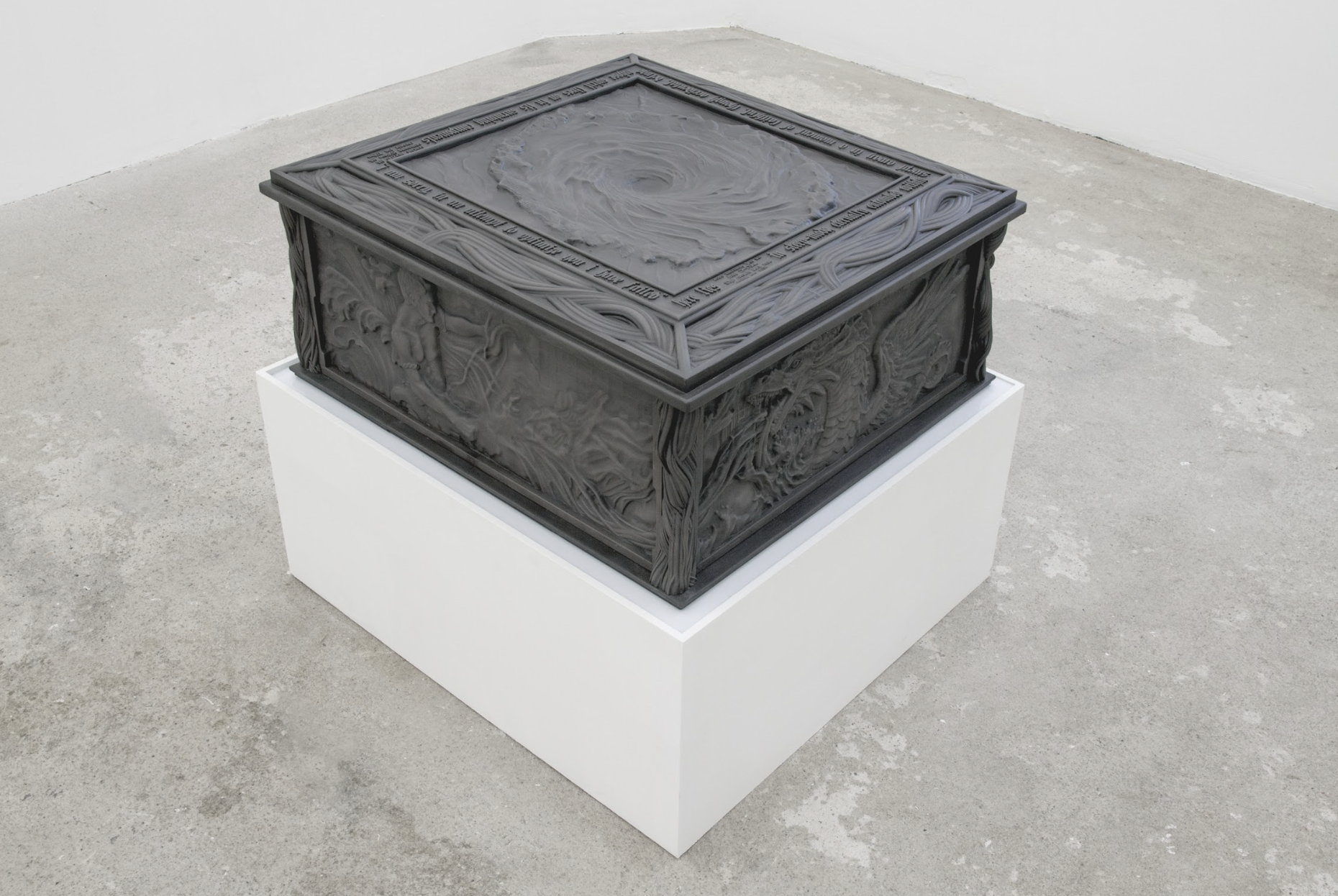
A: You’ve always been attracted to sculpture, and your sculptural works always have something sacred, kinda religious, about them. Your earliest computer-sculptures looked like triptychs, halos, sanctuaries, and now these last sarcophagi series. Can you tell us more about your relationship with sculpture and how it has evolved through time?
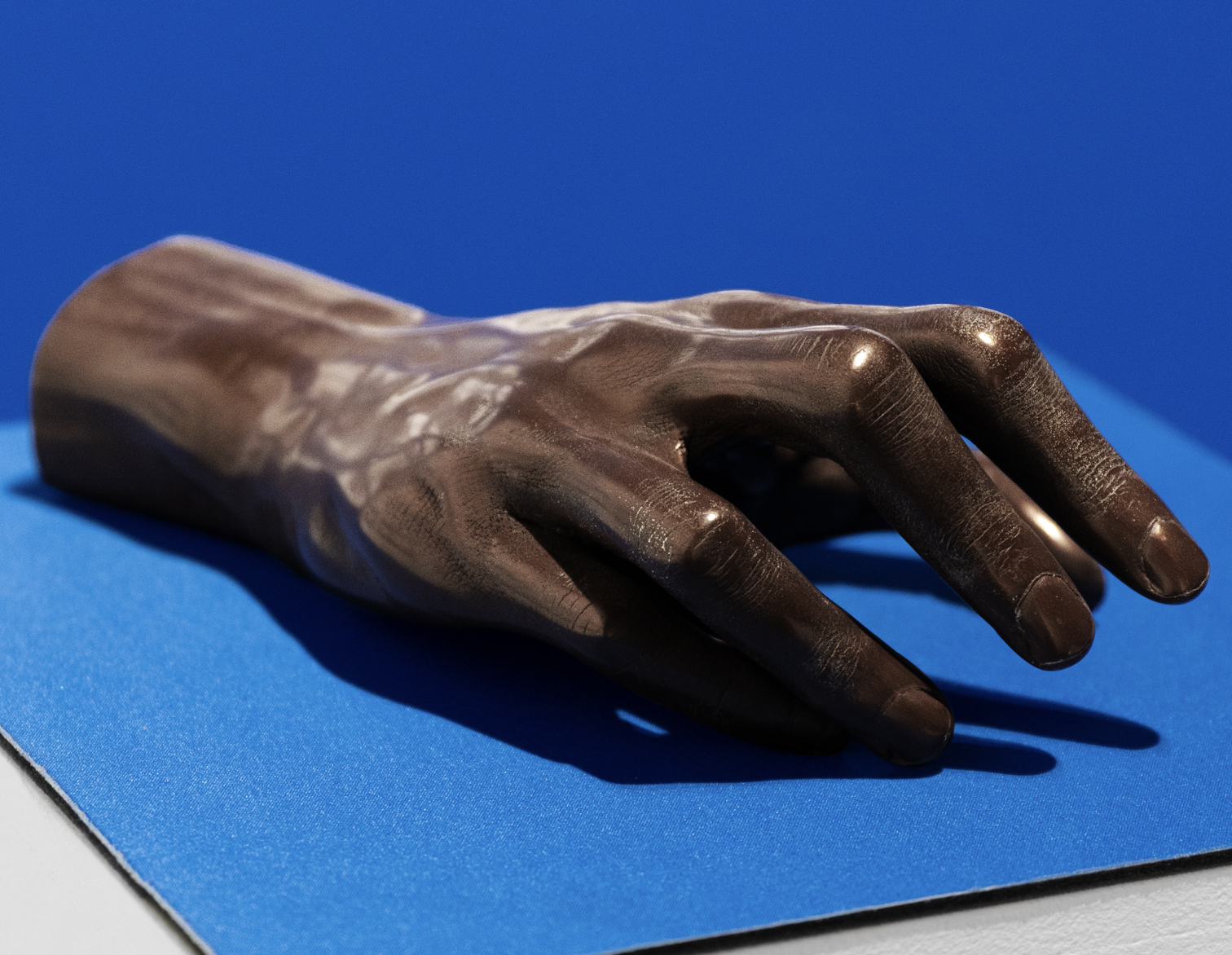
F: I feel like I truly fell in love with making sculptures when I realised that I could make computer cases as sculptures. In undergrad, I made a series of VR pieces where the computer had to be present by necessity, so I played around with what that presence could look like and mean. One of the first ones I made was a big rock that housed the components. It was attached to a VR headset that displayed a 1:1 recreation of the surrounding room, effectively turning the room itself into a sculpture. I like playing with the limitations of the hardware as a set of formal rules to work with. This has driven a lot of intuitive decisions I have made in the various computer sculptures I have made since those VR works in school – things like cable lengths, water cooling, and compartmentalisation of the different components and how they fit together. I always felt like it was natural and necessary for me to deal with the computer in a sculptural way – it is the object that everything tethers to in some way or another, and it’s where so many of the ideas for the work come from (also, where they are sketched out, conceptualised, and made usually.) I have always felt that computers get integrated into culture by disappearing and becoming obfuscated, but I find them to be fascinating and rich with meaning. I feel compelled to show them not just as a gesture of transgression in the hegemony of the disappeared computer, but as a desire to share the beauty and potential of knowing them.
A: Devirtualising online forms, images, feelings and transforming them into physical artworks is a very specific process that can be done in many ways and using many different approaches. How does it work for you specifically?
F: I guess I don’t think about it in a sort of directional vector between online/digital image or form and physical object or artwork. Things just feel as if they need to be a type of way, not as a gesture, but because it just makes sense. I also don’t particularly compartmentalise the online and the physical, or URL and irl, they are parts of the same thing filtered through each one of us… I grieve a friend I knew only through direct messages with the same body I used to grieve my grandmother. I hold all of these experiences, ideas, images, posts, and exchanges in the same place of inspiration, wherever that exists in me, and try to make the work as honestly as I can.
A: How would you describe yourself as an online user, and what are some of your typical habits online?
F: I spend every day of my life online unless I specifically make the effort not to be, barring some accidental instances when I have no signal. If I’m at home or in my studio, I am on Discord, but mostly to spend time with my friends, who I only know through gaming and Discord (I don’t spend much time in Discord communities/research spaces these days, it's purely social.) We will usually all get online in the evening and hop into a voice chat, sometimes silently just in our own zones, saying stuff every so often, sometimes streaming what we’re doing, sometimes playing games together. I love that I can do that, it means a lot to me to spend time with people as much as I can in some capacity and to spend time with these friends in particular. So many people I love dearly are on the internet.
A: You’re also very close to the ideas of “hacking” and “detour-ing”, as in interacting with the public, with the space you’re exhibiting in, or with pre-existing universes (such as video games) by changing the perspective on them, creating a twist. In relation to this, what’s your relationship with machinima, and to creating pieces starting from video game landscapes?
F: I am inspired by video games a lot. Video games have been the most consistent thing I have ever had in my life — I haven’t stopped in some form or another playing them since I started 27 years ago. I feel that I share this with so many people my age, and it’s a natural and honest place to make work from. The first video art I ever made was a machinima in World of Warcraft that I made in high school as a book report for Beowulf. I definitely did not think about it as such when I made it, but I do now, and it's one of my favourite things I’ve ever made. Making art in a non-art ontological space, like video games (whether making an intervention on an existing game, or making a new game entirely), always excites me because it presents a specific challenge: to make an artwork, a game for this instance, that is not using its ‘art-ness’ or its ’game-ness’ as a crutch for the other — or so to say, a game that is both interesting proposition as a game for an audience of gamers, and an artwork for an audience of artists. I think this is crucial for me when making something like a game intervention, or a game itself, or even machinima. I always ask myself, “Would a gamer fuck with this?”
A: Can you tell us more about your next project or what you’re working on right now?
F: I’m currently working on an ongoing project called Art World of Warcraft. It’s something like a fan fiction in which I am creating a parallel art world that exists concurrently with the Warcraft story/universe. The work itself takes form as an addon, which is typically a player-made tool that aids the player in some capacity with gameplay (though sometimes, rarely, they are role-playing extensions that enrich the story of the game). For the past few years, while I have been playing WOW, I simultaneously look for and document assets in the game that I consider to be artworks. Things like sculptures, paintings, which are mainly filler assets, meaning they have no use for gameplay and are purely for worldbuilding. But I also look for things that may not be art but look like art, like a room of unassuming objects which looks like a room at a museum, or an impromptu installation. I walk around Azeroth (the in-game World) and go into every possible space to find art. When I find an artwork, I mark it on a tracking sheet, I write a press release and review of the show grounded in existing lore, and finally, I add it to the addon so it can display when a player walks into the ‘gallery’ in the game. Honestly, I’m not totally sure what I’m trying to do with the whole thing, but it feels like the most honest work to make for me right now.
I often think about Diego Leclery’s work, Me Playing Civilization, in which he set up a desk and computer outside of the museum and played Sid Meier’s Civilization every day for the run of the exhibition. When asked about the work, he describes being invited to be a part of the Whitney Biennial at a time in his life in which he wasn’t really making art, he was just playing Civilization, so the most honest thing he could do was to make an artwork out of the thing he’s been doing for the past year. I have a lot of reverence for Leclery and his openness to what art can and should be. I've been playing a lot of World of Warcraft for the past few years, and maybe this addon is my ode to Me Playing Civilization in a way…
A: The only show I’ve ever curated (my time as a technical artist on Warner bros game) at Hogwarts (2024). Can you tell us more about it?
F: That’s interesting, I don’t know a terrible amount about Aby Warburg’s Mnemosyne, but the visual referent is uncanny with the salon style floating paintings. I had been sitting on this project/idea and had sketched it out a handful of times on Instagram since 2019. One of the tasks I took on during my time working on two Harry Potter virtual reality experiences was to “fill the staircase room with pre-approved Wizarding World and Getty paintings,” which I understood as “curate a painting show in the Harry Potter game.”
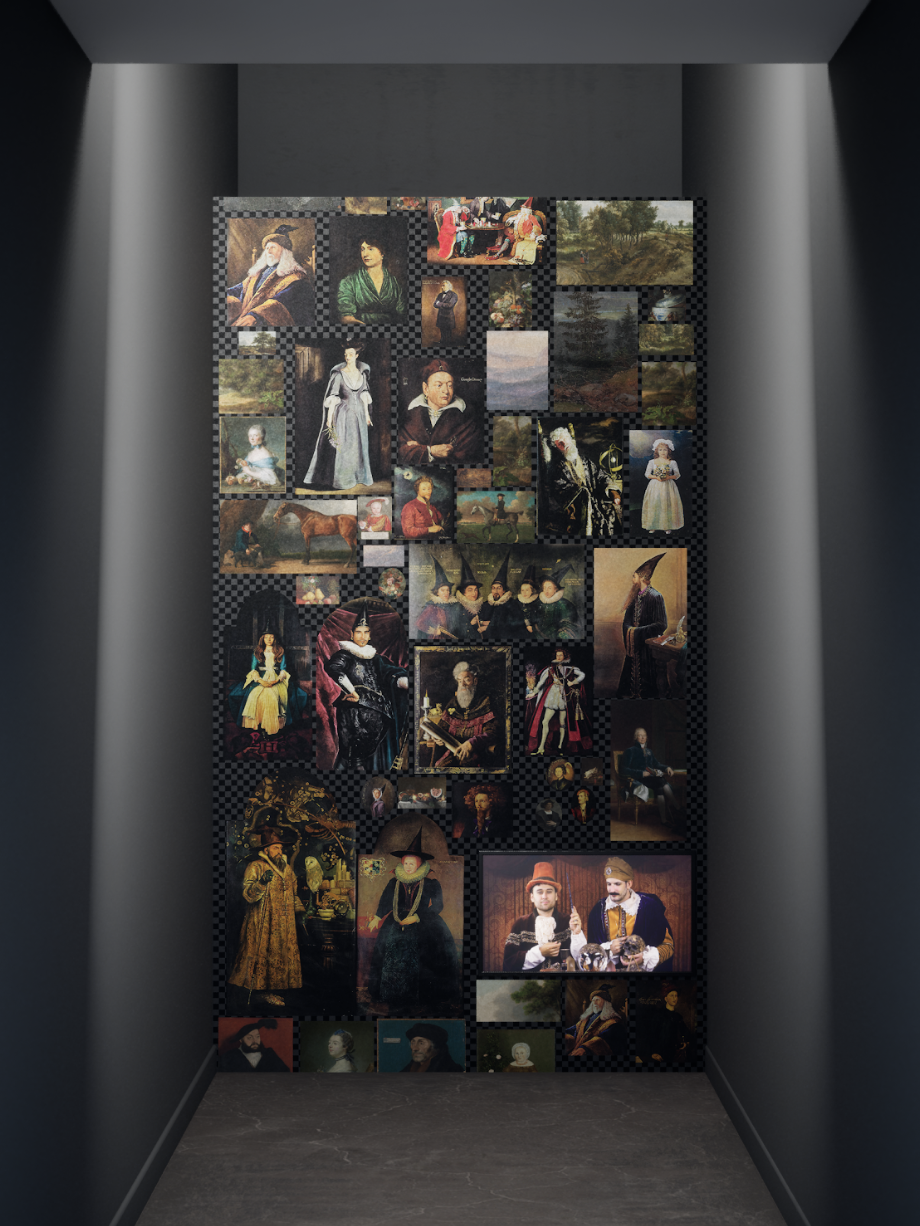
I had to create what’s called a Texture Atlas to populate the painting models that I had placed, which, for this instance, are image assets which fit together the various paintings at resolutions respective to their position in the virtual world, relative to the distance the player will see them from. So, more resolution is given to the paintings we get close to, and less to the ones that are far away, as a way to optimise. I really like this form of organisation and hierarchy as a way to re-assign value to these paintings through a different metric than before. I also thought it was funny to have my only curatorial credit be in the Harry Potter universe, within a game/experience that will cease to exist imminently. The final layer to this is that there was a series of ‘moving paintings’ that we made with the production team as a fun cost-saving optimisation, and one of those paintings is me and my old roommate. So the format for display felt like it needed to nod towards and use the formal qualities of the texture map atlas, the salon style hang that is used in Hogwarts per the rules set by Warner Brothers, and to include the video of my roommate and me.
A: Which of your works are you most attached to, and why?
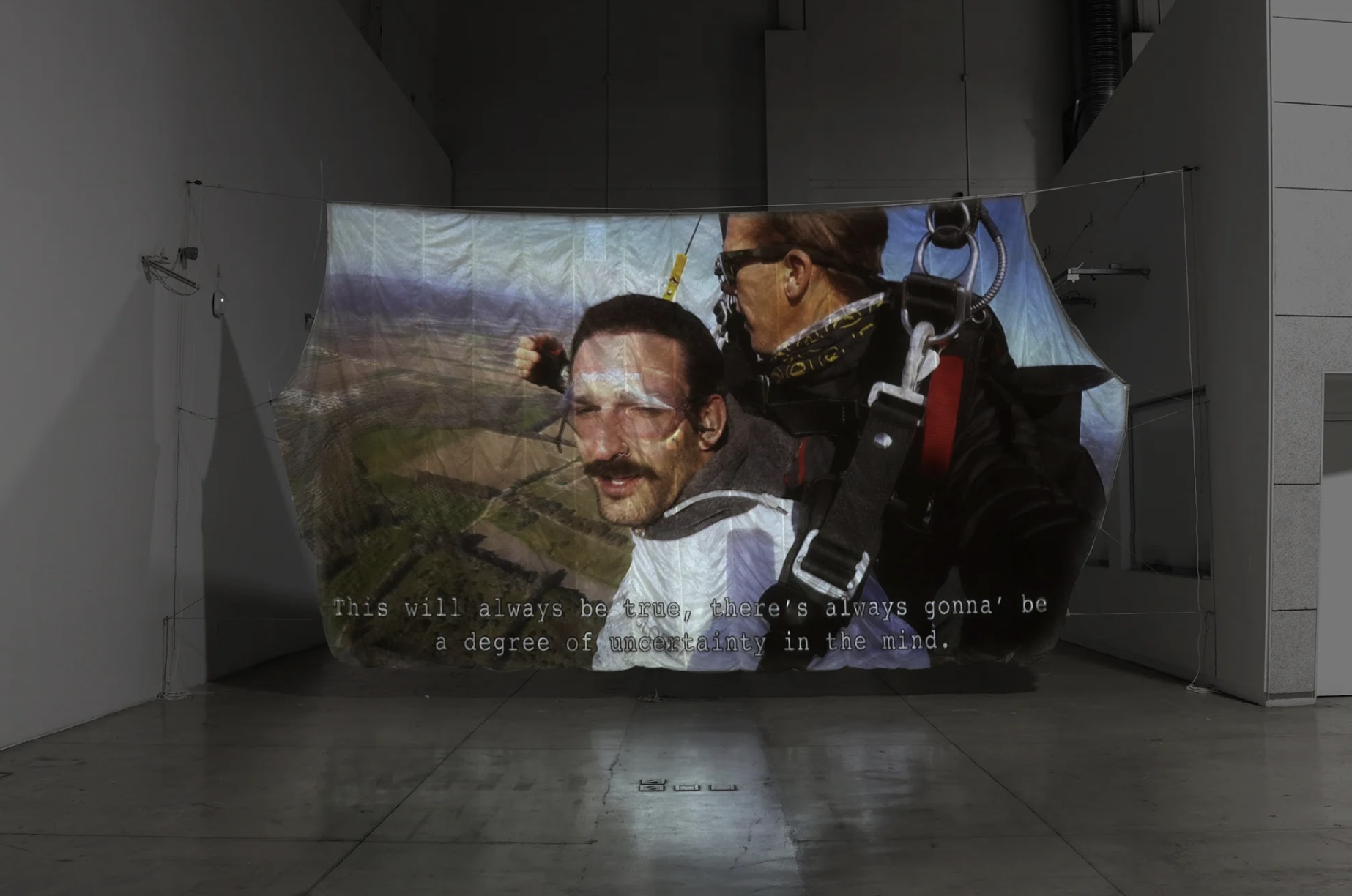
Probably Zetetic Method (2018) – a video where I go tandem skydiving and recite a passage from the first instance of Flat Earth Theory to my instructor. It is in many ways different from a lot of my other work, but it represents a kind of relationship to making art that I really like. This never ended up making it directly into the work, but I got my skydiving license as part of the work. I just felt like I needed to set the stakes higher or something because I was working with an ideology which defines reality for 5% of people in the US… My friends laugh at me for this. In short, I like when art puts you in positions that you otherwise wouldn’t be in. This work made me believe that I needed to be certified as a skydiver in order for the work to do what it needed to do.


In Chronically Online, we present the artists who are narrating what it means to inhabit today's online landscape, reflecting on this very present and imagining new alternatives. In this second chapter, we talk to LA-based artist Filip Kostic, who perfectly incarnates the trickster-artist archetype of post-internet art of the 2020s. By combining the exploration of online landscapes with questions about the inner structures, the context and reception of artworks, Kostic’s works often reflect on the thin demarcation line between the stiff ‘seriousness’ of the art world and everyday digital spaces, using irony as a filter to look at this dissonance.
A: Hi, Filip, thank you for accepting to do this interview.
We’d love to ask you about your work, Filip Kostic VS Filip Kostic, where you battled a footballer with the same name as you to see who could keep the username @filipkostic. The focus on having the perfect Instagram username — therefore matching one’s online persona with the version of ourselves we want to present — is such a specific experience of online life nobody talks about. Can you tell us more about this piece, maybe something we don’t know about it?
F: Thanks! Yeah, I really enjoyed that project… I feel very lucky to have had a chance to make a work as strange and specific as the Filip Kostic VS. Filip Kostic FIFA match. I was thinking a lot about Kristin Lucas’s work, Refresh, from 2007, in which she changes her legal name from Kristin Sue Lucas to Kristin Sue Lucas. In Refresh, the work really takes place in an exchange between her and a Supreme Court Judge in which Kristin makes a case for the work and process, and the judge, through a series of legal technicalities and definitions, decides whether or not this is a work of art that can (and perhaps should) exist.
I find these exchanges about art-ness between ‘Artist’ and ‘Non-Artist’ valuable, exciting, and rare — they are strange and awkward, and at times it's hard to understand whether or not a joke is being played by the artist, but I don’t believe one is. In a way, I was interested in doing this with Filip Kostic. I wanted to invite him to work with me. I was very honest from the beginning that what we are doing is an artwork, and I expressed why the decisions about how the project is being framed were important to me. I tried not to embellish as much as I could, but also had to try to make it enticing for someone with such a public-facing career and celebrity status to make art with a stranger. I was interested in the bureaucratic exchanges between an artist and a footballer about what art is or can be, our respective relations to labour, and how these relations manifest in an internet presence. I feel like this part of the project is one that I rarely get to point out because of the spectacular nature of everything else in the work, but I still, to this day, find it productive and feel that it left more questions than it provided answers.
A: What’s your modus operandi when you begin researching a topic? Is it more like digital ethnography, traditional reading, or how does that initial spark usually happen?
F: Most ideas begin as jokes I tell myself or bits I test with friends, and occasionally I post them online. If I come back to it later and it is still making me laugh, it’s probably worth seeing through. I don’t remember exactly where I read this, but I recall John Baldessari saying something about writing down the jokes you think of and coming back to them later. A teacher of mine repeated it in undergrad, and I’ve used it ever since. It works with just regular ideas without the humour, too. For me, the subject of the joke, or maybe even the punchline, only really works if I’m embedded in the thing in some way.. so the research, I guess, is a lived thing. I’m rarely sitting down to do research, or it never feels like I am, but maybe I am reading and participating in these spaces as a form of research in some latent sense.
A: You’ve always been attracted to sculpture, and your sculptural works always have something sacred, kinda religious, about them. Your earliest computer-sculptures looked like triptychs, halos, sanctuaries, and now these last sarcophagi series. Can you tell us more about your relationship with sculpture and how it has evolved through time?
F: I feel like I truly fell in love with making sculptures when I realised that I could make computer cases as sculptures. In undergrad, I made a series of VR pieces where the computer had to be present by necessity, so I played around with what that presence could look like and mean. One of the first ones I made was a big rock that housed the components. It was attached to a VR headset that displayed a 1:1 recreation of the surrounding room, effectively turning the room itself into a sculpture. I like playing with the limitations of the hardware as a set of formal rules to work with. This has driven a lot of intuitive decisions I have made in the various computer sculptures I have made since those VR works in school – things like cable lengths, water cooling, and compartmentalisation of the different components and how they fit together. I always felt like it was natural and necessary for me to deal with the computer in a sculptural way – it is the object that everything tethers to in some way or another, and it’s where so many of the ideas for the work come from (also, where they are sketched out, conceptualised, and made usually.) I have always felt that computers get integrated into culture by disappearing and becoming obfuscated, but I find them to be fascinating and rich with meaning. I feel compelled to show them not just as a gesture of transgression in the hegemony of the disappeared computer, but as a desire to share the beauty and potential of knowing them.
A: Devirtualising online forms, images, feelings and transforming them into physical artworks is a very specific process that can be done in many ways and using many different approaches. How does it work for you specifically?
F: I guess I don’t think about it in a sort of directional vector between online/digital image or form and physical object or artwork. Things just feel as if they need to be a type of way, not as a gesture, but because it just makes sense. I also don’t particularly compartmentalise the online and the physical, or URL and irl, they are parts of the same thing filtered through each one of us… I grieve a friend I knew only through direct messages with the same body I used to grieve my grandmother. I hold all of these experiences, ideas, images, posts, and exchanges in the same place of inspiration, wherever that exists in me, and try to make the work as honestly as I can.
A: How would you describe yourself as an online user, and what are some of your typical habits online?
F: I spend every day of my life online unless I specifically make the effort not to be, barring some accidental instances when I have no signal. If I’m at home or in my studio, I am on Discord, but mostly to spend time with my friends, who I only know through gaming and Discord (I don’t spend much time in Discord communities/research spaces these days, it's purely social.) We will usually all get online in the evening and hop into a voice chat, sometimes silently just in our own zones, saying stuff every so often, sometimes streaming what we’re doing, sometimes playing games together. I love that I can do that, it means a lot to me to spend time with people as much as I can in some capacity and to spend time with these friends in particular. So many people I love dearly are on the internet.
A: You’re also very close to the ideas of “hacking” and “detour-ing”, as in interacting with the public, with the space you’re exhibiting in, or with pre-existing universes (such as video games) by changing the perspective on them, creating a twist. In relation to this, what’s your relationship with machinima, and to creating pieces starting from video game landscapes?
F: I am inspired by video games a lot. Video games have been the most consistent thing I have ever had in my life — I haven’t stopped in some form or another playing them since I started 27 years ago. I feel that I share this with so many people my age, and it’s a natural and honest place to make work from. The first video art I ever made was a machinima in World of Warcraft that I made in high school as a book report for Beowulf. I definitely did not think about it as such when I made it, but I do now, and it's one of my favourite things I’ve ever made. Making art in a non-art ontological space, like video games (whether making an intervention on an existing game, or making a new game entirely), always excites me because it presents a specific challenge: to make an artwork, a game for this instance, that is not using its ‘art-ness’ or its ’game-ness’ as a crutch for the other — or so to say, a game that is both interesting proposition as a game for an audience of gamers, and an artwork for an audience of artists. I think this is crucial for me when making something like a game intervention, or a game itself, or even machinima. I always ask myself, “Would a gamer fuck with this?”
A: Can you tell us more about your next project or what you’re working on right now?
F: I’m currently working on an ongoing project called Art World of Warcraft. It’s something like a fan fiction in which I am creating a parallel art world that exists concurrently with the Warcraft story/universe. The work itself takes form as an addon, which is typically a player-made tool that aids the player in some capacity with gameplay (though sometimes, rarely, they are role-playing extensions that enrich the story of the game). For the past few years, while I have been playing WOW, I simultaneously look for and document assets in the game that I consider to be artworks. Things like sculptures, paintings, which are mainly filler assets, meaning they have no use for gameplay and are purely for worldbuilding. But I also look for things that may not be art but look like art, like a room of unassuming objects which looks like a room at a museum, or an impromptu installation. I walk around Azeroth (the in-game World) and go into every possible space to find art. When I find an artwork, I mark it on a tracking sheet, I write a press release and review of the show grounded in existing lore, and finally, I add it to the addon so it can display when a player walks into the ‘gallery’ in the game. Honestly, I’m not totally sure what I’m trying to do with the whole thing, but it feels like the most honest work to make for me right now.
I often think about Diego Leclery’s work, Me Playing Civilization, in which he set up a desk and computer outside of the museum and played Sid Meier’s Civilization every day for the run of the exhibition. When asked about the work, he describes being invited to be a part of the Whitney Biennial at a time in his life in which he wasn’t really making art, he was just playing Civilization, so the most honest thing he could do was to make an artwork out of the thing he’s been doing for the past year. I have a lot of reverence for Leclery and his openness to what art can and should be. I've been playing a lot of World of Warcraft for the past few years, and maybe this addon is my ode to Me Playing Civilization in a way…
A: The only show I’ve ever curated (my time as a technical artist on Warner bros game) at Hogwarts (2024). Can you tell us more about it?
F: That’s interesting, I don’t know a terrible amount about Aby Warburg’s Mnemosyne, but the visual referent is uncanny with the salon style floating paintings. I had been sitting on this project/idea and had sketched it out a handful of times on Instagram since 2019. One of the tasks I took on during my time working on two Harry Potter virtual reality experiences was to “fill the staircase room with pre-approved Wizarding World and Getty paintings,” which I understood as “curate a painting show in the Harry Potter game.”
I had to create what’s called a Texture Atlas to populate the painting models that I had placed, which, for this instance, are image assets which fit together the various paintings at resolutions respective to their position in the virtual world, relative to the distance the player will see them from. So, more resolution is given to the paintings we get close to, and less to the ones that are far away, as a way to optimise. I really like this form of organisation and hierarchy as a way to re-assign value to these paintings through a different metric than before. I also thought it was funny to have my only curatorial credit be in the Harry Potter universe, within a game/experience that will cease to exist imminently. The final layer to this is that there was a series of ‘moving paintings’ that we made with the production team as a fun cost-saving optimisation, and one of those paintings is me and my old roommate. So the format for display felt like it needed to nod towards and use the formal qualities of the texture map atlas, the salon style hang that is used in Hogwarts per the rules set by Warner Brothers, and to include the video of my roommate and me.
A: Which of your works are you most attached to, and why?
Probably Zetetic Method (2018) – a video where I go tandem skydiving and recite a passage from the first instance of Flat Earth Theory to my instructor. It is in many ways different from a lot of my other work, but it represents a kind of relationship to making art that I really like. This never ended up making it directly into the work, but I got my skydiving license as part of the work. I just felt like I needed to set the stakes higher or something because I was working with an ideology which defines reality for 5% of people in the US… My friends laugh at me for this. In short, I like when art puts you in positions that you otherwise wouldn’t be in. This work made me believe that I needed to be certified as a skydiver in order for the work to do what it needed to do.
In Chronically Online, we present the artists who are narrating what it means to inhabit today's online landscape, reflecting on this very present and imagining new alternatives. In this second chapter, we talk to LA-based artist Filip Kostic, who perfectly incarnates the trickster-artist archetype of post-internet art of the 2020s. By combining the exploration of online landscapes with questions about the inner structures, the context and reception of artworks, Kostic’s works often reflect on the thin demarcation line between the stiff ‘seriousness’ of the art world and everyday digital spaces, using irony as a filter to look at this dissonance.
A: Hi, Filip, thank you for accepting to do this interview.
We’d love to ask you about your work, Filip Kostic VS Filip Kostic, where you battled a footballer with the same name as you to see who could keep the username @filipkostic. The focus on having the perfect Instagram username — therefore matching one’s online persona with the version of ourselves we want to present — is such a specific experience of online life nobody talks about. Can you tell us more about this piece, maybe something we don’t know about it?
F: Thanks! Yeah, I really enjoyed that project… I feel very lucky to have had a chance to make a work as strange and specific as the Filip Kostic VS. Filip Kostic FIFA match. I was thinking a lot about Kristin Lucas’s work, Refresh, from 2007, in which she changes her legal name from Kristin Sue Lucas to Kristin Sue Lucas. In Refresh, the work really takes place in an exchange between her and a Supreme Court Judge in which Kristin makes a case for the work and process, and the judge, through a series of legal technicalities and definitions, decides whether or not this is a work of art that can (and perhaps should) exist.
I find these exchanges about art-ness between ‘Artist’ and ‘Non-Artist’ valuable, exciting, and rare — they are strange and awkward, and at times it's hard to understand whether or not a joke is being played by the artist, but I don’t believe one is. In a way, I was interested in doing this with Filip Kostic. I wanted to invite him to work with me. I was very honest from the beginning that what we are doing is an artwork, and I expressed why the decisions about how the project is being framed were important to me. I tried not to embellish as much as I could, but also had to try to make it enticing for someone with such a public-facing career and celebrity status to make art with a stranger. I was interested in the bureaucratic exchanges between an artist and a footballer about what art is or can be, our respective relations to labour, and how these relations manifest in an internet presence. I feel like this part of the project is one that I rarely get to point out because of the spectacular nature of everything else in the work, but I still, to this day, find it productive and feel that it left more questions than it provided answers.
A: What’s your modus operandi when you begin researching a topic? Is it more like digital ethnography, traditional reading, or how does that initial spark usually happen?
F: Most ideas begin as jokes I tell myself or bits I test with friends, and occasionally I post them online. If I come back to it later and it is still making me laugh, it’s probably worth seeing through. I don’t remember exactly where I read this, but I recall John Baldessari saying something about writing down the jokes you think of and coming back to them later. A teacher of mine repeated it in undergrad, and I’ve used it ever since. It works with just regular ideas without the humour, too. For me, the subject of the joke, or maybe even the punchline, only really works if I’m embedded in the thing in some way.. so the research, I guess, is a lived thing. I’m rarely sitting down to do research, or it never feels like I am, but maybe I am reading and participating in these spaces as a form of research in some latent sense.
A: You’ve always been attracted to sculpture, and your sculptural works always have something sacred, kinda religious, about them. Your earliest computer-sculptures looked like triptychs, halos, sanctuaries, and now these last sarcophagi series. Can you tell us more about your relationship with sculpture and how it has evolved through time?
F: I feel like I truly fell in love with making sculptures when I realised that I could make computer cases as sculptures. In undergrad, I made a series of VR pieces where the computer had to be present by necessity, so I played around with what that presence could look like and mean. One of the first ones I made was a big rock that housed the components. It was attached to a VR headset that displayed a 1:1 recreation of the surrounding room, effectively turning the room itself into a sculpture. I like playing with the limitations of the hardware as a set of formal rules to work with. This has driven a lot of intuitive decisions I have made in the various computer sculptures I have made since those VR works in school – things like cable lengths, water cooling, and compartmentalisation of the different components and how they fit together. I always felt like it was natural and necessary for me to deal with the computer in a sculptural way – it is the object that everything tethers to in some way or another, and it’s where so many of the ideas for the work come from (also, where they are sketched out, conceptualised, and made usually.) I have always felt that computers get integrated into culture by disappearing and becoming obfuscated, but I find them to be fascinating and rich with meaning. I feel compelled to show them not just as a gesture of transgression in the hegemony of the disappeared computer, but as a desire to share the beauty and potential of knowing them.
A: Devirtualising online forms, images, feelings and transforming them into physical artworks is a very specific process that can be done in many ways and using many different approaches. How does it work for you specifically?
F: I guess I don’t think about it in a sort of directional vector between online/digital image or form and physical object or artwork. Things just feel as if they need to be a type of way, not as a gesture, but because it just makes sense. I also don’t particularly compartmentalise the online and the physical, or URL and irl, they are parts of the same thing filtered through each one of us… I grieve a friend I knew only through direct messages with the same body I used to grieve my grandmother. I hold all of these experiences, ideas, images, posts, and exchanges in the same place of inspiration, wherever that exists in me, and try to make the work as honestly as I can.
A: How would you describe yourself as an online user, and what are some of your typical habits online?
F: I spend every day of my life online unless I specifically make the effort not to be, barring some accidental instances when I have no signal. If I’m at home or in my studio, I am on Discord, but mostly to spend time with my friends, who I only know through gaming and Discord (I don’t spend much time in Discord communities/research spaces these days, it's purely social.) We will usually all get online in the evening and hop into a voice chat, sometimes silently just in our own zones, saying stuff every so often, sometimes streaming what we’re doing, sometimes playing games together. I love that I can do that, it means a lot to me to spend time with people as much as I can in some capacity and to spend time with these friends in particular. So many people I love dearly are on the internet.
A: You’re also very close to the ideas of “hacking” and “detour-ing”, as in interacting with the public, with the space you’re exhibiting in, or with pre-existing universes (such as video games) by changing the perspective on them, creating a twist. In relation to this, what’s your relationship with machinima, and to creating pieces starting from video game landscapes?
F: I am inspired by video games a lot. Video games have been the most consistent thing I have ever had in my life — I haven’t stopped in some form or another playing them since I started 27 years ago. I feel that I share this with so many people my age, and it’s a natural and honest place to make work from. The first video art I ever made was a machinima in World of Warcraft that I made in high school as a book report for Beowulf. I definitely did not think about it as such when I made it, but I do now, and it's one of my favourite things I’ve ever made. Making art in a non-art ontological space, like video games (whether making an intervention on an existing game, or making a new game entirely), always excites me because it presents a specific challenge: to make an artwork, a game for this instance, that is not using its ‘art-ness’ or its ’game-ness’ as a crutch for the other — or so to say, a game that is both interesting proposition as a game for an audience of gamers, and an artwork for an audience of artists. I think this is crucial for me when making something like a game intervention, or a game itself, or even machinima. I always ask myself, “Would a gamer fuck with this?”
A: Can you tell us more about your next project or what you’re working on right now?
F: I’m currently working on an ongoing project called Art World of Warcraft. It’s something like a fan fiction in which I am creating a parallel art world that exists concurrently with the Warcraft story/universe. The work itself takes form as an addon, which is typically a player-made tool that aids the player in some capacity with gameplay (though sometimes, rarely, they are role-playing extensions that enrich the story of the game). For the past few years, while I have been playing WOW, I simultaneously look for and document assets in the game that I consider to be artworks. Things like sculptures, paintings, which are mainly filler assets, meaning they have no use for gameplay and are purely for worldbuilding. But I also look for things that may not be art but look like art, like a room of unassuming objects which looks like a room at a museum, or an impromptu installation. I walk around Azeroth (the in-game World) and go into every possible space to find art. When I find an artwork, I mark it on a tracking sheet, I write a press release and review of the show grounded in existing lore, and finally, I add it to the addon so it can display when a player walks into the ‘gallery’ in the game. Honestly, I’m not totally sure what I’m trying to do with the whole thing, but it feels like the most honest work to make for me right now.
I often think about Diego Leclery’s work, Me Playing Civilization, in which he set up a desk and computer outside of the museum and played Sid Meier’s Civilization every day for the run of the exhibition. When asked about the work, he describes being invited to be a part of the Whitney Biennial at a time in his life in which he wasn’t really making art, he was just playing Civilization, so the most honest thing he could do was to make an artwork out of the thing he’s been doing for the past year. I have a lot of reverence for Leclery and his openness to what art can and should be. I've been playing a lot of World of Warcraft for the past few years, and maybe this addon is my ode to Me Playing Civilization in a way…
A: The only show I’ve ever curated (my time as a technical artist on Warner bros game) at Hogwarts (2024). Can you tell us more about it?
F: That’s interesting, I don’t know a terrible amount about Aby Warburg’s Mnemosyne, but the visual referent is uncanny with the salon style floating paintings. I had been sitting on this project/idea and had sketched it out a handful of times on Instagram since 2019. One of the tasks I took on during my time working on two Harry Potter virtual reality experiences was to “fill the staircase room with pre-approved Wizarding World and Getty paintings,” which I understood as “curate a painting show in the Harry Potter game.”
I had to create what’s called a Texture Atlas to populate the painting models that I had placed, which, for this instance, are image assets which fit together the various paintings at resolutions respective to their position in the virtual world, relative to the distance the player will see them from. So, more resolution is given to the paintings we get close to, and less to the ones that are far away, as a way to optimise. I really like this form of organisation and hierarchy as a way to re-assign value to these paintings through a different metric than before. I also thought it was funny to have my only curatorial credit be in the Harry Potter universe, within a game/experience that will cease to exist imminently. The final layer to this is that there was a series of ‘moving paintings’ that we made with the production team as a fun cost-saving optimisation, and one of those paintings is me and my old roommate. So the format for display felt like it needed to nod towards and use the formal qualities of the texture map atlas, the salon style hang that is used in Hogwarts per the rules set by Warner Brothers, and to include the video of my roommate and me.
A: Which of your works are you most attached to, and why?
Probably Zetetic Method (2018) – a video where I go tandem skydiving and recite a passage from the first instance of Flat Earth Theory to my instructor. It is in many ways different from a lot of my other work, but it represents a kind of relationship to making art that I really like. This never ended up making it directly into the work, but I got my skydiving license as part of the work. I just felt like I needed to set the stakes higher or something because I was working with an ideology which defines reality for 5% of people in the US… My friends laugh at me for this. In short, I like when art puts you in positions that you otherwise wouldn’t be in. This work made me believe that I needed to be certified as a skydiver in order for the work to do what it needed to do.
In Chronically Online, we present the artists who are narrating what it means to inhabit today's online landscape, reflecting on this very present and imagining new alternatives. In this second chapter, we talk to LA-based artist Filip Kostic, who perfectly incarnates the trickster-artist archetype of post-internet art of the 2020s. By combining the exploration of online landscapes with questions about the inner structures, the context and reception of artworks, Kostic’s works often reflect on the thin demarcation line between the stiff ‘seriousness’ of the art world and everyday digital spaces, using irony as a filter to look at this dissonance.
A: Hi, Filip, thank you for accepting to do this interview.
We’d love to ask you about your work, Filip Kostic VS Filip Kostic, where you battled a footballer with the same name as you to see who could keep the username @filipkostic. The focus on having the perfect Instagram username — therefore matching one’s online persona with the version of ourselves we want to present — is such a specific experience of online life nobody talks about. Can you tell us more about this piece, maybe something we don’t know about it?
F: Thanks! Yeah, I really enjoyed that project… I feel very lucky to have had a chance to make a work as strange and specific as the Filip Kostic VS. Filip Kostic FIFA match. I was thinking a lot about Kristin Lucas’s work, Refresh, from 2007, in which she changes her legal name from Kristin Sue Lucas to Kristin Sue Lucas. In Refresh, the work really takes place in an exchange between her and a Supreme Court Judge in which Kristin makes a case for the work and process, and the judge, through a series of legal technicalities and definitions, decides whether or not this is a work of art that can (and perhaps should) exist.
I find these exchanges about art-ness between ‘Artist’ and ‘Non-Artist’ valuable, exciting, and rare — they are strange and awkward, and at times it's hard to understand whether or not a joke is being played by the artist, but I don’t believe one is. In a way, I was interested in doing this with Filip Kostic. I wanted to invite him to work with me. I was very honest from the beginning that what we are doing is an artwork, and I expressed why the decisions about how the project is being framed were important to me. I tried not to embellish as much as I could, but also had to try to make it enticing for someone with such a public-facing career and celebrity status to make art with a stranger. I was interested in the bureaucratic exchanges between an artist and a footballer about what art is or can be, our respective relations to labour, and how these relations manifest in an internet presence. I feel like this part of the project is one that I rarely get to point out because of the spectacular nature of everything else in the work, but I still, to this day, find it productive and feel that it left more questions than it provided answers.
A: What’s your modus operandi when you begin researching a topic? Is it more like digital ethnography, traditional reading, or how does that initial spark usually happen?
F: Most ideas begin as jokes I tell myself or bits I test with friends, and occasionally I post them online. If I come back to it later and it is still making me laugh, it’s probably worth seeing through. I don’t remember exactly where I read this, but I recall John Baldessari saying something about writing down the jokes you think of and coming back to them later. A teacher of mine repeated it in undergrad, and I’ve used it ever since. It works with just regular ideas without the humour, too. For me, the subject of the joke, or maybe even the punchline, only really works if I’m embedded in the thing in some way.. so the research, I guess, is a lived thing. I’m rarely sitting down to do research, or it never feels like I am, but maybe I am reading and participating in these spaces as a form of research in some latent sense.
A: You’ve always been attracted to sculpture, and your sculptural works always have something sacred, kinda religious, about them. Your earliest computer-sculptures looked like triptychs, halos, sanctuaries, and now these last sarcophagi series. Can you tell us more about your relationship with sculpture and how it has evolved through time?
F: I feel like I truly fell in love with making sculptures when I realised that I could make computer cases as sculptures. In undergrad, I made a series of VR pieces where the computer had to be present by necessity, so I played around with what that presence could look like and mean. One of the first ones I made was a big rock that housed the components. It was attached to a VR headset that displayed a 1:1 recreation of the surrounding room, effectively turning the room itself into a sculpture. I like playing with the limitations of the hardware as a set of formal rules to work with. This has driven a lot of intuitive decisions I have made in the various computer sculptures I have made since those VR works in school – things like cable lengths, water cooling, and compartmentalisation of the different components and how they fit together. I always felt like it was natural and necessary for me to deal with the computer in a sculptural way – it is the object that everything tethers to in some way or another, and it’s where so many of the ideas for the work come from (also, where they are sketched out, conceptualised, and made usually.) I have always felt that computers get integrated into culture by disappearing and becoming obfuscated, but I find them to be fascinating and rich with meaning. I feel compelled to show them not just as a gesture of transgression in the hegemony of the disappeared computer, but as a desire to share the beauty and potential of knowing them.
A: Devirtualising online forms, images, feelings and transforming them into physical artworks is a very specific process that can be done in many ways and using many different approaches. How does it work for you specifically?
F: I guess I don’t think about it in a sort of directional vector between online/digital image or form and physical object or artwork. Things just feel as if they need to be a type of way, not as a gesture, but because it just makes sense. I also don’t particularly compartmentalise the online and the physical, or URL and irl, they are parts of the same thing filtered through each one of us… I grieve a friend I knew only through direct messages with the same body I used to grieve my grandmother. I hold all of these experiences, ideas, images, posts, and exchanges in the same place of inspiration, wherever that exists in me, and try to make the work as honestly as I can.
A: How would you describe yourself as an online user, and what are some of your typical habits online?
F: I spend every day of my life online unless I specifically make the effort not to be, barring some accidental instances when I have no signal. If I’m at home or in my studio, I am on Discord, but mostly to spend time with my friends, who I only know through gaming and Discord (I don’t spend much time in Discord communities/research spaces these days, it's purely social.) We will usually all get online in the evening and hop into a voice chat, sometimes silently just in our own zones, saying stuff every so often, sometimes streaming what we’re doing, sometimes playing games together. I love that I can do that, it means a lot to me to spend time with people as much as I can in some capacity and to spend time with these friends in particular. So many people I love dearly are on the internet.
A: You’re also very close to the ideas of “hacking” and “detour-ing”, as in interacting with the public, with the space you’re exhibiting in, or with pre-existing universes (such as video games) by changing the perspective on them, creating a twist. In relation to this, what’s your relationship with machinima, and to creating pieces starting from video game landscapes?
F: I am inspired by video games a lot. Video games have been the most consistent thing I have ever had in my life — I haven’t stopped in some form or another playing them since I started 27 years ago. I feel that I share this with so many people my age, and it’s a natural and honest place to make work from. The first video art I ever made was a machinima in World of Warcraft that I made in high school as a book report for Beowulf. I definitely did not think about it as such when I made it, but I do now, and it's one of my favourite things I’ve ever made. Making art in a non-art ontological space, like video games (whether making an intervention on an existing game, or making a new game entirely), always excites me because it presents a specific challenge: to make an artwork, a game for this instance, that is not using its ‘art-ness’ or its ’game-ness’ as a crutch for the other — or so to say, a game that is both interesting proposition as a game for an audience of gamers, and an artwork for an audience of artists. I think this is crucial for me when making something like a game intervention, or a game itself, or even machinima. I always ask myself, “Would a gamer fuck with this?”
A: Can you tell us more about your next project or what you’re working on right now?
F: I’m currently working on an ongoing project called Art World of Warcraft. It’s something like a fan fiction in which I am creating a parallel art world that exists concurrently with the Warcraft story/universe. The work itself takes form as an addon, which is typically a player-made tool that aids the player in some capacity with gameplay (though sometimes, rarely, they are role-playing extensions that enrich the story of the game). For the past few years, while I have been playing WOW, I simultaneously look for and document assets in the game that I consider to be artworks. Things like sculptures, paintings, which are mainly filler assets, meaning they have no use for gameplay and are purely for worldbuilding. But I also look for things that may not be art but look like art, like a room of unassuming objects which looks like a room at a museum, or an impromptu installation. I walk around Azeroth (the in-game World) and go into every possible space to find art. When I find an artwork, I mark it on a tracking sheet, I write a press release and review of the show grounded in existing lore, and finally, I add it to the addon so it can display when a player walks into the ‘gallery’ in the game. Honestly, I’m not totally sure what I’m trying to do with the whole thing, but it feels like the most honest work to make for me right now.
I often think about Diego Leclery’s work, Me Playing Civilization, in which he set up a desk and computer outside of the museum and played Sid Meier’s Civilization every day for the run of the exhibition. When asked about the work, he describes being invited to be a part of the Whitney Biennial at a time in his life in which he wasn’t really making art, he was just playing Civilization, so the most honest thing he could do was to make an artwork out of the thing he’s been doing for the past year. I have a lot of reverence for Leclery and his openness to what art can and should be. I've been playing a lot of World of Warcraft for the past few years, and maybe this addon is my ode to Me Playing Civilization in a way…
A: The only show I’ve ever curated (my time as a technical artist on Warner bros game) at Hogwarts (2024). Can you tell us more about it?
F: That’s interesting, I don’t know a terrible amount about Aby Warburg’s Mnemosyne, but the visual referent is uncanny with the salon style floating paintings. I had been sitting on this project/idea and had sketched it out a handful of times on Instagram since 2019. One of the tasks I took on during my time working on two Harry Potter virtual reality experiences was to “fill the staircase room with pre-approved Wizarding World and Getty paintings,” which I understood as “curate a painting show in the Harry Potter game.”
I had to create what’s called a Texture Atlas to populate the painting models that I had placed, which, for this instance, are image assets which fit together the various paintings at resolutions respective to their position in the virtual world, relative to the distance the player will see them from. So, more resolution is given to the paintings we get close to, and less to the ones that are far away, as a way to optimise. I really like this form of organisation and hierarchy as a way to re-assign value to these paintings through a different metric than before. I also thought it was funny to have my only curatorial credit be in the Harry Potter universe, within a game/experience that will cease to exist imminently. The final layer to this is that there was a series of ‘moving paintings’ that we made with the production team as a fun cost-saving optimisation, and one of those paintings is me and my old roommate. So the format for display felt like it needed to nod towards and use the formal qualities of the texture map atlas, the salon style hang that is used in Hogwarts per the rules set by Warner Brothers, and to include the video of my roommate and me.
A: Which of your works are you most attached to, and why?
Probably Zetetic Method (2018) – a video where I go tandem skydiving and recite a passage from the first instance of Flat Earth Theory to my instructor. It is in many ways different from a lot of my other work, but it represents a kind of relationship to making art that I really like. This never ended up making it directly into the work, but I got my skydiving license as part of the work. I just felt like I needed to set the stakes higher or something because I was working with an ideology which defines reality for 5% of people in the US… My friends laugh at me for this. In short, I like when art puts you in positions that you otherwise wouldn’t be in. This work made me believe that I needed to be certified as a skydiver in order for the work to do what it needed to do.
In Chronically Online, we present the artists who are narrating what it means to inhabit today's online landscape, reflecting on this very present and imagining new alternatives. In this second chapter, we talk to LA-based artist Filip Kostic, who perfectly incarnates the trickster-artist archetype of post-internet art of the 2020s. By combining the exploration of online landscapes with questions about the inner structures, the context and reception of artworks, Kostic’s works often reflect on the thin demarcation line between the stiff ‘seriousness’ of the art world and everyday digital spaces, using irony as a filter to look at this dissonance.
A: Hi, Filip, thank you for accepting to do this interview.
We’d love to ask you about your work, Filip Kostic VS Filip Kostic, where you battled a footballer with the same name as you to see who could keep the username @filipkostic. The focus on having the perfect Instagram username — therefore matching one’s online persona with the version of ourselves we want to present — is such a specific experience of online life nobody talks about. Can you tell us more about this piece, maybe something we don’t know about it?
F: Thanks! Yeah, I really enjoyed that project… I feel very lucky to have had a chance to make a work as strange and specific as the Filip Kostic VS. Filip Kostic FIFA match. I was thinking a lot about Kristin Lucas’s work, Refresh, from 2007, in which she changes her legal name from Kristin Sue Lucas to Kristin Sue Lucas. In Refresh, the work really takes place in an exchange between her and a Supreme Court Judge in which Kristin makes a case for the work and process, and the judge, through a series of legal technicalities and definitions, decides whether or not this is a work of art that can (and perhaps should) exist.
I find these exchanges about art-ness between ‘Artist’ and ‘Non-Artist’ valuable, exciting, and rare — they are strange and awkward, and at times it's hard to understand whether or not a joke is being played by the artist, but I don’t believe one is. In a way, I was interested in doing this with Filip Kostic. I wanted to invite him to work with me. I was very honest from the beginning that what we are doing is an artwork, and I expressed why the decisions about how the project is being framed were important to me. I tried not to embellish as much as I could, but also had to try to make it enticing for someone with such a public-facing career and celebrity status to make art with a stranger. I was interested in the bureaucratic exchanges between an artist and a footballer about what art is or can be, our respective relations to labour, and how these relations manifest in an internet presence. I feel like this part of the project is one that I rarely get to point out because of the spectacular nature of everything else in the work, but I still, to this day, find it productive and feel that it left more questions than it provided answers.
A: What’s your modus operandi when you begin researching a topic? Is it more like digital ethnography, traditional reading, or how does that initial spark usually happen?
F: Most ideas begin as jokes I tell myself or bits I test with friends, and occasionally I post them online. If I come back to it later and it is still making me laugh, it’s probably worth seeing through. I don’t remember exactly where I read this, but I recall John Baldessari saying something about writing down the jokes you think of and coming back to them later. A teacher of mine repeated it in undergrad, and I’ve used it ever since. It works with just regular ideas without the humour, too. For me, the subject of the joke, or maybe even the punchline, only really works if I’m embedded in the thing in some way.. so the research, I guess, is a lived thing. I’m rarely sitting down to do research, or it never feels like I am, but maybe I am reading and participating in these spaces as a form of research in some latent sense.
A: You’ve always been attracted to sculpture, and your sculptural works always have something sacred, kinda religious, about them. Your earliest computer-sculptures looked like triptychs, halos, sanctuaries, and now these last sarcophagi series. Can you tell us more about your relationship with sculpture and how it has evolved through time?
F: I feel like I truly fell in love with making sculptures when I realised that I could make computer cases as sculptures. In undergrad, I made a series of VR pieces where the computer had to be present by necessity, so I played around with what that presence could look like and mean. One of the first ones I made was a big rock that housed the components. It was attached to a VR headset that displayed a 1:1 recreation of the surrounding room, effectively turning the room itself into a sculpture. I like playing with the limitations of the hardware as a set of formal rules to work with. This has driven a lot of intuitive decisions I have made in the various computer sculptures I have made since those VR works in school – things like cable lengths, water cooling, and compartmentalisation of the different components and how they fit together. I always felt like it was natural and necessary for me to deal with the computer in a sculptural way – it is the object that everything tethers to in some way or another, and it’s where so many of the ideas for the work come from (also, where they are sketched out, conceptualised, and made usually.) I have always felt that computers get integrated into culture by disappearing and becoming obfuscated, but I find them to be fascinating and rich with meaning. I feel compelled to show them not just as a gesture of transgression in the hegemony of the disappeared computer, but as a desire to share the beauty and potential of knowing them.
A: Devirtualising online forms, images, feelings and transforming them into physical artworks is a very specific process that can be done in many ways and using many different approaches. How does it work for you specifically?
F: I guess I don’t think about it in a sort of directional vector between online/digital image or form and physical object or artwork. Things just feel as if they need to be a type of way, not as a gesture, but because it just makes sense. I also don’t particularly compartmentalise the online and the physical, or URL and irl, they are parts of the same thing filtered through each one of us… I grieve a friend I knew only through direct messages with the same body I used to grieve my grandmother. I hold all of these experiences, ideas, images, posts, and exchanges in the same place of inspiration, wherever that exists in me, and try to make the work as honestly as I can.
A: How would you describe yourself as an online user, and what are some of your typical habits online?
F: I spend every day of my life online unless I specifically make the effort not to be, barring some accidental instances when I have no signal. If I’m at home or in my studio, I am on Discord, but mostly to spend time with my friends, who I only know through gaming and Discord (I don’t spend much time in Discord communities/research spaces these days, it's purely social.) We will usually all get online in the evening and hop into a voice chat, sometimes silently just in our own zones, saying stuff every so often, sometimes streaming what we’re doing, sometimes playing games together. I love that I can do that, it means a lot to me to spend time with people as much as I can in some capacity and to spend time with these friends in particular. So many people I love dearly are on the internet.
A: You’re also very close to the ideas of “hacking” and “detour-ing”, as in interacting with the public, with the space you’re exhibiting in, or with pre-existing universes (such as video games) by changing the perspective on them, creating a twist. In relation to this, what’s your relationship with machinima, and to creating pieces starting from video game landscapes?
F: I am inspired by video games a lot. Video games have been the most consistent thing I have ever had in my life — I haven’t stopped in some form or another playing them since I started 27 years ago. I feel that I share this with so many people my age, and it’s a natural and honest place to make work from. The first video art I ever made was a machinima in World of Warcraft that I made in high school as a book report for Beowulf. I definitely did not think about it as such when I made it, but I do now, and it's one of my favourite things I’ve ever made. Making art in a non-art ontological space, like video games (whether making an intervention on an existing game, or making a new game entirely), always excites me because it presents a specific challenge: to make an artwork, a game for this instance, that is not using its ‘art-ness’ or its ’game-ness’ as a crutch for the other — or so to say, a game that is both interesting proposition as a game for an audience of gamers, and an artwork for an audience of artists. I think this is crucial for me when making something like a game intervention, or a game itself, or even machinima. I always ask myself, “Would a gamer fuck with this?”
A: Can you tell us more about your next project or what you’re working on right now?
F: I’m currently working on an ongoing project called Art World of Warcraft. It’s something like a fan fiction in which I am creating a parallel art world that exists concurrently with the Warcraft story/universe. The work itself takes form as an addon, which is typically a player-made tool that aids the player in some capacity with gameplay (though sometimes, rarely, they are role-playing extensions that enrich the story of the game). For the past few years, while I have been playing WOW, I simultaneously look for and document assets in the game that I consider to be artworks. Things like sculptures, paintings, which are mainly filler assets, meaning they have no use for gameplay and are purely for worldbuilding. But I also look for things that may not be art but look like art, like a room of unassuming objects which looks like a room at a museum, or an impromptu installation. I walk around Azeroth (the in-game World) and go into every possible space to find art. When I find an artwork, I mark it on a tracking sheet, I write a press release and review of the show grounded in existing lore, and finally, I add it to the addon so it can display when a player walks into the ‘gallery’ in the game. Honestly, I’m not totally sure what I’m trying to do with the whole thing, but it feels like the most honest work to make for me right now.
I often think about Diego Leclery’s work, Me Playing Civilization, in which he set up a desk and computer outside of the museum and played Sid Meier’s Civilization every day for the run of the exhibition. When asked about the work, he describes being invited to be a part of the Whitney Biennial at a time in his life in which he wasn’t really making art, he was just playing Civilization, so the most honest thing he could do was to make an artwork out of the thing he’s been doing for the past year. I have a lot of reverence for Leclery and his openness to what art can and should be. I've been playing a lot of World of Warcraft for the past few years, and maybe this addon is my ode to Me Playing Civilization in a way…
A: The only show I’ve ever curated (my time as a technical artist on Warner bros game) at Hogwarts (2024). Can you tell us more about it?
F: That’s interesting, I don’t know a terrible amount about Aby Warburg’s Mnemosyne, but the visual referent is uncanny with the salon style floating paintings. I had been sitting on this project/idea and had sketched it out a handful of times on Instagram since 2019. One of the tasks I took on during my time working on two Harry Potter virtual reality experiences was to “fill the staircase room with pre-approved Wizarding World and Getty paintings,” which I understood as “curate a painting show in the Harry Potter game.”
I had to create what’s called a Texture Atlas to populate the painting models that I had placed, which, for this instance, are image assets which fit together the various paintings at resolutions respective to their position in the virtual world, relative to the distance the player will see them from. So, more resolution is given to the paintings we get close to, and less to the ones that are far away, as a way to optimise. I really like this form of organisation and hierarchy as a way to re-assign value to these paintings through a different metric than before. I also thought it was funny to have my only curatorial credit be in the Harry Potter universe, within a game/experience that will cease to exist imminently. The final layer to this is that there was a series of ‘moving paintings’ that we made with the production team as a fun cost-saving optimisation, and one of those paintings is me and my old roommate. So the format for display felt like it needed to nod towards and use the formal qualities of the texture map atlas, the salon style hang that is used in Hogwarts per the rules set by Warner Brothers, and to include the video of my roommate and me.
A: Which of your works are you most attached to, and why?
Probably Zetetic Method (2018) – a video where I go tandem skydiving and recite a passage from the first instance of Flat Earth Theory to my instructor. It is in many ways different from a lot of my other work, but it represents a kind of relationship to making art that I really like. This never ended up making it directly into the work, but I got my skydiving license as part of the work. I just felt like I needed to set the stakes higher or something because I was working with an ideology which defines reality for 5% of people in the US… My friends laugh at me for this. In short, I like when art puts you in positions that you otherwise wouldn’t be in. This work made me believe that I needed to be certified as a skydiver in order for the work to do what it needed to do.
In Chronically Online, we present the artists who are narrating what it means to inhabit today's online landscape, reflecting on this very present and imagining new alternatives. In this second chapter, we talk to LA-based artist Filip Kostic, who perfectly incarnates the trickster-artist archetype of post-internet art of the 2020s. By combining the exploration of online landscapes with questions about the inner structures, the context and reception of artworks, Kostic’s works often reflect on the thin demarcation line between the stiff ‘seriousness’ of the art world and everyday digital spaces, using irony as a filter to look at this dissonance.
A: Hi, Filip, thank you for accepting to do this interview.
We’d love to ask you about your work, Filip Kostic VS Filip Kostic, where you battled a footballer with the same name as you to see who could keep the username @filipkostic. The focus on having the perfect Instagram username — therefore matching one’s online persona with the version of ourselves we want to present — is such a specific experience of online life nobody talks about. Can you tell us more about this piece, maybe something we don’t know about it?
F: Thanks! Yeah, I really enjoyed that project… I feel very lucky to have had a chance to make a work as strange and specific as the Filip Kostic VS. Filip Kostic FIFA match. I was thinking a lot about Kristin Lucas’s work, Refresh, from 2007, in which she changes her legal name from Kristin Sue Lucas to Kristin Sue Lucas. In Refresh, the work really takes place in an exchange between her and a Supreme Court Judge in which Kristin makes a case for the work and process, and the judge, through a series of legal technicalities and definitions, decides whether or not this is a work of art that can (and perhaps should) exist.
I find these exchanges about art-ness between ‘Artist’ and ‘Non-Artist’ valuable, exciting, and rare — they are strange and awkward, and at times it's hard to understand whether or not a joke is being played by the artist, but I don’t believe one is. In a way, I was interested in doing this with Filip Kostic. I wanted to invite him to work with me. I was very honest from the beginning that what we are doing is an artwork, and I expressed why the decisions about how the project is being framed were important to me. I tried not to embellish as much as I could, but also had to try to make it enticing for someone with such a public-facing career and celebrity status to make art with a stranger. I was interested in the bureaucratic exchanges between an artist and a footballer about what art is or can be, our respective relations to labour, and how these relations manifest in an internet presence. I feel like this part of the project is one that I rarely get to point out because of the spectacular nature of everything else in the work, but I still, to this day, find it productive and feel that it left more questions than it provided answers.
A: What’s your modus operandi when you begin researching a topic? Is it more like digital ethnography, traditional reading, or how does that initial spark usually happen?
F: Most ideas begin as jokes I tell myself or bits I test with friends, and occasionally I post them online. If I come back to it later and it is still making me laugh, it’s probably worth seeing through. I don’t remember exactly where I read this, but I recall John Baldessari saying something about writing down the jokes you think of and coming back to them later. A teacher of mine repeated it in undergrad, and I’ve used it ever since. It works with just regular ideas without the humour, too. For me, the subject of the joke, or maybe even the punchline, only really works if I’m embedded in the thing in some way.. so the research, I guess, is a lived thing. I’m rarely sitting down to do research, or it never feels like I am, but maybe I am reading and participating in these spaces as a form of research in some latent sense.
A: You’ve always been attracted to sculpture, and your sculptural works always have something sacred, kinda religious, about them. Your earliest computer-sculptures looked like triptychs, halos, sanctuaries, and now these last sarcophagi series. Can you tell us more about your relationship with sculpture and how it has evolved through time?
F: I feel like I truly fell in love with making sculptures when I realised that I could make computer cases as sculptures. In undergrad, I made a series of VR pieces where the computer had to be present by necessity, so I played around with what that presence could look like and mean. One of the first ones I made was a big rock that housed the components. It was attached to a VR headset that displayed a 1:1 recreation of the surrounding room, effectively turning the room itself into a sculpture. I like playing with the limitations of the hardware as a set of formal rules to work with. This has driven a lot of intuitive decisions I have made in the various computer sculptures I have made since those VR works in school – things like cable lengths, water cooling, and compartmentalisation of the different components and how they fit together. I always felt like it was natural and necessary for me to deal with the computer in a sculptural way – it is the object that everything tethers to in some way or another, and it’s where so many of the ideas for the work come from (also, where they are sketched out, conceptualised, and made usually.) I have always felt that computers get integrated into culture by disappearing and becoming obfuscated, but I find them to be fascinating and rich with meaning. I feel compelled to show them not just as a gesture of transgression in the hegemony of the disappeared computer, but as a desire to share the beauty and potential of knowing them.
A: Devirtualising online forms, images, feelings and transforming them into physical artworks is a very specific process that can be done in many ways and using many different approaches. How does it work for you specifically?
F: I guess I don’t think about it in a sort of directional vector between online/digital image or form and physical object or artwork. Things just feel as if they need to be a type of way, not as a gesture, but because it just makes sense. I also don’t particularly compartmentalise the online and the physical, or URL and irl, they are parts of the same thing filtered through each one of us… I grieve a friend I knew only through direct messages with the same body I used to grieve my grandmother. I hold all of these experiences, ideas, images, posts, and exchanges in the same place of inspiration, wherever that exists in me, and try to make the work as honestly as I can.
A: How would you describe yourself as an online user, and what are some of your typical habits online?
F: I spend every day of my life online unless I specifically make the effort not to be, barring some accidental instances when I have no signal. If I’m at home or in my studio, I am on Discord, but mostly to spend time with my friends, who I only know through gaming and Discord (I don’t spend much time in Discord communities/research spaces these days, it's purely social.) We will usually all get online in the evening and hop into a voice chat, sometimes silently just in our own zones, saying stuff every so often, sometimes streaming what we’re doing, sometimes playing games together. I love that I can do that, it means a lot to me to spend time with people as much as I can in some capacity and to spend time with these friends in particular. So many people I love dearly are on the internet.
A: You’re also very close to the ideas of “hacking” and “detour-ing”, as in interacting with the public, with the space you’re exhibiting in, or with pre-existing universes (such as video games) by changing the perspective on them, creating a twist. In relation to this, what’s your relationship with machinima, and to creating pieces starting from video game landscapes?
F: I am inspired by video games a lot. Video games have been the most consistent thing I have ever had in my life — I haven’t stopped in some form or another playing them since I started 27 years ago. I feel that I share this with so many people my age, and it’s a natural and honest place to make work from. The first video art I ever made was a machinima in World of Warcraft that I made in high school as a book report for Beowulf. I definitely did not think about it as such when I made it, but I do now, and it's one of my favourite things I’ve ever made. Making art in a non-art ontological space, like video games (whether making an intervention on an existing game, or making a new game entirely), always excites me because it presents a specific challenge: to make an artwork, a game for this instance, that is not using its ‘art-ness’ or its ’game-ness’ as a crutch for the other — or so to say, a game that is both interesting proposition as a game for an audience of gamers, and an artwork for an audience of artists. I think this is crucial for me when making something like a game intervention, or a game itself, or even machinima. I always ask myself, “Would a gamer fuck with this?”
A: Can you tell us more about your next project or what you’re working on right now?
F: I’m currently working on an ongoing project called Art World of Warcraft. It’s something like a fan fiction in which I am creating a parallel art world that exists concurrently with the Warcraft story/universe. The work itself takes form as an addon, which is typically a player-made tool that aids the player in some capacity with gameplay (though sometimes, rarely, they are role-playing extensions that enrich the story of the game). For the past few years, while I have been playing WOW, I simultaneously look for and document assets in the game that I consider to be artworks. Things like sculptures, paintings, which are mainly filler assets, meaning they have no use for gameplay and are purely for worldbuilding. But I also look for things that may not be art but look like art, like a room of unassuming objects which looks like a room at a museum, or an impromptu installation. I walk around Azeroth (the in-game World) and go into every possible space to find art. When I find an artwork, I mark it on a tracking sheet, I write a press release and review of the show grounded in existing lore, and finally, I add it to the addon so it can display when a player walks into the ‘gallery’ in the game. Honestly, I’m not totally sure what I’m trying to do with the whole thing, but it feels like the most honest work to make for me right now.
I often think about Diego Leclery’s work, Me Playing Civilization, in which he set up a desk and computer outside of the museum and played Sid Meier’s Civilization every day for the run of the exhibition. When asked about the work, he describes being invited to be a part of the Whitney Biennial at a time in his life in which he wasn’t really making art, he was just playing Civilization, so the most honest thing he could do was to make an artwork out of the thing he’s been doing for the past year. I have a lot of reverence for Leclery and his openness to what art can and should be. I've been playing a lot of World of Warcraft for the past few years, and maybe this addon is my ode to Me Playing Civilization in a way…
A: The only show I’ve ever curated (my time as a technical artist on Warner bros game) at Hogwarts (2024). Can you tell us more about it?
F: That’s interesting, I don’t know a terrible amount about Aby Warburg’s Mnemosyne, but the visual referent is uncanny with the salon style floating paintings. I had been sitting on this project/idea and had sketched it out a handful of times on Instagram since 2019. One of the tasks I took on during my time working on two Harry Potter virtual reality experiences was to “fill the staircase room with pre-approved Wizarding World and Getty paintings,” which I understood as “curate a painting show in the Harry Potter game.”
I had to create what’s called a Texture Atlas to populate the painting models that I had placed, which, for this instance, are image assets which fit together the various paintings at resolutions respective to their position in the virtual world, relative to the distance the player will see them from. So, more resolution is given to the paintings we get close to, and less to the ones that are far away, as a way to optimise. I really like this form of organisation and hierarchy as a way to re-assign value to these paintings through a different metric than before. I also thought it was funny to have my only curatorial credit be in the Harry Potter universe, within a game/experience that will cease to exist imminently. The final layer to this is that there was a series of ‘moving paintings’ that we made with the production team as a fun cost-saving optimisation, and one of those paintings is me and my old roommate. So the format for display felt like it needed to nod towards and use the formal qualities of the texture map atlas, the salon style hang that is used in Hogwarts per the rules set by Warner Brothers, and to include the video of my roommate and me.
A: Which of your works are you most attached to, and why?
Probably Zetetic Method (2018) – a video where I go tandem skydiving and recite a passage from the first instance of Flat Earth Theory to my instructor. It is in many ways different from a lot of my other work, but it represents a kind of relationship to making art that I really like. This never ended up making it directly into the work, but I got my skydiving license as part of the work. I just felt like I needed to set the stakes higher or something because I was working with an ideology which defines reality for 5% of people in the US… My friends laugh at me for this. In short, I like when art puts you in positions that you otherwise wouldn’t be in. This work made me believe that I needed to be certified as a skydiver in order for the work to do what it needed to do.
In Chronically Online, we present the artists who are narrating what it means to inhabit today's online landscape, reflecting on this very present and imagining new alternatives. In this second chapter, we talk to LA-based artist Filip Kostic, who perfectly incarnates the trickster-artist archetype of post-internet art of the 2020s. By combining the exploration of online landscapes with questions about the inner structures, the context and reception of artworks, Kostic’s works often reflect on the thin demarcation line between the stiff ‘seriousness’ of the art world and everyday digital spaces, using irony as a filter to look at this dissonance.
A: Hi, Filip, thank you for accepting to do this interview.
We’d love to ask you about your work, Filip Kostic VS Filip Kostic, where you battled a footballer with the same name as you to see who could keep the username @filipkostic. The focus on having the perfect Instagram username — therefore matching one’s online persona with the version of ourselves we want to present — is such a specific experience of online life nobody talks about. Can you tell us more about this piece, maybe something we don’t know about it?
F: Thanks! Yeah, I really enjoyed that project… I feel very lucky to have had a chance to make a work as strange and specific as the Filip Kostic VS. Filip Kostic FIFA match. I was thinking a lot about Kristin Lucas’s work, Refresh, from 2007, in which she changes her legal name from Kristin Sue Lucas to Kristin Sue Lucas. In Refresh, the work really takes place in an exchange between her and a Supreme Court Judge in which Kristin makes a case for the work and process, and the judge, through a series of legal technicalities and definitions, decides whether or not this is a work of art that can (and perhaps should) exist.
I find these exchanges about art-ness between ‘Artist’ and ‘Non-Artist’ valuable, exciting, and rare — they are strange and awkward, and at times it's hard to understand whether or not a joke is being played by the artist, but I don’t believe one is. In a way, I was interested in doing this with Filip Kostic. I wanted to invite him to work with me. I was very honest from the beginning that what we are doing is an artwork, and I expressed why the decisions about how the project is being framed were important to me. I tried not to embellish as much as I could, but also had to try to make it enticing for someone with such a public-facing career and celebrity status to make art with a stranger. I was interested in the bureaucratic exchanges between an artist and a footballer about what art is or can be, our respective relations to labour, and how these relations manifest in an internet presence. I feel like this part of the project is one that I rarely get to point out because of the spectacular nature of everything else in the work, but I still, to this day, find it productive and feel that it left more questions than it provided answers.
A: What’s your modus operandi when you begin researching a topic? Is it more like digital ethnography, traditional reading, or how does that initial spark usually happen?
F: Most ideas begin as jokes I tell myself or bits I test with friends, and occasionally I post them online. If I come back to it later and it is still making me laugh, it’s probably worth seeing through. I don’t remember exactly where I read this, but I recall John Baldessari saying something about writing down the jokes you think of and coming back to them later. A teacher of mine repeated it in undergrad, and I’ve used it ever since. It works with just regular ideas without the humour, too. For me, the subject of the joke, or maybe even the punchline, only really works if I’m embedded in the thing in some way.. so the research, I guess, is a lived thing. I’m rarely sitting down to do research, or it never feels like I am, but maybe I am reading and participating in these spaces as a form of research in some latent sense.
A: You’ve always been attracted to sculpture, and your sculptural works always have something sacred, kinda religious, about them. Your earliest computer-sculptures looked like triptychs, halos, sanctuaries, and now these last sarcophagi series. Can you tell us more about your relationship with sculpture and how it has evolved through time?
F: I feel like I truly fell in love with making sculptures when I realised that I could make computer cases as sculptures. In undergrad, I made a series of VR pieces where the computer had to be present by necessity, so I played around with what that presence could look like and mean. One of the first ones I made was a big rock that housed the components. It was attached to a VR headset that displayed a 1:1 recreation of the surrounding room, effectively turning the room itself into a sculpture. I like playing with the limitations of the hardware as a set of formal rules to work with. This has driven a lot of intuitive decisions I have made in the various computer sculptures I have made since those VR works in school – things like cable lengths, water cooling, and compartmentalisation of the different components and how they fit together. I always felt like it was natural and necessary for me to deal with the computer in a sculptural way – it is the object that everything tethers to in some way or another, and it’s where so many of the ideas for the work come from (also, where they are sketched out, conceptualised, and made usually.) I have always felt that computers get integrated into culture by disappearing and becoming obfuscated, but I find them to be fascinating and rich with meaning. I feel compelled to show them not just as a gesture of transgression in the hegemony of the disappeared computer, but as a desire to share the beauty and potential of knowing them.
A: Devirtualising online forms, images, feelings and transforming them into physical artworks is a very specific process that can be done in many ways and using many different approaches. How does it work for you specifically?
F: I guess I don’t think about it in a sort of directional vector between online/digital image or form and physical object or artwork. Things just feel as if they need to be a type of way, not as a gesture, but because it just makes sense. I also don’t particularly compartmentalise the online and the physical, or URL and irl, they are parts of the same thing filtered through each one of us… I grieve a friend I knew only through direct messages with the same body I used to grieve my grandmother. I hold all of these experiences, ideas, images, posts, and exchanges in the same place of inspiration, wherever that exists in me, and try to make the work as honestly as I can.
A: How would you describe yourself as an online user, and what are some of your typical habits online?
F: I spend every day of my life online unless I specifically make the effort not to be, barring some accidental instances when I have no signal. If I’m at home or in my studio, I am on Discord, but mostly to spend time with my friends, who I only know through gaming and Discord (I don’t spend much time in Discord communities/research spaces these days, it's purely social.) We will usually all get online in the evening and hop into a voice chat, sometimes silently just in our own zones, saying stuff every so often, sometimes streaming what we’re doing, sometimes playing games together. I love that I can do that, it means a lot to me to spend time with people as much as I can in some capacity and to spend time with these friends in particular. So many people I love dearly are on the internet.
A: You’re also very close to the ideas of “hacking” and “detour-ing”, as in interacting with the public, with the space you’re exhibiting in, or with pre-existing universes (such as video games) by changing the perspective on them, creating a twist. In relation to this, what’s your relationship with machinima, and to creating pieces starting from video game landscapes?
F: I am inspired by video games a lot. Video games have been the most consistent thing I have ever had in my life — I haven’t stopped in some form or another playing them since I started 27 years ago. I feel that I share this with so many people my age, and it’s a natural and honest place to make work from. The first video art I ever made was a machinima in World of Warcraft that I made in high school as a book report for Beowulf. I definitely did not think about it as such when I made it, but I do now, and it's one of my favourite things I’ve ever made. Making art in a non-art ontological space, like video games (whether making an intervention on an existing game, or making a new game entirely), always excites me because it presents a specific challenge: to make an artwork, a game for this instance, that is not using its ‘art-ness’ or its ’game-ness’ as a crutch for the other — or so to say, a game that is both interesting proposition as a game for an audience of gamers, and an artwork for an audience of artists. I think this is crucial for me when making something like a game intervention, or a game itself, or even machinima. I always ask myself, “Would a gamer fuck with this?”
A: Can you tell us more about your next project or what you’re working on right now?
F: I’m currently working on an ongoing project called Art World of Warcraft. It’s something like a fan fiction in which I am creating a parallel art world that exists concurrently with the Warcraft story/universe. The work itself takes form as an addon, which is typically a player-made tool that aids the player in some capacity with gameplay (though sometimes, rarely, they are role-playing extensions that enrich the story of the game). For the past few years, while I have been playing WOW, I simultaneously look for and document assets in the game that I consider to be artworks. Things like sculptures, paintings, which are mainly filler assets, meaning they have no use for gameplay and are purely for worldbuilding. But I also look for things that may not be art but look like art, like a room of unassuming objects which looks like a room at a museum, or an impromptu installation. I walk around Azeroth (the in-game World) and go into every possible space to find art. When I find an artwork, I mark it on a tracking sheet, I write a press release and review of the show grounded in existing lore, and finally, I add it to the addon so it can display when a player walks into the ‘gallery’ in the game. Honestly, I’m not totally sure what I’m trying to do with the whole thing, but it feels like the most honest work to make for me right now.
I often think about Diego Leclery’s work, Me Playing Civilization, in which he set up a desk and computer outside of the museum and played Sid Meier’s Civilization every day for the run of the exhibition. When asked about the work, he describes being invited to be a part of the Whitney Biennial at a time in his life in which he wasn’t really making art, he was just playing Civilization, so the most honest thing he could do was to make an artwork out of the thing he’s been doing for the past year. I have a lot of reverence for Leclery and his openness to what art can and should be. I've been playing a lot of World of Warcraft for the past few years, and maybe this addon is my ode to Me Playing Civilization in a way…
A: The only show I’ve ever curated (my time as a technical artist on Warner bros game) at Hogwarts (2024). Can you tell us more about it?
F: That’s interesting, I don’t know a terrible amount about Aby Warburg’s Mnemosyne, but the visual referent is uncanny with the salon style floating paintings. I had been sitting on this project/idea and had sketched it out a handful of times on Instagram since 2019. One of the tasks I took on during my time working on two Harry Potter virtual reality experiences was to “fill the staircase room with pre-approved Wizarding World and Getty paintings,” which I understood as “curate a painting show in the Harry Potter game.”
I had to create what’s called a Texture Atlas to populate the painting models that I had placed, which, for this instance, are image assets which fit together the various paintings at resolutions respective to their position in the virtual world, relative to the distance the player will see them from. So, more resolution is given to the paintings we get close to, and less to the ones that are far away, as a way to optimise. I really like this form of organisation and hierarchy as a way to re-assign value to these paintings through a different metric than before. I also thought it was funny to have my only curatorial credit be in the Harry Potter universe, within a game/experience that will cease to exist imminently. The final layer to this is that there was a series of ‘moving paintings’ that we made with the production team as a fun cost-saving optimisation, and one of those paintings is me and my old roommate. So the format for display felt like it needed to nod towards and use the formal qualities of the texture map atlas, the salon style hang that is used in Hogwarts per the rules set by Warner Brothers, and to include the video of my roommate and me.
A: Which of your works are you most attached to, and why?
Probably Zetetic Method (2018) – a video where I go tandem skydiving and recite a passage from the first instance of Flat Earth Theory to my instructor. It is in many ways different from a lot of my other work, but it represents a kind of relationship to making art that I really like. This never ended up making it directly into the work, but I got my skydiving license as part of the work. I just felt like I needed to set the stakes higher or something because I was working with an ideology which defines reality for 5% of people in the US… My friends laugh at me for this. In short, I like when art puts you in positions that you otherwise wouldn’t be in. This work made me believe that I needed to be certified as a skydiver in order for the work to do what it needed to do.
In Chronically Online, we present the artists who are narrating what it means to inhabit today's online landscape, reflecting on this very present and imagining new alternatives. In this second chapter, we talk to LA-based artist Filip Kostic, who perfectly incarnates the trickster-artist archetype of post-internet art of the 2020s. By combining the exploration of online landscapes with questions about the inner structures, the context and reception of artworks, Kostic’s works often reflect on the thin demarcation line between the stiff ‘seriousness’ of the art world and everyday digital spaces, using irony as a filter to look at this dissonance.
A: Hi, Filip, thank you for accepting to do this interview.
We’d love to ask you about your work, Filip Kostic VS Filip Kostic, where you battled a footballer with the same name as you to see who could keep the username @filipkostic. The focus on having the perfect Instagram username — therefore matching one’s online persona with the version of ourselves we want to present — is such a specific experience of online life nobody talks about. Can you tell us more about this piece, maybe something we don’t know about it?
F: Thanks! Yeah, I really enjoyed that project… I feel very lucky to have had a chance to make a work as strange and specific as the Filip Kostic VS. Filip Kostic FIFA match. I was thinking a lot about Kristin Lucas’s work, Refresh, from 2007, in which she changes her legal name from Kristin Sue Lucas to Kristin Sue Lucas. In Refresh, the work really takes place in an exchange between her and a Supreme Court Judge in which Kristin makes a case for the work and process, and the judge, through a series of legal technicalities and definitions, decides whether or not this is a work of art that can (and perhaps should) exist.
I find these exchanges about art-ness between ‘Artist’ and ‘Non-Artist’ valuable, exciting, and rare — they are strange and awkward, and at times it's hard to understand whether or not a joke is being played by the artist, but I don’t believe one is. In a way, I was interested in doing this with Filip Kostic. I wanted to invite him to work with me. I was very honest from the beginning that what we are doing is an artwork, and I expressed why the decisions about how the project is being framed were important to me. I tried not to embellish as much as I could, but also had to try to make it enticing for someone with such a public-facing career and celebrity status to make art with a stranger. I was interested in the bureaucratic exchanges between an artist and a footballer about what art is or can be, our respective relations to labour, and how these relations manifest in an internet presence. I feel like this part of the project is one that I rarely get to point out because of the spectacular nature of everything else in the work, but I still, to this day, find it productive and feel that it left more questions than it provided answers.
A: What’s your modus operandi when you begin researching a topic? Is it more like digital ethnography, traditional reading, or how does that initial spark usually happen?
F: Most ideas begin as jokes I tell myself or bits I test with friends, and occasionally I post them online. If I come back to it later and it is still making me laugh, it’s probably worth seeing through. I don’t remember exactly where I read this, but I recall John Baldessari saying something about writing down the jokes you think of and coming back to them later. A teacher of mine repeated it in undergrad, and I’ve used it ever since. It works with just regular ideas without the humour, too. For me, the subject of the joke, or maybe even the punchline, only really works if I’m embedded in the thing in some way.. so the research, I guess, is a lived thing. I’m rarely sitting down to do research, or it never feels like I am, but maybe I am reading and participating in these spaces as a form of research in some latent sense.
A: You’ve always been attracted to sculpture, and your sculptural works always have something sacred, kinda religious, about them. Your earliest computer-sculptures looked like triptychs, halos, sanctuaries, and now these last sarcophagi series. Can you tell us more about your relationship with sculpture and how it has evolved through time?
F: I feel like I truly fell in love with making sculptures when I realised that I could make computer cases as sculptures. In undergrad, I made a series of VR pieces where the computer had to be present by necessity, so I played around with what that presence could look like and mean. One of the first ones I made was a big rock that housed the components. It was attached to a VR headset that displayed a 1:1 recreation of the surrounding room, effectively turning the room itself into a sculpture. I like playing with the limitations of the hardware as a set of formal rules to work with. This has driven a lot of intuitive decisions I have made in the various computer sculptures I have made since those VR works in school – things like cable lengths, water cooling, and compartmentalisation of the different components and how they fit together. I always felt like it was natural and necessary for me to deal with the computer in a sculptural way – it is the object that everything tethers to in some way or another, and it’s where so many of the ideas for the work come from (also, where they are sketched out, conceptualised, and made usually.) I have always felt that computers get integrated into culture by disappearing and becoming obfuscated, but I find them to be fascinating and rich with meaning. I feel compelled to show them not just as a gesture of transgression in the hegemony of the disappeared computer, but as a desire to share the beauty and potential of knowing them.
A: Devirtualising online forms, images, feelings and transforming them into physical artworks is a very specific process that can be done in many ways and using many different approaches. How does it work for you specifically?
F: I guess I don’t think about it in a sort of directional vector between online/digital image or form and physical object or artwork. Things just feel as if they need to be a type of way, not as a gesture, but because it just makes sense. I also don’t particularly compartmentalise the online and the physical, or URL and irl, they are parts of the same thing filtered through each one of us… I grieve a friend I knew only through direct messages with the same body I used to grieve my grandmother. I hold all of these experiences, ideas, images, posts, and exchanges in the same place of inspiration, wherever that exists in me, and try to make the work as honestly as I can.
A: How would you describe yourself as an online user, and what are some of your typical habits online?
F: I spend every day of my life online unless I specifically make the effort not to be, barring some accidental instances when I have no signal. If I’m at home or in my studio, I am on Discord, but mostly to spend time with my friends, who I only know through gaming and Discord (I don’t spend much time in Discord communities/research spaces these days, it's purely social.) We will usually all get online in the evening and hop into a voice chat, sometimes silently just in our own zones, saying stuff every so often, sometimes streaming what we’re doing, sometimes playing games together. I love that I can do that, it means a lot to me to spend time with people as much as I can in some capacity and to spend time with these friends in particular. So many people I love dearly are on the internet.
A: You’re also very close to the ideas of “hacking” and “detour-ing”, as in interacting with the public, with the space you’re exhibiting in, or with pre-existing universes (such as video games) by changing the perspective on them, creating a twist. In relation to this, what’s your relationship with machinima, and to creating pieces starting from video game landscapes?
F: I am inspired by video games a lot. Video games have been the most consistent thing I have ever had in my life — I haven’t stopped in some form or another playing them since I started 27 years ago. I feel that I share this with so many people my age, and it’s a natural and honest place to make work from. The first video art I ever made was a machinima in World of Warcraft that I made in high school as a book report for Beowulf. I definitely did not think about it as such when I made it, but I do now, and it's one of my favourite things I’ve ever made. Making art in a non-art ontological space, like video games (whether making an intervention on an existing game, or making a new game entirely), always excites me because it presents a specific challenge: to make an artwork, a game for this instance, that is not using its ‘art-ness’ or its ’game-ness’ as a crutch for the other — or so to say, a game that is both interesting proposition as a game for an audience of gamers, and an artwork for an audience of artists. I think this is crucial for me when making something like a game intervention, or a game itself, or even machinima. I always ask myself, “Would a gamer fuck with this?”
A: Can you tell us more about your next project or what you’re working on right now?
F: I’m currently working on an ongoing project called Art World of Warcraft. It’s something like a fan fiction in which I am creating a parallel art world that exists concurrently with the Warcraft story/universe. The work itself takes form as an addon, which is typically a player-made tool that aids the player in some capacity with gameplay (though sometimes, rarely, they are role-playing extensions that enrich the story of the game). For the past few years, while I have been playing WOW, I simultaneously look for and document assets in the game that I consider to be artworks. Things like sculptures, paintings, which are mainly filler assets, meaning they have no use for gameplay and are purely for worldbuilding. But I also look for things that may not be art but look like art, like a room of unassuming objects which looks like a room at a museum, or an impromptu installation. I walk around Azeroth (the in-game World) and go into every possible space to find art. When I find an artwork, I mark it on a tracking sheet, I write a press release and review of the show grounded in existing lore, and finally, I add it to the addon so it can display when a player walks into the ‘gallery’ in the game. Honestly, I’m not totally sure what I’m trying to do with the whole thing, but it feels like the most honest work to make for me right now.
I often think about Diego Leclery’s work, Me Playing Civilization, in which he set up a desk and computer outside of the museum and played Sid Meier’s Civilization every day for the run of the exhibition. When asked about the work, he describes being invited to be a part of the Whitney Biennial at a time in his life in which he wasn’t really making art, he was just playing Civilization, so the most honest thing he could do was to make an artwork out of the thing he’s been doing for the past year. I have a lot of reverence for Leclery and his openness to what art can and should be. I've been playing a lot of World of Warcraft for the past few years, and maybe this addon is my ode to Me Playing Civilization in a way…
A: The only show I’ve ever curated (my time as a technical artist on Warner bros game) at Hogwarts (2024). Can you tell us more about it?
F: That’s interesting, I don’t know a terrible amount about Aby Warburg’s Mnemosyne, but the visual referent is uncanny with the salon style floating paintings. I had been sitting on this project/idea and had sketched it out a handful of times on Instagram since 2019. One of the tasks I took on during my time working on two Harry Potter virtual reality experiences was to “fill the staircase room with pre-approved Wizarding World and Getty paintings,” which I understood as “curate a painting show in the Harry Potter game.”
I had to create what’s called a Texture Atlas to populate the painting models that I had placed, which, for this instance, are image assets which fit together the various paintings at resolutions respective to their position in the virtual world, relative to the distance the player will see them from. So, more resolution is given to the paintings we get close to, and less to the ones that are far away, as a way to optimise. I really like this form of organisation and hierarchy as a way to re-assign value to these paintings through a different metric than before. I also thought it was funny to have my only curatorial credit be in the Harry Potter universe, within a game/experience that will cease to exist imminently. The final layer to this is that there was a series of ‘moving paintings’ that we made with the production team as a fun cost-saving optimisation, and one of those paintings is me and my old roommate. So the format for display felt like it needed to nod towards and use the formal qualities of the texture map atlas, the salon style hang that is used in Hogwarts per the rules set by Warner Brothers, and to include the video of my roommate and me.
A: Which of your works are you most attached to, and why?
Probably Zetetic Method (2018) – a video where I go tandem skydiving and recite a passage from the first instance of Flat Earth Theory to my instructor. It is in many ways different from a lot of my other work, but it represents a kind of relationship to making art that I really like. This never ended up making it directly into the work, but I got my skydiving license as part of the work. I just felt like I needed to set the stakes higher or something because I was working with an ideology which defines reality for 5% of people in the US… My friends laugh at me for this. In short, I like when art puts you in positions that you otherwise wouldn’t be in. This work made me believe that I needed to be certified as a skydiver in order for the work to do what it needed to do.
In Chronically Online, we present the artists who are narrating what it means to inhabit today's online landscape, reflecting on this very present and imagining new alternatives. In this second chapter, we talk to LA-based artist Filip Kostic, who perfectly incarnates the trickster-artist archetype of post-internet art of the 2020s. By combining the exploration of online landscapes with questions about the inner structures, the context and reception of artworks, Kostic’s works often reflect on the thin demarcation line between the stiff ‘seriousness’ of the art world and everyday digital spaces, using irony as a filter to look at this dissonance.
A: Hi, Filip, thank you for accepting to do this interview.
We’d love to ask you about your work, Filip Kostic VS Filip Kostic, where you battled a footballer with the same name as you to see who could keep the username @filipkostic. The focus on having the perfect Instagram username — therefore matching one’s online persona with the version of ourselves we want to present — is such a specific experience of online life nobody talks about. Can you tell us more about this piece, maybe something we don’t know about it?
F: Thanks! Yeah, I really enjoyed that project… I feel very lucky to have had a chance to make a work as strange and specific as the Filip Kostic VS. Filip Kostic FIFA match. I was thinking a lot about Kristin Lucas’s work, Refresh, from 2007, in which she changes her legal name from Kristin Sue Lucas to Kristin Sue Lucas. In Refresh, the work really takes place in an exchange between her and a Supreme Court Judge in which Kristin makes a case for the work and process, and the judge, through a series of legal technicalities and definitions, decides whether or not this is a work of art that can (and perhaps should) exist.
I find these exchanges about art-ness between ‘Artist’ and ‘Non-Artist’ valuable, exciting, and rare — they are strange and awkward, and at times it's hard to understand whether or not a joke is being played by the artist, but I don’t believe one is. In a way, I was interested in doing this with Filip Kostic. I wanted to invite him to work with me. I was very honest from the beginning that what we are doing is an artwork, and I expressed why the decisions about how the project is being framed were important to me. I tried not to embellish as much as I could, but also had to try to make it enticing for someone with such a public-facing career and celebrity status to make art with a stranger. I was interested in the bureaucratic exchanges between an artist and a footballer about what art is or can be, our respective relations to labour, and how these relations manifest in an internet presence. I feel like this part of the project is one that I rarely get to point out because of the spectacular nature of everything else in the work, but I still, to this day, find it productive and feel that it left more questions than it provided answers.
A: What’s your modus operandi when you begin researching a topic? Is it more like digital ethnography, traditional reading, or how does that initial spark usually happen?
F: Most ideas begin as jokes I tell myself or bits I test with friends, and occasionally I post them online. If I come back to it later and it is still making me laugh, it’s probably worth seeing through. I don’t remember exactly where I read this, but I recall John Baldessari saying something about writing down the jokes you think of and coming back to them later. A teacher of mine repeated it in undergrad, and I’ve used it ever since. It works with just regular ideas without the humour, too. For me, the subject of the joke, or maybe even the punchline, only really works if I’m embedded in the thing in some way.. so the research, I guess, is a lived thing. I’m rarely sitting down to do research, or it never feels like I am, but maybe I am reading and participating in these spaces as a form of research in some latent sense.
A: You’ve always been attracted to sculpture, and your sculptural works always have something sacred, kinda religious, about them. Your earliest computer-sculptures looked like triptychs, halos, sanctuaries, and now these last sarcophagi series. Can you tell us more about your relationship with sculpture and how it has evolved through time?
F: I feel like I truly fell in love with making sculptures when I realised that I could make computer cases as sculptures. In undergrad, I made a series of VR pieces where the computer had to be present by necessity, so I played around with what that presence could look like and mean. One of the first ones I made was a big rock that housed the components. It was attached to a VR headset that displayed a 1:1 recreation of the surrounding room, effectively turning the room itself into a sculpture. I like playing with the limitations of the hardware as a set of formal rules to work with. This has driven a lot of intuitive decisions I have made in the various computer sculptures I have made since those VR works in school – things like cable lengths, water cooling, and compartmentalisation of the different components and how they fit together. I always felt like it was natural and necessary for me to deal with the computer in a sculptural way – it is the object that everything tethers to in some way or another, and it’s where so many of the ideas for the work come from (also, where they are sketched out, conceptualised, and made usually.) I have always felt that computers get integrated into culture by disappearing and becoming obfuscated, but I find them to be fascinating and rich with meaning. I feel compelled to show them not just as a gesture of transgression in the hegemony of the disappeared computer, but as a desire to share the beauty and potential of knowing them.
A: Devirtualising online forms, images, feelings and transforming them into physical artworks is a very specific process that can be done in many ways and using many different approaches. How does it work for you specifically?
F: I guess I don’t think about it in a sort of directional vector between online/digital image or form and physical object or artwork. Things just feel as if they need to be a type of way, not as a gesture, but because it just makes sense. I also don’t particularly compartmentalise the online and the physical, or URL and irl, they are parts of the same thing filtered through each one of us… I grieve a friend I knew only through direct messages with the same body I used to grieve my grandmother. I hold all of these experiences, ideas, images, posts, and exchanges in the same place of inspiration, wherever that exists in me, and try to make the work as honestly as I can.
A: How would you describe yourself as an online user, and what are some of your typical habits online?
F: I spend every day of my life online unless I specifically make the effort not to be, barring some accidental instances when I have no signal. If I’m at home or in my studio, I am on Discord, but mostly to spend time with my friends, who I only know through gaming and Discord (I don’t spend much time in Discord communities/research spaces these days, it's purely social.) We will usually all get online in the evening and hop into a voice chat, sometimes silently just in our own zones, saying stuff every so often, sometimes streaming what we’re doing, sometimes playing games together. I love that I can do that, it means a lot to me to spend time with people as much as I can in some capacity and to spend time with these friends in particular. So many people I love dearly are on the internet.
A: You’re also very close to the ideas of “hacking” and “detour-ing”, as in interacting with the public, with the space you’re exhibiting in, or with pre-existing universes (such as video games) by changing the perspective on them, creating a twist. In relation to this, what’s your relationship with machinima, and to creating pieces starting from video game landscapes?
F: I am inspired by video games a lot. Video games have been the most consistent thing I have ever had in my life — I haven’t stopped in some form or another playing them since I started 27 years ago. I feel that I share this with so many people my age, and it’s a natural and honest place to make work from. The first video art I ever made was a machinima in World of Warcraft that I made in high school as a book report for Beowulf. I definitely did not think about it as such when I made it, but I do now, and it's one of my favourite things I’ve ever made. Making art in a non-art ontological space, like video games (whether making an intervention on an existing game, or making a new game entirely), always excites me because it presents a specific challenge: to make an artwork, a game for this instance, that is not using its ‘art-ness’ or its ’game-ness’ as a crutch for the other — or so to say, a game that is both interesting proposition as a game for an audience of gamers, and an artwork for an audience of artists. I think this is crucial for me when making something like a game intervention, or a game itself, or even machinima. I always ask myself, “Would a gamer fuck with this?”
A: Can you tell us more about your next project or what you’re working on right now?
F: I’m currently working on an ongoing project called Art World of Warcraft. It’s something like a fan fiction in which I am creating a parallel art world that exists concurrently with the Warcraft story/universe. The work itself takes form as an addon, which is typically a player-made tool that aids the player in some capacity with gameplay (though sometimes, rarely, they are role-playing extensions that enrich the story of the game). For the past few years, while I have been playing WOW, I simultaneously look for and document assets in the game that I consider to be artworks. Things like sculptures, paintings, which are mainly filler assets, meaning they have no use for gameplay and are purely for worldbuilding. But I also look for things that may not be art but look like art, like a room of unassuming objects which looks like a room at a museum, or an impromptu installation. I walk around Azeroth (the in-game World) and go into every possible space to find art. When I find an artwork, I mark it on a tracking sheet, I write a press release and review of the show grounded in existing lore, and finally, I add it to the addon so it can display when a player walks into the ‘gallery’ in the game. Honestly, I’m not totally sure what I’m trying to do with the whole thing, but it feels like the most honest work to make for me right now.
I often think about Diego Leclery’s work, Me Playing Civilization, in which he set up a desk and computer outside of the museum and played Sid Meier’s Civilization every day for the run of the exhibition. When asked about the work, he describes being invited to be a part of the Whitney Biennial at a time in his life in which he wasn’t really making art, he was just playing Civilization, so the most honest thing he could do was to make an artwork out of the thing he’s been doing for the past year. I have a lot of reverence for Leclery and his openness to what art can and should be. I've been playing a lot of World of Warcraft for the past few years, and maybe this addon is my ode to Me Playing Civilization in a way…
A: The only show I’ve ever curated (my time as a technical artist on Warner bros game) at Hogwarts (2024). Can you tell us more about it?
F: That’s interesting, I don’t know a terrible amount about Aby Warburg’s Mnemosyne, but the visual referent is uncanny with the salon style floating paintings. I had been sitting on this project/idea and had sketched it out a handful of times on Instagram since 2019. One of the tasks I took on during my time working on two Harry Potter virtual reality experiences was to “fill the staircase room with pre-approved Wizarding World and Getty paintings,” which I understood as “curate a painting show in the Harry Potter game.”
I had to create what’s called a Texture Atlas to populate the painting models that I had placed, which, for this instance, are image assets which fit together the various paintings at resolutions respective to their position in the virtual world, relative to the distance the player will see them from. So, more resolution is given to the paintings we get close to, and less to the ones that are far away, as a way to optimise. I really like this form of organisation and hierarchy as a way to re-assign value to these paintings through a different metric than before. I also thought it was funny to have my only curatorial credit be in the Harry Potter universe, within a game/experience that will cease to exist imminently. The final layer to this is that there was a series of ‘moving paintings’ that we made with the production team as a fun cost-saving optimisation, and one of those paintings is me and my old roommate. So the format for display felt like it needed to nod towards and use the formal qualities of the texture map atlas, the salon style hang that is used in Hogwarts per the rules set by Warner Brothers, and to include the video of my roommate and me.
A: Which of your works are you most attached to, and why?
Probably Zetetic Method (2018) – a video where I go tandem skydiving and recite a passage from the first instance of Flat Earth Theory to my instructor. It is in many ways different from a lot of my other work, but it represents a kind of relationship to making art that I really like. This never ended up making it directly into the work, but I got my skydiving license as part of the work. I just felt like I needed to set the stakes higher or something because I was working with an ideology which defines reality for 5% of people in the US… My friends laugh at me for this. In short, I like when art puts you in positions that you otherwise wouldn’t be in. This work made me believe that I needed to be certified as a skydiver in order for the work to do what it needed to do.
In Chronically Online, we present the artists who are narrating what it means to inhabit today's online landscape, reflecting on this very present and imagining new alternatives. In this second chapter, we talk to LA-based artist Filip Kostic, who perfectly incarnates the trickster-artist archetype of post-internet art of the 2020s. By combining the exploration of online landscapes with questions about the inner structures, the context and reception of artworks, Kostic’s works often reflect on the thin demarcation line between the stiff ‘seriousness’ of the art world and everyday digital spaces, using irony as a filter to look at this dissonance.
A: Hi, Filip, thank you for accepting to do this interview.
We’d love to ask you about your work, Filip Kostic VS Filip Kostic, where you battled a footballer with the same name as you to see who could keep the username @filipkostic. The focus on having the perfect Instagram username — therefore matching one’s online persona with the version of ourselves we want to present — is such a specific experience of online life nobody talks about. Can you tell us more about this piece, maybe something we don’t know about it?
F: Thanks! Yeah, I really enjoyed that project… I feel very lucky to have had a chance to make a work as strange and specific as the Filip Kostic VS. Filip Kostic FIFA match. I was thinking a lot about Kristin Lucas’s work, Refresh, from 2007, in which she changes her legal name from Kristin Sue Lucas to Kristin Sue Lucas. In Refresh, the work really takes place in an exchange between her and a Supreme Court Judge in which Kristin makes a case for the work and process, and the judge, through a series of legal technicalities and definitions, decides whether or not this is a work of art that can (and perhaps should) exist.
I find these exchanges about art-ness between ‘Artist’ and ‘Non-Artist’ valuable, exciting, and rare — they are strange and awkward, and at times it's hard to understand whether or not a joke is being played by the artist, but I don’t believe one is. In a way, I was interested in doing this with Filip Kostic. I wanted to invite him to work with me. I was very honest from the beginning that what we are doing is an artwork, and I expressed why the decisions about how the project is being framed were important to me. I tried not to embellish as much as I could, but also had to try to make it enticing for someone with such a public-facing career and celebrity status to make art with a stranger. I was interested in the bureaucratic exchanges between an artist and a footballer about what art is or can be, our respective relations to labour, and how these relations manifest in an internet presence. I feel like this part of the project is one that I rarely get to point out because of the spectacular nature of everything else in the work, but I still, to this day, find it productive and feel that it left more questions than it provided answers.
A: What’s your modus operandi when you begin researching a topic? Is it more like digital ethnography, traditional reading, or how does that initial spark usually happen?
F: Most ideas begin as jokes I tell myself or bits I test with friends, and occasionally I post them online. If I come back to it later and it is still making me laugh, it’s probably worth seeing through. I don’t remember exactly where I read this, but I recall John Baldessari saying something about writing down the jokes you think of and coming back to them later. A teacher of mine repeated it in undergrad, and I’ve used it ever since. It works with just regular ideas without the humour, too. For me, the subject of the joke, or maybe even the punchline, only really works if I’m embedded in the thing in some way.. so the research, I guess, is a lived thing. I’m rarely sitting down to do research, or it never feels like I am, but maybe I am reading and participating in these spaces as a form of research in some latent sense.
A: You’ve always been attracted to sculpture, and your sculptural works always have something sacred, kinda religious, about them. Your earliest computer-sculptures looked like triptychs, halos, sanctuaries, and now these last sarcophagi series. Can you tell us more about your relationship with sculpture and how it has evolved through time?
F: I feel like I truly fell in love with making sculptures when I realised that I could make computer cases as sculptures. In undergrad, I made a series of VR pieces where the computer had to be present by necessity, so I played around with what that presence could look like and mean. One of the first ones I made was a big rock that housed the components. It was attached to a VR headset that displayed a 1:1 recreation of the surrounding room, effectively turning the room itself into a sculpture. I like playing with the limitations of the hardware as a set of formal rules to work with. This has driven a lot of intuitive decisions I have made in the various computer sculptures I have made since those VR works in school – things like cable lengths, water cooling, and compartmentalisation of the different components and how they fit together. I always felt like it was natural and necessary for me to deal with the computer in a sculptural way – it is the object that everything tethers to in some way or another, and it’s where so many of the ideas for the work come from (also, where they are sketched out, conceptualised, and made usually.) I have always felt that computers get integrated into culture by disappearing and becoming obfuscated, but I find them to be fascinating and rich with meaning. I feel compelled to show them not just as a gesture of transgression in the hegemony of the disappeared computer, but as a desire to share the beauty and potential of knowing them.
A: Devirtualising online forms, images, feelings and transforming them into physical artworks is a very specific process that can be done in many ways and using many different approaches. How does it work for you specifically?
F: I guess I don’t think about it in a sort of directional vector between online/digital image or form and physical object or artwork. Things just feel as if they need to be a type of way, not as a gesture, but because it just makes sense. I also don’t particularly compartmentalise the online and the physical, or URL and irl, they are parts of the same thing filtered through each one of us… I grieve a friend I knew only through direct messages with the same body I used to grieve my grandmother. I hold all of these experiences, ideas, images, posts, and exchanges in the same place of inspiration, wherever that exists in me, and try to make the work as honestly as I can.
A: How would you describe yourself as an online user, and what are some of your typical habits online?
F: I spend every day of my life online unless I specifically make the effort not to be, barring some accidental instances when I have no signal. If I’m at home or in my studio, I am on Discord, but mostly to spend time with my friends, who I only know through gaming and Discord (I don’t spend much time in Discord communities/research spaces these days, it's purely social.) We will usually all get online in the evening and hop into a voice chat, sometimes silently just in our own zones, saying stuff every so often, sometimes streaming what we’re doing, sometimes playing games together. I love that I can do that, it means a lot to me to spend time with people as much as I can in some capacity and to spend time with these friends in particular. So many people I love dearly are on the internet.
A: You’re also very close to the ideas of “hacking” and “detour-ing”, as in interacting with the public, with the space you’re exhibiting in, or with pre-existing universes (such as video games) by changing the perspective on them, creating a twist. In relation to this, what’s your relationship with machinima, and to creating pieces starting from video game landscapes?
F: I am inspired by video games a lot. Video games have been the most consistent thing I have ever had in my life — I haven’t stopped in some form or another playing them since I started 27 years ago. I feel that I share this with so many people my age, and it’s a natural and honest place to make work from. The first video art I ever made was a machinima in World of Warcraft that I made in high school as a book report for Beowulf. I definitely did not think about it as such when I made it, but I do now, and it's one of my favourite things I’ve ever made. Making art in a non-art ontological space, like video games (whether making an intervention on an existing game, or making a new game entirely), always excites me because it presents a specific challenge: to make an artwork, a game for this instance, that is not using its ‘art-ness’ or its ’game-ness’ as a crutch for the other — or so to say, a game that is both interesting proposition as a game for an audience of gamers, and an artwork for an audience of artists. I think this is crucial for me when making something like a game intervention, or a game itself, or even machinima. I always ask myself, “Would a gamer fuck with this?”
A: Can you tell us more about your next project or what you’re working on right now?
F: I’m currently working on an ongoing project called Art World of Warcraft. It’s something like a fan fiction in which I am creating a parallel art world that exists concurrently with the Warcraft story/universe. The work itself takes form as an addon, which is typically a player-made tool that aids the player in some capacity with gameplay (though sometimes, rarely, they are role-playing extensions that enrich the story of the game). For the past few years, while I have been playing WOW, I simultaneously look for and document assets in the game that I consider to be artworks. Things like sculptures, paintings, which are mainly filler assets, meaning they have no use for gameplay and are purely for worldbuilding. But I also look for things that may not be art but look like art, like a room of unassuming objects which looks like a room at a museum, or an impromptu installation. I walk around Azeroth (the in-game World) and go into every possible space to find art. When I find an artwork, I mark it on a tracking sheet, I write a press release and review of the show grounded in existing lore, and finally, I add it to the addon so it can display when a player walks into the ‘gallery’ in the game. Honestly, I’m not totally sure what I’m trying to do with the whole thing, but it feels like the most honest work to make for me right now.
I often think about Diego Leclery’s work, Me Playing Civilization, in which he set up a desk and computer outside of the museum and played Sid Meier’s Civilization every day for the run of the exhibition. When asked about the work, he describes being invited to be a part of the Whitney Biennial at a time in his life in which he wasn’t really making art, he was just playing Civilization, so the most honest thing he could do was to make an artwork out of the thing he’s been doing for the past year. I have a lot of reverence for Leclery and his openness to what art can and should be. I've been playing a lot of World of Warcraft for the past few years, and maybe this addon is my ode to Me Playing Civilization in a way…
A: The only show I’ve ever curated (my time as a technical artist on Warner bros game) at Hogwarts (2024). Can you tell us more about it?
F: That’s interesting, I don’t know a terrible amount about Aby Warburg’s Mnemosyne, but the visual referent is uncanny with the salon style floating paintings. I had been sitting on this project/idea and had sketched it out a handful of times on Instagram since 2019. One of the tasks I took on during my time working on two Harry Potter virtual reality experiences was to “fill the staircase room with pre-approved Wizarding World and Getty paintings,” which I understood as “curate a painting show in the Harry Potter game.”
I had to create what’s called a Texture Atlas to populate the painting models that I had placed, which, for this instance, are image assets which fit together the various paintings at resolutions respective to their position in the virtual world, relative to the distance the player will see them from. So, more resolution is given to the paintings we get close to, and less to the ones that are far away, as a way to optimise. I really like this form of organisation and hierarchy as a way to re-assign value to these paintings through a different metric than before. I also thought it was funny to have my only curatorial credit be in the Harry Potter universe, within a game/experience that will cease to exist imminently. The final layer to this is that there was a series of ‘moving paintings’ that we made with the production team as a fun cost-saving optimisation, and one of those paintings is me and my old roommate. So the format for display felt like it needed to nod towards and use the formal qualities of the texture map atlas, the salon style hang that is used in Hogwarts per the rules set by Warner Brothers, and to include the video of my roommate and me.
A: Which of your works are you most attached to, and why?
Probably Zetetic Method (2018) – a video where I go tandem skydiving and recite a passage from the first instance of Flat Earth Theory to my instructor. It is in many ways different from a lot of my other work, but it represents a kind of relationship to making art that I really like. This never ended up making it directly into the work, but I got my skydiving license as part of the work. I just felt like I needed to set the stakes higher or something because I was working with an ideology which defines reality for 5% of people in the US… My friends laugh at me for this. In short, I like when art puts you in positions that you otherwise wouldn’t be in. This work made me believe that I needed to be certified as a skydiver in order for the work to do what it needed to do.
In Chronically Online, we present the artists who are narrating what it means to inhabit today's online landscape, reflecting on this very present and imagining new alternatives. In this second chapter, we talk to LA-based artist Filip Kostic, who perfectly incarnates the trickster-artist archetype of post-internet art of the 2020s. By combining the exploration of online landscapes with questions about the inner structures, the context and reception of artworks, Kostic’s works often reflect on the thin demarcation line between the stiff ‘seriousness’ of the art world and everyday digital spaces, using irony as a filter to look at this dissonance.
A: Hi, Filip, thank you for accepting to do this interview.
We’d love to ask you about your work, Filip Kostic VS Filip Kostic, where you battled a footballer with the same name as you to see who could keep the username @filipkostic. The focus on having the perfect Instagram username — therefore matching one’s online persona with the version of ourselves we want to present — is such a specific experience of online life nobody talks about. Can you tell us more about this piece, maybe something we don’t know about it?
F: Thanks! Yeah, I really enjoyed that project… I feel very lucky to have had a chance to make a work as strange and specific as the Filip Kostic VS. Filip Kostic FIFA match. I was thinking a lot about Kristin Lucas’s work, Refresh, from 2007, in which she changes her legal name from Kristin Sue Lucas to Kristin Sue Lucas. In Refresh, the work really takes place in an exchange between her and a Supreme Court Judge in which Kristin makes a case for the work and process, and the judge, through a series of legal technicalities and definitions, decides whether or not this is a work of art that can (and perhaps should) exist.
I find these exchanges about art-ness between ‘Artist’ and ‘Non-Artist’ valuable, exciting, and rare — they are strange and awkward, and at times it's hard to understand whether or not a joke is being played by the artist, but I don’t believe one is. In a way, I was interested in doing this with Filip Kostic. I wanted to invite him to work with me. I was very honest from the beginning that what we are doing is an artwork, and I expressed why the decisions about how the project is being framed were important to me. I tried not to embellish as much as I could, but also had to try to make it enticing for someone with such a public-facing career and celebrity status to make art with a stranger. I was interested in the bureaucratic exchanges between an artist and a footballer about what art is or can be, our respective relations to labour, and how these relations manifest in an internet presence. I feel like this part of the project is one that I rarely get to point out because of the spectacular nature of everything else in the work, but I still, to this day, find it productive and feel that it left more questions than it provided answers.
A: What’s your modus operandi when you begin researching a topic? Is it more like digital ethnography, traditional reading, or how does that initial spark usually happen?
F: Most ideas begin as jokes I tell myself or bits I test with friends, and occasionally I post them online. If I come back to it later and it is still making me laugh, it’s probably worth seeing through. I don’t remember exactly where I read this, but I recall John Baldessari saying something about writing down the jokes you think of and coming back to them later. A teacher of mine repeated it in undergrad, and I’ve used it ever since. It works with just regular ideas without the humour, too. For me, the subject of the joke, or maybe even the punchline, only really works if I’m embedded in the thing in some way.. so the research, I guess, is a lived thing. I’m rarely sitting down to do research, or it never feels like I am, but maybe I am reading and participating in these spaces as a form of research in some latent sense.
A: You’ve always been attracted to sculpture, and your sculptural works always have something sacred, kinda religious, about them. Your earliest computer-sculptures looked like triptychs, halos, sanctuaries, and now these last sarcophagi series. Can you tell us more about your relationship with sculpture and how it has evolved through time?
F: I feel like I truly fell in love with making sculptures when I realised that I could make computer cases as sculptures. In undergrad, I made a series of VR pieces where the computer had to be present by necessity, so I played around with what that presence could look like and mean. One of the first ones I made was a big rock that housed the components. It was attached to a VR headset that displayed a 1:1 recreation of the surrounding room, effectively turning the room itself into a sculpture. I like playing with the limitations of the hardware as a set of formal rules to work with. This has driven a lot of intuitive decisions I have made in the various computer sculptures I have made since those VR works in school – things like cable lengths, water cooling, and compartmentalisation of the different components and how they fit together. I always felt like it was natural and necessary for me to deal with the computer in a sculptural way – it is the object that everything tethers to in some way or another, and it’s where so many of the ideas for the work come from (also, where they are sketched out, conceptualised, and made usually.) I have always felt that computers get integrated into culture by disappearing and becoming obfuscated, but I find them to be fascinating and rich with meaning. I feel compelled to show them not just as a gesture of transgression in the hegemony of the disappeared computer, but as a desire to share the beauty and potential of knowing them.
A: Devirtualising online forms, images, feelings and transforming them into physical artworks is a very specific process that can be done in many ways and using many different approaches. How does it work for you specifically?
F: I guess I don’t think about it in a sort of directional vector between online/digital image or form and physical object or artwork. Things just feel as if they need to be a type of way, not as a gesture, but because it just makes sense. I also don’t particularly compartmentalise the online and the physical, or URL and irl, they are parts of the same thing filtered through each one of us… I grieve a friend I knew only through direct messages with the same body I used to grieve my grandmother. I hold all of these experiences, ideas, images, posts, and exchanges in the same place of inspiration, wherever that exists in me, and try to make the work as honestly as I can.
A: How would you describe yourself as an online user, and what are some of your typical habits online?
F: I spend every day of my life online unless I specifically make the effort not to be, barring some accidental instances when I have no signal. If I’m at home or in my studio, I am on Discord, but mostly to spend time with my friends, who I only know through gaming and Discord (I don’t spend much time in Discord communities/research spaces these days, it's purely social.) We will usually all get online in the evening and hop into a voice chat, sometimes silently just in our own zones, saying stuff every so often, sometimes streaming what we’re doing, sometimes playing games together. I love that I can do that, it means a lot to me to spend time with people as much as I can in some capacity and to spend time with these friends in particular. So many people I love dearly are on the internet.
A: You’re also very close to the ideas of “hacking” and “detour-ing”, as in interacting with the public, with the space you’re exhibiting in, or with pre-existing universes (such as video games) by changing the perspective on them, creating a twist. In relation to this, what’s your relationship with machinima, and to creating pieces starting from video game landscapes?
F: I am inspired by video games a lot. Video games have been the most consistent thing I have ever had in my life — I haven’t stopped in some form or another playing them since I started 27 years ago. I feel that I share this with so many people my age, and it’s a natural and honest place to make work from. The first video art I ever made was a machinima in World of Warcraft that I made in high school as a book report for Beowulf. I definitely did not think about it as such when I made it, but I do now, and it's one of my favourite things I’ve ever made. Making art in a non-art ontological space, like video games (whether making an intervention on an existing game, or making a new game entirely), always excites me because it presents a specific challenge: to make an artwork, a game for this instance, that is not using its ‘art-ness’ or its ’game-ness’ as a crutch for the other — or so to say, a game that is both interesting proposition as a game for an audience of gamers, and an artwork for an audience of artists. I think this is crucial for me when making something like a game intervention, or a game itself, or even machinima. I always ask myself, “Would a gamer fuck with this?”
A: Can you tell us more about your next project or what you’re working on right now?
F: I’m currently working on an ongoing project called Art World of Warcraft. It’s something like a fan fiction in which I am creating a parallel art world that exists concurrently with the Warcraft story/universe. The work itself takes form as an addon, which is typically a player-made tool that aids the player in some capacity with gameplay (though sometimes, rarely, they are role-playing extensions that enrich the story of the game). For the past few years, while I have been playing WOW, I simultaneously look for and document assets in the game that I consider to be artworks. Things like sculptures, paintings, which are mainly filler assets, meaning they have no use for gameplay and are purely for worldbuilding. But I also look for things that may not be art but look like art, like a room of unassuming objects which looks like a room at a museum, or an impromptu installation. I walk around Azeroth (the in-game World) and go into every possible space to find art. When I find an artwork, I mark it on a tracking sheet, I write a press release and review of the show grounded in existing lore, and finally, I add it to the addon so it can display when a player walks into the ‘gallery’ in the game. Honestly, I’m not totally sure what I’m trying to do with the whole thing, but it feels like the most honest work to make for me right now.
I often think about Diego Leclery’s work, Me Playing Civilization, in which he set up a desk and computer outside of the museum and played Sid Meier’s Civilization every day for the run of the exhibition. When asked about the work, he describes being invited to be a part of the Whitney Biennial at a time in his life in which he wasn’t really making art, he was just playing Civilization, so the most honest thing he could do was to make an artwork out of the thing he’s been doing for the past year. I have a lot of reverence for Leclery and his openness to what art can and should be. I've been playing a lot of World of Warcraft for the past few years, and maybe this addon is my ode to Me Playing Civilization in a way…
A: The only show I’ve ever curated (my time as a technical artist on Warner bros game) at Hogwarts (2024). Can you tell us more about it?
F: That’s interesting, I don’t know a terrible amount about Aby Warburg’s Mnemosyne, but the visual referent is uncanny with the salon style floating paintings. I had been sitting on this project/idea and had sketched it out a handful of times on Instagram since 2019. One of the tasks I took on during my time working on two Harry Potter virtual reality experiences was to “fill the staircase room with pre-approved Wizarding World and Getty paintings,” which I understood as “curate a painting show in the Harry Potter game.”
I had to create what’s called a Texture Atlas to populate the painting models that I had placed, which, for this instance, are image assets which fit together the various paintings at resolutions respective to their position in the virtual world, relative to the distance the player will see them from. So, more resolution is given to the paintings we get close to, and less to the ones that are far away, as a way to optimise. I really like this form of organisation and hierarchy as a way to re-assign value to these paintings through a different metric than before. I also thought it was funny to have my only curatorial credit be in the Harry Potter universe, within a game/experience that will cease to exist imminently. The final layer to this is that there was a series of ‘moving paintings’ that we made with the production team as a fun cost-saving optimisation, and one of those paintings is me and my old roommate. So the format for display felt like it needed to nod towards and use the formal qualities of the texture map atlas, the salon style hang that is used in Hogwarts per the rules set by Warner Brothers, and to include the video of my roommate and me.
A: Which of your works are you most attached to, and why?
Probably Zetetic Method (2018) – a video where I go tandem skydiving and recite a passage from the first instance of Flat Earth Theory to my instructor. It is in many ways different from a lot of my other work, but it represents a kind of relationship to making art that I really like. This never ended up making it directly into the work, but I got my skydiving license as part of the work. I just felt like I needed to set the stakes higher or something because I was working with an ideology which defines reality for 5% of people in the US… My friends laugh at me for this. In short, I like when art puts you in positions that you otherwise wouldn’t be in. This work made me believe that I needed to be certified as a skydiver in order for the work to do what it needed to do.


.png)


.svg)


