Welcome to 15 Questions With…, an interview series in which art writer Gary Grimes picks the brains of artists, curators and other creatives to understand what makes them tick through a series of quick-fire questions. This series aims to showcase the varying approaches creatives take to making art and how their relationships to the so-called art world differ, but also reveal what unifies those responsible for the art we love.
Andrew Schneider is an OBIE award-winning, Drama Desk-nominated director, performer, writer, and interactive-electronics artist from the USA who creates original works for theatre, dance, sound, video, installation and public art since 2007.
His work uses new and old, high and low tech - from Wave Field Synthesis arrays and Volumetric Lighting displays, to literal smoke and mirrors. He is interested in the edges of human perception and using science as a blueprint for staging.
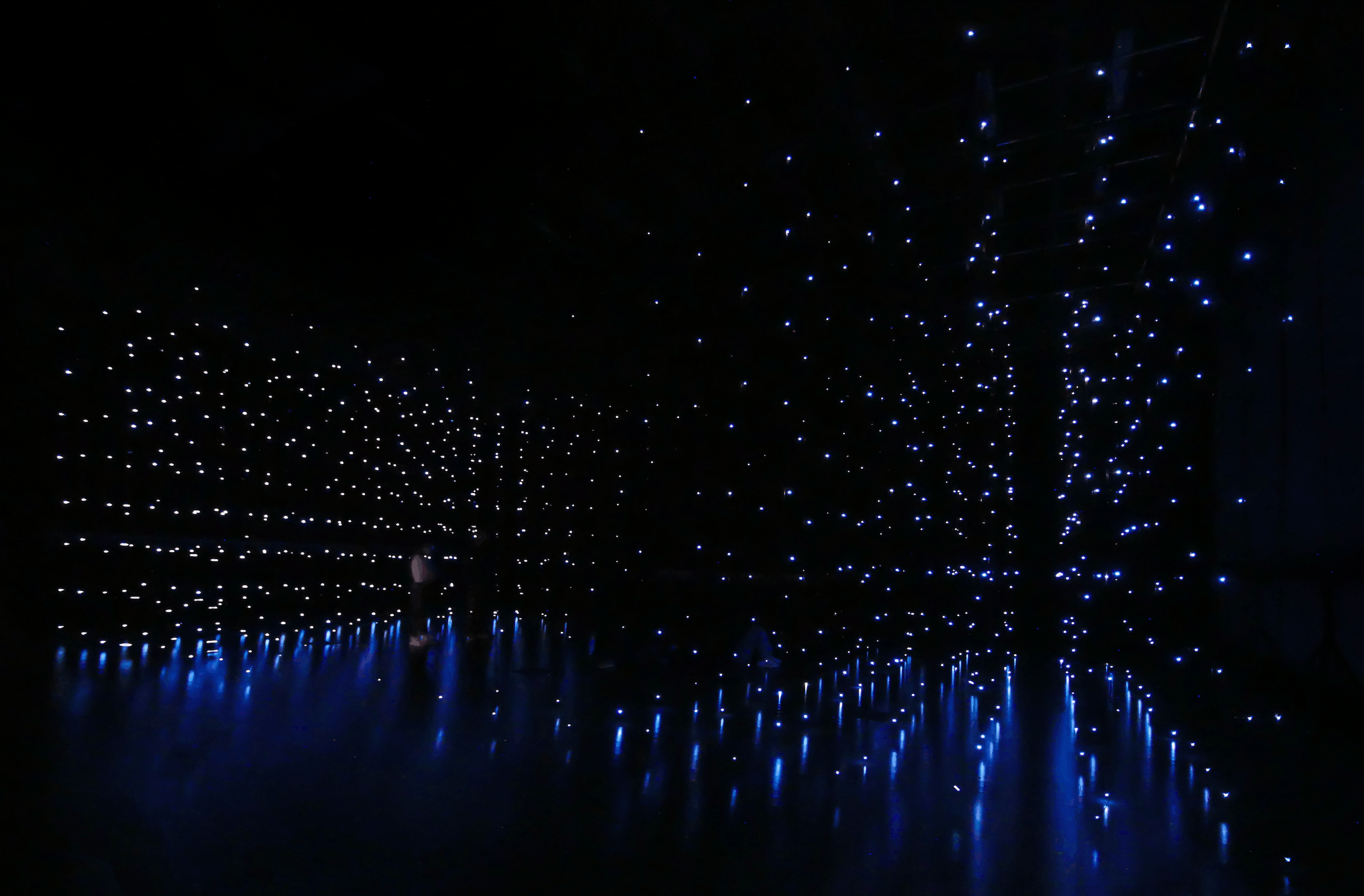
Schneider’s recent work NOWISWHENWEARE (the stars), has been shortlisted for the inaugural Annwn Prize. Set up by the Wales Millennium Centre, it is the first global award that celebrates excellence in immersive storytelling. NOWISWHENWEARE (the stars) is an interactive theatrical installation where the audience steps into total darkness and becomes the centre of a shifting constellation.
%5D.jpg)
1. What is your earliest memory of a work of art?
I remember being taken to the theatre on a class trip. The lights went down. I was absolutely enraptured. Then the lights came up again, and I was less enthused. The scene played out. Again, the lights went down - and when they came up, we were in a different place. The stage had changed. This wasn’t a film cutting to another location. The physical stuff on the stage was different. As if the entire theatre had been moved to another location. I was hooked. What magic was happening there in the dark?
2. Where do you turn to when you're in need of inspiration?
Almost always, I turn to non-fiction and nature. Cosmology, quantum mechanics, geology, and people watching. I find so much inspiration from reality and the study of reality - science. I try to use science as a blueprint for staging. How do you use psychological, physiological, and neurological phenomena as experience-making? How do you put an audience through something rather than just talk about it.
Most recently, I’m reading a book called Strata by Laura Poppick about the formation of the Earth - alongside a lot of books on consciousness, the simulation hypothesis, and AI. I make narrative, time-based art, but I find that visual art inspires me more than narrative art. Visual art includes the narrative of me encountering it. That’s what I'm usually after. Perceiving ourselves perceive.
3. What do you like to do when you need to take a break from your practice?
I run. I try to run 1,000 miles per year. It does incredible things to my brain. I don’t think about work. Or, if I do, it’s not forced. I also go backcountry camping in the American Southwest. I try not to see another human for a week. That’s also a paradigm-shifting experience. I climb at the bouldering gym. I watch baking shows. I try to be around animals.
4. Who is your favourite artist?
Ooof, wow. Robert Irwin and James Turrell taught me a ton about experience and learning how to see. I love the folks who get obsessed with ways of seeing. Janet Cardiff. Avedon is a giant. Dan Flavin. Cindy Sherman. Arthur Jafa. The Wooster Group. I don’t have a favourite artist. I have artists that are very important to who I am and how I see and think about seeing and experiencing.
5. What's the biggest crime an artist can commit?
Lying - about the work and about their process, sure - but lying to themselves about what is important is what I’m talking about here. Lack of integrity is the biggest crime. Trading curiosity for a trend.
6. Which gallery or museum should everyone try to visit at least once in their life?
I usually go to a museum more to be in the space than to look at the art. That being said, the Museum of Jurassic Technology in LA is a gem. The Dalí museum in Figueres was complete. Dia: Beacon is very special, as is Mass MoCA.
7. What is the worst thing about the art world?
Places like Mercer Labs in NYC and their ilk, who exist less to showcase artists and their lines of questioning and research, and more to be an Instagram background by copying successful artists’ aesthetics. It’s teaching people that art is about the product and not also about the process that led to the product.
8. Whose opinions on art do you actually care about?
I care about the curators who are deeply invested in lines of research, history, and uncovering those who have been historically unplatformed. And equal to that, I care about the random walk-in who has never heard of you or what you do.
9. What trend in art makes you roll your eyes?
Art and technology is a tough one for me. Technology is all around us. We've always been using it. Brushes, drums, tap shoes. I benefit from the categorisation of artists working with new technology, but I hope for a future where this conversation kind of goes away in favour of the idea that artists who work with technology are just artists and don’t need a special category.
10. Who are the last three musical artists you listened to?
Etta James, Dan Deacon, Big Thief.
11. What's your favourite colour and why?
Magenta. Ticks all the boxes. Warm and cool at the same time. As light, I want to bathe in it.
12. What three items would you grab if your house was burning down?
I live in Brooklyn. My apartment collapsed in 2009. And my art studio just burned down in September. Both times, I lost everything that was inside. The biggest things I miss from those two disasters: My books. My notebooks. The little things I put on the walls. Memories live in objects. My identity lives in my memories.
13. Is there an artistic skill you wish you were better at?
Metaphor on purpose. Actually, that’s not true - I think my accidental metaphor is what lets people read things into my work that I didn’t intend. I have no ability in figure drawing. I wish I had that skill.
13. What can you tell us about your work NOWISWHENWEARE (the stars)?
Two number 13’s! It’s a narrative installation. It’s best if you go in knowing as little as possible. It contains 11 miles of wire. It’s about you. It’s a container for whatever you want to bring to it.
%5D.jpeg)
14. Which element of the piece took the longest to perfect, and why?
The darkness took the longest to perfect. It’s a lighting installation, but the real magic for me comes from the darkness. The duration, the absoluteness. Even when the lighting elements are turned on, the entire installation runs a little under 10% of full brightness for most of the time. It has to do with perception. The brighter it gets, the more you can see, the more you can focus on anything but yourself, the less magical it becomes. The piece really relies on you not being able to distract yourself. When there’s nothing to look at, not even the floor, not even your hand in front of your face, the ability to distract yourself with fleeting thoughts really attenuates rapidly. The other tough part of this aspect is how long it takes the human eye to produce rhodopsin, the chemical that aids in seeing in darkness. I rely on knowing how adjusted your eye is to the dark in order to show things that you otherwise wouldn’t be able to see.
15. What impression do you hope people get after seeing the piece?
I would like for folks to come out feeling that they were able to be present with themselves. They don’t even need to be present with the work for all I care, but I do hope that they feel like they spent some time alone together.
And I hope they call someone they haven’t talked with in a little while and tell them that they love them.


Welcome to 15 Questions With…, an interview series in which art writer Gary Grimes picks the brains of artists, curators and other creatives to understand what makes them tick through a series of quick-fire questions. This series aims to showcase the varying approaches creatives take to making art and how their relationships to the so-called art world differ, but also reveal what unifies those responsible for the art we love.
Andrew Schneider is an OBIE award-winning, Drama Desk-nominated director, performer, writer, and interactive-electronics artist from the USA who creates original works for theatre, dance, sound, video, installation and public art since 2007.
His work uses new and old, high and low tech - from Wave Field Synthesis arrays and Volumetric Lighting displays, to literal smoke and mirrors. He is interested in the edges of human perception and using science as a blueprint for staging.
Schneider’s recent work NOWISWHENWEARE (the stars), has been shortlisted for the inaugural Annwn Prize. Set up by the Wales Millennium Centre, it is the first global award that celebrates excellence in immersive storytelling. NOWISWHENWEARE (the stars) is an interactive theatrical installation where the audience steps into total darkness and becomes the centre of a shifting constellation.
1. What is your earliest memory of a work of art?
I remember being taken to the theatre on a class trip. The lights went down. I was absolutely enraptured. Then the lights came up again, and I was less enthused. The scene played out. Again, the lights went down - and when they came up, we were in a different place. The stage had changed. This wasn’t a film cutting to another location. The physical stuff on the stage was different. As if the entire theatre had been moved to another location. I was hooked. What magic was happening there in the dark?
2. Where do you turn to when you're in need of inspiration?
Almost always, I turn to non-fiction and nature. Cosmology, quantum mechanics, geology, and people watching. I find so much inspiration from reality and the study of reality - science. I try to use science as a blueprint for staging. How do you use psychological, physiological, and neurological phenomena as experience-making? How do you put an audience through something rather than just talk about it.
Most recently, I’m reading a book called Strata by Laura Poppick about the formation of the Earth - alongside a lot of books on consciousness, the simulation hypothesis, and AI. I make narrative, time-based art, but I find that visual art inspires me more than narrative art. Visual art includes the narrative of me encountering it. That’s what I'm usually after. Perceiving ourselves perceive.
3. What do you like to do when you need to take a break from your practice?
I run. I try to run 1,000 miles per year. It does incredible things to my brain. I don’t think about work. Or, if I do, it’s not forced. I also go backcountry camping in the American Southwest. I try not to see another human for a week. That’s also a paradigm-shifting experience. I climb at the bouldering gym. I watch baking shows. I try to be around animals.
4. Who is your favourite artist?
Ooof, wow. Robert Irwin and James Turrell taught me a ton about experience and learning how to see. I love the folks who get obsessed with ways of seeing. Janet Cardiff. Avedon is a giant. Dan Flavin. Cindy Sherman. Arthur Jafa. The Wooster Group. I don’t have a favourite artist. I have artists that are very important to who I am and how I see and think about seeing and experiencing.
5. What's the biggest crime an artist can commit?
Lying - about the work and about their process, sure - but lying to themselves about what is important is what I’m talking about here. Lack of integrity is the biggest crime. Trading curiosity for a trend.
6. Which gallery or museum should everyone try to visit at least once in their life?
I usually go to a museum more to be in the space than to look at the art. That being said, the Museum of Jurassic Technology in LA is a gem. The Dalí museum in Figueres was complete. Dia: Beacon is very special, as is Mass MoCA.
7. What is the worst thing about the art world?
Places like Mercer Labs in NYC and their ilk, who exist less to showcase artists and their lines of questioning and research, and more to be an Instagram background by copying successful artists’ aesthetics. It’s teaching people that art is about the product and not also about the process that led to the product.
8. Whose opinions on art do you actually care about?
I care about the curators who are deeply invested in lines of research, history, and uncovering those who have been historically unplatformed. And equal to that, I care about the random walk-in who has never heard of you or what you do.
9. What trend in art makes you roll your eyes?
Art and technology is a tough one for me. Technology is all around us. We've always been using it. Brushes, drums, tap shoes. I benefit from the categorisation of artists working with new technology, but I hope for a future where this conversation kind of goes away in favour of the idea that artists who work with technology are just artists and don’t need a special category.
10. Who are the last three musical artists you listened to?
Etta James, Dan Deacon, Big Thief.
11. What's your favourite colour and why?
Magenta. Ticks all the boxes. Warm and cool at the same time. As light, I want to bathe in it.
12. What three items would you grab if your house was burning down?
I live in Brooklyn. My apartment collapsed in 2009. And my art studio just burned down in September. Both times, I lost everything that was inside. The biggest things I miss from those two disasters: My books. My notebooks. The little things I put on the walls. Memories live in objects. My identity lives in my memories.
13. Is there an artistic skill you wish you were better at?
Metaphor on purpose. Actually, that’s not true - I think my accidental metaphor is what lets people read things into my work that I didn’t intend. I have no ability in figure drawing. I wish I had that skill.
13. What can you tell us about your work NOWISWHENWEARE (the stars)?
Two number 13’s! It’s a narrative installation. It’s best if you go in knowing as little as possible. It contains 11 miles of wire. It’s about you. It’s a container for whatever you want to bring to it.
14. Which element of the piece took the longest to perfect, and why?
The darkness took the longest to perfect. It’s a lighting installation, but the real magic for me comes from the darkness. The duration, the absoluteness. Even when the lighting elements are turned on, the entire installation runs a little under 10% of full brightness for most of the time. It has to do with perception. The brighter it gets, the more you can see, the more you can focus on anything but yourself, the less magical it becomes. The piece really relies on you not being able to distract yourself. When there’s nothing to look at, not even the floor, not even your hand in front of your face, the ability to distract yourself with fleeting thoughts really attenuates rapidly. The other tough part of this aspect is how long it takes the human eye to produce rhodopsin, the chemical that aids in seeing in darkness. I rely on knowing how adjusted your eye is to the dark in order to show things that you otherwise wouldn’t be able to see.
15. What impression do you hope people get after seeing the piece?
I would like for folks to come out feeling that they were able to be present with themselves. They don’t even need to be present with the work for all I care, but I do hope that they feel like they spent some time alone together.
And I hope they call someone they haven’t talked with in a little while and tell them that they love them.
Welcome to 15 Questions With…, an interview series in which art writer Gary Grimes picks the brains of artists, curators and other creatives to understand what makes them tick through a series of quick-fire questions. This series aims to showcase the varying approaches creatives take to making art and how their relationships to the so-called art world differ, but also reveal what unifies those responsible for the art we love.
Andrew Schneider is an OBIE award-winning, Drama Desk-nominated director, performer, writer, and interactive-electronics artist from the USA who creates original works for theatre, dance, sound, video, installation and public art since 2007.
His work uses new and old, high and low tech - from Wave Field Synthesis arrays and Volumetric Lighting displays, to literal smoke and mirrors. He is interested in the edges of human perception and using science as a blueprint for staging.
Schneider’s recent work NOWISWHENWEARE (the stars), has been shortlisted for the inaugural Annwn Prize. Set up by the Wales Millennium Centre, it is the first global award that celebrates excellence in immersive storytelling. NOWISWHENWEARE (the stars) is an interactive theatrical installation where the audience steps into total darkness and becomes the centre of a shifting constellation.
1. What is your earliest memory of a work of art?
I remember being taken to the theatre on a class trip. The lights went down. I was absolutely enraptured. Then the lights came up again, and I was less enthused. The scene played out. Again, the lights went down - and when they came up, we were in a different place. The stage had changed. This wasn’t a film cutting to another location. The physical stuff on the stage was different. As if the entire theatre had been moved to another location. I was hooked. What magic was happening there in the dark?
2. Where do you turn to when you're in need of inspiration?
Almost always, I turn to non-fiction and nature. Cosmology, quantum mechanics, geology, and people watching. I find so much inspiration from reality and the study of reality - science. I try to use science as a blueprint for staging. How do you use psychological, physiological, and neurological phenomena as experience-making? How do you put an audience through something rather than just talk about it.
Most recently, I’m reading a book called Strata by Laura Poppick about the formation of the Earth - alongside a lot of books on consciousness, the simulation hypothesis, and AI. I make narrative, time-based art, but I find that visual art inspires me more than narrative art. Visual art includes the narrative of me encountering it. That’s what I'm usually after. Perceiving ourselves perceive.
3. What do you like to do when you need to take a break from your practice?
I run. I try to run 1,000 miles per year. It does incredible things to my brain. I don’t think about work. Or, if I do, it’s not forced. I also go backcountry camping in the American Southwest. I try not to see another human for a week. That’s also a paradigm-shifting experience. I climb at the bouldering gym. I watch baking shows. I try to be around animals.
4. Who is your favourite artist?
Ooof, wow. Robert Irwin and James Turrell taught me a ton about experience and learning how to see. I love the folks who get obsessed with ways of seeing. Janet Cardiff. Avedon is a giant. Dan Flavin. Cindy Sherman. Arthur Jafa. The Wooster Group. I don’t have a favourite artist. I have artists that are very important to who I am and how I see and think about seeing and experiencing.
5. What's the biggest crime an artist can commit?
Lying - about the work and about their process, sure - but lying to themselves about what is important is what I’m talking about here. Lack of integrity is the biggest crime. Trading curiosity for a trend.
6. Which gallery or museum should everyone try to visit at least once in their life?
I usually go to a museum more to be in the space than to look at the art. That being said, the Museum of Jurassic Technology in LA is a gem. The Dalí museum in Figueres was complete. Dia: Beacon is very special, as is Mass MoCA.
7. What is the worst thing about the art world?
Places like Mercer Labs in NYC and their ilk, who exist less to showcase artists and their lines of questioning and research, and more to be an Instagram background by copying successful artists’ aesthetics. It’s teaching people that art is about the product and not also about the process that led to the product.
8. Whose opinions on art do you actually care about?
I care about the curators who are deeply invested in lines of research, history, and uncovering those who have been historically unplatformed. And equal to that, I care about the random walk-in who has never heard of you or what you do.
9. What trend in art makes you roll your eyes?
Art and technology is a tough one for me. Technology is all around us. We've always been using it. Brushes, drums, tap shoes. I benefit from the categorisation of artists working with new technology, but I hope for a future where this conversation kind of goes away in favour of the idea that artists who work with technology are just artists and don’t need a special category.
10. Who are the last three musical artists you listened to?
Etta James, Dan Deacon, Big Thief.
11. What's your favourite colour and why?
Magenta. Ticks all the boxes. Warm and cool at the same time. As light, I want to bathe in it.
12. What three items would you grab if your house was burning down?
I live in Brooklyn. My apartment collapsed in 2009. And my art studio just burned down in September. Both times, I lost everything that was inside. The biggest things I miss from those two disasters: My books. My notebooks. The little things I put on the walls. Memories live in objects. My identity lives in my memories.
13. Is there an artistic skill you wish you were better at?
Metaphor on purpose. Actually, that’s not true - I think my accidental metaphor is what lets people read things into my work that I didn’t intend. I have no ability in figure drawing. I wish I had that skill.
13. What can you tell us about your work NOWISWHENWEARE (the stars)?
Two number 13’s! It’s a narrative installation. It’s best if you go in knowing as little as possible. It contains 11 miles of wire. It’s about you. It’s a container for whatever you want to bring to it.
14. Which element of the piece took the longest to perfect, and why?
The darkness took the longest to perfect. It’s a lighting installation, but the real magic for me comes from the darkness. The duration, the absoluteness. Even when the lighting elements are turned on, the entire installation runs a little under 10% of full brightness for most of the time. It has to do with perception. The brighter it gets, the more you can see, the more you can focus on anything but yourself, the less magical it becomes. The piece really relies on you not being able to distract yourself. When there’s nothing to look at, not even the floor, not even your hand in front of your face, the ability to distract yourself with fleeting thoughts really attenuates rapidly. The other tough part of this aspect is how long it takes the human eye to produce rhodopsin, the chemical that aids in seeing in darkness. I rely on knowing how adjusted your eye is to the dark in order to show things that you otherwise wouldn’t be able to see.
15. What impression do you hope people get after seeing the piece?
I would like for folks to come out feeling that they were able to be present with themselves. They don’t even need to be present with the work for all I care, but I do hope that they feel like they spent some time alone together.
And I hope they call someone they haven’t talked with in a little while and tell them that they love them.
Welcome to 15 Questions With…, an interview series in which art writer Gary Grimes picks the brains of artists, curators and other creatives to understand what makes them tick through a series of quick-fire questions. This series aims to showcase the varying approaches creatives take to making art and how their relationships to the so-called art world differ, but also reveal what unifies those responsible for the art we love.
Andrew Schneider is an OBIE award-winning, Drama Desk-nominated director, performer, writer, and interactive-electronics artist from the USA who creates original works for theatre, dance, sound, video, installation and public art since 2007.
His work uses new and old, high and low tech - from Wave Field Synthesis arrays and Volumetric Lighting displays, to literal smoke and mirrors. He is interested in the edges of human perception and using science as a blueprint for staging.
Schneider’s recent work NOWISWHENWEARE (the stars), has been shortlisted for the inaugural Annwn Prize. Set up by the Wales Millennium Centre, it is the first global award that celebrates excellence in immersive storytelling. NOWISWHENWEARE (the stars) is an interactive theatrical installation where the audience steps into total darkness and becomes the centre of a shifting constellation.
1. What is your earliest memory of a work of art?
I remember being taken to the theatre on a class trip. The lights went down. I was absolutely enraptured. Then the lights came up again, and I was less enthused. The scene played out. Again, the lights went down - and when they came up, we were in a different place. The stage had changed. This wasn’t a film cutting to another location. The physical stuff on the stage was different. As if the entire theatre had been moved to another location. I was hooked. What magic was happening there in the dark?
2. Where do you turn to when you're in need of inspiration?
Almost always, I turn to non-fiction and nature. Cosmology, quantum mechanics, geology, and people watching. I find so much inspiration from reality and the study of reality - science. I try to use science as a blueprint for staging. How do you use psychological, physiological, and neurological phenomena as experience-making? How do you put an audience through something rather than just talk about it.
Most recently, I’m reading a book called Strata by Laura Poppick about the formation of the Earth - alongside a lot of books on consciousness, the simulation hypothesis, and AI. I make narrative, time-based art, but I find that visual art inspires me more than narrative art. Visual art includes the narrative of me encountering it. That’s what I'm usually after. Perceiving ourselves perceive.
3. What do you like to do when you need to take a break from your practice?
I run. I try to run 1,000 miles per year. It does incredible things to my brain. I don’t think about work. Or, if I do, it’s not forced. I also go backcountry camping in the American Southwest. I try not to see another human for a week. That’s also a paradigm-shifting experience. I climb at the bouldering gym. I watch baking shows. I try to be around animals.
4. Who is your favourite artist?
Ooof, wow. Robert Irwin and James Turrell taught me a ton about experience and learning how to see. I love the folks who get obsessed with ways of seeing. Janet Cardiff. Avedon is a giant. Dan Flavin. Cindy Sherman. Arthur Jafa. The Wooster Group. I don’t have a favourite artist. I have artists that are very important to who I am and how I see and think about seeing and experiencing.
5. What's the biggest crime an artist can commit?
Lying - about the work and about their process, sure - but lying to themselves about what is important is what I’m talking about here. Lack of integrity is the biggest crime. Trading curiosity for a trend.
6. Which gallery or museum should everyone try to visit at least once in their life?
I usually go to a museum more to be in the space than to look at the art. That being said, the Museum of Jurassic Technology in LA is a gem. The Dalí museum in Figueres was complete. Dia: Beacon is very special, as is Mass MoCA.
7. What is the worst thing about the art world?
Places like Mercer Labs in NYC and their ilk, who exist less to showcase artists and their lines of questioning and research, and more to be an Instagram background by copying successful artists’ aesthetics. It’s teaching people that art is about the product and not also about the process that led to the product.
8. Whose opinions on art do you actually care about?
I care about the curators who are deeply invested in lines of research, history, and uncovering those who have been historically unplatformed. And equal to that, I care about the random walk-in who has never heard of you or what you do.
9. What trend in art makes you roll your eyes?
Art and technology is a tough one for me. Technology is all around us. We've always been using it. Brushes, drums, tap shoes. I benefit from the categorisation of artists working with new technology, but I hope for a future where this conversation kind of goes away in favour of the idea that artists who work with technology are just artists and don’t need a special category.
10. Who are the last three musical artists you listened to?
Etta James, Dan Deacon, Big Thief.
11. What's your favourite colour and why?
Magenta. Ticks all the boxes. Warm and cool at the same time. As light, I want to bathe in it.
12. What three items would you grab if your house was burning down?
I live in Brooklyn. My apartment collapsed in 2009. And my art studio just burned down in September. Both times, I lost everything that was inside. The biggest things I miss from those two disasters: My books. My notebooks. The little things I put on the walls. Memories live in objects. My identity lives in my memories.
13. Is there an artistic skill you wish you were better at?
Metaphor on purpose. Actually, that’s not true - I think my accidental metaphor is what lets people read things into my work that I didn’t intend. I have no ability in figure drawing. I wish I had that skill.
13. What can you tell us about your work NOWISWHENWEARE (the stars)?
Two number 13’s! It’s a narrative installation. It’s best if you go in knowing as little as possible. It contains 11 miles of wire. It’s about you. It’s a container for whatever you want to bring to it.
14. Which element of the piece took the longest to perfect, and why?
The darkness took the longest to perfect. It’s a lighting installation, but the real magic for me comes from the darkness. The duration, the absoluteness. Even when the lighting elements are turned on, the entire installation runs a little under 10% of full brightness for most of the time. It has to do with perception. The brighter it gets, the more you can see, the more you can focus on anything but yourself, the less magical it becomes. The piece really relies on you not being able to distract yourself. When there’s nothing to look at, not even the floor, not even your hand in front of your face, the ability to distract yourself with fleeting thoughts really attenuates rapidly. The other tough part of this aspect is how long it takes the human eye to produce rhodopsin, the chemical that aids in seeing in darkness. I rely on knowing how adjusted your eye is to the dark in order to show things that you otherwise wouldn’t be able to see.
15. What impression do you hope people get after seeing the piece?
I would like for folks to come out feeling that they were able to be present with themselves. They don’t even need to be present with the work for all I care, but I do hope that they feel like they spent some time alone together.
And I hope they call someone they haven’t talked with in a little while and tell them that they love them.
Welcome to 15 Questions With…, an interview series in which art writer Gary Grimes picks the brains of artists, curators and other creatives to understand what makes them tick through a series of quick-fire questions. This series aims to showcase the varying approaches creatives take to making art and how their relationships to the so-called art world differ, but also reveal what unifies those responsible for the art we love.
Andrew Schneider is an OBIE award-winning, Drama Desk-nominated director, performer, writer, and interactive-electronics artist from the USA who creates original works for theatre, dance, sound, video, installation and public art since 2007.
His work uses new and old, high and low tech - from Wave Field Synthesis arrays and Volumetric Lighting displays, to literal smoke and mirrors. He is interested in the edges of human perception and using science as a blueprint for staging.
Schneider’s recent work NOWISWHENWEARE (the stars), has been shortlisted for the inaugural Annwn Prize. Set up by the Wales Millennium Centre, it is the first global award that celebrates excellence in immersive storytelling. NOWISWHENWEARE (the stars) is an interactive theatrical installation where the audience steps into total darkness and becomes the centre of a shifting constellation.
1. What is your earliest memory of a work of art?
I remember being taken to the theatre on a class trip. The lights went down. I was absolutely enraptured. Then the lights came up again, and I was less enthused. The scene played out. Again, the lights went down - and when they came up, we were in a different place. The stage had changed. This wasn’t a film cutting to another location. The physical stuff on the stage was different. As if the entire theatre had been moved to another location. I was hooked. What magic was happening there in the dark?
2. Where do you turn to when you're in need of inspiration?
Almost always, I turn to non-fiction and nature. Cosmology, quantum mechanics, geology, and people watching. I find so much inspiration from reality and the study of reality - science. I try to use science as a blueprint for staging. How do you use psychological, physiological, and neurological phenomena as experience-making? How do you put an audience through something rather than just talk about it.
Most recently, I’m reading a book called Strata by Laura Poppick about the formation of the Earth - alongside a lot of books on consciousness, the simulation hypothesis, and AI. I make narrative, time-based art, but I find that visual art inspires me more than narrative art. Visual art includes the narrative of me encountering it. That’s what I'm usually after. Perceiving ourselves perceive.
3. What do you like to do when you need to take a break from your practice?
I run. I try to run 1,000 miles per year. It does incredible things to my brain. I don’t think about work. Or, if I do, it’s not forced. I also go backcountry camping in the American Southwest. I try not to see another human for a week. That’s also a paradigm-shifting experience. I climb at the bouldering gym. I watch baking shows. I try to be around animals.
4. Who is your favourite artist?
Ooof, wow. Robert Irwin and James Turrell taught me a ton about experience and learning how to see. I love the folks who get obsessed with ways of seeing. Janet Cardiff. Avedon is a giant. Dan Flavin. Cindy Sherman. Arthur Jafa. The Wooster Group. I don’t have a favourite artist. I have artists that are very important to who I am and how I see and think about seeing and experiencing.
5. What's the biggest crime an artist can commit?
Lying - about the work and about their process, sure - but lying to themselves about what is important is what I’m talking about here. Lack of integrity is the biggest crime. Trading curiosity for a trend.
6. Which gallery or museum should everyone try to visit at least once in their life?
I usually go to a museum more to be in the space than to look at the art. That being said, the Museum of Jurassic Technology in LA is a gem. The Dalí museum in Figueres was complete. Dia: Beacon is very special, as is Mass MoCA.
7. What is the worst thing about the art world?
Places like Mercer Labs in NYC and their ilk, who exist less to showcase artists and their lines of questioning and research, and more to be an Instagram background by copying successful artists’ aesthetics. It’s teaching people that art is about the product and not also about the process that led to the product.
8. Whose opinions on art do you actually care about?
I care about the curators who are deeply invested in lines of research, history, and uncovering those who have been historically unplatformed. And equal to that, I care about the random walk-in who has never heard of you or what you do.
9. What trend in art makes you roll your eyes?
Art and technology is a tough one for me. Technology is all around us. We've always been using it. Brushes, drums, tap shoes. I benefit from the categorisation of artists working with new technology, but I hope for a future where this conversation kind of goes away in favour of the idea that artists who work with technology are just artists and don’t need a special category.
10. Who are the last three musical artists you listened to?
Etta James, Dan Deacon, Big Thief.
11. What's your favourite colour and why?
Magenta. Ticks all the boxes. Warm and cool at the same time. As light, I want to bathe in it.
12. What three items would you grab if your house was burning down?
I live in Brooklyn. My apartment collapsed in 2009. And my art studio just burned down in September. Both times, I lost everything that was inside. The biggest things I miss from those two disasters: My books. My notebooks. The little things I put on the walls. Memories live in objects. My identity lives in my memories.
13. Is there an artistic skill you wish you were better at?
Metaphor on purpose. Actually, that’s not true - I think my accidental metaphor is what lets people read things into my work that I didn’t intend. I have no ability in figure drawing. I wish I had that skill.
13. What can you tell us about your work NOWISWHENWEARE (the stars)?
Two number 13’s! It’s a narrative installation. It’s best if you go in knowing as little as possible. It contains 11 miles of wire. It’s about you. It’s a container for whatever you want to bring to it.
14. Which element of the piece took the longest to perfect, and why?
The darkness took the longest to perfect. It’s a lighting installation, but the real magic for me comes from the darkness. The duration, the absoluteness. Even when the lighting elements are turned on, the entire installation runs a little under 10% of full brightness for most of the time. It has to do with perception. The brighter it gets, the more you can see, the more you can focus on anything but yourself, the less magical it becomes. The piece really relies on you not being able to distract yourself. When there’s nothing to look at, not even the floor, not even your hand in front of your face, the ability to distract yourself with fleeting thoughts really attenuates rapidly. The other tough part of this aspect is how long it takes the human eye to produce rhodopsin, the chemical that aids in seeing in darkness. I rely on knowing how adjusted your eye is to the dark in order to show things that you otherwise wouldn’t be able to see.
15. What impression do you hope people get after seeing the piece?
I would like for folks to come out feeling that they were able to be present with themselves. They don’t even need to be present with the work for all I care, but I do hope that they feel like they spent some time alone together.
And I hope they call someone they haven’t talked with in a little while and tell them that they love them.
Welcome to 15 Questions With…, an interview series in which art writer Gary Grimes picks the brains of artists, curators and other creatives to understand what makes them tick through a series of quick-fire questions. This series aims to showcase the varying approaches creatives take to making art and how their relationships to the so-called art world differ, but also reveal what unifies those responsible for the art we love.
Andrew Schneider is an OBIE award-winning, Drama Desk-nominated director, performer, writer, and interactive-electronics artist from the USA who creates original works for theatre, dance, sound, video, installation and public art since 2007.
His work uses new and old, high and low tech - from Wave Field Synthesis arrays and Volumetric Lighting displays, to literal smoke and mirrors. He is interested in the edges of human perception and using science as a blueprint for staging.
Schneider’s recent work NOWISWHENWEARE (the stars), has been shortlisted for the inaugural Annwn Prize. Set up by the Wales Millennium Centre, it is the first global award that celebrates excellence in immersive storytelling. NOWISWHENWEARE (the stars) is an interactive theatrical installation where the audience steps into total darkness and becomes the centre of a shifting constellation.
1. What is your earliest memory of a work of art?
I remember being taken to the theatre on a class trip. The lights went down. I was absolutely enraptured. Then the lights came up again, and I was less enthused. The scene played out. Again, the lights went down - and when they came up, we were in a different place. The stage had changed. This wasn’t a film cutting to another location. The physical stuff on the stage was different. As if the entire theatre had been moved to another location. I was hooked. What magic was happening there in the dark?
2. Where do you turn to when you're in need of inspiration?
Almost always, I turn to non-fiction and nature. Cosmology, quantum mechanics, geology, and people watching. I find so much inspiration from reality and the study of reality - science. I try to use science as a blueprint for staging. How do you use psychological, physiological, and neurological phenomena as experience-making? How do you put an audience through something rather than just talk about it.
Most recently, I’m reading a book called Strata by Laura Poppick about the formation of the Earth - alongside a lot of books on consciousness, the simulation hypothesis, and AI. I make narrative, time-based art, but I find that visual art inspires me more than narrative art. Visual art includes the narrative of me encountering it. That’s what I'm usually after. Perceiving ourselves perceive.
3. What do you like to do when you need to take a break from your practice?
I run. I try to run 1,000 miles per year. It does incredible things to my brain. I don’t think about work. Or, if I do, it’s not forced. I also go backcountry camping in the American Southwest. I try not to see another human for a week. That’s also a paradigm-shifting experience. I climb at the bouldering gym. I watch baking shows. I try to be around animals.
4. Who is your favourite artist?
Ooof, wow. Robert Irwin and James Turrell taught me a ton about experience and learning how to see. I love the folks who get obsessed with ways of seeing. Janet Cardiff. Avedon is a giant. Dan Flavin. Cindy Sherman. Arthur Jafa. The Wooster Group. I don’t have a favourite artist. I have artists that are very important to who I am and how I see and think about seeing and experiencing.
5. What's the biggest crime an artist can commit?
Lying - about the work and about their process, sure - but lying to themselves about what is important is what I’m talking about here. Lack of integrity is the biggest crime. Trading curiosity for a trend.
6. Which gallery or museum should everyone try to visit at least once in their life?
I usually go to a museum more to be in the space than to look at the art. That being said, the Museum of Jurassic Technology in LA is a gem. The Dalí museum in Figueres was complete. Dia: Beacon is very special, as is Mass MoCA.
7. What is the worst thing about the art world?
Places like Mercer Labs in NYC and their ilk, who exist less to showcase artists and their lines of questioning and research, and more to be an Instagram background by copying successful artists’ aesthetics. It’s teaching people that art is about the product and not also about the process that led to the product.
8. Whose opinions on art do you actually care about?
I care about the curators who are deeply invested in lines of research, history, and uncovering those who have been historically unplatformed. And equal to that, I care about the random walk-in who has never heard of you or what you do.
9. What trend in art makes you roll your eyes?
Art and technology is a tough one for me. Technology is all around us. We've always been using it. Brushes, drums, tap shoes. I benefit from the categorisation of artists working with new technology, but I hope for a future where this conversation kind of goes away in favour of the idea that artists who work with technology are just artists and don’t need a special category.
10. Who are the last three musical artists you listened to?
Etta James, Dan Deacon, Big Thief.
11. What's your favourite colour and why?
Magenta. Ticks all the boxes. Warm and cool at the same time. As light, I want to bathe in it.
12. What three items would you grab if your house was burning down?
I live in Brooklyn. My apartment collapsed in 2009. And my art studio just burned down in September. Both times, I lost everything that was inside. The biggest things I miss from those two disasters: My books. My notebooks. The little things I put on the walls. Memories live in objects. My identity lives in my memories.
13. Is there an artistic skill you wish you were better at?
Metaphor on purpose. Actually, that’s not true - I think my accidental metaphor is what lets people read things into my work that I didn’t intend. I have no ability in figure drawing. I wish I had that skill.
13. What can you tell us about your work NOWISWHENWEARE (the stars)?
Two number 13’s! It’s a narrative installation. It’s best if you go in knowing as little as possible. It contains 11 miles of wire. It’s about you. It’s a container for whatever you want to bring to it.
14. Which element of the piece took the longest to perfect, and why?
The darkness took the longest to perfect. It’s a lighting installation, but the real magic for me comes from the darkness. The duration, the absoluteness. Even when the lighting elements are turned on, the entire installation runs a little under 10% of full brightness for most of the time. It has to do with perception. The brighter it gets, the more you can see, the more you can focus on anything but yourself, the less magical it becomes. The piece really relies on you not being able to distract yourself. When there’s nothing to look at, not even the floor, not even your hand in front of your face, the ability to distract yourself with fleeting thoughts really attenuates rapidly. The other tough part of this aspect is how long it takes the human eye to produce rhodopsin, the chemical that aids in seeing in darkness. I rely on knowing how adjusted your eye is to the dark in order to show things that you otherwise wouldn’t be able to see.
15. What impression do you hope people get after seeing the piece?
I would like for folks to come out feeling that they were able to be present with themselves. They don’t even need to be present with the work for all I care, but I do hope that they feel like they spent some time alone together.
And I hope they call someone they haven’t talked with in a little while and tell them that they love them.
Welcome to 15 Questions With…, an interview series in which art writer Gary Grimes picks the brains of artists, curators and other creatives to understand what makes them tick through a series of quick-fire questions. This series aims to showcase the varying approaches creatives take to making art and how their relationships to the so-called art world differ, but also reveal what unifies those responsible for the art we love.
Andrew Schneider is an OBIE award-winning, Drama Desk-nominated director, performer, writer, and interactive-electronics artist from the USA who creates original works for theatre, dance, sound, video, installation and public art since 2007.
His work uses new and old, high and low tech - from Wave Field Synthesis arrays and Volumetric Lighting displays, to literal smoke and mirrors. He is interested in the edges of human perception and using science as a blueprint for staging.
Schneider’s recent work NOWISWHENWEARE (the stars), has been shortlisted for the inaugural Annwn Prize. Set up by the Wales Millennium Centre, it is the first global award that celebrates excellence in immersive storytelling. NOWISWHENWEARE (the stars) is an interactive theatrical installation where the audience steps into total darkness and becomes the centre of a shifting constellation.
1. What is your earliest memory of a work of art?
I remember being taken to the theatre on a class trip. The lights went down. I was absolutely enraptured. Then the lights came up again, and I was less enthused. The scene played out. Again, the lights went down - and when they came up, we were in a different place. The stage had changed. This wasn’t a film cutting to another location. The physical stuff on the stage was different. As if the entire theatre had been moved to another location. I was hooked. What magic was happening there in the dark?
2. Where do you turn to when you're in need of inspiration?
Almost always, I turn to non-fiction and nature. Cosmology, quantum mechanics, geology, and people watching. I find so much inspiration from reality and the study of reality - science. I try to use science as a blueprint for staging. How do you use psychological, physiological, and neurological phenomena as experience-making? How do you put an audience through something rather than just talk about it.
Most recently, I’m reading a book called Strata by Laura Poppick about the formation of the Earth - alongside a lot of books on consciousness, the simulation hypothesis, and AI. I make narrative, time-based art, but I find that visual art inspires me more than narrative art. Visual art includes the narrative of me encountering it. That’s what I'm usually after. Perceiving ourselves perceive.
3. What do you like to do when you need to take a break from your practice?
I run. I try to run 1,000 miles per year. It does incredible things to my brain. I don’t think about work. Or, if I do, it’s not forced. I also go backcountry camping in the American Southwest. I try not to see another human for a week. That’s also a paradigm-shifting experience. I climb at the bouldering gym. I watch baking shows. I try to be around animals.
4. Who is your favourite artist?
Ooof, wow. Robert Irwin and James Turrell taught me a ton about experience and learning how to see. I love the folks who get obsessed with ways of seeing. Janet Cardiff. Avedon is a giant. Dan Flavin. Cindy Sherman. Arthur Jafa. The Wooster Group. I don’t have a favourite artist. I have artists that are very important to who I am and how I see and think about seeing and experiencing.
5. What's the biggest crime an artist can commit?
Lying - about the work and about their process, sure - but lying to themselves about what is important is what I’m talking about here. Lack of integrity is the biggest crime. Trading curiosity for a trend.
6. Which gallery or museum should everyone try to visit at least once in their life?
I usually go to a museum more to be in the space than to look at the art. That being said, the Museum of Jurassic Technology in LA is a gem. The Dalí museum in Figueres was complete. Dia: Beacon is very special, as is Mass MoCA.
7. What is the worst thing about the art world?
Places like Mercer Labs in NYC and their ilk, who exist less to showcase artists and their lines of questioning and research, and more to be an Instagram background by copying successful artists’ aesthetics. It’s teaching people that art is about the product and not also about the process that led to the product.
8. Whose opinions on art do you actually care about?
I care about the curators who are deeply invested in lines of research, history, and uncovering those who have been historically unplatformed. And equal to that, I care about the random walk-in who has never heard of you or what you do.
9. What trend in art makes you roll your eyes?
Art and technology is a tough one for me. Technology is all around us. We've always been using it. Brushes, drums, tap shoes. I benefit from the categorisation of artists working with new technology, but I hope for a future where this conversation kind of goes away in favour of the idea that artists who work with technology are just artists and don’t need a special category.
10. Who are the last three musical artists you listened to?
Etta James, Dan Deacon, Big Thief.
11. What's your favourite colour and why?
Magenta. Ticks all the boxes. Warm and cool at the same time. As light, I want to bathe in it.
12. What three items would you grab if your house was burning down?
I live in Brooklyn. My apartment collapsed in 2009. And my art studio just burned down in September. Both times, I lost everything that was inside. The biggest things I miss from those two disasters: My books. My notebooks. The little things I put on the walls. Memories live in objects. My identity lives in my memories.
13. Is there an artistic skill you wish you were better at?
Metaphor on purpose. Actually, that’s not true - I think my accidental metaphor is what lets people read things into my work that I didn’t intend. I have no ability in figure drawing. I wish I had that skill.
13. What can you tell us about your work NOWISWHENWEARE (the stars)?
Two number 13’s! It’s a narrative installation. It’s best if you go in knowing as little as possible. It contains 11 miles of wire. It’s about you. It’s a container for whatever you want to bring to it.
14. Which element of the piece took the longest to perfect, and why?
The darkness took the longest to perfect. It’s a lighting installation, but the real magic for me comes from the darkness. The duration, the absoluteness. Even when the lighting elements are turned on, the entire installation runs a little under 10% of full brightness for most of the time. It has to do with perception. The brighter it gets, the more you can see, the more you can focus on anything but yourself, the less magical it becomes. The piece really relies on you not being able to distract yourself. When there’s nothing to look at, not even the floor, not even your hand in front of your face, the ability to distract yourself with fleeting thoughts really attenuates rapidly. The other tough part of this aspect is how long it takes the human eye to produce rhodopsin, the chemical that aids in seeing in darkness. I rely on knowing how adjusted your eye is to the dark in order to show things that you otherwise wouldn’t be able to see.
15. What impression do you hope people get after seeing the piece?
I would like for folks to come out feeling that they were able to be present with themselves. They don’t even need to be present with the work for all I care, but I do hope that they feel like they spent some time alone together.
And I hope they call someone they haven’t talked with in a little while and tell them that they love them.
Welcome to 15 Questions With…, an interview series in which art writer Gary Grimes picks the brains of artists, curators and other creatives to understand what makes them tick through a series of quick-fire questions. This series aims to showcase the varying approaches creatives take to making art and how their relationships to the so-called art world differ, but also reveal what unifies those responsible for the art we love.
Andrew Schneider is an OBIE award-winning, Drama Desk-nominated director, performer, writer, and interactive-electronics artist from the USA who creates original works for theatre, dance, sound, video, installation and public art since 2007.
His work uses new and old, high and low tech - from Wave Field Synthesis arrays and Volumetric Lighting displays, to literal smoke and mirrors. He is interested in the edges of human perception and using science as a blueprint for staging.
Schneider’s recent work NOWISWHENWEARE (the stars), has been shortlisted for the inaugural Annwn Prize. Set up by the Wales Millennium Centre, it is the first global award that celebrates excellence in immersive storytelling. NOWISWHENWEARE (the stars) is an interactive theatrical installation where the audience steps into total darkness and becomes the centre of a shifting constellation.
1. What is your earliest memory of a work of art?
I remember being taken to the theatre on a class trip. The lights went down. I was absolutely enraptured. Then the lights came up again, and I was less enthused. The scene played out. Again, the lights went down - and when they came up, we were in a different place. The stage had changed. This wasn’t a film cutting to another location. The physical stuff on the stage was different. As if the entire theatre had been moved to another location. I was hooked. What magic was happening there in the dark?
2. Where do you turn to when you're in need of inspiration?
Almost always, I turn to non-fiction and nature. Cosmology, quantum mechanics, geology, and people watching. I find so much inspiration from reality and the study of reality - science. I try to use science as a blueprint for staging. How do you use psychological, physiological, and neurological phenomena as experience-making? How do you put an audience through something rather than just talk about it.
Most recently, I’m reading a book called Strata by Laura Poppick about the formation of the Earth - alongside a lot of books on consciousness, the simulation hypothesis, and AI. I make narrative, time-based art, but I find that visual art inspires me more than narrative art. Visual art includes the narrative of me encountering it. That’s what I'm usually after. Perceiving ourselves perceive.
3. What do you like to do when you need to take a break from your practice?
I run. I try to run 1,000 miles per year. It does incredible things to my brain. I don’t think about work. Or, if I do, it’s not forced. I also go backcountry camping in the American Southwest. I try not to see another human for a week. That’s also a paradigm-shifting experience. I climb at the bouldering gym. I watch baking shows. I try to be around animals.
4. Who is your favourite artist?
Ooof, wow. Robert Irwin and James Turrell taught me a ton about experience and learning how to see. I love the folks who get obsessed with ways of seeing. Janet Cardiff. Avedon is a giant. Dan Flavin. Cindy Sherman. Arthur Jafa. The Wooster Group. I don’t have a favourite artist. I have artists that are very important to who I am and how I see and think about seeing and experiencing.
5. What's the biggest crime an artist can commit?
Lying - about the work and about their process, sure - but lying to themselves about what is important is what I’m talking about here. Lack of integrity is the biggest crime. Trading curiosity for a trend.
6. Which gallery or museum should everyone try to visit at least once in their life?
I usually go to a museum more to be in the space than to look at the art. That being said, the Museum of Jurassic Technology in LA is a gem. The Dalí museum in Figueres was complete. Dia: Beacon is very special, as is Mass MoCA.
7. What is the worst thing about the art world?
Places like Mercer Labs in NYC and their ilk, who exist less to showcase artists and their lines of questioning and research, and more to be an Instagram background by copying successful artists’ aesthetics. It’s teaching people that art is about the product and not also about the process that led to the product.
8. Whose opinions on art do you actually care about?
I care about the curators who are deeply invested in lines of research, history, and uncovering those who have been historically unplatformed. And equal to that, I care about the random walk-in who has never heard of you or what you do.
9. What trend in art makes you roll your eyes?
Art and technology is a tough one for me. Technology is all around us. We've always been using it. Brushes, drums, tap shoes. I benefit from the categorisation of artists working with new technology, but I hope for a future where this conversation kind of goes away in favour of the idea that artists who work with technology are just artists and don’t need a special category.
10. Who are the last three musical artists you listened to?
Etta James, Dan Deacon, Big Thief.
11. What's your favourite colour and why?
Magenta. Ticks all the boxes. Warm and cool at the same time. As light, I want to bathe in it.
12. What three items would you grab if your house was burning down?
I live in Brooklyn. My apartment collapsed in 2009. And my art studio just burned down in September. Both times, I lost everything that was inside. The biggest things I miss from those two disasters: My books. My notebooks. The little things I put on the walls. Memories live in objects. My identity lives in my memories.
13. Is there an artistic skill you wish you were better at?
Metaphor on purpose. Actually, that’s not true - I think my accidental metaphor is what lets people read things into my work that I didn’t intend. I have no ability in figure drawing. I wish I had that skill.
13. What can you tell us about your work NOWISWHENWEARE (the stars)?
Two number 13’s! It’s a narrative installation. It’s best if you go in knowing as little as possible. It contains 11 miles of wire. It’s about you. It’s a container for whatever you want to bring to it.
14. Which element of the piece took the longest to perfect, and why?
The darkness took the longest to perfect. It’s a lighting installation, but the real magic for me comes from the darkness. The duration, the absoluteness. Even when the lighting elements are turned on, the entire installation runs a little under 10% of full brightness for most of the time. It has to do with perception. The brighter it gets, the more you can see, the more you can focus on anything but yourself, the less magical it becomes. The piece really relies on you not being able to distract yourself. When there’s nothing to look at, not even the floor, not even your hand in front of your face, the ability to distract yourself with fleeting thoughts really attenuates rapidly. The other tough part of this aspect is how long it takes the human eye to produce rhodopsin, the chemical that aids in seeing in darkness. I rely on knowing how adjusted your eye is to the dark in order to show things that you otherwise wouldn’t be able to see.
15. What impression do you hope people get after seeing the piece?
I would like for folks to come out feeling that they were able to be present with themselves. They don’t even need to be present with the work for all I care, but I do hope that they feel like they spent some time alone together.
And I hope they call someone they haven’t talked with in a little while and tell them that they love them.
Welcome to 15 Questions With…, an interview series in which art writer Gary Grimes picks the brains of artists, curators and other creatives to understand what makes them tick through a series of quick-fire questions. This series aims to showcase the varying approaches creatives take to making art and how their relationships to the so-called art world differ, but also reveal what unifies those responsible for the art we love.
Andrew Schneider is an OBIE award-winning, Drama Desk-nominated director, performer, writer, and interactive-electronics artist from the USA who creates original works for theatre, dance, sound, video, installation and public art since 2007.
His work uses new and old, high and low tech - from Wave Field Synthesis arrays and Volumetric Lighting displays, to literal smoke and mirrors. He is interested in the edges of human perception and using science as a blueprint for staging.
Schneider’s recent work NOWISWHENWEARE (the stars), has been shortlisted for the inaugural Annwn Prize. Set up by the Wales Millennium Centre, it is the first global award that celebrates excellence in immersive storytelling. NOWISWHENWEARE (the stars) is an interactive theatrical installation where the audience steps into total darkness and becomes the centre of a shifting constellation.
1. What is your earliest memory of a work of art?
I remember being taken to the theatre on a class trip. The lights went down. I was absolutely enraptured. Then the lights came up again, and I was less enthused. The scene played out. Again, the lights went down - and when they came up, we were in a different place. The stage had changed. This wasn’t a film cutting to another location. The physical stuff on the stage was different. As if the entire theatre had been moved to another location. I was hooked. What magic was happening there in the dark?
2. Where do you turn to when you're in need of inspiration?
Almost always, I turn to non-fiction and nature. Cosmology, quantum mechanics, geology, and people watching. I find so much inspiration from reality and the study of reality - science. I try to use science as a blueprint for staging. How do you use psychological, physiological, and neurological phenomena as experience-making? How do you put an audience through something rather than just talk about it.
Most recently, I’m reading a book called Strata by Laura Poppick about the formation of the Earth - alongside a lot of books on consciousness, the simulation hypothesis, and AI. I make narrative, time-based art, but I find that visual art inspires me more than narrative art. Visual art includes the narrative of me encountering it. That’s what I'm usually after. Perceiving ourselves perceive.
3. What do you like to do when you need to take a break from your practice?
I run. I try to run 1,000 miles per year. It does incredible things to my brain. I don’t think about work. Or, if I do, it’s not forced. I also go backcountry camping in the American Southwest. I try not to see another human for a week. That’s also a paradigm-shifting experience. I climb at the bouldering gym. I watch baking shows. I try to be around animals.
4. Who is your favourite artist?
Ooof, wow. Robert Irwin and James Turrell taught me a ton about experience and learning how to see. I love the folks who get obsessed with ways of seeing. Janet Cardiff. Avedon is a giant. Dan Flavin. Cindy Sherman. Arthur Jafa. The Wooster Group. I don’t have a favourite artist. I have artists that are very important to who I am and how I see and think about seeing and experiencing.
5. What's the biggest crime an artist can commit?
Lying - about the work and about their process, sure - but lying to themselves about what is important is what I’m talking about here. Lack of integrity is the biggest crime. Trading curiosity for a trend.
6. Which gallery or museum should everyone try to visit at least once in their life?
I usually go to a museum more to be in the space than to look at the art. That being said, the Museum of Jurassic Technology in LA is a gem. The Dalí museum in Figueres was complete. Dia: Beacon is very special, as is Mass MoCA.
7. What is the worst thing about the art world?
Places like Mercer Labs in NYC and their ilk, who exist less to showcase artists and their lines of questioning and research, and more to be an Instagram background by copying successful artists’ aesthetics. It’s teaching people that art is about the product and not also about the process that led to the product.
8. Whose opinions on art do you actually care about?
I care about the curators who are deeply invested in lines of research, history, and uncovering those who have been historically unplatformed. And equal to that, I care about the random walk-in who has never heard of you or what you do.
9. What trend in art makes you roll your eyes?
Art and technology is a tough one for me. Technology is all around us. We've always been using it. Brushes, drums, tap shoes. I benefit from the categorisation of artists working with new technology, but I hope for a future where this conversation kind of goes away in favour of the idea that artists who work with technology are just artists and don’t need a special category.
10. Who are the last three musical artists you listened to?
Etta James, Dan Deacon, Big Thief.
11. What's your favourite colour and why?
Magenta. Ticks all the boxes. Warm and cool at the same time. As light, I want to bathe in it.
12. What three items would you grab if your house was burning down?
I live in Brooklyn. My apartment collapsed in 2009. And my art studio just burned down in September. Both times, I lost everything that was inside. The biggest things I miss from those two disasters: My books. My notebooks. The little things I put on the walls. Memories live in objects. My identity lives in my memories.
13. Is there an artistic skill you wish you were better at?
Metaphor on purpose. Actually, that’s not true - I think my accidental metaphor is what lets people read things into my work that I didn’t intend. I have no ability in figure drawing. I wish I had that skill.
13. What can you tell us about your work NOWISWHENWEARE (the stars)?
Two number 13’s! It’s a narrative installation. It’s best if you go in knowing as little as possible. It contains 11 miles of wire. It’s about you. It’s a container for whatever you want to bring to it.
14. Which element of the piece took the longest to perfect, and why?
The darkness took the longest to perfect. It’s a lighting installation, but the real magic for me comes from the darkness. The duration, the absoluteness. Even when the lighting elements are turned on, the entire installation runs a little under 10% of full brightness for most of the time. It has to do with perception. The brighter it gets, the more you can see, the more you can focus on anything but yourself, the less magical it becomes. The piece really relies on you not being able to distract yourself. When there’s nothing to look at, not even the floor, not even your hand in front of your face, the ability to distract yourself with fleeting thoughts really attenuates rapidly. The other tough part of this aspect is how long it takes the human eye to produce rhodopsin, the chemical that aids in seeing in darkness. I rely on knowing how adjusted your eye is to the dark in order to show things that you otherwise wouldn’t be able to see.
15. What impression do you hope people get after seeing the piece?
I would like for folks to come out feeling that they were able to be present with themselves. They don’t even need to be present with the work for all I care, but I do hope that they feel like they spent some time alone together.
And I hope they call someone they haven’t talked with in a little while and tell them that they love them.
Welcome to 15 Questions With…, an interview series in which art writer Gary Grimes picks the brains of artists, curators and other creatives to understand what makes them tick through a series of quick-fire questions. This series aims to showcase the varying approaches creatives take to making art and how their relationships to the so-called art world differ, but also reveal what unifies those responsible for the art we love.
Andrew Schneider is an OBIE award-winning, Drama Desk-nominated director, performer, writer, and interactive-electronics artist from the USA who creates original works for theatre, dance, sound, video, installation and public art since 2007.
His work uses new and old, high and low tech - from Wave Field Synthesis arrays and Volumetric Lighting displays, to literal smoke and mirrors. He is interested in the edges of human perception and using science as a blueprint for staging.
Schneider’s recent work NOWISWHENWEARE (the stars), has been shortlisted for the inaugural Annwn Prize. Set up by the Wales Millennium Centre, it is the first global award that celebrates excellence in immersive storytelling. NOWISWHENWEARE (the stars) is an interactive theatrical installation where the audience steps into total darkness and becomes the centre of a shifting constellation.
1. What is your earliest memory of a work of art?
I remember being taken to the theatre on a class trip. The lights went down. I was absolutely enraptured. Then the lights came up again, and I was less enthused. The scene played out. Again, the lights went down - and when they came up, we were in a different place. The stage had changed. This wasn’t a film cutting to another location. The physical stuff on the stage was different. As if the entire theatre had been moved to another location. I was hooked. What magic was happening there in the dark?
2. Where do you turn to when you're in need of inspiration?
Almost always, I turn to non-fiction and nature. Cosmology, quantum mechanics, geology, and people watching. I find so much inspiration from reality and the study of reality - science. I try to use science as a blueprint for staging. How do you use psychological, physiological, and neurological phenomena as experience-making? How do you put an audience through something rather than just talk about it.
Most recently, I’m reading a book called Strata by Laura Poppick about the formation of the Earth - alongside a lot of books on consciousness, the simulation hypothesis, and AI. I make narrative, time-based art, but I find that visual art inspires me more than narrative art. Visual art includes the narrative of me encountering it. That’s what I'm usually after. Perceiving ourselves perceive.
3. What do you like to do when you need to take a break from your practice?
I run. I try to run 1,000 miles per year. It does incredible things to my brain. I don’t think about work. Or, if I do, it’s not forced. I also go backcountry camping in the American Southwest. I try not to see another human for a week. That’s also a paradigm-shifting experience. I climb at the bouldering gym. I watch baking shows. I try to be around animals.
4. Who is your favourite artist?
Ooof, wow. Robert Irwin and James Turrell taught me a ton about experience and learning how to see. I love the folks who get obsessed with ways of seeing. Janet Cardiff. Avedon is a giant. Dan Flavin. Cindy Sherman. Arthur Jafa. The Wooster Group. I don’t have a favourite artist. I have artists that are very important to who I am and how I see and think about seeing and experiencing.
5. What's the biggest crime an artist can commit?
Lying - about the work and about their process, sure - but lying to themselves about what is important is what I’m talking about here. Lack of integrity is the biggest crime. Trading curiosity for a trend.
6. Which gallery or museum should everyone try to visit at least once in their life?
I usually go to a museum more to be in the space than to look at the art. That being said, the Museum of Jurassic Technology in LA is a gem. The Dalí museum in Figueres was complete. Dia: Beacon is very special, as is Mass MoCA.
7. What is the worst thing about the art world?
Places like Mercer Labs in NYC and their ilk, who exist less to showcase artists and their lines of questioning and research, and more to be an Instagram background by copying successful artists’ aesthetics. It’s teaching people that art is about the product and not also about the process that led to the product.
8. Whose opinions on art do you actually care about?
I care about the curators who are deeply invested in lines of research, history, and uncovering those who have been historically unplatformed. And equal to that, I care about the random walk-in who has never heard of you or what you do.
9. What trend in art makes you roll your eyes?
Art and technology is a tough one for me. Technology is all around us. We've always been using it. Brushes, drums, tap shoes. I benefit from the categorisation of artists working with new technology, but I hope for a future where this conversation kind of goes away in favour of the idea that artists who work with technology are just artists and don’t need a special category.
10. Who are the last three musical artists you listened to?
Etta James, Dan Deacon, Big Thief.
11. What's your favourite colour and why?
Magenta. Ticks all the boxes. Warm and cool at the same time. As light, I want to bathe in it.
12. What three items would you grab if your house was burning down?
I live in Brooklyn. My apartment collapsed in 2009. And my art studio just burned down in September. Both times, I lost everything that was inside. The biggest things I miss from those two disasters: My books. My notebooks. The little things I put on the walls. Memories live in objects. My identity lives in my memories.
13. Is there an artistic skill you wish you were better at?
Metaphor on purpose. Actually, that’s not true - I think my accidental metaphor is what lets people read things into my work that I didn’t intend. I have no ability in figure drawing. I wish I had that skill.
13. What can you tell us about your work NOWISWHENWEARE (the stars)?
Two number 13’s! It’s a narrative installation. It’s best if you go in knowing as little as possible. It contains 11 miles of wire. It’s about you. It’s a container for whatever you want to bring to it.
14. Which element of the piece took the longest to perfect, and why?
The darkness took the longest to perfect. It’s a lighting installation, but the real magic for me comes from the darkness. The duration, the absoluteness. Even when the lighting elements are turned on, the entire installation runs a little under 10% of full brightness for most of the time. It has to do with perception. The brighter it gets, the more you can see, the more you can focus on anything but yourself, the less magical it becomes. The piece really relies on you not being able to distract yourself. When there’s nothing to look at, not even the floor, not even your hand in front of your face, the ability to distract yourself with fleeting thoughts really attenuates rapidly. The other tough part of this aspect is how long it takes the human eye to produce rhodopsin, the chemical that aids in seeing in darkness. I rely on knowing how adjusted your eye is to the dark in order to show things that you otherwise wouldn’t be able to see.
15. What impression do you hope people get after seeing the piece?
I would like for folks to come out feeling that they were able to be present with themselves. They don’t even need to be present with the work for all I care, but I do hope that they feel like they spent some time alone together.
And I hope they call someone they haven’t talked with in a little while and tell them that they love them.
Welcome to 15 Questions With…, an interview series in which art writer Gary Grimes picks the brains of artists, curators and other creatives to understand what makes them tick through a series of quick-fire questions. This series aims to showcase the varying approaches creatives take to making art and how their relationships to the so-called art world differ, but also reveal what unifies those responsible for the art we love.
Andrew Schneider is an OBIE award-winning, Drama Desk-nominated director, performer, writer, and interactive-electronics artist from the USA who creates original works for theatre, dance, sound, video, installation and public art since 2007.
His work uses new and old, high and low tech - from Wave Field Synthesis arrays and Volumetric Lighting displays, to literal smoke and mirrors. He is interested in the edges of human perception and using science as a blueprint for staging.
Schneider’s recent work NOWISWHENWEARE (the stars), has been shortlisted for the inaugural Annwn Prize. Set up by the Wales Millennium Centre, it is the first global award that celebrates excellence in immersive storytelling. NOWISWHENWEARE (the stars) is an interactive theatrical installation where the audience steps into total darkness and becomes the centre of a shifting constellation.
1. What is your earliest memory of a work of art?
I remember being taken to the theatre on a class trip. The lights went down. I was absolutely enraptured. Then the lights came up again, and I was less enthused. The scene played out. Again, the lights went down - and when they came up, we were in a different place. The stage had changed. This wasn’t a film cutting to another location. The physical stuff on the stage was different. As if the entire theatre had been moved to another location. I was hooked. What magic was happening there in the dark?
2. Where do you turn to when you're in need of inspiration?
Almost always, I turn to non-fiction and nature. Cosmology, quantum mechanics, geology, and people watching. I find so much inspiration from reality and the study of reality - science. I try to use science as a blueprint for staging. How do you use psychological, physiological, and neurological phenomena as experience-making? How do you put an audience through something rather than just talk about it.
Most recently, I’m reading a book called Strata by Laura Poppick about the formation of the Earth - alongside a lot of books on consciousness, the simulation hypothesis, and AI. I make narrative, time-based art, but I find that visual art inspires me more than narrative art. Visual art includes the narrative of me encountering it. That’s what I'm usually after. Perceiving ourselves perceive.
3. What do you like to do when you need to take a break from your practice?
I run. I try to run 1,000 miles per year. It does incredible things to my brain. I don’t think about work. Or, if I do, it’s not forced. I also go backcountry camping in the American Southwest. I try not to see another human for a week. That’s also a paradigm-shifting experience. I climb at the bouldering gym. I watch baking shows. I try to be around animals.
4. Who is your favourite artist?
Ooof, wow. Robert Irwin and James Turrell taught me a ton about experience and learning how to see. I love the folks who get obsessed with ways of seeing. Janet Cardiff. Avedon is a giant. Dan Flavin. Cindy Sherman. Arthur Jafa. The Wooster Group. I don’t have a favourite artist. I have artists that are very important to who I am and how I see and think about seeing and experiencing.
5. What's the biggest crime an artist can commit?
Lying - about the work and about their process, sure - but lying to themselves about what is important is what I’m talking about here. Lack of integrity is the biggest crime. Trading curiosity for a trend.
6. Which gallery or museum should everyone try to visit at least once in their life?
I usually go to a museum more to be in the space than to look at the art. That being said, the Museum of Jurassic Technology in LA is a gem. The Dalí museum in Figueres was complete. Dia: Beacon is very special, as is Mass MoCA.
7. What is the worst thing about the art world?
Places like Mercer Labs in NYC and their ilk, who exist less to showcase artists and their lines of questioning and research, and more to be an Instagram background by copying successful artists’ aesthetics. It’s teaching people that art is about the product and not also about the process that led to the product.
8. Whose opinions on art do you actually care about?
I care about the curators who are deeply invested in lines of research, history, and uncovering those who have been historically unplatformed. And equal to that, I care about the random walk-in who has never heard of you or what you do.
9. What trend in art makes you roll your eyes?
Art and technology is a tough one for me. Technology is all around us. We've always been using it. Brushes, drums, tap shoes. I benefit from the categorisation of artists working with new technology, but I hope for a future where this conversation kind of goes away in favour of the idea that artists who work with technology are just artists and don’t need a special category.
10. Who are the last three musical artists you listened to?
Etta James, Dan Deacon, Big Thief.
11. What's your favourite colour and why?
Magenta. Ticks all the boxes. Warm and cool at the same time. As light, I want to bathe in it.
12. What three items would you grab if your house was burning down?
I live in Brooklyn. My apartment collapsed in 2009. And my art studio just burned down in September. Both times, I lost everything that was inside. The biggest things I miss from those two disasters: My books. My notebooks. The little things I put on the walls. Memories live in objects. My identity lives in my memories.
13. Is there an artistic skill you wish you were better at?
Metaphor on purpose. Actually, that’s not true - I think my accidental metaphor is what lets people read things into my work that I didn’t intend. I have no ability in figure drawing. I wish I had that skill.
13. What can you tell us about your work NOWISWHENWEARE (the stars)?
Two number 13’s! It’s a narrative installation. It’s best if you go in knowing as little as possible. It contains 11 miles of wire. It’s about you. It’s a container for whatever you want to bring to it.
14. Which element of the piece took the longest to perfect, and why?
The darkness took the longest to perfect. It’s a lighting installation, but the real magic for me comes from the darkness. The duration, the absoluteness. Even when the lighting elements are turned on, the entire installation runs a little under 10% of full brightness for most of the time. It has to do with perception. The brighter it gets, the more you can see, the more you can focus on anything but yourself, the less magical it becomes. The piece really relies on you not being able to distract yourself. When there’s nothing to look at, not even the floor, not even your hand in front of your face, the ability to distract yourself with fleeting thoughts really attenuates rapidly. The other tough part of this aspect is how long it takes the human eye to produce rhodopsin, the chemical that aids in seeing in darkness. I rely on knowing how adjusted your eye is to the dark in order to show things that you otherwise wouldn’t be able to see.
15. What impression do you hope people get after seeing the piece?
I would like for folks to come out feeling that they were able to be present with themselves. They don’t even need to be present with the work for all I care, but I do hope that they feel like they spent some time alone together.
And I hope they call someone they haven’t talked with in a little while and tell them that they love them.


.png)


.svg)


