


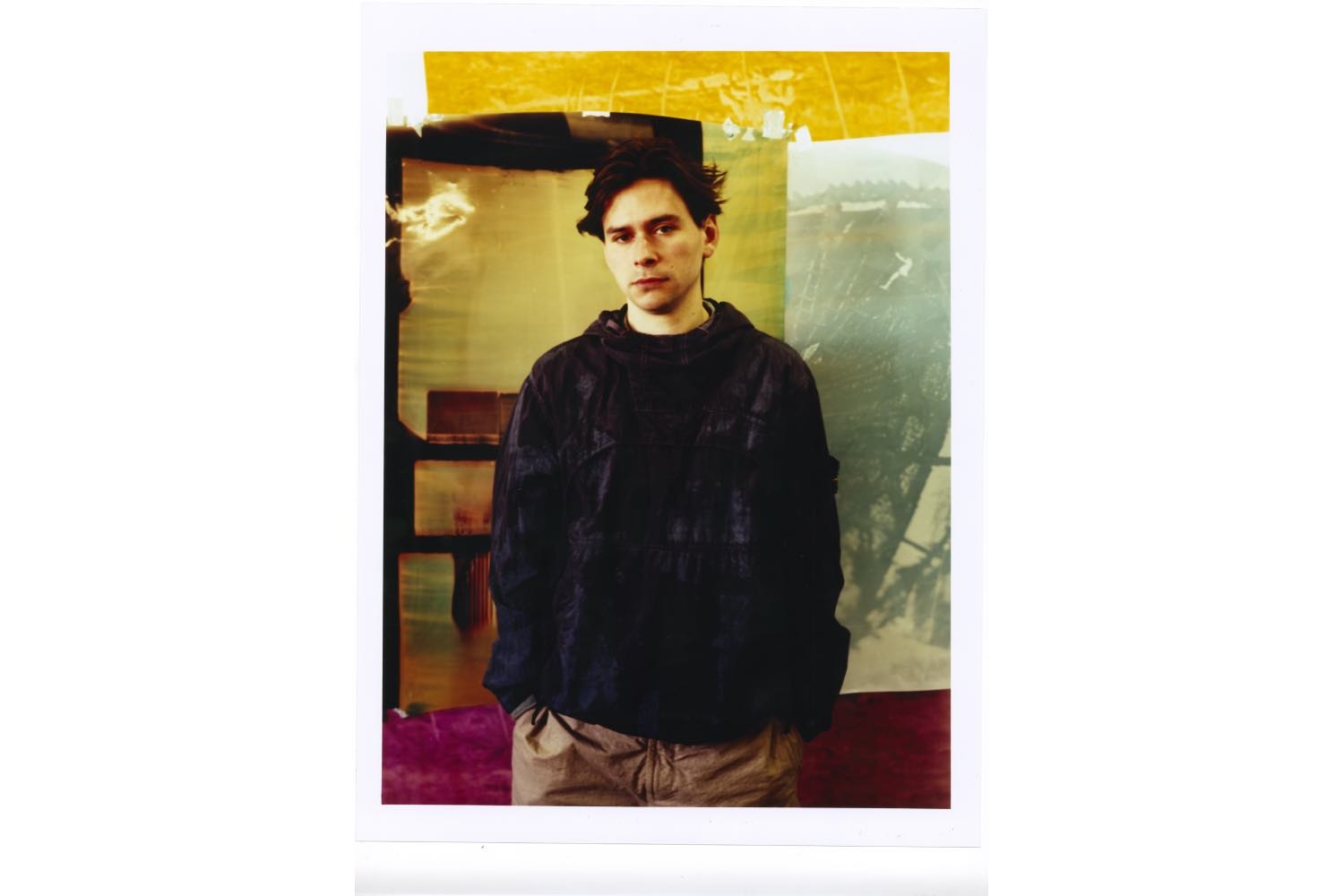

We sat down with Gina Buenfeld-Murley, the exhibition's curator at Camden Art Centre, who had the privilege of working with Nat Faulkner on his current exhibition, Strong Water. We discussed what these “landscapes of work” reveal beneath the surface.
When I first encountered Nat Faulkner’s work, it immediately reminded me of my own artistic journey and photographic experiments during my Fine Art Photography studies at the University of the Arts. His approach to photography has reawakened the same passion and curiosity I once felt for the potential of the image, particularly when pushing the material’s boundaries and sculpting with photographs in the 3D workshop. Faulkner’s work moves, like water, through different material states — shifting between photographs and sculptural objects — constantly on the verge of transformation. Looking at his works, I perceive a micro-world, almost a landscape in itself.
Thinking of one of my favourite books, Anima on Photo: The Hidden Sense of Japanese Photography by Shigeo Goto and Chihiro Minato, a landscape is understood in the Western sense as something distant and observed from afar, rather than something alive and connected. In Japanese thought, the word for landscape, fukei, suggests “wind scenery” — the universal flow and movement of all things. Similarly, Faulkner's works are not mere images to be viewed; they feel like environments shaped by flow, tension, and time. Each piece embodies a shifting terrain, connecting material, memory, and transformation.
What is the meaning of Strong Water?
Strong Water is derived from the Latin term aquafortis, which is the name of nitric acid. So it's a very, very old term and a kind of arcane reference. Nitric acid can dissolve other metals, making it an extremely strong, highly potent substance. I think the title holds something quite benign. You think of water — it’s a very everyday, harmless substance — but it also has this charge. It's a strong substance as well. That sort of dual meaning really charges the exhibition.
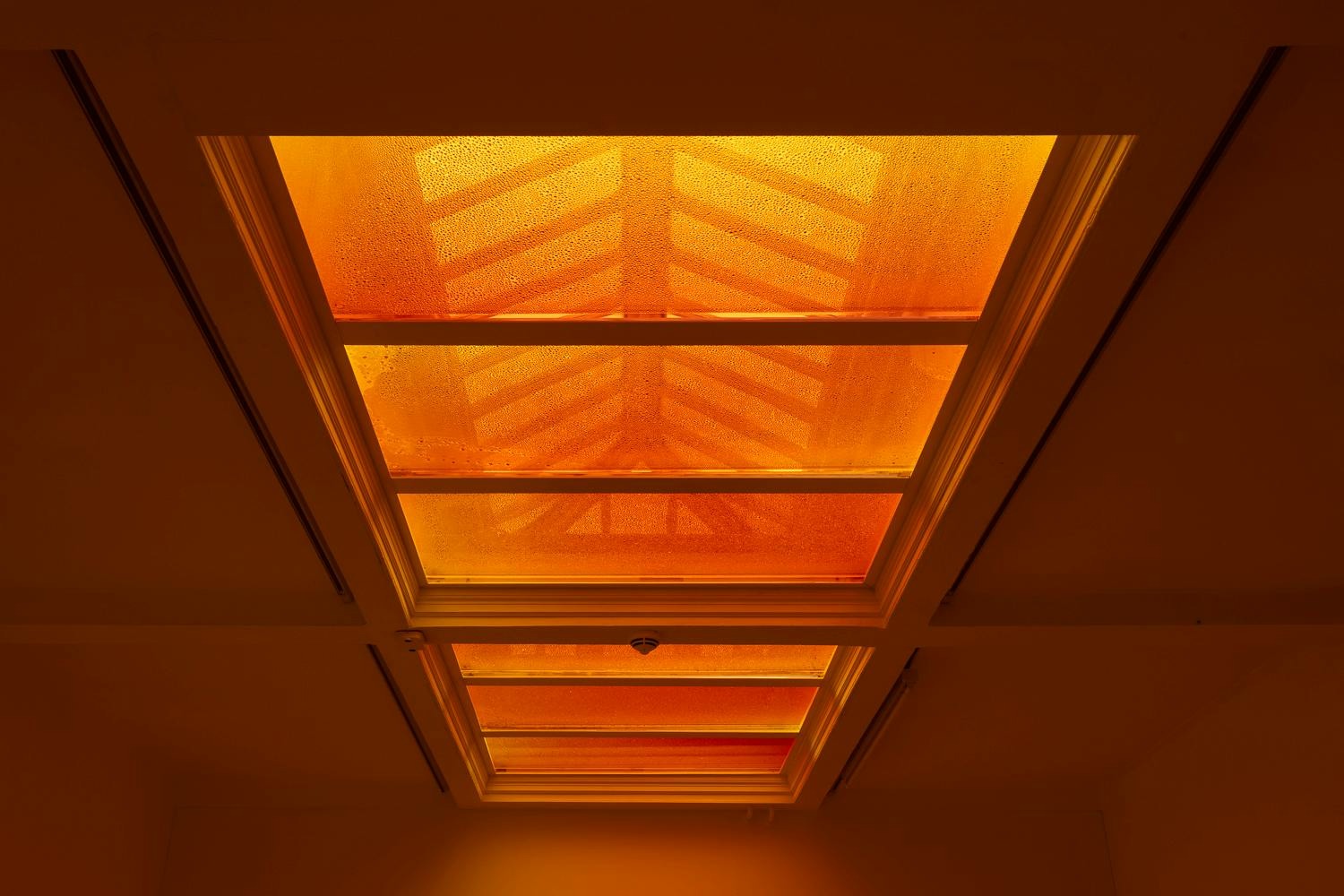
Water is also an important substance to Nat. He uses it in all of the processes in his work, whether that's electroplating the metal, frottage rubbings, processing the photographs — which is an analogue process that he does himself in his studio — or the iodine light boxes, the kind of vessels that are bathing the first space in the exhibition with an orange light. An iodine solution is diluted in water, so it's a substance that he's always working with, and it's obviously a substance that transforms dramatically if you think about the precipitation cycle.
It moves across vast distances and goes through states — from ice, when it's frozen, to rain, when it's precipitating from the sky. It evaporates, condenses, and returns to larger bodies of water.
His work seems to linger at the brink of transformation. What attracts him to that unstable moment?
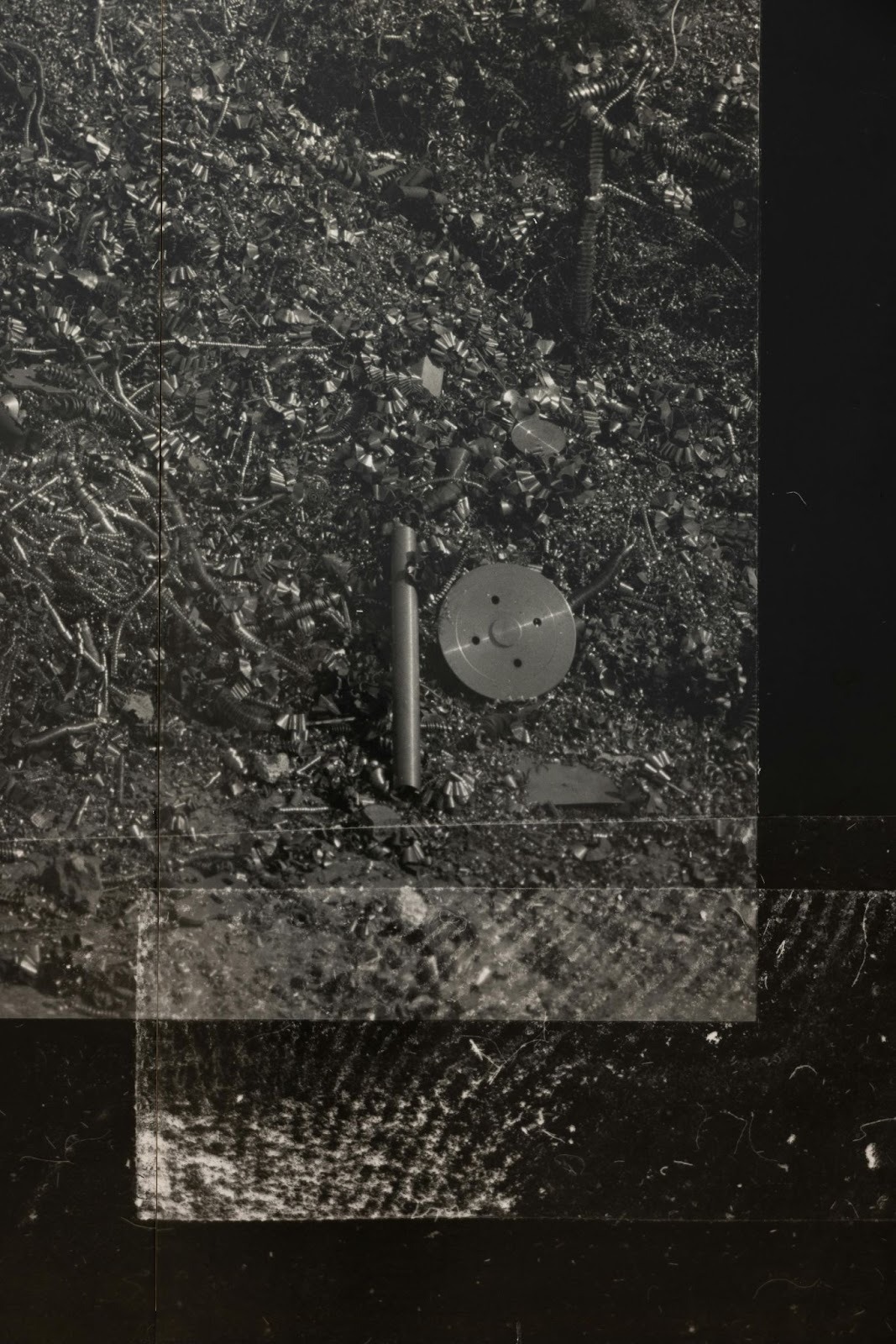
I think he's fascinated with state changes and transformation. Metal features throughout this exhibition, both as a substance and as a material. We're sitting next to this vast photograph, taken in eight panels. The material is a silver gelatin print, so what you're looking at is silver on the surface of the paper, and the subject is also metal.
From a distance, it looks like an abstract mound of material, sort of an undisclosed material. It could be something organic, like a pile of cut grass. When you approach it, you see it's shredded metal — metal in the process of being recycled and will turn into something else. Nat is really interested in the potential of materials that change from one state to another.
Thinking of the silver from NHS X-rays, what does “memory” mean in his work?
I think it's a broader inquiry, perhaps philosophical or even metaphysical. I wouldn’t go so far as to call it an animist approach, thinking that everything is alive and materials also have a life, but very much that materials, when they go through these state changes, have a kind of biography. They have a life; they move through different stages and maybe carry something with them — a kind of memory.
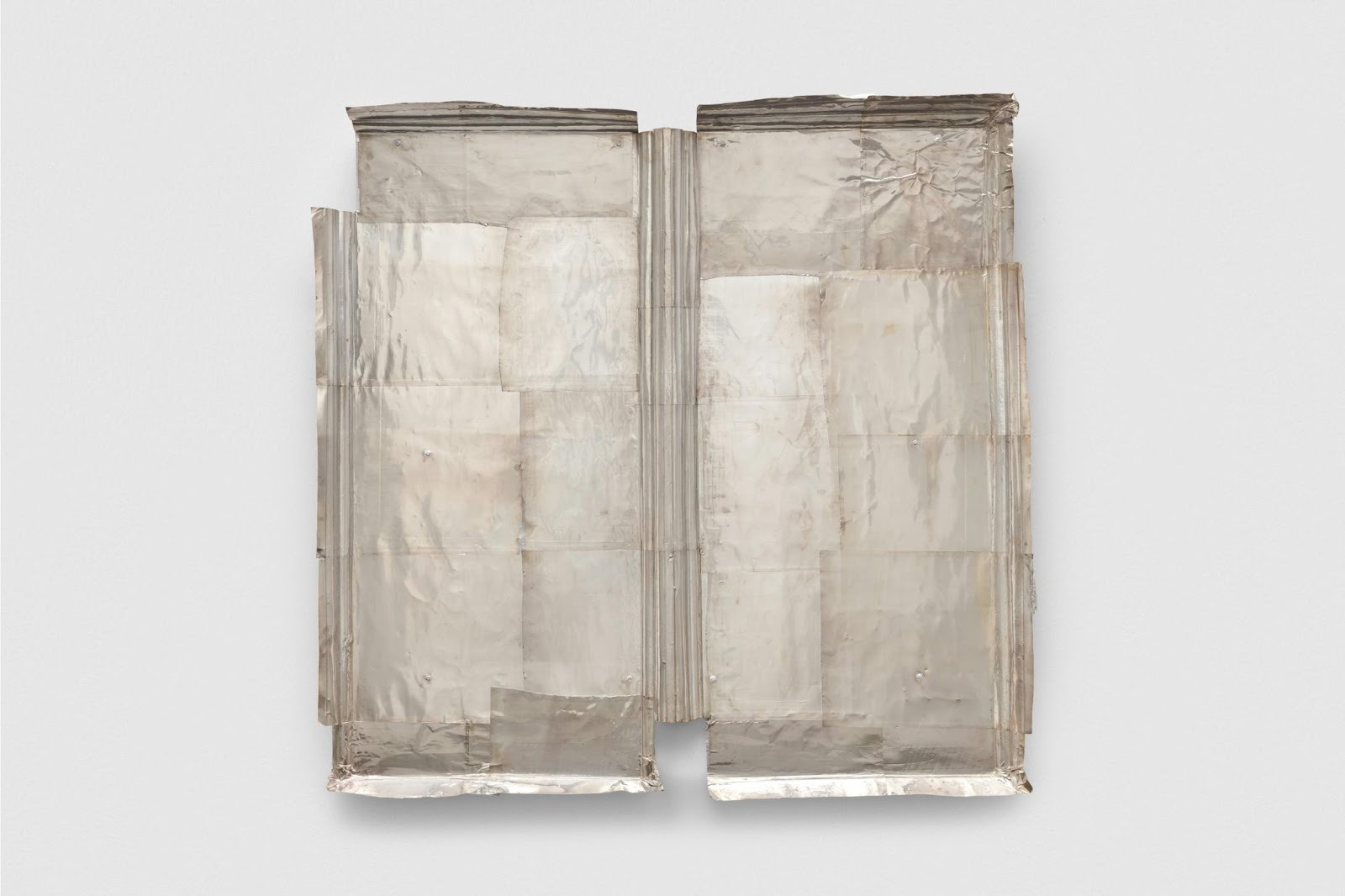
What is interesting about the X-ray process is that it images what you can't see inside your body. It's a kind of hermetic or occult realm. If we think about photography, which is the core of Nat's work, he departs from it in different ways. We often think of photography as providing images, but much of Nat's work is not interested in the image. It's interested in the mechanics, apparatus, and processes of photography. So, really honing in on the material itself — the silver — and thinking about how it can carry this prior life. The materials and sculptures that we're sitting around have a kind of afterlife of that earlier imaging process.
I studied photography at university. When I saw his work, it reminded me of why I fell in love with photography. There is so much more going on behind the use of photography. I remember reading Jane Bennett's book Vibrant Matter. It talks a lot about what you just said: matter and materials are not just static objects; they have living systems. They have a memory, a biography; they transform. I found it so fascinating how Nat works with images — not just images — images are just the starting point. It feels like everything is sort of alive when I look at his work, especially knowing what lurks behind his images.
Yeah, those ideas are really relevant to Nat’s practice. He talks a lot about vitality, especially in materials. That speaks to the sense in which they have their own life. There’s an energy that charges them; they can change state, transform, and there’s definitely something alive in them. That’s what he’s drawn to.
His research moves between darkrooms, scrap yards, chemical processes and studio surfaces. At what point does research itself become the work?
Nat is an avid reader. When I visited his studio, I was struck by his collection of books — an amazing library of reference material. He's a deep thinker, which is very apparent in the exhibition. It’s a conceptual practice with a very generous and elegant materiality. Formally, it manifests in the exhibition, but it’s deeply embedded in metaphysical and philosophical thinking. There are through-lines woven throughout the exhibition; you don’t need to know them to appreciate the work, but if you spend time with it, you can see it’s been carefully conceived. Each work is a microcosm.
Ideas around photography run through the exhibition. In the first room, iodine — a light-sensitive substance used in X-ray processes and daguerreotypes — is present. The image at the end of the gallery, a moth, is a tangential meditation on photography. It’s often cited in discussions of natural selection. During the Industrial Revolution, the white variant became less common while the black variant survived because it was better camouflaged. This change from light to dark is an analogue for photography, like the frottages — they’re imprints, not the thing itself.
Nat’s research is deeply material. Everything has been touched by his hand; he produces everything himself. His intimacy with materials allows him to understand their behaviour and properties. There are moments of crystallisation, where vast amounts of labour condense into a single moment — like exposing a photograph. He sets parameters and then lets the work unfold; it’s a process of discovery.
In a time saturated with digital images, why does his material approach matter, and how is it actively reshaping the conversation around photography today?
Yeah, in an age oversaturated with digital imagery, where everyone can be a photographer, there’s a certain fatigue from continually looking without understanding why or what it means. His practice looks back to the beginnings of photography. He’s naturally drawn to analogue processes rather than digital, though it’s not decisive — it’s just something he leans into because there’s more mystery, a greater sense of discovery inherent in a darkroom practice. Photography is a subject he explores in different ways, not just through images, but through the apparatus and approach to materials. It’s a visual practice that asks us to slow down. It’s extremely meditative and poetic, a kind of antidote to the fast pace of digital imagery. I’ve been thinking a lot about premodern images and how they communicate the consciousness of their time. Nat’s work is situated in this kind of thinking — it extends beyond what is depicted into a deeper inquiry into the nature of being.
If you could recommend another art space for me to visit, what would it be?
There’s a community of young, emerging galleries that is very collegiate, doing important work. I’m thinking about A Squire, Nat’s Gallery, Brunette Coleman, Ginny on Frederick, and, close to here, Palmer Gallery. This community of young galleries is making great programs happen and supporting young artists. I would recommend all four of these galleries.

We sat down with Gina Buenfeld-Murley, the exhibition's curator at Camden Art Centre, who had the privilege of working with Nat Faulkner on his current exhibition, Strong Water. We discussed what these “landscapes of work” reveal beneath the surface.
When I first encountered Nat Faulkner’s work, it immediately reminded me of my own artistic journey and photographic experiments during my Fine Art Photography studies at the University of the Arts. His approach to photography has reawakened the same passion and curiosity I once felt for the potential of the image, particularly when pushing the material’s boundaries and sculpting with photographs in the 3D workshop. Faulkner’s work moves, like water, through different material states — shifting between photographs and sculptural objects — constantly on the verge of transformation. Looking at his works, I perceive a micro-world, almost a landscape in itself.
Thinking of one of my favourite books, Anima on Photo: The Hidden Sense of Japanese Photography by Shigeo Goto and Chihiro Minato, a landscape is understood in the Western sense as something distant and observed from afar, rather than something alive and connected. In Japanese thought, the word for landscape, fukei, suggests “wind scenery” — the universal flow and movement of all things. Similarly, Faulkner's works are not mere images to be viewed; they feel like environments shaped by flow, tension, and time. Each piece embodies a shifting terrain, connecting material, memory, and transformation.

What is the meaning of Strong Water?
Strong Water is derived from the Latin term aquafortis, which is the name of nitric acid. So it's a very, very old term and a kind of arcane reference. Nitric acid can dissolve other metals, making it an extremely strong, highly potent substance. I think the title holds something quite benign. You think of water — it’s a very everyday, harmless substance — but it also has this charge. It's a strong substance as well. That sort of dual meaning really charges the exhibition.
Water is also an important substance to Nat. He uses it in all of the processes in his work, whether that's electroplating the metal, frottage rubbings, processing the photographs — which is an analogue process that he does himself in his studio — or the iodine light boxes, the kind of vessels that are bathing the first space in the exhibition with an orange light. An iodine solution is diluted in water, so it's a substance that he's always working with, and it's obviously a substance that transforms dramatically if you think about the precipitation cycle.
It moves across vast distances and goes through states — from ice, when it's frozen, to rain, when it's precipitating from the sky. It evaporates, condenses, and returns to larger bodies of water.

His work seems to linger at the brink of transformation. What attracts him to that unstable moment?
I think he's fascinated with state changes and transformation. Metal features throughout this exhibition, both as a substance and as a material. We're sitting next to this vast photograph, taken in eight panels. The material is a silver gelatin print, so what you're looking at is silver on the surface of the paper, and the subject is also metal.
From a distance, it looks like an abstract mound of material, sort of an undisclosed material. It could be something organic, like a pile of cut grass. When you approach it, you see it's shredded metal — metal in the process of being recycled and will turn into something else. Nat is really interested in the potential of materials that change from one state to another.

Thinking of the silver from NHS X-rays, what does “memory” mean in his work?
I think it's a broader inquiry, perhaps philosophical or even metaphysical. I wouldn’t go so far as to call it an animist approach, thinking that everything is alive and materials also have a life, but very much that materials, when they go through these state changes, have a kind of biography. They have a life; they move through different stages and maybe carry something with them — a kind of memory.
What is interesting about the X-ray process is that it images what you can't see inside your body. It's a kind of hermetic or occult realm. If we think about photography, which is the core of Nat's work, he departs from it in different ways. We often think of photography as providing images, but much of Nat's work is not interested in the image. It's interested in the mechanics, apparatus, and processes of photography. So, really honing in on the material itself — the silver — and thinking about how it can carry this prior life. The materials and sculptures that we're sitting around have a kind of afterlife of that earlier imaging process.

I studied photography at university. When I saw his work, it reminded me of why I fell in love with photography. There is so much more going on behind the use of photography. I remember reading Jane Bennett's book Vibrant Matter. It talks a lot about what you just said: matter and materials are not just static objects; they have living systems. They have a memory, a biography; they transform. I found it so fascinating how Nat works with images — not just images — images are just the starting point. It feels like everything is sort of alive when I look at his work, especially knowing what lurks behind his images.
Yeah, those ideas are really relevant to Nat’s practice. He talks a lot about vitality, especially in materials. That speaks to the sense in which they have their own life. There’s an energy that charges them; they can change state, transform, and there’s definitely something alive in them. That’s what he’s drawn to.

His research moves between darkrooms, scrap yards, chemical processes and studio surfaces. At what point does research itself become the work?
Nat is an avid reader. When I visited his studio, I was struck by his collection of books — an amazing library of reference material. He's a deep thinker, which is very apparent in the exhibition. It’s a conceptual practice with a very generous and elegant materiality. Formally, it manifests in the exhibition, but it’s deeply embedded in metaphysical and philosophical thinking. There are through-lines woven throughout the exhibition; you don’t need to know them to appreciate the work, but if you spend time with it, you can see it’s been carefully conceived. Each work is a microcosm.
Ideas around photography run through the exhibition. In the first room, iodine — a light-sensitive substance used in X-ray processes and daguerreotypes — is present. The image at the end of the gallery, a moth, is a tangential meditation on photography. It’s often cited in discussions of natural selection. During the Industrial Revolution, the white variant became less common while the black variant survived because it was better camouflaged. This change from light to dark is an analogue for photography, like the frottages — they’re imprints, not the thing itself.
Nat’s research is deeply material. Everything has been touched by his hand; he produces everything himself. His intimacy with materials allows him to understand their behaviour and properties. There are moments of crystallisation, where vast amounts of labour condense into a single moment — like exposing a photograph. He sets parameters and then lets the work unfold; it’s a process of discovery.

In a time saturated with digital images, why does his material approach matter, and how is it actively reshaping the conversation around photography today?
Yeah, in an age oversaturated with digital imagery, where everyone can be a photographer, there’s a certain fatigue from continually looking without understanding why or what it means. His practice looks back to the beginnings of photography. He’s naturally drawn to analogue processes rather than digital, though it’s not decisive — it’s just something he leans into because there’s more mystery, a greater sense of discovery inherent in a darkroom practice. Photography is a subject he explores in different ways, not just through images, but through the apparatus and approach to materials. It’s a visual practice that asks us to slow down. It’s extremely meditative and poetic, a kind of antidote to the fast pace of digital imagery. I’ve been thinking a lot about premodern images and how they communicate the consciousness of their time. Nat’s work is situated in this kind of thinking — it extends beyond what is depicted into a deeper inquiry into the nature of being.
If you could recommend another art space for me to visit, what would it be?
There’s a community of young, emerging galleries that is very collegiate, doing important work. I’m thinking about A Squire, Nat’s Gallery, Brunette Coleman, Ginny on Frederick, and, close to here, Palmer Gallery. This community of young galleries is making great programs happen and supporting young artists. I would recommend all four of these galleries.

We sat down with Gina Buenfeld-Murley, the exhibition's curator at Camden Art Centre, who had the privilege of working with Nat Faulkner on his current exhibition, Strong Water. We discussed what these “landscapes of work” reveal beneath the surface.
When I first encountered Nat Faulkner’s work, it immediately reminded me of my own artistic journey and photographic experiments during my Fine Art Photography studies at the University of the Arts. His approach to photography has reawakened the same passion and curiosity I once felt for the potential of the image, particularly when pushing the material’s boundaries and sculpting with photographs in the 3D workshop. Faulkner’s work moves, like water, through different material states — shifting between photographs and sculptural objects — constantly on the verge of transformation. Looking at his works, I perceive a micro-world, almost a landscape in itself.
Thinking of one of my favourite books, Anima on Photo: The Hidden Sense of Japanese Photography by Shigeo Goto and Chihiro Minato, a landscape is understood in the Western sense as something distant and observed from afar, rather than something alive and connected. In Japanese thought, the word for landscape, fukei, suggests “wind scenery” — the universal flow and movement of all things. Similarly, Faulkner's works are not mere images to be viewed; they feel like environments shaped by flow, tension, and time. Each piece embodies a shifting terrain, connecting material, memory, and transformation.

What is the meaning of Strong Water?
Strong Water is derived from the Latin term aquafortis, which is the name of nitric acid. So it's a very, very old term and a kind of arcane reference. Nitric acid can dissolve other metals, making it an extremely strong, highly potent substance. I think the title holds something quite benign. You think of water — it’s a very everyday, harmless substance — but it also has this charge. It's a strong substance as well. That sort of dual meaning really charges the exhibition.
Water is also an important substance to Nat. He uses it in all of the processes in his work, whether that's electroplating the metal, frottage rubbings, processing the photographs — which is an analogue process that he does himself in his studio — or the iodine light boxes, the kind of vessels that are bathing the first space in the exhibition with an orange light. An iodine solution is diluted in water, so it's a substance that he's always working with, and it's obviously a substance that transforms dramatically if you think about the precipitation cycle.
It moves across vast distances and goes through states — from ice, when it's frozen, to rain, when it's precipitating from the sky. It evaporates, condenses, and returns to larger bodies of water.

His work seems to linger at the brink of transformation. What attracts him to that unstable moment?
I think he's fascinated with state changes and transformation. Metal features throughout this exhibition, both as a substance and as a material. We're sitting next to this vast photograph, taken in eight panels. The material is a silver gelatin print, so what you're looking at is silver on the surface of the paper, and the subject is also metal.
From a distance, it looks like an abstract mound of material, sort of an undisclosed material. It could be something organic, like a pile of cut grass. When you approach it, you see it's shredded metal — metal in the process of being recycled and will turn into something else. Nat is really interested in the potential of materials that change from one state to another.

Thinking of the silver from NHS X-rays, what does “memory” mean in his work?
I think it's a broader inquiry, perhaps philosophical or even metaphysical. I wouldn’t go so far as to call it an animist approach, thinking that everything is alive and materials also have a life, but very much that materials, when they go through these state changes, have a kind of biography. They have a life; they move through different stages and maybe carry something with them — a kind of memory.
What is interesting about the X-ray process is that it images what you can't see inside your body. It's a kind of hermetic or occult realm. If we think about photography, which is the core of Nat's work, he departs from it in different ways. We often think of photography as providing images, but much of Nat's work is not interested in the image. It's interested in the mechanics, apparatus, and processes of photography. So, really honing in on the material itself — the silver — and thinking about how it can carry this prior life. The materials and sculptures that we're sitting around have a kind of afterlife of that earlier imaging process.

I studied photography at university. When I saw his work, it reminded me of why I fell in love with photography. There is so much more going on behind the use of photography. I remember reading Jane Bennett's book Vibrant Matter. It talks a lot about what you just said: matter and materials are not just static objects; they have living systems. They have a memory, a biography; they transform. I found it so fascinating how Nat works with images — not just images — images are just the starting point. It feels like everything is sort of alive when I look at his work, especially knowing what lurks behind his images.
Yeah, those ideas are really relevant to Nat’s practice. He talks a lot about vitality, especially in materials. That speaks to the sense in which they have their own life. There’s an energy that charges them; they can change state, transform, and there’s definitely something alive in them. That’s what he’s drawn to.

His research moves between darkrooms, scrap yards, chemical processes and studio surfaces. At what point does research itself become the work?
Nat is an avid reader. When I visited his studio, I was struck by his collection of books — an amazing library of reference material. He's a deep thinker, which is very apparent in the exhibition. It’s a conceptual practice with a very generous and elegant materiality. Formally, it manifests in the exhibition, but it’s deeply embedded in metaphysical and philosophical thinking. There are through-lines woven throughout the exhibition; you don’t need to know them to appreciate the work, but if you spend time with it, you can see it’s been carefully conceived. Each work is a microcosm.
Ideas around photography run through the exhibition. In the first room, iodine — a light-sensitive substance used in X-ray processes and daguerreotypes — is present. The image at the end of the gallery, a moth, is a tangential meditation on photography. It’s often cited in discussions of natural selection. During the Industrial Revolution, the white variant became less common while the black variant survived because it was better camouflaged. This change from light to dark is an analogue for photography, like the frottages — they’re imprints, not the thing itself.
Nat’s research is deeply material. Everything has been touched by his hand; he produces everything himself. His intimacy with materials allows him to understand their behaviour and properties. There are moments of crystallisation, where vast amounts of labour condense into a single moment — like exposing a photograph. He sets parameters and then lets the work unfold; it’s a process of discovery.

In a time saturated with digital images, why does his material approach matter, and how is it actively reshaping the conversation around photography today?
Yeah, in an age oversaturated with digital imagery, where everyone can be a photographer, there’s a certain fatigue from continually looking without understanding why or what it means. His practice looks back to the beginnings of photography. He’s naturally drawn to analogue processes rather than digital, though it’s not decisive — it’s just something he leans into because there’s more mystery, a greater sense of discovery inherent in a darkroom practice. Photography is a subject he explores in different ways, not just through images, but through the apparatus and approach to materials. It’s a visual practice that asks us to slow down. It’s extremely meditative and poetic, a kind of antidote to the fast pace of digital imagery. I’ve been thinking a lot about premodern images and how they communicate the consciousness of their time. Nat’s work is situated in this kind of thinking — it extends beyond what is depicted into a deeper inquiry into the nature of being.
If you could recommend another art space for me to visit, what would it be?
There’s a community of young, emerging galleries that is very collegiate, doing important work. I’m thinking about A Squire, Nat’s Gallery, Brunette Coleman, Ginny on Frederick, and, close to here, Palmer Gallery. This community of young galleries is making great programs happen and supporting young artists. I would recommend all four of these galleries.

We sat down with Gina Buenfeld-Murley, the exhibition's curator at Camden Art Centre, who had the privilege of working with Nat Faulkner on his current exhibition, Strong Water. We discussed what these “landscapes of work” reveal beneath the surface.
When I first encountered Nat Faulkner’s work, it immediately reminded me of my own artistic journey and photographic experiments during my Fine Art Photography studies at the University of the Arts. His approach to photography has reawakened the same passion and curiosity I once felt for the potential of the image, particularly when pushing the material’s boundaries and sculpting with photographs in the 3D workshop. Faulkner’s work moves, like water, through different material states — shifting between photographs and sculptural objects — constantly on the verge of transformation. Looking at his works, I perceive a micro-world, almost a landscape in itself.
Thinking of one of my favourite books, Anima on Photo: The Hidden Sense of Japanese Photography by Shigeo Goto and Chihiro Minato, a landscape is understood in the Western sense as something distant and observed from afar, rather than something alive and connected. In Japanese thought, the word for landscape, fukei, suggests “wind scenery” — the universal flow and movement of all things. Similarly, Faulkner's works are not mere images to be viewed; they feel like environments shaped by flow, tension, and time. Each piece embodies a shifting terrain, connecting material, memory, and transformation.

What is the meaning of Strong Water?
Strong Water is derived from the Latin term aquafortis, which is the name of nitric acid. So it's a very, very old term and a kind of arcane reference. Nitric acid can dissolve other metals, making it an extremely strong, highly potent substance. I think the title holds something quite benign. You think of water — it’s a very everyday, harmless substance — but it also has this charge. It's a strong substance as well. That sort of dual meaning really charges the exhibition.
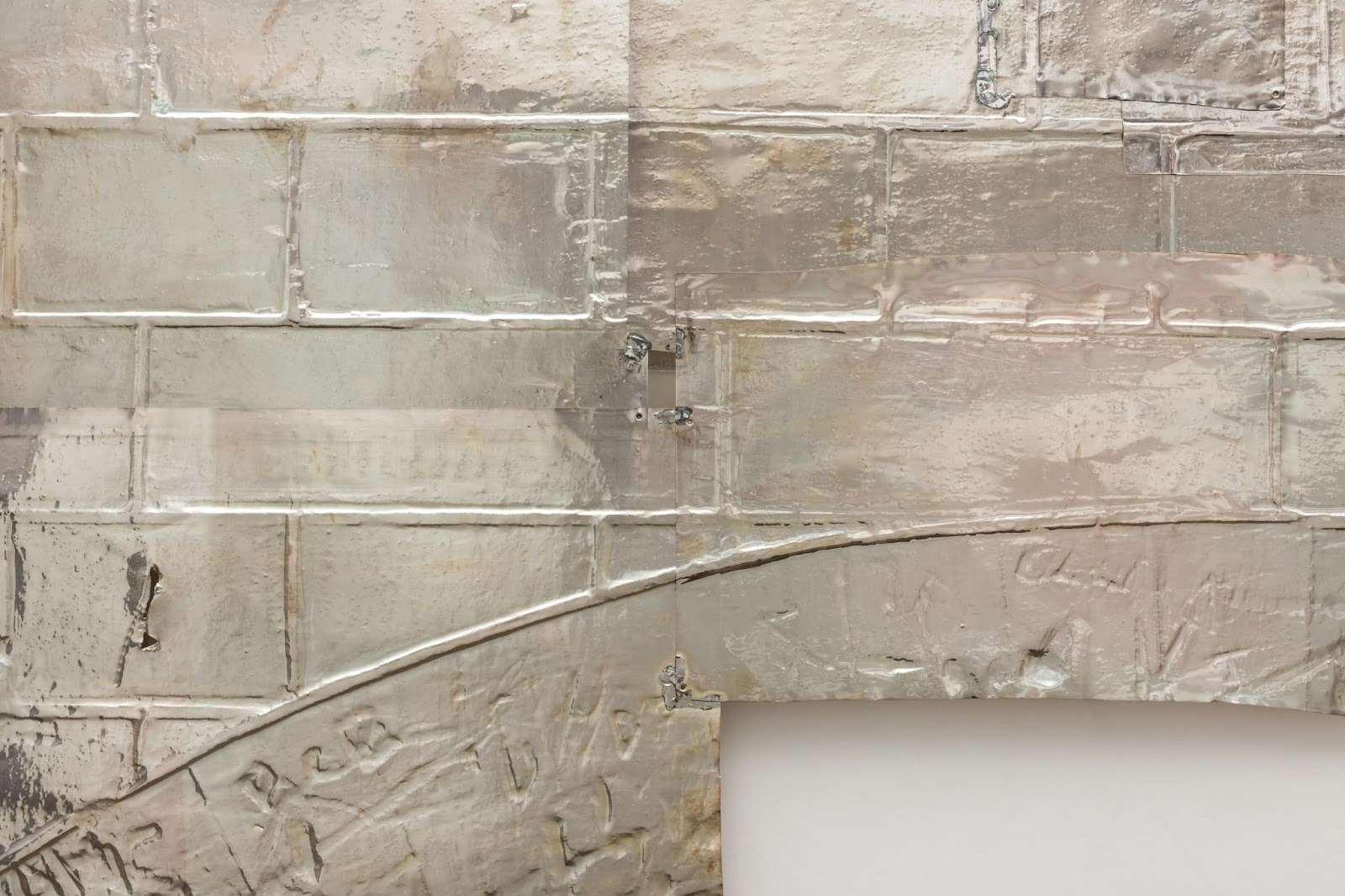
Water is also an important substance to Nat. He uses it in all of the processes in his work, whether that's electroplating the metal, frottage rubbings, processing the photographs — which is an analogue process that he does himself in his studio — or the iodine light boxes, the kind of vessels that are bathing the first space in the exhibition with an orange light. An iodine solution is diluted in water, so it's a substance that he's always working with, and it's obviously a substance that transforms dramatically if you think about the precipitation cycle.
It moves across vast distances and goes through states — from ice, when it's frozen, to rain, when it's precipitating from the sky. It evaporates, condenses, and returns to larger bodies of water.

His work seems to linger at the brink of transformation. What attracts him to that unstable moment?
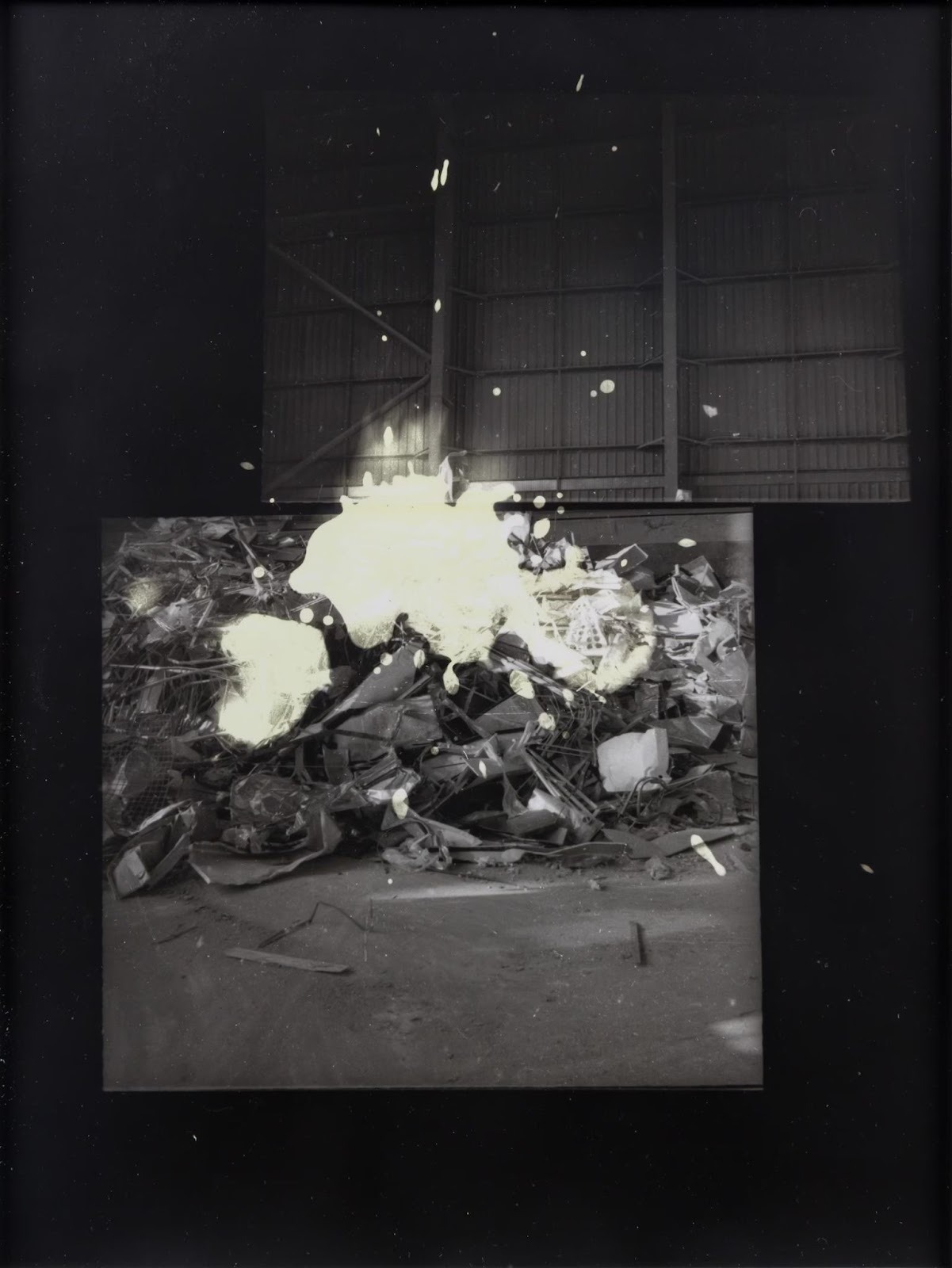
I think he's fascinated with state changes and transformation. Metal features throughout this exhibition, both as a substance and as a material. We're sitting next to this vast photograph, taken in eight panels. The material is a silver gelatin print, so what you're looking at is silver on the surface of the paper, and the subject is also metal.
From a distance, it looks like an abstract mound of material, sort of an undisclosed material. It could be something organic, like a pile of cut grass. When you approach it, you see it's shredded metal — metal in the process of being recycled and will turn into something else. Nat is really interested in the potential of materials that change from one state to another.

Thinking of the silver from NHS X-rays, what does “memory” mean in his work?
I think it's a broader inquiry, perhaps philosophical or even metaphysical. I wouldn’t go so far as to call it an animist approach, thinking that everything is alive and materials also have a life, but very much that materials, when they go through these state changes, have a kind of biography. They have a life; they move through different stages and maybe carry something with them — a kind of memory.
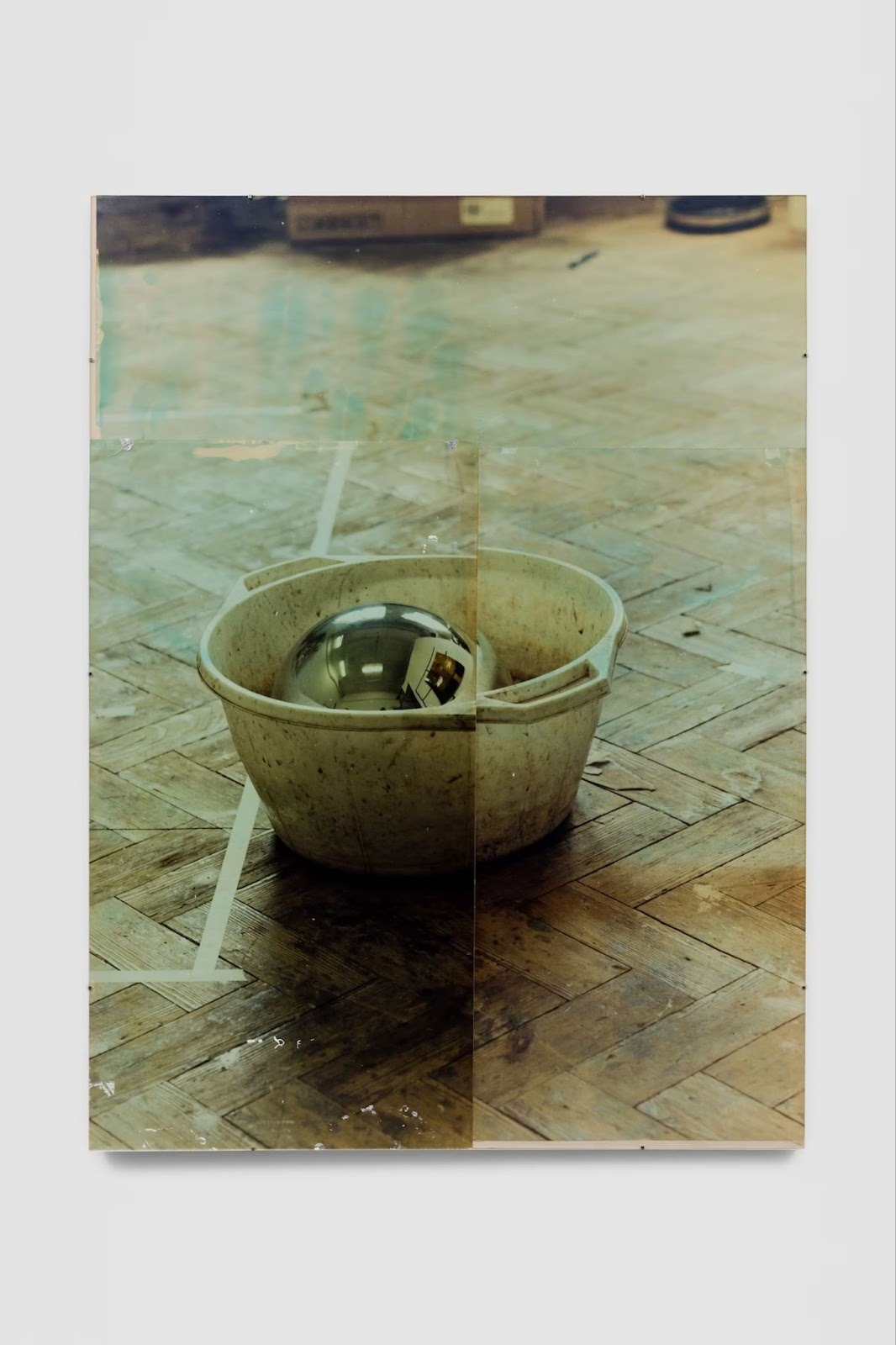
What is interesting about the X-ray process is that it images what you can't see inside your body. It's a kind of hermetic or occult realm. If we think about photography, which is the core of Nat's work, he departs from it in different ways. We often think of photography as providing images, but much of Nat's work is not interested in the image. It's interested in the mechanics, apparatus, and processes of photography. So, really honing in on the material itself — the silver — and thinking about how it can carry this prior life. The materials and sculptures that we're sitting around have a kind of afterlife of that earlier imaging process.

I studied photography at university. When I saw his work, it reminded me of why I fell in love with photography. There is so much more going on behind the use of photography. I remember reading Jane Bennett's book Vibrant Matter. It talks a lot about what you just said: matter and materials are not just static objects; they have living systems. They have a memory, a biography; they transform. I found it so fascinating how Nat works with images — not just images — images are just the starting point. It feels like everything is sort of alive when I look at his work, especially knowing what lurks behind his images.
Yeah, those ideas are really relevant to Nat’s practice. He talks a lot about vitality, especially in materials. That speaks to the sense in which they have their own life. There’s an energy that charges them; they can change state, transform, and there’s definitely something alive in them. That’s what he’s drawn to.

His research moves between darkrooms, scrap yards, chemical processes and studio surfaces. At what point does research itself become the work?
Nat is an avid reader. When I visited his studio, I was struck by his collection of books — an amazing library of reference material. He's a deep thinker, which is very apparent in the exhibition. It’s a conceptual practice with a very generous and elegant materiality. Formally, it manifests in the exhibition, but it’s deeply embedded in metaphysical and philosophical thinking. There are through-lines woven throughout the exhibition; you don’t need to know them to appreciate the work, but if you spend time with it, you can see it’s been carefully conceived. Each work is a microcosm.
Ideas around photography run through the exhibition. In the first room, iodine — a light-sensitive substance used in X-ray processes and daguerreotypes — is present. The image at the end of the gallery, a moth, is a tangential meditation on photography. It’s often cited in discussions of natural selection. During the Industrial Revolution, the white variant became less common while the black variant survived because it was better camouflaged. This change from light to dark is an analogue for photography, like the frottages — they’re imprints, not the thing itself.
Nat’s research is deeply material. Everything has been touched by his hand; he produces everything himself. His intimacy with materials allows him to understand their behaviour and properties. There are moments of crystallisation, where vast amounts of labour condense into a single moment — like exposing a photograph. He sets parameters and then lets the work unfold; it’s a process of discovery.

In a time saturated with digital images, why does his material approach matter, and how is it actively reshaping the conversation around photography today?
Yeah, in an age oversaturated with digital imagery, where everyone can be a photographer, there’s a certain fatigue from continually looking without understanding why or what it means. His practice looks back to the beginnings of photography. He’s naturally drawn to analogue processes rather than digital, though it’s not decisive — it’s just something he leans into because there’s more mystery, a greater sense of discovery inherent in a darkroom practice. Photography is a subject he explores in different ways, not just through images, but through the apparatus and approach to materials. It’s a visual practice that asks us to slow down. It’s extremely meditative and poetic, a kind of antidote to the fast pace of digital imagery. I’ve been thinking a lot about premodern images and how they communicate the consciousness of their time. Nat’s work is situated in this kind of thinking — it extends beyond what is depicted into a deeper inquiry into the nature of being.
If you could recommend another art space for me to visit, what would it be?
There’s a community of young, emerging galleries that is very collegiate, doing important work. I’m thinking about A Squire, Nat’s Gallery, Brunette Coleman, Ginny on Frederick, and, close to here, Palmer Gallery. This community of young galleries is making great programs happen and supporting young artists. I would recommend all four of these galleries.

We sat down with Gina Buenfeld-Murley, the exhibition's curator at Camden Art Centre, who had the privilege of working with Nat Faulkner on his current exhibition, Strong Water. We discussed what these “landscapes of work” reveal beneath the surface.
When I first encountered Nat Faulkner’s work, it immediately reminded me of my own artistic journey and photographic experiments during my Fine Art Photography studies at the University of the Arts. His approach to photography has reawakened the same passion and curiosity I once felt for the potential of the image, particularly when pushing the material’s boundaries and sculpting with photographs in the 3D workshop. Faulkner’s work moves, like water, through different material states — shifting between photographs and sculptural objects — constantly on the verge of transformation. Looking at his works, I perceive a micro-world, almost a landscape in itself.
Thinking of one of my favourite books, Anima on Photo: The Hidden Sense of Japanese Photography by Shigeo Goto and Chihiro Minato, a landscape is understood in the Western sense as something distant and observed from afar, rather than something alive and connected. In Japanese thought, the word for landscape, fukei, suggests “wind scenery” — the universal flow and movement of all things. Similarly, Faulkner's works are not mere images to be viewed; they feel like environments shaped by flow, tension, and time. Each piece embodies a shifting terrain, connecting material, memory, and transformation.

What is the meaning of Strong Water?
Strong Water is derived from the Latin term aquafortis, which is the name of nitric acid. So it's a very, very old term and a kind of arcane reference. Nitric acid can dissolve other metals, making it an extremely strong, highly potent substance. I think the title holds something quite benign. You think of water — it’s a very everyday, harmless substance — but it also has this charge. It's a strong substance as well. That sort of dual meaning really charges the exhibition.
Water is also an important substance to Nat. He uses it in all of the processes in his work, whether that's electroplating the metal, frottage rubbings, processing the photographs — which is an analogue process that he does himself in his studio — or the iodine light boxes, the kind of vessels that are bathing the first space in the exhibition with an orange light. An iodine solution is diluted in water, so it's a substance that he's always working with, and it's obviously a substance that transforms dramatically if you think about the precipitation cycle.
It moves across vast distances and goes through states — from ice, when it's frozen, to rain, when it's precipitating from the sky. It evaporates, condenses, and returns to larger bodies of water.

His work seems to linger at the brink of transformation. What attracts him to that unstable moment?
I think he's fascinated with state changes and transformation. Metal features throughout this exhibition, both as a substance and as a material. We're sitting next to this vast photograph, taken in eight panels. The material is a silver gelatin print, so what you're looking at is silver on the surface of the paper, and the subject is also metal.
From a distance, it looks like an abstract mound of material, sort of an undisclosed material. It could be something organic, like a pile of cut grass. When you approach it, you see it's shredded metal — metal in the process of being recycled and will turn into something else. Nat is really interested in the potential of materials that change from one state to another.

Thinking of the silver from NHS X-rays, what does “memory” mean in his work?
I think it's a broader inquiry, perhaps philosophical or even metaphysical. I wouldn’t go so far as to call it an animist approach, thinking that everything is alive and materials also have a life, but very much that materials, when they go through these state changes, have a kind of biography. They have a life; they move through different stages and maybe carry something with them — a kind of memory.
What is interesting about the X-ray process is that it images what you can't see inside your body. It's a kind of hermetic or occult realm. If we think about photography, which is the core of Nat's work, he departs from it in different ways. We often think of photography as providing images, but much of Nat's work is not interested in the image. It's interested in the mechanics, apparatus, and processes of photography. So, really honing in on the material itself — the silver — and thinking about how it can carry this prior life. The materials and sculptures that we're sitting around have a kind of afterlife of that earlier imaging process.

I studied photography at university. When I saw his work, it reminded me of why I fell in love with photography. There is so much more going on behind the use of photography. I remember reading Jane Bennett's book Vibrant Matter. It talks a lot about what you just said: matter and materials are not just static objects; they have living systems. They have a memory, a biography; they transform. I found it so fascinating how Nat works with images — not just images — images are just the starting point. It feels like everything is sort of alive when I look at his work, especially knowing what lurks behind his images.
Yeah, those ideas are really relevant to Nat’s practice. He talks a lot about vitality, especially in materials. That speaks to the sense in which they have their own life. There’s an energy that charges them; they can change state, transform, and there’s definitely something alive in them. That’s what he’s drawn to.

His research moves between darkrooms, scrap yards, chemical processes and studio surfaces. At what point does research itself become the work?
Nat is an avid reader. When I visited his studio, I was struck by his collection of books — an amazing library of reference material. He's a deep thinker, which is very apparent in the exhibition. It’s a conceptual practice with a very generous and elegant materiality. Formally, it manifests in the exhibition, but it’s deeply embedded in metaphysical and philosophical thinking. There are through-lines woven throughout the exhibition; you don’t need to know them to appreciate the work, but if you spend time with it, you can see it’s been carefully conceived. Each work is a microcosm.
Ideas around photography run through the exhibition. In the first room, iodine — a light-sensitive substance used in X-ray processes and daguerreotypes — is present. The image at the end of the gallery, a moth, is a tangential meditation on photography. It’s often cited in discussions of natural selection. During the Industrial Revolution, the white variant became less common while the black variant survived because it was better camouflaged. This change from light to dark is an analogue for photography, like the frottages — they’re imprints, not the thing itself.
Nat’s research is deeply material. Everything has been touched by his hand; he produces everything himself. His intimacy with materials allows him to understand their behaviour and properties. There are moments of crystallisation, where vast amounts of labour condense into a single moment — like exposing a photograph. He sets parameters and then lets the work unfold; it’s a process of discovery.

In a time saturated with digital images, why does his material approach matter, and how is it actively reshaping the conversation around photography today?
Yeah, in an age oversaturated with digital imagery, where everyone can be a photographer, there’s a certain fatigue from continually looking without understanding why or what it means. His practice looks back to the beginnings of photography. He’s naturally drawn to analogue processes rather than digital, though it’s not decisive — it’s just something he leans into because there’s more mystery, a greater sense of discovery inherent in a darkroom practice. Photography is a subject he explores in different ways, not just through images, but through the apparatus and approach to materials. It’s a visual practice that asks us to slow down. It’s extremely meditative and poetic, a kind of antidote to the fast pace of digital imagery. I’ve been thinking a lot about premodern images and how they communicate the consciousness of their time. Nat’s work is situated in this kind of thinking — it extends beyond what is depicted into a deeper inquiry into the nature of being.
If you could recommend another art space for me to visit, what would it be?
There’s a community of young, emerging galleries that is very collegiate, doing important work. I’m thinking about A Squire, Nat’s Gallery, Brunette Coleman, Ginny on Frederick, and, close to here, Palmer Gallery. This community of young galleries is making great programs happen and supporting young artists. I would recommend all four of these galleries.

We sat down with Gina Buenfeld-Murley, the exhibition's curator at Camden Art Centre, who had the privilege of working with Nat Faulkner on his current exhibition, Strong Water. We discussed what these “landscapes of work” reveal beneath the surface.
When I first encountered Nat Faulkner’s work, it immediately reminded me of my own artistic journey and photographic experiments during my Fine Art Photography studies at the University of the Arts. His approach to photography has reawakened the same passion and curiosity I once felt for the potential of the image, particularly when pushing the material’s boundaries and sculpting with photographs in the 3D workshop. Faulkner’s work moves, like water, through different material states — shifting between photographs and sculptural objects — constantly on the verge of transformation. Looking at his works, I perceive a micro-world, almost a landscape in itself.
Thinking of one of my favourite books, Anima on Photo: The Hidden Sense of Japanese Photography by Shigeo Goto and Chihiro Minato, a landscape is understood in the Western sense as something distant and observed from afar, rather than something alive and connected. In Japanese thought, the word for landscape, fukei, suggests “wind scenery” — the universal flow and movement of all things. Similarly, Faulkner's works are not mere images to be viewed; they feel like environments shaped by flow, tension, and time. Each piece embodies a shifting terrain, connecting material, memory, and transformation.

What is the meaning of Strong Water?
Strong Water is derived from the Latin term aquafortis, which is the name of nitric acid. So it's a very, very old term and a kind of arcane reference. Nitric acid can dissolve other metals, making it an extremely strong, highly potent substance. I think the title holds something quite benign. You think of water — it’s a very everyday, harmless substance — but it also has this charge. It's a strong substance as well. That sort of dual meaning really charges the exhibition.
Water is also an important substance to Nat. He uses it in all of the processes in his work, whether that's electroplating the metal, frottage rubbings, processing the photographs — which is an analogue process that he does himself in his studio — or the iodine light boxes, the kind of vessels that are bathing the first space in the exhibition with an orange light. An iodine solution is diluted in water, so it's a substance that he's always working with, and it's obviously a substance that transforms dramatically if you think about the precipitation cycle.
It moves across vast distances and goes through states — from ice, when it's frozen, to rain, when it's precipitating from the sky. It evaporates, condenses, and returns to larger bodies of water.

His work seems to linger at the brink of transformation. What attracts him to that unstable moment?
I think he's fascinated with state changes and transformation. Metal features throughout this exhibition, both as a substance and as a material. We're sitting next to this vast photograph, taken in eight panels. The material is a silver gelatin print, so what you're looking at is silver on the surface of the paper, and the subject is also metal.
From a distance, it looks like an abstract mound of material, sort of an undisclosed material. It could be something organic, like a pile of cut grass. When you approach it, you see it's shredded metal — metal in the process of being recycled and will turn into something else. Nat is really interested in the potential of materials that change from one state to another.

Thinking of the silver from NHS X-rays, what does “memory” mean in his work?
I think it's a broader inquiry, perhaps philosophical or even metaphysical. I wouldn’t go so far as to call it an animist approach, thinking that everything is alive and materials also have a life, but very much that materials, when they go through these state changes, have a kind of biography. They have a life; they move through different stages and maybe carry something with them — a kind of memory.
What is interesting about the X-ray process is that it images what you can't see inside your body. It's a kind of hermetic or occult realm. If we think about photography, which is the core of Nat's work, he departs from it in different ways. We often think of photography as providing images, but much of Nat's work is not interested in the image. It's interested in the mechanics, apparatus, and processes of photography. So, really honing in on the material itself — the silver — and thinking about how it can carry this prior life. The materials and sculptures that we're sitting around have a kind of afterlife of that earlier imaging process.

I studied photography at university. When I saw his work, it reminded me of why I fell in love with photography. There is so much more going on behind the use of photography. I remember reading Jane Bennett's book Vibrant Matter. It talks a lot about what you just said: matter and materials are not just static objects; they have living systems. They have a memory, a biography; they transform. I found it so fascinating how Nat works with images — not just images — images are just the starting point. It feels like everything is sort of alive when I look at his work, especially knowing what lurks behind his images.
Yeah, those ideas are really relevant to Nat’s practice. He talks a lot about vitality, especially in materials. That speaks to the sense in which they have their own life. There’s an energy that charges them; they can change state, transform, and there’s definitely something alive in them. That’s what he’s drawn to.

His research moves between darkrooms, scrap yards, chemical processes and studio surfaces. At what point does research itself become the work?
Nat is an avid reader. When I visited his studio, I was struck by his collection of books — an amazing library of reference material. He's a deep thinker, which is very apparent in the exhibition. It’s a conceptual practice with a very generous and elegant materiality. Formally, it manifests in the exhibition, but it’s deeply embedded in metaphysical and philosophical thinking. There are through-lines woven throughout the exhibition; you don’t need to know them to appreciate the work, but if you spend time with it, you can see it’s been carefully conceived. Each work is a microcosm.
Ideas around photography run through the exhibition. In the first room, iodine — a light-sensitive substance used in X-ray processes and daguerreotypes — is present. The image at the end of the gallery, a moth, is a tangential meditation on photography. It’s often cited in discussions of natural selection. During the Industrial Revolution, the white variant became less common while the black variant survived because it was better camouflaged. This change from light to dark is an analogue for photography, like the frottages — they’re imprints, not the thing itself.
Nat’s research is deeply material. Everything has been touched by his hand; he produces everything himself. His intimacy with materials allows him to understand their behaviour and properties. There are moments of crystallisation, where vast amounts of labour condense into a single moment — like exposing a photograph. He sets parameters and then lets the work unfold; it’s a process of discovery.

In a time saturated with digital images, why does his material approach matter, and how is it actively reshaping the conversation around photography today?
Yeah, in an age oversaturated with digital imagery, where everyone can be a photographer, there’s a certain fatigue from continually looking without understanding why or what it means. His practice looks back to the beginnings of photography. He’s naturally drawn to analogue processes rather than digital, though it’s not decisive — it’s just something he leans into because there’s more mystery, a greater sense of discovery inherent in a darkroom practice. Photography is a subject he explores in different ways, not just through images, but through the apparatus and approach to materials. It’s a visual practice that asks us to slow down. It’s extremely meditative and poetic, a kind of antidote to the fast pace of digital imagery. I’ve been thinking a lot about premodern images and how they communicate the consciousness of their time. Nat’s work is situated in this kind of thinking — it extends beyond what is depicted into a deeper inquiry into the nature of being.
If you could recommend another art space for me to visit, what would it be?
There’s a community of young, emerging galleries that is very collegiate, doing important work. I’m thinking about A Squire, Nat’s Gallery, Brunette Coleman, Ginny on Frederick, and, close to here, Palmer Gallery. This community of young galleries is making great programs happen and supporting young artists. I would recommend all four of these galleries.

We sat down with Gina Buenfeld-Murley, the exhibition's curator at Camden Art Centre, who had the privilege of working with Nat Faulkner on his current exhibition, Strong Water. We discussed what these “landscapes of work” reveal beneath the surface.
When I first encountered Nat Faulkner’s work, it immediately reminded me of my own artistic journey and photographic experiments during my Fine Art Photography studies at the University of the Arts. His approach to photography has reawakened the same passion and curiosity I once felt for the potential of the image, particularly when pushing the material’s boundaries and sculpting with photographs in the 3D workshop. Faulkner’s work moves, like water, through different material states — shifting between photographs and sculptural objects — constantly on the verge of transformation. Looking at his works, I perceive a micro-world, almost a landscape in itself.
Thinking of one of my favourite books, Anima on Photo: The Hidden Sense of Japanese Photography by Shigeo Goto and Chihiro Minato, a landscape is understood in the Western sense as something distant and observed from afar, rather than something alive and connected. In Japanese thought, the word for landscape, fukei, suggests “wind scenery” — the universal flow and movement of all things. Similarly, Faulkner's works are not mere images to be viewed; they feel like environments shaped by flow, tension, and time. Each piece embodies a shifting terrain, connecting material, memory, and transformation.

What is the meaning of Strong Water?
Strong Water is derived from the Latin term aquafortis, which is the name of nitric acid. So it's a very, very old term and a kind of arcane reference. Nitric acid can dissolve other metals, making it an extremely strong, highly potent substance. I think the title holds something quite benign. You think of water — it’s a very everyday, harmless substance — but it also has this charge. It's a strong substance as well. That sort of dual meaning really charges the exhibition.
Water is also an important substance to Nat. He uses it in all of the processes in his work, whether that's electroplating the metal, frottage rubbings, processing the photographs — which is an analogue process that he does himself in his studio — or the iodine light boxes, the kind of vessels that are bathing the first space in the exhibition with an orange light. An iodine solution is diluted in water, so it's a substance that he's always working with, and it's obviously a substance that transforms dramatically if you think about the precipitation cycle.
It moves across vast distances and goes through states — from ice, when it's frozen, to rain, when it's precipitating from the sky. It evaporates, condenses, and returns to larger bodies of water.

His work seems to linger at the brink of transformation. What attracts him to that unstable moment?
I think he's fascinated with state changes and transformation. Metal features throughout this exhibition, both as a substance and as a material. We're sitting next to this vast photograph, taken in eight panels. The material is a silver gelatin print, so what you're looking at is silver on the surface of the paper, and the subject is also metal.
From a distance, it looks like an abstract mound of material, sort of an undisclosed material. It could be something organic, like a pile of cut grass. When you approach it, you see it's shredded metal — metal in the process of being recycled and will turn into something else. Nat is really interested in the potential of materials that change from one state to another.

Thinking of the silver from NHS X-rays, what does “memory” mean in his work?
I think it's a broader inquiry, perhaps philosophical or even metaphysical. I wouldn’t go so far as to call it an animist approach, thinking that everything is alive and materials also have a life, but very much that materials, when they go through these state changes, have a kind of biography. They have a life; they move through different stages and maybe carry something with them — a kind of memory.
What is interesting about the X-ray process is that it images what you can't see inside your body. It's a kind of hermetic or occult realm. If we think about photography, which is the core of Nat's work, he departs from it in different ways. We often think of photography as providing images, but much of Nat's work is not interested in the image. It's interested in the mechanics, apparatus, and processes of photography. So, really honing in on the material itself — the silver — and thinking about how it can carry this prior life. The materials and sculptures that we're sitting around have a kind of afterlife of that earlier imaging process.

I studied photography at university. When I saw his work, it reminded me of why I fell in love with photography. There is so much more going on behind the use of photography. I remember reading Jane Bennett's book Vibrant Matter. It talks a lot about what you just said: matter and materials are not just static objects; they have living systems. They have a memory, a biography; they transform. I found it so fascinating how Nat works with images — not just images — images are just the starting point. It feels like everything is sort of alive when I look at his work, especially knowing what lurks behind his images.
Yeah, those ideas are really relevant to Nat’s practice. He talks a lot about vitality, especially in materials. That speaks to the sense in which they have their own life. There’s an energy that charges them; they can change state, transform, and there’s definitely something alive in them. That’s what he’s drawn to.

His research moves between darkrooms, scrap yards, chemical processes and studio surfaces. At what point does research itself become the work?
Nat is an avid reader. When I visited his studio, I was struck by his collection of books — an amazing library of reference material. He's a deep thinker, which is very apparent in the exhibition. It’s a conceptual practice with a very generous and elegant materiality. Formally, it manifests in the exhibition, but it’s deeply embedded in metaphysical and philosophical thinking. There are through-lines woven throughout the exhibition; you don’t need to know them to appreciate the work, but if you spend time with it, you can see it’s been carefully conceived. Each work is a microcosm.
Ideas around photography run through the exhibition. In the first room, iodine — a light-sensitive substance used in X-ray processes and daguerreotypes — is present. The image at the end of the gallery, a moth, is a tangential meditation on photography. It’s often cited in discussions of natural selection. During the Industrial Revolution, the white variant became less common while the black variant survived because it was better camouflaged. This change from light to dark is an analogue for photography, like the frottages — they’re imprints, not the thing itself.
Nat’s research is deeply material. Everything has been touched by his hand; he produces everything himself. His intimacy with materials allows him to understand their behaviour and properties. There are moments of crystallisation, where vast amounts of labour condense into a single moment — like exposing a photograph. He sets parameters and then lets the work unfold; it’s a process of discovery.

In a time saturated with digital images, why does his material approach matter, and how is it actively reshaping the conversation around photography today?
Yeah, in an age oversaturated with digital imagery, where everyone can be a photographer, there’s a certain fatigue from continually looking without understanding why or what it means. His practice looks back to the beginnings of photography. He’s naturally drawn to analogue processes rather than digital, though it’s not decisive — it’s just something he leans into because there’s more mystery, a greater sense of discovery inherent in a darkroom practice. Photography is a subject he explores in different ways, not just through images, but through the apparatus and approach to materials. It’s a visual practice that asks us to slow down. It’s extremely meditative and poetic, a kind of antidote to the fast pace of digital imagery. I’ve been thinking a lot about premodern images and how they communicate the consciousness of their time. Nat’s work is situated in this kind of thinking — it extends beyond what is depicted into a deeper inquiry into the nature of being.
If you could recommend another art space for me to visit, what would it be?
There’s a community of young, emerging galleries that is very collegiate, doing important work. I’m thinking about A Squire, Nat’s Gallery, Brunette Coleman, Ginny on Frederick, and, close to here, Palmer Gallery. This community of young galleries is making great programs happen and supporting young artists. I would recommend all four of these galleries.

We sat down with Gina Buenfeld-Murley, the exhibition's curator at Camden Art Centre, who had the privilege of working with Nat Faulkner on his current exhibition, Strong Water. We discussed what these “landscapes of work” reveal beneath the surface.
When I first encountered Nat Faulkner’s work, it immediately reminded me of my own artistic journey and photographic experiments during my Fine Art Photography studies at the University of the Arts. His approach to photography has reawakened the same passion and curiosity I once felt for the potential of the image, particularly when pushing the material’s boundaries and sculpting with photographs in the 3D workshop. Faulkner’s work moves, like water, through different material states — shifting between photographs and sculptural objects — constantly on the verge of transformation. Looking at his works, I perceive a micro-world, almost a landscape in itself.
Thinking of one of my favourite books, Anima on Photo: The Hidden Sense of Japanese Photography by Shigeo Goto and Chihiro Minato, a landscape is understood in the Western sense as something distant and observed from afar, rather than something alive and connected. In Japanese thought, the word for landscape, fukei, suggests “wind scenery” — the universal flow and movement of all things. Similarly, Faulkner's works are not mere images to be viewed; they feel like environments shaped by flow, tension, and time. Each piece embodies a shifting terrain, connecting material, memory, and transformation.

What is the meaning of Strong Water?
Strong Water is derived from the Latin term aquafortis, which is the name of nitric acid. So it's a very, very old term and a kind of arcane reference. Nitric acid can dissolve other metals, making it an extremely strong, highly potent substance. I think the title holds something quite benign. You think of water — it’s a very everyday, harmless substance — but it also has this charge. It's a strong substance as well. That sort of dual meaning really charges the exhibition.
Water is also an important substance to Nat. He uses it in all of the processes in his work, whether that's electroplating the metal, frottage rubbings, processing the photographs — which is an analogue process that he does himself in his studio — or the iodine light boxes, the kind of vessels that are bathing the first space in the exhibition with an orange light. An iodine solution is diluted in water, so it's a substance that he's always working with, and it's obviously a substance that transforms dramatically if you think about the precipitation cycle.
It moves across vast distances and goes through states — from ice, when it's frozen, to rain, when it's precipitating from the sky. It evaporates, condenses, and returns to larger bodies of water.

His work seems to linger at the brink of transformation. What attracts him to that unstable moment?
I think he's fascinated with state changes and transformation. Metal features throughout this exhibition, both as a substance and as a material. We're sitting next to this vast photograph, taken in eight panels. The material is a silver gelatin print, so what you're looking at is silver on the surface of the paper, and the subject is also metal.
From a distance, it looks like an abstract mound of material, sort of an undisclosed material. It could be something organic, like a pile of cut grass. When you approach it, you see it's shredded metal — metal in the process of being recycled and will turn into something else. Nat is really interested in the potential of materials that change from one state to another.

Thinking of the silver from NHS X-rays, what does “memory” mean in his work?
I think it's a broader inquiry, perhaps philosophical or even metaphysical. I wouldn’t go so far as to call it an animist approach, thinking that everything is alive and materials also have a life, but very much that materials, when they go through these state changes, have a kind of biography. They have a life; they move through different stages and maybe carry something with them — a kind of memory.
What is interesting about the X-ray process is that it images what you can't see inside your body. It's a kind of hermetic or occult realm. If we think about photography, which is the core of Nat's work, he departs from it in different ways. We often think of photography as providing images, but much of Nat's work is not interested in the image. It's interested in the mechanics, apparatus, and processes of photography. So, really honing in on the material itself — the silver — and thinking about how it can carry this prior life. The materials and sculptures that we're sitting around have a kind of afterlife of that earlier imaging process.

I studied photography at university. When I saw his work, it reminded me of why I fell in love with photography. There is so much more going on behind the use of photography. I remember reading Jane Bennett's book Vibrant Matter. It talks a lot about what you just said: matter and materials are not just static objects; they have living systems. They have a memory, a biography; they transform. I found it so fascinating how Nat works with images — not just images — images are just the starting point. It feels like everything is sort of alive when I look at his work, especially knowing what lurks behind his images.
Yeah, those ideas are really relevant to Nat’s practice. He talks a lot about vitality, especially in materials. That speaks to the sense in which they have their own life. There’s an energy that charges them; they can change state, transform, and there’s definitely something alive in them. That’s what he’s drawn to.

His research moves between darkrooms, scrap yards, chemical processes and studio surfaces. At what point does research itself become the work?
Nat is an avid reader. When I visited his studio, I was struck by his collection of books — an amazing library of reference material. He's a deep thinker, which is very apparent in the exhibition. It’s a conceptual practice with a very generous and elegant materiality. Formally, it manifests in the exhibition, but it’s deeply embedded in metaphysical and philosophical thinking. There are through-lines woven throughout the exhibition; you don’t need to know them to appreciate the work, but if you spend time with it, you can see it’s been carefully conceived. Each work is a microcosm.
Ideas around photography run through the exhibition. In the first room, iodine — a light-sensitive substance used in X-ray processes and daguerreotypes — is present. The image at the end of the gallery, a moth, is a tangential meditation on photography. It’s often cited in discussions of natural selection. During the Industrial Revolution, the white variant became less common while the black variant survived because it was better camouflaged. This change from light to dark is an analogue for photography, like the frottages — they’re imprints, not the thing itself.
Nat’s research is deeply material. Everything has been touched by his hand; he produces everything himself. His intimacy with materials allows him to understand their behaviour and properties. There are moments of crystallisation, where vast amounts of labour condense into a single moment — like exposing a photograph. He sets parameters and then lets the work unfold; it’s a process of discovery.

In a time saturated with digital images, why does his material approach matter, and how is it actively reshaping the conversation around photography today?
Yeah, in an age oversaturated with digital imagery, where everyone can be a photographer, there’s a certain fatigue from continually looking without understanding why or what it means. His practice looks back to the beginnings of photography. He’s naturally drawn to analogue processes rather than digital, though it’s not decisive — it’s just something he leans into because there’s more mystery, a greater sense of discovery inherent in a darkroom practice. Photography is a subject he explores in different ways, not just through images, but through the apparatus and approach to materials. It’s a visual practice that asks us to slow down. It’s extremely meditative and poetic, a kind of antidote to the fast pace of digital imagery. I’ve been thinking a lot about premodern images and how they communicate the consciousness of their time. Nat’s work is situated in this kind of thinking — it extends beyond what is depicted into a deeper inquiry into the nature of being.
If you could recommend another art space for me to visit, what would it be?
There’s a community of young, emerging galleries that is very collegiate, doing important work. I’m thinking about A Squire, Nat’s Gallery, Brunette Coleman, Ginny on Frederick, and, close to here, Palmer Gallery. This community of young galleries is making great programs happen and supporting young artists. I would recommend all four of these galleries.

We sat down with Gina Buenfeld-Murley, the exhibition's curator at Camden Art Centre, who had the privilege of working with Nat Faulkner on his current exhibition, Strong Water. We discussed what these “landscapes of work” reveal beneath the surface.
When I first encountered Nat Faulkner’s work, it immediately reminded me of my own artistic journey and photographic experiments during my Fine Art Photography studies at the University of the Arts. His approach to photography has reawakened the same passion and curiosity I once felt for the potential of the image, particularly when pushing the material’s boundaries and sculpting with photographs in the 3D workshop. Faulkner’s work moves, like water, through different material states — shifting between photographs and sculptural objects — constantly on the verge of transformation. Looking at his works, I perceive a micro-world, almost a landscape in itself.
Thinking of one of my favourite books, Anima on Photo: The Hidden Sense of Japanese Photography by Shigeo Goto and Chihiro Minato, a landscape is understood in the Western sense as something distant and observed from afar, rather than something alive and connected. In Japanese thought, the word for landscape, fukei, suggests “wind scenery” — the universal flow and movement of all things. Similarly, Faulkner's works are not mere images to be viewed; they feel like environments shaped by flow, tension, and time. Each piece embodies a shifting terrain, connecting material, memory, and transformation.

What is the meaning of Strong Water?
Strong Water is derived from the Latin term aquafortis, which is the name of nitric acid. So it's a very, very old term and a kind of arcane reference. Nitric acid can dissolve other metals, making it an extremely strong, highly potent substance. I think the title holds something quite benign. You think of water — it’s a very everyday, harmless substance — but it also has this charge. It's a strong substance as well. That sort of dual meaning really charges the exhibition.
Water is also an important substance to Nat. He uses it in all of the processes in his work, whether that's electroplating the metal, frottage rubbings, processing the photographs — which is an analogue process that he does himself in his studio — or the iodine light boxes, the kind of vessels that are bathing the first space in the exhibition with an orange light. An iodine solution is diluted in water, so it's a substance that he's always working with, and it's obviously a substance that transforms dramatically if you think about the precipitation cycle.
It moves across vast distances and goes through states — from ice, when it's frozen, to rain, when it's precipitating from the sky. It evaporates, condenses, and returns to larger bodies of water.

His work seems to linger at the brink of transformation. What attracts him to that unstable moment?
I think he's fascinated with state changes and transformation. Metal features throughout this exhibition, both as a substance and as a material. We're sitting next to this vast photograph, taken in eight panels. The material is a silver gelatin print, so what you're looking at is silver on the surface of the paper, and the subject is also metal.
From a distance, it looks like an abstract mound of material, sort of an undisclosed material. It could be something organic, like a pile of cut grass. When you approach it, you see it's shredded metal — metal in the process of being recycled and will turn into something else. Nat is really interested in the potential of materials that change from one state to another.

Thinking of the silver from NHS X-rays, what does “memory” mean in his work?
I think it's a broader inquiry, perhaps philosophical or even metaphysical. I wouldn’t go so far as to call it an animist approach, thinking that everything is alive and materials also have a life, but very much that materials, when they go through these state changes, have a kind of biography. They have a life; they move through different stages and maybe carry something with them — a kind of memory.
What is interesting about the X-ray process is that it images what you can't see inside your body. It's a kind of hermetic or occult realm. If we think about photography, which is the core of Nat's work, he departs from it in different ways. We often think of photography as providing images, but much of Nat's work is not interested in the image. It's interested in the mechanics, apparatus, and processes of photography. So, really honing in on the material itself — the silver — and thinking about how it can carry this prior life. The materials and sculptures that we're sitting around have a kind of afterlife of that earlier imaging process.

I studied photography at university. When I saw his work, it reminded me of why I fell in love with photography. There is so much more going on behind the use of photography. I remember reading Jane Bennett's book Vibrant Matter. It talks a lot about what you just said: matter and materials are not just static objects; they have living systems. They have a memory, a biography; they transform. I found it so fascinating how Nat works with images — not just images — images are just the starting point. It feels like everything is sort of alive when I look at his work, especially knowing what lurks behind his images.
Yeah, those ideas are really relevant to Nat’s practice. He talks a lot about vitality, especially in materials. That speaks to the sense in which they have their own life. There’s an energy that charges them; they can change state, transform, and there’s definitely something alive in them. That’s what he’s drawn to.

His research moves between darkrooms, scrap yards, chemical processes and studio surfaces. At what point does research itself become the work?
Nat is an avid reader. When I visited his studio, I was struck by his collection of books — an amazing library of reference material. He's a deep thinker, which is very apparent in the exhibition. It’s a conceptual practice with a very generous and elegant materiality. Formally, it manifests in the exhibition, but it’s deeply embedded in metaphysical and philosophical thinking. There are through-lines woven throughout the exhibition; you don’t need to know them to appreciate the work, but if you spend time with it, you can see it’s been carefully conceived. Each work is a microcosm.
Ideas around photography run through the exhibition. In the first room, iodine — a light-sensitive substance used in X-ray processes and daguerreotypes — is present. The image at the end of the gallery, a moth, is a tangential meditation on photography. It’s often cited in discussions of natural selection. During the Industrial Revolution, the white variant became less common while the black variant survived because it was better camouflaged. This change from light to dark is an analogue for photography, like the frottages — they’re imprints, not the thing itself.
Nat’s research is deeply material. Everything has been touched by his hand; he produces everything himself. His intimacy with materials allows him to understand their behaviour and properties. There are moments of crystallisation, where vast amounts of labour condense into a single moment — like exposing a photograph. He sets parameters and then lets the work unfold; it’s a process of discovery.

In a time saturated with digital images, why does his material approach matter, and how is it actively reshaping the conversation around photography today?
Yeah, in an age oversaturated with digital imagery, where everyone can be a photographer, there’s a certain fatigue from continually looking without understanding why or what it means. His practice looks back to the beginnings of photography. He’s naturally drawn to analogue processes rather than digital, though it’s not decisive — it’s just something he leans into because there’s more mystery, a greater sense of discovery inherent in a darkroom practice. Photography is a subject he explores in different ways, not just through images, but through the apparatus and approach to materials. It’s a visual practice that asks us to slow down. It’s extremely meditative and poetic, a kind of antidote to the fast pace of digital imagery. I’ve been thinking a lot about premodern images and how they communicate the consciousness of their time. Nat’s work is situated in this kind of thinking — it extends beyond what is depicted into a deeper inquiry into the nature of being.
If you could recommend another art space for me to visit, what would it be?
There’s a community of young, emerging galleries that is very collegiate, doing important work. I’m thinking about A Squire, Nat’s Gallery, Brunette Coleman, Ginny on Frederick, and, close to here, Palmer Gallery. This community of young galleries is making great programs happen and supporting young artists. I would recommend all four of these galleries.

We sat down with Gina Buenfeld-Murley, the exhibition's curator at Camden Art Centre, who had the privilege of working with Nat Faulkner on his current exhibition, Strong Water. We discussed what these “landscapes of work” reveal beneath the surface.
When I first encountered Nat Faulkner’s work, it immediately reminded me of my own artistic journey and photographic experiments during my Fine Art Photography studies at the University of the Arts. His approach to photography has reawakened the same passion and curiosity I once felt for the potential of the image, particularly when pushing the material’s boundaries and sculpting with photographs in the 3D workshop. Faulkner’s work moves, like water, through different material states — shifting between photographs and sculptural objects — constantly on the verge of transformation. Looking at his works, I perceive a micro-world, almost a landscape in itself.
Thinking of one of my favourite books, Anima on Photo: The Hidden Sense of Japanese Photography by Shigeo Goto and Chihiro Minato, a landscape is understood in the Western sense as something distant and observed from afar, rather than something alive and connected. In Japanese thought, the word for landscape, fukei, suggests “wind scenery” — the universal flow and movement of all things. Similarly, Faulkner's works are not mere images to be viewed; they feel like environments shaped by flow, tension, and time. Each piece embodies a shifting terrain, connecting material, memory, and transformation.

What is the meaning of Strong Water?
Strong Water is derived from the Latin term aquafortis, which is the name of nitric acid. So it's a very, very old term and a kind of arcane reference. Nitric acid can dissolve other metals, making it an extremely strong, highly potent substance. I think the title holds something quite benign. You think of water — it’s a very everyday, harmless substance — but it also has this charge. It's a strong substance as well. That sort of dual meaning really charges the exhibition.
Water is also an important substance to Nat. He uses it in all of the processes in his work, whether that's electroplating the metal, frottage rubbings, processing the photographs — which is an analogue process that he does himself in his studio — or the iodine light boxes, the kind of vessels that are bathing the first space in the exhibition with an orange light. An iodine solution is diluted in water, so it's a substance that he's always working with, and it's obviously a substance that transforms dramatically if you think about the precipitation cycle.
It moves across vast distances and goes through states — from ice, when it's frozen, to rain, when it's precipitating from the sky. It evaporates, condenses, and returns to larger bodies of water.

His work seems to linger at the brink of transformation. What attracts him to that unstable moment?
I think he's fascinated with state changes and transformation. Metal features throughout this exhibition, both as a substance and as a material. We're sitting next to this vast photograph, taken in eight panels. The material is a silver gelatin print, so what you're looking at is silver on the surface of the paper, and the subject is also metal.
From a distance, it looks like an abstract mound of material, sort of an undisclosed material. It could be something organic, like a pile of cut grass. When you approach it, you see it's shredded metal — metal in the process of being recycled and will turn into something else. Nat is really interested in the potential of materials that change from one state to another.

Thinking of the silver from NHS X-rays, what does “memory” mean in his work?
I think it's a broader inquiry, perhaps philosophical or even metaphysical. I wouldn’t go so far as to call it an animist approach, thinking that everything is alive and materials also have a life, but very much that materials, when they go through these state changes, have a kind of biography. They have a life; they move through different stages and maybe carry something with them — a kind of memory.
What is interesting about the X-ray process is that it images what you can't see inside your body. It's a kind of hermetic or occult realm. If we think about photography, which is the core of Nat's work, he departs from it in different ways. We often think of photography as providing images, but much of Nat's work is not interested in the image. It's interested in the mechanics, apparatus, and processes of photography. So, really honing in on the material itself — the silver — and thinking about how it can carry this prior life. The materials and sculptures that we're sitting around have a kind of afterlife of that earlier imaging process.

I studied photography at university. When I saw his work, it reminded me of why I fell in love with photography. There is so much more going on behind the use of photography. I remember reading Jane Bennett's book Vibrant Matter. It talks a lot about what you just said: matter and materials are not just static objects; they have living systems. They have a memory, a biography; they transform. I found it so fascinating how Nat works with images — not just images — images are just the starting point. It feels like everything is sort of alive when I look at his work, especially knowing what lurks behind his images.
Yeah, those ideas are really relevant to Nat’s practice. He talks a lot about vitality, especially in materials. That speaks to the sense in which they have their own life. There’s an energy that charges them; they can change state, transform, and there’s definitely something alive in them. That’s what he’s drawn to.

His research moves between darkrooms, scrap yards, chemical processes and studio surfaces. At what point does research itself become the work?
Nat is an avid reader. When I visited his studio, I was struck by his collection of books — an amazing library of reference material. He's a deep thinker, which is very apparent in the exhibition. It’s a conceptual practice with a very generous and elegant materiality. Formally, it manifests in the exhibition, but it’s deeply embedded in metaphysical and philosophical thinking. There are through-lines woven throughout the exhibition; you don’t need to know them to appreciate the work, but if you spend time with it, you can see it’s been carefully conceived. Each work is a microcosm.
Ideas around photography run through the exhibition. In the first room, iodine — a light-sensitive substance used in X-ray processes and daguerreotypes — is present. The image at the end of the gallery, a moth, is a tangential meditation on photography. It’s often cited in discussions of natural selection. During the Industrial Revolution, the white variant became less common while the black variant survived because it was better camouflaged. This change from light to dark is an analogue for photography, like the frottages — they’re imprints, not the thing itself.
Nat’s research is deeply material. Everything has been touched by his hand; he produces everything himself. His intimacy with materials allows him to understand their behaviour and properties. There are moments of crystallisation, where vast amounts of labour condense into a single moment — like exposing a photograph. He sets parameters and then lets the work unfold; it’s a process of discovery.

In a time saturated with digital images, why does his material approach matter, and how is it actively reshaping the conversation around photography today?
Yeah, in an age oversaturated with digital imagery, where everyone can be a photographer, there’s a certain fatigue from continually looking without understanding why or what it means. His practice looks back to the beginnings of photography. He’s naturally drawn to analogue processes rather than digital, though it’s not decisive — it’s just something he leans into because there’s more mystery, a greater sense of discovery inherent in a darkroom practice. Photography is a subject he explores in different ways, not just through images, but through the apparatus and approach to materials. It’s a visual practice that asks us to slow down. It’s extremely meditative and poetic, a kind of antidote to the fast pace of digital imagery. I’ve been thinking a lot about premodern images and how they communicate the consciousness of their time. Nat’s work is situated in this kind of thinking — it extends beyond what is depicted into a deeper inquiry into the nature of being.
If you could recommend another art space for me to visit, what would it be?
There’s a community of young, emerging galleries that is very collegiate, doing important work. I’m thinking about A Squire, Nat’s Gallery, Brunette Coleman, Ginny on Frederick, and, close to here, Palmer Gallery. This community of young galleries is making great programs happen and supporting young artists. I would recommend all four of these galleries.

We sat down with Gina Buenfeld-Murley, the exhibition's curator at Camden Art Centre, who had the privilege of working with Nat Faulkner on his current exhibition, Strong Water. We discussed what these “landscapes of work” reveal beneath the surface.
When I first encountered Nat Faulkner’s work, it immediately reminded me of my own artistic journey and photographic experiments during my Fine Art Photography studies at the University of the Arts. His approach to photography has reawakened the same passion and curiosity I once felt for the potential of the image, particularly when pushing the material’s boundaries and sculpting with photographs in the 3D workshop. Faulkner’s work moves, like water, through different material states — shifting between photographs and sculptural objects — constantly on the verge of transformation. Looking at his works, I perceive a micro-world, almost a landscape in itself.
Thinking of one of my favourite books, Anima on Photo: The Hidden Sense of Japanese Photography by Shigeo Goto and Chihiro Minato, a landscape is understood in the Western sense as something distant and observed from afar, rather than something alive and connected. In Japanese thought, the word for landscape, fukei, suggests “wind scenery” — the universal flow and movement of all things. Similarly, Faulkner's works are not mere images to be viewed; they feel like environments shaped by flow, tension, and time. Each piece embodies a shifting terrain, connecting material, memory, and transformation.

What is the meaning of Strong Water?
Strong Water is derived from the Latin term aquafortis, which is the name of nitric acid. So it's a very, very old term and a kind of arcane reference. Nitric acid can dissolve other metals, making it an extremely strong, highly potent substance. I think the title holds something quite benign. You think of water — it’s a very everyday, harmless substance — but it also has this charge. It's a strong substance as well. That sort of dual meaning really charges the exhibition.
Water is also an important substance to Nat. He uses it in all of the processes in his work, whether that's electroplating the metal, frottage rubbings, processing the photographs — which is an analogue process that he does himself in his studio — or the iodine light boxes, the kind of vessels that are bathing the first space in the exhibition with an orange light. An iodine solution is diluted in water, so it's a substance that he's always working with, and it's obviously a substance that transforms dramatically if you think about the precipitation cycle.
It moves across vast distances and goes through states — from ice, when it's frozen, to rain, when it's precipitating from the sky. It evaporates, condenses, and returns to larger bodies of water.

His work seems to linger at the brink of transformation. What attracts him to that unstable moment?
I think he's fascinated with state changes and transformation. Metal features throughout this exhibition, both as a substance and as a material. We're sitting next to this vast photograph, taken in eight panels. The material is a silver gelatin print, so what you're looking at is silver on the surface of the paper, and the subject is also metal.
From a distance, it looks like an abstract mound of material, sort of an undisclosed material. It could be something organic, like a pile of cut grass. When you approach it, you see it's shredded metal — metal in the process of being recycled and will turn into something else. Nat is really interested in the potential of materials that change from one state to another.

Thinking of the silver from NHS X-rays, what does “memory” mean in his work?
I think it's a broader inquiry, perhaps philosophical or even metaphysical. I wouldn’t go so far as to call it an animist approach, thinking that everything is alive and materials also have a life, but very much that materials, when they go through these state changes, have a kind of biography. They have a life; they move through different stages and maybe carry something with them — a kind of memory.
What is interesting about the X-ray process is that it images what you can't see inside your body. It's a kind of hermetic or occult realm. If we think about photography, which is the core of Nat's work, he departs from it in different ways. We often think of photography as providing images, but much of Nat's work is not interested in the image. It's interested in the mechanics, apparatus, and processes of photography. So, really honing in on the material itself — the silver — and thinking about how it can carry this prior life. The materials and sculptures that we're sitting around have a kind of afterlife of that earlier imaging process.

I studied photography at university. When I saw his work, it reminded me of why I fell in love with photography. There is so much more going on behind the use of photography. I remember reading Jane Bennett's book Vibrant Matter. It talks a lot about what you just said: matter and materials are not just static objects; they have living systems. They have a memory, a biography; they transform. I found it so fascinating how Nat works with images — not just images — images are just the starting point. It feels like everything is sort of alive when I look at his work, especially knowing what lurks behind his images.
Yeah, those ideas are really relevant to Nat’s practice. He talks a lot about vitality, especially in materials. That speaks to the sense in which they have their own life. There’s an energy that charges them; they can change state, transform, and there’s definitely something alive in them. That’s what he’s drawn to.

His research moves between darkrooms, scrap yards, chemical processes and studio surfaces. At what point does research itself become the work?
Nat is an avid reader. When I visited his studio, I was struck by his collection of books — an amazing library of reference material. He's a deep thinker, which is very apparent in the exhibition. It’s a conceptual practice with a very generous and elegant materiality. Formally, it manifests in the exhibition, but it’s deeply embedded in metaphysical and philosophical thinking. There are through-lines woven throughout the exhibition; you don’t need to know them to appreciate the work, but if you spend time with it, you can see it’s been carefully conceived. Each work is a microcosm.
Ideas around photography run through the exhibition. In the first room, iodine — a light-sensitive substance used in X-ray processes and daguerreotypes — is present. The image at the end of the gallery, a moth, is a tangential meditation on photography. It’s often cited in discussions of natural selection. During the Industrial Revolution, the white variant became less common while the black variant survived because it was better camouflaged. This change from light to dark is an analogue for photography, like the frottages — they’re imprints, not the thing itself.
Nat’s research is deeply material. Everything has been touched by his hand; he produces everything himself. His intimacy with materials allows him to understand their behaviour and properties. There are moments of crystallisation, where vast amounts of labour condense into a single moment — like exposing a photograph. He sets parameters and then lets the work unfold; it’s a process of discovery.

In a time saturated with digital images, why does his material approach matter, and how is it actively reshaping the conversation around photography today?
Yeah, in an age oversaturated with digital imagery, where everyone can be a photographer, there’s a certain fatigue from continually looking without understanding why or what it means. His practice looks back to the beginnings of photography. He’s naturally drawn to analogue processes rather than digital, though it’s not decisive — it’s just something he leans into because there’s more mystery, a greater sense of discovery inherent in a darkroom practice. Photography is a subject he explores in different ways, not just through images, but through the apparatus and approach to materials. It’s a visual practice that asks us to slow down. It’s extremely meditative and poetic, a kind of antidote to the fast pace of digital imagery. I’ve been thinking a lot about premodern images and how they communicate the consciousness of their time. Nat’s work is situated in this kind of thinking — it extends beyond what is depicted into a deeper inquiry into the nature of being.
If you could recommend another art space for me to visit, what would it be?
There’s a community of young, emerging galleries that is very collegiate, doing important work. I’m thinking about A Squire, Nat’s Gallery, Brunette Coleman, Ginny on Frederick, and, close to here, Palmer Gallery. This community of young galleries is making great programs happen and supporting young artists. I would recommend all four of these galleries.