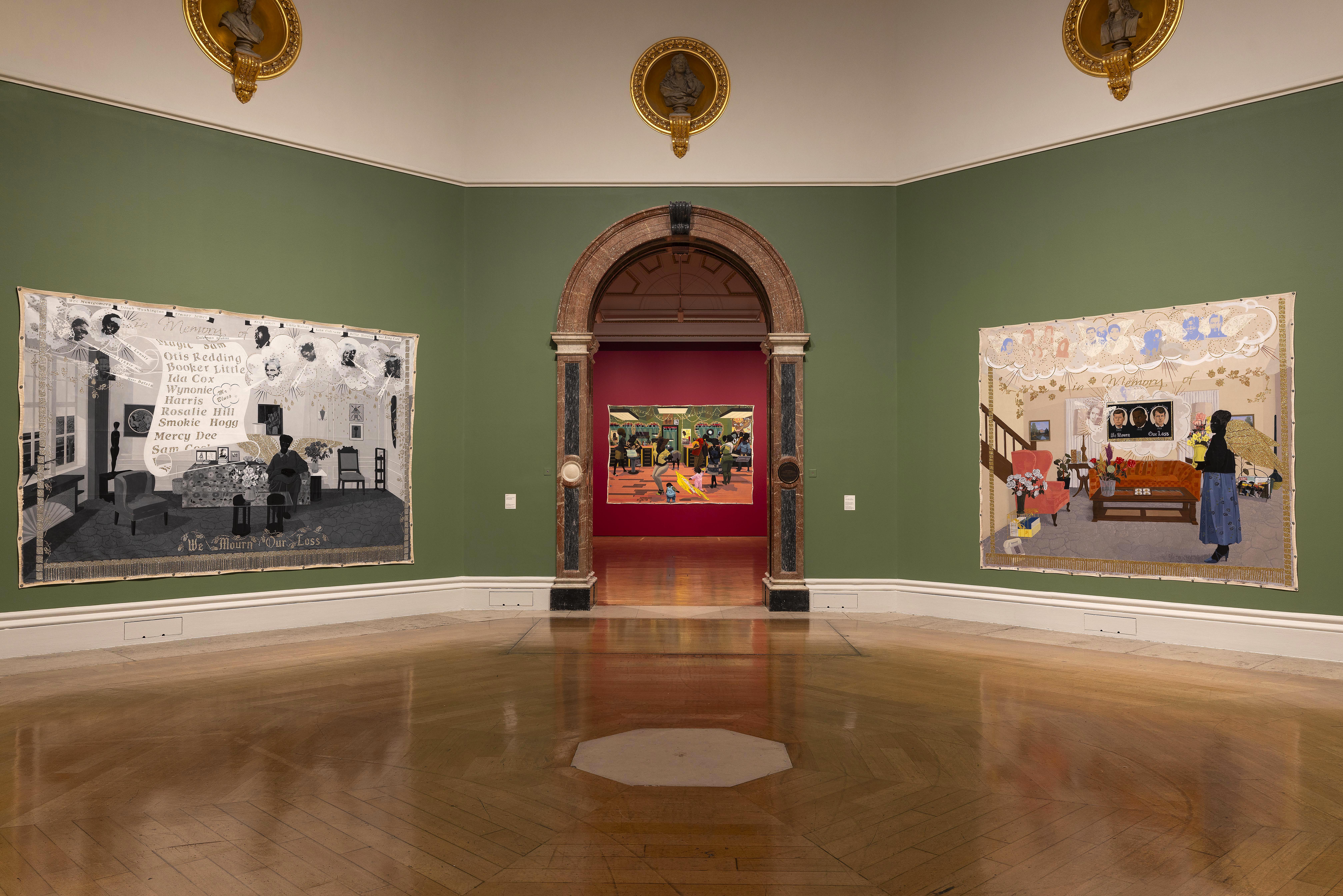
Kerry James Marshall: The Histories at the Royal Academy of the Arts is the largest survey of Marshall’s work ever to be exhibited in Europe, and the first institutional presentation in the UK since 2006. Coinciding with his 70th birthday, the exhibition maps Marshall’s distinguished contributions as well as critiques of the American art canon. His large-scale depictions of the variety and vibrancy of the African American experience have positioned him as one of the most influential artists working today.
Curated by Mark Godfrey and Adrian Locke, the works in the exhibition were made between 1980 and the present day. Marshall creates in cycles and series; eleven series are represented and grouped accordingly throughout the exhibition, non-chronologically. The first room features work made between 2008–2018: paintings of various scenes taking place in art studios, schools and museums, of artists and their muses at work.
The richness of colour and vast size of the paintings stop one in one’s tracks. When depicting skin, Marshall rarely portrays the brown tones of real skin; rather, he uses a variety of black pigments layered on top of each other or side by side (ivory black, carbon black, Mars black), mixing in other colours to create shades of black that are fully chromatic.
In Untitled (Studio) (2014), an artist donning a paint-smudged apron positions her model’s head — the same model whose portrait is in progress on the easel in the foreground. A cartoonishly yellow dog lies beneath a table covered in well-loved painting supplies, a bouquet of flowers, books and a small bust of former President Abraham Lincoln next to an anatomically correct skull (memento mori). The skull, dog, and flowers are recurring features in seventeenth-century Dutch still-life painting, perhaps a nod to, or a challenge of, the Old Masters. In the background, partially covered by a red curtain, a male model gazes directly at the viewer while he gets dressed or undressed. A second male model poses nude for an unseen artist. It is worth noting that both women are fully clothed, and it is the men who are nude.

Walking into the next room, the colours and tone shift. The Invisible Man series, inspired by the 1952 Ralph Ellison novel of the same name, is quieter but nonetheless confronting. In some of the works, black figures are set against dark backgrounds, making it difficult to distinguish them from their environment. The same highly saturated, monochromatic black figure appears throughout the series, a critique of racist caricatures and stereotypes. In the If I Had Possession Over Judgement Day (1988) drawing, the man is seen juggling while hula-hooping against a patchy yellow background. A stream of musical notes and lyrics (a motif that will become prominent in Marshall’s work), from the classic blues song of the same name by Robert Johnson, unravels from his mouth. It is an assertion of the desire for agency while seemingly stuck in the role of a performer with a forced grin.
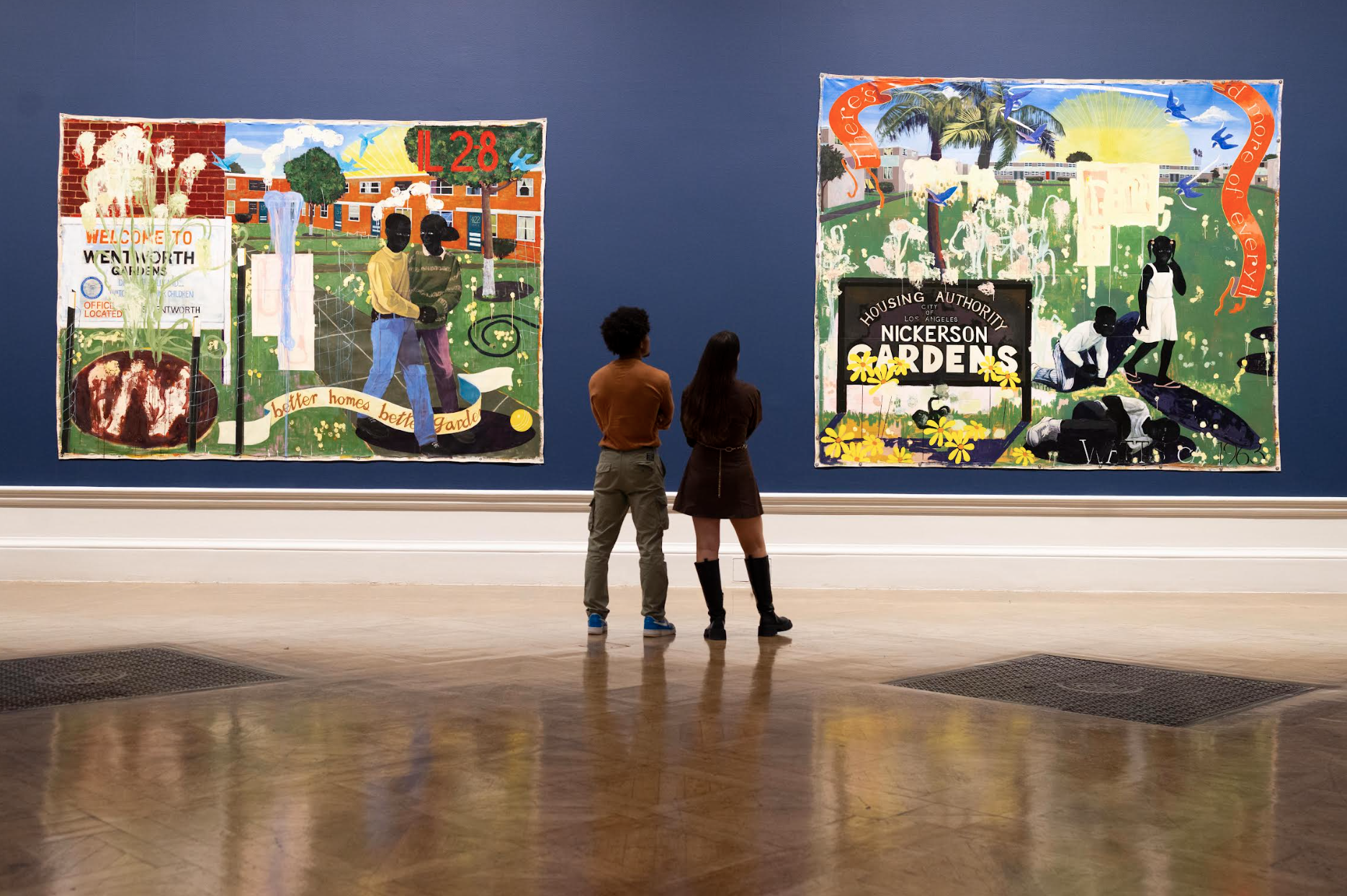
Between 1994 and 1995, Marshall embarked on his ‘Garden Project’ series, creating five enormous paintings, three of which appear in the next room: Watts 1963, Better Homes, Better Gardens, and Many Mansions. This series explores the American public housing projects developed following the Second Great Migration of the 1940s, when Black families moved from the South to cities in the North and West, including Marshall’s own. The paintings are tethered together with recurring motifs: flowing banners, Abstract Expressionist-style graffiti and bluebirds that look as if they have been plucked from a Disney animation. The whimsical is juxtaposed with the unfair, yet a sense of pride and hope permeates the series as a cartoon setting sun casts a warm glow over the Gardens.
In the only autobiographical painting of the series, Watts 1963, yellow psychedelic daisies sprout from the ground in front of a ‘Nickerson Gardens’ sign — the neighbourhood where Marshall and his family lived for two years. Marshall and his siblings are depicted as children, locking eyes with the viewer beneath blue skies and a red banner, cut off mid-text, that reads: “There’s more of everyth—”.
Marshall uses nostalgic, Pop-art, child-like symbols to create a stark contrast in his work, which explores sinister subjects such as institutionalised racism and the long-lasting consequences of slavery. In Great America 1994, an amusement-park water-ride boat becomes a startling allegory for the transatlantic slave trade and the Middle Passage. A rainbow-patterned maze, reminiscent of the board game Candy Land, sits front and centre in Visible Means of Support (2008), dual murals of the plantation homes of presidents Thomas Jefferson and George Washington.
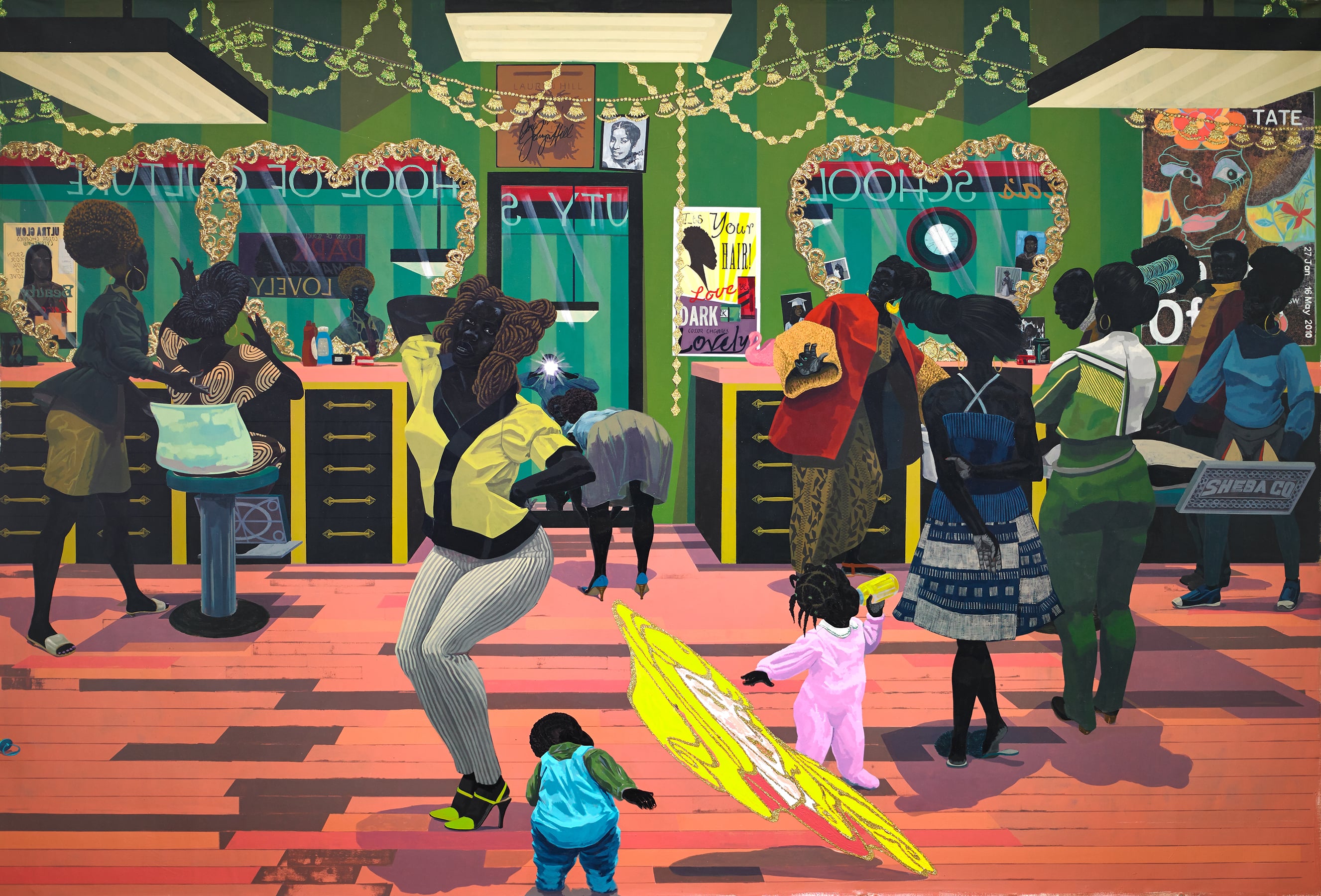
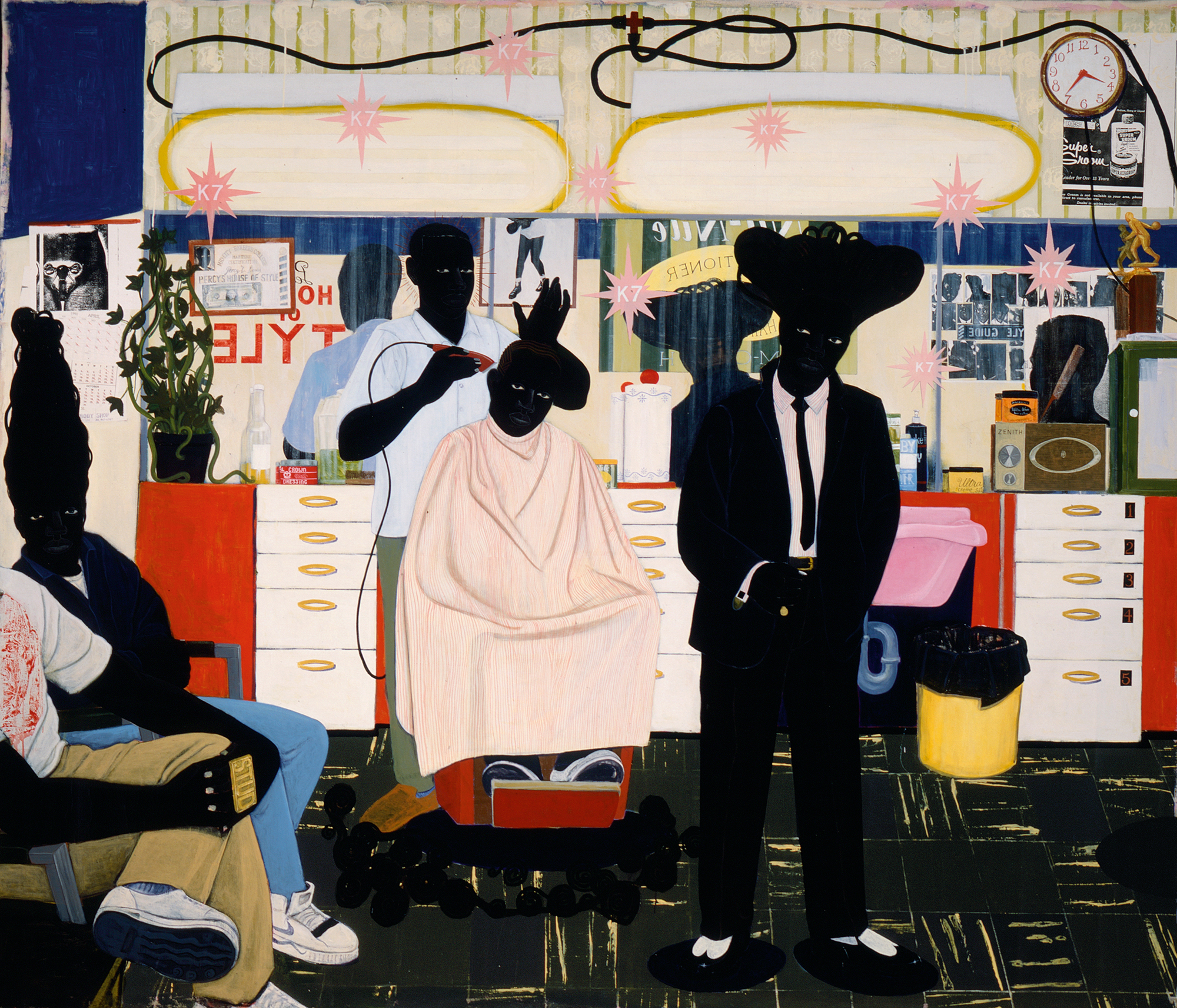
Glitter becomes a prominent feature in Marshall’s later series, such as ‘Souvenirs’ and ‘The Painting of Modern Life II’, his body of work from the 2010s. School of Beauty, School of Culture 2012 is a tableau of a beauty school — a significant social institution within African American communities — and a companion piece to his earlier painting, De Style (1993). Sleeping Beauty’s anamorphic head floats off the floor, recalling the skull in Hans Holbein the Younger’s painting The Ambassadors 1533. Everyone in the painting, except for two young children, seems unfazed by it.
A woman poses in the foreground, next to the Disney princess, showing off her new locks. Reflected in a mirror, we see a flash as someone takes a picture, and the viewer is now standing in the place of the photographer. There is a musicality to the painting: your eye dances around the canvas, back and forth, taking everything in, following the trails of glitter.
Almost three hours pass as I move through the exhibition, doubling back to take in favourite works again and again. It’s rather easy to become enraptured by the grandness and brilliance of Kerry James Marshall’s storytelling.


Kerry James Marshall: The Histories at the Royal Academy of the Arts is the largest survey of Marshall’s work ever to be exhibited in Europe, and the first institutional presentation in the UK since 2006. Coinciding with his 70th birthday, the exhibition maps Marshall’s distinguished contributions as well as critiques of the American art canon. His large-scale depictions of the variety and vibrancy of the African American experience have positioned him as one of the most influential artists working today.
Curated by Mark Godfrey and Adrian Locke, the works in the exhibition were made between 1980 and the present day. Marshall creates in cycles and series; eleven series are represented and grouped accordingly throughout the exhibition, non-chronologically. The first room features work made between 2008–2018: paintings of various scenes taking place in art studios, schools and museums, of artists and their muses at work.
The richness of colour and vast size of the paintings stop one in one’s tracks. When depicting skin, Marshall rarely portrays the brown tones of real skin; rather, he uses a variety of black pigments layered on top of each other or side by side (ivory black, carbon black, Mars black), mixing in other colours to create shades of black that are fully chromatic.
In Untitled (Studio) (2014), an artist donning a paint-smudged apron positions her model’s head — the same model whose portrait is in progress on the easel in the foreground. A cartoonishly yellow dog lies beneath a table covered in well-loved painting supplies, a bouquet of flowers, books and a small bust of former President Abraham Lincoln next to an anatomically correct skull (memento mori). The skull, dog, and flowers are recurring features in seventeenth-century Dutch still-life painting, perhaps a nod to, or a challenge of, the Old Masters. In the background, partially covered by a red curtain, a male model gazes directly at the viewer while he gets dressed or undressed. A second male model poses nude for an unseen artist. It is worth noting that both women are fully clothed, and it is the men who are nude.
Walking into the next room, the colours and tone shift. The Invisible Man series, inspired by the 1952 Ralph Ellison novel of the same name, is quieter but nonetheless confronting. In some of the works, black figures are set against dark backgrounds, making it difficult to distinguish them from their environment. The same highly saturated, monochromatic black figure appears throughout the series, a critique of racist caricatures and stereotypes. In the If I Had Possession Over Judgement Day (1988) drawing, the man is seen juggling while hula-hooping against a patchy yellow background. A stream of musical notes and lyrics (a motif that will become prominent in Marshall’s work), from the classic blues song of the same name by Robert Johnson, unravels from his mouth. It is an assertion of the desire for agency while seemingly stuck in the role of a performer with a forced grin.
Between 1994 and 1995, Marshall embarked on his ‘Garden Project’ series, creating five enormous paintings, three of which appear in the next room: Watts 1963, Better Homes, Better Gardens, and Many Mansions. This series explores the American public housing projects developed following the Second Great Migration of the 1940s, when Black families moved from the South to cities in the North and West, including Marshall’s own. The paintings are tethered together with recurring motifs: flowing banners, Abstract Expressionist-style graffiti and bluebirds that look as if they have been plucked from a Disney animation. The whimsical is juxtaposed with the unfair, yet a sense of pride and hope permeates the series as a cartoon setting sun casts a warm glow over the Gardens.
In the only autobiographical painting of the series, Watts 1963, yellow psychedelic daisies sprout from the ground in front of a ‘Nickerson Gardens’ sign — the neighbourhood where Marshall and his family lived for two years. Marshall and his siblings are depicted as children, locking eyes with the viewer beneath blue skies and a red banner, cut off mid-text, that reads: “There’s more of everyth—”.
Marshall uses nostalgic, Pop-art, child-like symbols to create a stark contrast in his work, which explores sinister subjects such as institutionalised racism and the long-lasting consequences of slavery. In Great America 1994, an amusement-park water-ride boat becomes a startling allegory for the transatlantic slave trade and the Middle Passage. A rainbow-patterned maze, reminiscent of the board game Candy Land, sits front and centre in Visible Means of Support (2008), dual murals of the plantation homes of presidents Thomas Jefferson and George Washington.
Glitter becomes a prominent feature in Marshall’s later series, such as ‘Souvenirs’ and ‘The Painting of Modern Life II’, his body of work from the 2010s. School of Beauty, School of Culture 2012 is a tableau of a beauty school — a significant social institution within African American communities — and a companion piece to his earlier painting, De Style (1993). Sleeping Beauty’s anamorphic head floats off the floor, recalling the skull in Hans Holbein the Younger’s painting The Ambassadors 1533. Everyone in the painting, except for two young children, seems unfazed by it.
A woman poses in the foreground, next to the Disney princess, showing off her new locks. Reflected in a mirror, we see a flash as someone takes a picture, and the viewer is now standing in the place of the photographer. There is a musicality to the painting: your eye dances around the canvas, back and forth, taking everything in, following the trails of glitter.
Almost three hours pass as I move through the exhibition, doubling back to take in favourite works again and again. It’s rather easy to become enraptured by the grandness and brilliance of Kerry James Marshall’s storytelling.
Kerry James Marshall: The Histories at the Royal Academy of the Arts is the largest survey of Marshall’s work ever to be exhibited in Europe, and the first institutional presentation in the UK since 2006. Coinciding with his 70th birthday, the exhibition maps Marshall’s distinguished contributions as well as critiques of the American art canon. His large-scale depictions of the variety and vibrancy of the African American experience have positioned him as one of the most influential artists working today.
Curated by Mark Godfrey and Adrian Locke, the works in the exhibition were made between 1980 and the present day. Marshall creates in cycles and series; eleven series are represented and grouped accordingly throughout the exhibition, non-chronologically. The first room features work made between 2008–2018: paintings of various scenes taking place in art studios, schools and museums, of artists and their muses at work.
The richness of colour and vast size of the paintings stop one in one’s tracks. When depicting skin, Marshall rarely portrays the brown tones of real skin; rather, he uses a variety of black pigments layered on top of each other or side by side (ivory black, carbon black, Mars black), mixing in other colours to create shades of black that are fully chromatic.
In Untitled (Studio) (2014), an artist donning a paint-smudged apron positions her model’s head — the same model whose portrait is in progress on the easel in the foreground. A cartoonishly yellow dog lies beneath a table covered in well-loved painting supplies, a bouquet of flowers, books and a small bust of former President Abraham Lincoln next to an anatomically correct skull (memento mori). The skull, dog, and flowers are recurring features in seventeenth-century Dutch still-life painting, perhaps a nod to, or a challenge of, the Old Masters. In the background, partially covered by a red curtain, a male model gazes directly at the viewer while he gets dressed or undressed. A second male model poses nude for an unseen artist. It is worth noting that both women are fully clothed, and it is the men who are nude.
Walking into the next room, the colours and tone shift. The Invisible Man series, inspired by the 1952 Ralph Ellison novel of the same name, is quieter but nonetheless confronting. In some of the works, black figures are set against dark backgrounds, making it difficult to distinguish them from their environment. The same highly saturated, monochromatic black figure appears throughout the series, a critique of racist caricatures and stereotypes. In the If I Had Possession Over Judgement Day (1988) drawing, the man is seen juggling while hula-hooping against a patchy yellow background. A stream of musical notes and lyrics (a motif that will become prominent in Marshall’s work), from the classic blues song of the same name by Robert Johnson, unravels from his mouth. It is an assertion of the desire for agency while seemingly stuck in the role of a performer with a forced grin.
Between 1994 and 1995, Marshall embarked on his ‘Garden Project’ series, creating five enormous paintings, three of which appear in the next room: Watts 1963, Better Homes, Better Gardens, and Many Mansions. This series explores the American public housing projects developed following the Second Great Migration of the 1940s, when Black families moved from the South to cities in the North and West, including Marshall’s own. The paintings are tethered together with recurring motifs: flowing banners, Abstract Expressionist-style graffiti and bluebirds that look as if they have been plucked from a Disney animation. The whimsical is juxtaposed with the unfair, yet a sense of pride and hope permeates the series as a cartoon setting sun casts a warm glow over the Gardens.
In the only autobiographical painting of the series, Watts 1963, yellow psychedelic daisies sprout from the ground in front of a ‘Nickerson Gardens’ sign — the neighbourhood where Marshall and his family lived for two years. Marshall and his siblings are depicted as children, locking eyes with the viewer beneath blue skies and a red banner, cut off mid-text, that reads: “There’s more of everyth—”.
Marshall uses nostalgic, Pop-art, child-like symbols to create a stark contrast in his work, which explores sinister subjects such as institutionalised racism and the long-lasting consequences of slavery. In Great America 1994, an amusement-park water-ride boat becomes a startling allegory for the transatlantic slave trade and the Middle Passage. A rainbow-patterned maze, reminiscent of the board game Candy Land, sits front and centre in Visible Means of Support (2008), dual murals of the plantation homes of presidents Thomas Jefferson and George Washington.
Glitter becomes a prominent feature in Marshall’s later series, such as ‘Souvenirs’ and ‘The Painting of Modern Life II’, his body of work from the 2010s. School of Beauty, School of Culture 2012 is a tableau of a beauty school — a significant social institution within African American communities — and a companion piece to his earlier painting, De Style (1993). Sleeping Beauty’s anamorphic head floats off the floor, recalling the skull in Hans Holbein the Younger’s painting The Ambassadors 1533. Everyone in the painting, except for two young children, seems unfazed by it.
A woman poses in the foreground, next to the Disney princess, showing off her new locks. Reflected in a mirror, we see a flash as someone takes a picture, and the viewer is now standing in the place of the photographer. There is a musicality to the painting: your eye dances around the canvas, back and forth, taking everything in, following the trails of glitter.
Almost three hours pass as I move through the exhibition, doubling back to take in favourite works again and again. It’s rather easy to become enraptured by the grandness and brilliance of Kerry James Marshall’s storytelling.
Kerry James Marshall: The Histories at the Royal Academy of the Arts is the largest survey of Marshall’s work ever to be exhibited in Europe, and the first institutional presentation in the UK since 2006. Coinciding with his 70th birthday, the exhibition maps Marshall’s distinguished contributions as well as critiques of the American art canon. His large-scale depictions of the variety and vibrancy of the African American experience have positioned him as one of the most influential artists working today.
Curated by Mark Godfrey and Adrian Locke, the works in the exhibition were made between 1980 and the present day. Marshall creates in cycles and series; eleven series are represented and grouped accordingly throughout the exhibition, non-chronologically. The first room features work made between 2008–2018: paintings of various scenes taking place in art studios, schools and museums, of artists and their muses at work.
The richness of colour and vast size of the paintings stop one in one’s tracks. When depicting skin, Marshall rarely portrays the brown tones of real skin; rather, he uses a variety of black pigments layered on top of each other or side by side (ivory black, carbon black, Mars black), mixing in other colours to create shades of black that are fully chromatic.
In Untitled (Studio) (2014), an artist donning a paint-smudged apron positions her model’s head — the same model whose portrait is in progress on the easel in the foreground. A cartoonishly yellow dog lies beneath a table covered in well-loved painting supplies, a bouquet of flowers, books and a small bust of former President Abraham Lincoln next to an anatomically correct skull (memento mori). The skull, dog, and flowers are recurring features in seventeenth-century Dutch still-life painting, perhaps a nod to, or a challenge of, the Old Masters. In the background, partially covered by a red curtain, a male model gazes directly at the viewer while he gets dressed or undressed. A second male model poses nude for an unseen artist. It is worth noting that both women are fully clothed, and it is the men who are nude.
Walking into the next room, the colours and tone shift. The Invisible Man series, inspired by the 1952 Ralph Ellison novel of the same name, is quieter but nonetheless confronting. In some of the works, black figures are set against dark backgrounds, making it difficult to distinguish them from their environment. The same highly saturated, monochromatic black figure appears throughout the series, a critique of racist caricatures and stereotypes. In the If I Had Possession Over Judgement Day (1988) drawing, the man is seen juggling while hula-hooping against a patchy yellow background. A stream of musical notes and lyrics (a motif that will become prominent in Marshall’s work), from the classic blues song of the same name by Robert Johnson, unravels from his mouth. It is an assertion of the desire for agency while seemingly stuck in the role of a performer with a forced grin.
Between 1994 and 1995, Marshall embarked on his ‘Garden Project’ series, creating five enormous paintings, three of which appear in the next room: Watts 1963, Better Homes, Better Gardens, and Many Mansions. This series explores the American public housing projects developed following the Second Great Migration of the 1940s, when Black families moved from the South to cities in the North and West, including Marshall’s own. The paintings are tethered together with recurring motifs: flowing banners, Abstract Expressionist-style graffiti and bluebirds that look as if they have been plucked from a Disney animation. The whimsical is juxtaposed with the unfair, yet a sense of pride and hope permeates the series as a cartoon setting sun casts a warm glow over the Gardens.
In the only autobiographical painting of the series, Watts 1963, yellow psychedelic daisies sprout from the ground in front of a ‘Nickerson Gardens’ sign — the neighbourhood where Marshall and his family lived for two years. Marshall and his siblings are depicted as children, locking eyes with the viewer beneath blue skies and a red banner, cut off mid-text, that reads: “There’s more of everyth—”.
Marshall uses nostalgic, Pop-art, child-like symbols to create a stark contrast in his work, which explores sinister subjects such as institutionalised racism and the long-lasting consequences of slavery. In Great America 1994, an amusement-park water-ride boat becomes a startling allegory for the transatlantic slave trade and the Middle Passage. A rainbow-patterned maze, reminiscent of the board game Candy Land, sits front and centre in Visible Means of Support (2008), dual murals of the plantation homes of presidents Thomas Jefferson and George Washington.
Glitter becomes a prominent feature in Marshall’s later series, such as ‘Souvenirs’ and ‘The Painting of Modern Life II’, his body of work from the 2010s. School of Beauty, School of Culture 2012 is a tableau of a beauty school — a significant social institution within African American communities — and a companion piece to his earlier painting, De Style (1993). Sleeping Beauty’s anamorphic head floats off the floor, recalling the skull in Hans Holbein the Younger’s painting The Ambassadors 1533. Everyone in the painting, except for two young children, seems unfazed by it.
A woman poses in the foreground, next to the Disney princess, showing off her new locks. Reflected in a mirror, we see a flash as someone takes a picture, and the viewer is now standing in the place of the photographer. There is a musicality to the painting: your eye dances around the canvas, back and forth, taking everything in, following the trails of glitter.
Almost three hours pass as I move through the exhibition, doubling back to take in favourite works again and again. It’s rather easy to become enraptured by the grandness and brilliance of Kerry James Marshall’s storytelling.
Kerry James Marshall: The Histories at the Royal Academy of the Arts is the largest survey of Marshall’s work ever to be exhibited in Europe, and the first institutional presentation in the UK since 2006. Coinciding with his 70th birthday, the exhibition maps Marshall’s distinguished contributions as well as critiques of the American art canon. His large-scale depictions of the variety and vibrancy of the African American experience have positioned him as one of the most influential artists working today.
Curated by Mark Godfrey and Adrian Locke, the works in the exhibition were made between 1980 and the present day. Marshall creates in cycles and series; eleven series are represented and grouped accordingly throughout the exhibition, non-chronologically. The first room features work made between 2008–2018: paintings of various scenes taking place in art studios, schools and museums, of artists and their muses at work.
The richness of colour and vast size of the paintings stop one in one’s tracks. When depicting skin, Marshall rarely portrays the brown tones of real skin; rather, he uses a variety of black pigments layered on top of each other or side by side (ivory black, carbon black, Mars black), mixing in other colours to create shades of black that are fully chromatic.
In Untitled (Studio) (2014), an artist donning a paint-smudged apron positions her model’s head — the same model whose portrait is in progress on the easel in the foreground. A cartoonishly yellow dog lies beneath a table covered in well-loved painting supplies, a bouquet of flowers, books and a small bust of former President Abraham Lincoln next to an anatomically correct skull (memento mori). The skull, dog, and flowers are recurring features in seventeenth-century Dutch still-life painting, perhaps a nod to, or a challenge of, the Old Masters. In the background, partially covered by a red curtain, a male model gazes directly at the viewer while he gets dressed or undressed. A second male model poses nude for an unseen artist. It is worth noting that both women are fully clothed, and it is the men who are nude.
Walking into the next room, the colours and tone shift. The Invisible Man series, inspired by the 1952 Ralph Ellison novel of the same name, is quieter but nonetheless confronting. In some of the works, black figures are set against dark backgrounds, making it difficult to distinguish them from their environment. The same highly saturated, monochromatic black figure appears throughout the series, a critique of racist caricatures and stereotypes. In the If I Had Possession Over Judgement Day (1988) drawing, the man is seen juggling while hula-hooping against a patchy yellow background. A stream of musical notes and lyrics (a motif that will become prominent in Marshall’s work), from the classic blues song of the same name by Robert Johnson, unravels from his mouth. It is an assertion of the desire for agency while seemingly stuck in the role of a performer with a forced grin.
Between 1994 and 1995, Marshall embarked on his ‘Garden Project’ series, creating five enormous paintings, three of which appear in the next room: Watts 1963, Better Homes, Better Gardens, and Many Mansions. This series explores the American public housing projects developed following the Second Great Migration of the 1940s, when Black families moved from the South to cities in the North and West, including Marshall’s own. The paintings are tethered together with recurring motifs: flowing banners, Abstract Expressionist-style graffiti and bluebirds that look as if they have been plucked from a Disney animation. The whimsical is juxtaposed with the unfair, yet a sense of pride and hope permeates the series as a cartoon setting sun casts a warm glow over the Gardens.
In the only autobiographical painting of the series, Watts 1963, yellow psychedelic daisies sprout from the ground in front of a ‘Nickerson Gardens’ sign — the neighbourhood where Marshall and his family lived for two years. Marshall and his siblings are depicted as children, locking eyes with the viewer beneath blue skies and a red banner, cut off mid-text, that reads: “There’s more of everyth—”.
Marshall uses nostalgic, Pop-art, child-like symbols to create a stark contrast in his work, which explores sinister subjects such as institutionalised racism and the long-lasting consequences of slavery. In Great America 1994, an amusement-park water-ride boat becomes a startling allegory for the transatlantic slave trade and the Middle Passage. A rainbow-patterned maze, reminiscent of the board game Candy Land, sits front and centre in Visible Means of Support (2008), dual murals of the plantation homes of presidents Thomas Jefferson and George Washington.
Glitter becomes a prominent feature in Marshall’s later series, such as ‘Souvenirs’ and ‘The Painting of Modern Life II’, his body of work from the 2010s. School of Beauty, School of Culture 2012 is a tableau of a beauty school — a significant social institution within African American communities — and a companion piece to his earlier painting, De Style (1993). Sleeping Beauty’s anamorphic head floats off the floor, recalling the skull in Hans Holbein the Younger’s painting The Ambassadors 1533. Everyone in the painting, except for two young children, seems unfazed by it.
A woman poses in the foreground, next to the Disney princess, showing off her new locks. Reflected in a mirror, we see a flash as someone takes a picture, and the viewer is now standing in the place of the photographer. There is a musicality to the painting: your eye dances around the canvas, back and forth, taking everything in, following the trails of glitter.
Almost three hours pass as I move through the exhibition, doubling back to take in favourite works again and again. It’s rather easy to become enraptured by the grandness and brilliance of Kerry James Marshall’s storytelling.
Kerry James Marshall: The Histories at the Royal Academy of the Arts is the largest survey of Marshall’s work ever to be exhibited in Europe, and the first institutional presentation in the UK since 2006. Coinciding with his 70th birthday, the exhibition maps Marshall’s distinguished contributions as well as critiques of the American art canon. His large-scale depictions of the variety and vibrancy of the African American experience have positioned him as one of the most influential artists working today.
Curated by Mark Godfrey and Adrian Locke, the works in the exhibition were made between 1980 and the present day. Marshall creates in cycles and series; eleven series are represented and grouped accordingly throughout the exhibition, non-chronologically. The first room features work made between 2008–2018: paintings of various scenes taking place in art studios, schools and museums, of artists and their muses at work.
The richness of colour and vast size of the paintings stop one in one’s tracks. When depicting skin, Marshall rarely portrays the brown tones of real skin; rather, he uses a variety of black pigments layered on top of each other or side by side (ivory black, carbon black, Mars black), mixing in other colours to create shades of black that are fully chromatic.
In Untitled (Studio) (2014), an artist donning a paint-smudged apron positions her model’s head — the same model whose portrait is in progress on the easel in the foreground. A cartoonishly yellow dog lies beneath a table covered in well-loved painting supplies, a bouquet of flowers, books and a small bust of former President Abraham Lincoln next to an anatomically correct skull (memento mori). The skull, dog, and flowers are recurring features in seventeenth-century Dutch still-life painting, perhaps a nod to, or a challenge of, the Old Masters. In the background, partially covered by a red curtain, a male model gazes directly at the viewer while he gets dressed or undressed. A second male model poses nude for an unseen artist. It is worth noting that both women are fully clothed, and it is the men who are nude.
Walking into the next room, the colours and tone shift. The Invisible Man series, inspired by the 1952 Ralph Ellison novel of the same name, is quieter but nonetheless confronting. In some of the works, black figures are set against dark backgrounds, making it difficult to distinguish them from their environment. The same highly saturated, monochromatic black figure appears throughout the series, a critique of racist caricatures and stereotypes. In the If I Had Possession Over Judgement Day (1988) drawing, the man is seen juggling while hula-hooping against a patchy yellow background. A stream of musical notes and lyrics (a motif that will become prominent in Marshall’s work), from the classic blues song of the same name by Robert Johnson, unravels from his mouth. It is an assertion of the desire for agency while seemingly stuck in the role of a performer with a forced grin.
Between 1994 and 1995, Marshall embarked on his ‘Garden Project’ series, creating five enormous paintings, three of which appear in the next room: Watts 1963, Better Homes, Better Gardens, and Many Mansions. This series explores the American public housing projects developed following the Second Great Migration of the 1940s, when Black families moved from the South to cities in the North and West, including Marshall’s own. The paintings are tethered together with recurring motifs: flowing banners, Abstract Expressionist-style graffiti and bluebirds that look as if they have been plucked from a Disney animation. The whimsical is juxtaposed with the unfair, yet a sense of pride and hope permeates the series as a cartoon setting sun casts a warm glow over the Gardens.
In the only autobiographical painting of the series, Watts 1963, yellow psychedelic daisies sprout from the ground in front of a ‘Nickerson Gardens’ sign — the neighbourhood where Marshall and his family lived for two years. Marshall and his siblings are depicted as children, locking eyes with the viewer beneath blue skies and a red banner, cut off mid-text, that reads: “There’s more of everyth—”.
Marshall uses nostalgic, Pop-art, child-like symbols to create a stark contrast in his work, which explores sinister subjects such as institutionalised racism and the long-lasting consequences of slavery. In Great America 1994, an amusement-park water-ride boat becomes a startling allegory for the transatlantic slave trade and the Middle Passage. A rainbow-patterned maze, reminiscent of the board game Candy Land, sits front and centre in Visible Means of Support (2008), dual murals of the plantation homes of presidents Thomas Jefferson and George Washington.
Glitter becomes a prominent feature in Marshall’s later series, such as ‘Souvenirs’ and ‘The Painting of Modern Life II’, his body of work from the 2010s. School of Beauty, School of Culture 2012 is a tableau of a beauty school — a significant social institution within African American communities — and a companion piece to his earlier painting, De Style (1993). Sleeping Beauty’s anamorphic head floats off the floor, recalling the skull in Hans Holbein the Younger’s painting The Ambassadors 1533. Everyone in the painting, except for two young children, seems unfazed by it.
A woman poses in the foreground, next to the Disney princess, showing off her new locks. Reflected in a mirror, we see a flash as someone takes a picture, and the viewer is now standing in the place of the photographer. There is a musicality to the painting: your eye dances around the canvas, back and forth, taking everything in, following the trails of glitter.
Almost three hours pass as I move through the exhibition, doubling back to take in favourite works again and again. It’s rather easy to become enraptured by the grandness and brilliance of Kerry James Marshall’s storytelling.
Kerry James Marshall: The Histories at the Royal Academy of the Arts is the largest survey of Marshall’s work ever to be exhibited in Europe, and the first institutional presentation in the UK since 2006. Coinciding with his 70th birthday, the exhibition maps Marshall’s distinguished contributions as well as critiques of the American art canon. His large-scale depictions of the variety and vibrancy of the African American experience have positioned him as one of the most influential artists working today.
Curated by Mark Godfrey and Adrian Locke, the works in the exhibition were made between 1980 and the present day. Marshall creates in cycles and series; eleven series are represented and grouped accordingly throughout the exhibition, non-chronologically. The first room features work made between 2008–2018: paintings of various scenes taking place in art studios, schools and museums, of artists and their muses at work.
The richness of colour and vast size of the paintings stop one in one’s tracks. When depicting skin, Marshall rarely portrays the brown tones of real skin; rather, he uses a variety of black pigments layered on top of each other or side by side (ivory black, carbon black, Mars black), mixing in other colours to create shades of black that are fully chromatic.
In Untitled (Studio) (2014), an artist donning a paint-smudged apron positions her model’s head — the same model whose portrait is in progress on the easel in the foreground. A cartoonishly yellow dog lies beneath a table covered in well-loved painting supplies, a bouquet of flowers, books and a small bust of former President Abraham Lincoln next to an anatomically correct skull (memento mori). The skull, dog, and flowers are recurring features in seventeenth-century Dutch still-life painting, perhaps a nod to, or a challenge of, the Old Masters. In the background, partially covered by a red curtain, a male model gazes directly at the viewer while he gets dressed or undressed. A second male model poses nude for an unseen artist. It is worth noting that both women are fully clothed, and it is the men who are nude.
Walking into the next room, the colours and tone shift. The Invisible Man series, inspired by the 1952 Ralph Ellison novel of the same name, is quieter but nonetheless confronting. In some of the works, black figures are set against dark backgrounds, making it difficult to distinguish them from their environment. The same highly saturated, monochromatic black figure appears throughout the series, a critique of racist caricatures and stereotypes. In the If I Had Possession Over Judgement Day (1988) drawing, the man is seen juggling while hula-hooping against a patchy yellow background. A stream of musical notes and lyrics (a motif that will become prominent in Marshall’s work), from the classic blues song of the same name by Robert Johnson, unravels from his mouth. It is an assertion of the desire for agency while seemingly stuck in the role of a performer with a forced grin.
Between 1994 and 1995, Marshall embarked on his ‘Garden Project’ series, creating five enormous paintings, three of which appear in the next room: Watts 1963, Better Homes, Better Gardens, and Many Mansions. This series explores the American public housing projects developed following the Second Great Migration of the 1940s, when Black families moved from the South to cities in the North and West, including Marshall’s own. The paintings are tethered together with recurring motifs: flowing banners, Abstract Expressionist-style graffiti and bluebirds that look as if they have been plucked from a Disney animation. The whimsical is juxtaposed with the unfair, yet a sense of pride and hope permeates the series as a cartoon setting sun casts a warm glow over the Gardens.
In the only autobiographical painting of the series, Watts 1963, yellow psychedelic daisies sprout from the ground in front of a ‘Nickerson Gardens’ sign — the neighbourhood where Marshall and his family lived for two years. Marshall and his siblings are depicted as children, locking eyes with the viewer beneath blue skies and a red banner, cut off mid-text, that reads: “There’s more of everyth—”.
Marshall uses nostalgic, Pop-art, child-like symbols to create a stark contrast in his work, which explores sinister subjects such as institutionalised racism and the long-lasting consequences of slavery. In Great America 1994, an amusement-park water-ride boat becomes a startling allegory for the transatlantic slave trade and the Middle Passage. A rainbow-patterned maze, reminiscent of the board game Candy Land, sits front and centre in Visible Means of Support (2008), dual murals of the plantation homes of presidents Thomas Jefferson and George Washington.
Glitter becomes a prominent feature in Marshall’s later series, such as ‘Souvenirs’ and ‘The Painting of Modern Life II’, his body of work from the 2010s. School of Beauty, School of Culture 2012 is a tableau of a beauty school — a significant social institution within African American communities — and a companion piece to his earlier painting, De Style (1993). Sleeping Beauty’s anamorphic head floats off the floor, recalling the skull in Hans Holbein the Younger’s painting The Ambassadors 1533. Everyone in the painting, except for two young children, seems unfazed by it.
A woman poses in the foreground, next to the Disney princess, showing off her new locks. Reflected in a mirror, we see a flash as someone takes a picture, and the viewer is now standing in the place of the photographer. There is a musicality to the painting: your eye dances around the canvas, back and forth, taking everything in, following the trails of glitter.
Almost three hours pass as I move through the exhibition, doubling back to take in favourite works again and again. It’s rather easy to become enraptured by the grandness and brilliance of Kerry James Marshall’s storytelling.
Kerry James Marshall: The Histories at the Royal Academy of the Arts is the largest survey of Marshall’s work ever to be exhibited in Europe, and the first institutional presentation in the UK since 2006. Coinciding with his 70th birthday, the exhibition maps Marshall’s distinguished contributions as well as critiques of the American art canon. His large-scale depictions of the variety and vibrancy of the African American experience have positioned him as one of the most influential artists working today.
Curated by Mark Godfrey and Adrian Locke, the works in the exhibition were made between 1980 and the present day. Marshall creates in cycles and series; eleven series are represented and grouped accordingly throughout the exhibition, non-chronologically. The first room features work made between 2008–2018: paintings of various scenes taking place in art studios, schools and museums, of artists and their muses at work.
The richness of colour and vast size of the paintings stop one in one’s tracks. When depicting skin, Marshall rarely portrays the brown tones of real skin; rather, he uses a variety of black pigments layered on top of each other or side by side (ivory black, carbon black, Mars black), mixing in other colours to create shades of black that are fully chromatic.
In Untitled (Studio) (2014), an artist donning a paint-smudged apron positions her model’s head — the same model whose portrait is in progress on the easel in the foreground. A cartoonishly yellow dog lies beneath a table covered in well-loved painting supplies, a bouquet of flowers, books and a small bust of former President Abraham Lincoln next to an anatomically correct skull (memento mori). The skull, dog, and flowers are recurring features in seventeenth-century Dutch still-life painting, perhaps a nod to, or a challenge of, the Old Masters. In the background, partially covered by a red curtain, a male model gazes directly at the viewer while he gets dressed or undressed. A second male model poses nude for an unseen artist. It is worth noting that both women are fully clothed, and it is the men who are nude.
Walking into the next room, the colours and tone shift. The Invisible Man series, inspired by the 1952 Ralph Ellison novel of the same name, is quieter but nonetheless confronting. In some of the works, black figures are set against dark backgrounds, making it difficult to distinguish them from their environment. The same highly saturated, monochromatic black figure appears throughout the series, a critique of racist caricatures and stereotypes. In the If I Had Possession Over Judgement Day (1988) drawing, the man is seen juggling while hula-hooping against a patchy yellow background. A stream of musical notes and lyrics (a motif that will become prominent in Marshall’s work), from the classic blues song of the same name by Robert Johnson, unravels from his mouth. It is an assertion of the desire for agency while seemingly stuck in the role of a performer with a forced grin.
Between 1994 and 1995, Marshall embarked on his ‘Garden Project’ series, creating five enormous paintings, three of which appear in the next room: Watts 1963, Better Homes, Better Gardens, and Many Mansions. This series explores the American public housing projects developed following the Second Great Migration of the 1940s, when Black families moved from the South to cities in the North and West, including Marshall’s own. The paintings are tethered together with recurring motifs: flowing banners, Abstract Expressionist-style graffiti and bluebirds that look as if they have been plucked from a Disney animation. The whimsical is juxtaposed with the unfair, yet a sense of pride and hope permeates the series as a cartoon setting sun casts a warm glow over the Gardens.
In the only autobiographical painting of the series, Watts 1963, yellow psychedelic daisies sprout from the ground in front of a ‘Nickerson Gardens’ sign — the neighbourhood where Marshall and his family lived for two years. Marshall and his siblings are depicted as children, locking eyes with the viewer beneath blue skies and a red banner, cut off mid-text, that reads: “There’s more of everyth—”.
Marshall uses nostalgic, Pop-art, child-like symbols to create a stark contrast in his work, which explores sinister subjects such as institutionalised racism and the long-lasting consequences of slavery. In Great America 1994, an amusement-park water-ride boat becomes a startling allegory for the transatlantic slave trade and the Middle Passage. A rainbow-patterned maze, reminiscent of the board game Candy Land, sits front and centre in Visible Means of Support (2008), dual murals of the plantation homes of presidents Thomas Jefferson and George Washington.
Glitter becomes a prominent feature in Marshall’s later series, such as ‘Souvenirs’ and ‘The Painting of Modern Life II’, his body of work from the 2010s. School of Beauty, School of Culture 2012 is a tableau of a beauty school — a significant social institution within African American communities — and a companion piece to his earlier painting, De Style (1993). Sleeping Beauty’s anamorphic head floats off the floor, recalling the skull in Hans Holbein the Younger’s painting The Ambassadors 1533. Everyone in the painting, except for two young children, seems unfazed by it.
A woman poses in the foreground, next to the Disney princess, showing off her new locks. Reflected in a mirror, we see a flash as someone takes a picture, and the viewer is now standing in the place of the photographer. There is a musicality to the painting: your eye dances around the canvas, back and forth, taking everything in, following the trails of glitter.
Almost three hours pass as I move through the exhibition, doubling back to take in favourite works again and again. It’s rather easy to become enraptured by the grandness and brilliance of Kerry James Marshall’s storytelling.
Kerry James Marshall: The Histories at the Royal Academy of the Arts is the largest survey of Marshall’s work ever to be exhibited in Europe, and the first institutional presentation in the UK since 2006. Coinciding with his 70th birthday, the exhibition maps Marshall’s distinguished contributions as well as critiques of the American art canon. His large-scale depictions of the variety and vibrancy of the African American experience have positioned him as one of the most influential artists working today.
Curated by Mark Godfrey and Adrian Locke, the works in the exhibition were made between 1980 and the present day. Marshall creates in cycles and series; eleven series are represented and grouped accordingly throughout the exhibition, non-chronologically. The first room features work made between 2008–2018: paintings of various scenes taking place in art studios, schools and museums, of artists and their muses at work.
The richness of colour and vast size of the paintings stop one in one’s tracks. When depicting skin, Marshall rarely portrays the brown tones of real skin; rather, he uses a variety of black pigments layered on top of each other or side by side (ivory black, carbon black, Mars black), mixing in other colours to create shades of black that are fully chromatic.
In Untitled (Studio) (2014), an artist donning a paint-smudged apron positions her model’s head — the same model whose portrait is in progress on the easel in the foreground. A cartoonishly yellow dog lies beneath a table covered in well-loved painting supplies, a bouquet of flowers, books and a small bust of former President Abraham Lincoln next to an anatomically correct skull (memento mori). The skull, dog, and flowers are recurring features in seventeenth-century Dutch still-life painting, perhaps a nod to, or a challenge of, the Old Masters. In the background, partially covered by a red curtain, a male model gazes directly at the viewer while he gets dressed or undressed. A second male model poses nude for an unseen artist. It is worth noting that both women are fully clothed, and it is the men who are nude.
Walking into the next room, the colours and tone shift. The Invisible Man series, inspired by the 1952 Ralph Ellison novel of the same name, is quieter but nonetheless confronting. In some of the works, black figures are set against dark backgrounds, making it difficult to distinguish them from their environment. The same highly saturated, monochromatic black figure appears throughout the series, a critique of racist caricatures and stereotypes. In the If I Had Possession Over Judgement Day (1988) drawing, the man is seen juggling while hula-hooping against a patchy yellow background. A stream of musical notes and lyrics (a motif that will become prominent in Marshall’s work), from the classic blues song of the same name by Robert Johnson, unravels from his mouth. It is an assertion of the desire for agency while seemingly stuck in the role of a performer with a forced grin.
Between 1994 and 1995, Marshall embarked on his ‘Garden Project’ series, creating five enormous paintings, three of which appear in the next room: Watts 1963, Better Homes, Better Gardens, and Many Mansions. This series explores the American public housing projects developed following the Second Great Migration of the 1940s, when Black families moved from the South to cities in the North and West, including Marshall’s own. The paintings are tethered together with recurring motifs: flowing banners, Abstract Expressionist-style graffiti and bluebirds that look as if they have been plucked from a Disney animation. The whimsical is juxtaposed with the unfair, yet a sense of pride and hope permeates the series as a cartoon setting sun casts a warm glow over the Gardens.
In the only autobiographical painting of the series, Watts 1963, yellow psychedelic daisies sprout from the ground in front of a ‘Nickerson Gardens’ sign — the neighbourhood where Marshall and his family lived for two years. Marshall and his siblings are depicted as children, locking eyes with the viewer beneath blue skies and a red banner, cut off mid-text, that reads: “There’s more of everyth—”.
Marshall uses nostalgic, Pop-art, child-like symbols to create a stark contrast in his work, which explores sinister subjects such as institutionalised racism and the long-lasting consequences of slavery. In Great America 1994, an amusement-park water-ride boat becomes a startling allegory for the transatlantic slave trade and the Middle Passage. A rainbow-patterned maze, reminiscent of the board game Candy Land, sits front and centre in Visible Means of Support (2008), dual murals of the plantation homes of presidents Thomas Jefferson and George Washington.
Glitter becomes a prominent feature in Marshall’s later series, such as ‘Souvenirs’ and ‘The Painting of Modern Life II’, his body of work from the 2010s. School of Beauty, School of Culture 2012 is a tableau of a beauty school — a significant social institution within African American communities — and a companion piece to his earlier painting, De Style (1993). Sleeping Beauty’s anamorphic head floats off the floor, recalling the skull in Hans Holbein the Younger’s painting The Ambassadors 1533. Everyone in the painting, except for two young children, seems unfazed by it.
A woman poses in the foreground, next to the Disney princess, showing off her new locks. Reflected in a mirror, we see a flash as someone takes a picture, and the viewer is now standing in the place of the photographer. There is a musicality to the painting: your eye dances around the canvas, back and forth, taking everything in, following the trails of glitter.
Almost three hours pass as I move through the exhibition, doubling back to take in favourite works again and again. It’s rather easy to become enraptured by the grandness and brilliance of Kerry James Marshall’s storytelling.
Kerry James Marshall: The Histories at the Royal Academy of the Arts is the largest survey of Marshall’s work ever to be exhibited in Europe, and the first institutional presentation in the UK since 2006. Coinciding with his 70th birthday, the exhibition maps Marshall’s distinguished contributions as well as critiques of the American art canon. His large-scale depictions of the variety and vibrancy of the African American experience have positioned him as one of the most influential artists working today.
Curated by Mark Godfrey and Adrian Locke, the works in the exhibition were made between 1980 and the present day. Marshall creates in cycles and series; eleven series are represented and grouped accordingly throughout the exhibition, non-chronologically. The first room features work made between 2008–2018: paintings of various scenes taking place in art studios, schools and museums, of artists and their muses at work.
The richness of colour and vast size of the paintings stop one in one’s tracks. When depicting skin, Marshall rarely portrays the brown tones of real skin; rather, he uses a variety of black pigments layered on top of each other or side by side (ivory black, carbon black, Mars black), mixing in other colours to create shades of black that are fully chromatic.
In Untitled (Studio) (2014), an artist donning a paint-smudged apron positions her model’s head — the same model whose portrait is in progress on the easel in the foreground. A cartoonishly yellow dog lies beneath a table covered in well-loved painting supplies, a bouquet of flowers, books and a small bust of former President Abraham Lincoln next to an anatomically correct skull (memento mori). The skull, dog, and flowers are recurring features in seventeenth-century Dutch still-life painting, perhaps a nod to, or a challenge of, the Old Masters. In the background, partially covered by a red curtain, a male model gazes directly at the viewer while he gets dressed or undressed. A second male model poses nude for an unseen artist. It is worth noting that both women are fully clothed, and it is the men who are nude.
Walking into the next room, the colours and tone shift. The Invisible Man series, inspired by the 1952 Ralph Ellison novel of the same name, is quieter but nonetheless confronting. In some of the works, black figures are set against dark backgrounds, making it difficult to distinguish them from their environment. The same highly saturated, monochromatic black figure appears throughout the series, a critique of racist caricatures and stereotypes. In the If I Had Possession Over Judgement Day (1988) drawing, the man is seen juggling while hula-hooping against a patchy yellow background. A stream of musical notes and lyrics (a motif that will become prominent in Marshall’s work), from the classic blues song of the same name by Robert Johnson, unravels from his mouth. It is an assertion of the desire for agency while seemingly stuck in the role of a performer with a forced grin.
Between 1994 and 1995, Marshall embarked on his ‘Garden Project’ series, creating five enormous paintings, three of which appear in the next room: Watts 1963, Better Homes, Better Gardens, and Many Mansions. This series explores the American public housing projects developed following the Second Great Migration of the 1940s, when Black families moved from the South to cities in the North and West, including Marshall’s own. The paintings are tethered together with recurring motifs: flowing banners, Abstract Expressionist-style graffiti and bluebirds that look as if they have been plucked from a Disney animation. The whimsical is juxtaposed with the unfair, yet a sense of pride and hope permeates the series as a cartoon setting sun casts a warm glow over the Gardens.
In the only autobiographical painting of the series, Watts 1963, yellow psychedelic daisies sprout from the ground in front of a ‘Nickerson Gardens’ sign — the neighbourhood where Marshall and his family lived for two years. Marshall and his siblings are depicted as children, locking eyes with the viewer beneath blue skies and a red banner, cut off mid-text, that reads: “There’s more of everyth—”.
Marshall uses nostalgic, Pop-art, child-like symbols to create a stark contrast in his work, which explores sinister subjects such as institutionalised racism and the long-lasting consequences of slavery. In Great America 1994, an amusement-park water-ride boat becomes a startling allegory for the transatlantic slave trade and the Middle Passage. A rainbow-patterned maze, reminiscent of the board game Candy Land, sits front and centre in Visible Means of Support (2008), dual murals of the plantation homes of presidents Thomas Jefferson and George Washington.
Glitter becomes a prominent feature in Marshall’s later series, such as ‘Souvenirs’ and ‘The Painting of Modern Life II’, his body of work from the 2010s. School of Beauty, School of Culture 2012 is a tableau of a beauty school — a significant social institution within African American communities — and a companion piece to his earlier painting, De Style (1993). Sleeping Beauty’s anamorphic head floats off the floor, recalling the skull in Hans Holbein the Younger’s painting The Ambassadors 1533. Everyone in the painting, except for two young children, seems unfazed by it.
A woman poses in the foreground, next to the Disney princess, showing off her new locks. Reflected in a mirror, we see a flash as someone takes a picture, and the viewer is now standing in the place of the photographer. There is a musicality to the painting: your eye dances around the canvas, back and forth, taking everything in, following the trails of glitter.
Almost three hours pass as I move through the exhibition, doubling back to take in favourite works again and again. It’s rather easy to become enraptured by the grandness and brilliance of Kerry James Marshall’s storytelling.
Kerry James Marshall: The Histories at the Royal Academy of the Arts is the largest survey of Marshall’s work ever to be exhibited in Europe, and the first institutional presentation in the UK since 2006. Coinciding with his 70th birthday, the exhibition maps Marshall’s distinguished contributions as well as critiques of the American art canon. His large-scale depictions of the variety and vibrancy of the African American experience have positioned him as one of the most influential artists working today.
Curated by Mark Godfrey and Adrian Locke, the works in the exhibition were made between 1980 and the present day. Marshall creates in cycles and series; eleven series are represented and grouped accordingly throughout the exhibition, non-chronologically. The first room features work made between 2008–2018: paintings of various scenes taking place in art studios, schools and museums, of artists and their muses at work.
The richness of colour and vast size of the paintings stop one in one’s tracks. When depicting skin, Marshall rarely portrays the brown tones of real skin; rather, he uses a variety of black pigments layered on top of each other or side by side (ivory black, carbon black, Mars black), mixing in other colours to create shades of black that are fully chromatic.
In Untitled (Studio) (2014), an artist donning a paint-smudged apron positions her model’s head — the same model whose portrait is in progress on the easel in the foreground. A cartoonishly yellow dog lies beneath a table covered in well-loved painting supplies, a bouquet of flowers, books and a small bust of former President Abraham Lincoln next to an anatomically correct skull (memento mori). The skull, dog, and flowers are recurring features in seventeenth-century Dutch still-life painting, perhaps a nod to, or a challenge of, the Old Masters. In the background, partially covered by a red curtain, a male model gazes directly at the viewer while he gets dressed or undressed. A second male model poses nude for an unseen artist. It is worth noting that both women are fully clothed, and it is the men who are nude.
Walking into the next room, the colours and tone shift. The Invisible Man series, inspired by the 1952 Ralph Ellison novel of the same name, is quieter but nonetheless confronting. In some of the works, black figures are set against dark backgrounds, making it difficult to distinguish them from their environment. The same highly saturated, monochromatic black figure appears throughout the series, a critique of racist caricatures and stereotypes. In the If I Had Possession Over Judgement Day (1988) drawing, the man is seen juggling while hula-hooping against a patchy yellow background. A stream of musical notes and lyrics (a motif that will become prominent in Marshall’s work), from the classic blues song of the same name by Robert Johnson, unravels from his mouth. It is an assertion of the desire for agency while seemingly stuck in the role of a performer with a forced grin.
Between 1994 and 1995, Marshall embarked on his ‘Garden Project’ series, creating five enormous paintings, three of which appear in the next room: Watts 1963, Better Homes, Better Gardens, and Many Mansions. This series explores the American public housing projects developed following the Second Great Migration of the 1940s, when Black families moved from the South to cities in the North and West, including Marshall’s own. The paintings are tethered together with recurring motifs: flowing banners, Abstract Expressionist-style graffiti and bluebirds that look as if they have been plucked from a Disney animation. The whimsical is juxtaposed with the unfair, yet a sense of pride and hope permeates the series as a cartoon setting sun casts a warm glow over the Gardens.
In the only autobiographical painting of the series, Watts 1963, yellow psychedelic daisies sprout from the ground in front of a ‘Nickerson Gardens’ sign — the neighbourhood where Marshall and his family lived for two years. Marshall and his siblings are depicted as children, locking eyes with the viewer beneath blue skies and a red banner, cut off mid-text, that reads: “There’s more of everyth—”.
Marshall uses nostalgic, Pop-art, child-like symbols to create a stark contrast in his work, which explores sinister subjects such as institutionalised racism and the long-lasting consequences of slavery. In Great America 1994, an amusement-park water-ride boat becomes a startling allegory for the transatlantic slave trade and the Middle Passage. A rainbow-patterned maze, reminiscent of the board game Candy Land, sits front and centre in Visible Means of Support (2008), dual murals of the plantation homes of presidents Thomas Jefferson and George Washington.
Glitter becomes a prominent feature in Marshall’s later series, such as ‘Souvenirs’ and ‘The Painting of Modern Life II’, his body of work from the 2010s. School of Beauty, School of Culture 2012 is a tableau of a beauty school — a significant social institution within African American communities — and a companion piece to his earlier painting, De Style (1993). Sleeping Beauty’s anamorphic head floats off the floor, recalling the skull in Hans Holbein the Younger’s painting The Ambassadors 1533. Everyone in the painting, except for two young children, seems unfazed by it.
A woman poses in the foreground, next to the Disney princess, showing off her new locks. Reflected in a mirror, we see a flash as someone takes a picture, and the viewer is now standing in the place of the photographer. There is a musicality to the painting: your eye dances around the canvas, back and forth, taking everything in, following the trails of glitter.
Almost three hours pass as I move through the exhibition, doubling back to take in favourite works again and again. It’s rather easy to become enraptured by the grandness and brilliance of Kerry James Marshall’s storytelling.


.png)


.svg)


