
A horde of sweaty press and art-world fixtures stood in a crowd, eagerly awaiting entry to one of the most anticipated exhibitions at Tate Modern in 2026: Tracey Emin: A Second Life. On a weekday afternoon, a few days after the opening, I returned to the exhibition to find a crowd of equal size. What can you say? People love Tracey Emin.
Emin is one of the most well-known contemporary female artists. Her ever-quotable neon signs were once a Tumblr staple. She entered the art scene at the tail end of the abject feminist art movement of the 1980s and 1990s, when artists such as Cindy Sherman and Sarah Lucas were exploring the female body and its various fluids as a way to challenge patriarchal standards of repulsion and desire. Emin’s work has largely, if not exclusively, focused on depictions of aspects of the female experience, or at least her experience as a woman, that are considered taboo like sexual violence and abortion. In 1993, Emin opened an art and clothing boutique with Lucas in Bethnal Green called “The Shop.” Both Emin and the feminist artists who came before her created work that challenged the notion of chaste and pure femininity, instead championing unruliness, excess, and emotional exposure.
An unmade bed, with stained sheets and a miscellaneous pile of trash including a stuffed animal, a packet of McDonald’s barbecue sauce, a vodka bottle and used condoms, spills across the floor like a shrine to the messiness of women. Emin’s most famous work, My Bed (1998), was first exhibited at the Tate Britain, then known as the Tate Gallery, in 1999, where it was shortlisted for the Turner Prize. It was shocking and refreshing, a look behind the curtain of the typical and expected performance of femininity. Now, 27 years later, it is on display again as part of her largest survey exhibition yet at the Tate Modern.
.jpeg)
In the decades since, leaps and bounds have been made in what is widely accepted in the mainstream as depictions of the female experience. Today, multiple popular Instagram accounts post submitted photos of #girlrooms and #girlclutter and few bat an eye. “Bedrotting” is now both an activity and a slang term that has entered mainstream vocabulary.
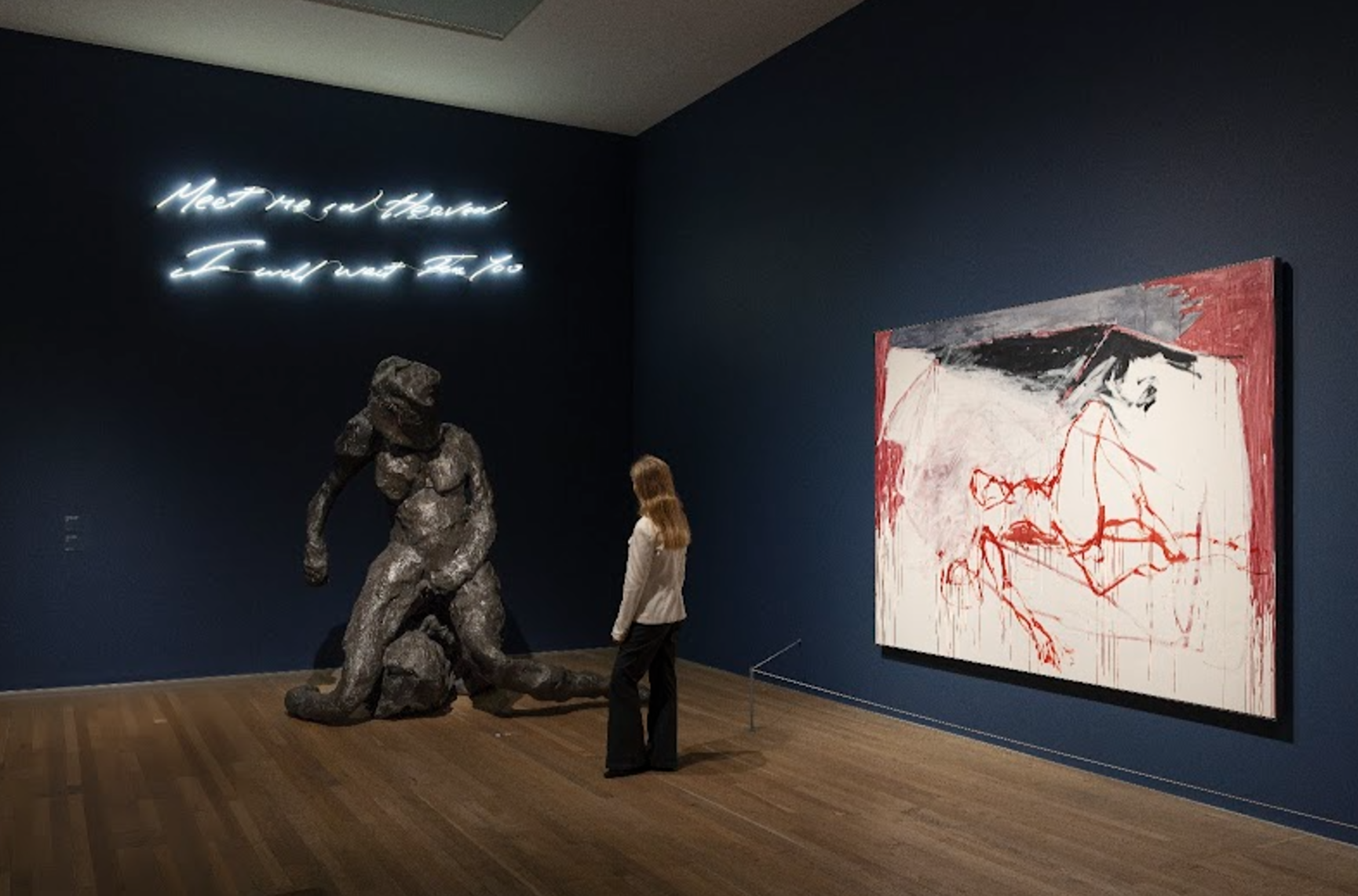
The exhibition, curated by Maria Balshaw, encompasses forty years of Emin’s career, including paintings, film, photographs, sculpture, textiles, neon signs and a great deal of stream-of-consciousness writing on A4 sheets of paper. The most recent works are paintings from 2024. The exhibition opens with Hotel International (1993), a colourful appliquéd blanket stitched with phrases and pieces of clothing alongside handwritten prose. One text recalls a period of temporary homelessness during her childhood. Another recounts a violent confrontation with a former roommate: “She picked up her favourite art deco vase, ran across the room and smashed it across my head.” The heaviness of the exhibition never really lets up, nor are we given a moment of release.
In the next room, a Super 8 film titled Why I Never Became a Dancer (1995) shows Emin recounting sexual encounters she had as a teenager with older men she met at the pub, remarking, “It didn’t matter that I was 13… 14 years old.” She describes these encounters in a matter-of-fact tone, almost detached. The same men, whom she goes on to name, later heckle her while she performs in a dance competition. By the end of the film, her rage is palpable.
The layout of the exhibition, however, feels puzzling and at times inaccessible. Important text is hidden behind the installation Exorcism of the Last Painting I Ever Made (1996), and there are rooms dedicated to abortion-themed works. The first half of the show is dominated by handwritten notebook pages, 32 of them making up Exploration of the Soul (1994). During both of my visits, viewers clustered around these works three people deep. Unless your face was inches from the pages, and even then, the writing was extremely difficult to decipher. For an artist whose work relies so heavily on confession and language, this feels like a curatorial misstep. The absence of a booklet or typed transcript makes much of the text inaccessible, an unfortunate decision given both the sensitivity of the subject matter and the sheer number of visitors passing through the space.
.jpg)
A dull navy-blue shade, similar to the colour that appears in several of Emin’s paintings, covers the walls of the entire exhibition. The colour is reminiscent of a teenage boy’s bedroom. I could almost smell the dirty socks, but perhaps that was the point.
A long, narrow corridor contains glass vitrines on either side, showcasing two different series of self-portraits from different moments in Emin’s career. The first, Self-portraits (2001), consists of roughly ten to fifteen Polaroids: close-up shots of a younger Emin, her chest in a black lace bra, folds of her stomach and hair falling across her face. They feel youthful and demure, a time capsule of an earlier period in her life, but also of an outdated cultural hesitancy around female self-portraiture.
On the opposite side are Self-portraits (2020–2025), featuring iPhone images and nude mirror selfies taken after surgery. These photographs show her stoma bag, surgical incisions, bloody bandages and blood running down her stomach into her crotch. It is uncomfortable to look at the deteriorating effects of cancer and ageing on the body. Yet this, to me, is the most radical and intimate work in the entire exhibition. It challenges how we define the abject. Placed side by side, the two series highlight both the vastness and resilience of the body. It is Emin at her best, not just criticising the performance of femininity, but expanding it.
Today, conversations about abortion, sexual violence and the general grit of being a woman are not only present in popular culture but critically acclaimed. From Lena Dunham’s Girls, to I May Destroy You by Michaela Coel, to Bad Feminist by Roxane Gay, honesty is no longer disturbing, but rather commercial and critically acclaimed.
But it did not used to be this way. Women’s stories, especially those that are neither romantic nor sexy, once drew side-eyes and the familiar question: “Is this really the time for that?” Emin is one of many artists who helped shift that dial. Emin made them listen.
Tracey Emin: A Second Life is showing at the Tate Modern from 27 February – 31 August 2026. Don't forget to check in and leave your review in the gowithYamo app!


A horde of sweaty press and art-world fixtures stood in a crowd, eagerly awaiting entry to one of the most anticipated exhibitions at Tate Modern in 2026: Tracey Emin: A Second Life. On a weekday afternoon, a few days after the opening, I returned to the exhibition to find a crowd of equal size. What can you say? People love Tracey Emin.
Emin is one of the most well-known contemporary female artists. Her ever-quotable neon signs were once a Tumblr staple. She entered the art scene at the tail end of the abject feminist art movement of the 1980s and 1990s, when artists such as Cindy Sherman and Sarah Lucas were exploring the female body and its various fluids as a way to challenge patriarchal standards of repulsion and desire. Emin’s work has largely, if not exclusively, focused on depictions of aspects of the female experience, or at least her experience as a woman, that are considered taboo like sexual violence and abortion. In 1993, Emin opened an art and clothing boutique with Lucas in Bethnal Green called “The Shop.” Both Emin and the feminist artists who came before her created work that challenged the notion of chaste and pure femininity, instead championing unruliness, excess, and emotional exposure.
An unmade bed, with stained sheets and a miscellaneous pile of trash including a stuffed animal, a packet of McDonald’s barbecue sauce, a vodka bottle and used condoms, spills across the floor like a shrine to the messiness of women. Emin’s most famous work, My Bed (1998), was first exhibited at the Tate Britain, then known as the Tate Gallery, in 1999, where it was shortlisted for the Turner Prize. It was shocking and refreshing, a look behind the curtain of the typical and expected performance of femininity. Now, 27 years later, it is on display again as part of her largest survey exhibition yet at the Tate Modern.
In the decades since, leaps and bounds have been made in what is widely accepted in the mainstream as depictions of the female experience. Today, multiple popular Instagram accounts post submitted photos of #girlrooms and #girlclutter and few bat an eye. “Bedrotting” is now both an activity and a slang term that has entered mainstream vocabulary.
The exhibition, curated by Maria Balshaw, encompasses forty years of Emin’s career, including paintings, film, photographs, sculpture, textiles, neon signs and a great deal of stream-of-consciousness writing on A4 sheets of paper. The most recent works are paintings from 2024. The exhibition opens with Hotel International (1993), a colourful appliquéd blanket stitched with phrases and pieces of clothing alongside handwritten prose. One text recalls a period of temporary homelessness during her childhood. Another recounts a violent confrontation with a former roommate: “She picked up her favourite art deco vase, ran across the room and smashed it across my head.” The heaviness of the exhibition never really lets up, nor are we given a moment of release.
In the next room, a Super 8 film titled Why I Never Became a Dancer (1995) shows Emin recounting sexual encounters she had as a teenager with older men she met at the pub, remarking, “It didn’t matter that I was 13… 14 years old.” She describes these encounters in a matter-of-fact tone, almost detached. The same men, whom she goes on to name, later heckle her while she performs in a dance competition. By the end of the film, her rage is palpable.
The layout of the exhibition, however, feels puzzling and at times inaccessible. Important text is hidden behind the installation Exorcism of the Last Painting I Ever Made (1996), and there are rooms dedicated to abortion-themed works. The first half of the show is dominated by handwritten notebook pages, 32 of them making up Exploration of the Soul (1994). During both of my visits, viewers clustered around these works three people deep. Unless your face was inches from the pages, and even then, the writing was extremely difficult to decipher. For an artist whose work relies so heavily on confession and language, this feels like a curatorial misstep. The absence of a booklet or typed transcript makes much of the text inaccessible, an unfortunate decision given both the sensitivity of the subject matter and the sheer number of visitors passing through the space.
A dull navy-blue shade, similar to the colour that appears in several of Emin’s paintings, covers the walls of the entire exhibition. The colour is reminiscent of a teenage boy’s bedroom. I could almost smell the dirty socks, but perhaps that was the point.
A long, narrow corridor contains glass vitrines on either side, showcasing two different series of self-portraits from different moments in Emin’s career. The first, Self-portraits (2001), consists of roughly ten to fifteen Polaroids: close-up shots of a younger Emin, her chest in a black lace bra, folds of her stomach and hair falling across her face. They feel youthful and demure, a time capsule of an earlier period in her life, but also of an outdated cultural hesitancy around female self-portraiture.
On the opposite side are Self-portraits (2020–2025), featuring iPhone images and nude mirror selfies taken after surgery. These photographs show her stoma bag, surgical incisions, bloody bandages and blood running down her stomach into her crotch. It is uncomfortable to look at the deteriorating effects of cancer and ageing on the body. Yet this, to me, is the most radical and intimate work in the entire exhibition. It challenges how we define the abject. Placed side by side, the two series highlight both the vastness and resilience of the body. It is Emin at her best, not just criticising the performance of femininity, but expanding it.
Today, conversations about abortion, sexual violence and the general grit of being a woman are not only present in popular culture but critically acclaimed. From Lena Dunham’s Girls, to I May Destroy You by Michaela Coel, to Bad Feminist by Roxane Gay, honesty is no longer disturbing, but rather commercial and critically acclaimed.
But it did not used to be this way. Women’s stories, especially those that are neither romantic nor sexy, once drew side-eyes and the familiar question: “Is this really the time for that?” Emin is one of many artists who helped shift that dial. Emin made them listen.
Tracey Emin: A Second Life is showing at the Tate Modern from 27 February – 31 August 2026. Don't forget to check in and leave your review in the gowithYamo app!
A horde of sweaty press and art-world fixtures stood in a crowd, eagerly awaiting entry to one of the most anticipated exhibitions at Tate Modern in 2026: Tracey Emin: A Second Life. On a weekday afternoon, a few days after the opening, I returned to the exhibition to find a crowd of equal size. What can you say? People love Tracey Emin.
Emin is one of the most well-known contemporary female artists. Her ever-quotable neon signs were once a Tumblr staple. She entered the art scene at the tail end of the abject feminist art movement of the 1980s and 1990s, when artists such as Cindy Sherman and Sarah Lucas were exploring the female body and its various fluids as a way to challenge patriarchal standards of repulsion and desire. Emin’s work has largely, if not exclusively, focused on depictions of aspects of the female experience, or at least her experience as a woman, that are considered taboo like sexual violence and abortion. In 1993, Emin opened an art and clothing boutique with Lucas in Bethnal Green called “The Shop.” Both Emin and the feminist artists who came before her created work that challenged the notion of chaste and pure femininity, instead championing unruliness, excess, and emotional exposure.
An unmade bed, with stained sheets and a miscellaneous pile of trash including a stuffed animal, a packet of McDonald’s barbecue sauce, a vodka bottle and used condoms, spills across the floor like a shrine to the messiness of women. Emin’s most famous work, My Bed (1998), was first exhibited at the Tate Britain, then known as the Tate Gallery, in 1999, where it was shortlisted for the Turner Prize. It was shocking and refreshing, a look behind the curtain of the typical and expected performance of femininity. Now, 27 years later, it is on display again as part of her largest survey exhibition yet at the Tate Modern.
In the decades since, leaps and bounds have been made in what is widely accepted in the mainstream as depictions of the female experience. Today, multiple popular Instagram accounts post submitted photos of #girlrooms and #girlclutter and few bat an eye. “Bedrotting” is now both an activity and a slang term that has entered mainstream vocabulary.
The exhibition, curated by Maria Balshaw, encompasses forty years of Emin’s career, including paintings, film, photographs, sculpture, textiles, neon signs and a great deal of stream-of-consciousness writing on A4 sheets of paper. The most recent works are paintings from 2024. The exhibition opens with Hotel International (1993), a colourful appliquéd blanket stitched with phrases and pieces of clothing alongside handwritten prose. One text recalls a period of temporary homelessness during her childhood. Another recounts a violent confrontation with a former roommate: “She picked up her favourite art deco vase, ran across the room and smashed it across my head.” The heaviness of the exhibition never really lets up, nor are we given a moment of release.
In the next room, a Super 8 film titled Why I Never Became a Dancer (1995) shows Emin recounting sexual encounters she had as a teenager with older men she met at the pub, remarking, “It didn’t matter that I was 13… 14 years old.” She describes these encounters in a matter-of-fact tone, almost detached. The same men, whom she goes on to name, later heckle her while she performs in a dance competition. By the end of the film, her rage is palpable.
The layout of the exhibition, however, feels puzzling and at times inaccessible. Important text is hidden behind the installation Exorcism of the Last Painting I Ever Made (1996), and there are rooms dedicated to abortion-themed works. The first half of the show is dominated by handwritten notebook pages, 32 of them making up Exploration of the Soul (1994). During both of my visits, viewers clustered around these works three people deep. Unless your face was inches from the pages, and even then, the writing was extremely difficult to decipher. For an artist whose work relies so heavily on confession and language, this feels like a curatorial misstep. The absence of a booklet or typed transcript makes much of the text inaccessible, an unfortunate decision given both the sensitivity of the subject matter and the sheer number of visitors passing through the space.
A dull navy-blue shade, similar to the colour that appears in several of Emin’s paintings, covers the walls of the entire exhibition. The colour is reminiscent of a teenage boy’s bedroom. I could almost smell the dirty socks, but perhaps that was the point.
A long, narrow corridor contains glass vitrines on either side, showcasing two different series of self-portraits from different moments in Emin’s career. The first, Self-portraits (2001), consists of roughly ten to fifteen Polaroids: close-up shots of a younger Emin, her chest in a black lace bra, folds of her stomach and hair falling across her face. They feel youthful and demure, a time capsule of an earlier period in her life, but also of an outdated cultural hesitancy around female self-portraiture.
On the opposite side are Self-portraits (2020–2025), featuring iPhone images and nude mirror selfies taken after surgery. These photographs show her stoma bag, surgical incisions, bloody bandages and blood running down her stomach into her crotch. It is uncomfortable to look at the deteriorating effects of cancer and ageing on the body. Yet this, to me, is the most radical and intimate work in the entire exhibition. It challenges how we define the abject. Placed side by side, the two series highlight both the vastness and resilience of the body. It is Emin at her best, not just criticising the performance of femininity, but expanding it.
Today, conversations about abortion, sexual violence and the general grit of being a woman are not only present in popular culture but critically acclaimed. From Lena Dunham’s Girls, to I May Destroy You by Michaela Coel, to Bad Feminist by Roxane Gay, honesty is no longer disturbing, but rather commercial and critically acclaimed.
But it did not used to be this way. Women’s stories, especially those that are neither romantic nor sexy, once drew side-eyes and the familiar question: “Is this really the time for that?” Emin is one of many artists who helped shift that dial. Emin made them listen.
Tracey Emin: A Second Life is showing at the Tate Modern from 27 February – 31 August 2026. Don't forget to check in and leave your review in the gowithYamo app!
A horde of sweaty press and art-world fixtures stood in a crowd, eagerly awaiting entry to one of the most anticipated exhibitions at Tate Modern in 2026: Tracey Emin: A Second Life. On a weekday afternoon, a few days after the opening, I returned to the exhibition to find a crowd of equal size. What can you say? People love Tracey Emin.
Emin is one of the most well-known contemporary female artists. Her ever-quotable neon signs were once a Tumblr staple. She entered the art scene at the tail end of the abject feminist art movement of the 1980s and 1990s, when artists such as Cindy Sherman and Sarah Lucas were exploring the female body and its various fluids as a way to challenge patriarchal standards of repulsion and desire. Emin’s work has largely, if not exclusively, focused on depictions of aspects of the female experience, or at least her experience as a woman, that are considered taboo like sexual violence and abortion. In 1993, Emin opened an art and clothing boutique with Lucas in Bethnal Green called “The Shop.” Both Emin and the feminist artists who came before her created work that challenged the notion of chaste and pure femininity, instead championing unruliness, excess, and emotional exposure.
An unmade bed, with stained sheets and a miscellaneous pile of trash including a stuffed animal, a packet of McDonald’s barbecue sauce, a vodka bottle and used condoms, spills across the floor like a shrine to the messiness of women. Emin’s most famous work, My Bed (1998), was first exhibited at the Tate Britain, then known as the Tate Gallery, in 1999, where it was shortlisted for the Turner Prize. It was shocking and refreshing, a look behind the curtain of the typical and expected performance of femininity. Now, 27 years later, it is on display again as part of her largest survey exhibition yet at the Tate Modern.
In the decades since, leaps and bounds have been made in what is widely accepted in the mainstream as depictions of the female experience. Today, multiple popular Instagram accounts post submitted photos of #girlrooms and #girlclutter and few bat an eye. “Bedrotting” is now both an activity and a slang term that has entered mainstream vocabulary.
The exhibition, curated by Maria Balshaw, encompasses forty years of Emin’s career, including paintings, film, photographs, sculpture, textiles, neon signs and a great deal of stream-of-consciousness writing on A4 sheets of paper. The most recent works are paintings from 2024. The exhibition opens with Hotel International (1993), a colourful appliquéd blanket stitched with phrases and pieces of clothing alongside handwritten prose. One text recalls a period of temporary homelessness during her childhood. Another recounts a violent confrontation with a former roommate: “She picked up her favourite art deco vase, ran across the room and smashed it across my head.” The heaviness of the exhibition never really lets up, nor are we given a moment of release.
In the next room, a Super 8 film titled Why I Never Became a Dancer (1995) shows Emin recounting sexual encounters she had as a teenager with older men she met at the pub, remarking, “It didn’t matter that I was 13… 14 years old.” She describes these encounters in a matter-of-fact tone, almost detached. The same men, whom she goes on to name, later heckle her while she performs in a dance competition. By the end of the film, her rage is palpable.
The layout of the exhibition, however, feels puzzling and at times inaccessible. Important text is hidden behind the installation Exorcism of the Last Painting I Ever Made (1996), and there are rooms dedicated to abortion-themed works. The first half of the show is dominated by handwritten notebook pages, 32 of them making up Exploration of the Soul (1994). During both of my visits, viewers clustered around these works three people deep. Unless your face was inches from the pages, and even then, the writing was extremely difficult to decipher. For an artist whose work relies so heavily on confession and language, this feels like a curatorial misstep. The absence of a booklet or typed transcript makes much of the text inaccessible, an unfortunate decision given both the sensitivity of the subject matter and the sheer number of visitors passing through the space.
A dull navy-blue shade, similar to the colour that appears in several of Emin’s paintings, covers the walls of the entire exhibition. The colour is reminiscent of a teenage boy’s bedroom. I could almost smell the dirty socks, but perhaps that was the point.
A long, narrow corridor contains glass vitrines on either side, showcasing two different series of self-portraits from different moments in Emin’s career. The first, Self-portraits (2001), consists of roughly ten to fifteen Polaroids: close-up shots of a younger Emin, her chest in a black lace bra, folds of her stomach and hair falling across her face. They feel youthful and demure, a time capsule of an earlier period in her life, but also of an outdated cultural hesitancy around female self-portraiture.
On the opposite side are Self-portraits (2020–2025), featuring iPhone images and nude mirror selfies taken after surgery. These photographs show her stoma bag, surgical incisions, bloody bandages and blood running down her stomach into her crotch. It is uncomfortable to look at the deteriorating effects of cancer and ageing on the body. Yet this, to me, is the most radical and intimate work in the entire exhibition. It challenges how we define the abject. Placed side by side, the two series highlight both the vastness and resilience of the body. It is Emin at her best, not just criticising the performance of femininity, but expanding it.
Today, conversations about abortion, sexual violence and the general grit of being a woman are not only present in popular culture but critically acclaimed. From Lena Dunham’s Girls, to I May Destroy You by Michaela Coel, to Bad Feminist by Roxane Gay, honesty is no longer disturbing, but rather commercial and critically acclaimed.
But it did not used to be this way. Women’s stories, especially those that are neither romantic nor sexy, once drew side-eyes and the familiar question: “Is this really the time for that?” Emin is one of many artists who helped shift that dial. Emin made them listen.
Tracey Emin: A Second Life is showing at the Tate Modern from 27 February – 31 August 2026. Don't forget to check in and leave your review in the gowithYamo app!
A horde of sweaty press and art-world fixtures stood in a crowd, eagerly awaiting entry to one of the most anticipated exhibitions at Tate Modern in 2026: Tracey Emin: A Second Life. On a weekday afternoon, a few days after the opening, I returned to the exhibition to find a crowd of equal size. What can you say? People love Tracey Emin.
Emin is one of the most well-known contemporary female artists. Her ever-quotable neon signs were once a Tumblr staple. She entered the art scene at the tail end of the abject feminist art movement of the 1980s and 1990s, when artists such as Cindy Sherman and Sarah Lucas were exploring the female body and its various fluids as a way to challenge patriarchal standards of repulsion and desire. Emin’s work has largely, if not exclusively, focused on depictions of aspects of the female experience, or at least her experience as a woman, that are considered taboo like sexual violence and abortion. In 1993, Emin opened an art and clothing boutique with Lucas in Bethnal Green called “The Shop.” Both Emin and the feminist artists who came before her created work that challenged the notion of chaste and pure femininity, instead championing unruliness, excess, and emotional exposure.
An unmade bed, with stained sheets and a miscellaneous pile of trash including a stuffed animal, a packet of McDonald’s barbecue sauce, a vodka bottle and used condoms, spills across the floor like a shrine to the messiness of women. Emin’s most famous work, My Bed (1998), was first exhibited at the Tate Britain, then known as the Tate Gallery, in 1999, where it was shortlisted for the Turner Prize. It was shocking and refreshing, a look behind the curtain of the typical and expected performance of femininity. Now, 27 years later, it is on display again as part of her largest survey exhibition yet at the Tate Modern.
In the decades since, leaps and bounds have been made in what is widely accepted in the mainstream as depictions of the female experience. Today, multiple popular Instagram accounts post submitted photos of #girlrooms and #girlclutter and few bat an eye. “Bedrotting” is now both an activity and a slang term that has entered mainstream vocabulary.
The exhibition, curated by Maria Balshaw, encompasses forty years of Emin’s career, including paintings, film, photographs, sculpture, textiles, neon signs and a great deal of stream-of-consciousness writing on A4 sheets of paper. The most recent works are paintings from 2024. The exhibition opens with Hotel International (1993), a colourful appliquéd blanket stitched with phrases and pieces of clothing alongside handwritten prose. One text recalls a period of temporary homelessness during her childhood. Another recounts a violent confrontation with a former roommate: “She picked up her favourite art deco vase, ran across the room and smashed it across my head.” The heaviness of the exhibition never really lets up, nor are we given a moment of release.
In the next room, a Super 8 film titled Why I Never Became a Dancer (1995) shows Emin recounting sexual encounters she had as a teenager with older men she met at the pub, remarking, “It didn’t matter that I was 13… 14 years old.” She describes these encounters in a matter-of-fact tone, almost detached. The same men, whom she goes on to name, later heckle her while she performs in a dance competition. By the end of the film, her rage is palpable.
The layout of the exhibition, however, feels puzzling and at times inaccessible. Important text is hidden behind the installation Exorcism of the Last Painting I Ever Made (1996), and there are rooms dedicated to abortion-themed works. The first half of the show is dominated by handwritten notebook pages, 32 of them making up Exploration of the Soul (1994). During both of my visits, viewers clustered around these works three people deep. Unless your face was inches from the pages, and even then, the writing was extremely difficult to decipher. For an artist whose work relies so heavily on confession and language, this feels like a curatorial misstep. The absence of a booklet or typed transcript makes much of the text inaccessible, an unfortunate decision given both the sensitivity of the subject matter and the sheer number of visitors passing through the space.
A dull navy-blue shade, similar to the colour that appears in several of Emin’s paintings, covers the walls of the entire exhibition. The colour is reminiscent of a teenage boy’s bedroom. I could almost smell the dirty socks, but perhaps that was the point.
A long, narrow corridor contains glass vitrines on either side, showcasing two different series of self-portraits from different moments in Emin’s career. The first, Self-portraits (2001), consists of roughly ten to fifteen Polaroids: close-up shots of a younger Emin, her chest in a black lace bra, folds of her stomach and hair falling across her face. They feel youthful and demure, a time capsule of an earlier period in her life, but also of an outdated cultural hesitancy around female self-portraiture.
On the opposite side are Self-portraits (2020–2025), featuring iPhone images and nude mirror selfies taken after surgery. These photographs show her stoma bag, surgical incisions, bloody bandages and blood running down her stomach into her crotch. It is uncomfortable to look at the deteriorating effects of cancer and ageing on the body. Yet this, to me, is the most radical and intimate work in the entire exhibition. It challenges how we define the abject. Placed side by side, the two series highlight both the vastness and resilience of the body. It is Emin at her best, not just criticising the performance of femininity, but expanding it.
Today, conversations about abortion, sexual violence and the general grit of being a woman are not only present in popular culture but critically acclaimed. From Lena Dunham’s Girls, to I May Destroy You by Michaela Coel, to Bad Feminist by Roxane Gay, honesty is no longer disturbing, but rather commercial and critically acclaimed.
But it did not used to be this way. Women’s stories, especially those that are neither romantic nor sexy, once drew side-eyes and the familiar question: “Is this really the time for that?” Emin is one of many artists who helped shift that dial. Emin made them listen.
Tracey Emin: A Second Life is showing at the Tate Modern from 27 February – 31 August 2026. Don't forget to check in and leave your review in the gowithYamo app!
A horde of sweaty press and art-world fixtures stood in a crowd, eagerly awaiting entry to one of the most anticipated exhibitions at Tate Modern in 2026: Tracey Emin: A Second Life. On a weekday afternoon, a few days after the opening, I returned to the exhibition to find a crowd of equal size. What can you say? People love Tracey Emin.
Emin is one of the most well-known contemporary female artists. Her ever-quotable neon signs were once a Tumblr staple. She entered the art scene at the tail end of the abject feminist art movement of the 1980s and 1990s, when artists such as Cindy Sherman and Sarah Lucas were exploring the female body and its various fluids as a way to challenge patriarchal standards of repulsion and desire. Emin’s work has largely, if not exclusively, focused on depictions of aspects of the female experience, or at least her experience as a woman, that are considered taboo like sexual violence and abortion. In 1993, Emin opened an art and clothing boutique with Lucas in Bethnal Green called “The Shop.” Both Emin and the feminist artists who came before her created work that challenged the notion of chaste and pure femininity, instead championing unruliness, excess, and emotional exposure.
An unmade bed, with stained sheets and a miscellaneous pile of trash including a stuffed animal, a packet of McDonald’s barbecue sauce, a vodka bottle and used condoms, spills across the floor like a shrine to the messiness of women. Emin’s most famous work, My Bed (1998), was first exhibited at the Tate Britain, then known as the Tate Gallery, in 1999, where it was shortlisted for the Turner Prize. It was shocking and refreshing, a look behind the curtain of the typical and expected performance of femininity. Now, 27 years later, it is on display again as part of her largest survey exhibition yet at the Tate Modern.
In the decades since, leaps and bounds have been made in what is widely accepted in the mainstream as depictions of the female experience. Today, multiple popular Instagram accounts post submitted photos of #girlrooms and #girlclutter and few bat an eye. “Bedrotting” is now both an activity and a slang term that has entered mainstream vocabulary.
The exhibition, curated by Maria Balshaw, encompasses forty years of Emin’s career, including paintings, film, photographs, sculpture, textiles, neon signs and a great deal of stream-of-consciousness writing on A4 sheets of paper. The most recent works are paintings from 2024. The exhibition opens with Hotel International (1993), a colourful appliquéd blanket stitched with phrases and pieces of clothing alongside handwritten prose. One text recalls a period of temporary homelessness during her childhood. Another recounts a violent confrontation with a former roommate: “She picked up her favourite art deco vase, ran across the room and smashed it across my head.” The heaviness of the exhibition never really lets up, nor are we given a moment of release.
In the next room, a Super 8 film titled Why I Never Became a Dancer (1995) shows Emin recounting sexual encounters she had as a teenager with older men she met at the pub, remarking, “It didn’t matter that I was 13… 14 years old.” She describes these encounters in a matter-of-fact tone, almost detached. The same men, whom she goes on to name, later heckle her while she performs in a dance competition. By the end of the film, her rage is palpable.
The layout of the exhibition, however, feels puzzling and at times inaccessible. Important text is hidden behind the installation Exorcism of the Last Painting I Ever Made (1996), and there are rooms dedicated to abortion-themed works. The first half of the show is dominated by handwritten notebook pages, 32 of them making up Exploration of the Soul (1994). During both of my visits, viewers clustered around these works three people deep. Unless your face was inches from the pages, and even then, the writing was extremely difficult to decipher. For an artist whose work relies so heavily on confession and language, this feels like a curatorial misstep. The absence of a booklet or typed transcript makes much of the text inaccessible, an unfortunate decision given both the sensitivity of the subject matter and the sheer number of visitors passing through the space.
A dull navy-blue shade, similar to the colour that appears in several of Emin’s paintings, covers the walls of the entire exhibition. The colour is reminiscent of a teenage boy’s bedroom. I could almost smell the dirty socks, but perhaps that was the point.
A long, narrow corridor contains glass vitrines on either side, showcasing two different series of self-portraits from different moments in Emin’s career. The first, Self-portraits (2001), consists of roughly ten to fifteen Polaroids: close-up shots of a younger Emin, her chest in a black lace bra, folds of her stomach and hair falling across her face. They feel youthful and demure, a time capsule of an earlier period in her life, but also of an outdated cultural hesitancy around female self-portraiture.
On the opposite side are Self-portraits (2020–2025), featuring iPhone images and nude mirror selfies taken after surgery. These photographs show her stoma bag, surgical incisions, bloody bandages and blood running down her stomach into her crotch. It is uncomfortable to look at the deteriorating effects of cancer and ageing on the body. Yet this, to me, is the most radical and intimate work in the entire exhibition. It challenges how we define the abject. Placed side by side, the two series highlight both the vastness and resilience of the body. It is Emin at her best, not just criticising the performance of femininity, but expanding it.
Today, conversations about abortion, sexual violence and the general grit of being a woman are not only present in popular culture but critically acclaimed. From Lena Dunham’s Girls, to I May Destroy You by Michaela Coel, to Bad Feminist by Roxane Gay, honesty is no longer disturbing, but rather commercial and critically acclaimed.
But it did not used to be this way. Women’s stories, especially those that are neither romantic nor sexy, once drew side-eyes and the familiar question: “Is this really the time for that?” Emin is one of many artists who helped shift that dial. Emin made them listen.
Tracey Emin: A Second Life is showing at the Tate Modern from 27 February – 31 August 2026. Don't forget to check in and leave your review in the gowithYamo app!
A horde of sweaty press and art-world fixtures stood in a crowd, eagerly awaiting entry to one of the most anticipated exhibitions at Tate Modern in 2026: Tracey Emin: A Second Life. On a weekday afternoon, a few days after the opening, I returned to the exhibition to find a crowd of equal size. What can you say? People love Tracey Emin.
Emin is one of the most well-known contemporary female artists. Her ever-quotable neon signs were once a Tumblr staple. She entered the art scene at the tail end of the abject feminist art movement of the 1980s and 1990s, when artists such as Cindy Sherman and Sarah Lucas were exploring the female body and its various fluids as a way to challenge patriarchal standards of repulsion and desire. Emin’s work has largely, if not exclusively, focused on depictions of aspects of the female experience, or at least her experience as a woman, that are considered taboo like sexual violence and abortion. In 1993, Emin opened an art and clothing boutique with Lucas in Bethnal Green called “The Shop.” Both Emin and the feminist artists who came before her created work that challenged the notion of chaste and pure femininity, instead championing unruliness, excess, and emotional exposure.
An unmade bed, with stained sheets and a miscellaneous pile of trash including a stuffed animal, a packet of McDonald’s barbecue sauce, a vodka bottle and used condoms, spills across the floor like a shrine to the messiness of women. Emin’s most famous work, My Bed (1998), was first exhibited at the Tate Britain, then known as the Tate Gallery, in 1999, where it was shortlisted for the Turner Prize. It was shocking and refreshing, a look behind the curtain of the typical and expected performance of femininity. Now, 27 years later, it is on display again as part of her largest survey exhibition yet at the Tate Modern.
In the decades since, leaps and bounds have been made in what is widely accepted in the mainstream as depictions of the female experience. Today, multiple popular Instagram accounts post submitted photos of #girlrooms and #girlclutter and few bat an eye. “Bedrotting” is now both an activity and a slang term that has entered mainstream vocabulary.
The exhibition, curated by Maria Balshaw, encompasses forty years of Emin’s career, including paintings, film, photographs, sculpture, textiles, neon signs and a great deal of stream-of-consciousness writing on A4 sheets of paper. The most recent works are paintings from 2024. The exhibition opens with Hotel International (1993), a colourful appliquéd blanket stitched with phrases and pieces of clothing alongside handwritten prose. One text recalls a period of temporary homelessness during her childhood. Another recounts a violent confrontation with a former roommate: “She picked up her favourite art deco vase, ran across the room and smashed it across my head.” The heaviness of the exhibition never really lets up, nor are we given a moment of release.
In the next room, a Super 8 film titled Why I Never Became a Dancer (1995) shows Emin recounting sexual encounters she had as a teenager with older men she met at the pub, remarking, “It didn’t matter that I was 13… 14 years old.” She describes these encounters in a matter-of-fact tone, almost detached. The same men, whom she goes on to name, later heckle her while she performs in a dance competition. By the end of the film, her rage is palpable.
The layout of the exhibition, however, feels puzzling and at times inaccessible. Important text is hidden behind the installation Exorcism of the Last Painting I Ever Made (1996), and there are rooms dedicated to abortion-themed works. The first half of the show is dominated by handwritten notebook pages, 32 of them making up Exploration of the Soul (1994). During both of my visits, viewers clustered around these works three people deep. Unless your face was inches from the pages, and even then, the writing was extremely difficult to decipher. For an artist whose work relies so heavily on confession and language, this feels like a curatorial misstep. The absence of a booklet or typed transcript makes much of the text inaccessible, an unfortunate decision given both the sensitivity of the subject matter and the sheer number of visitors passing through the space.
A dull navy-blue shade, similar to the colour that appears in several of Emin’s paintings, covers the walls of the entire exhibition. The colour is reminiscent of a teenage boy’s bedroom. I could almost smell the dirty socks, but perhaps that was the point.
A long, narrow corridor contains glass vitrines on either side, showcasing two different series of self-portraits from different moments in Emin’s career. The first, Self-portraits (2001), consists of roughly ten to fifteen Polaroids: close-up shots of a younger Emin, her chest in a black lace bra, folds of her stomach and hair falling across her face. They feel youthful and demure, a time capsule of an earlier period in her life, but also of an outdated cultural hesitancy around female self-portraiture.
On the opposite side are Self-portraits (2020–2025), featuring iPhone images and nude mirror selfies taken after surgery. These photographs show her stoma bag, surgical incisions, bloody bandages and blood running down her stomach into her crotch. It is uncomfortable to look at the deteriorating effects of cancer and ageing on the body. Yet this, to me, is the most radical and intimate work in the entire exhibition. It challenges how we define the abject. Placed side by side, the two series highlight both the vastness and resilience of the body. It is Emin at her best, not just criticising the performance of femininity, but expanding it.
Today, conversations about abortion, sexual violence and the general grit of being a woman are not only present in popular culture but critically acclaimed. From Lena Dunham’s Girls, to I May Destroy You by Michaela Coel, to Bad Feminist by Roxane Gay, honesty is no longer disturbing, but rather commercial and critically acclaimed.
But it did not used to be this way. Women’s stories, especially those that are neither romantic nor sexy, once drew side-eyes and the familiar question: “Is this really the time for that?” Emin is one of many artists who helped shift that dial. Emin made them listen.
Tracey Emin: A Second Life is showing at the Tate Modern from 27 February – 31 August 2026. Don't forget to check in and leave your review in the gowithYamo app!
A horde of sweaty press and art-world fixtures stood in a crowd, eagerly awaiting entry to one of the most anticipated exhibitions at Tate Modern in 2026: Tracey Emin: A Second Life. On a weekday afternoon, a few days after the opening, I returned to the exhibition to find a crowd of equal size. What can you say? People love Tracey Emin.
Emin is one of the most well-known contemporary female artists. Her ever-quotable neon signs were once a Tumblr staple. She entered the art scene at the tail end of the abject feminist art movement of the 1980s and 1990s, when artists such as Cindy Sherman and Sarah Lucas were exploring the female body and its various fluids as a way to challenge patriarchal standards of repulsion and desire. Emin’s work has largely, if not exclusively, focused on depictions of aspects of the female experience, or at least her experience as a woman, that are considered taboo like sexual violence and abortion. In 1993, Emin opened an art and clothing boutique with Lucas in Bethnal Green called “The Shop.” Both Emin and the feminist artists who came before her created work that challenged the notion of chaste and pure femininity, instead championing unruliness, excess, and emotional exposure.
An unmade bed, with stained sheets and a miscellaneous pile of trash including a stuffed animal, a packet of McDonald’s barbecue sauce, a vodka bottle and used condoms, spills across the floor like a shrine to the messiness of women. Emin’s most famous work, My Bed (1998), was first exhibited at the Tate Britain, then known as the Tate Gallery, in 1999, where it was shortlisted for the Turner Prize. It was shocking and refreshing, a look behind the curtain of the typical and expected performance of femininity. Now, 27 years later, it is on display again as part of her largest survey exhibition yet at the Tate Modern.
In the decades since, leaps and bounds have been made in what is widely accepted in the mainstream as depictions of the female experience. Today, multiple popular Instagram accounts post submitted photos of #girlrooms and #girlclutter and few bat an eye. “Bedrotting” is now both an activity and a slang term that has entered mainstream vocabulary.
The exhibition, curated by Maria Balshaw, encompasses forty years of Emin’s career, including paintings, film, photographs, sculpture, textiles, neon signs and a great deal of stream-of-consciousness writing on A4 sheets of paper. The most recent works are paintings from 2024. The exhibition opens with Hotel International (1993), a colourful appliquéd blanket stitched with phrases and pieces of clothing alongside handwritten prose. One text recalls a period of temporary homelessness during her childhood. Another recounts a violent confrontation with a former roommate: “She picked up her favourite art deco vase, ran across the room and smashed it across my head.” The heaviness of the exhibition never really lets up, nor are we given a moment of release.
In the next room, a Super 8 film titled Why I Never Became a Dancer (1995) shows Emin recounting sexual encounters she had as a teenager with older men she met at the pub, remarking, “It didn’t matter that I was 13… 14 years old.” She describes these encounters in a matter-of-fact tone, almost detached. The same men, whom she goes on to name, later heckle her while she performs in a dance competition. By the end of the film, her rage is palpable.
The layout of the exhibition, however, feels puzzling and at times inaccessible. Important text is hidden behind the installation Exorcism of the Last Painting I Ever Made (1996), and there are rooms dedicated to abortion-themed works. The first half of the show is dominated by handwritten notebook pages, 32 of them making up Exploration of the Soul (1994). During both of my visits, viewers clustered around these works three people deep. Unless your face was inches from the pages, and even then, the writing was extremely difficult to decipher. For an artist whose work relies so heavily on confession and language, this feels like a curatorial misstep. The absence of a booklet or typed transcript makes much of the text inaccessible, an unfortunate decision given both the sensitivity of the subject matter and the sheer number of visitors passing through the space.
A dull navy-blue shade, similar to the colour that appears in several of Emin’s paintings, covers the walls of the entire exhibition. The colour is reminiscent of a teenage boy’s bedroom. I could almost smell the dirty socks, but perhaps that was the point.
A long, narrow corridor contains glass vitrines on either side, showcasing two different series of self-portraits from different moments in Emin’s career. The first, Self-portraits (2001), consists of roughly ten to fifteen Polaroids: close-up shots of a younger Emin, her chest in a black lace bra, folds of her stomach and hair falling across her face. They feel youthful and demure, a time capsule of an earlier period in her life, but also of an outdated cultural hesitancy around female self-portraiture.
On the opposite side are Self-portraits (2020–2025), featuring iPhone images and nude mirror selfies taken after surgery. These photographs show her stoma bag, surgical incisions, bloody bandages and blood running down her stomach into her crotch. It is uncomfortable to look at the deteriorating effects of cancer and ageing on the body. Yet this, to me, is the most radical and intimate work in the entire exhibition. It challenges how we define the abject. Placed side by side, the two series highlight both the vastness and resilience of the body. It is Emin at her best, not just criticising the performance of femininity, but expanding it.
Today, conversations about abortion, sexual violence and the general grit of being a woman are not only present in popular culture but critically acclaimed. From Lena Dunham’s Girls, to I May Destroy You by Michaela Coel, to Bad Feminist by Roxane Gay, honesty is no longer disturbing, but rather commercial and critically acclaimed.
But it did not used to be this way. Women’s stories, especially those that are neither romantic nor sexy, once drew side-eyes and the familiar question: “Is this really the time for that?” Emin is one of many artists who helped shift that dial. Emin made them listen.
Tracey Emin: A Second Life is showing at the Tate Modern from 27 February – 31 August 2026. Don't forget to check in and leave your review in the gowithYamo app!
A horde of sweaty press and art-world fixtures stood in a crowd, eagerly awaiting entry to one of the most anticipated exhibitions at Tate Modern in 2026: Tracey Emin: A Second Life. On a weekday afternoon, a few days after the opening, I returned to the exhibition to find a crowd of equal size. What can you say? People love Tracey Emin.
Emin is one of the most well-known contemporary female artists. Her ever-quotable neon signs were once a Tumblr staple. She entered the art scene at the tail end of the abject feminist art movement of the 1980s and 1990s, when artists such as Cindy Sherman and Sarah Lucas were exploring the female body and its various fluids as a way to challenge patriarchal standards of repulsion and desire. Emin’s work has largely, if not exclusively, focused on depictions of aspects of the female experience, or at least her experience as a woman, that are considered taboo like sexual violence and abortion. In 1993, Emin opened an art and clothing boutique with Lucas in Bethnal Green called “The Shop.” Both Emin and the feminist artists who came before her created work that challenged the notion of chaste and pure femininity, instead championing unruliness, excess, and emotional exposure.
An unmade bed, with stained sheets and a miscellaneous pile of trash including a stuffed animal, a packet of McDonald’s barbecue sauce, a vodka bottle and used condoms, spills across the floor like a shrine to the messiness of women. Emin’s most famous work, My Bed (1998), was first exhibited at the Tate Britain, then known as the Tate Gallery, in 1999, where it was shortlisted for the Turner Prize. It was shocking and refreshing, a look behind the curtain of the typical and expected performance of femininity. Now, 27 years later, it is on display again as part of her largest survey exhibition yet at the Tate Modern.
In the decades since, leaps and bounds have been made in what is widely accepted in the mainstream as depictions of the female experience. Today, multiple popular Instagram accounts post submitted photos of #girlrooms and #girlclutter and few bat an eye. “Bedrotting” is now both an activity and a slang term that has entered mainstream vocabulary.
The exhibition, curated by Maria Balshaw, encompasses forty years of Emin’s career, including paintings, film, photographs, sculpture, textiles, neon signs and a great deal of stream-of-consciousness writing on A4 sheets of paper. The most recent works are paintings from 2024. The exhibition opens with Hotel International (1993), a colourful appliquéd blanket stitched with phrases and pieces of clothing alongside handwritten prose. One text recalls a period of temporary homelessness during her childhood. Another recounts a violent confrontation with a former roommate: “She picked up her favourite art deco vase, ran across the room and smashed it across my head.” The heaviness of the exhibition never really lets up, nor are we given a moment of release.
In the next room, a Super 8 film titled Why I Never Became a Dancer (1995) shows Emin recounting sexual encounters she had as a teenager with older men she met at the pub, remarking, “It didn’t matter that I was 13… 14 years old.” She describes these encounters in a matter-of-fact tone, almost detached. The same men, whom she goes on to name, later heckle her while she performs in a dance competition. By the end of the film, her rage is palpable.
The layout of the exhibition, however, feels puzzling and at times inaccessible. Important text is hidden behind the installation Exorcism of the Last Painting I Ever Made (1996), and there are rooms dedicated to abortion-themed works. The first half of the show is dominated by handwritten notebook pages, 32 of them making up Exploration of the Soul (1994). During both of my visits, viewers clustered around these works three people deep. Unless your face was inches from the pages, and even then, the writing was extremely difficult to decipher. For an artist whose work relies so heavily on confession and language, this feels like a curatorial misstep. The absence of a booklet or typed transcript makes much of the text inaccessible, an unfortunate decision given both the sensitivity of the subject matter and the sheer number of visitors passing through the space.
A dull navy-blue shade, similar to the colour that appears in several of Emin’s paintings, covers the walls of the entire exhibition. The colour is reminiscent of a teenage boy’s bedroom. I could almost smell the dirty socks, but perhaps that was the point.
A long, narrow corridor contains glass vitrines on either side, showcasing two different series of self-portraits from different moments in Emin’s career. The first, Self-portraits (2001), consists of roughly ten to fifteen Polaroids: close-up shots of a younger Emin, her chest in a black lace bra, folds of her stomach and hair falling across her face. They feel youthful and demure, a time capsule of an earlier period in her life, but also of an outdated cultural hesitancy around female self-portraiture.
On the opposite side are Self-portraits (2020–2025), featuring iPhone images and nude mirror selfies taken after surgery. These photographs show her stoma bag, surgical incisions, bloody bandages and blood running down her stomach into her crotch. It is uncomfortable to look at the deteriorating effects of cancer and ageing on the body. Yet this, to me, is the most radical and intimate work in the entire exhibition. It challenges how we define the abject. Placed side by side, the two series highlight both the vastness and resilience of the body. It is Emin at her best, not just criticising the performance of femininity, but expanding it.
Today, conversations about abortion, sexual violence and the general grit of being a woman are not only present in popular culture but critically acclaimed. From Lena Dunham’s Girls, to I May Destroy You by Michaela Coel, to Bad Feminist by Roxane Gay, honesty is no longer disturbing, but rather commercial and critically acclaimed.
But it did not used to be this way. Women’s stories, especially those that are neither romantic nor sexy, once drew side-eyes and the familiar question: “Is this really the time for that?” Emin is one of many artists who helped shift that dial. Emin made them listen.
Tracey Emin: A Second Life is showing at the Tate Modern from 27 February – 31 August 2026. Don't forget to check in and leave your review in the gowithYamo app!
A horde of sweaty press and art-world fixtures stood in a crowd, eagerly awaiting entry to one of the most anticipated exhibitions at Tate Modern in 2026: Tracey Emin: A Second Life. On a weekday afternoon, a few days after the opening, I returned to the exhibition to find a crowd of equal size. What can you say? People love Tracey Emin.
Emin is one of the most well-known contemporary female artists. Her ever-quotable neon signs were once a Tumblr staple. She entered the art scene at the tail end of the abject feminist art movement of the 1980s and 1990s, when artists such as Cindy Sherman and Sarah Lucas were exploring the female body and its various fluids as a way to challenge patriarchal standards of repulsion and desire. Emin’s work has largely, if not exclusively, focused on depictions of aspects of the female experience, or at least her experience as a woman, that are considered taboo like sexual violence and abortion. In 1993, Emin opened an art and clothing boutique with Lucas in Bethnal Green called “The Shop.” Both Emin and the feminist artists who came before her created work that challenged the notion of chaste and pure femininity, instead championing unruliness, excess, and emotional exposure.
An unmade bed, with stained sheets and a miscellaneous pile of trash including a stuffed animal, a packet of McDonald’s barbecue sauce, a vodka bottle and used condoms, spills across the floor like a shrine to the messiness of women. Emin’s most famous work, My Bed (1998), was first exhibited at the Tate Britain, then known as the Tate Gallery, in 1999, where it was shortlisted for the Turner Prize. It was shocking and refreshing, a look behind the curtain of the typical and expected performance of femininity. Now, 27 years later, it is on display again as part of her largest survey exhibition yet at the Tate Modern.
In the decades since, leaps and bounds have been made in what is widely accepted in the mainstream as depictions of the female experience. Today, multiple popular Instagram accounts post submitted photos of #girlrooms and #girlclutter and few bat an eye. “Bedrotting” is now both an activity and a slang term that has entered mainstream vocabulary.
The exhibition, curated by Maria Balshaw, encompasses forty years of Emin’s career, including paintings, film, photographs, sculpture, textiles, neon signs and a great deal of stream-of-consciousness writing on A4 sheets of paper. The most recent works are paintings from 2024. The exhibition opens with Hotel International (1993), a colourful appliquéd blanket stitched with phrases and pieces of clothing alongside handwritten prose. One text recalls a period of temporary homelessness during her childhood. Another recounts a violent confrontation with a former roommate: “She picked up her favourite art deco vase, ran across the room and smashed it across my head.” The heaviness of the exhibition never really lets up, nor are we given a moment of release.
In the next room, a Super 8 film titled Why I Never Became a Dancer (1995) shows Emin recounting sexual encounters she had as a teenager with older men she met at the pub, remarking, “It didn’t matter that I was 13… 14 years old.” She describes these encounters in a matter-of-fact tone, almost detached. The same men, whom she goes on to name, later heckle her while she performs in a dance competition. By the end of the film, her rage is palpable.
The layout of the exhibition, however, feels puzzling and at times inaccessible. Important text is hidden behind the installation Exorcism of the Last Painting I Ever Made (1996), and there are rooms dedicated to abortion-themed works. The first half of the show is dominated by handwritten notebook pages, 32 of them making up Exploration of the Soul (1994). During both of my visits, viewers clustered around these works three people deep. Unless your face was inches from the pages, and even then, the writing was extremely difficult to decipher. For an artist whose work relies so heavily on confession and language, this feels like a curatorial misstep. The absence of a booklet or typed transcript makes much of the text inaccessible, an unfortunate decision given both the sensitivity of the subject matter and the sheer number of visitors passing through the space.
A dull navy-blue shade, similar to the colour that appears in several of Emin’s paintings, covers the walls of the entire exhibition. The colour is reminiscent of a teenage boy’s bedroom. I could almost smell the dirty socks, but perhaps that was the point.
A long, narrow corridor contains glass vitrines on either side, showcasing two different series of self-portraits from different moments in Emin’s career. The first, Self-portraits (2001), consists of roughly ten to fifteen Polaroids: close-up shots of a younger Emin, her chest in a black lace bra, folds of her stomach and hair falling across her face. They feel youthful and demure, a time capsule of an earlier period in her life, but also of an outdated cultural hesitancy around female self-portraiture.
On the opposite side are Self-portraits (2020–2025), featuring iPhone images and nude mirror selfies taken after surgery. These photographs show her stoma bag, surgical incisions, bloody bandages and blood running down her stomach into her crotch. It is uncomfortable to look at the deteriorating effects of cancer and ageing on the body. Yet this, to me, is the most radical and intimate work in the entire exhibition. It challenges how we define the abject. Placed side by side, the two series highlight both the vastness and resilience of the body. It is Emin at her best, not just criticising the performance of femininity, but expanding it.
Today, conversations about abortion, sexual violence and the general grit of being a woman are not only present in popular culture but critically acclaimed. From Lena Dunham’s Girls, to I May Destroy You by Michaela Coel, to Bad Feminist by Roxane Gay, honesty is no longer disturbing, but rather commercial and critically acclaimed.
But it did not used to be this way. Women’s stories, especially those that are neither romantic nor sexy, once drew side-eyes and the familiar question: “Is this really the time for that?” Emin is one of many artists who helped shift that dial. Emin made them listen.
Tracey Emin: A Second Life is showing at the Tate Modern from 27 February – 31 August 2026. Don't forget to check in and leave your review in the gowithYamo app!
A horde of sweaty press and art-world fixtures stood in a crowd, eagerly awaiting entry to one of the most anticipated exhibitions at Tate Modern in 2026: Tracey Emin: A Second Life. On a weekday afternoon, a few days after the opening, I returned to the exhibition to find a crowd of equal size. What can you say? People love Tracey Emin.
Emin is one of the most well-known contemporary female artists. Her ever-quotable neon signs were once a Tumblr staple. She entered the art scene at the tail end of the abject feminist art movement of the 1980s and 1990s, when artists such as Cindy Sherman and Sarah Lucas were exploring the female body and its various fluids as a way to challenge patriarchal standards of repulsion and desire. Emin’s work has largely, if not exclusively, focused on depictions of aspects of the female experience, or at least her experience as a woman, that are considered taboo like sexual violence and abortion. In 1993, Emin opened an art and clothing boutique with Lucas in Bethnal Green called “The Shop.” Both Emin and the feminist artists who came before her created work that challenged the notion of chaste and pure femininity, instead championing unruliness, excess, and emotional exposure.
An unmade bed, with stained sheets and a miscellaneous pile of trash including a stuffed animal, a packet of McDonald’s barbecue sauce, a vodka bottle and used condoms, spills across the floor like a shrine to the messiness of women. Emin’s most famous work, My Bed (1998), was first exhibited at the Tate Britain, then known as the Tate Gallery, in 1999, where it was shortlisted for the Turner Prize. It was shocking and refreshing, a look behind the curtain of the typical and expected performance of femininity. Now, 27 years later, it is on display again as part of her largest survey exhibition yet at the Tate Modern.
In the decades since, leaps and bounds have been made in what is widely accepted in the mainstream as depictions of the female experience. Today, multiple popular Instagram accounts post submitted photos of #girlrooms and #girlclutter and few bat an eye. “Bedrotting” is now both an activity and a slang term that has entered mainstream vocabulary.
The exhibition, curated by Maria Balshaw, encompasses forty years of Emin’s career, including paintings, film, photographs, sculpture, textiles, neon signs and a great deal of stream-of-consciousness writing on A4 sheets of paper. The most recent works are paintings from 2024. The exhibition opens with Hotel International (1993), a colourful appliquéd blanket stitched with phrases and pieces of clothing alongside handwritten prose. One text recalls a period of temporary homelessness during her childhood. Another recounts a violent confrontation with a former roommate: “She picked up her favourite art deco vase, ran across the room and smashed it across my head.” The heaviness of the exhibition never really lets up, nor are we given a moment of release.
In the next room, a Super 8 film titled Why I Never Became a Dancer (1995) shows Emin recounting sexual encounters she had as a teenager with older men she met at the pub, remarking, “It didn’t matter that I was 13… 14 years old.” She describes these encounters in a matter-of-fact tone, almost detached. The same men, whom she goes on to name, later heckle her while she performs in a dance competition. By the end of the film, her rage is palpable.
The layout of the exhibition, however, feels puzzling and at times inaccessible. Important text is hidden behind the installation Exorcism of the Last Painting I Ever Made (1996), and there are rooms dedicated to abortion-themed works. The first half of the show is dominated by handwritten notebook pages, 32 of them making up Exploration of the Soul (1994). During both of my visits, viewers clustered around these works three people deep. Unless your face was inches from the pages, and even then, the writing was extremely difficult to decipher. For an artist whose work relies so heavily on confession and language, this feels like a curatorial misstep. The absence of a booklet or typed transcript makes much of the text inaccessible, an unfortunate decision given both the sensitivity of the subject matter and the sheer number of visitors passing through the space.
A dull navy-blue shade, similar to the colour that appears in several of Emin’s paintings, covers the walls of the entire exhibition. The colour is reminiscent of a teenage boy’s bedroom. I could almost smell the dirty socks, but perhaps that was the point.
A long, narrow corridor contains glass vitrines on either side, showcasing two different series of self-portraits from different moments in Emin’s career. The first, Self-portraits (2001), consists of roughly ten to fifteen Polaroids: close-up shots of a younger Emin, her chest in a black lace bra, folds of her stomach and hair falling across her face. They feel youthful and demure, a time capsule of an earlier period in her life, but also of an outdated cultural hesitancy around female self-portraiture.
On the opposite side are Self-portraits (2020–2025), featuring iPhone images and nude mirror selfies taken after surgery. These photographs show her stoma bag, surgical incisions, bloody bandages and blood running down her stomach into her crotch. It is uncomfortable to look at the deteriorating effects of cancer and ageing on the body. Yet this, to me, is the most radical and intimate work in the entire exhibition. It challenges how we define the abject. Placed side by side, the two series highlight both the vastness and resilience of the body. It is Emin at her best, not just criticising the performance of femininity, but expanding it.
Today, conversations about abortion, sexual violence and the general grit of being a woman are not only present in popular culture but critically acclaimed. From Lena Dunham’s Girls, to I May Destroy You by Michaela Coel, to Bad Feminist by Roxane Gay, honesty is no longer disturbing, but rather commercial and critically acclaimed.
But it did not used to be this way. Women’s stories, especially those that are neither romantic nor sexy, once drew side-eyes and the familiar question: “Is this really the time for that?” Emin is one of many artists who helped shift that dial. Emin made them listen.
Tracey Emin: A Second Life is showing at the Tate Modern from 27 February – 31 August 2026. Don't forget to check in and leave your review in the gowithYamo app!


.png)


.svg)


