


Emilija Škarnulytė at Tate, St Ives
January 12, 2026

Immersive is an overused term, but for Tate St Ives’ presentation of Lithuanian artist Emilija Skarnulyte, it is a true reflection of being enveloped in the artist’s worldview as a future archaeologist.

Skarnulyte’s most well-known work, Aldona (2012), plays in an antechamber with a foliaged ceiling of fragrant dried plants, creating a frame of shadowy vegetal forms across the top of the screen. The environment of the viewer and the environment of Aldona, the artist’s grandmother in southern Lithuania, feel merged, as if for the duration of the 13-minute film, borders between historic time and geographic space are dissolved.
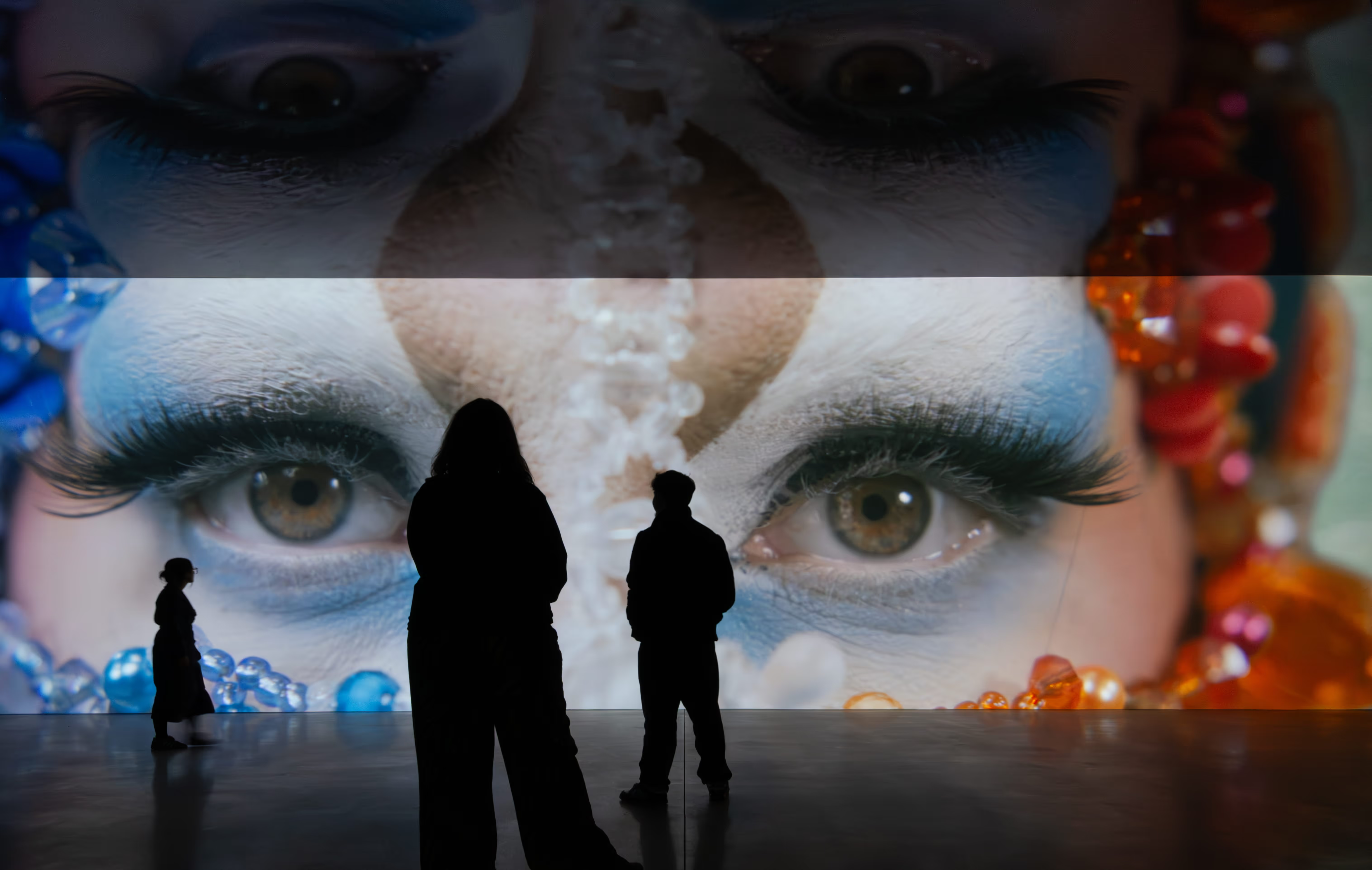
Emilija Škarnulytė, Riparia 2023, Tate St Ives. Photo © Tate (Sonal Bakrania)

Aldona is the only Skarnulyte film Tate St Ives is showing in its entirety. In the work, we follow the artist’s grandmother, who lost her sight in 1986, attributed to nerve damage from the Chernobyl nuclear disaster, as she goes for her daily walk in Grutas Park. The park is an open-air museum of former Soviet monuments, transplanted from the public realm. We accompany Aldona as she circles around a statue of Stalin, and feels the nose on a giant head of Lenin, accompanied by bombastic Soviet military music blasting from tinny speakers. Skarnulyte says that while Grutas Park is a popular tourist attraction, complete with a restaurant serving food on aluminium plates, for Lithuanians, it recalls a very painful period in their history. The area was used as a site for the transportation of dissidents to gulags and penal colonies. The artist adds that the park has now changed hands, with the new owner adding a private zoo, so grazing kangaroos add to the surrealness of a congregation of supersized Soviet figures. A further change since 2012 is the increasing militarisation of southern Lithuania, so the idyllic landscape of medicinal plants portrayed on the screen now plays host to NATO border activity and heat cameras.

The second half of the film follows Aldona’s domestic routine, as she rinses homemade cheese and gathers apple peelings to create compost. On the kitchen radio, a folktale about a fisherman is narrated, referencing the Lithuanian origin story of Jurate and Kastytis. Meditations on folk wisdom, living in harmony with the land and ancient belief systems serve as an introduction to the main body of the show.

Aldona is also being shown at the Baltic Gateshead, and Skarnulyte says she likes to think of the work having its own life, independent of her. Her grandmother was a great influence and support to Skarnulyte becoming an artist. “I think of her as a blind prophet guiding us. I’m glad you met her.”

The main exhibition space has been choreographed to reflect Tate St Ives' circular architecture, “the temple-like structure of the gallery”, as Skarnulyte terms it.  Director of Tate St Ives, Anne Barlow, says “the circular is new”, and the artist’s work has never been seen in this way before. For Skarnulyte, the four spaces between the four huge, curved screens are portals. “Enter through these portals into the circle, into the Wheel of the Goddess.” The circle also reflects Cornwall’s Neolithic stone circles, explored by the artist during a residency at Porthmeor Studios, and incorporated into Telstar, 2025, showing on a side screen.

Describing the chapters of her practice as grandmother, power plants and burial grounds, “I spent seven years underground”, then water, Skarnulyte wants viewers to feel a sense of embodiment in the works, to have the light from the screen pixels pass through them like energy.

Emilija Škarnulytė, Riparia 2023. Courtesy of the artist. Co-produced with Ferme-Asile and Taurus Foundation for Art and Science

The sequence of films in the circle is an excerpt from Hypoxia, 2023, exploring the deoxygenated dead zones of the Baltic Sea, where life is unsustainable, and we journey through murky water over a junk-ridden seabed. In Aphotic Zone, 2022, filmed off Costa Rica, we go to the depths of the sea where sunlight cannot reach, in search of a pollution-resistant coral. Riparia, 2023, follows the Rhone from Switzerland to the Camargue. Skarnulyte is particularly critical of the effect of dams on watercourses. “Dams are extractive - taking, taking but never giving back.” The two serpent life figures who glide through the Rhone were inspired by Neolithic goddess figurines. Sunken Cities, 2021, portrays the Roman city of Baiae in the Bay of Naples, submerged by volcanic activity. Observing Baiae is only 8 metres below the water’s surface, Skarnulyte says: “Seeing the underwater city from above shows cities rise and then go back into the water.” 

Emilija Škarnulytė, Riparia, 2023. Courtesy of the artist. Co-produced withFerme-Asile and Taurus Foundation for Art and Science

The print Nucleotides, 2025, covers a wall with the forms of the microscopic marine organisms, the artist believes we will all return to if the destruction of the environment continues at its present pace.

On the opposite wall, we see the dramatic video Aequalia, 2023, where the artist wears a fish tail to swim the Amazon, at the confluence of the creamy Rio Solimoes and dark Rio Grande, depicting the river as a symbol for community between species.

Emilija Škarnulytė, still fromÆqualia2023. Courtesy of the artist

In Skarnulyte’s work, viewers are given an imaginative, multi-media, navigable alternative to dreary art full of eco doom.

Emilija Skarnulyte, Tate St Ives, until 22 April.

Susan Gray
12/01/2026
Reviews
Susan Gray
Emilija Škarnulytė at Tate, St Ives
Written by
Susan Gray
Date Published
12/01/2026
Tate St Ives

Immersive is an overused term, but for Tate St Ives’ presentation of Lithuanian artist Emilija Skarnulyte, it is a true reflection of being enveloped in the artist’s worldview as a future archaeologist.

Skarnulyte’s most well-known work, Aldona (2012), plays in an antechamber with a foliaged ceiling of fragrant dried plants, creating a frame of shadowy vegetal forms across the top of the screen. The environment of the viewer and the environment of Aldona, the artist’s grandmother in southern Lithuania, feel merged, as if for the duration of the 13-minute film, borders between historic time and geographic space are dissolved.

Emilija Škarnulytė, Riparia 2023, Tate St Ives. Photo © Tate (Sonal Bakrania)

Aldona is the only Skarnulyte film Tate St Ives is showing in its entirety. In the work, we follow the artist’s grandmother, who lost her sight in 1986, attributed to nerve damage from the Chernobyl nuclear disaster, as she goes for her daily walk in Grutas Park. The park is an open-air museum of former Soviet monuments, transplanted from the public realm. We accompany Aldona as she circles around a statue of Stalin, and feels the nose on a giant head of Lenin, accompanied by bombastic Soviet military music blasting from tinny speakers. Skarnulyte says that while Grutas Park is a popular tourist attraction, complete with a restaurant serving food on aluminium plates, for Lithuanians, it recalls a very painful period in their history. The area was used as a site for the transportation of dissidents to gulags and penal colonies. The artist adds that the park has now changed hands, with the new owner adding a private zoo, so grazing kangaroos add to the surrealness of a congregation of supersized Soviet figures. A further change since 2012 is the increasing militarisation of southern Lithuania, so the idyllic landscape of medicinal plants portrayed on the screen now plays host to NATO border activity and heat cameras.

The second half of the film follows Aldona’s domestic routine, as she rinses homemade cheese and gathers apple peelings to create compost. On the kitchen radio, a folktale about a fisherman is narrated, referencing the Lithuanian origin story of Jurate and Kastytis. Meditations on folk wisdom, living in harmony with the land and ancient belief systems serve as an introduction to the main body of the show.

Aldona is also being shown at the Baltic Gateshead, and Skarnulyte says she likes to think of the work having its own life, independent of her. Her grandmother was a great influence and support to Skarnulyte becoming an artist. “I think of her as a blind prophet guiding us. I’m glad you met her.”

The main exhibition space has been choreographed to reflect Tate St Ives' circular architecture, “the temple-like structure of the gallery”, as Skarnulyte terms it.  Director of Tate St Ives, Anne Barlow, says “the circular is new”, and the artist’s work has never been seen in this way before. For Skarnulyte, the four spaces between the four huge, curved screens are portals. “Enter through these portals into the circle, into the Wheel of the Goddess.” The circle also reflects Cornwall’s Neolithic stone circles, explored by the artist during a residency at Porthmeor Studios, and incorporated into Telstar, 2025, showing on a side screen.

Describing the chapters of her practice as grandmother, power plants and burial grounds, “I spent seven years underground”, then water, Skarnulyte wants viewers to feel a sense of embodiment in the works, to have the light from the screen pixels pass through them like energy.

Emilija Škarnulytė, Riparia 2023. Courtesy of the artist. Co-produced with Ferme-Asile and Taurus Foundation for Art and Science

The sequence of films in the circle is an excerpt from Hypoxia, 2023, exploring the deoxygenated dead zones of the Baltic Sea, where life is unsustainable, and we journey through murky water over a junk-ridden seabed. In Aphotic Zone, 2022, filmed off Costa Rica, we go to the depths of the sea where sunlight cannot reach, in search of a pollution-resistant coral. Riparia, 2023, follows the Rhone from Switzerland to the Camargue. Skarnulyte is particularly critical of the effect of dams on watercourses. “Dams are extractive - taking, taking but never giving back.” The two serpent life figures who glide through the Rhone were inspired by Neolithic goddess figurines. Sunken Cities, 2021, portrays the Roman city of Baiae in the Bay of Naples, submerged by volcanic activity. Observing Baiae is only 8 metres below the water’s surface, Skarnulyte says: “Seeing the underwater city from above shows cities rise and then go back into the water.” 

Emilija Škarnulytė, Riparia, 2023. Courtesy of the artist. Co-produced withFerme-Asile and Taurus Foundation for Art and Science

The print Nucleotides, 2025, covers a wall with the forms of the microscopic marine organisms, the artist believes we will all return to if the destruction of the environment continues at its present pace.

On the opposite wall, we see the dramatic video Aequalia, 2023, where the artist wears a fish tail to swim the Amazon, at the confluence of the creamy Rio Solimoes and dark Rio Grande, depicting the river as a symbol for community between species.

Emilija Škarnulytė, still fromÆqualia2023. Courtesy of the artist

In Skarnulyte’s work, viewers are given an imaginative, multi-media, navigable alternative to dreary art full of eco doom.

Emilija Skarnulyte, Tate St Ives, until 22 April.

Thanks for reading
Collect your 5 yamos below
REDEEM YAMOS
Emilija Škarnulytė at Tate, St Ives
Reviews
Susan Gray
Written by
Susan Gray
Date Published
12/01/2026
Tate St Ives

Immersive is an overused term, but for Tate St Ives’ presentation of Lithuanian artist Emilija Skarnulyte, it is a true reflection of being enveloped in the artist’s worldview as a future archaeologist.

Skarnulyte’s most well-known work, Aldona (2012), plays in an antechamber with a foliaged ceiling of fragrant dried plants, creating a frame of shadowy vegetal forms across the top of the screen. The environment of the viewer and the environment of Aldona, the artist’s grandmother in southern Lithuania, feel merged, as if for the duration of the 13-minute film, borders between historic time and geographic space are dissolved.

Emilija Škarnulytė, Riparia 2023, Tate St Ives. Photo © Tate (Sonal Bakrania)

Aldona is the only Skarnulyte film Tate St Ives is showing in its entirety. In the work, we follow the artist’s grandmother, who lost her sight in 1986, attributed to nerve damage from the Chernobyl nuclear disaster, as she goes for her daily walk in Grutas Park. The park is an open-air museum of former Soviet monuments, transplanted from the public realm. We accompany Aldona as she circles around a statue of Stalin, and feels the nose on a giant head of Lenin, accompanied by bombastic Soviet military music blasting from tinny speakers. Skarnulyte says that while Grutas Park is a popular tourist attraction, complete with a restaurant serving food on aluminium plates, for Lithuanians, it recalls a very painful period in their history. The area was used as a site for the transportation of dissidents to gulags and penal colonies. The artist adds that the park has now changed hands, with the new owner adding a private zoo, so grazing kangaroos add to the surrealness of a congregation of supersized Soviet figures. A further change since 2012 is the increasing militarisation of southern Lithuania, so the idyllic landscape of medicinal plants portrayed on the screen now plays host to NATO border activity and heat cameras.

The second half of the film follows Aldona’s domestic routine, as she rinses homemade cheese and gathers apple peelings to create compost. On the kitchen radio, a folktale about a fisherman is narrated, referencing the Lithuanian origin story of Jurate and Kastytis. Meditations on folk wisdom, living in harmony with the land and ancient belief systems serve as an introduction to the main body of the show.

Aldona is also being shown at the Baltic Gateshead, and Skarnulyte says she likes to think of the work having its own life, independent of her. Her grandmother was a great influence and support to Skarnulyte becoming an artist. “I think of her as a blind prophet guiding us. I’m glad you met her.”

The main exhibition space has been choreographed to reflect Tate St Ives' circular architecture, “the temple-like structure of the gallery”, as Skarnulyte terms it.  Director of Tate St Ives, Anne Barlow, says “the circular is new”, and the artist’s work has never been seen in this way before. For Skarnulyte, the four spaces between the four huge, curved screens are portals. “Enter through these portals into the circle, into the Wheel of the Goddess.” The circle also reflects Cornwall’s Neolithic stone circles, explored by the artist during a residency at Porthmeor Studios, and incorporated into Telstar, 2025, showing on a side screen.

Describing the chapters of her practice as grandmother, power plants and burial grounds, “I spent seven years underground”, then water, Skarnulyte wants viewers to feel a sense of embodiment in the works, to have the light from the screen pixels pass through them like energy.

Emilija Škarnulytė, Riparia 2023. Courtesy of the artist. Co-produced with Ferme-Asile and Taurus Foundation for Art and Science

The sequence of films in the circle is an excerpt from Hypoxia, 2023, exploring the deoxygenated dead zones of the Baltic Sea, where life is unsustainable, and we journey through murky water over a junk-ridden seabed. In Aphotic Zone, 2022, filmed off Costa Rica, we go to the depths of the sea where sunlight cannot reach, in search of a pollution-resistant coral. Riparia, 2023, follows the Rhone from Switzerland to the Camargue. Skarnulyte is particularly critical of the effect of dams on watercourses. “Dams are extractive - taking, taking but never giving back.” The two serpent life figures who glide through the Rhone were inspired by Neolithic goddess figurines. Sunken Cities, 2021, portrays the Roman city of Baiae in the Bay of Naples, submerged by volcanic activity. Observing Baiae is only 8 metres below the water’s surface, Skarnulyte says: “Seeing the underwater city from above shows cities rise and then go back into the water.” 

Emilija Škarnulytė, Riparia, 2023. Courtesy of the artist. Co-produced withFerme-Asile and Taurus Foundation for Art and Science

The print Nucleotides, 2025, covers a wall with the forms of the microscopic marine organisms, the artist believes we will all return to if the destruction of the environment continues at its present pace.

On the opposite wall, we see the dramatic video Aequalia, 2023, where the artist wears a fish tail to swim the Amazon, at the confluence of the creamy Rio Solimoes and dark Rio Grande, depicting the river as a symbol for community between species.

Emilija Škarnulytė, still fromÆqualia2023. Courtesy of the artist

In Skarnulyte’s work, viewers are given an imaginative, multi-media, navigable alternative to dreary art full of eco doom.

Emilija Skarnulyte, Tate St Ives, until 22 April.

Thanks for reading
Collect your 5 yamos below
REDEEM YAMOS
12/01/2026
Reviews
Susan Gray
Emilija Škarnulytė at Tate, St Ives
Written by
Susan Gray
Date Published
12/01/2026
Tate St Ives

Immersive is an overused term, but for Tate St Ives’ presentation of Lithuanian artist Emilija Skarnulyte, it is a true reflection of being enveloped in the artist’s worldview as a future archaeologist.

Skarnulyte’s most well-known work, Aldona (2012), plays in an antechamber with a foliaged ceiling of fragrant dried plants, creating a frame of shadowy vegetal forms across the top of the screen. The environment of the viewer and the environment of Aldona, the artist’s grandmother in southern Lithuania, feel merged, as if for the duration of the 13-minute film, borders between historic time and geographic space are dissolved.

Emilija Škarnulytė, Riparia 2023, Tate St Ives. Photo © Tate (Sonal Bakrania)

Aldona is the only Skarnulyte film Tate St Ives is showing in its entirety. In the work, we follow the artist’s grandmother, who lost her sight in 1986, attributed to nerve damage from the Chernobyl nuclear disaster, as she goes for her daily walk in Grutas Park. The park is an open-air museum of former Soviet monuments, transplanted from the public realm. We accompany Aldona as she circles around a statue of Stalin, and feels the nose on a giant head of Lenin, accompanied by bombastic Soviet military music blasting from tinny speakers. Skarnulyte says that while Grutas Park is a popular tourist attraction, complete with a restaurant serving food on aluminium plates, for Lithuanians, it recalls a very painful period in their history. The area was used as a site for the transportation of dissidents to gulags and penal colonies. The artist adds that the park has now changed hands, with the new owner adding a private zoo, so grazing kangaroos add to the surrealness of a congregation of supersized Soviet figures. A further change since 2012 is the increasing militarisation of southern Lithuania, so the idyllic landscape of medicinal plants portrayed on the screen now plays host to NATO border activity and heat cameras.

The second half of the film follows Aldona’s domestic routine, as she rinses homemade cheese and gathers apple peelings to create compost. On the kitchen radio, a folktale about a fisherman is narrated, referencing the Lithuanian origin story of Jurate and Kastytis. Meditations on folk wisdom, living in harmony with the land and ancient belief systems serve as an introduction to the main body of the show.

Aldona is also being shown at the Baltic Gateshead, and Skarnulyte says she likes to think of the work having its own life, independent of her. Her grandmother was a great influence and support to Skarnulyte becoming an artist. “I think of her as a blind prophet guiding us. I’m glad you met her.”

The main exhibition space has been choreographed to reflect Tate St Ives' circular architecture, “the temple-like structure of the gallery”, as Skarnulyte terms it.  Director of Tate St Ives, Anne Barlow, says “the circular is new”, and the artist’s work has never been seen in this way before. For Skarnulyte, the four spaces between the four huge, curved screens are portals. “Enter through these portals into the circle, into the Wheel of the Goddess.” The circle also reflects Cornwall’s Neolithic stone circles, explored by the artist during a residency at Porthmeor Studios, and incorporated into Telstar, 2025, showing on a side screen.

Describing the chapters of her practice as grandmother, power plants and burial grounds, “I spent seven years underground”, then water, Skarnulyte wants viewers to feel a sense of embodiment in the works, to have the light from the screen pixels pass through them like energy.

Emilija Škarnulytė, Riparia 2023. Courtesy of the artist. Co-produced with Ferme-Asile and Taurus Foundation for Art and Science

The sequence of films in the circle is an excerpt from Hypoxia, 2023, exploring the deoxygenated dead zones of the Baltic Sea, where life is unsustainable, and we journey through murky water over a junk-ridden seabed. In Aphotic Zone, 2022, filmed off Costa Rica, we go to the depths of the sea where sunlight cannot reach, in search of a pollution-resistant coral. Riparia, 2023, follows the Rhone from Switzerland to the Camargue. Skarnulyte is particularly critical of the effect of dams on watercourses. “Dams are extractive - taking, taking but never giving back.” The two serpent life figures who glide through the Rhone were inspired by Neolithic goddess figurines. Sunken Cities, 2021, portrays the Roman city of Baiae in the Bay of Naples, submerged by volcanic activity. Observing Baiae is only 8 metres below the water’s surface, Skarnulyte says: “Seeing the underwater city from above shows cities rise and then go back into the water.” 

Emilija Škarnulytė, Riparia, 2023. Courtesy of the artist. Co-produced withFerme-Asile and Taurus Foundation for Art and Science

The print Nucleotides, 2025, covers a wall with the forms of the microscopic marine organisms, the artist believes we will all return to if the destruction of the environment continues at its present pace.

On the opposite wall, we see the dramatic video Aequalia, 2023, where the artist wears a fish tail to swim the Amazon, at the confluence of the creamy Rio Solimoes and dark Rio Grande, depicting the river as a symbol for community between species.

Emilija Škarnulytė, still fromÆqualia2023. Courtesy of the artist

In Skarnulyte’s work, viewers are given an imaginative, multi-media, navigable alternative to dreary art full of eco doom.

Emilija Skarnulyte, Tate St Ives, until 22 April.

Thanks for reading
Collect your 5 yamos below
REDEEM YAMOS
12/01/2026
Reviews
Susan Gray
Emilija Škarnulytė at Tate, St Ives
Written by
Susan Gray
Date Published
12/01/2026
Tate St Ives

Immersive is an overused term, but for Tate St Ives’ presentation of Lithuanian artist Emilija Skarnulyte, it is a true reflection of being enveloped in the artist’s worldview as a future archaeologist.

Skarnulyte’s most well-known work, Aldona (2012), plays in an antechamber with a foliaged ceiling of fragrant dried plants, creating a frame of shadowy vegetal forms across the top of the screen. The environment of the viewer and the environment of Aldona, the artist’s grandmother in southern Lithuania, feel merged, as if for the duration of the 13-minute film, borders between historic time and geographic space are dissolved.

Emilija Škarnulytė, Riparia 2023, Tate St Ives. Photo © Tate (Sonal Bakrania)

Aldona is the only Skarnulyte film Tate St Ives is showing in its entirety. In the work, we follow the artist’s grandmother, who lost her sight in 1986, attributed to nerve damage from the Chernobyl nuclear disaster, as she goes for her daily walk in Grutas Park. The park is an open-air museum of former Soviet monuments, transplanted from the public realm. We accompany Aldona as she circles around a statue of Stalin, and feels the nose on a giant head of Lenin, accompanied by bombastic Soviet military music blasting from tinny speakers. Skarnulyte says that while Grutas Park is a popular tourist attraction, complete with a restaurant serving food on aluminium plates, for Lithuanians, it recalls a very painful period in their history. The area was used as a site for the transportation of dissidents to gulags and penal colonies. The artist adds that the park has now changed hands, with the new owner adding a private zoo, so grazing kangaroos add to the surrealness of a congregation of supersized Soviet figures. A further change since 2012 is the increasing militarisation of southern Lithuania, so the idyllic landscape of medicinal plants portrayed on the screen now plays host to NATO border activity and heat cameras.

The second half of the film follows Aldona’s domestic routine, as she rinses homemade cheese and gathers apple peelings to create compost. On the kitchen radio, a folktale about a fisherman is narrated, referencing the Lithuanian origin story of Jurate and Kastytis. Meditations on folk wisdom, living in harmony with the land and ancient belief systems serve as an introduction to the main body of the show.

Aldona is also being shown at the Baltic Gateshead, and Skarnulyte says she likes to think of the work having its own life, independent of her. Her grandmother was a great influence and support to Skarnulyte becoming an artist. “I think of her as a blind prophet guiding us. I’m glad you met her.”

The main exhibition space has been choreographed to reflect Tate St Ives' circular architecture, “the temple-like structure of the gallery”, as Skarnulyte terms it.  Director of Tate St Ives, Anne Barlow, says “the circular is new”, and the artist’s work has never been seen in this way before. For Skarnulyte, the four spaces between the four huge, curved screens are portals. “Enter through these portals into the circle, into the Wheel of the Goddess.” The circle also reflects Cornwall’s Neolithic stone circles, explored by the artist during a residency at Porthmeor Studios, and incorporated into Telstar, 2025, showing on a side screen.

Describing the chapters of her practice as grandmother, power plants and burial grounds, “I spent seven years underground”, then water, Skarnulyte wants viewers to feel a sense of embodiment in the works, to have the light from the screen pixels pass through them like energy.

Emilija Škarnulytė, Riparia 2023. Courtesy of the artist. Co-produced with Ferme-Asile and Taurus Foundation for Art and Science

The sequence of films in the circle is an excerpt from Hypoxia, 2023, exploring the deoxygenated dead zones of the Baltic Sea, where life is unsustainable, and we journey through murky water over a junk-ridden seabed. In Aphotic Zone, 2022, filmed off Costa Rica, we go to the depths of the sea where sunlight cannot reach, in search of a pollution-resistant coral. Riparia, 2023, follows the Rhone from Switzerland to the Camargue. Skarnulyte is particularly critical of the effect of dams on watercourses. “Dams are extractive - taking, taking but never giving back.” The two serpent life figures who glide through the Rhone were inspired by Neolithic goddess figurines. Sunken Cities, 2021, portrays the Roman city of Baiae in the Bay of Naples, submerged by volcanic activity. Observing Baiae is only 8 metres below the water’s surface, Skarnulyte says: “Seeing the underwater city from above shows cities rise and then go back into the water.” 

Emilija Škarnulytė, Riparia, 2023. Courtesy of the artist. Co-produced withFerme-Asile and Taurus Foundation for Art and Science

The print Nucleotides, 2025, covers a wall with the forms of the microscopic marine organisms, the artist believes we will all return to if the destruction of the environment continues at its present pace.

On the opposite wall, we see the dramatic video Aequalia, 2023, where the artist wears a fish tail to swim the Amazon, at the confluence of the creamy Rio Solimoes and dark Rio Grande, depicting the river as a symbol for community between species.

Emilija Škarnulytė, still fromÆqualia2023. Courtesy of the artist

In Skarnulyte’s work, viewers are given an imaginative, multi-media, navigable alternative to dreary art full of eco doom.

Emilija Skarnulyte, Tate St Ives, until 22 April.

Thanks for reading
Collect your 5 yamos below
REDEEM YAMOS
12/01/2026
Reviews
Susan Gray
Emilija Škarnulytė at Tate, St Ives
Written by
Susan Gray
Date Published
12/01/2026
Tate St Ives

Immersive is an overused term, but for Tate St Ives’ presentation of Lithuanian artist Emilija Skarnulyte, it is a true reflection of being enveloped in the artist’s worldview as a future archaeologist.

Skarnulyte’s most well-known work, Aldona (2012), plays in an antechamber with a foliaged ceiling of fragrant dried plants, creating a frame of shadowy vegetal forms across the top of the screen. The environment of the viewer and the environment of Aldona, the artist’s grandmother in southern Lithuania, feel merged, as if for the duration of the 13-minute film, borders between historic time and geographic space are dissolved.

Emilija Škarnulytė, Riparia 2023, Tate St Ives. Photo © Tate (Sonal Bakrania)

Aldona is the only Skarnulyte film Tate St Ives is showing in its entirety. In the work, we follow the artist’s grandmother, who lost her sight in 1986, attributed to nerve damage from the Chernobyl nuclear disaster, as she goes for her daily walk in Grutas Park. The park is an open-air museum of former Soviet monuments, transplanted from the public realm. We accompany Aldona as she circles around a statue of Stalin, and feels the nose on a giant head of Lenin, accompanied by bombastic Soviet military music blasting from tinny speakers. Skarnulyte says that while Grutas Park is a popular tourist attraction, complete with a restaurant serving food on aluminium plates, for Lithuanians, it recalls a very painful period in their history. The area was used as a site for the transportation of dissidents to gulags and penal colonies. The artist adds that the park has now changed hands, with the new owner adding a private zoo, so grazing kangaroos add to the surrealness of a congregation of supersized Soviet figures. A further change since 2012 is the increasing militarisation of southern Lithuania, so the idyllic landscape of medicinal plants portrayed on the screen now plays host to NATO border activity and heat cameras.

The second half of the film follows Aldona’s domestic routine, as she rinses homemade cheese and gathers apple peelings to create compost. On the kitchen radio, a folktale about a fisherman is narrated, referencing the Lithuanian origin story of Jurate and Kastytis. Meditations on folk wisdom, living in harmony with the land and ancient belief systems serve as an introduction to the main body of the show.

Aldona is also being shown at the Baltic Gateshead, and Skarnulyte says she likes to think of the work having its own life, independent of her. Her grandmother was a great influence and support to Skarnulyte becoming an artist. “I think of her as a blind prophet guiding us. I’m glad you met her.”

The main exhibition space has been choreographed to reflect Tate St Ives' circular architecture, “the temple-like structure of the gallery”, as Skarnulyte terms it.  Director of Tate St Ives, Anne Barlow, says “the circular is new”, and the artist’s work has never been seen in this way before. For Skarnulyte, the four spaces between the four huge, curved screens are portals. “Enter through these portals into the circle, into the Wheel of the Goddess.” The circle also reflects Cornwall’s Neolithic stone circles, explored by the artist during a residency at Porthmeor Studios, and incorporated into Telstar, 2025, showing on a side screen.

Describing the chapters of her practice as grandmother, power plants and burial grounds, “I spent seven years underground”, then water, Skarnulyte wants viewers to feel a sense of embodiment in the works, to have the light from the screen pixels pass through them like energy.

Emilija Škarnulytė, Riparia 2023. Courtesy of the artist. Co-produced with Ferme-Asile and Taurus Foundation for Art and Science

The sequence of films in the circle is an excerpt from Hypoxia, 2023, exploring the deoxygenated dead zones of the Baltic Sea, where life is unsustainable, and we journey through murky water over a junk-ridden seabed. In Aphotic Zone, 2022, filmed off Costa Rica, we go to the depths of the sea where sunlight cannot reach, in search of a pollution-resistant coral. Riparia, 2023, follows the Rhone from Switzerland to the Camargue. Skarnulyte is particularly critical of the effect of dams on watercourses. “Dams are extractive - taking, taking but never giving back.” The two serpent life figures who glide through the Rhone were inspired by Neolithic goddess figurines. Sunken Cities, 2021, portrays the Roman city of Baiae in the Bay of Naples, submerged by volcanic activity. Observing Baiae is only 8 metres below the water’s surface, Skarnulyte says: “Seeing the underwater city from above shows cities rise and then go back into the water.” 

Emilija Škarnulytė, Riparia, 2023. Courtesy of the artist. Co-produced withFerme-Asile and Taurus Foundation for Art and Science

The print Nucleotides, 2025, covers a wall with the forms of the microscopic marine organisms, the artist believes we will all return to if the destruction of the environment continues at its present pace.

On the opposite wall, we see the dramatic video Aequalia, 2023, where the artist wears a fish tail to swim the Amazon, at the confluence of the creamy Rio Solimoes and dark Rio Grande, depicting the river as a symbol for community between species.

Emilija Škarnulytė, still fromÆqualia2023. Courtesy of the artist

In Skarnulyte’s work, viewers are given an imaginative, multi-media, navigable alternative to dreary art full of eco doom.

Emilija Skarnulyte, Tate St Ives, until 22 April.

Thanks for reading
Collect your 5 yamos below
REDEEM YAMOS
Written by
Susan Gray
Date Published
12/01/2026
Tate St Ives
12/01/2026
Reviews
Susan Gray
Emilija Škarnulytė at Tate, St Ives

Immersive is an overused term, but for Tate St Ives’ presentation of Lithuanian artist Emilija Skarnulyte, it is a true reflection of being enveloped in the artist’s worldview as a future archaeologist.

Skarnulyte’s most well-known work, Aldona (2012), plays in an antechamber with a foliaged ceiling of fragrant dried plants, creating a frame of shadowy vegetal forms across the top of the screen. The environment of the viewer and the environment of Aldona, the artist’s grandmother in southern Lithuania, feel merged, as if for the duration of the 13-minute film, borders between historic time and geographic space are dissolved.

Emilija Škarnulytė, Riparia 2023, Tate St Ives. Photo © Tate (Sonal Bakrania)

Aldona is the only Skarnulyte film Tate St Ives is showing in its entirety. In the work, we follow the artist’s grandmother, who lost her sight in 1986, attributed to nerve damage from the Chernobyl nuclear disaster, as she goes for her daily walk in Grutas Park. The park is an open-air museum of former Soviet monuments, transplanted from the public realm. We accompany Aldona as she circles around a statue of Stalin, and feels the nose on a giant head of Lenin, accompanied by bombastic Soviet military music blasting from tinny speakers. Skarnulyte says that while Grutas Park is a popular tourist attraction, complete with a restaurant serving food on aluminium plates, for Lithuanians, it recalls a very painful period in their history. The area was used as a site for the transportation of dissidents to gulags and penal colonies. The artist adds that the park has now changed hands, with the new owner adding a private zoo, so grazing kangaroos add to the surrealness of a congregation of supersized Soviet figures. A further change since 2012 is the increasing militarisation of southern Lithuania, so the idyllic landscape of medicinal plants portrayed on the screen now plays host to NATO border activity and heat cameras.

The second half of the film follows Aldona’s domestic routine, as she rinses homemade cheese and gathers apple peelings to create compost. On the kitchen radio, a folktale about a fisherman is narrated, referencing the Lithuanian origin story of Jurate and Kastytis. Meditations on folk wisdom, living in harmony with the land and ancient belief systems serve as an introduction to the main body of the show.

Aldona is also being shown at the Baltic Gateshead, and Skarnulyte says she likes to think of the work having its own life, independent of her. Her grandmother was a great influence and support to Skarnulyte becoming an artist. “I think of her as a blind prophet guiding us. I’m glad you met her.”

The main exhibition space has been choreographed to reflect Tate St Ives' circular architecture, “the temple-like structure of the gallery”, as Skarnulyte terms it.  Director of Tate St Ives, Anne Barlow, says “the circular is new”, and the artist’s work has never been seen in this way before. For Skarnulyte, the four spaces between the four huge, curved screens are portals. “Enter through these portals into the circle, into the Wheel of the Goddess.” The circle also reflects Cornwall’s Neolithic stone circles, explored by the artist during a residency at Porthmeor Studios, and incorporated into Telstar, 2025, showing on a side screen.

Describing the chapters of her practice as grandmother, power plants and burial grounds, “I spent seven years underground”, then water, Skarnulyte wants viewers to feel a sense of embodiment in the works, to have the light from the screen pixels pass through them like energy.

Emilija Škarnulytė, Riparia 2023. Courtesy of the artist. Co-produced with Ferme-Asile and Taurus Foundation for Art and Science

The sequence of films in the circle is an excerpt from Hypoxia, 2023, exploring the deoxygenated dead zones of the Baltic Sea, where life is unsustainable, and we journey through murky water over a junk-ridden seabed. In Aphotic Zone, 2022, filmed off Costa Rica, we go to the depths of the sea where sunlight cannot reach, in search of a pollution-resistant coral. Riparia, 2023, follows the Rhone from Switzerland to the Camargue. Skarnulyte is particularly critical of the effect of dams on watercourses. “Dams are extractive - taking, taking but never giving back.” The two serpent life figures who glide through the Rhone were inspired by Neolithic goddess figurines. Sunken Cities, 2021, portrays the Roman city of Baiae in the Bay of Naples, submerged by volcanic activity. Observing Baiae is only 8 metres below the water’s surface, Skarnulyte says: “Seeing the underwater city from above shows cities rise and then go back into the water.” 

Emilija Škarnulytė, Riparia, 2023. Courtesy of the artist. Co-produced withFerme-Asile and Taurus Foundation for Art and Science

The print Nucleotides, 2025, covers a wall with the forms of the microscopic marine organisms, the artist believes we will all return to if the destruction of the environment continues at its present pace.

On the opposite wall, we see the dramatic video Aequalia, 2023, where the artist wears a fish tail to swim the Amazon, at the confluence of the creamy Rio Solimoes and dark Rio Grande, depicting the river as a symbol for community between species.

Emilija Škarnulytė, still fromÆqualia2023. Courtesy of the artist

In Skarnulyte’s work, viewers are given an imaginative, multi-media, navigable alternative to dreary art full of eco doom.

Emilija Skarnulyte, Tate St Ives, until 22 April.

Thanks for reading
Collect your 5 yamos below
REDEEM YAMOS
Emilija Škarnulytė at Tate, St Ives
12/01/2026
Reviews
Susan Gray
Written by
Susan Gray
Date Published
12/01/2026
Tate St Ives

Immersive is an overused term, but for Tate St Ives’ presentation of Lithuanian artist Emilija Skarnulyte, it is a true reflection of being enveloped in the artist’s worldview as a future archaeologist.

Skarnulyte’s most well-known work, Aldona (2012), plays in an antechamber with a foliaged ceiling of fragrant dried plants, creating a frame of shadowy vegetal forms across the top of the screen. The environment of the viewer and the environment of Aldona, the artist’s grandmother in southern Lithuania, feel merged, as if for the duration of the 13-minute film, borders between historic time and geographic space are dissolved.

Emilija Škarnulytė, Riparia 2023, Tate St Ives. Photo © Tate (Sonal Bakrania)

Aldona is the only Skarnulyte film Tate St Ives is showing in its entirety. In the work, we follow the artist’s grandmother, who lost her sight in 1986, attributed to nerve damage from the Chernobyl nuclear disaster, as she goes for her daily walk in Grutas Park. The park is an open-air museum of former Soviet monuments, transplanted from the public realm. We accompany Aldona as she circles around a statue of Stalin, and feels the nose on a giant head of Lenin, accompanied by bombastic Soviet military music blasting from tinny speakers. Skarnulyte says that while Grutas Park is a popular tourist attraction, complete with a restaurant serving food on aluminium plates, for Lithuanians, it recalls a very painful period in their history. The area was used as a site for the transportation of dissidents to gulags and penal colonies. The artist adds that the park has now changed hands, with the new owner adding a private zoo, so grazing kangaroos add to the surrealness of a congregation of supersized Soviet figures. A further change since 2012 is the increasing militarisation of southern Lithuania, so the idyllic landscape of medicinal plants portrayed on the screen now plays host to NATO border activity and heat cameras.

The second half of the film follows Aldona’s domestic routine, as she rinses homemade cheese and gathers apple peelings to create compost. On the kitchen radio, a folktale about a fisherman is narrated, referencing the Lithuanian origin story of Jurate and Kastytis. Meditations on folk wisdom, living in harmony with the land and ancient belief systems serve as an introduction to the main body of the show.

Aldona is also being shown at the Baltic Gateshead, and Skarnulyte says she likes to think of the work having its own life, independent of her. Her grandmother was a great influence and support to Skarnulyte becoming an artist. “I think of her as a blind prophet guiding us. I’m glad you met her.”

The main exhibition space has been choreographed to reflect Tate St Ives' circular architecture, “the temple-like structure of the gallery”, as Skarnulyte terms it.  Director of Tate St Ives, Anne Barlow, says “the circular is new”, and the artist’s work has never been seen in this way before. For Skarnulyte, the four spaces between the four huge, curved screens are portals. “Enter through these portals into the circle, into the Wheel of the Goddess.” The circle also reflects Cornwall’s Neolithic stone circles, explored by the artist during a residency at Porthmeor Studios, and incorporated into Telstar, 2025, showing on a side screen.

Describing the chapters of her practice as grandmother, power plants and burial grounds, “I spent seven years underground”, then water, Skarnulyte wants viewers to feel a sense of embodiment in the works, to have the light from the screen pixels pass through them like energy.

Emilija Škarnulytė, Riparia 2023. Courtesy of the artist. Co-produced with Ferme-Asile and Taurus Foundation for Art and Science

The sequence of films in the circle is an excerpt from Hypoxia, 2023, exploring the deoxygenated dead zones of the Baltic Sea, where life is unsustainable, and we journey through murky water over a junk-ridden seabed. In Aphotic Zone, 2022, filmed off Costa Rica, we go to the depths of the sea where sunlight cannot reach, in search of a pollution-resistant coral. Riparia, 2023, follows the Rhone from Switzerland to the Camargue. Skarnulyte is particularly critical of the effect of dams on watercourses. “Dams are extractive - taking, taking but never giving back.” The two serpent life figures who glide through the Rhone were inspired by Neolithic goddess figurines. Sunken Cities, 2021, portrays the Roman city of Baiae in the Bay of Naples, submerged by volcanic activity. Observing Baiae is only 8 metres below the water’s surface, Skarnulyte says: “Seeing the underwater city from above shows cities rise and then go back into the water.” 

Emilija Škarnulytė, Riparia, 2023. Courtesy of the artist. Co-produced withFerme-Asile and Taurus Foundation for Art and Science

The print Nucleotides, 2025, covers a wall with the forms of the microscopic marine organisms, the artist believes we will all return to if the destruction of the environment continues at its present pace.

On the opposite wall, we see the dramatic video Aequalia, 2023, where the artist wears a fish tail to swim the Amazon, at the confluence of the creamy Rio Solimoes and dark Rio Grande, depicting the river as a symbol for community between species.

Emilija Škarnulytė, still fromÆqualia2023. Courtesy of the artist

In Skarnulyte’s work, viewers are given an imaginative, multi-media, navigable alternative to dreary art full of eco doom.

Emilija Skarnulyte, Tate St Ives, until 22 April.

Thanks for reading
Collect your 5 yamos below
REDEEM YAMOS
Emilija Škarnulytė at Tate, St Ives
Written by
Susan Gray
Date Published
12/01/2026
12/01/2026
Reviews
Susan Gray

Immersive is an overused term, but for Tate St Ives’ presentation of Lithuanian artist Emilija Skarnulyte, it is a true reflection of being enveloped in the artist’s worldview as a future archaeologist.

Skarnulyte’s most well-known work, Aldona (2012), plays in an antechamber with a foliaged ceiling of fragrant dried plants, creating a frame of shadowy vegetal forms across the top of the screen. The environment of the viewer and the environment of Aldona, the artist’s grandmother in southern Lithuania, feel merged, as if for the duration of the 13-minute film, borders between historic time and geographic space are dissolved.

Emilija Škarnulytė, Riparia 2023, Tate St Ives. Photo © Tate (Sonal Bakrania)

Aldona is the only Skarnulyte film Tate St Ives is showing in its entirety. In the work, we follow the artist’s grandmother, who lost her sight in 1986, attributed to nerve damage from the Chernobyl nuclear disaster, as she goes for her daily walk in Grutas Park. The park is an open-air museum of former Soviet monuments, transplanted from the public realm. We accompany Aldona as she circles around a statue of Stalin, and feels the nose on a giant head of Lenin, accompanied by bombastic Soviet military music blasting from tinny speakers. Skarnulyte says that while Grutas Park is a popular tourist attraction, complete with a restaurant serving food on aluminium plates, for Lithuanians, it recalls a very painful period in their history. The area was used as a site for the transportation of dissidents to gulags and penal colonies. The artist adds that the park has now changed hands, with the new owner adding a private zoo, so grazing kangaroos add to the surrealness of a congregation of supersized Soviet figures. A further change since 2012 is the increasing militarisation of southern Lithuania, so the idyllic landscape of medicinal plants portrayed on the screen now plays host to NATO border activity and heat cameras.

The second half of the film follows Aldona’s domestic routine, as she rinses homemade cheese and gathers apple peelings to create compost. On the kitchen radio, a folktale about a fisherman is narrated, referencing the Lithuanian origin story of Jurate and Kastytis. Meditations on folk wisdom, living in harmony with the land and ancient belief systems serve as an introduction to the main body of the show.

Aldona is also being shown at the Baltic Gateshead, and Skarnulyte says she likes to think of the work having its own life, independent of her. Her grandmother was a great influence and support to Skarnulyte becoming an artist. “I think of her as a blind prophet guiding us. I’m glad you met her.”

The main exhibition space has been choreographed to reflect Tate St Ives' circular architecture, “the temple-like structure of the gallery”, as Skarnulyte terms it.  Director of Tate St Ives, Anne Barlow, says “the circular is new”, and the artist’s work has never been seen in this way before. For Skarnulyte, the four spaces between the four huge, curved screens are portals. “Enter through these portals into the circle, into the Wheel of the Goddess.” The circle also reflects Cornwall’s Neolithic stone circles, explored by the artist during a residency at Porthmeor Studios, and incorporated into Telstar, 2025, showing on a side screen.

Describing the chapters of her practice as grandmother, power plants and burial grounds, “I spent seven years underground”, then water, Skarnulyte wants viewers to feel a sense of embodiment in the works, to have the light from the screen pixels pass through them like energy.

Emilija Škarnulytė, Riparia 2023. Courtesy of the artist. Co-produced with Ferme-Asile and Taurus Foundation for Art and Science

The sequence of films in the circle is an excerpt from Hypoxia, 2023, exploring the deoxygenated dead zones of the Baltic Sea, where life is unsustainable, and we journey through murky water over a junk-ridden seabed. In Aphotic Zone, 2022, filmed off Costa Rica, we go to the depths of the sea where sunlight cannot reach, in search of a pollution-resistant coral. Riparia, 2023, follows the Rhone from Switzerland to the Camargue. Skarnulyte is particularly critical of the effect of dams on watercourses. “Dams are extractive - taking, taking but never giving back.” The two serpent life figures who glide through the Rhone were inspired by Neolithic goddess figurines. Sunken Cities, 2021, portrays the Roman city of Baiae in the Bay of Naples, submerged by volcanic activity. Observing Baiae is only 8 metres below the water’s surface, Skarnulyte says: “Seeing the underwater city from above shows cities rise and then go back into the water.” 

Emilija Škarnulytė, Riparia, 2023. Courtesy of the artist. Co-produced withFerme-Asile and Taurus Foundation for Art and Science

The print Nucleotides, 2025, covers a wall with the forms of the microscopic marine organisms, the artist believes we will all return to if the destruction of the environment continues at its present pace.

On the opposite wall, we see the dramatic video Aequalia, 2023, where the artist wears a fish tail to swim the Amazon, at the confluence of the creamy Rio Solimoes and dark Rio Grande, depicting the river as a symbol for community between species.

Emilija Škarnulytė, still fromÆqualia2023. Courtesy of the artist

In Skarnulyte’s work, viewers are given an imaginative, multi-media, navigable alternative to dreary art full of eco doom.

Emilija Skarnulyte, Tate St Ives, until 22 April.

Thanks for reading
Collect your 5 yamos below
REDEEM YAMOS
Emilija Škarnulytė at Tate, St Ives
Written by
Susan Gray
Date Published
12/01/2026
Tate St Ives
12/01/2026
Reviews
Susan Gray

Immersive is an overused term, but for Tate St Ives’ presentation of Lithuanian artist Emilija Skarnulyte, it is a true reflection of being enveloped in the artist’s worldview as a future archaeologist.

Skarnulyte’s most well-known work, Aldona (2012), plays in an antechamber with a foliaged ceiling of fragrant dried plants, creating a frame of shadowy vegetal forms across the top of the screen. The environment of the viewer and the environment of Aldona, the artist’s grandmother in southern Lithuania, feel merged, as if for the duration of the 13-minute film, borders between historic time and geographic space are dissolved.

Emilija Škarnulytė, Riparia 2023, Tate St Ives. Photo © Tate (Sonal Bakrania)

Aldona is the only Skarnulyte film Tate St Ives is showing in its entirety. In the work, we follow the artist’s grandmother, who lost her sight in 1986, attributed to nerve damage from the Chernobyl nuclear disaster, as she goes for her daily walk in Grutas Park. The park is an open-air museum of former Soviet monuments, transplanted from the public realm. We accompany Aldona as she circles around a statue of Stalin, and feels the nose on a giant head of Lenin, accompanied by bombastic Soviet military music blasting from tinny speakers. Skarnulyte says that while Grutas Park is a popular tourist attraction, complete with a restaurant serving food on aluminium plates, for Lithuanians, it recalls a very painful period in their history. The area was used as a site for the transportation of dissidents to gulags and penal colonies. The artist adds that the park has now changed hands, with the new owner adding a private zoo, so grazing kangaroos add to the surrealness of a congregation of supersized Soviet figures. A further change since 2012 is the increasing militarisation of southern Lithuania, so the idyllic landscape of medicinal plants portrayed on the screen now plays host to NATO border activity and heat cameras.

The second half of the film follows Aldona’s domestic routine, as she rinses homemade cheese and gathers apple peelings to create compost. On the kitchen radio, a folktale about a fisherman is narrated, referencing the Lithuanian origin story of Jurate and Kastytis. Meditations on folk wisdom, living in harmony with the land and ancient belief systems serve as an introduction to the main body of the show.

Aldona is also being shown at the Baltic Gateshead, and Skarnulyte says she likes to think of the work having its own life, independent of her. Her grandmother was a great influence and support to Skarnulyte becoming an artist. “I think of her as a blind prophet guiding us. I’m glad you met her.”

The main exhibition space has been choreographed to reflect Tate St Ives' circular architecture, “the temple-like structure of the gallery”, as Skarnulyte terms it.  Director of Tate St Ives, Anne Barlow, says “the circular is new”, and the artist’s work has never been seen in this way before. For Skarnulyte, the four spaces between the four huge, curved screens are portals. “Enter through these portals into the circle, into the Wheel of the Goddess.” The circle also reflects Cornwall’s Neolithic stone circles, explored by the artist during a residency at Porthmeor Studios, and incorporated into Telstar, 2025, showing on a side screen.

Describing the chapters of her practice as grandmother, power plants and burial grounds, “I spent seven years underground”, then water, Skarnulyte wants viewers to feel a sense of embodiment in the works, to have the light from the screen pixels pass through them like energy.

Emilija Škarnulytė, Riparia 2023. Courtesy of the artist. Co-produced with Ferme-Asile and Taurus Foundation for Art and Science

The sequence of films in the circle is an excerpt from Hypoxia, 2023, exploring the deoxygenated dead zones of the Baltic Sea, where life is unsustainable, and we journey through murky water over a junk-ridden seabed. In Aphotic Zone, 2022, filmed off Costa Rica, we go to the depths of the sea where sunlight cannot reach, in search of a pollution-resistant coral. Riparia, 2023, follows the Rhone from Switzerland to the Camargue. Skarnulyte is particularly critical of the effect of dams on watercourses. “Dams are extractive - taking, taking but never giving back.” The two serpent life figures who glide through the Rhone were inspired by Neolithic goddess figurines. Sunken Cities, 2021, portrays the Roman city of Baiae in the Bay of Naples, submerged by volcanic activity. Observing Baiae is only 8 metres below the water’s surface, Skarnulyte says: “Seeing the underwater city from above shows cities rise and then go back into the water.” 

Emilija Škarnulytė, Riparia, 2023. Courtesy of the artist. Co-produced withFerme-Asile and Taurus Foundation for Art and Science

The print Nucleotides, 2025, covers a wall with the forms of the microscopic marine organisms, the artist believes we will all return to if the destruction of the environment continues at its present pace.

On the opposite wall, we see the dramatic video Aequalia, 2023, where the artist wears a fish tail to swim the Amazon, at the confluence of the creamy Rio Solimoes and dark Rio Grande, depicting the river as a symbol for community between species.

Emilija Škarnulytė, still fromÆqualia2023. Courtesy of the artist

In Skarnulyte’s work, viewers are given an imaginative, multi-media, navigable alternative to dreary art full of eco doom.

Emilija Skarnulyte, Tate St Ives, until 22 April.

Thanks for reading
Collect your 5 yamos below
REDEEM YAMOS
12/01/2026
Reviews
Susan Gray
Emilija Škarnulytė at Tate, St Ives

Immersive is an overused term, but for Tate St Ives’ presentation of Lithuanian artist Emilija Skarnulyte, it is a true reflection of being enveloped in the artist’s worldview as a future archaeologist.

Skarnulyte’s most well-known work, Aldona (2012), plays in an antechamber with a foliaged ceiling of fragrant dried plants, creating a frame of shadowy vegetal forms across the top of the screen. The environment of the viewer and the environment of Aldona, the artist’s grandmother in southern Lithuania, feel merged, as if for the duration of the 13-minute film, borders between historic time and geographic space are dissolved.

Emilija Škarnulytė, Riparia 2023, Tate St Ives. Photo © Tate (Sonal Bakrania)

Aldona is the only Skarnulyte film Tate St Ives is showing in its entirety. In the work, we follow the artist’s grandmother, who lost her sight in 1986, attributed to nerve damage from the Chernobyl nuclear disaster, as she goes for her daily walk in Grutas Park. The park is an open-air museum of former Soviet monuments, transplanted from the public realm. We accompany Aldona as she circles around a statue of Stalin, and feels the nose on a giant head of Lenin, accompanied by bombastic Soviet military music blasting from tinny speakers. Skarnulyte says that while Grutas Park is a popular tourist attraction, complete with a restaurant serving food on aluminium plates, for Lithuanians, it recalls a very painful period in their history. The area was used as a site for the transportation of dissidents to gulags and penal colonies. The artist adds that the park has now changed hands, with the new owner adding a private zoo, so grazing kangaroos add to the surrealness of a congregation of supersized Soviet figures. A further change since 2012 is the increasing militarisation of southern Lithuania, so the idyllic landscape of medicinal plants portrayed on the screen now plays host to NATO border activity and heat cameras.

The second half of the film follows Aldona’s domestic routine, as she rinses homemade cheese and gathers apple peelings to create compost. On the kitchen radio, a folktale about a fisherman is narrated, referencing the Lithuanian origin story of Jurate and Kastytis. Meditations on folk wisdom, living in harmony with the land and ancient belief systems serve as an introduction to the main body of the show.

Aldona is also being shown at the Baltic Gateshead, and Skarnulyte says she likes to think of the work having its own life, independent of her. Her grandmother was a great influence and support to Skarnulyte becoming an artist. “I think of her as a blind prophet guiding us. I’m glad you met her.”

The main exhibition space has been choreographed to reflect Tate St Ives' circular architecture, “the temple-like structure of the gallery”, as Skarnulyte terms it.  Director of Tate St Ives, Anne Barlow, says “the circular is new”, and the artist’s work has never been seen in this way before. For Skarnulyte, the four spaces between the four huge, curved screens are portals. “Enter through these portals into the circle, into the Wheel of the Goddess.” The circle also reflects Cornwall’s Neolithic stone circles, explored by the artist during a residency at Porthmeor Studios, and incorporated into Telstar, 2025, showing on a side screen.

Describing the chapters of her practice as grandmother, power plants and burial grounds, “I spent seven years underground”, then water, Skarnulyte wants viewers to feel a sense of embodiment in the works, to have the light from the screen pixels pass through them like energy.

Emilija Škarnulytė, Riparia 2023. Courtesy of the artist. Co-produced with Ferme-Asile and Taurus Foundation for Art and Science

The sequence of films in the circle is an excerpt from Hypoxia, 2023, exploring the deoxygenated dead zones of the Baltic Sea, where life is unsustainable, and we journey through murky water over a junk-ridden seabed. In Aphotic Zone, 2022, filmed off Costa Rica, we go to the depths of the sea where sunlight cannot reach, in search of a pollution-resistant coral. Riparia, 2023, follows the Rhone from Switzerland to the Camargue. Skarnulyte is particularly critical of the effect of dams on watercourses. “Dams are extractive - taking, taking but never giving back.” The two serpent life figures who glide through the Rhone were inspired by Neolithic goddess figurines. Sunken Cities, 2021, portrays the Roman city of Baiae in the Bay of Naples, submerged by volcanic activity. Observing Baiae is only 8 metres below the water’s surface, Skarnulyte says: “Seeing the underwater city from above shows cities rise and then go back into the water.” 

Emilija Škarnulytė, Riparia, 2023. Courtesy of the artist. Co-produced withFerme-Asile and Taurus Foundation for Art and Science

The print Nucleotides, 2025, covers a wall with the forms of the microscopic marine organisms, the artist believes we will all return to if the destruction of the environment continues at its present pace.

On the opposite wall, we see the dramatic video Aequalia, 2023, where the artist wears a fish tail to swim the Amazon, at the confluence of the creamy Rio Solimoes and dark Rio Grande, depicting the river as a symbol for community between species.

Emilija Škarnulytė, still fromÆqualia2023. Courtesy of the artist

In Skarnulyte’s work, viewers are given an imaginative, multi-media, navigable alternative to dreary art full of eco doom.

Emilija Skarnulyte, Tate St Ives, until 22 April.

Thanks for reading
Collect your 5 yamos below
REDEEM YAMOS
*NEW* LONDON ART + CLIMATE WEEK