
Lou Mensah Meets Taous Dahmani, Curator at The Photographers’ Gallery, on Sanlé Sory: Colour Years

“African art and creativity were always there; it’s simply that the world is finally paying attention.”
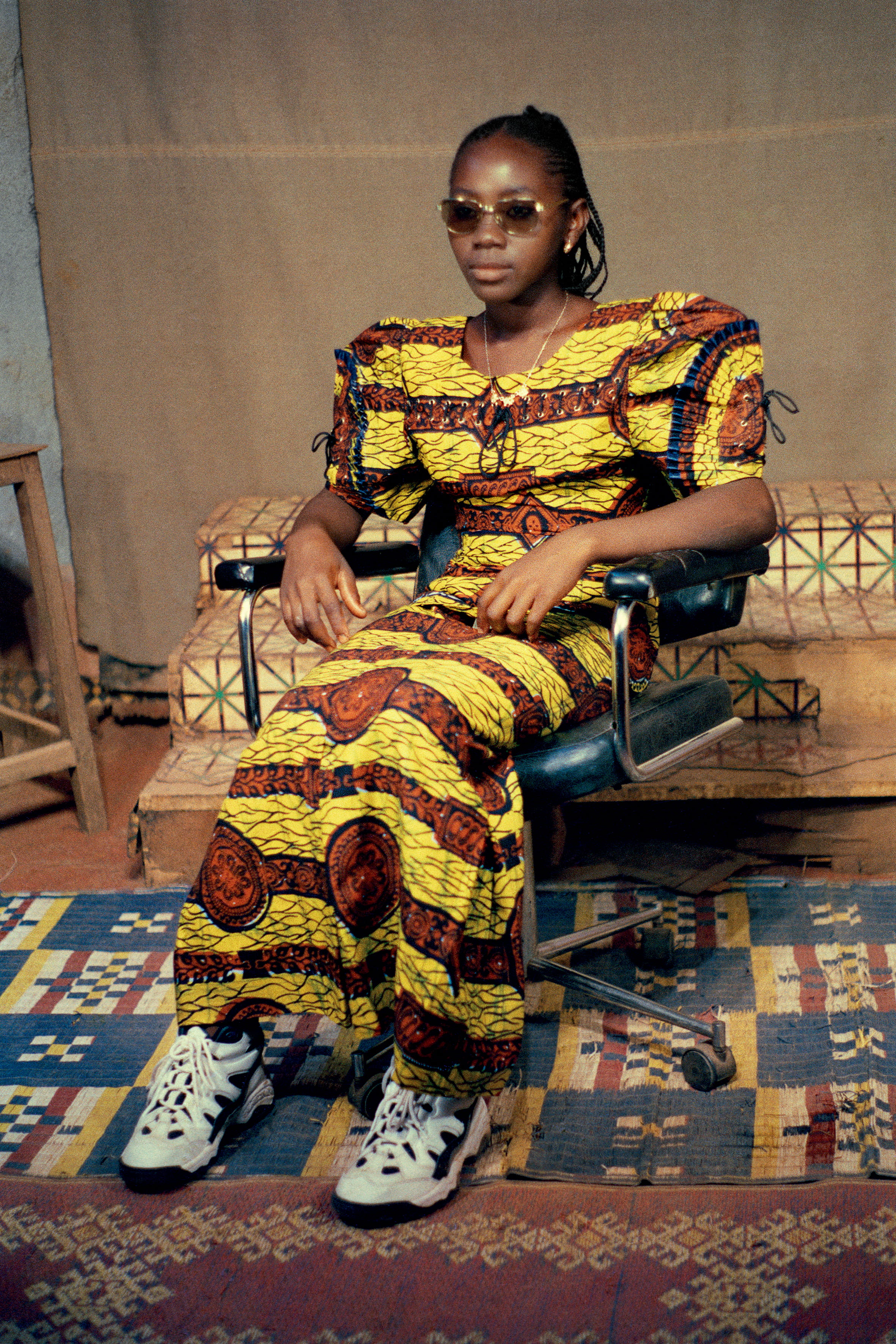
Sanlé Sory: Colour Years is at The Photographers’ Gallery until 21 February 2027. One of West Africa’s most prolific photographers, Sanlé Sory (b. 1943, Burkina Faso) took an estimated million portraits over six decades from his Volta Photo studio in Bobo-Dioulasso. Best known for his black-and-white work from the 1960s and ’70s, this exhibition presents his colour portraits, restored from his archive and shown in the UK for the first time.

It’s incredible to think that Sory had the drive to open his own studio, Volta Photo, at the age of 17 in 1960, the same year Burkina Faso gained independence. When you started working on this exhibition, what did you discover about those early years at the studio? And how did looking at that earlier work help you understand the development of his practice and his eventual move into colour?
Sanlé Sory is an extraordinarily dedicated and driven person. He spent three years learning his craft before opening his own studio, followed soon after by a second location, both under the Volta Photo name. He was constantly coming up with fresh ideas for his clientele: props, outfits, even make-up. He also organised parties in the countryside, which became events in their own right for him to photograph. He was a true entrepreneur.
Above all, Sory loves photography: the craft, the process, the making. He is a real maker of photographs. His move into colour was driven by his sitters, who wanted access to this new technology and the chance to represent themselves in the most contemporary way possible.
Having spent so much time with the archive, what did you come to understand about the relationship between Sory and his subjects?
Looking at Sory’s photographs, I see far more than portraits. Taken together, they map an entire region in all its diversity: its ethnic groups and faiths, its customs and rituals. Across an estimated million portraits and six decades, everyone seemed to pass through Volta Photo, from the fashionable youth of Bobo-Dioulasso to farmers who had come into town for the day.
The archive also reveals so much about what his clients wanted, how those desires shifted over the decades, and Sory’s remarkable ability to deliver them. It was a genuine collaboration. In the 1960s and 70s, sitters arrived ready to play a part (a cowboy, a film star, a devoted Eddy Mitchell fan) and Sory supplied the backdrops and props to bring their ideas to life. By the colour years, it’s families, couples and friends, identity photographs, traders and shopkeepers at the market: the same community, now presenting itself as a country in transition.
Many of his sitters were loyal friends as well as customers. Sory was hugely well known and respected in Bobo-Dioulasso, and you can feel that trust in every frame.
Sory is often discussed alongside photographers such as Seydou Keïta and Malick Sidibé in Mali, and James Barnor in Ghana. I’m curious about why we tend to group these photographers together. From a curatorial perspective, what do those connections help us understand, and what might they obscure about the differences between their practices?
There are good reasons why Sanlé Sory is so often discussed alongside Seydou Keïta and Malick Sidibé. Burkina Faso and Mali are neighbours, and all three played a pivotal role in shaping the history of West African studio photography. But the comparison only takes us so far.
Part of the issue is where the grouping comes from. These photographers reached international audiences largely through Western collectors, curators and galleries from the 1990s onwards, and there’s a real temptation, from a Western perspective, to file them all under one heading: “West African studio photography”. It’s a useful shorthand, but it risks flattening very different careers, cities and political contexts into a single aesthetic.

Generation matters, for a start. Keïta was born around 1921 and ran his Bamako studio from the late 1940s until 1962, when he was asked to close it and work for the new government. Sory, born in 1943, belongs much more to Sidibé’s generation.
I find the comparison with Sidibé particularly rich, not only because they shared a studio practice, but because they had a similar artistic sensibility. Sidibé is well known for the vibrant reverse-glass painted frames, made with local artists, that surround many of his prints. Sory, for his part, was an accomplished draughtsman who also illustrated record sleeves. He never drew on his photographs, but he poured enormous care and imagination into his studio backdrops (beaches, aeroplanes, a modern cityscape), which became an integral part of the visual language of his portraits.
What fascinates me most is that, long before the internet, Sory and his peers across the border were developing strikingly similar commercial practices and visual strategies in parallel. They were responding to comparable social and cultural changes, building thriving portrait businesses and creating distinctive aesthetic worlds, largely without knowing one another’s work. That’s exactly why each of them deserves to be looked at on their own terms: the parallels are striking, but so are the differences.
Sory once explained his move into colour in the mid-1980s by saying, “When you are in a place where everybody dances, you have to try to dance like everyone else.” Has he spoken to you about what that transition involved in practice, and how he adapted his way of working to colour?
Yes, and it’s a fascinating story, because colour transformed his whole way of working. Sory had learnt his trade in the darkroom, processing and printing his own black-and-white negatives from the very start. But his darkroom wasn’t equipped for colour, so he had to let go of that part of the process and collaborate with a neighbouring processing lab.
His equipment changed too. He moved from the square-format Rolleiflex that defined his black-and-white portraits to 35mm cameras by Olympus and Konica, working primarily with Konica film, as well as Kodak and Agfa.
Simply getting hold of materials was an adventure in itself. Every six weeks, Sory made a two-day train journey to Abidjan, in Côte d’Ivoire, to stock up on film, photographic paper and developing chemicals. That tells you everything about his commitment. By the late 1980s, colour had become the heart of his practice. He really did learn to dance like everybody else.

Sory is 83 and still lives in Bobo-Dioulasso, yet his work has travelled far beyond the community in which it was made. Have you had a sense of how he feels about that wider attention, and what his relationship with photography is like today?
I think part of him still finds it hard to believe. For decades, his photographs lived in Bobo-Dioulasso, as keepsakes, identity photos and the covers of local records. When the French music producer Florent Mazzoleni met him for the first time, he found Sanlé Sory burning old negatives outside his studio. To go from that moment to exhibitions in Chicago, New York and now London is quite a journey.
He is incredibly grateful and genuinely thrilled at the idea of his work reaching new audiences around the world. He’s clear-eyed about it, too. As he has put it himself, African art and creativity were always there; it’s simply that the world is finally paying attention. And photography is still part of his everyday life. He keeps a studio in Bobo, much smaller than it once was, and well into his eighties, he is still riding around the city on his motorbike, photographing its people. After more than six decades, he remains a maker of photographs.
Sanlé Sory: Colour Years. The Photographers’ Gallery. Until 21 February 2027.
Don't forget to check in and leave your review on the gowithYamo app!