
15 Questions with... Nomin Zezegmaa

Welcome to 15 Questions With…, an interview series in which art writer Gary Grimes picks the brains of artists, curators and other creatives to understand what makes them tick through a series of quick-fire questions. This series aims to showcase the varying approaches creatives take to making art and how their relationships to the so-called art world differ, but also reveal what unifies those responsible for the art we love.
Nomin Zezegmaa is a Mongolian multidisciplinary artist, researcher, writer and silversmith, born in Berlin, Germany, now based in Ulaanbaatar, Mongolia. Her theory and practice draw from Mongol foundational mythologies to investigate interwoven histories and the materials that surround us. Natural materials found in the Mongolian landscape, such as horsehair, driftwood, bone, charcoal and wool, influence the work she creates, which is often site-specific.
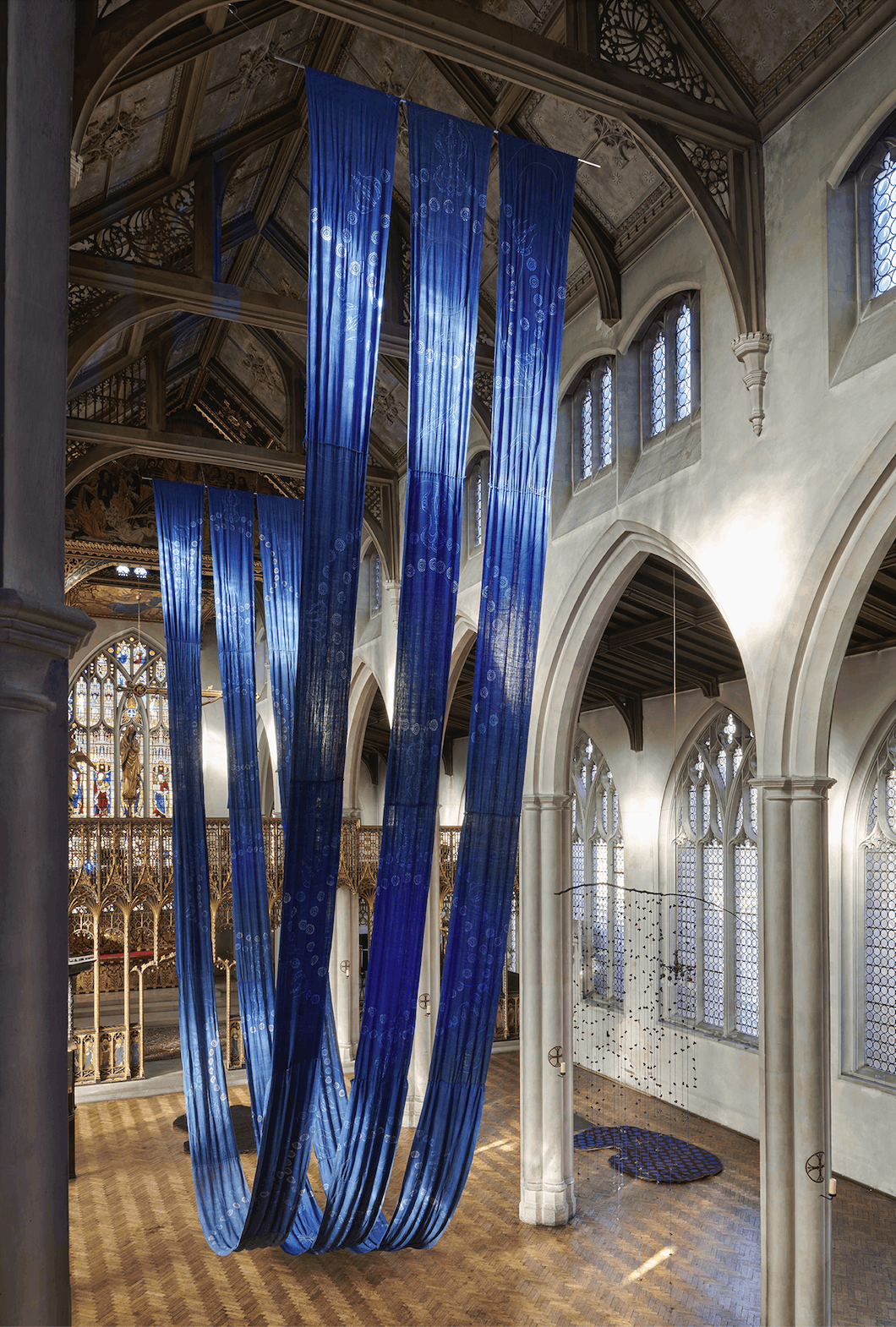
In October of this year, she exhibited a monumental 24-metre Batik installation responding to the architecture of St Cyprian's Church, a Grade II listed building in London, exploring the relationship between sound, architecture and ritual. The exhibition brings together materials including horsehair, copper, silk and specially-crafted bells sourced and cast in Mongolia, creating connections between sound, landscape, spirituality and pastoral life. The presentation was a part of the Bagri Foundation’s Springboard exhibition programme, which aims to give a platform to undiscovered artists from Asia who have never previously exhibited in the UK.

1. What is your earliest memory of a work of art?
One striking memory, perhaps less in terms of “art” understood under Western paradigms: It is a precious memory from my early childhood, when I was visiting Mongolia, barely remembering much of my visits there during the summer breaks. One memory remains very clear.
I remember my grandfather styling my Barbie toy horse’s mane, in the traditional fashion of a Mongolian racing horse, and placing it on the altar. This act is so deeply ingrained in my visual memory. It is both ritual and an expression of worship, an animal, culturally and spiritually incredibly sacred to Mongols–a totem, so to speak. Even an “insignificant” toy horse became worthy to be placed on the altar. As a child, I was merely mesmerised and in awe, confused but in awe. Now I can reflect on the deeper nuances and meaning of this gesture. My grandfather was a legendary horse herder.
2. Where do you turn to when you're in need of inspiration?
To the wisdom of my ancestors, mostly. To Bogd Khan Mountain, to the ancient, genius wisdom of creators and artisans. To books, imagination, and worlds dreamed into existence through storytelling.
3. What do you like to do when you need to take a break from your practice?
I don’t believe in “taking breaks,” though I should. The artist’s mind is 24/7, 365, fermenting and ruminating. It is not about endless production or creation of content, but the artist’s mind is in endless motion, in constant flux.
However, I recently discovered “creativity without pressure” as a way to take a sort of physical and mental breather from my main work. It is basically like creating silly little things that are precious and make you a little happy without the overwhelming labour of a large artistic production. (Not speaking about silversmithing here; this falls under artistic production as well, for me.)
Or I would be out on the mountain. Or running. Or cooking. I realised that to create, I am living more. To create, I maintain my health and vigour.
4. Who is your favourite artist?
In this line of work, it is hard to pick just one artist; many inspire me, as the biggest blessing must be the many fellow artists you get to encounter and entangle with; pick each other’s brains, learn their life histories, decisions and challenges. Living or long gone, inspiration is shared.
5. What's the biggest crime an artist can commit?
Losing one’s curiosity and awe of things. Creating for purely commercial profitability.
6. Which gallery or museum should everyone try to visit at least once in their life?
Zanabazar Museum, Ulaanbaatar, Mongolia
7. What is the worst thing about the art world?
The void people seek to pretentiously fill only with art.
8. Whose opinions on art do you actually care about?
If it is about my own art, without doubt, I trust my own intuition.

9. Who are the last three musical artists you listened to?
CORTIS, Alan Hovhaness & Ryuichi Sakamoto. But there will always be some Mongolian music sprinkled in between as well.
10. What's your favourite colour and why?
Depends on what for. For clothes, it’s black, because it just allows my brain and mental capacity to be fully available for other things than the colour of clothes. Do not get me wrong, I love self-expression through clothes and fashion, but colour is something that would wreck my brain. Also, black has a certain weight that grounds me; other colours feel too light. As if I would defy gravity and take off.
I believe this somewhat pragmatic or practical approach also translates into my work. It is very monochromatic and straightforward when it comes to colour.
11. What three items would you grab if your house was burning down?
My cat Soyo, my mother’s blue deel (a traditional Mongolian garment), and my yatga (zither).
12. Is there an artistic skill you wish you were better at?
I haven’t grappled much with oil painting yet. But I am genuinely always open to challenging myself to learn new skills. One thing that matters a lot in the background of my work is reading. Hence, I wish I could divide myself into 9, and place a different book in each of the carbon copy Nomins, that combines all knowledge, skills and insights into one super brain haha.
13. What can you tell us about your work that's on view at St Cyprian's Church?
I put the sky in the church, so you may feel a bit closer to your ancestors. Most importantly, I wanted to create an atmosphere where the magnificent architectural beauty of St Cyprian's does not fight with whatever I would create.
14. Which element of the artwork took the longest to perfect and why?
Most definitely the batik, as it’s grand in size and directed the course of its development. Without the many helping souls and hands, this work would have been impossible in the short timeframe for production we had. Traditional Javanese Batik itself is a beautifully meditative, time-intensive process. It still blows my mind how it even worked out within 2-3 weeks during my time in Yogyakarta. And then every single fabric was embroidered by hand with large symbols based on my Writing Without Writing calligraphy practice.
If we take into consideration the origin of the fabric itself, we would have to go into the soil. The cotton is grown in East Java, in Tuban, a village famous for its cotton, gedog. Woven by hand, by the elderly, on a backstrap loom. From the growth of the cotton to what it is today, shown in the St Cyprians, it has come a long way. And it will continue to go on for a long way further. Every time this piece is shown in the future, I plan to continually work, add layers and details, show it, and install it in different ways.
In Javanese cosmological practice, one is born and receives a batik, tailored to their astrological practice, Pawukon. You live and die with this batik; it is in itself a symbolic carrier, but also a companion, an amulet and a friend.
In this manner, my somewhat overly large batik will also remain with me and go through many changes, in constant flux.
15. What impression do you hope people get after seeing your show?
Nuances yet similarities of expression of spirituality, the preciousness of slowness, and perhaps that we all live under the same sky on the same soil.
