
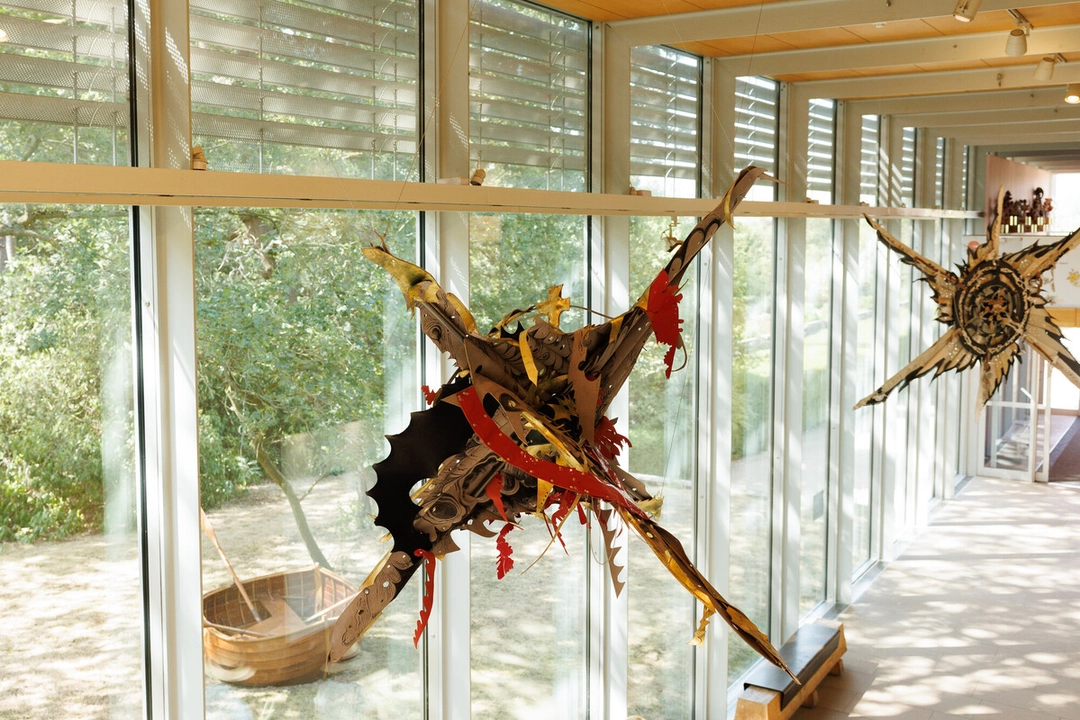
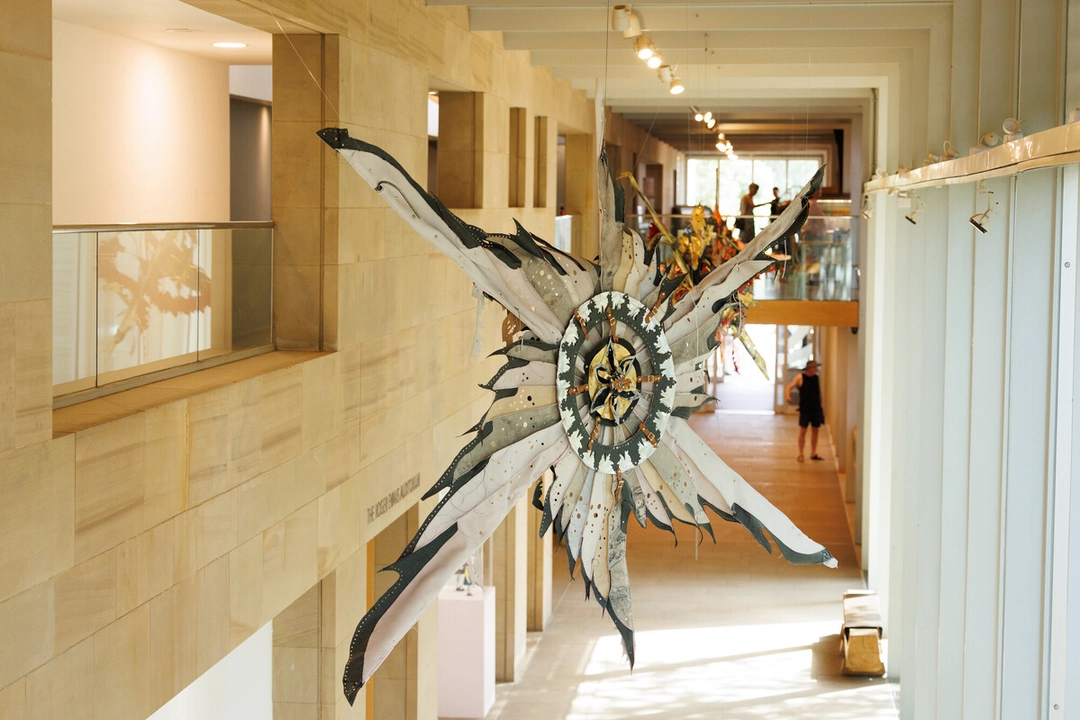
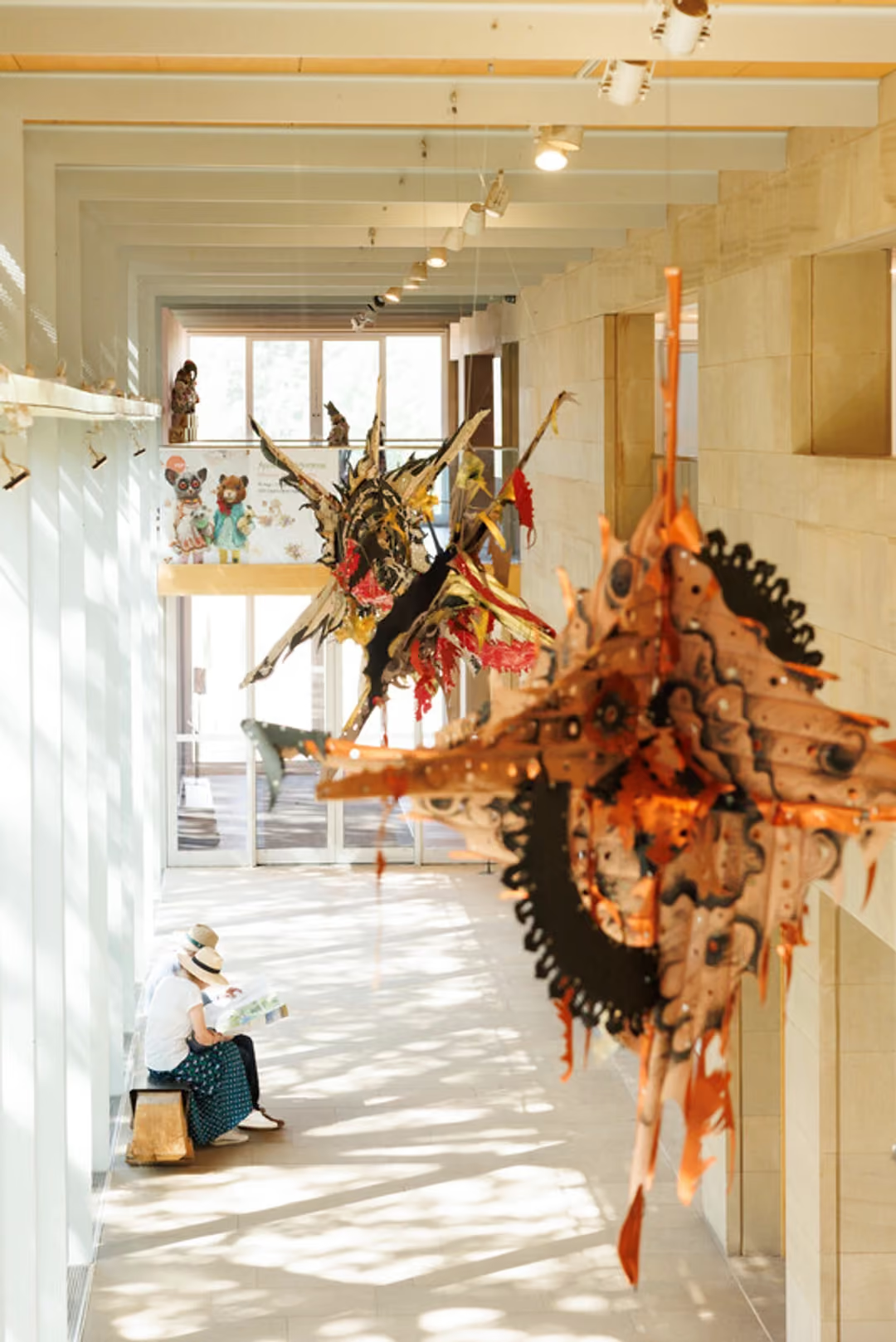
Jakob Rowlinson's ROTATOR at Yorkshire Sculpture Park
How did you become interested in Medieval art?
I'm particularly interested in the fantasy genre, whether that’s literature, film or video games. They are all drawing on imagery that we associate with the European Medieval. As a kid, it felt like a sanctuary or a place that I identified with as a young queer person who hadn't quite worked all that out yet. I love the mystery, the pageantry and the embellishments. I think I was drawn to the campness of it and the reimagining of new worlds. Where I grew up in Norfolk, you're surrounded by that kind of imagery. I also think it's very important to discuss now, with the rise of the far right and arguments around who has ownership over nationalism and our history.
Is queerness overt in Medieval art, or do you have to seek it out?
Terms such as LGBTQIA+ are very modern constructs. These are identity labels that clearly didn't exist in the same way in the past. So there is always a challenge about how fairly you can use them. People like me certainly existed at that time, but they wouldn't have necessarily thought about themselves in the way that we do. A lot of that has been erased, and we have evidence of it being erased. We can see that it was either chiselled off buildings, or it was expunged from records, or it's just not talked about. But if there are punishments existing for it, then it must have been happening. There is a certain lack of visibility in that way.
Tell me what “queering the archive” means for you.
When I talk about queering the archive, it's more nuanced than LGBTQ-ifying the past. I think that's a brilliant thing, but queering, for me, has many layers. It's challenging those status quos as well as challenging the binaries between sex and gender. It’s also about creating this unstable ground where multiple things become apparent, so that when an audience is looking at a work, they are prompted to think, "Oh, what's really happening here?" A medieval gargoyle or grotesque figure is never just one thing. They're blended with several other hybrid faces, maybe part-animal, part-plant, part-human. I'm more interested in that multiplicity, rather than simply projecting contemporary homoerotic imagery onto the past.
Tell me about your residencies at Yorkshire Sculpture Park and The Art House, Wakefield.
In 2024, I did a joint residency, on site at Yorkshire Sculpture Park in this beautiful cottage, and at The Art House in Wakefield. As it turns out, The Art House is built on top of a medieval tannery. This felt like a gift, because one of my most-used materials is leather. During its construction in 2008, the remnants of wooden vats - one used to store urine - were found in the basement. Historically, when making leather, you'd have to scrape the hair off the hide, then put it in tannic acid, which is made from trees. You’d then leave it for 12 months to denature the proteins in the skin. When it’s done, you can't just wash off the acid; you have to balance the pH with something alkaline like ammonia, which is found in…urine.
How did your practice develop?
I had been working with leather for a while, but for the first time, I started to work with the full hide of the cow. They are extraordinarily beautiful. I was very conscious of the fact that I was holding an animal in my hands. I don't like to waste the material at all - I want to use it with a degree of caution. I started to play with marbling on the surface. You can do marbling that's very controlled with combs, and you can get a very special pattern. But I really like the more chance encounters. I also experimented with tattooing into the surface of the leather with a tattoo gun, which allowed me to do some drawing on the hides. For ‘Psychopompous' (2026), I used a particular ink called Oak Gall ink, which I made from the oak balls I sourced from the Sculpture Park.
Tell me about the exhibition at YSP.
There are two parts to it. The exhibition is called REVIVER. Reviver is a palindrome, a word that can be spelled forward and backwards and read the same. Similarly, the installation is called ROTATOR, which is also a palindrome. Both ROTATOR and REVIVER have this element of things coming back to life, the wheel turning. I made a commissioned installation comprised of large hanging works in the main atrium area. They're angelic forms that reference the beautiful resident butterflies, the Orange-tip and Comma butterfly. I thought, “how can I create a mythology about these butterflies dying and being turned into angels?” And so the works look a lot like Ophanim, which are circular, celestial beings.
How does your work draw on mythology?
I am really interested in the Myth of the Eternal Return. Most world mythologies have a creation myth with a chaotic primordial god who is a feminine, amorphous entity. A son comes along and overthrows this being and instils a kind of heteronormative order. Zeus and Marduk are good examples. The idea of there being no linear line, but an eternal return, felt like my approach. All of my work is collage. It's taking materials, recutting them and repasting them. For this project, everything has been revived; I have used my dad's old leather jacket and my mum's old shoes. The idea of things coming back to life is synonymous with the queer experience. We're collaging things together, having to reanimate it. In this exhibition, for the first time, I’ve also cannibalised earlier artworks. I show them in a different format. Many of the titles will include something like revived from and then the former name of the artwork. So there's a layer of archiving in the work itself.
Tell me something surprising about your practice.
I actually don't view these works as finished. Some of them will go into homes, or perhaps into institutions. It's not going to fall apart in two years' time, but in the lifetime of the material, it is ultimately going to change again. The works that do come back to my studio, I will then revive them a third time or fourth time. This idea of the works never being fixed or finished is interesting for a practice. I'm cannibalising really; eating it up and churning it back out again.
What is the relationship between masks - something wearable - and sculpture?
I think of them more as sculpted faces that can be worn. They are sculptures. When my works are displayed, I think they are so powerful because they're not worn, but they have this potential to be. One of the masks in the exhibition has a digital CCTV-style camera embedded inside it. I placed it very high up, somewhat reminiscent of a gargoyle or a grotesque, but it has a surveillance nature to it. Some people have commented that they feel a real presence in the sculptures. They feel quite intimidated by them, which isn't a particularly nice thing, but I think it does mean that something is happening.
What excites you about the show?
I'm so excited by the smell. Leather has a very strong odour; it’s a lovely, sumptuous smell. A lot of my work is about playing with historical things. Scent is clearly one of the things that bypasses the normal regulatory systems in your brain and goes straight to the hypothalamus and the amygdala, so certain memories arise straight away. You'll know when you've smelt some old fragrance you haven't smelt for years, or something that reminds you of your mum. The garments and shoes have been worn, and so they also carry natural oils from someone's body. The idea of playing with scent in my work is such a natural progression.
Why is it important to look towards the past?
A few years ago, I did an exhibition in New Zealand, and it was an amazing opportunity. It was my first major institutional show there, and I learned so much about Māori culture. One of the main takeaways is the idea that the future is over your shoulder, and the past is ahead of you, because that is what you can see and that is what you know. You have no idea about the future. Therefore, if you want to build a more equal society in the future, you need to deal with post-colonialism and gender issues; you need to address the past.
ROTATOR is on at Yorkshire Sculpture Park until 19 September.
Don't forget to check in and leave your review on the gowithYamo app!