
Hattie Quigley at Refusés
Have you always wanted to be an artist? How did this urge develop during your time at Edinburgh College of Art?
As a child, I was always doing art in the corner as a way to keep myself out of trouble. Other little girls would say, "I want to be a princess," whereas I would say, "I want to be an artist." I think I've always seen the world through figures, and I ever since I was tiny, I've been interested in drawing people. At art school, I became more educated on the male gaze and why, as women, we're told to be or look a certain way, and art's relation to that. I became very interested in the Old Masters as a way of rooting my work in a dialogue and giving it some sort of historical weight. I would look at The Three Graces by Rubens and see these fleshy, voluptuous women with their non-flat stomachs. They made me look at my body in a different way.
How did your practice change?
At the start, I was always doing portraiture. I’d take these photos in the photography room with disgusting, grotesque food like porridge all over my face to make photorealistic paintings. During my final year, I felt like I'd found a subject matter that was really close to my heart, but it was becoming tedious and more like it was a chore. From there, I went purely abstract. That was a breakthrough for me. I think my work took on a more painterly quality as a result, because it's so much about the body and emotion and gesture, and that's where it all fell into place. Then, slowly, the figure crept back.
How do Old Masters influence your practice?
I always look to history to see how it is interpreted today, and how we can learn from it. I’m fascinated by Bacchanalia and the sheer amount of Bacchic paintings that exist. I’m interested in the similarities you find in the drunkards in these paintings from hundreds of years ago and me, as a 24-year-old woman, and my peers. I also love the drama of Baroque art; the excess and the theatricality. I find it awe-inspiring. I also find it funny, in a way, that I’m here making these grand historical, excessive compositions. I love how it's too much.
Tell me about SWELL, your last solo exhibition at Refuses.
I’ve always felt that if I didn't have art, I would explode. This is my first big solo show, and I think it encapsulates that feeling of explosion. It's an exploration of excess versus restraint, and this innate human need for these explosions of excess and festivities, as well as places where pleasure is rampant. I chose the name Swell because I love how many different meanings it has: the feeling of being bloated after a really big meal, when you're uncomfortably swollen, or when a part of your body swells up after an injury, or in a positive way, as in, "I'm having a swell time!" or like a wave or tide.
And the works are influenced by Brazil’s carnival culture?
I have always been really interested in excess, and I recently became interested in the idea of the party as a place where social orders are temporarily suspended, and everyone lets loose. In February, I went to Brazil for seven weeks. I visited five different regions of Brazil and went to carnival in all of these different places. I loved seeing bodies of all shapes and sizes and how free people felt. I read somewhere that carnival means “abundance” in every language. There are carnivals all around the world - it’s such a universal, human thing.
Two of the works in the show evoke feelings of ‘day’ and ‘night.’ Why is this?
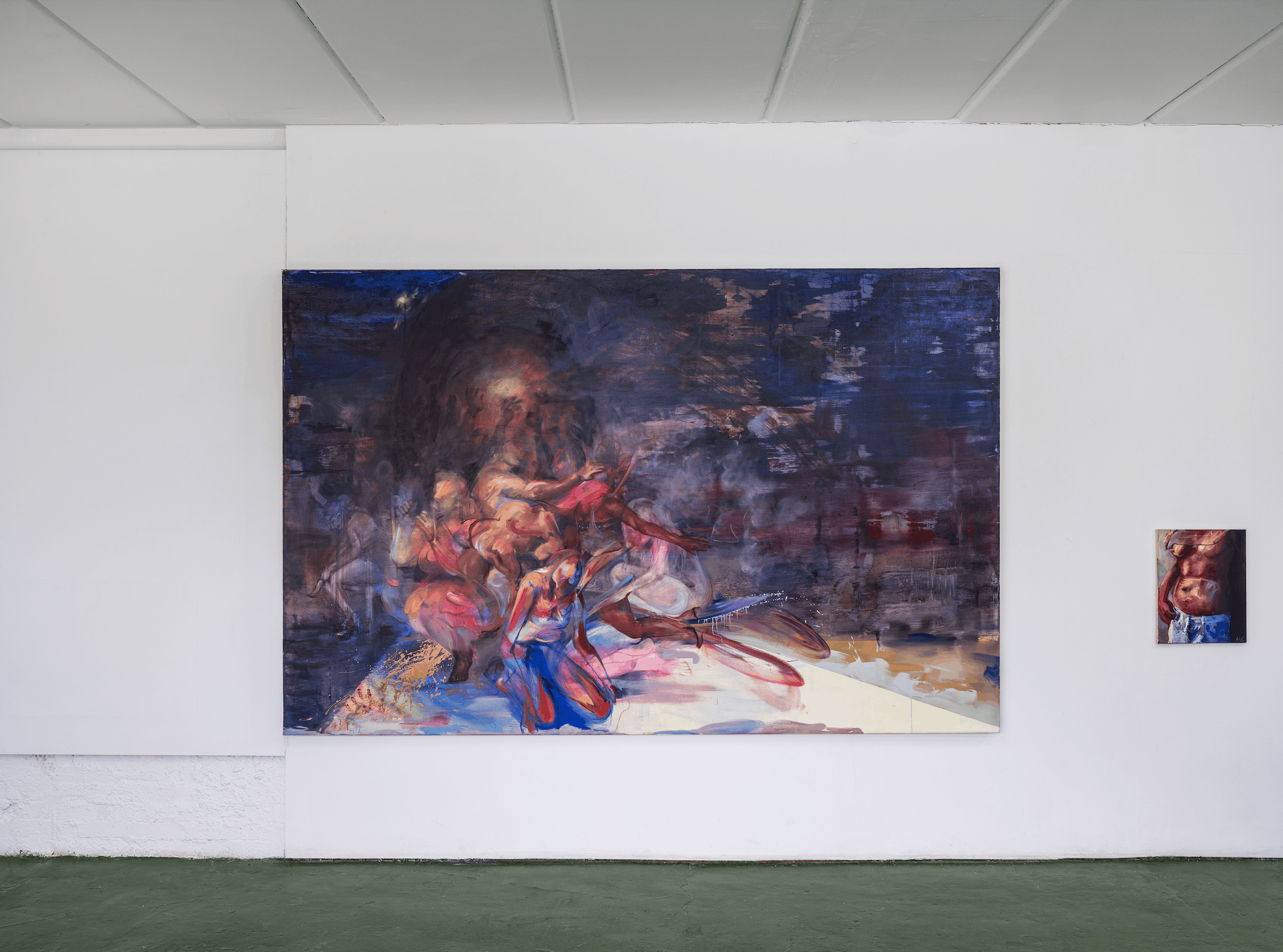
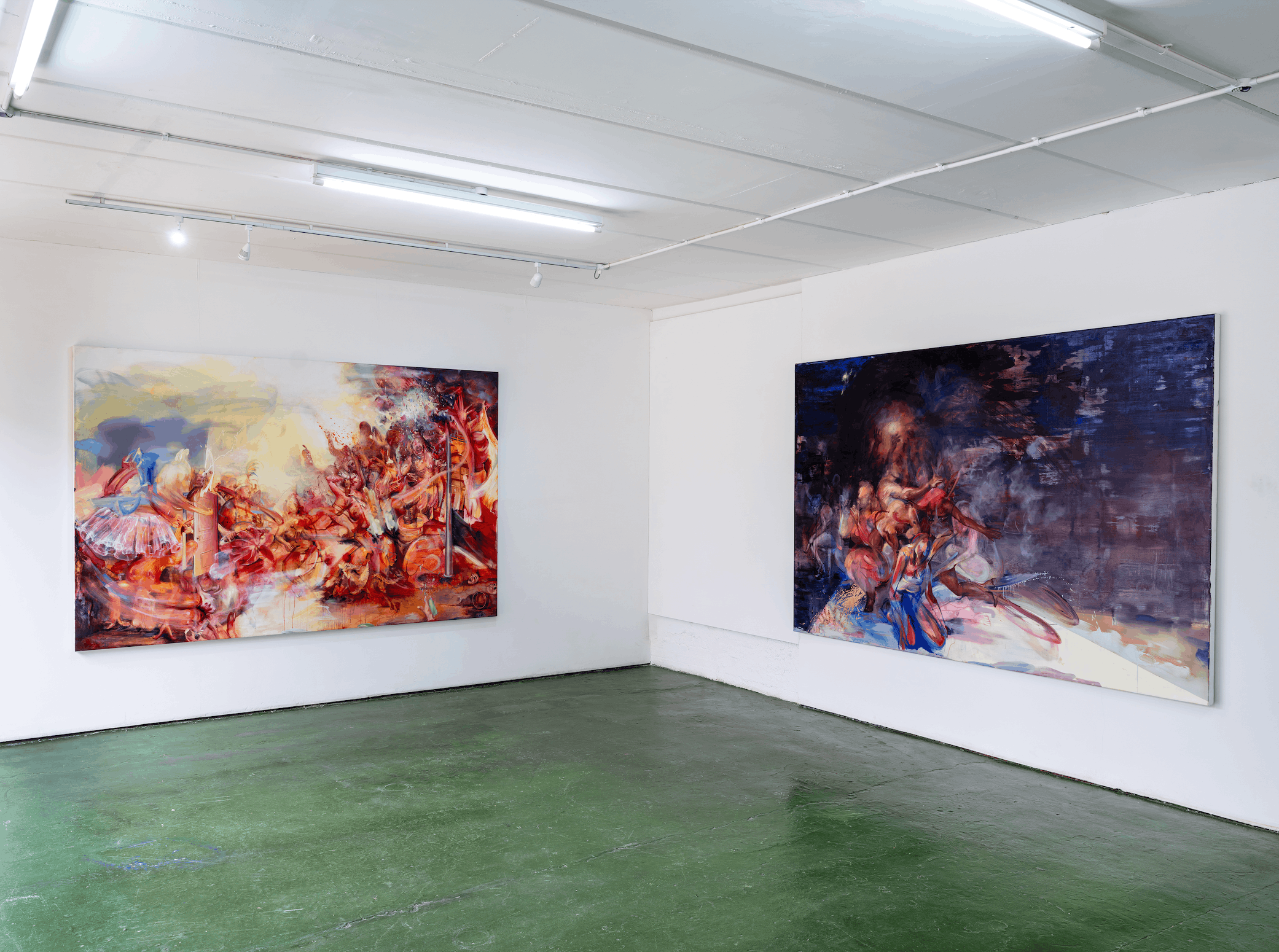
When I was envisioning the works for the show, I was reading about the history of drunkenness and how, since the beginning of time, societies have found a way to indulge. I really wanted to deep-dive into that, the carnivalesque and UK nightlife. I knew that Chaser for a Collapsing Body was going to have a lot of paint on the surface. I thought that with Feel, Everything, I needed to have the complete opposite, with spaces where it's just the bare primed canvas. I wanted there to be breathing space.
In the exhibition, you included a glimpse into your studio practice. Tell me more about it.
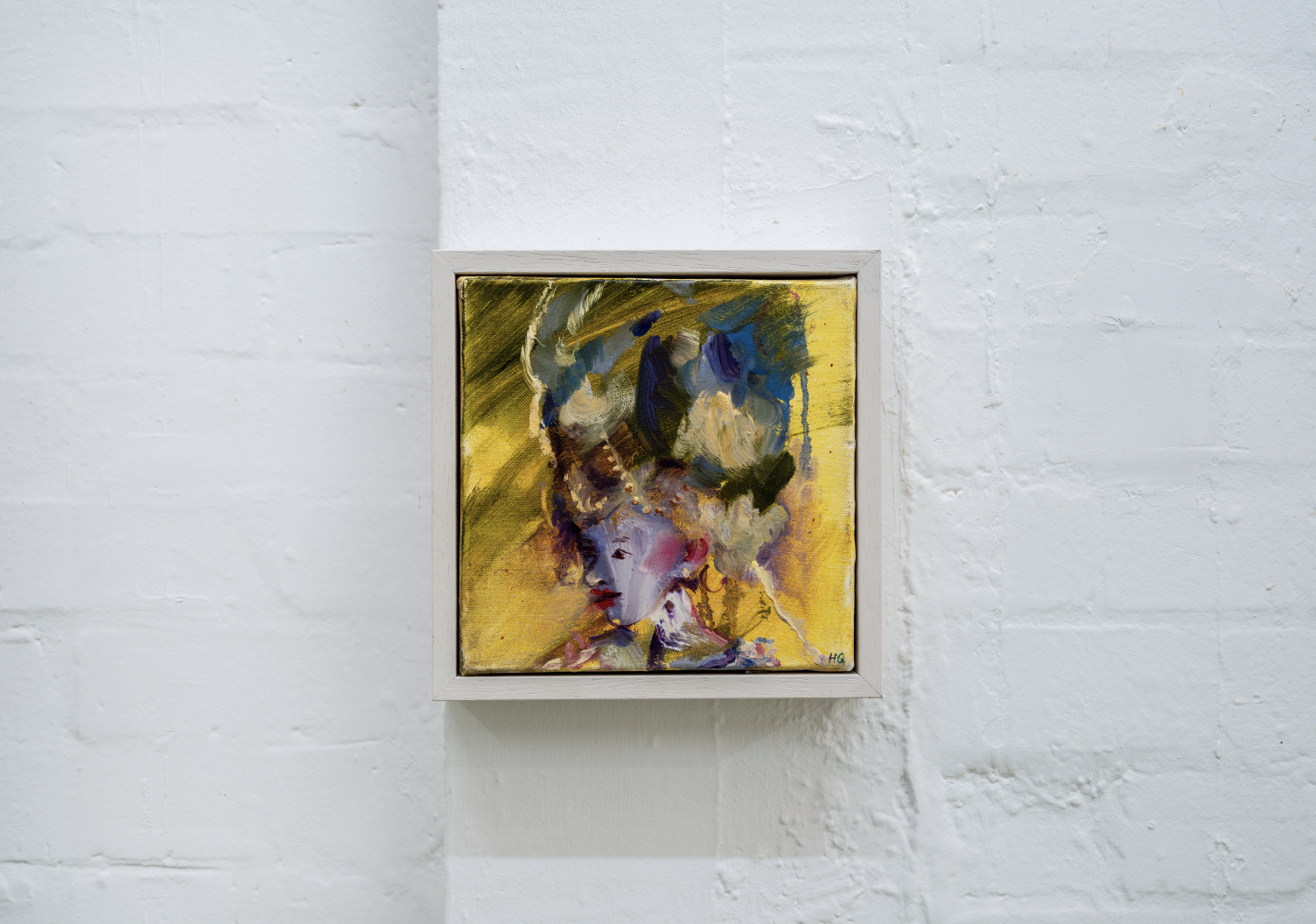
I'll do a lot of monochrome drawings with ink or charcoal as a way of thinking through the figures. I then do small colour studies where I'm thinking about gesture, colour and form - that's the abstract part of my practice. Then I'll try to build up these compositions, which takes quite a while. Sometimes I use art historical references, other times it's more intuitive. But once I start the painting, it changes so much. I start off with a framework, and then I battle with it. When I start on the canvases, it becomes more honed in. I'll use brooms, different sponges or anything that I can get my hands on to make a mark. I love going to B&Q and getting weird cleaning products.
I hear you occasionally make your own?
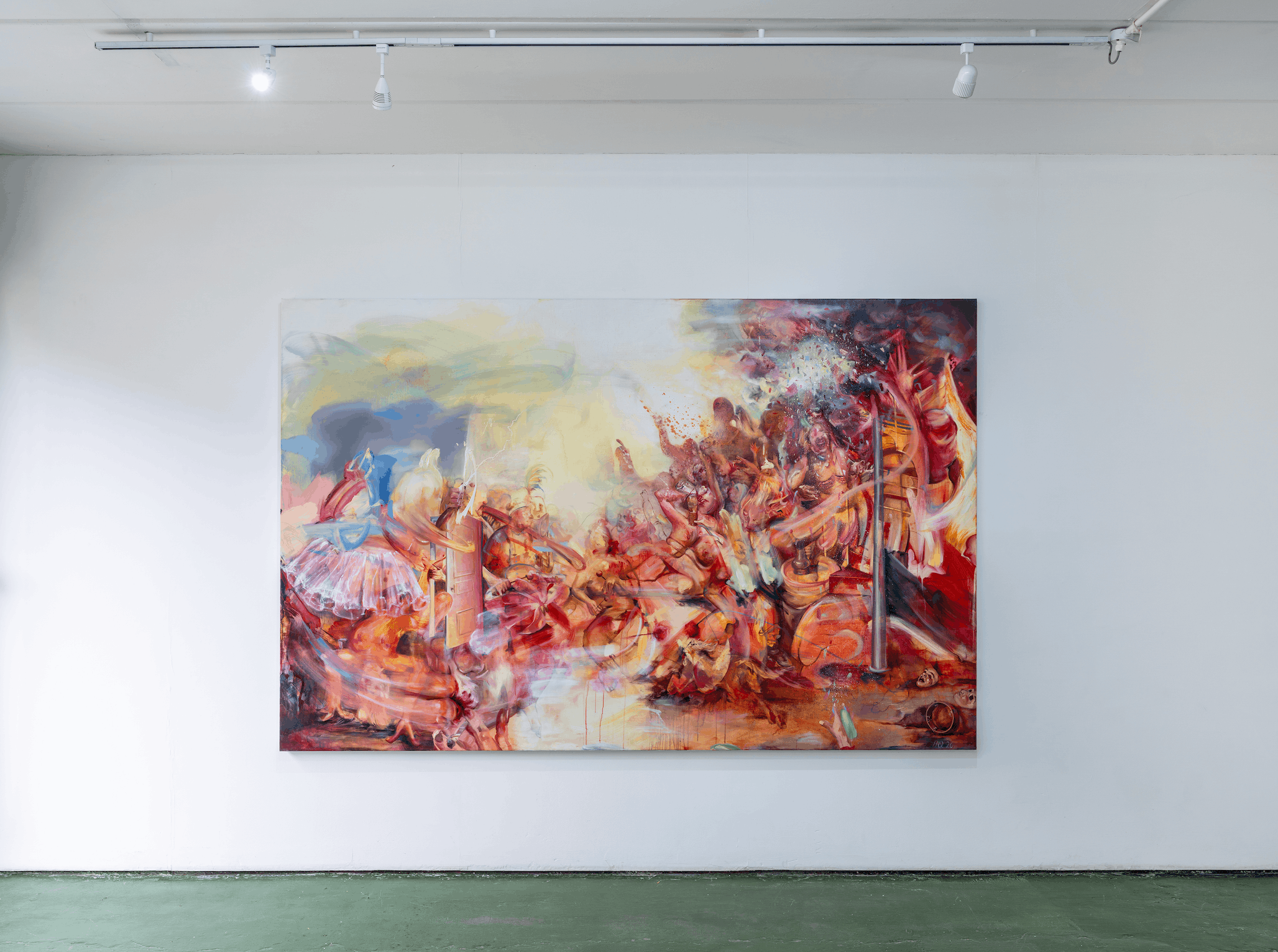
I go through obsessive phases over artists, and recently I went through a Richter phase. I was watching his documentaries, and I got really inspired. I thought, “I'm going to make my own squeegee”. So I did, and it was great! I made it from a piece of acrylic plastic that I had in the studio. I then got two blocks of wood from my dad's workshop and just superglued them on. I used it in Chaser for a Collapsing Body, and I love the effect it’s made. It's like makeup that's smudged - like a smudged smoky eye - or like sweat being dragged across the surface. I don't think you could get that effect with a brush.
Why do you include surreptitious symbols and objects in your works?
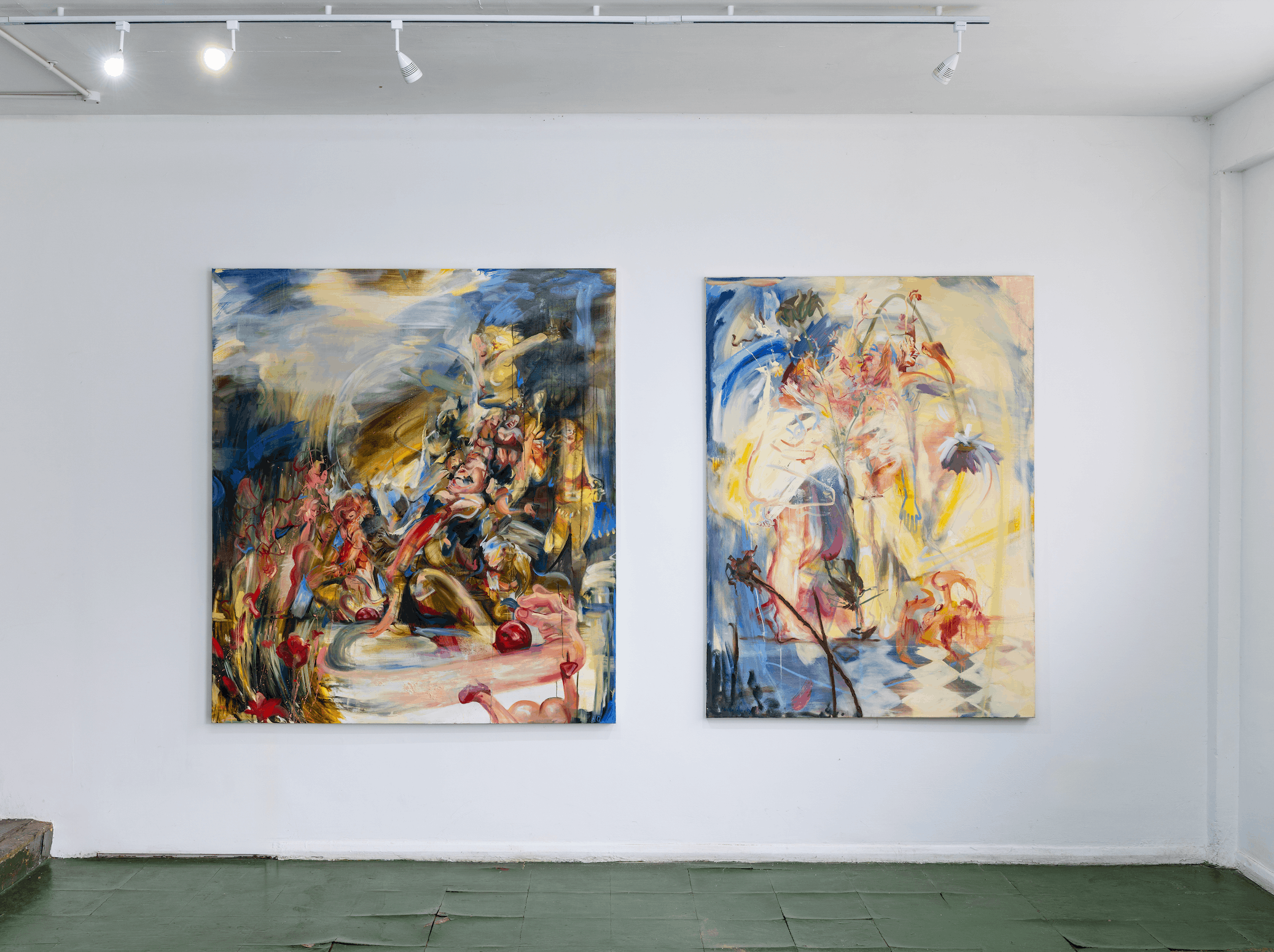
It's so fun to hide secrets in the paintings. I like how different people's eyes see different things. The paintings show the work of the human hand over a period of time, and within these layers are different meanings. For Feel, Everything, I had visited the National Gallery a few days before and saw works by Poussin. I was stuck on the painting, and it was like, eureka! when I saw his tambourines. I love using figures from the Dutch Golden Age. In Chaser for a Collapsing Body, I looked at Jan Steen’s The Drunken Couple, where a woman has fallen over, drunk. During the creation of What if You Had Held a Grudge, Fondled it, and Found You Had Fallen in Love? I was living at home, and my mum had gotten really into floristry. So flowers crept into the paintings. And now, whenever I look at that painting, I’m taken back to that time in my life.
Do you have a favourite work from the show?
Maybe What Have You Held a Grudge, Fondled It, and Realised You Had Fallen in Love? The title comes from a poetry book called Monica's Overcoat of Flesh. I love this one because I really switched it up in terms of technique. I never want to go into a painting knowing what to expect. I feel like I really pushed myself with that one.
Would you say your practice is autobiographical?
It's incredibly autobiographical. I grew up during the genesis of social media. Almost every friend of mine has had issues with food, and I’ve had terrible issues with body image. Through my practice, I feel the need to explore this vulnerable part of myself, and what it all means in this age of flatness and AI - especially now, with women wanting to be very small and thin.
Which artists are you obsessing over right now?
I’m having a Soutine obsession at the moment. I think the way he uses paint is sensational. I follow this Instagram account called @chaimsoutine, which posts close-ups of his paintings almost every day. Instead of seeing news, I'm seeing these old paintings. Every time I see them, I'm in awe. I can almost feel him through the paintings. Also, Dorothea Tanning.
What’s next?
I’m starting at the Royal College this month, on the MA Painting programme. I’m excited to paint without thinking about any show in particular. I don't want to feel like I have to create anything for anyone. I just want to go back to the basics, surprise myself, make friends and have fun, because life is short.