
Bringing National Heritage to Life

Britain is full of history and heritage shaped on our shores and abroad, and this is often epitomised in the publicly-accessible properties, gardens and estates that are dotted around the country. But whilst these establishments are truly remarkable, holding vast collections steeped in history, they can also feel a little stuffy at times and risk appealing only to a limited audience. One remedy for these well-established institutions is to collaborate with artists and curators outside of their usual remit, thus drawing in different crowds and bringing fresh perspectives to their permanent collections.
This summer, two exhibitions in West London take centre stage within traditional spaces loaded with heritage: Karun Thakar’s textile collection at the National Trust property of Osterley House and Henry Moore’s monumental sculptures at Kew Gardens. And for those seeking similar cultural experiences out of the capital, both of these shows also have satellite exhibitions outside of London, in Sussex, Bath and Norfolk.
'Journeys' at Osterley Park and House: Global Textiles from the Karun Thakar Collection
Wedding Shawls, Baghs and Phulkaris at Osterley
Osterley House is a grand, imposing building set within an expansive park in West London. It was originally built in the 1560’s for Sir Thomas Gresham, a prominent Tudor financier and adviser to four successive monarchs. In the late 18th century, the estate was transformed by architect Robert Adams for the Child family. There is no doubt that the property was built to impress the high-ranking guests of this wealthy banking family. Visitors must climb up a wide set of stairs, past a neoclassical double portico and through a large, austere exterior courtyard before entering the property and being dazzled by its lavish interiors.

This is the setting for ‘Journeys’, an exhibition of Punjabi wedding textiles from the Karun Thakar collection. On arrival, visitors are presented with a beautifully illustrated guide to the exhibition, which also provides a narrative structure to the exhibition, tracing a bride's journey through her wedding day. For me, this storyline slightly missed the mark as most of the garments were draped over cuboid plinths, so I didn't find myself personifying them as much as intended. What was far more poignant for me, however, was seeing how the intricate decoration and rich stories behind the garments entered into a dialogue with the resplendent ornamental interiors of Osterley House.
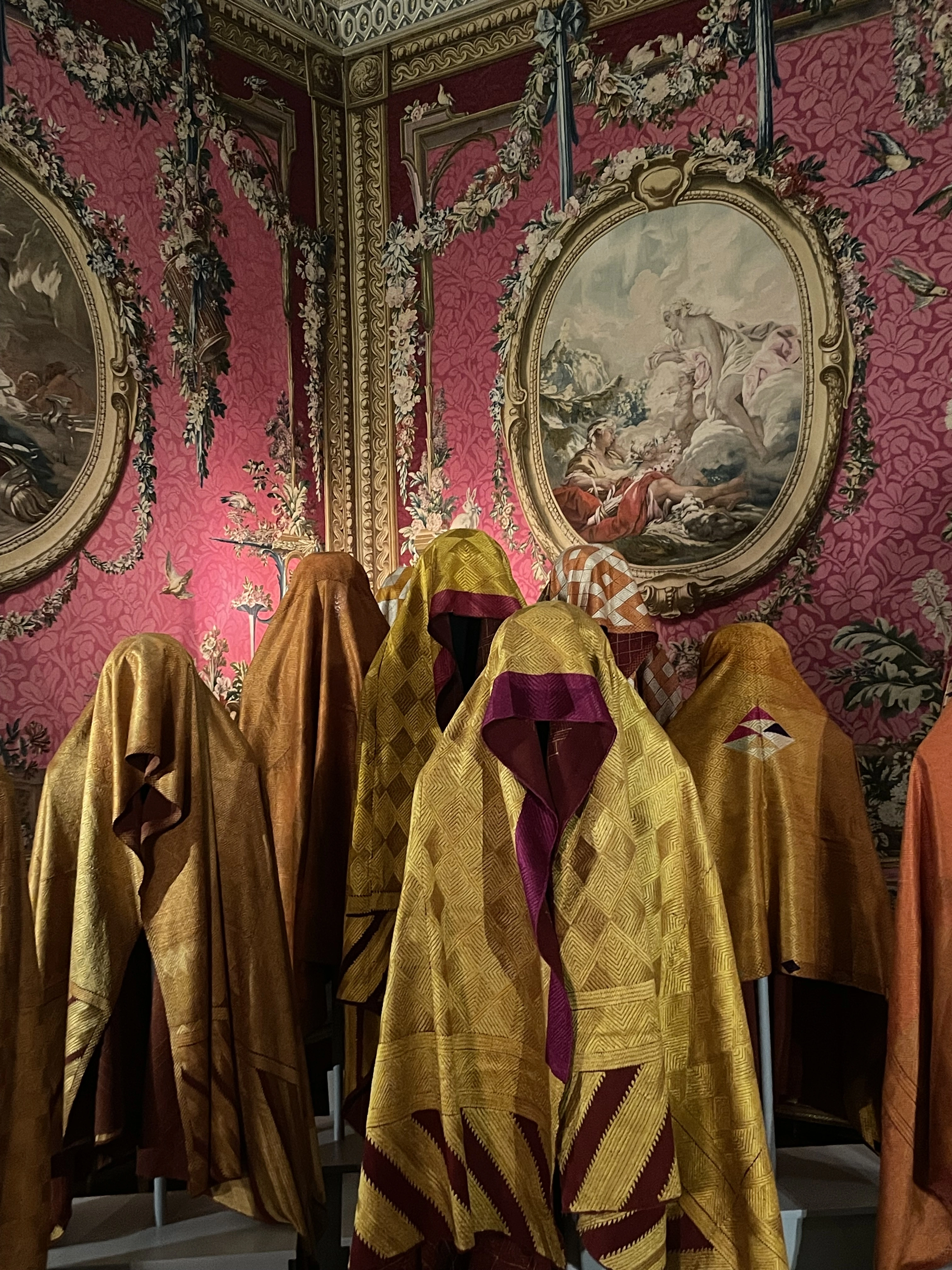
It’s the sheer splendour of it all that struck me most. The textiles on display here from Karun Thakar’s collection are Punjabi wedding shawls, baghs (which are fully-embroidered shawls with geometric depictions of gardens) and phulkaris (which are cotton shawls featuring vibrant silk flower-work embroidery). These beautiful, intricate textiles were worn during special occasions, and this is reflected in their making. Vast amounts of time and skill are passed down through generations of women and poured into the embroidery work. The luxurious silk embroidery thread shines when the fabric moves. And visually, these textiles really sing when placed side by side with the dazzling interiors of Osterley House, with its gilded mirrors, relief panelling, inlaid marquetry, embroidered furnishings, coffered ceilings, hand-painted murals, woven tapestries, and more.

But beyond the dazzle, these symbols of wealth at Osterley reveal a darker history. The Child family were linked to the East India Company, and their wealth was partially derived from maritime trade. All this opulence relied on colonial rule. The art and objects furnishing the house, which were sourced from all around the world, were there to reflect the status, taste and worldly culture of their owners. And this context is further accentuated when Karun Thakar’s Punjabi textiles are placed alongside the original furnishings of the house, thus shedding light on some of the more difficult and problematic aspects of British history. Here, journeys of exile and displacement are interwoven with journeys of colonial conquest and global trade. This is most perceptible in one piece from Thakar’s collection in particular: a strip of the wedding bagh his aunt used to conceal jewellery about her person when his family had to leave their home in Lahore during the partition between India and Pakistan, which was orchestrated by the British as they withdrew from Crown rule in India in 1947, forcibly tearing friends and families apart overnight.
This exhibition left me feeling simultaneously stunned by its splendour and challenged by the complex histories it reveals. It’s a powerful reminder that, beyond its beauty, the decorative can also operate as a testament of the stories that shape us all, whether they’re global stories of trade and travel or personal stories of union and division.
Two sister exhibitions to Journeys are also on show in other National Trust properties: Karun Thakar’s collection of Asafo flags is on show at Dyrham near Bath, and his collection of global textiles is on show at Blickling Estate in Norfolk.
'Henry Moore: Monumental Nature' at Kew Gardens
The Royal Botanical Gardens at Kew are a haven of peace. Step inside its walls and you’ll be greeted with a vast open space, subdivided into smaller gardens filled with a rich variety of plants from all over the world. Various landmarks are dotted around the place, including the Great Pagoda and the Palm House, with its remarkable indoor rainforest filled with all sorts of strange and wonderful plants.
Kew Gardens was founded in 1759, and many generations of Brits and tourists have enjoyed its idyllic scenery for centuries now. Whilst it’s undeniably green and pleasant land, entry tickets for Kew are not cheap, so it always helps to encourage visitors when there’s the added bonus of an artistic or other cultural intervention to enjoy there.
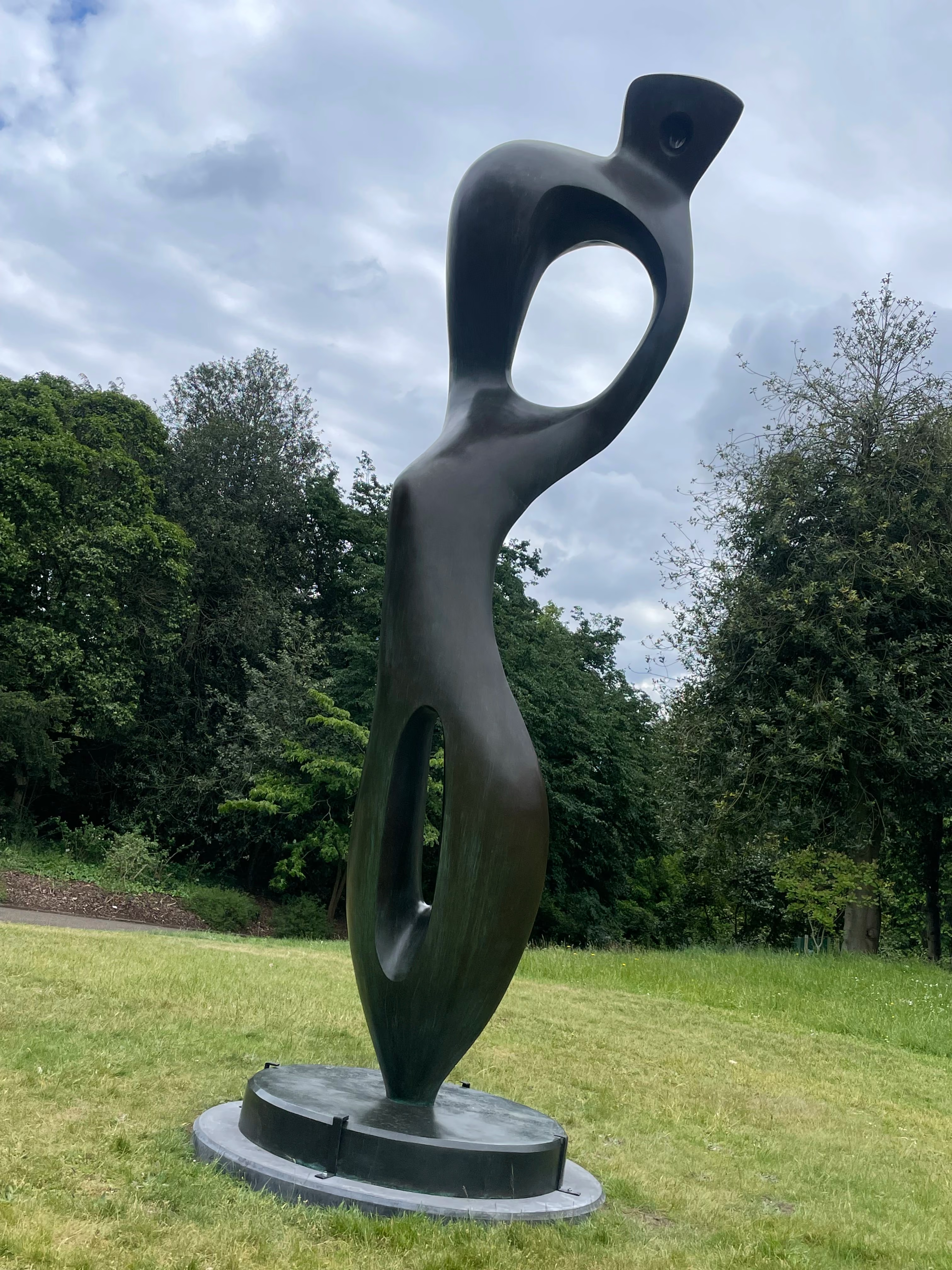
Cue Henry Moore… This year, Kew has installed Moore’s mega sculptures all across its grounds. With 30 sculptures displayed across the gardens, the exhibition at Kew boasts being the biggest ever outdoor exhibition of Moore's monumental sculptural work. Finding the sculptures is a bit like a game; as you follow the map, you can create your own trail and spot the sculptures in the distance before coming up close to see them. This allows you to discover every part of Kew Gardens and perhaps even areas that you’ve never seen before.
Moore’s sculptures and their natural environment are in constant conversation. The gardens operate as the stage for the sculptures, but the sculptures also frame their surroundings: every time you step this way or that around the three-dimensional pieces – or better yet, peep through the many gaps in Moore’s sculptures, like looking through the lens of a camera – you are rewarded with a fresh new perspective. There’s something really joyful about this unique experience.
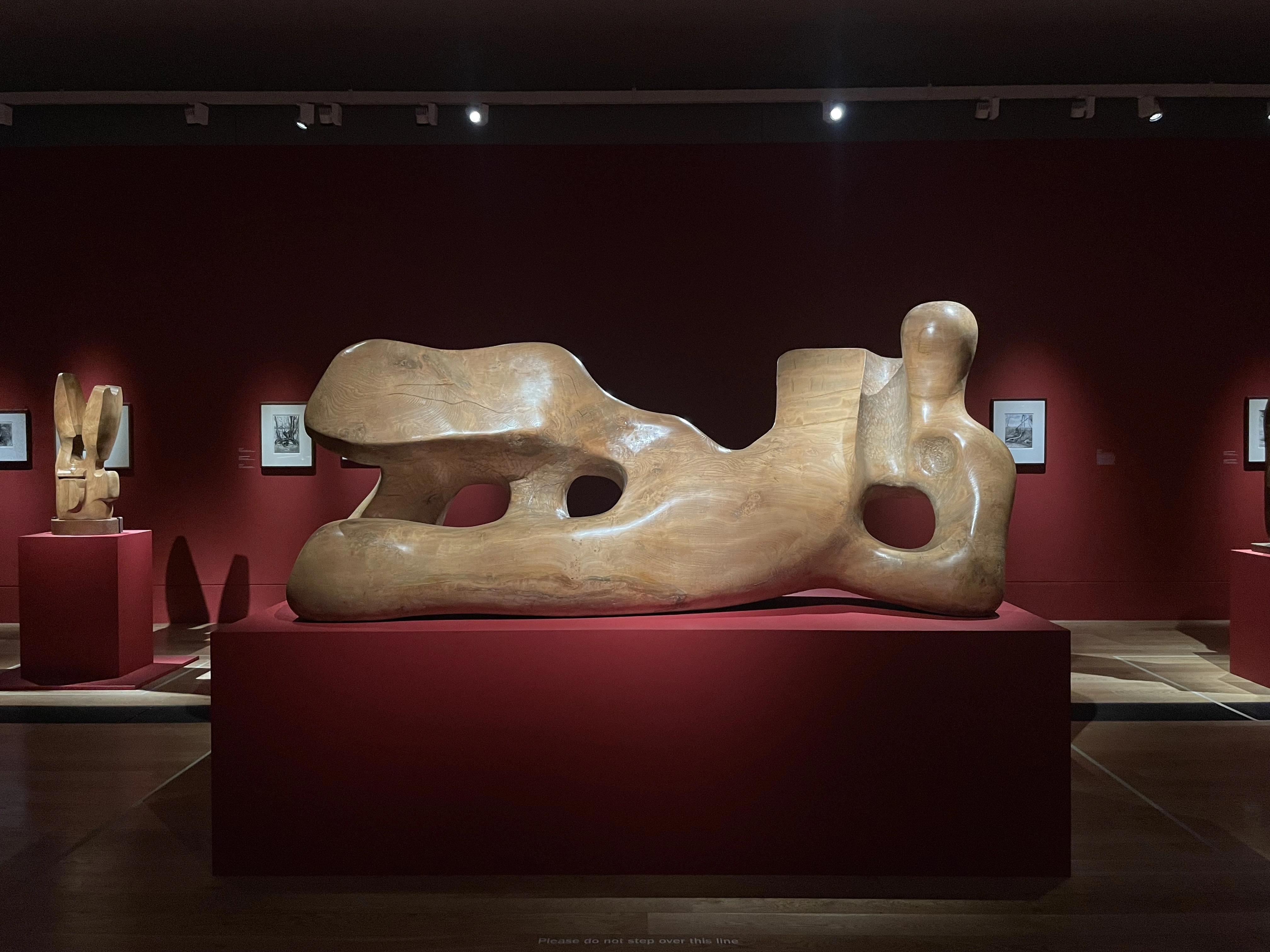
The outdoor installation is also accompanied by an exhibition inside the Shirley Sherwood Gallery of Botanical Art, where, in a series of small atmospheric rooms, Moore’s smaller sculptures and his drawings are displayed alongside plant specimens and prints from Kew’s own botanical collections. Once you’ve visited this exhibition and step back outside, it’s impossible not to see Moore-esque forms throughout the gardens: the hollow in a tree trunk, the knot in a branch and the weaving of palm leaves are all reminiscent of the curves and hollows in Moore’s sculptures.
A parallel presentation of Moore’s sculptures is also on show at Wakehurst, Kew’s wild botanic garden in Sussex, alongside contemporary works from artists Rana Begum, Rafael Perez Evans and Paloma Varga Weisz.