
Salman Toor at the Courtauld
Narrative scenes are making a comeback in contemporary art, yet it is rare to see those which, as do Saman Toor’s, recall so directly 18th-century conversation pieces. Toor has been strongly influenced by the Western canon and conveys contemporary life in the visual language of the past, representing themes such as belonging, community and technology. Toor’s compositions also draw on the visual language of the Mughal School, freezing fragments of a story in time. His paintings of imagined scenes from his home in Lahore particularly evoke the detailed intimacy of Mughal miniatures. ‘Back Lawn’ (2021), despite being far from miniature in scale, at 1.27 by 1.22 metres, gives the viewer that panoramic omniscient perspective of a Mughal miniature, we are an outsider privy to viewing all groups depicted but part of none.
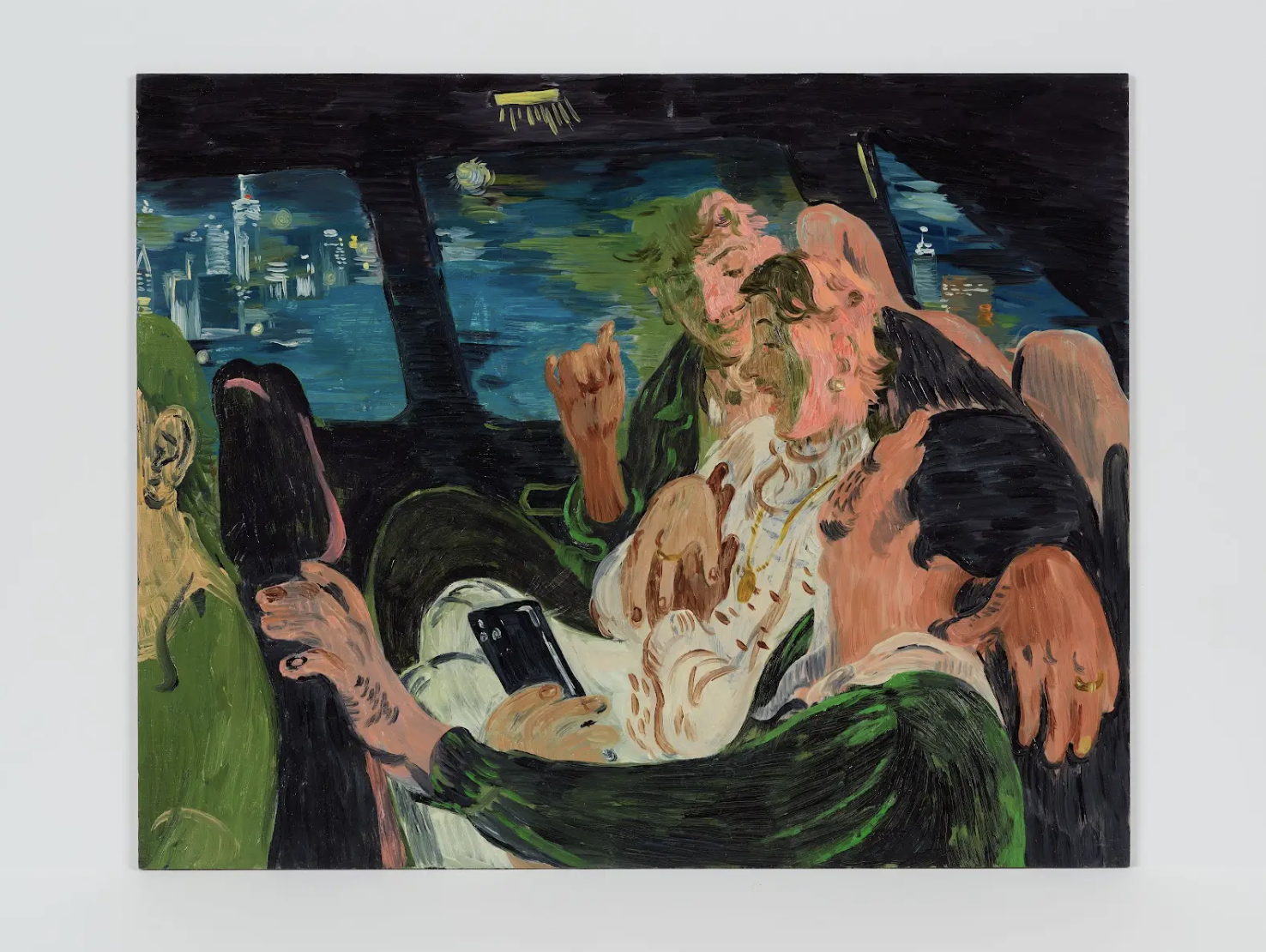
The family remains an important space for Toor, who recalls the homes he grew up in in Pakistan fondly, but, as with the experience of many queer men, particularly those coming of age in a highly religious society, the nostalgia is interlaced with trauma. However, in this nocturnal scene, the male lovers own the composition, centred in the foreground, they are able to engage in a passionate embrace within the relative safety of the family home. And yet they are still marginalised. To the right, families are engaged in gossip and tea drinking; to the left, the servants are smoking, taking a break from their duties. The lovers, therefore, occupy a central but liminal space. Between the two groups, and watched only by us and a white cat, perhaps a pet? Or a stray?
Liminality is a recurring theme throughout Toor’s work, his series of portraits of men at Immigration Checks, such as ‘Man with Face Creams and Phone Plug’ (2019), uses the scrutiny of a portrait to place the viewer in the shoes of the immigration officer, othering the subject. Toor moved to New York just after 9/11 and subsequently experienced a heightened level of scrutiny at border checks. In ‘Man with Face Creams and Phone Plug’, the man empties his belongings onto the table, which is presented to us for judgment. How do we place him or define him? Equally in ‘Bar Boy’ (2029), Toor presents the subject as engrossed in his phone, set completely apart from every other figure. But wearing a wide-brimmed floppy felt hat with perhaps a pink flower. His dress thus also sets him apart from the crowd, wearing more conventional beanies and flat caps.
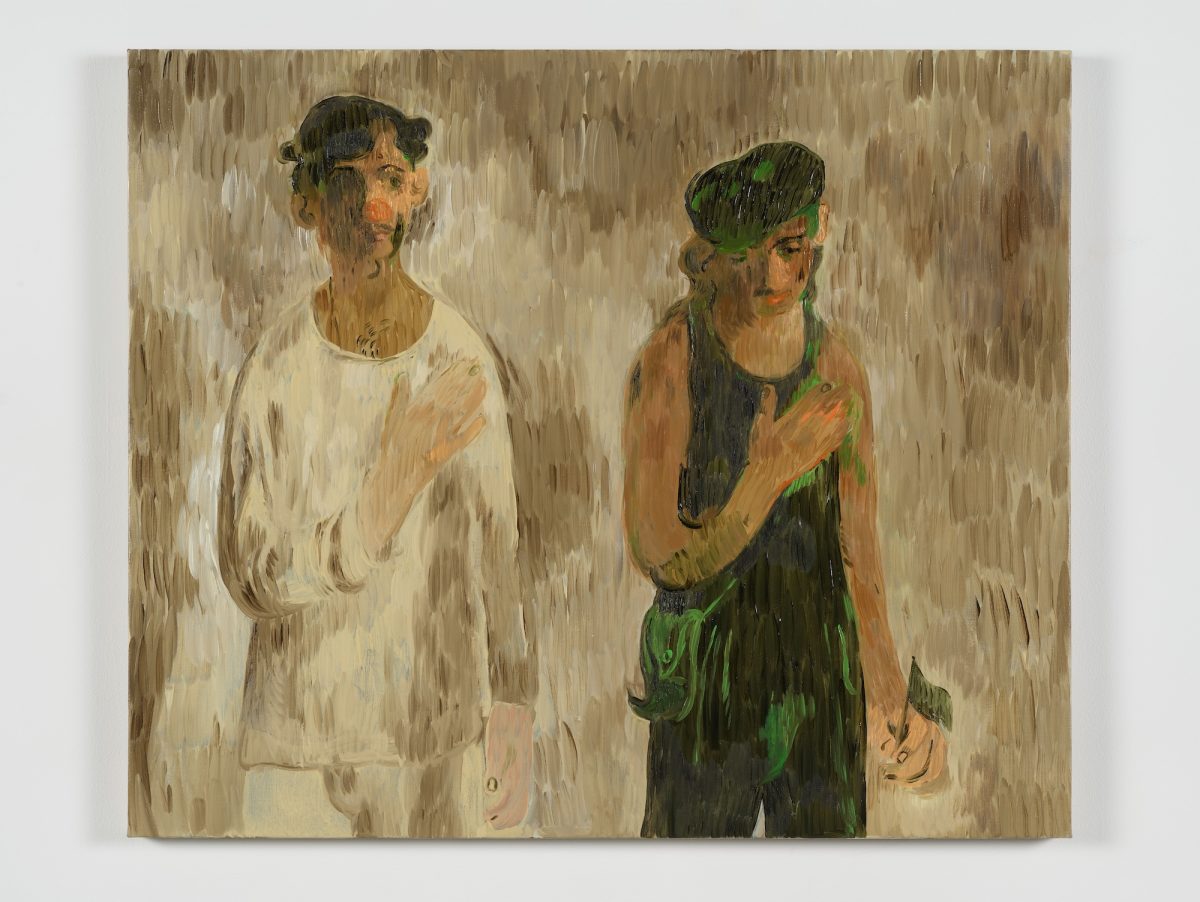
Like the stray cat, Toor’s characters often appear to be vagabonds. The theme of the outcast is ever-present, for example, ‘Wandering Beggars’ (2022) draws on the representation of societal misfits in 17th-century Dutch painting, responding to the work of Adriaen Brouwer or David Teniers the Younger. Toor employs a strange motif to capture this in nearly all of his works: the rounded nose, sometimes painted onto the face as if it were a rounded clown’s nose, other times looking more like an elongated bulbous growth. Again, othering his characters through their appearance. The nose can be an appendage of shame, vulnerability and performance. Dr Elena Crippa, the Courtauld’s curator of contemporary art, describes this motif as a way of exploring the feeling of being self-conscious or, at times, even humiliated, appearing and feeling different to everyone else.
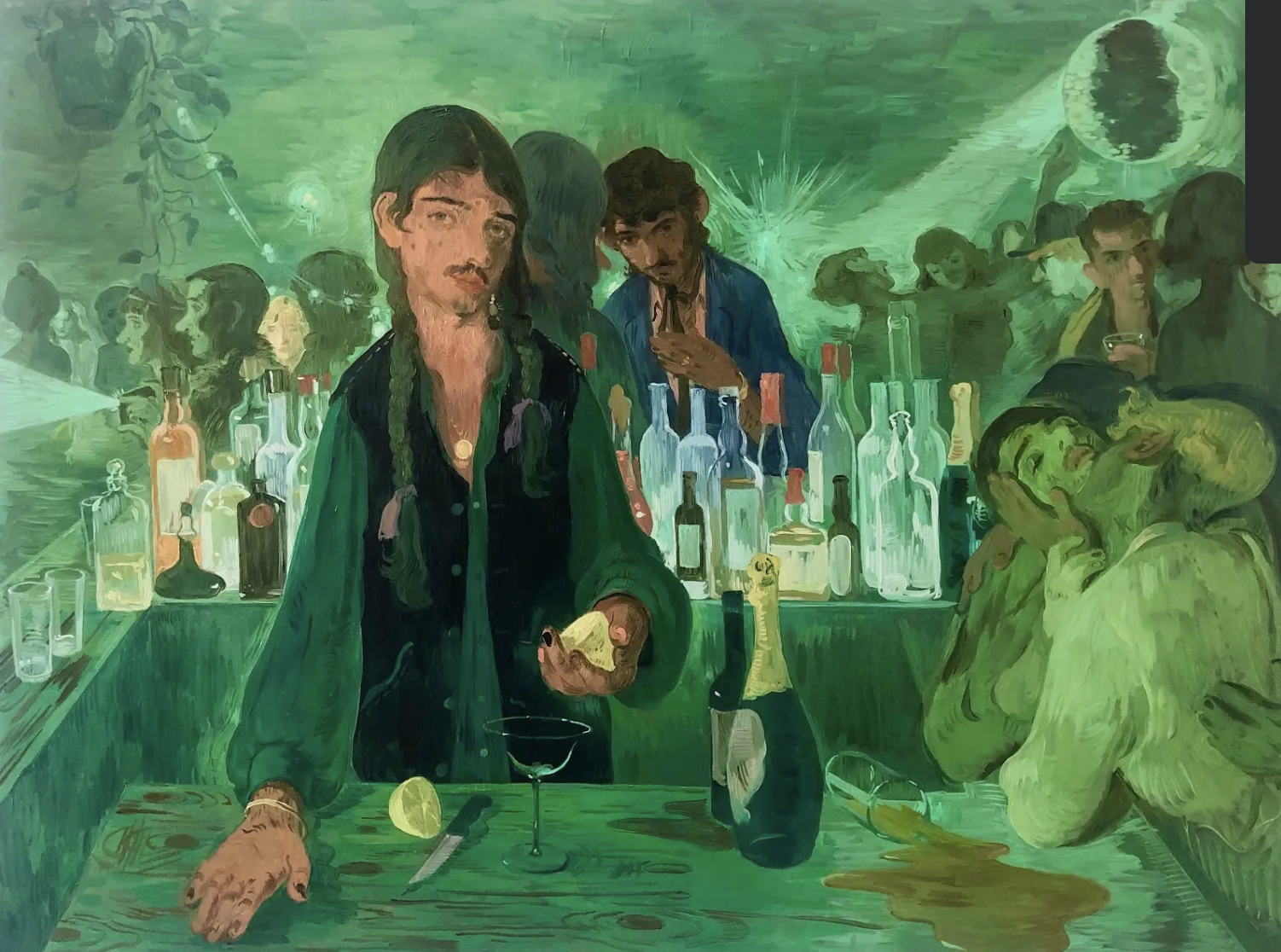
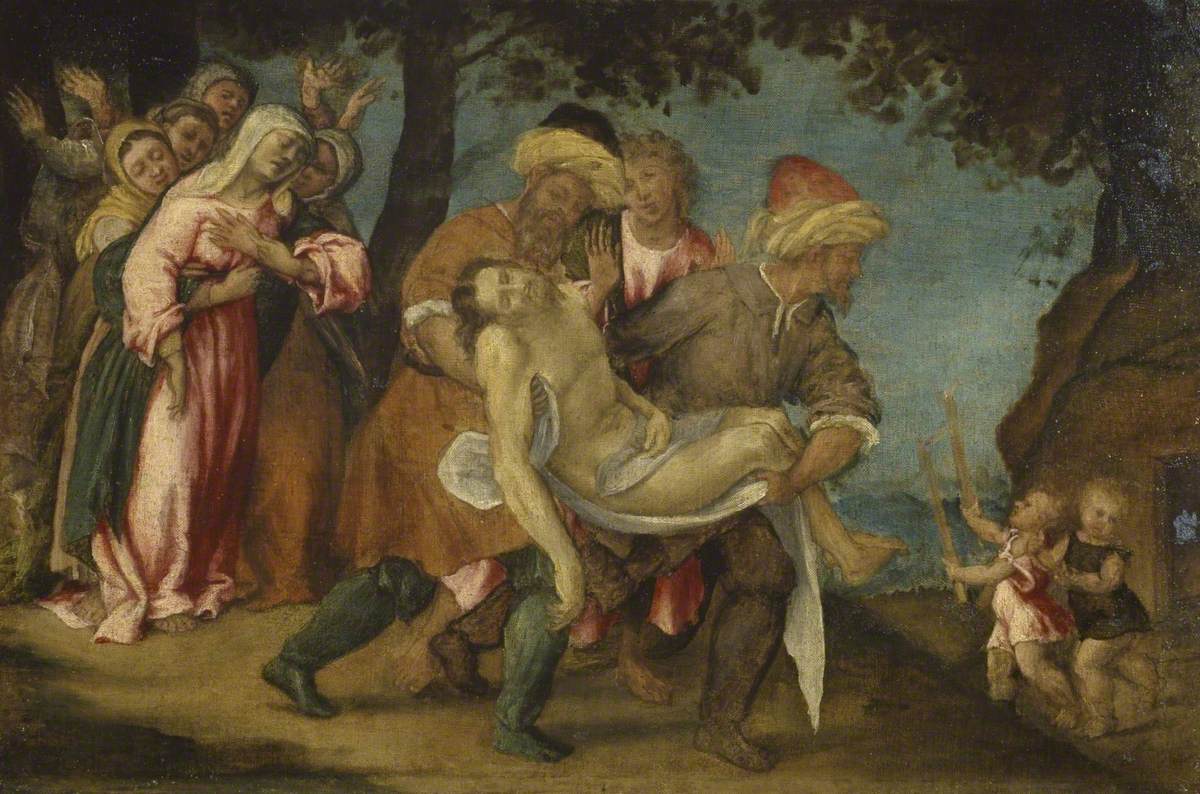
The influence of 18th and 19th-century painting on Toor’s oeuvre should be the focus of one's attention at the Courtauld's exhibition. By virtue of having the unique opportunity to view many of the works which inspired Toor, exhibited in the same museum. The most obvious comparison being ‘The Bar on East 13th, 2019’ with Manet’s ‘A Bar at the Folies-Bergère’ (1882). But if you look carefully, you may find other similarities, for one, as you enter the exhibition space, take note of the Seurat sketches displayed near the entrance. The brushwork is uncannily similar to Toor’s fluid green patchwork. Another painting directly inspired and commissioned by The Courtauld, especially for this exhibition, is ‘Fag Puddle with Carriers’ (2026). Toor had long admired Lorenzo Lotto’s ‘The Entombment’ (around 1550-55), and the present exhibition provided the perfect chance to create a new work based on its composition. The Lotto is displayed on the second floor.

Not all of Toor’s work carries the weight of the outcast and outsider. Toor is playful, even whimsical. While his green palette and lethargic figures evoke feelings of feverish depersonalisation, there is also humour and tenderness in his reverie-like vignettes. In ‘Pillow Fight’ (2022), Toor explores the bed as a space of playfulness and intimacy, returning to one of his favourite subjects, ‘interacting bodies’. Again, contemporary life is central to the scene with the open laptop casting its luminous light over the couple, Toor said of this work, ‘an exciting doubt is whether this scene is being surveilled by technology or performed for it’.
Toor is as much a drawer as a painter, and drawing is central to his practice. ‘Painting was something I learned when I moved from Pakistan to the United States, but drawing I always considered as second nature’, he said. Downstairs, in the Drawings Gallery, the Courtauld have exhibited a series of sketches, many of which form the basis of the paintings upstairs. Although many sketches are works in their own right, here Toor’s admiration for Baroque lighting and his love of Caravaggio are evident in the strong chiaroscuro of his charcoal, ink and gouache sketches. There are also two sketchbooks on display, giving an insight into Toor’s daily drawing habit.
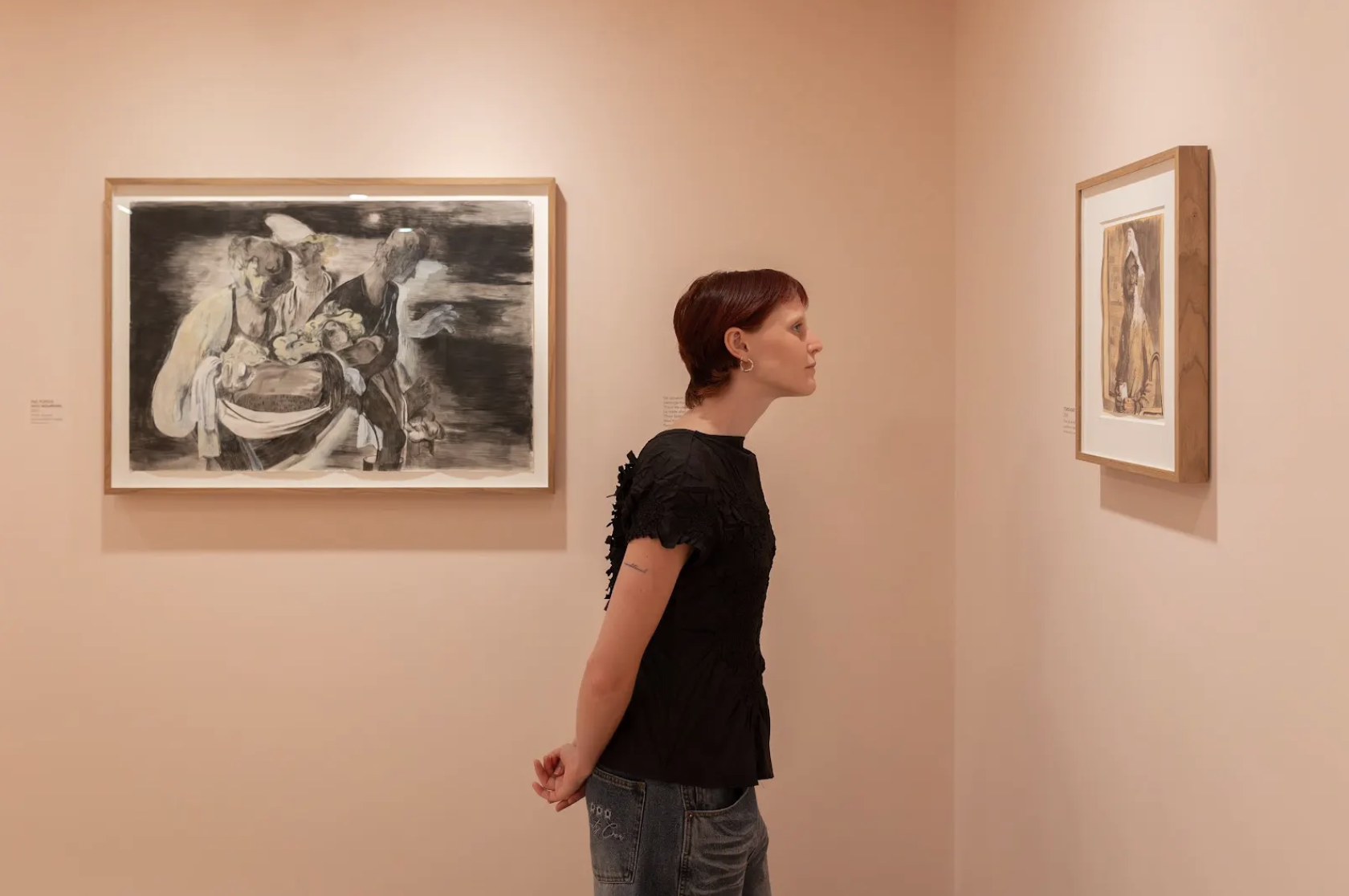
Salman Toor's solo show ‘Someone Like You’, his first in Europe, follows a recent shift in the Courtauld’s exhibition programming, expanding the scope of the institute's curatorial and academic expertise. Building on a series of blockbuster contemporary art exhibitions, including Peter Doig and Claudette Johnson and including the appointment of Dr Elena Crippa in 2024 as the contemporary art curator, as well as the announcement of two new purpose-built contemporary art galleries scheduled to open in 2029.
Someone Like You runs from 2 October 2026 to 10 January 2027 at The Courtauld Gallery.
Don't forget to check in and leave your review on the gowithYamo app!