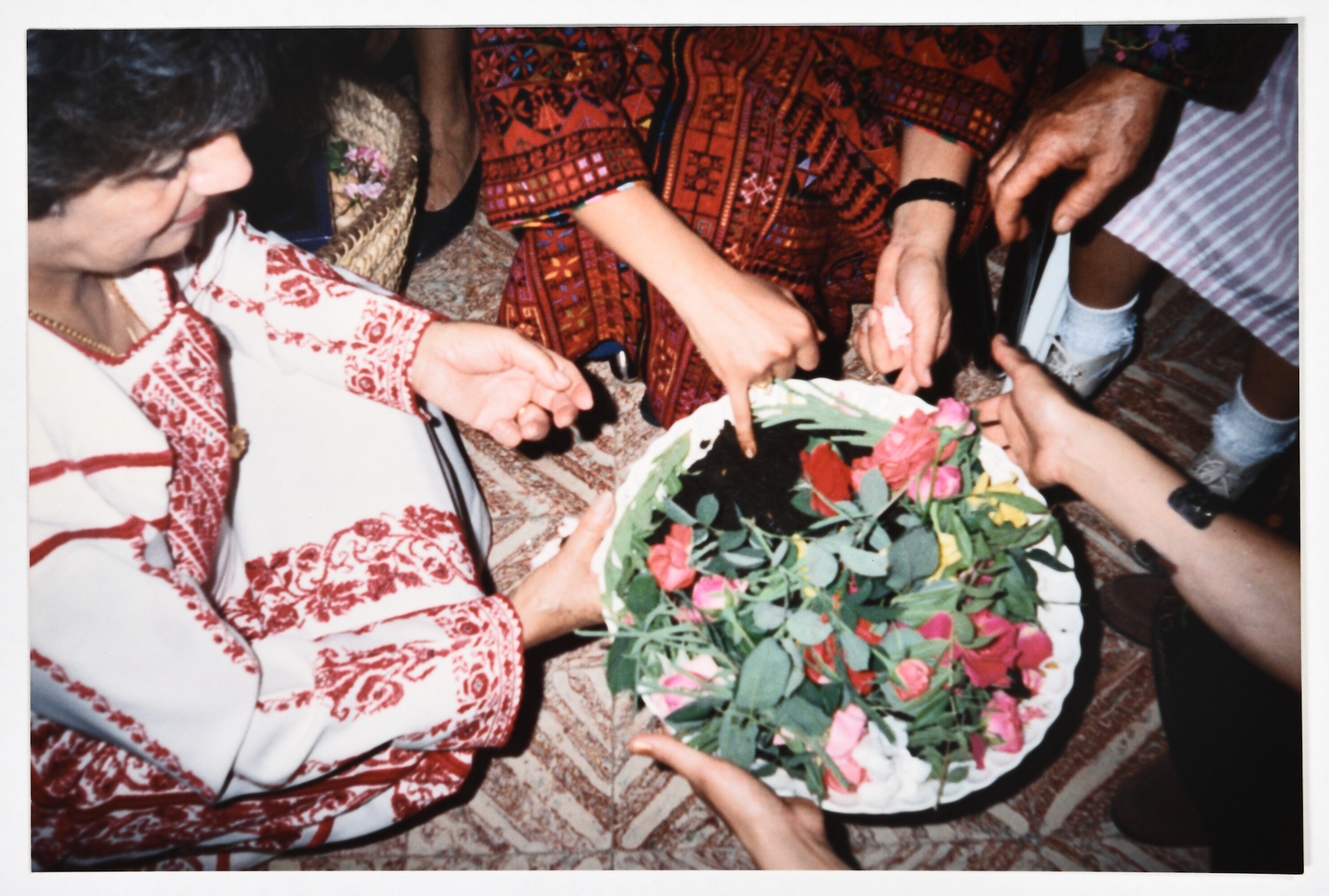
Presented by the V&A Museum in Dundee, ‘Thread Memories’ is a survey of heritage and contemporary Palestinian embroidery practices from the early 20th century to the present day. This exhibition speaks of the universal human instinct to leave a mark and to tell one's story through those marks. It’s evidence that, by adorning garments with embroidery, they are imbued with heritage, narrative and power.
Palestinian embroidery, or tatreez, is a cultural heritage which is passed down through the generations. The skills and intangible knowledge are taught by women to their children and grandchildren. The garments themselves are also passed down and then treasured, mended and adapted to new circumstances again and again by those who inherit them. The latter is evident in a dress from Beit Nabala, made for work in the fields and at home, where the dress was adapted to fit changing circumstances repeatedly: firstly, a large patch was created around the chest area for breastfeeding before being sewn up again, and then, when it was later handed down to someone else, the dress was lengthened at the waist to fit another, taller person.
.jpeg)
Each motif, technique or colour in tatreez is like a word, heavy with symbolism. When they’re assembled, these motifs make up a broader language. Using this language, traditional patterns tell the stories of their weavers and their wearers. Embroidered motifs speak of women’s interests, pastimes and jobs, and also where they’re from. Singing birds, for example, are a recurring pattern which symbolise the harmonious environment of the Palestinian land. Women from Beit Dajan used the ‘airy fairy branch motif’ or orange blossom motif to represent their region, where oranges were grown. Meanwhile, Gazan dresses are recognisable by their pointed chest panels in bright pinks and reds, which emulate jewellery and bring good luck.
Religious ideals are sometimes embedded in embroidery practices. In Islamic tradition, creating something too perfect might ‘tempt fate’ and bring misfortune, so makers regularly introduce touches of imperfection to their garments. In tatreez, this is usually done by using a different coloured thread within a small section of the overall design.
Embroidered patterns also commemorate the important events that punctuate one’s life and which inevitably leave their mark. One example of such a change in personal circumstances is visible in a dress from Southern Palestine from the 1920’s, where a combination of different regional styles from Bethlehem and Gaza might have been the result of a bride marrying into a family from a different region, thus bridging two local styles.
.jpeg)
Variations in design can also be traced back to greater technological or societal change. For example, when cars and motorised methods of transport were introduced in the 1920s, this brought further cultural mixing and therefore more exposure to other forms of visual culture, which led to a mixing of styles on embroidered garments.
After detailing some of the symbolisms behind traditional tatreez embroidery, the V&A exhibition then examines the impact that the Nakba – which means "catastrophe" in Arabic and refers to the mass displacement and dispossession of Palestinians before and during the 1948 Arab-Israeli war – had on these embroidery practices. During this period of displacement, people and their cultures were suddenly brought together in refugee camps, which led to the erasure of local histories and a blurring of the regional boundaries between different styles.
In her book Threads of Life: A History of the World Through the Eye of a Needle (2019), Clare Hunter describes how the symbolism of Palestinian embroidery shifted from representing regional village identities to a broader national identity at this time. This key shift is also visible in the last room of the V&A’s exhibition, where motifs like the flag and the colours of Palestine, as well as the name of ‘Palestine’ itself, become more and more prominent on embroidered garments.
.jpeg)
In a chapter of her book which is entitled ‘Identity’, Clare Hunter writes about the ways in which the identity of entire communities and nations are tied to garments and how these ties are tested in times of war and conflict. She describes different historical attempts from around the world to erase national identity through the suppression of an adversary’s national dress. After the Jacobite rising of 1745, the English banned the Scottish kilt, amongst other symbols of Highland culture. And when the Soviet Union was created in the 20th century, the cultures of its previously independent nations were heavily suppressed; traditional embroidered costumes from Ukraine, such as the vyshyvanka, became heavily simplified by the Soviets and therefore stripped of their original meaning and cultural resonance. Indeed, Hunter writes that ‘‘oppressors’ assertion of power has frequently been enforced through the suppression of traditional dress. Their intention is not only to sever a community from its past, but also to rob it of its spiritual protection and its cultural identity, beliefs, relationships and mutual significance.’’
Similarly, during a period of Palestinian uprising against the Israeli occupation of the West Bank and Gaza, known as the First Intifada (1987-1993), Palestinians were banned from displaying their national flag or Palestinian colours. But this had the unintended effect of reinforcing the potency of these Palestinian symbols as women started to stitch 'Intifada dresses’, combining traditional motifs in national colours with new designs associated with nationhood and resistance. This is where the image of the watermelon, which bears the national colours, emerged as a symbol of defiance. To this day, tatreez continues to be practised around the world as an emblem of resistance and advocacy for Palestinian people.
.jpeg)
The history of tatreez is a potent reminder of how powerful these seemingly benign forms of cultural heritage really are, particularly in the face of oppression or displacement. When heritage craft and contemporary craft practices like Palestinian embroidery are spotlighted, we’re also reminded of the creativity and humanity that lie at the heart of communities who may otherwise have been robbed of their agency during times of conflict and tragedy. When a whole population is solely depicted as the victim of tragedy within the media, it’s more important than ever to remember that each individual within that population also has their own voice, agency and identity to express.
Thread Memory: Embroidery from Palestine is showing at the V&A Dundee until 26 April 2026. Don't forget to check in and leave your review in the gowithYamo app!


Presented by the V&A Museum in Dundee, ‘Thread Memories’ is a survey of heritage and contemporary Palestinian embroidery practices from the early 20th century to the present day. This exhibition speaks of the universal human instinct to leave a mark and to tell one's story through those marks. It’s evidence that, by adorning garments with embroidery, they are imbued with heritage, narrative and power.
Palestinian embroidery, or tatreez, is a cultural heritage which is passed down through the generations. The skills and intangible knowledge are taught by women to their children and grandchildren. The garments themselves are also passed down and then treasured, mended and adapted to new circumstances again and again by those who inherit them. The latter is evident in a dress from Beit Nabala, made for work in the fields and at home, where the dress was adapted to fit changing circumstances repeatedly: firstly, a large patch was created around the chest area for breastfeeding before being sewn up again, and then, when it was later handed down to someone else, the dress was lengthened at the waist to fit another, taller person.
Each motif, technique or colour in tatreez is like a word, heavy with symbolism. When they’re assembled, these motifs make up a broader language. Using this language, traditional patterns tell the stories of their weavers and their wearers. Embroidered motifs speak of women’s interests, pastimes and jobs, and also where they’re from. Singing birds, for example, are a recurring pattern which symbolise the harmonious environment of the Palestinian land. Women from Beit Dajan used the ‘airy fairy branch motif’ or orange blossom motif to represent their region, where oranges were grown. Meanwhile, Gazan dresses are recognisable by their pointed chest panels in bright pinks and reds, which emulate jewellery and bring good luck.
Religious ideals are sometimes embedded in embroidery practices. In Islamic tradition, creating something too perfect might ‘tempt fate’ and bring misfortune, so makers regularly introduce touches of imperfection to their garments. In tatreez, this is usually done by using a different coloured thread within a small section of the overall design.
Embroidered patterns also commemorate the important events that punctuate one’s life and which inevitably leave their mark. One example of such a change in personal circumstances is visible in a dress from Southern Palestine from the 1920’s, where a combination of different regional styles from Bethlehem and Gaza might have been the result of a bride marrying into a family from a different region, thus bridging two local styles.
Variations in design can also be traced back to greater technological or societal change. For example, when cars and motorised methods of transport were introduced in the 1920s, this brought further cultural mixing and therefore more exposure to other forms of visual culture, which led to a mixing of styles on embroidered garments.
After detailing some of the symbolisms behind traditional tatreez embroidery, the V&A exhibition then examines the impact that the Nakba – which means "catastrophe" in Arabic and refers to the mass displacement and dispossession of Palestinians before and during the 1948 Arab-Israeli war – had on these embroidery practices. During this period of displacement, people and their cultures were suddenly brought together in refugee camps, which led to the erasure of local histories and a blurring of the regional boundaries between different styles.
In her book Threads of Life: A History of the World Through the Eye of a Needle (2019), Clare Hunter describes how the symbolism of Palestinian embroidery shifted from representing regional village identities to a broader national identity at this time. This key shift is also visible in the last room of the V&A’s exhibition, where motifs like the flag and the colours of Palestine, as well as the name of ‘Palestine’ itself, become more and more prominent on embroidered garments.
In a chapter of her book which is entitled ‘Identity’, Clare Hunter writes about the ways in which the identity of entire communities and nations are tied to garments and how these ties are tested in times of war and conflict. She describes different historical attempts from around the world to erase national identity through the suppression of an adversary’s national dress. After the Jacobite rising of 1745, the English banned the Scottish kilt, amongst other symbols of Highland culture. And when the Soviet Union was created in the 20th century, the cultures of its previously independent nations were heavily suppressed; traditional embroidered costumes from Ukraine, such as the vyshyvanka, became heavily simplified by the Soviets and therefore stripped of their original meaning and cultural resonance. Indeed, Hunter writes that ‘‘oppressors’ assertion of power has frequently been enforced through the suppression of traditional dress. Their intention is not only to sever a community from its past, but also to rob it of its spiritual protection and its cultural identity, beliefs, relationships and mutual significance.’’
Similarly, during a period of Palestinian uprising against the Israeli occupation of the West Bank and Gaza, known as the First Intifada (1987-1993), Palestinians were banned from displaying their national flag or Palestinian colours. But this had the unintended effect of reinforcing the potency of these Palestinian symbols as women started to stitch 'Intifada dresses’, combining traditional motifs in national colours with new designs associated with nationhood and resistance. This is where the image of the watermelon, which bears the national colours, emerged as a symbol of defiance. To this day, tatreez continues to be practised around the world as an emblem of resistance and advocacy for Palestinian people.
The history of tatreez is a potent reminder of how powerful these seemingly benign forms of cultural heritage really are, particularly in the face of oppression or displacement. When heritage craft and contemporary craft practices like Palestinian embroidery are spotlighted, we’re also reminded of the creativity and humanity that lie at the heart of communities who may otherwise have been robbed of their agency during times of conflict and tragedy. When a whole population is solely depicted as the victim of tragedy within the media, it’s more important than ever to remember that each individual within that population also has their own voice, agency and identity to express.
Thread Memory: Embroidery from Palestine is showing at the V&A Dundee until 26 April 2026. Don't forget to check in and leave your review in the gowithYamo app!
Presented by the V&A Museum in Dundee, ‘Thread Memories’ is a survey of heritage and contemporary Palestinian embroidery practices from the early 20th century to the present day. This exhibition speaks of the universal human instinct to leave a mark and to tell one's story through those marks. It’s evidence that, by adorning garments with embroidery, they are imbued with heritage, narrative and power.
Palestinian embroidery, or tatreez, is a cultural heritage which is passed down through the generations. The skills and intangible knowledge are taught by women to their children and grandchildren. The garments themselves are also passed down and then treasured, mended and adapted to new circumstances again and again by those who inherit them. The latter is evident in a dress from Beit Nabala, made for work in the fields and at home, where the dress was adapted to fit changing circumstances repeatedly: firstly, a large patch was created around the chest area for breastfeeding before being sewn up again, and then, when it was later handed down to someone else, the dress was lengthened at the waist to fit another, taller person.
Each motif, technique or colour in tatreez is like a word, heavy with symbolism. When they’re assembled, these motifs make up a broader language. Using this language, traditional patterns tell the stories of their weavers and their wearers. Embroidered motifs speak of women’s interests, pastimes and jobs, and also where they’re from. Singing birds, for example, are a recurring pattern which symbolise the harmonious environment of the Palestinian land. Women from Beit Dajan used the ‘airy fairy branch motif’ or orange blossom motif to represent their region, where oranges were grown. Meanwhile, Gazan dresses are recognisable by their pointed chest panels in bright pinks and reds, which emulate jewellery and bring good luck.
Religious ideals are sometimes embedded in embroidery practices. In Islamic tradition, creating something too perfect might ‘tempt fate’ and bring misfortune, so makers regularly introduce touches of imperfection to their garments. In tatreez, this is usually done by using a different coloured thread within a small section of the overall design.
Embroidered patterns also commemorate the important events that punctuate one’s life and which inevitably leave their mark. One example of such a change in personal circumstances is visible in a dress from Southern Palestine from the 1920’s, where a combination of different regional styles from Bethlehem and Gaza might have been the result of a bride marrying into a family from a different region, thus bridging two local styles.
Variations in design can also be traced back to greater technological or societal change. For example, when cars and motorised methods of transport were introduced in the 1920s, this brought further cultural mixing and therefore more exposure to other forms of visual culture, which led to a mixing of styles on embroidered garments.
After detailing some of the symbolisms behind traditional tatreez embroidery, the V&A exhibition then examines the impact that the Nakba – which means "catastrophe" in Arabic and refers to the mass displacement and dispossession of Palestinians before and during the 1948 Arab-Israeli war – had on these embroidery practices. During this period of displacement, people and their cultures were suddenly brought together in refugee camps, which led to the erasure of local histories and a blurring of the regional boundaries between different styles.
In her book Threads of Life: A History of the World Through the Eye of a Needle (2019), Clare Hunter describes how the symbolism of Palestinian embroidery shifted from representing regional village identities to a broader national identity at this time. This key shift is also visible in the last room of the V&A’s exhibition, where motifs like the flag and the colours of Palestine, as well as the name of ‘Palestine’ itself, become more and more prominent on embroidered garments.
In a chapter of her book which is entitled ‘Identity’, Clare Hunter writes about the ways in which the identity of entire communities and nations are tied to garments and how these ties are tested in times of war and conflict. She describes different historical attempts from around the world to erase national identity through the suppression of an adversary’s national dress. After the Jacobite rising of 1745, the English banned the Scottish kilt, amongst other symbols of Highland culture. And when the Soviet Union was created in the 20th century, the cultures of its previously independent nations were heavily suppressed; traditional embroidered costumes from Ukraine, such as the vyshyvanka, became heavily simplified by the Soviets and therefore stripped of their original meaning and cultural resonance. Indeed, Hunter writes that ‘‘oppressors’ assertion of power has frequently been enforced through the suppression of traditional dress. Their intention is not only to sever a community from its past, but also to rob it of its spiritual protection and its cultural identity, beliefs, relationships and mutual significance.’’
Similarly, during a period of Palestinian uprising against the Israeli occupation of the West Bank and Gaza, known as the First Intifada (1987-1993), Palestinians were banned from displaying their national flag or Palestinian colours. But this had the unintended effect of reinforcing the potency of these Palestinian symbols as women started to stitch 'Intifada dresses’, combining traditional motifs in national colours with new designs associated with nationhood and resistance. This is where the image of the watermelon, which bears the national colours, emerged as a symbol of defiance. To this day, tatreez continues to be practised around the world as an emblem of resistance and advocacy for Palestinian people.
The history of tatreez is a potent reminder of how powerful these seemingly benign forms of cultural heritage really are, particularly in the face of oppression or displacement. When heritage craft and contemporary craft practices like Palestinian embroidery are spotlighted, we’re also reminded of the creativity and humanity that lie at the heart of communities who may otherwise have been robbed of their agency during times of conflict and tragedy. When a whole population is solely depicted as the victim of tragedy within the media, it’s more important than ever to remember that each individual within that population also has their own voice, agency and identity to express.
Thread Memory: Embroidery from Palestine is showing at the V&A Dundee until 26 April 2026. Don't forget to check in and leave your review in the gowithYamo app!
Presented by the V&A Museum in Dundee, ‘Thread Memories’ is a survey of heritage and contemporary Palestinian embroidery practices from the early 20th century to the present day. This exhibition speaks of the universal human instinct to leave a mark and to tell one's story through those marks. It’s evidence that, by adorning garments with embroidery, they are imbued with heritage, narrative and power.
Palestinian embroidery, or tatreez, is a cultural heritage which is passed down through the generations. The skills and intangible knowledge are taught by women to their children and grandchildren. The garments themselves are also passed down and then treasured, mended and adapted to new circumstances again and again by those who inherit them. The latter is evident in a dress from Beit Nabala, made for work in the fields and at home, where the dress was adapted to fit changing circumstances repeatedly: firstly, a large patch was created around the chest area for breastfeeding before being sewn up again, and then, when it was later handed down to someone else, the dress was lengthened at the waist to fit another, taller person.
Each motif, technique or colour in tatreez is like a word, heavy with symbolism. When they’re assembled, these motifs make up a broader language. Using this language, traditional patterns tell the stories of their weavers and their wearers. Embroidered motifs speak of women’s interests, pastimes and jobs, and also where they’re from. Singing birds, for example, are a recurring pattern which symbolise the harmonious environment of the Palestinian land. Women from Beit Dajan used the ‘airy fairy branch motif’ or orange blossom motif to represent their region, where oranges were grown. Meanwhile, Gazan dresses are recognisable by their pointed chest panels in bright pinks and reds, which emulate jewellery and bring good luck.
Religious ideals are sometimes embedded in embroidery practices. In Islamic tradition, creating something too perfect might ‘tempt fate’ and bring misfortune, so makers regularly introduce touches of imperfection to their garments. In tatreez, this is usually done by using a different coloured thread within a small section of the overall design.
Embroidered patterns also commemorate the important events that punctuate one’s life and which inevitably leave their mark. One example of such a change in personal circumstances is visible in a dress from Southern Palestine from the 1920’s, where a combination of different regional styles from Bethlehem and Gaza might have been the result of a bride marrying into a family from a different region, thus bridging two local styles.
Variations in design can also be traced back to greater technological or societal change. For example, when cars and motorised methods of transport were introduced in the 1920s, this brought further cultural mixing and therefore more exposure to other forms of visual culture, which led to a mixing of styles on embroidered garments.
After detailing some of the symbolisms behind traditional tatreez embroidery, the V&A exhibition then examines the impact that the Nakba – which means "catastrophe" in Arabic and refers to the mass displacement and dispossession of Palestinians before and during the 1948 Arab-Israeli war – had on these embroidery practices. During this period of displacement, people and their cultures were suddenly brought together in refugee camps, which led to the erasure of local histories and a blurring of the regional boundaries between different styles.
In her book Threads of Life: A History of the World Through the Eye of a Needle (2019), Clare Hunter describes how the symbolism of Palestinian embroidery shifted from representing regional village identities to a broader national identity at this time. This key shift is also visible in the last room of the V&A’s exhibition, where motifs like the flag and the colours of Palestine, as well as the name of ‘Palestine’ itself, become more and more prominent on embroidered garments.
In a chapter of her book which is entitled ‘Identity’, Clare Hunter writes about the ways in which the identity of entire communities and nations are tied to garments and how these ties are tested in times of war and conflict. She describes different historical attempts from around the world to erase national identity through the suppression of an adversary’s national dress. After the Jacobite rising of 1745, the English banned the Scottish kilt, amongst other symbols of Highland culture. And when the Soviet Union was created in the 20th century, the cultures of its previously independent nations were heavily suppressed; traditional embroidered costumes from Ukraine, such as the vyshyvanka, became heavily simplified by the Soviets and therefore stripped of their original meaning and cultural resonance. Indeed, Hunter writes that ‘‘oppressors’ assertion of power has frequently been enforced through the suppression of traditional dress. Their intention is not only to sever a community from its past, but also to rob it of its spiritual protection and its cultural identity, beliefs, relationships and mutual significance.’’
Similarly, during a period of Palestinian uprising against the Israeli occupation of the West Bank and Gaza, known as the First Intifada (1987-1993), Palestinians were banned from displaying their national flag or Palestinian colours. But this had the unintended effect of reinforcing the potency of these Palestinian symbols as women started to stitch 'Intifada dresses’, combining traditional motifs in national colours with new designs associated with nationhood and resistance. This is where the image of the watermelon, which bears the national colours, emerged as a symbol of defiance. To this day, tatreez continues to be practised around the world as an emblem of resistance and advocacy for Palestinian people.
The history of tatreez is a potent reminder of how powerful these seemingly benign forms of cultural heritage really are, particularly in the face of oppression or displacement. When heritage craft and contemporary craft practices like Palestinian embroidery are spotlighted, we’re also reminded of the creativity and humanity that lie at the heart of communities who may otherwise have been robbed of their agency during times of conflict and tragedy. When a whole population is solely depicted as the victim of tragedy within the media, it’s more important than ever to remember that each individual within that population also has their own voice, agency and identity to express.
Thread Memory: Embroidery from Palestine is showing at the V&A Dundee until 26 April 2026. Don't forget to check in and leave your review in the gowithYamo app!
Presented by the V&A Museum in Dundee, ‘Thread Memories’ is a survey of heritage and contemporary Palestinian embroidery practices from the early 20th century to the present day. This exhibition speaks of the universal human instinct to leave a mark and to tell one's story through those marks. It’s evidence that, by adorning garments with embroidery, they are imbued with heritage, narrative and power.
Palestinian embroidery, or tatreez, is a cultural heritage which is passed down through the generations. The skills and intangible knowledge are taught by women to their children and grandchildren. The garments themselves are also passed down and then treasured, mended and adapted to new circumstances again and again by those who inherit them. The latter is evident in a dress from Beit Nabala, made for work in the fields and at home, where the dress was adapted to fit changing circumstances repeatedly: firstly, a large patch was created around the chest area for breastfeeding before being sewn up again, and then, when it was later handed down to someone else, the dress was lengthened at the waist to fit another, taller person.
Each motif, technique or colour in tatreez is like a word, heavy with symbolism. When they’re assembled, these motifs make up a broader language. Using this language, traditional patterns tell the stories of their weavers and their wearers. Embroidered motifs speak of women’s interests, pastimes and jobs, and also where they’re from. Singing birds, for example, are a recurring pattern which symbolise the harmonious environment of the Palestinian land. Women from Beit Dajan used the ‘airy fairy branch motif’ or orange blossom motif to represent their region, where oranges were grown. Meanwhile, Gazan dresses are recognisable by their pointed chest panels in bright pinks and reds, which emulate jewellery and bring good luck.
Religious ideals are sometimes embedded in embroidery practices. In Islamic tradition, creating something too perfect might ‘tempt fate’ and bring misfortune, so makers regularly introduce touches of imperfection to their garments. In tatreez, this is usually done by using a different coloured thread within a small section of the overall design.
Embroidered patterns also commemorate the important events that punctuate one’s life and which inevitably leave their mark. One example of such a change in personal circumstances is visible in a dress from Southern Palestine from the 1920’s, where a combination of different regional styles from Bethlehem and Gaza might have been the result of a bride marrying into a family from a different region, thus bridging two local styles.
Variations in design can also be traced back to greater technological or societal change. For example, when cars and motorised methods of transport were introduced in the 1920s, this brought further cultural mixing and therefore more exposure to other forms of visual culture, which led to a mixing of styles on embroidered garments.
After detailing some of the symbolisms behind traditional tatreez embroidery, the V&A exhibition then examines the impact that the Nakba – which means "catastrophe" in Arabic and refers to the mass displacement and dispossession of Palestinians before and during the 1948 Arab-Israeli war – had on these embroidery practices. During this period of displacement, people and their cultures were suddenly brought together in refugee camps, which led to the erasure of local histories and a blurring of the regional boundaries between different styles.
In her book Threads of Life: A History of the World Through the Eye of a Needle (2019), Clare Hunter describes how the symbolism of Palestinian embroidery shifted from representing regional village identities to a broader national identity at this time. This key shift is also visible in the last room of the V&A’s exhibition, where motifs like the flag and the colours of Palestine, as well as the name of ‘Palestine’ itself, become more and more prominent on embroidered garments.
In a chapter of her book which is entitled ‘Identity’, Clare Hunter writes about the ways in which the identity of entire communities and nations are tied to garments and how these ties are tested in times of war and conflict. She describes different historical attempts from around the world to erase national identity through the suppression of an adversary’s national dress. After the Jacobite rising of 1745, the English banned the Scottish kilt, amongst other symbols of Highland culture. And when the Soviet Union was created in the 20th century, the cultures of its previously independent nations were heavily suppressed; traditional embroidered costumes from Ukraine, such as the vyshyvanka, became heavily simplified by the Soviets and therefore stripped of their original meaning and cultural resonance. Indeed, Hunter writes that ‘‘oppressors’ assertion of power has frequently been enforced through the suppression of traditional dress. Their intention is not only to sever a community from its past, but also to rob it of its spiritual protection and its cultural identity, beliefs, relationships and mutual significance.’’
Similarly, during a period of Palestinian uprising against the Israeli occupation of the West Bank and Gaza, known as the First Intifada (1987-1993), Palestinians were banned from displaying their national flag or Palestinian colours. But this had the unintended effect of reinforcing the potency of these Palestinian symbols as women started to stitch 'Intifada dresses’, combining traditional motifs in national colours with new designs associated with nationhood and resistance. This is where the image of the watermelon, which bears the national colours, emerged as a symbol of defiance. To this day, tatreez continues to be practised around the world as an emblem of resistance and advocacy for Palestinian people.
The history of tatreez is a potent reminder of how powerful these seemingly benign forms of cultural heritage really are, particularly in the face of oppression or displacement. When heritage craft and contemporary craft practices like Palestinian embroidery are spotlighted, we’re also reminded of the creativity and humanity that lie at the heart of communities who may otherwise have been robbed of their agency during times of conflict and tragedy. When a whole population is solely depicted as the victim of tragedy within the media, it’s more important than ever to remember that each individual within that population also has their own voice, agency and identity to express.
Thread Memory: Embroidery from Palestine is showing at the V&A Dundee until 26 April 2026. Don't forget to check in and leave your review in the gowithYamo app!
Presented by the V&A Museum in Dundee, ‘Thread Memories’ is a survey of heritage and contemporary Palestinian embroidery practices from the early 20th century to the present day. This exhibition speaks of the universal human instinct to leave a mark and to tell one's story through those marks. It’s evidence that, by adorning garments with embroidery, they are imbued with heritage, narrative and power.
Palestinian embroidery, or tatreez, is a cultural heritage which is passed down through the generations. The skills and intangible knowledge are taught by women to their children and grandchildren. The garments themselves are also passed down and then treasured, mended and adapted to new circumstances again and again by those who inherit them. The latter is evident in a dress from Beit Nabala, made for work in the fields and at home, where the dress was adapted to fit changing circumstances repeatedly: firstly, a large patch was created around the chest area for breastfeeding before being sewn up again, and then, when it was later handed down to someone else, the dress was lengthened at the waist to fit another, taller person.
Each motif, technique or colour in tatreez is like a word, heavy with symbolism. When they’re assembled, these motifs make up a broader language. Using this language, traditional patterns tell the stories of their weavers and their wearers. Embroidered motifs speak of women’s interests, pastimes and jobs, and also where they’re from. Singing birds, for example, are a recurring pattern which symbolise the harmonious environment of the Palestinian land. Women from Beit Dajan used the ‘airy fairy branch motif’ or orange blossom motif to represent their region, where oranges were grown. Meanwhile, Gazan dresses are recognisable by their pointed chest panels in bright pinks and reds, which emulate jewellery and bring good luck.
Religious ideals are sometimes embedded in embroidery practices. In Islamic tradition, creating something too perfect might ‘tempt fate’ and bring misfortune, so makers regularly introduce touches of imperfection to their garments. In tatreez, this is usually done by using a different coloured thread within a small section of the overall design.
Embroidered patterns also commemorate the important events that punctuate one’s life and which inevitably leave their mark. One example of such a change in personal circumstances is visible in a dress from Southern Palestine from the 1920’s, where a combination of different regional styles from Bethlehem and Gaza might have been the result of a bride marrying into a family from a different region, thus bridging two local styles.
Variations in design can also be traced back to greater technological or societal change. For example, when cars and motorised methods of transport were introduced in the 1920s, this brought further cultural mixing and therefore more exposure to other forms of visual culture, which led to a mixing of styles on embroidered garments.
After detailing some of the symbolisms behind traditional tatreez embroidery, the V&A exhibition then examines the impact that the Nakba – which means "catastrophe" in Arabic and refers to the mass displacement and dispossession of Palestinians before and during the 1948 Arab-Israeli war – had on these embroidery practices. During this period of displacement, people and their cultures were suddenly brought together in refugee camps, which led to the erasure of local histories and a blurring of the regional boundaries between different styles.
In her book Threads of Life: A History of the World Through the Eye of a Needle (2019), Clare Hunter describes how the symbolism of Palestinian embroidery shifted from representing regional village identities to a broader national identity at this time. This key shift is also visible in the last room of the V&A’s exhibition, where motifs like the flag and the colours of Palestine, as well as the name of ‘Palestine’ itself, become more and more prominent on embroidered garments.
In a chapter of her book which is entitled ‘Identity’, Clare Hunter writes about the ways in which the identity of entire communities and nations are tied to garments and how these ties are tested in times of war and conflict. She describes different historical attempts from around the world to erase national identity through the suppression of an adversary’s national dress. After the Jacobite rising of 1745, the English banned the Scottish kilt, amongst other symbols of Highland culture. And when the Soviet Union was created in the 20th century, the cultures of its previously independent nations were heavily suppressed; traditional embroidered costumes from Ukraine, such as the vyshyvanka, became heavily simplified by the Soviets and therefore stripped of their original meaning and cultural resonance. Indeed, Hunter writes that ‘‘oppressors’ assertion of power has frequently been enforced through the suppression of traditional dress. Their intention is not only to sever a community from its past, but also to rob it of its spiritual protection and its cultural identity, beliefs, relationships and mutual significance.’’
Similarly, during a period of Palestinian uprising against the Israeli occupation of the West Bank and Gaza, known as the First Intifada (1987-1993), Palestinians were banned from displaying their national flag or Palestinian colours. But this had the unintended effect of reinforcing the potency of these Palestinian symbols as women started to stitch 'Intifada dresses’, combining traditional motifs in national colours with new designs associated with nationhood and resistance. This is where the image of the watermelon, which bears the national colours, emerged as a symbol of defiance. To this day, tatreez continues to be practised around the world as an emblem of resistance and advocacy for Palestinian people.
The history of tatreez is a potent reminder of how powerful these seemingly benign forms of cultural heritage really are, particularly in the face of oppression or displacement. When heritage craft and contemporary craft practices like Palestinian embroidery are spotlighted, we’re also reminded of the creativity and humanity that lie at the heart of communities who may otherwise have been robbed of their agency during times of conflict and tragedy. When a whole population is solely depicted as the victim of tragedy within the media, it’s more important than ever to remember that each individual within that population also has their own voice, agency and identity to express.
Thread Memory: Embroidery from Palestine is showing at the V&A Dundee until 26 April 2026. Don't forget to check in and leave your review in the gowithYamo app!
Presented by the V&A Museum in Dundee, ‘Thread Memories’ is a survey of heritage and contemporary Palestinian embroidery practices from the early 20th century to the present day. This exhibition speaks of the universal human instinct to leave a mark and to tell one's story through those marks. It’s evidence that, by adorning garments with embroidery, they are imbued with heritage, narrative and power.
Palestinian embroidery, or tatreez, is a cultural heritage which is passed down through the generations. The skills and intangible knowledge are taught by women to their children and grandchildren. The garments themselves are also passed down and then treasured, mended and adapted to new circumstances again and again by those who inherit them. The latter is evident in a dress from Beit Nabala, made for work in the fields and at home, where the dress was adapted to fit changing circumstances repeatedly: firstly, a large patch was created around the chest area for breastfeeding before being sewn up again, and then, when it was later handed down to someone else, the dress was lengthened at the waist to fit another, taller person.
Each motif, technique or colour in tatreez is like a word, heavy with symbolism. When they’re assembled, these motifs make up a broader language. Using this language, traditional patterns tell the stories of their weavers and their wearers. Embroidered motifs speak of women’s interests, pastimes and jobs, and also where they’re from. Singing birds, for example, are a recurring pattern which symbolise the harmonious environment of the Palestinian land. Women from Beit Dajan used the ‘airy fairy branch motif’ or orange blossom motif to represent their region, where oranges were grown. Meanwhile, Gazan dresses are recognisable by their pointed chest panels in bright pinks and reds, which emulate jewellery and bring good luck.
Religious ideals are sometimes embedded in embroidery practices. In Islamic tradition, creating something too perfect might ‘tempt fate’ and bring misfortune, so makers regularly introduce touches of imperfection to their garments. In tatreez, this is usually done by using a different coloured thread within a small section of the overall design.
Embroidered patterns also commemorate the important events that punctuate one’s life and which inevitably leave their mark. One example of such a change in personal circumstances is visible in a dress from Southern Palestine from the 1920’s, where a combination of different regional styles from Bethlehem and Gaza might have been the result of a bride marrying into a family from a different region, thus bridging two local styles.
Variations in design can also be traced back to greater technological or societal change. For example, when cars and motorised methods of transport were introduced in the 1920s, this brought further cultural mixing and therefore more exposure to other forms of visual culture, which led to a mixing of styles on embroidered garments.
After detailing some of the symbolisms behind traditional tatreez embroidery, the V&A exhibition then examines the impact that the Nakba – which means "catastrophe" in Arabic and refers to the mass displacement and dispossession of Palestinians before and during the 1948 Arab-Israeli war – had on these embroidery practices. During this period of displacement, people and their cultures were suddenly brought together in refugee camps, which led to the erasure of local histories and a blurring of the regional boundaries between different styles.
In her book Threads of Life: A History of the World Through the Eye of a Needle (2019), Clare Hunter describes how the symbolism of Palestinian embroidery shifted from representing regional village identities to a broader national identity at this time. This key shift is also visible in the last room of the V&A’s exhibition, where motifs like the flag and the colours of Palestine, as well as the name of ‘Palestine’ itself, become more and more prominent on embroidered garments.
In a chapter of her book which is entitled ‘Identity’, Clare Hunter writes about the ways in which the identity of entire communities and nations are tied to garments and how these ties are tested in times of war and conflict. She describes different historical attempts from around the world to erase national identity through the suppression of an adversary’s national dress. After the Jacobite rising of 1745, the English banned the Scottish kilt, amongst other symbols of Highland culture. And when the Soviet Union was created in the 20th century, the cultures of its previously independent nations were heavily suppressed; traditional embroidered costumes from Ukraine, such as the vyshyvanka, became heavily simplified by the Soviets and therefore stripped of their original meaning and cultural resonance. Indeed, Hunter writes that ‘‘oppressors’ assertion of power has frequently been enforced through the suppression of traditional dress. Their intention is not only to sever a community from its past, but also to rob it of its spiritual protection and its cultural identity, beliefs, relationships and mutual significance.’’
Similarly, during a period of Palestinian uprising against the Israeli occupation of the West Bank and Gaza, known as the First Intifada (1987-1993), Palestinians were banned from displaying their national flag or Palestinian colours. But this had the unintended effect of reinforcing the potency of these Palestinian symbols as women started to stitch 'Intifada dresses’, combining traditional motifs in national colours with new designs associated with nationhood and resistance. This is where the image of the watermelon, which bears the national colours, emerged as a symbol of defiance. To this day, tatreez continues to be practised around the world as an emblem of resistance and advocacy for Palestinian people.
The history of tatreez is a potent reminder of how powerful these seemingly benign forms of cultural heritage really are, particularly in the face of oppression or displacement. When heritage craft and contemporary craft practices like Palestinian embroidery are spotlighted, we’re also reminded of the creativity and humanity that lie at the heart of communities who may otherwise have been robbed of their agency during times of conflict and tragedy. When a whole population is solely depicted as the victim of tragedy within the media, it’s more important than ever to remember that each individual within that population also has their own voice, agency and identity to express.
Thread Memory: Embroidery from Palestine is showing at the V&A Dundee until 26 April 2026. Don't forget to check in and leave your review in the gowithYamo app!
Presented by the V&A Museum in Dundee, ‘Thread Memories’ is a survey of heritage and contemporary Palestinian embroidery practices from the early 20th century to the present day. This exhibition speaks of the universal human instinct to leave a mark and to tell one's story through those marks. It’s evidence that, by adorning garments with embroidery, they are imbued with heritage, narrative and power.
Palestinian embroidery, or tatreez, is a cultural heritage which is passed down through the generations. The skills and intangible knowledge are taught by women to their children and grandchildren. The garments themselves are also passed down and then treasured, mended and adapted to new circumstances again and again by those who inherit them. The latter is evident in a dress from Beit Nabala, made for work in the fields and at home, where the dress was adapted to fit changing circumstances repeatedly: firstly, a large patch was created around the chest area for breastfeeding before being sewn up again, and then, when it was later handed down to someone else, the dress was lengthened at the waist to fit another, taller person.
Each motif, technique or colour in tatreez is like a word, heavy with symbolism. When they’re assembled, these motifs make up a broader language. Using this language, traditional patterns tell the stories of their weavers and their wearers. Embroidered motifs speak of women’s interests, pastimes and jobs, and also where they’re from. Singing birds, for example, are a recurring pattern which symbolise the harmonious environment of the Palestinian land. Women from Beit Dajan used the ‘airy fairy branch motif’ or orange blossom motif to represent their region, where oranges were grown. Meanwhile, Gazan dresses are recognisable by their pointed chest panels in bright pinks and reds, which emulate jewellery and bring good luck.
Religious ideals are sometimes embedded in embroidery practices. In Islamic tradition, creating something too perfect might ‘tempt fate’ and bring misfortune, so makers regularly introduce touches of imperfection to their garments. In tatreez, this is usually done by using a different coloured thread within a small section of the overall design.
Embroidered patterns also commemorate the important events that punctuate one’s life and which inevitably leave their mark. One example of such a change in personal circumstances is visible in a dress from Southern Palestine from the 1920’s, where a combination of different regional styles from Bethlehem and Gaza might have been the result of a bride marrying into a family from a different region, thus bridging two local styles.
Variations in design can also be traced back to greater technological or societal change. For example, when cars and motorised methods of transport were introduced in the 1920s, this brought further cultural mixing and therefore more exposure to other forms of visual culture, which led to a mixing of styles on embroidered garments.
After detailing some of the symbolisms behind traditional tatreez embroidery, the V&A exhibition then examines the impact that the Nakba – which means "catastrophe" in Arabic and refers to the mass displacement and dispossession of Palestinians before and during the 1948 Arab-Israeli war – had on these embroidery practices. During this period of displacement, people and their cultures were suddenly brought together in refugee camps, which led to the erasure of local histories and a blurring of the regional boundaries between different styles.
In her book Threads of Life: A History of the World Through the Eye of a Needle (2019), Clare Hunter describes how the symbolism of Palestinian embroidery shifted from representing regional village identities to a broader national identity at this time. This key shift is also visible in the last room of the V&A’s exhibition, where motifs like the flag and the colours of Palestine, as well as the name of ‘Palestine’ itself, become more and more prominent on embroidered garments.
In a chapter of her book which is entitled ‘Identity’, Clare Hunter writes about the ways in which the identity of entire communities and nations are tied to garments and how these ties are tested in times of war and conflict. She describes different historical attempts from around the world to erase national identity through the suppression of an adversary’s national dress. After the Jacobite rising of 1745, the English banned the Scottish kilt, amongst other symbols of Highland culture. And when the Soviet Union was created in the 20th century, the cultures of its previously independent nations were heavily suppressed; traditional embroidered costumes from Ukraine, such as the vyshyvanka, became heavily simplified by the Soviets and therefore stripped of their original meaning and cultural resonance. Indeed, Hunter writes that ‘‘oppressors’ assertion of power has frequently been enforced through the suppression of traditional dress. Their intention is not only to sever a community from its past, but also to rob it of its spiritual protection and its cultural identity, beliefs, relationships and mutual significance.’’
Similarly, during a period of Palestinian uprising against the Israeli occupation of the West Bank and Gaza, known as the First Intifada (1987-1993), Palestinians were banned from displaying their national flag or Palestinian colours. But this had the unintended effect of reinforcing the potency of these Palestinian symbols as women started to stitch 'Intifada dresses’, combining traditional motifs in national colours with new designs associated with nationhood and resistance. This is where the image of the watermelon, which bears the national colours, emerged as a symbol of defiance. To this day, tatreez continues to be practised around the world as an emblem of resistance and advocacy for Palestinian people.
The history of tatreez is a potent reminder of how powerful these seemingly benign forms of cultural heritage really are, particularly in the face of oppression or displacement. When heritage craft and contemporary craft practices like Palestinian embroidery are spotlighted, we’re also reminded of the creativity and humanity that lie at the heart of communities who may otherwise have been robbed of their agency during times of conflict and tragedy. When a whole population is solely depicted as the victim of tragedy within the media, it’s more important than ever to remember that each individual within that population also has their own voice, agency and identity to express.
Thread Memory: Embroidery from Palestine is showing at the V&A Dundee until 26 April 2026. Don't forget to check in and leave your review in the gowithYamo app!
Presented by the V&A Museum in Dundee, ‘Thread Memories’ is a survey of heritage and contemporary Palestinian embroidery practices from the early 20th century to the present day. This exhibition speaks of the universal human instinct to leave a mark and to tell one's story through those marks. It’s evidence that, by adorning garments with embroidery, they are imbued with heritage, narrative and power.
Palestinian embroidery, or tatreez, is a cultural heritage which is passed down through the generations. The skills and intangible knowledge are taught by women to their children and grandchildren. The garments themselves are also passed down and then treasured, mended and adapted to new circumstances again and again by those who inherit them. The latter is evident in a dress from Beit Nabala, made for work in the fields and at home, where the dress was adapted to fit changing circumstances repeatedly: firstly, a large patch was created around the chest area for breastfeeding before being sewn up again, and then, when it was later handed down to someone else, the dress was lengthened at the waist to fit another, taller person.
Each motif, technique or colour in tatreez is like a word, heavy with symbolism. When they’re assembled, these motifs make up a broader language. Using this language, traditional patterns tell the stories of their weavers and their wearers. Embroidered motifs speak of women’s interests, pastimes and jobs, and also where they’re from. Singing birds, for example, are a recurring pattern which symbolise the harmonious environment of the Palestinian land. Women from Beit Dajan used the ‘airy fairy branch motif’ or orange blossom motif to represent their region, where oranges were grown. Meanwhile, Gazan dresses are recognisable by their pointed chest panels in bright pinks and reds, which emulate jewellery and bring good luck.
Religious ideals are sometimes embedded in embroidery practices. In Islamic tradition, creating something too perfect might ‘tempt fate’ and bring misfortune, so makers regularly introduce touches of imperfection to their garments. In tatreez, this is usually done by using a different coloured thread within a small section of the overall design.
Embroidered patterns also commemorate the important events that punctuate one’s life and which inevitably leave their mark. One example of such a change in personal circumstances is visible in a dress from Southern Palestine from the 1920’s, where a combination of different regional styles from Bethlehem and Gaza might have been the result of a bride marrying into a family from a different region, thus bridging two local styles.
Variations in design can also be traced back to greater technological or societal change. For example, when cars and motorised methods of transport were introduced in the 1920s, this brought further cultural mixing and therefore more exposure to other forms of visual culture, which led to a mixing of styles on embroidered garments.
After detailing some of the symbolisms behind traditional tatreez embroidery, the V&A exhibition then examines the impact that the Nakba – which means "catastrophe" in Arabic and refers to the mass displacement and dispossession of Palestinians before and during the 1948 Arab-Israeli war – had on these embroidery practices. During this period of displacement, people and their cultures were suddenly brought together in refugee camps, which led to the erasure of local histories and a blurring of the regional boundaries between different styles.
In her book Threads of Life: A History of the World Through the Eye of a Needle (2019), Clare Hunter describes how the symbolism of Palestinian embroidery shifted from representing regional village identities to a broader national identity at this time. This key shift is also visible in the last room of the V&A’s exhibition, where motifs like the flag and the colours of Palestine, as well as the name of ‘Palestine’ itself, become more and more prominent on embroidered garments.
In a chapter of her book which is entitled ‘Identity’, Clare Hunter writes about the ways in which the identity of entire communities and nations are tied to garments and how these ties are tested in times of war and conflict. She describes different historical attempts from around the world to erase national identity through the suppression of an adversary’s national dress. After the Jacobite rising of 1745, the English banned the Scottish kilt, amongst other symbols of Highland culture. And when the Soviet Union was created in the 20th century, the cultures of its previously independent nations were heavily suppressed; traditional embroidered costumes from Ukraine, such as the vyshyvanka, became heavily simplified by the Soviets and therefore stripped of their original meaning and cultural resonance. Indeed, Hunter writes that ‘‘oppressors’ assertion of power has frequently been enforced through the suppression of traditional dress. Their intention is not only to sever a community from its past, but also to rob it of its spiritual protection and its cultural identity, beliefs, relationships and mutual significance.’’
Similarly, during a period of Palestinian uprising against the Israeli occupation of the West Bank and Gaza, known as the First Intifada (1987-1993), Palestinians were banned from displaying their national flag or Palestinian colours. But this had the unintended effect of reinforcing the potency of these Palestinian symbols as women started to stitch 'Intifada dresses’, combining traditional motifs in national colours with new designs associated with nationhood and resistance. This is where the image of the watermelon, which bears the national colours, emerged as a symbol of defiance. To this day, tatreez continues to be practised around the world as an emblem of resistance and advocacy for Palestinian people.
The history of tatreez is a potent reminder of how powerful these seemingly benign forms of cultural heritage really are, particularly in the face of oppression or displacement. When heritage craft and contemporary craft practices like Palestinian embroidery are spotlighted, we’re also reminded of the creativity and humanity that lie at the heart of communities who may otherwise have been robbed of their agency during times of conflict and tragedy. When a whole population is solely depicted as the victim of tragedy within the media, it’s more important than ever to remember that each individual within that population also has their own voice, agency and identity to express.
Thread Memory: Embroidery from Palestine is showing at the V&A Dundee until 26 April 2026. Don't forget to check in and leave your review in the gowithYamo app!
Presented by the V&A Museum in Dundee, ‘Thread Memories’ is a survey of heritage and contemporary Palestinian embroidery practices from the early 20th century to the present day. This exhibition speaks of the universal human instinct to leave a mark and to tell one's story through those marks. It’s evidence that, by adorning garments with embroidery, they are imbued with heritage, narrative and power.
Palestinian embroidery, or tatreez, is a cultural heritage which is passed down through the generations. The skills and intangible knowledge are taught by women to their children and grandchildren. The garments themselves are also passed down and then treasured, mended and adapted to new circumstances again and again by those who inherit them. The latter is evident in a dress from Beit Nabala, made for work in the fields and at home, where the dress was adapted to fit changing circumstances repeatedly: firstly, a large patch was created around the chest area for breastfeeding before being sewn up again, and then, when it was later handed down to someone else, the dress was lengthened at the waist to fit another, taller person.
Each motif, technique or colour in tatreez is like a word, heavy with symbolism. When they’re assembled, these motifs make up a broader language. Using this language, traditional patterns tell the stories of their weavers and their wearers. Embroidered motifs speak of women’s interests, pastimes and jobs, and also where they’re from. Singing birds, for example, are a recurring pattern which symbolise the harmonious environment of the Palestinian land. Women from Beit Dajan used the ‘airy fairy branch motif’ or orange blossom motif to represent their region, where oranges were grown. Meanwhile, Gazan dresses are recognisable by their pointed chest panels in bright pinks and reds, which emulate jewellery and bring good luck.
Religious ideals are sometimes embedded in embroidery practices. In Islamic tradition, creating something too perfect might ‘tempt fate’ and bring misfortune, so makers regularly introduce touches of imperfection to their garments. In tatreez, this is usually done by using a different coloured thread within a small section of the overall design.
Embroidered patterns also commemorate the important events that punctuate one’s life and which inevitably leave their mark. One example of such a change in personal circumstances is visible in a dress from Southern Palestine from the 1920’s, where a combination of different regional styles from Bethlehem and Gaza might have been the result of a bride marrying into a family from a different region, thus bridging two local styles.
Variations in design can also be traced back to greater technological or societal change. For example, when cars and motorised methods of transport were introduced in the 1920s, this brought further cultural mixing and therefore more exposure to other forms of visual culture, which led to a mixing of styles on embroidered garments.
After detailing some of the symbolisms behind traditional tatreez embroidery, the V&A exhibition then examines the impact that the Nakba – which means "catastrophe" in Arabic and refers to the mass displacement and dispossession of Palestinians before and during the 1948 Arab-Israeli war – had on these embroidery practices. During this period of displacement, people and their cultures were suddenly brought together in refugee camps, which led to the erasure of local histories and a blurring of the regional boundaries between different styles.
In her book Threads of Life: A History of the World Through the Eye of a Needle (2019), Clare Hunter describes how the symbolism of Palestinian embroidery shifted from representing regional village identities to a broader national identity at this time. This key shift is also visible in the last room of the V&A’s exhibition, where motifs like the flag and the colours of Palestine, as well as the name of ‘Palestine’ itself, become more and more prominent on embroidered garments.
In a chapter of her book which is entitled ‘Identity’, Clare Hunter writes about the ways in which the identity of entire communities and nations are tied to garments and how these ties are tested in times of war and conflict. She describes different historical attempts from around the world to erase national identity through the suppression of an adversary’s national dress. After the Jacobite rising of 1745, the English banned the Scottish kilt, amongst other symbols of Highland culture. And when the Soviet Union was created in the 20th century, the cultures of its previously independent nations were heavily suppressed; traditional embroidered costumes from Ukraine, such as the vyshyvanka, became heavily simplified by the Soviets and therefore stripped of their original meaning and cultural resonance. Indeed, Hunter writes that ‘‘oppressors’ assertion of power has frequently been enforced through the suppression of traditional dress. Their intention is not only to sever a community from its past, but also to rob it of its spiritual protection and its cultural identity, beliefs, relationships and mutual significance.’’
Similarly, during a period of Palestinian uprising against the Israeli occupation of the West Bank and Gaza, known as the First Intifada (1987-1993), Palestinians were banned from displaying their national flag or Palestinian colours. But this had the unintended effect of reinforcing the potency of these Palestinian symbols as women started to stitch 'Intifada dresses’, combining traditional motifs in national colours with new designs associated with nationhood and resistance. This is where the image of the watermelon, which bears the national colours, emerged as a symbol of defiance. To this day, tatreez continues to be practised around the world as an emblem of resistance and advocacy for Palestinian people.
The history of tatreez is a potent reminder of how powerful these seemingly benign forms of cultural heritage really are, particularly in the face of oppression or displacement. When heritage craft and contemporary craft practices like Palestinian embroidery are spotlighted, we’re also reminded of the creativity and humanity that lie at the heart of communities who may otherwise have been robbed of their agency during times of conflict and tragedy. When a whole population is solely depicted as the victim of tragedy within the media, it’s more important than ever to remember that each individual within that population also has their own voice, agency and identity to express.
Thread Memory: Embroidery from Palestine is showing at the V&A Dundee until 26 April 2026. Don't forget to check in and leave your review in the gowithYamo app!
Presented by the V&A Museum in Dundee, ‘Thread Memories’ is a survey of heritage and contemporary Palestinian embroidery practices from the early 20th century to the present day. This exhibition speaks of the universal human instinct to leave a mark and to tell one's story through those marks. It’s evidence that, by adorning garments with embroidery, they are imbued with heritage, narrative and power.
Palestinian embroidery, or tatreez, is a cultural heritage which is passed down through the generations. The skills and intangible knowledge are taught by women to their children and grandchildren. The garments themselves are also passed down and then treasured, mended and adapted to new circumstances again and again by those who inherit them. The latter is evident in a dress from Beit Nabala, made for work in the fields and at home, where the dress was adapted to fit changing circumstances repeatedly: firstly, a large patch was created around the chest area for breastfeeding before being sewn up again, and then, when it was later handed down to someone else, the dress was lengthened at the waist to fit another, taller person.
Each motif, technique or colour in tatreez is like a word, heavy with symbolism. When they’re assembled, these motifs make up a broader language. Using this language, traditional patterns tell the stories of their weavers and their wearers. Embroidered motifs speak of women’s interests, pastimes and jobs, and also where they’re from. Singing birds, for example, are a recurring pattern which symbolise the harmonious environment of the Palestinian land. Women from Beit Dajan used the ‘airy fairy branch motif’ or orange blossom motif to represent their region, where oranges were grown. Meanwhile, Gazan dresses are recognisable by their pointed chest panels in bright pinks and reds, which emulate jewellery and bring good luck.
Religious ideals are sometimes embedded in embroidery practices. In Islamic tradition, creating something too perfect might ‘tempt fate’ and bring misfortune, so makers regularly introduce touches of imperfection to their garments. In tatreez, this is usually done by using a different coloured thread within a small section of the overall design.
Embroidered patterns also commemorate the important events that punctuate one’s life and which inevitably leave their mark. One example of such a change in personal circumstances is visible in a dress from Southern Palestine from the 1920’s, where a combination of different regional styles from Bethlehem and Gaza might have been the result of a bride marrying into a family from a different region, thus bridging two local styles.
Variations in design can also be traced back to greater technological or societal change. For example, when cars and motorised methods of transport were introduced in the 1920s, this brought further cultural mixing and therefore more exposure to other forms of visual culture, which led to a mixing of styles on embroidered garments.
After detailing some of the symbolisms behind traditional tatreez embroidery, the V&A exhibition then examines the impact that the Nakba – which means "catastrophe" in Arabic and refers to the mass displacement and dispossession of Palestinians before and during the 1948 Arab-Israeli war – had on these embroidery practices. During this period of displacement, people and their cultures were suddenly brought together in refugee camps, which led to the erasure of local histories and a blurring of the regional boundaries between different styles.
In her book Threads of Life: A History of the World Through the Eye of a Needle (2019), Clare Hunter describes how the symbolism of Palestinian embroidery shifted from representing regional village identities to a broader national identity at this time. This key shift is also visible in the last room of the V&A’s exhibition, where motifs like the flag and the colours of Palestine, as well as the name of ‘Palestine’ itself, become more and more prominent on embroidered garments.
In a chapter of her book which is entitled ‘Identity’, Clare Hunter writes about the ways in which the identity of entire communities and nations are tied to garments and how these ties are tested in times of war and conflict. She describes different historical attempts from around the world to erase national identity through the suppression of an adversary’s national dress. After the Jacobite rising of 1745, the English banned the Scottish kilt, amongst other symbols of Highland culture. And when the Soviet Union was created in the 20th century, the cultures of its previously independent nations were heavily suppressed; traditional embroidered costumes from Ukraine, such as the vyshyvanka, became heavily simplified by the Soviets and therefore stripped of their original meaning and cultural resonance. Indeed, Hunter writes that ‘‘oppressors’ assertion of power has frequently been enforced through the suppression of traditional dress. Their intention is not only to sever a community from its past, but also to rob it of its spiritual protection and its cultural identity, beliefs, relationships and mutual significance.’’
Similarly, during a period of Palestinian uprising against the Israeli occupation of the West Bank and Gaza, known as the First Intifada (1987-1993), Palestinians were banned from displaying their national flag or Palestinian colours. But this had the unintended effect of reinforcing the potency of these Palestinian symbols as women started to stitch 'Intifada dresses’, combining traditional motifs in national colours with new designs associated with nationhood and resistance. This is where the image of the watermelon, which bears the national colours, emerged as a symbol of defiance. To this day, tatreez continues to be practised around the world as an emblem of resistance and advocacy for Palestinian people.
The history of tatreez is a potent reminder of how powerful these seemingly benign forms of cultural heritage really are, particularly in the face of oppression or displacement. When heritage craft and contemporary craft practices like Palestinian embroidery are spotlighted, we’re also reminded of the creativity and humanity that lie at the heart of communities who may otherwise have been robbed of their agency during times of conflict and tragedy. When a whole population is solely depicted as the victim of tragedy within the media, it’s more important than ever to remember that each individual within that population also has their own voice, agency and identity to express.
Thread Memory: Embroidery from Palestine is showing at the V&A Dundee until 26 April 2026. Don't forget to check in and leave your review in the gowithYamo app!


.png)


.svg)


