.jpg)
.jpg)
The Royal Academy’s blockbuster exhibitions never disappoint. For one thing, as far as temporary exhibition space goes, the galleries are unrivalled in their lofty grandeur. The space the main galleries offer is perfect to appreciate the scale of Wylie’s canvases. Though still aesthetically strong when viewed on a device, ‘The Picture Comes First’ offers the opportunity for close looking at an extensive body of Wylie’s work spanning four decades and eight rooms. It is the biggest survey of Wylie’s oeuvre to date, bringing some of her most important works together with previously unexhibited paintings and drawings.
Certain images etch themselves onto the psyche, particularly from a young age. For Wylie, this was the doodlebug, a predecessor to the cruise missile used by the Nazi’s to terrorise London’s inhabitants, one such target was a young Rose Wylie, who described, in the naive manner characteristic of a child, growing up in the Blitz as more thrilling than scary. However, the doodlebug has made its mark, appearing as a recurring motif in Wylie’s work. In fact, the repetition of motifs is central to Wylie’s practice. She draws on her extensive visual memory bank, topped up by popular culture, newspapers, films, TV, as well as observations of her own daily life.
.jpg)
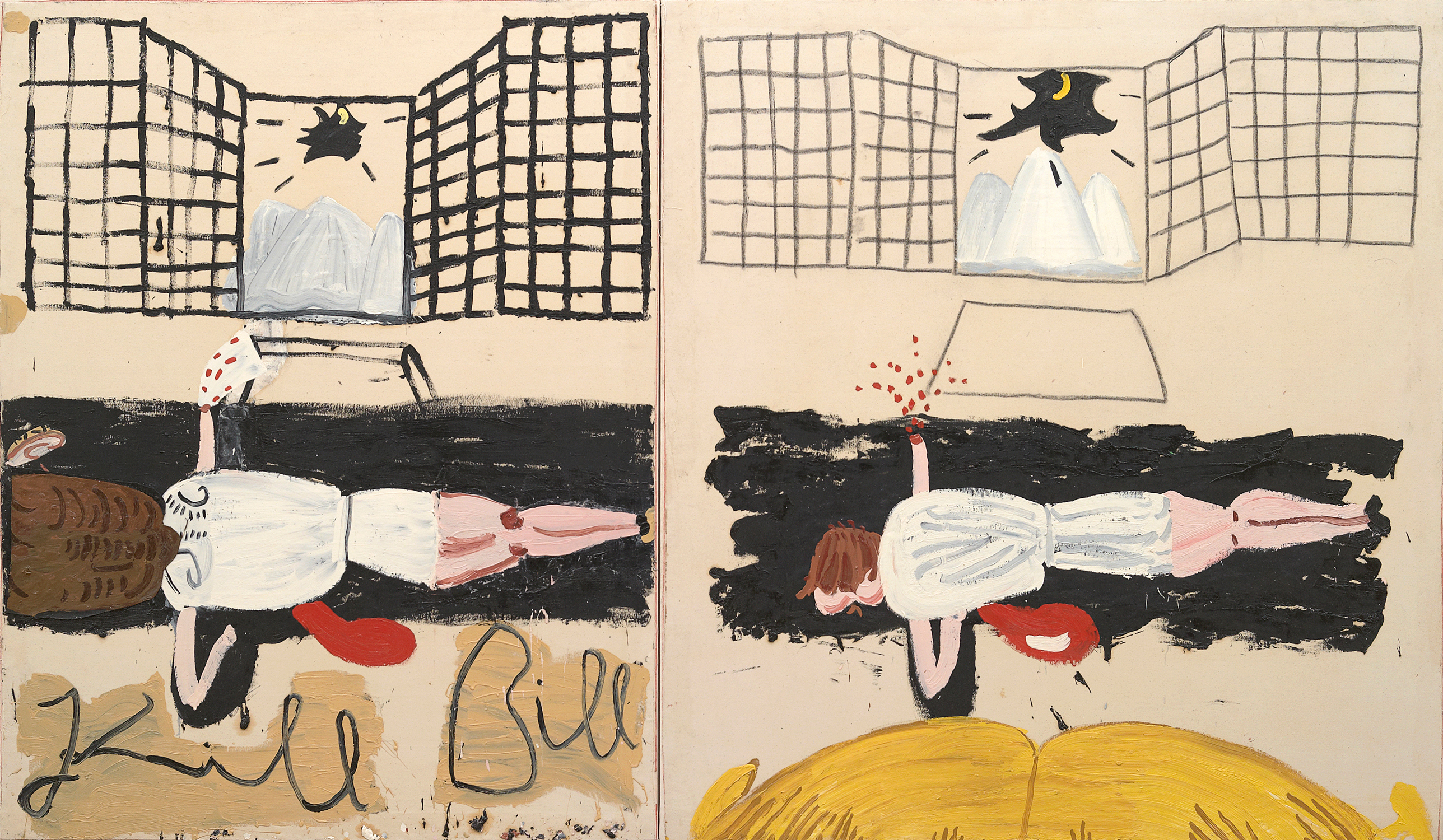
Wylie is a prolific scribbler, as evidenced in the fourth room of the exhibition displaying her diaries and sketchbooks, alongside her painting ‘HAND, drawing as central’ (2022). It is from these sketches, in which images are distilled and reworked over and over, that she draws inspiration for her paintings. The exhibition is not chronological; it is loosely thematic, picking out themes in Wylie’s practice. The subsequent room, for instance, displays her paintings drawn from film stills; she is a great fan of Quentin Tarantino, and displayed are huge canvases depicting scenes from his movies such as Inglorious Basterds (2009) and Kill Bill (2003).
Despite Wylie being a long-standing academician, this is her first show at the RA, in fact, the first time a female British artist has commanded the Academy’s main galleries. The show is long overdue, as Simon Wallis, Secretary and Chief Executive of the RA, has noted. Her critics, however, have compared her to a lesser Basquiat or Guston. With a slightly more muddled execution. She is a regular contributor to the Academy’s Summer Exhibition, and in 2013, a review by the scathing critic Brian Sewel branded her submission ‘Lorry Art’ (2013) as ‘a daub worthy of a child of four’. But Wylie was not offended; she takes these criticisms as compliments; she is a rebel at heart and has always challenged the academic approach to Fine Art.
More recent works displayed in the final room take on a wholly unconventional approach in which she used her hands to paint monochrome silhouettes of animals, looming five metres wide each. If only Sewel could see that – you couldn’t get much more infantile. Yet, of course, there is a Wylie-quality to these canvases, a certain sensuality, which perhaps the curators have anticipated. When confronted by these immense canvases, one is inclined to really inspect Wylie’s process, the layering, the haphazard application of paint. It is tempting to try and smell the canvas, and beside the wall text of some paintings, a sign reads ‘do not touch’.
.jpg)
Wylie has said, “A painting is not finally what it does, or what it makes, or what it has, or what it means... it is. The painting is the meaning”. This could be interpreted in one of two ways: either it is a long-winded way to say her paintings have no message, or it could be that they do have a message, except it is their own and not for her to explain; the painting will speak for itself. Of course, there are clues to an intended meaning in the slogans adorning the canvas, as well as the titles. ‘Pink Skater, Will I Win, Will I Win’ (2015), featured on the exhibition’s banner on the Academy’s facade, depicts a defiant female figure skater prancing across an ice rink before a wall of red stars, yet the caption painted beneath ‘Will I Win’ draws our attention away from her confident stance to her preoccupied face. Exterior confidence meets internal doubt.
What the exhibition lacks is a background of how Wylie’s style developed. Why is her work so similar to Basquiat’s and Guston’s? What or who were her influences? She has described herself as a hermit who has for decades lived in the same 17th-century house in a hamlet in Kent. To understand more about the decisions behind her process, when coupled with the opportunity to examine it so fully, would have been a great addition to the show.
Her faux-naif style is at its core optimistic, an omnipresent charge in her work, which is altogether uplifting and found even in her paintings of Kill Bill murder scenes, SS soldiers and the London night sky illuminated by dog fights. Though she does not want to be known for her age, to be producing such immense canvases, which communicate her jovial, guileless observations, and all the while remain at the forefront of British contemporary art, is an inspiration.
Rose Wylie: The Picture Comes First runs 28 February – 19 April 2026, at the Main Galleries of the Royal Academy, Piccadilly.


The Royal Academy’s blockbuster exhibitions never disappoint. For one thing, as far as temporary exhibition space goes, the galleries are unrivalled in their lofty grandeur. The space the main galleries offer is perfect to appreciate the scale of Wylie’s canvases. Though still aesthetically strong when viewed on a device, ‘The Picture Comes First’ offers the opportunity for close looking at an extensive body of Wylie’s work spanning four decades and eight rooms. It is the biggest survey of Wylie’s oeuvre to date, bringing some of her most important works together with previously unexhibited paintings and drawings.
Certain images etch themselves onto the psyche, particularly from a young age. For Wylie, this was the doodlebug, a predecessor to the cruise missile used by the Nazi’s to terrorise London’s inhabitants, one such target was a young Rose Wylie, who described, in the naive manner characteristic of a child, growing up in the Blitz as more thrilling than scary. However, the doodlebug has made its mark, appearing as a recurring motif in Wylie’s work. In fact, the repetition of motifs is central to Wylie’s practice. She draws on her extensive visual memory bank, topped up by popular culture, newspapers, films, TV, as well as observations of her own daily life.
Wylie is a prolific scribbler, as evidenced in the fourth room of the exhibition displaying her diaries and sketchbooks, alongside her painting ‘HAND, drawing as central’ (2022). It is from these sketches, in which images are distilled and reworked over and over, that she draws inspiration for her paintings. The exhibition is not chronological; it is loosely thematic, picking out themes in Wylie’s practice. The subsequent room, for instance, displays her paintings drawn from film stills; she is a great fan of Quentin Tarantino, and displayed are huge canvases depicting scenes from his movies such as Inglorious Basterds (2009) and Kill Bill (2003).
Despite Wylie being a long-standing academician, this is her first show at the RA, in fact, the first time a female British artist has commanded the Academy’s main galleries. The show is long overdue, as Simon Wallis, Secretary and Chief Executive of the RA, has noted. Her critics, however, have compared her to a lesser Basquiat or Guston. With a slightly more muddled execution. She is a regular contributor to the Academy’s Summer Exhibition, and in 2013, a review by the scathing critic Brian Sewel branded her submission ‘Lorry Art’ (2013) as ‘a daub worthy of a child of four’. But Wylie was not offended; she takes these criticisms as compliments; she is a rebel at heart and has always challenged the academic approach to Fine Art.
More recent works displayed in the final room take on a wholly unconventional approach in which she used her hands to paint monochrome silhouettes of animals, looming five metres wide each. If only Sewel could see that – you couldn’t get much more infantile. Yet, of course, there is a Wylie-quality to these canvases, a certain sensuality, which perhaps the curators have anticipated. When confronted by these immense canvases, one is inclined to really inspect Wylie’s process, the layering, the haphazard application of paint. It is tempting to try and smell the canvas, and beside the wall text of some paintings, a sign reads ‘do not touch’.
Wylie has said, “A painting is not finally what it does, or what it makes, or what it has, or what it means... it is. The painting is the meaning”. This could be interpreted in one of two ways: either it is a long-winded way to say her paintings have no message, or it could be that they do have a message, except it is their own and not for her to explain; the painting will speak for itself. Of course, there are clues to an intended meaning in the slogans adorning the canvas, as well as the titles. ‘Pink Skater, Will I Win, Will I Win’ (2015), featured on the exhibition’s banner on the Academy’s facade, depicts a defiant female figure skater prancing across an ice rink before a wall of red stars, yet the caption painted beneath ‘Will I Win’ draws our attention away from her confident stance to her preoccupied face. Exterior confidence meets internal doubt.
What the exhibition lacks is a background of how Wylie’s style developed. Why is her work so similar to Basquiat’s and Guston’s? What or who were her influences? She has described herself as a hermit who has for decades lived in the same 17th-century house in a hamlet in Kent. To understand more about the decisions behind her process, when coupled with the opportunity to examine it so fully, would have been a great addition to the show.
Her faux-naif style is at its core optimistic, an omnipresent charge in her work, which is altogether uplifting and found even in her paintings of Kill Bill murder scenes, SS soldiers and the London night sky illuminated by dog fights. Though she does not want to be known for her age, to be producing such immense canvases, which communicate her jovial, guileless observations, and all the while remain at the forefront of British contemporary art, is an inspiration.
Rose Wylie: The Picture Comes First runs 28 February – 19 April 2026, at the Main Galleries of the Royal Academy, Piccadilly.
The Royal Academy’s blockbuster exhibitions never disappoint. For one thing, as far as temporary exhibition space goes, the galleries are unrivalled in their lofty grandeur. The space the main galleries offer is perfect to appreciate the scale of Wylie’s canvases. Though still aesthetically strong when viewed on a device, ‘The Picture Comes First’ offers the opportunity for close looking at an extensive body of Wylie’s work spanning four decades and eight rooms. It is the biggest survey of Wylie’s oeuvre to date, bringing some of her most important works together with previously unexhibited paintings and drawings.
Certain images etch themselves onto the psyche, particularly from a young age. For Wylie, this was the doodlebug, a predecessor to the cruise missile used by the Nazi’s to terrorise London’s inhabitants, one such target was a young Rose Wylie, who described, in the naive manner characteristic of a child, growing up in the Blitz as more thrilling than scary. However, the doodlebug has made its mark, appearing as a recurring motif in Wylie’s work. In fact, the repetition of motifs is central to Wylie’s practice. She draws on her extensive visual memory bank, topped up by popular culture, newspapers, films, TV, as well as observations of her own daily life.
Wylie is a prolific scribbler, as evidenced in the fourth room of the exhibition displaying her diaries and sketchbooks, alongside her painting ‘HAND, drawing as central’ (2022). It is from these sketches, in which images are distilled and reworked over and over, that she draws inspiration for her paintings. The exhibition is not chronological; it is loosely thematic, picking out themes in Wylie’s practice. The subsequent room, for instance, displays her paintings drawn from film stills; she is a great fan of Quentin Tarantino, and displayed are huge canvases depicting scenes from his movies such as Inglorious Basterds (2009) and Kill Bill (2003).
Despite Wylie being a long-standing academician, this is her first show at the RA, in fact, the first time a female British artist has commanded the Academy’s main galleries. The show is long overdue, as Simon Wallis, Secretary and Chief Executive of the RA, has noted. Her critics, however, have compared her to a lesser Basquiat or Guston. With a slightly more muddled execution. She is a regular contributor to the Academy’s Summer Exhibition, and in 2013, a review by the scathing critic Brian Sewel branded her submission ‘Lorry Art’ (2013) as ‘a daub worthy of a child of four’. But Wylie was not offended; she takes these criticisms as compliments; she is a rebel at heart and has always challenged the academic approach to Fine Art.
More recent works displayed in the final room take on a wholly unconventional approach in which she used her hands to paint monochrome silhouettes of animals, looming five metres wide each. If only Sewel could see that – you couldn’t get much more infantile. Yet, of course, there is a Wylie-quality to these canvases, a certain sensuality, which perhaps the curators have anticipated. When confronted by these immense canvases, one is inclined to really inspect Wylie’s process, the layering, the haphazard application of paint. It is tempting to try and smell the canvas, and beside the wall text of some paintings, a sign reads ‘do not touch’.
Wylie has said, “A painting is not finally what it does, or what it makes, or what it has, or what it means... it is. The painting is the meaning”. This could be interpreted in one of two ways: either it is a long-winded way to say her paintings have no message, or it could be that they do have a message, except it is their own and not for her to explain; the painting will speak for itself. Of course, there are clues to an intended meaning in the slogans adorning the canvas, as well as the titles. ‘Pink Skater, Will I Win, Will I Win’ (2015), featured on the exhibition’s banner on the Academy’s facade, depicts a defiant female figure skater prancing across an ice rink before a wall of red stars, yet the caption painted beneath ‘Will I Win’ draws our attention away from her confident stance to her preoccupied face. Exterior confidence meets internal doubt.
What the exhibition lacks is a background of how Wylie’s style developed. Why is her work so similar to Basquiat’s and Guston’s? What or who were her influences? She has described herself as a hermit who has for decades lived in the same 17th-century house in a hamlet in Kent. To understand more about the decisions behind her process, when coupled with the opportunity to examine it so fully, would have been a great addition to the show.
Her faux-naif style is at its core optimistic, an omnipresent charge in her work, which is altogether uplifting and found even in her paintings of Kill Bill murder scenes, SS soldiers and the London night sky illuminated by dog fights. Though she does not want to be known for her age, to be producing such immense canvases, which communicate her jovial, guileless observations, and all the while remain at the forefront of British contemporary art, is an inspiration.
Rose Wylie: The Picture Comes First runs 28 February – 19 April 2026, at the Main Galleries of the Royal Academy, Piccadilly.
The Royal Academy’s blockbuster exhibitions never disappoint. For one thing, as far as temporary exhibition space goes, the galleries are unrivalled in their lofty grandeur. The space the main galleries offer is perfect to appreciate the scale of Wylie’s canvases. Though still aesthetically strong when viewed on a device, ‘The Picture Comes First’ offers the opportunity for close looking at an extensive body of Wylie’s work spanning four decades and eight rooms. It is the biggest survey of Wylie’s oeuvre to date, bringing some of her most important works together with previously unexhibited paintings and drawings.
Certain images etch themselves onto the psyche, particularly from a young age. For Wylie, this was the doodlebug, a predecessor to the cruise missile used by the Nazi’s to terrorise London’s inhabitants, one such target was a young Rose Wylie, who described, in the naive manner characteristic of a child, growing up in the Blitz as more thrilling than scary. However, the doodlebug has made its mark, appearing as a recurring motif in Wylie’s work. In fact, the repetition of motifs is central to Wylie’s practice. She draws on her extensive visual memory bank, topped up by popular culture, newspapers, films, TV, as well as observations of her own daily life.
Wylie is a prolific scribbler, as evidenced in the fourth room of the exhibition displaying her diaries and sketchbooks, alongside her painting ‘HAND, drawing as central’ (2022). It is from these sketches, in which images are distilled and reworked over and over, that she draws inspiration for her paintings. The exhibition is not chronological; it is loosely thematic, picking out themes in Wylie’s practice. The subsequent room, for instance, displays her paintings drawn from film stills; she is a great fan of Quentin Tarantino, and displayed are huge canvases depicting scenes from his movies such as Inglorious Basterds (2009) and Kill Bill (2003).
Despite Wylie being a long-standing academician, this is her first show at the RA, in fact, the first time a female British artist has commanded the Academy’s main galleries. The show is long overdue, as Simon Wallis, Secretary and Chief Executive of the RA, has noted. Her critics, however, have compared her to a lesser Basquiat or Guston. With a slightly more muddled execution. She is a regular contributor to the Academy’s Summer Exhibition, and in 2013, a review by the scathing critic Brian Sewel branded her submission ‘Lorry Art’ (2013) as ‘a daub worthy of a child of four’. But Wylie was not offended; she takes these criticisms as compliments; she is a rebel at heart and has always challenged the academic approach to Fine Art.
More recent works displayed in the final room take on a wholly unconventional approach in which she used her hands to paint monochrome silhouettes of animals, looming five metres wide each. If only Sewel could see that – you couldn’t get much more infantile. Yet, of course, there is a Wylie-quality to these canvases, a certain sensuality, which perhaps the curators have anticipated. When confronted by these immense canvases, one is inclined to really inspect Wylie’s process, the layering, the haphazard application of paint. It is tempting to try and smell the canvas, and beside the wall text of some paintings, a sign reads ‘do not touch’.
Wylie has said, “A painting is not finally what it does, or what it makes, or what it has, or what it means... it is. The painting is the meaning”. This could be interpreted in one of two ways: either it is a long-winded way to say her paintings have no message, or it could be that they do have a message, except it is their own and not for her to explain; the painting will speak for itself. Of course, there are clues to an intended meaning in the slogans adorning the canvas, as well as the titles. ‘Pink Skater, Will I Win, Will I Win’ (2015), featured on the exhibition’s banner on the Academy’s facade, depicts a defiant female figure skater prancing across an ice rink before a wall of red stars, yet the caption painted beneath ‘Will I Win’ draws our attention away from her confident stance to her preoccupied face. Exterior confidence meets internal doubt.
What the exhibition lacks is a background of how Wylie’s style developed. Why is her work so similar to Basquiat’s and Guston’s? What or who were her influences? She has described herself as a hermit who has for decades lived in the same 17th-century house in a hamlet in Kent. To understand more about the decisions behind her process, when coupled with the opportunity to examine it so fully, would have been a great addition to the show.
Her faux-naif style is at its core optimistic, an omnipresent charge in her work, which is altogether uplifting and found even in her paintings of Kill Bill murder scenes, SS soldiers and the London night sky illuminated by dog fights. Though she does not want to be known for her age, to be producing such immense canvases, which communicate her jovial, guileless observations, and all the while remain at the forefront of British contemporary art, is an inspiration.
Rose Wylie: The Picture Comes First runs 28 February – 19 April 2026, at the Main Galleries of the Royal Academy, Piccadilly.
The Royal Academy’s blockbuster exhibitions never disappoint. For one thing, as far as temporary exhibition space goes, the galleries are unrivalled in their lofty grandeur. The space the main galleries offer is perfect to appreciate the scale of Wylie’s canvases. Though still aesthetically strong when viewed on a device, ‘The Picture Comes First’ offers the opportunity for close looking at an extensive body of Wylie’s work spanning four decades and eight rooms. It is the biggest survey of Wylie’s oeuvre to date, bringing some of her most important works together with previously unexhibited paintings and drawings.
Certain images etch themselves onto the psyche, particularly from a young age. For Wylie, this was the doodlebug, a predecessor to the cruise missile used by the Nazi’s to terrorise London’s inhabitants, one such target was a young Rose Wylie, who described, in the naive manner characteristic of a child, growing up in the Blitz as more thrilling than scary. However, the doodlebug has made its mark, appearing as a recurring motif in Wylie’s work. In fact, the repetition of motifs is central to Wylie’s practice. She draws on her extensive visual memory bank, topped up by popular culture, newspapers, films, TV, as well as observations of her own daily life.
Wylie is a prolific scribbler, as evidenced in the fourth room of the exhibition displaying her diaries and sketchbooks, alongside her painting ‘HAND, drawing as central’ (2022). It is from these sketches, in which images are distilled and reworked over and over, that she draws inspiration for her paintings. The exhibition is not chronological; it is loosely thematic, picking out themes in Wylie’s practice. The subsequent room, for instance, displays her paintings drawn from film stills; she is a great fan of Quentin Tarantino, and displayed are huge canvases depicting scenes from his movies such as Inglorious Basterds (2009) and Kill Bill (2003).
Despite Wylie being a long-standing academician, this is her first show at the RA, in fact, the first time a female British artist has commanded the Academy’s main galleries. The show is long overdue, as Simon Wallis, Secretary and Chief Executive of the RA, has noted. Her critics, however, have compared her to a lesser Basquiat or Guston. With a slightly more muddled execution. She is a regular contributor to the Academy’s Summer Exhibition, and in 2013, a review by the scathing critic Brian Sewel branded her submission ‘Lorry Art’ (2013) as ‘a daub worthy of a child of four’. But Wylie was not offended; she takes these criticisms as compliments; she is a rebel at heart and has always challenged the academic approach to Fine Art.
More recent works displayed in the final room take on a wholly unconventional approach in which she used her hands to paint monochrome silhouettes of animals, looming five metres wide each. If only Sewel could see that – you couldn’t get much more infantile. Yet, of course, there is a Wylie-quality to these canvases, a certain sensuality, which perhaps the curators have anticipated. When confronted by these immense canvases, one is inclined to really inspect Wylie’s process, the layering, the haphazard application of paint. It is tempting to try and smell the canvas, and beside the wall text of some paintings, a sign reads ‘do not touch’.
Wylie has said, “A painting is not finally what it does, or what it makes, or what it has, or what it means... it is. The painting is the meaning”. This could be interpreted in one of two ways: either it is a long-winded way to say her paintings have no message, or it could be that they do have a message, except it is their own and not for her to explain; the painting will speak for itself. Of course, there are clues to an intended meaning in the slogans adorning the canvas, as well as the titles. ‘Pink Skater, Will I Win, Will I Win’ (2015), featured on the exhibition’s banner on the Academy’s facade, depicts a defiant female figure skater prancing across an ice rink before a wall of red stars, yet the caption painted beneath ‘Will I Win’ draws our attention away from her confident stance to her preoccupied face. Exterior confidence meets internal doubt.
What the exhibition lacks is a background of how Wylie’s style developed. Why is her work so similar to Basquiat’s and Guston’s? What or who were her influences? She has described herself as a hermit who has for decades lived in the same 17th-century house in a hamlet in Kent. To understand more about the decisions behind her process, when coupled with the opportunity to examine it so fully, would have been a great addition to the show.
Her faux-naif style is at its core optimistic, an omnipresent charge in her work, which is altogether uplifting and found even in her paintings of Kill Bill murder scenes, SS soldiers and the London night sky illuminated by dog fights. Though she does not want to be known for her age, to be producing such immense canvases, which communicate her jovial, guileless observations, and all the while remain at the forefront of British contemporary art, is an inspiration.
Rose Wylie: The Picture Comes First runs 28 February – 19 April 2026, at the Main Galleries of the Royal Academy, Piccadilly.
The Royal Academy’s blockbuster exhibitions never disappoint. For one thing, as far as temporary exhibition space goes, the galleries are unrivalled in their lofty grandeur. The space the main galleries offer is perfect to appreciate the scale of Wylie’s canvases. Though still aesthetically strong when viewed on a device, ‘The Picture Comes First’ offers the opportunity for close looking at an extensive body of Wylie’s work spanning four decades and eight rooms. It is the biggest survey of Wylie’s oeuvre to date, bringing some of her most important works together with previously unexhibited paintings and drawings.
Certain images etch themselves onto the psyche, particularly from a young age. For Wylie, this was the doodlebug, a predecessor to the cruise missile used by the Nazi’s to terrorise London’s inhabitants, one such target was a young Rose Wylie, who described, in the naive manner characteristic of a child, growing up in the Blitz as more thrilling than scary. However, the doodlebug has made its mark, appearing as a recurring motif in Wylie’s work. In fact, the repetition of motifs is central to Wylie’s practice. She draws on her extensive visual memory bank, topped up by popular culture, newspapers, films, TV, as well as observations of her own daily life.
Wylie is a prolific scribbler, as evidenced in the fourth room of the exhibition displaying her diaries and sketchbooks, alongside her painting ‘HAND, drawing as central’ (2022). It is from these sketches, in which images are distilled and reworked over and over, that she draws inspiration for her paintings. The exhibition is not chronological; it is loosely thematic, picking out themes in Wylie’s practice. The subsequent room, for instance, displays her paintings drawn from film stills; she is a great fan of Quentin Tarantino, and displayed are huge canvases depicting scenes from his movies such as Inglorious Basterds (2009) and Kill Bill (2003).
Despite Wylie being a long-standing academician, this is her first show at the RA, in fact, the first time a female British artist has commanded the Academy’s main galleries. The show is long overdue, as Simon Wallis, Secretary and Chief Executive of the RA, has noted. Her critics, however, have compared her to a lesser Basquiat or Guston. With a slightly more muddled execution. She is a regular contributor to the Academy’s Summer Exhibition, and in 2013, a review by the scathing critic Brian Sewel branded her submission ‘Lorry Art’ (2013) as ‘a daub worthy of a child of four’. But Wylie was not offended; she takes these criticisms as compliments; she is a rebel at heart and has always challenged the academic approach to Fine Art.
More recent works displayed in the final room take on a wholly unconventional approach in which she used her hands to paint monochrome silhouettes of animals, looming five metres wide each. If only Sewel could see that – you couldn’t get much more infantile. Yet, of course, there is a Wylie-quality to these canvases, a certain sensuality, which perhaps the curators have anticipated. When confronted by these immense canvases, one is inclined to really inspect Wylie’s process, the layering, the haphazard application of paint. It is tempting to try and smell the canvas, and beside the wall text of some paintings, a sign reads ‘do not touch’.
Wylie has said, “A painting is not finally what it does, or what it makes, or what it has, or what it means... it is. The painting is the meaning”. This could be interpreted in one of two ways: either it is a long-winded way to say her paintings have no message, or it could be that they do have a message, except it is their own and not for her to explain; the painting will speak for itself. Of course, there are clues to an intended meaning in the slogans adorning the canvas, as well as the titles. ‘Pink Skater, Will I Win, Will I Win’ (2015), featured on the exhibition’s banner on the Academy’s facade, depicts a defiant female figure skater prancing across an ice rink before a wall of red stars, yet the caption painted beneath ‘Will I Win’ draws our attention away from her confident stance to her preoccupied face. Exterior confidence meets internal doubt.
What the exhibition lacks is a background of how Wylie’s style developed. Why is her work so similar to Basquiat’s and Guston’s? What or who were her influences? She has described herself as a hermit who has for decades lived in the same 17th-century house in a hamlet in Kent. To understand more about the decisions behind her process, when coupled with the opportunity to examine it so fully, would have been a great addition to the show.
Her faux-naif style is at its core optimistic, an omnipresent charge in her work, which is altogether uplifting and found even in her paintings of Kill Bill murder scenes, SS soldiers and the London night sky illuminated by dog fights. Though she does not want to be known for her age, to be producing such immense canvases, which communicate her jovial, guileless observations, and all the while remain at the forefront of British contemporary art, is an inspiration.
Rose Wylie: The Picture Comes First runs 28 February – 19 April 2026, at the Main Galleries of the Royal Academy, Piccadilly.
The Royal Academy’s blockbuster exhibitions never disappoint. For one thing, as far as temporary exhibition space goes, the galleries are unrivalled in their lofty grandeur. The space the main galleries offer is perfect to appreciate the scale of Wylie’s canvases. Though still aesthetically strong when viewed on a device, ‘The Picture Comes First’ offers the opportunity for close looking at an extensive body of Wylie’s work spanning four decades and eight rooms. It is the biggest survey of Wylie’s oeuvre to date, bringing some of her most important works together with previously unexhibited paintings and drawings.
Certain images etch themselves onto the psyche, particularly from a young age. For Wylie, this was the doodlebug, a predecessor to the cruise missile used by the Nazi’s to terrorise London’s inhabitants, one such target was a young Rose Wylie, who described, in the naive manner characteristic of a child, growing up in the Blitz as more thrilling than scary. However, the doodlebug has made its mark, appearing as a recurring motif in Wylie’s work. In fact, the repetition of motifs is central to Wylie’s practice. She draws on her extensive visual memory bank, topped up by popular culture, newspapers, films, TV, as well as observations of her own daily life.
Wylie is a prolific scribbler, as evidenced in the fourth room of the exhibition displaying her diaries and sketchbooks, alongside her painting ‘HAND, drawing as central’ (2022). It is from these sketches, in which images are distilled and reworked over and over, that she draws inspiration for her paintings. The exhibition is not chronological; it is loosely thematic, picking out themes in Wylie’s practice. The subsequent room, for instance, displays her paintings drawn from film stills; she is a great fan of Quentin Tarantino, and displayed are huge canvases depicting scenes from his movies such as Inglorious Basterds (2009) and Kill Bill (2003).
Despite Wylie being a long-standing academician, this is her first show at the RA, in fact, the first time a female British artist has commanded the Academy’s main galleries. The show is long overdue, as Simon Wallis, Secretary and Chief Executive of the RA, has noted. Her critics, however, have compared her to a lesser Basquiat or Guston. With a slightly more muddled execution. She is a regular contributor to the Academy’s Summer Exhibition, and in 2013, a review by the scathing critic Brian Sewel branded her submission ‘Lorry Art’ (2013) as ‘a daub worthy of a child of four’. But Wylie was not offended; she takes these criticisms as compliments; she is a rebel at heart and has always challenged the academic approach to Fine Art.
More recent works displayed in the final room take on a wholly unconventional approach in which she used her hands to paint monochrome silhouettes of animals, looming five metres wide each. If only Sewel could see that – you couldn’t get much more infantile. Yet, of course, there is a Wylie-quality to these canvases, a certain sensuality, which perhaps the curators have anticipated. When confronted by these immense canvases, one is inclined to really inspect Wylie’s process, the layering, the haphazard application of paint. It is tempting to try and smell the canvas, and beside the wall text of some paintings, a sign reads ‘do not touch’.
Wylie has said, “A painting is not finally what it does, or what it makes, or what it has, or what it means... it is. The painting is the meaning”. This could be interpreted in one of two ways: either it is a long-winded way to say her paintings have no message, or it could be that they do have a message, except it is their own and not for her to explain; the painting will speak for itself. Of course, there are clues to an intended meaning in the slogans adorning the canvas, as well as the titles. ‘Pink Skater, Will I Win, Will I Win’ (2015), featured on the exhibition’s banner on the Academy’s facade, depicts a defiant female figure skater prancing across an ice rink before a wall of red stars, yet the caption painted beneath ‘Will I Win’ draws our attention away from her confident stance to her preoccupied face. Exterior confidence meets internal doubt.
What the exhibition lacks is a background of how Wylie’s style developed. Why is her work so similar to Basquiat’s and Guston’s? What or who were her influences? She has described herself as a hermit who has for decades lived in the same 17th-century house in a hamlet in Kent. To understand more about the decisions behind her process, when coupled with the opportunity to examine it so fully, would have been a great addition to the show.
Her faux-naif style is at its core optimistic, an omnipresent charge in her work, which is altogether uplifting and found even in her paintings of Kill Bill murder scenes, SS soldiers and the London night sky illuminated by dog fights. Though she does not want to be known for her age, to be producing such immense canvases, which communicate her jovial, guileless observations, and all the while remain at the forefront of British contemporary art, is an inspiration.
Rose Wylie: The Picture Comes First runs 28 February – 19 April 2026, at the Main Galleries of the Royal Academy, Piccadilly.
The Royal Academy’s blockbuster exhibitions never disappoint. For one thing, as far as temporary exhibition space goes, the galleries are unrivalled in their lofty grandeur. The space the main galleries offer is perfect to appreciate the scale of Wylie’s canvases. Though still aesthetically strong when viewed on a device, ‘The Picture Comes First’ offers the opportunity for close looking at an extensive body of Wylie’s work spanning four decades and eight rooms. It is the biggest survey of Wylie’s oeuvre to date, bringing some of her most important works together with previously unexhibited paintings and drawings.
Certain images etch themselves onto the psyche, particularly from a young age. For Wylie, this was the doodlebug, a predecessor to the cruise missile used by the Nazi’s to terrorise London’s inhabitants, one such target was a young Rose Wylie, who described, in the naive manner characteristic of a child, growing up in the Blitz as more thrilling than scary. However, the doodlebug has made its mark, appearing as a recurring motif in Wylie’s work. In fact, the repetition of motifs is central to Wylie’s practice. She draws on her extensive visual memory bank, topped up by popular culture, newspapers, films, TV, as well as observations of her own daily life.
Wylie is a prolific scribbler, as evidenced in the fourth room of the exhibition displaying her diaries and sketchbooks, alongside her painting ‘HAND, drawing as central’ (2022). It is from these sketches, in which images are distilled and reworked over and over, that she draws inspiration for her paintings. The exhibition is not chronological; it is loosely thematic, picking out themes in Wylie’s practice. The subsequent room, for instance, displays her paintings drawn from film stills; she is a great fan of Quentin Tarantino, and displayed are huge canvases depicting scenes from his movies such as Inglorious Basterds (2009) and Kill Bill (2003).
Despite Wylie being a long-standing academician, this is her first show at the RA, in fact, the first time a female British artist has commanded the Academy’s main galleries. The show is long overdue, as Simon Wallis, Secretary and Chief Executive of the RA, has noted. Her critics, however, have compared her to a lesser Basquiat or Guston. With a slightly more muddled execution. She is a regular contributor to the Academy’s Summer Exhibition, and in 2013, a review by the scathing critic Brian Sewel branded her submission ‘Lorry Art’ (2013) as ‘a daub worthy of a child of four’. But Wylie was not offended; she takes these criticisms as compliments; she is a rebel at heart and has always challenged the academic approach to Fine Art.
More recent works displayed in the final room take on a wholly unconventional approach in which she used her hands to paint monochrome silhouettes of animals, looming five metres wide each. If only Sewel could see that – you couldn’t get much more infantile. Yet, of course, there is a Wylie-quality to these canvases, a certain sensuality, which perhaps the curators have anticipated. When confronted by these immense canvases, one is inclined to really inspect Wylie’s process, the layering, the haphazard application of paint. It is tempting to try and smell the canvas, and beside the wall text of some paintings, a sign reads ‘do not touch’.
Wylie has said, “A painting is not finally what it does, or what it makes, or what it has, or what it means... it is. The painting is the meaning”. This could be interpreted in one of two ways: either it is a long-winded way to say her paintings have no message, or it could be that they do have a message, except it is their own and not for her to explain; the painting will speak for itself. Of course, there are clues to an intended meaning in the slogans adorning the canvas, as well as the titles. ‘Pink Skater, Will I Win, Will I Win’ (2015), featured on the exhibition’s banner on the Academy’s facade, depicts a defiant female figure skater prancing across an ice rink before a wall of red stars, yet the caption painted beneath ‘Will I Win’ draws our attention away from her confident stance to her preoccupied face. Exterior confidence meets internal doubt.
What the exhibition lacks is a background of how Wylie’s style developed. Why is her work so similar to Basquiat’s and Guston’s? What or who were her influences? She has described herself as a hermit who has for decades lived in the same 17th-century house in a hamlet in Kent. To understand more about the decisions behind her process, when coupled with the opportunity to examine it so fully, would have been a great addition to the show.
Her faux-naif style is at its core optimistic, an omnipresent charge in her work, which is altogether uplifting and found even in her paintings of Kill Bill murder scenes, SS soldiers and the London night sky illuminated by dog fights. Though she does not want to be known for her age, to be producing such immense canvases, which communicate her jovial, guileless observations, and all the while remain at the forefront of British contemporary art, is an inspiration.
Rose Wylie: The Picture Comes First runs 28 February – 19 April 2026, at the Main Galleries of the Royal Academy, Piccadilly.
The Royal Academy’s blockbuster exhibitions never disappoint. For one thing, as far as temporary exhibition space goes, the galleries are unrivalled in their lofty grandeur. The space the main galleries offer is perfect to appreciate the scale of Wylie’s canvases. Though still aesthetically strong when viewed on a device, ‘The Picture Comes First’ offers the opportunity for close looking at an extensive body of Wylie’s work spanning four decades and eight rooms. It is the biggest survey of Wylie’s oeuvre to date, bringing some of her most important works together with previously unexhibited paintings and drawings.
Certain images etch themselves onto the psyche, particularly from a young age. For Wylie, this was the doodlebug, a predecessor to the cruise missile used by the Nazi’s to terrorise London’s inhabitants, one such target was a young Rose Wylie, who described, in the naive manner characteristic of a child, growing up in the Blitz as more thrilling than scary. However, the doodlebug has made its mark, appearing as a recurring motif in Wylie’s work. In fact, the repetition of motifs is central to Wylie’s practice. She draws on her extensive visual memory bank, topped up by popular culture, newspapers, films, TV, as well as observations of her own daily life.
Wylie is a prolific scribbler, as evidenced in the fourth room of the exhibition displaying her diaries and sketchbooks, alongside her painting ‘HAND, drawing as central’ (2022). It is from these sketches, in which images are distilled and reworked over and over, that she draws inspiration for her paintings. The exhibition is not chronological; it is loosely thematic, picking out themes in Wylie’s practice. The subsequent room, for instance, displays her paintings drawn from film stills; she is a great fan of Quentin Tarantino, and displayed are huge canvases depicting scenes from his movies such as Inglorious Basterds (2009) and Kill Bill (2003).
Despite Wylie being a long-standing academician, this is her first show at the RA, in fact, the first time a female British artist has commanded the Academy’s main galleries. The show is long overdue, as Simon Wallis, Secretary and Chief Executive of the RA, has noted. Her critics, however, have compared her to a lesser Basquiat or Guston. With a slightly more muddled execution. She is a regular contributor to the Academy’s Summer Exhibition, and in 2013, a review by the scathing critic Brian Sewel branded her submission ‘Lorry Art’ (2013) as ‘a daub worthy of a child of four’. But Wylie was not offended; she takes these criticisms as compliments; she is a rebel at heart and has always challenged the academic approach to Fine Art.
More recent works displayed in the final room take on a wholly unconventional approach in which she used her hands to paint monochrome silhouettes of animals, looming five metres wide each. If only Sewel could see that – you couldn’t get much more infantile. Yet, of course, there is a Wylie-quality to these canvases, a certain sensuality, which perhaps the curators have anticipated. When confronted by these immense canvases, one is inclined to really inspect Wylie’s process, the layering, the haphazard application of paint. It is tempting to try and smell the canvas, and beside the wall text of some paintings, a sign reads ‘do not touch’.
Wylie has said, “A painting is not finally what it does, or what it makes, or what it has, or what it means... it is. The painting is the meaning”. This could be interpreted in one of two ways: either it is a long-winded way to say her paintings have no message, or it could be that they do have a message, except it is their own and not for her to explain; the painting will speak for itself. Of course, there are clues to an intended meaning in the slogans adorning the canvas, as well as the titles. ‘Pink Skater, Will I Win, Will I Win’ (2015), featured on the exhibition’s banner on the Academy’s facade, depicts a defiant female figure skater prancing across an ice rink before a wall of red stars, yet the caption painted beneath ‘Will I Win’ draws our attention away from her confident stance to her preoccupied face. Exterior confidence meets internal doubt.
What the exhibition lacks is a background of how Wylie’s style developed. Why is her work so similar to Basquiat’s and Guston’s? What or who were her influences? She has described herself as a hermit who has for decades lived in the same 17th-century house in a hamlet in Kent. To understand more about the decisions behind her process, when coupled with the opportunity to examine it so fully, would have been a great addition to the show.
Her faux-naif style is at its core optimistic, an omnipresent charge in her work, which is altogether uplifting and found even in her paintings of Kill Bill murder scenes, SS soldiers and the London night sky illuminated by dog fights. Though she does not want to be known for her age, to be producing such immense canvases, which communicate her jovial, guileless observations, and all the while remain at the forefront of British contemporary art, is an inspiration.
Rose Wylie: The Picture Comes First runs 28 February – 19 April 2026, at the Main Galleries of the Royal Academy, Piccadilly.
The Royal Academy’s blockbuster exhibitions never disappoint. For one thing, as far as temporary exhibition space goes, the galleries are unrivalled in their lofty grandeur. The space the main galleries offer is perfect to appreciate the scale of Wylie’s canvases. Though still aesthetically strong when viewed on a device, ‘The Picture Comes First’ offers the opportunity for close looking at an extensive body of Wylie’s work spanning four decades and eight rooms. It is the biggest survey of Wylie’s oeuvre to date, bringing some of her most important works together with previously unexhibited paintings and drawings.
Certain images etch themselves onto the psyche, particularly from a young age. For Wylie, this was the doodlebug, a predecessor to the cruise missile used by the Nazi’s to terrorise London’s inhabitants, one such target was a young Rose Wylie, who described, in the naive manner characteristic of a child, growing up in the Blitz as more thrilling than scary. However, the doodlebug has made its mark, appearing as a recurring motif in Wylie’s work. In fact, the repetition of motifs is central to Wylie’s practice. She draws on her extensive visual memory bank, topped up by popular culture, newspapers, films, TV, as well as observations of her own daily life.
Wylie is a prolific scribbler, as evidenced in the fourth room of the exhibition displaying her diaries and sketchbooks, alongside her painting ‘HAND, drawing as central’ (2022). It is from these sketches, in which images are distilled and reworked over and over, that she draws inspiration for her paintings. The exhibition is not chronological; it is loosely thematic, picking out themes in Wylie’s practice. The subsequent room, for instance, displays her paintings drawn from film stills; she is a great fan of Quentin Tarantino, and displayed are huge canvases depicting scenes from his movies such as Inglorious Basterds (2009) and Kill Bill (2003).
Despite Wylie being a long-standing academician, this is her first show at the RA, in fact, the first time a female British artist has commanded the Academy’s main galleries. The show is long overdue, as Simon Wallis, Secretary and Chief Executive of the RA, has noted. Her critics, however, have compared her to a lesser Basquiat or Guston. With a slightly more muddled execution. She is a regular contributor to the Academy’s Summer Exhibition, and in 2013, a review by the scathing critic Brian Sewel branded her submission ‘Lorry Art’ (2013) as ‘a daub worthy of a child of four’. But Wylie was not offended; she takes these criticisms as compliments; she is a rebel at heart and has always challenged the academic approach to Fine Art.
More recent works displayed in the final room take on a wholly unconventional approach in which she used her hands to paint monochrome silhouettes of animals, looming five metres wide each. If only Sewel could see that – you couldn’t get much more infantile. Yet, of course, there is a Wylie-quality to these canvases, a certain sensuality, which perhaps the curators have anticipated. When confronted by these immense canvases, one is inclined to really inspect Wylie’s process, the layering, the haphazard application of paint. It is tempting to try and smell the canvas, and beside the wall text of some paintings, a sign reads ‘do not touch’.
Wylie has said, “A painting is not finally what it does, or what it makes, or what it has, or what it means... it is. The painting is the meaning”. This could be interpreted in one of two ways: either it is a long-winded way to say her paintings have no message, or it could be that they do have a message, except it is their own and not for her to explain; the painting will speak for itself. Of course, there are clues to an intended meaning in the slogans adorning the canvas, as well as the titles. ‘Pink Skater, Will I Win, Will I Win’ (2015), featured on the exhibition’s banner on the Academy’s facade, depicts a defiant female figure skater prancing across an ice rink before a wall of red stars, yet the caption painted beneath ‘Will I Win’ draws our attention away from her confident stance to her preoccupied face. Exterior confidence meets internal doubt.
What the exhibition lacks is a background of how Wylie’s style developed. Why is her work so similar to Basquiat’s and Guston’s? What or who were her influences? She has described herself as a hermit who has for decades lived in the same 17th-century house in a hamlet in Kent. To understand more about the decisions behind her process, when coupled with the opportunity to examine it so fully, would have been a great addition to the show.
Her faux-naif style is at its core optimistic, an omnipresent charge in her work, which is altogether uplifting and found even in her paintings of Kill Bill murder scenes, SS soldiers and the London night sky illuminated by dog fights. Though she does not want to be known for her age, to be producing such immense canvases, which communicate her jovial, guileless observations, and all the while remain at the forefront of British contemporary art, is an inspiration.
Rose Wylie: The Picture Comes First runs 28 February – 19 April 2026, at the Main Galleries of the Royal Academy, Piccadilly.
The Royal Academy’s blockbuster exhibitions never disappoint. For one thing, as far as temporary exhibition space goes, the galleries are unrivalled in their lofty grandeur. The space the main galleries offer is perfect to appreciate the scale of Wylie’s canvases. Though still aesthetically strong when viewed on a device, ‘The Picture Comes First’ offers the opportunity for close looking at an extensive body of Wylie’s work spanning four decades and eight rooms. It is the biggest survey of Wylie’s oeuvre to date, bringing some of her most important works together with previously unexhibited paintings and drawings.
Certain images etch themselves onto the psyche, particularly from a young age. For Wylie, this was the doodlebug, a predecessor to the cruise missile used by the Nazi’s to terrorise London’s inhabitants, one such target was a young Rose Wylie, who described, in the naive manner characteristic of a child, growing up in the Blitz as more thrilling than scary. However, the doodlebug has made its mark, appearing as a recurring motif in Wylie’s work. In fact, the repetition of motifs is central to Wylie’s practice. She draws on her extensive visual memory bank, topped up by popular culture, newspapers, films, TV, as well as observations of her own daily life.
Wylie is a prolific scribbler, as evidenced in the fourth room of the exhibition displaying her diaries and sketchbooks, alongside her painting ‘HAND, drawing as central’ (2022). It is from these sketches, in which images are distilled and reworked over and over, that she draws inspiration for her paintings. The exhibition is not chronological; it is loosely thematic, picking out themes in Wylie’s practice. The subsequent room, for instance, displays her paintings drawn from film stills; she is a great fan of Quentin Tarantino, and displayed are huge canvases depicting scenes from his movies such as Inglorious Basterds (2009) and Kill Bill (2003).
Despite Wylie being a long-standing academician, this is her first show at the RA, in fact, the first time a female British artist has commanded the Academy’s main galleries. The show is long overdue, as Simon Wallis, Secretary and Chief Executive of the RA, has noted. Her critics, however, have compared her to a lesser Basquiat or Guston. With a slightly more muddled execution. She is a regular contributor to the Academy’s Summer Exhibition, and in 2013, a review by the scathing critic Brian Sewel branded her submission ‘Lorry Art’ (2013) as ‘a daub worthy of a child of four’. But Wylie was not offended; she takes these criticisms as compliments; she is a rebel at heart and has always challenged the academic approach to Fine Art.
More recent works displayed in the final room take on a wholly unconventional approach in which she used her hands to paint monochrome silhouettes of animals, looming five metres wide each. If only Sewel could see that – you couldn’t get much more infantile. Yet, of course, there is a Wylie-quality to these canvases, a certain sensuality, which perhaps the curators have anticipated. When confronted by these immense canvases, one is inclined to really inspect Wylie’s process, the layering, the haphazard application of paint. It is tempting to try and smell the canvas, and beside the wall text of some paintings, a sign reads ‘do not touch’.
Wylie has said, “A painting is not finally what it does, or what it makes, or what it has, or what it means... it is. The painting is the meaning”. This could be interpreted in one of two ways: either it is a long-winded way to say her paintings have no message, or it could be that they do have a message, except it is their own and not for her to explain; the painting will speak for itself. Of course, there are clues to an intended meaning in the slogans adorning the canvas, as well as the titles. ‘Pink Skater, Will I Win, Will I Win’ (2015), featured on the exhibition’s banner on the Academy’s facade, depicts a defiant female figure skater prancing across an ice rink before a wall of red stars, yet the caption painted beneath ‘Will I Win’ draws our attention away from her confident stance to her preoccupied face. Exterior confidence meets internal doubt.
What the exhibition lacks is a background of how Wylie’s style developed. Why is her work so similar to Basquiat’s and Guston’s? What or who were her influences? She has described herself as a hermit who has for decades lived in the same 17th-century house in a hamlet in Kent. To understand more about the decisions behind her process, when coupled with the opportunity to examine it so fully, would have been a great addition to the show.
Her faux-naif style is at its core optimistic, an omnipresent charge in her work, which is altogether uplifting and found even in her paintings of Kill Bill murder scenes, SS soldiers and the London night sky illuminated by dog fights. Though she does not want to be known for her age, to be producing such immense canvases, which communicate her jovial, guileless observations, and all the while remain at the forefront of British contemporary art, is an inspiration.
Rose Wylie: The Picture Comes First runs 28 February – 19 April 2026, at the Main Galleries of the Royal Academy, Piccadilly.


.png)


.svg)


