
Lou Mensah spends time with Sir Frank Bowling
Lou Mensah spends time with Sir Frank Bowling during his 92nd birthday celebrations, on the eve of his exhibition Seeking the Sublime at the Fitzwilliam Museum, Cambridge...
By
Lou Mensah
April 1, 2026
"The thing about the sublime is that it won't sit still for you." - Sir Frank Bowling
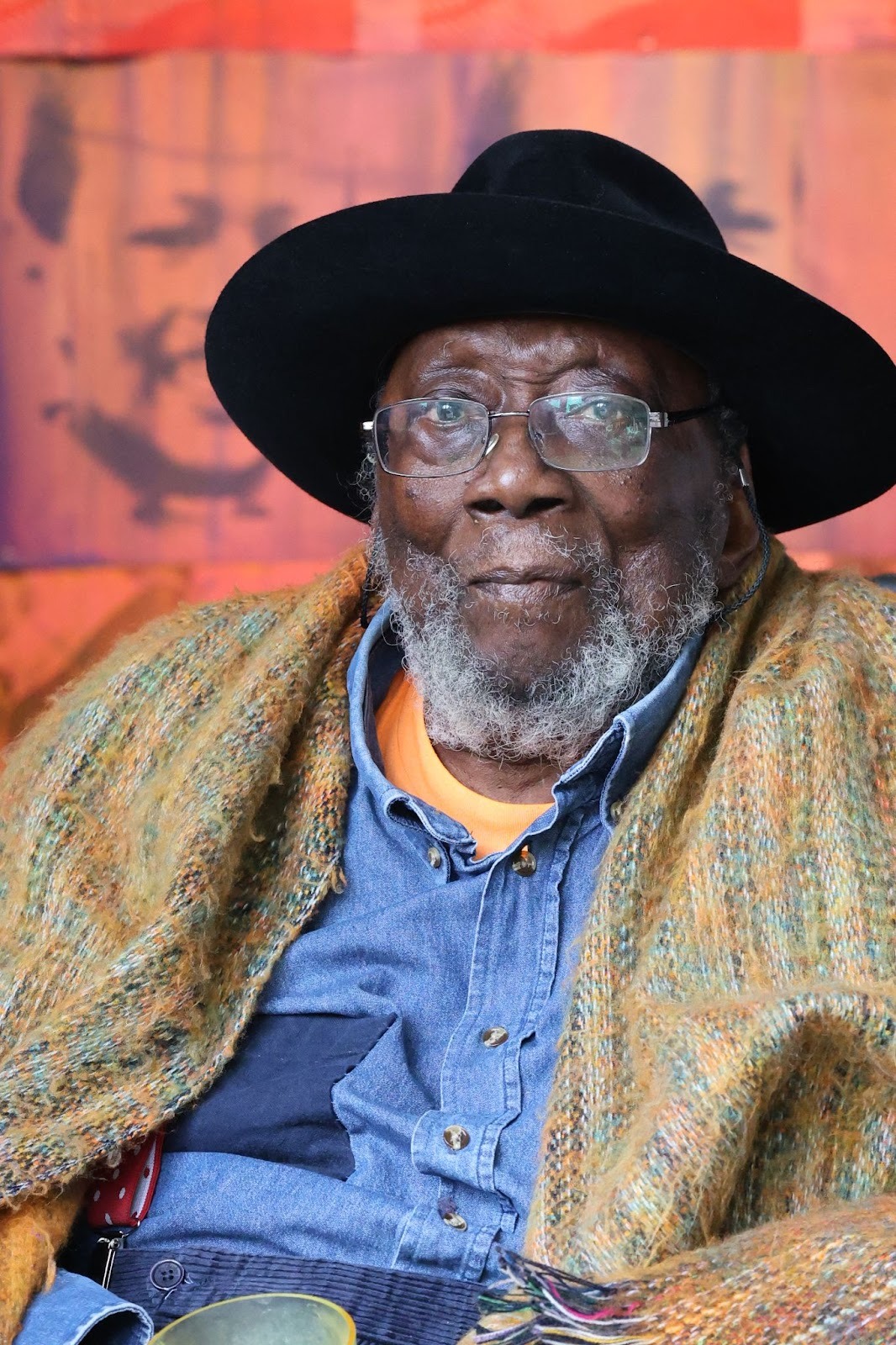
For over six decades, Sir Frank Bowling has given his life to a practice that boldly expands the possibilities and properties of paint. Born in British Guiana (now Guyana) in 1934, he arrived in London at nineteen. What followed was a career between London and New York that has resulted in paintings of unparalleled originality and power. He works every day in his South London studio, driven by his fascination with exploring the vast and radiant possibilities of paint. "I want to spin the paint and make magic out of it”, he told Lou.
Seeking the Sublime opens at the Fitzwilliam Museum, Cambridge on 27 March and brings together a lifetime of work, from the figurative 4 Horsemen of the Apocalypse (1961) to Yellow Map (2025), shown publicly for the first time. Visitors are invited to move between Bowling's paintings and Fitzwilliam's own Titian, Constable, Turner and Millais, tracing a shared pursuit of something beyond what paint alone should be able to do.
With special thanks to Ben, Iona, Evie, and the wonderful team at the Frank Bowling Studio for making this possible.
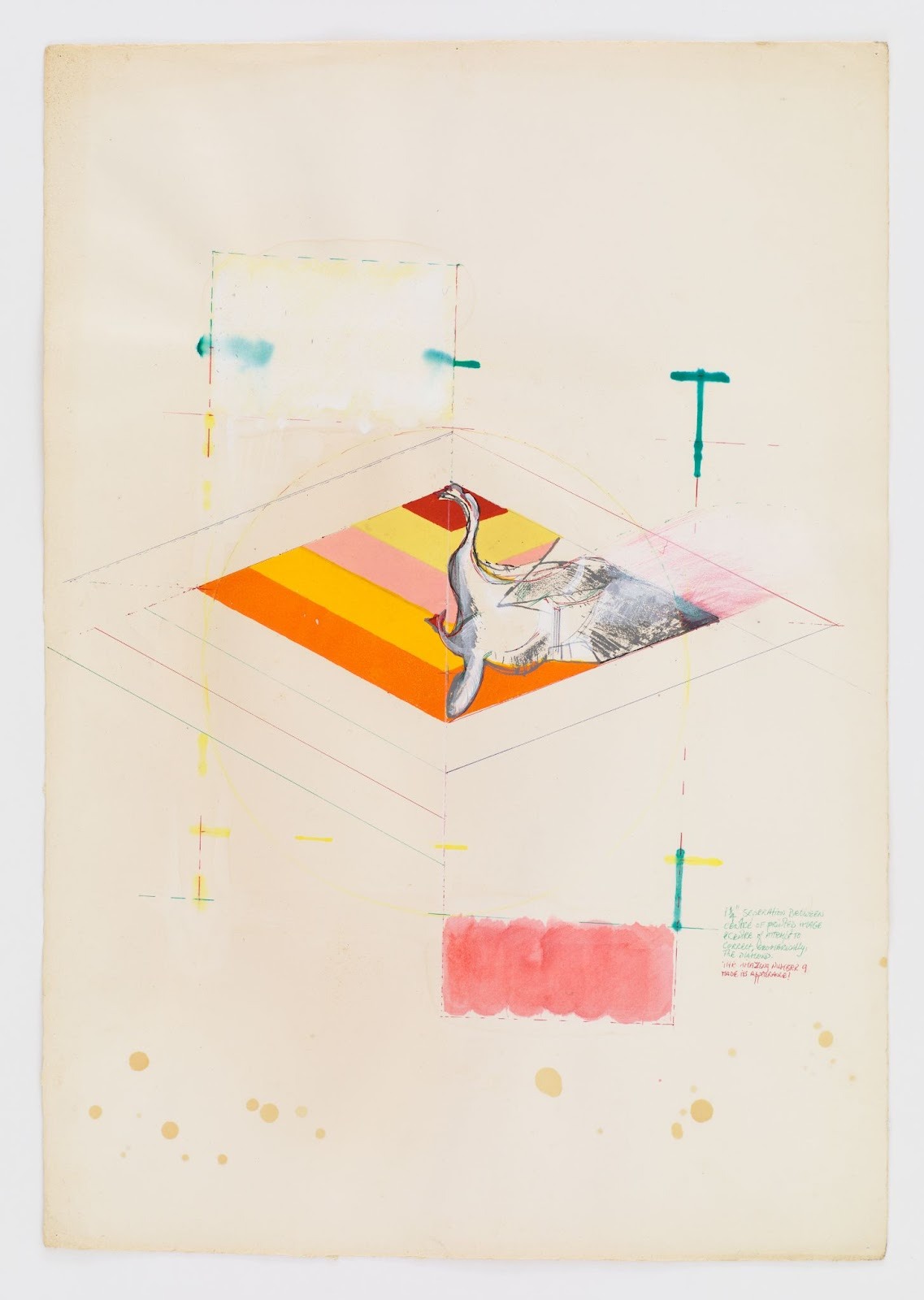
Sir Frank, thank you for taking the time. The show is called Seeking the Sublime; we'd love to hear about the title and how you approached the selection.
The title for the show emerged from discussions with the curators Martin Gayford and Habda Rashid at the Fitzwilliam, and they selected the works. I think their idea was to produce a kind of career survey in a dozen paintings, which would look good in the Octagon room at the Museum. They've gone for very early figurative works, some of the swan works, poured paintings from the 1970s, and then through the decades, including paintings right up to what I'm trying to do at the moment. The sublime is elusive, and it's hard to talk about. I'm even fumbling in my head to find the right words, but I know the experience of it! The thing about the sublime is that it won't sit still for you. You can talk around it, you can circle it, but it slips away the moment you try to pin it down. It's elusive. I think that in my work, it has to do with paint-colour-light, perhaps memory, a feeling that you've been there before without knowing when. I just keep on working at it, keep on moving liquid paint around on the carrier surface, and then the painting itself, as a thing, arrives unannounced. Suddenly it opens up, and you realise that it's doing something beyond you. You can't simply summon it up just because you want it. It comes of its own accord, so you keep working at it, you keep trying, and then every now and then, it appears.
Is there a moment in the making of a painting where the sublime reveals itself?
Sometimes the painting takes over, so no matter how hard you try, it doesn't matter how much you know. Your wrist is placed where it all takes place, and you hold a brush and take a spin at the paint, and it happens, but it doesn't happen all the time, which gets frustrating, and it makes you want to go on and on, and you may still not be getting it. A painting of mine, like Watermelon Bight, is a painting that's sublime. It's hard to describe the feeling, but perhaps I'd say that a painting like that happens without me really realising that I'm doing it, in the way that I use light in my paintings and that relationship to the sublime. Every time I go out to my studio, with the brush in my hand, I want to spin the paint and make magic out of it. If I sit and think about it, I guess magic does connect to the sublime. I want that in my work, and I sometimes see it, but not all the time; it gets there on its own. I can't do it like that all the time, I wish I did. It doesn't come very often, sometimes it's not the right brush! Sometimes it's just simply because I can't do it, I can't get there. I've never bothered to sit down and work out what I mean by magic, but I know it when I see it.
"I've never bothered to sit down and work out what I mean by magic, but I know it when I see it." Sir Frank Bowling
The Fitzwilliam has Titian, Millais, Constable on its walls, and the show invites visitors to move between their work and yours. What charges you about those painters?
Those painters, and Poussin and Rembrandt too, are the ones that I would choose. And of course, Turner. Those painters ‘paint like an angel' as they say, with colour, the colour is evoked, and I think therein lies the sublime for me in the work of all those artists to some extent. I was once interviewed by Martin Gayford about Titian's Death of Acteon, which I maintain is driven by experimenting with paint and how it moves across the surface of the canvas. I think abstraction begins at the edges of Old Masters paintings. I am trying to get that quality in painting. When I see the work of Poussin, the pulse, the heat, the stroke, it's sublime. He gets there. It's something that artists aim at.
"I think abstraction begins at the edges of Old Masters paintings." Sir Frank Bowling
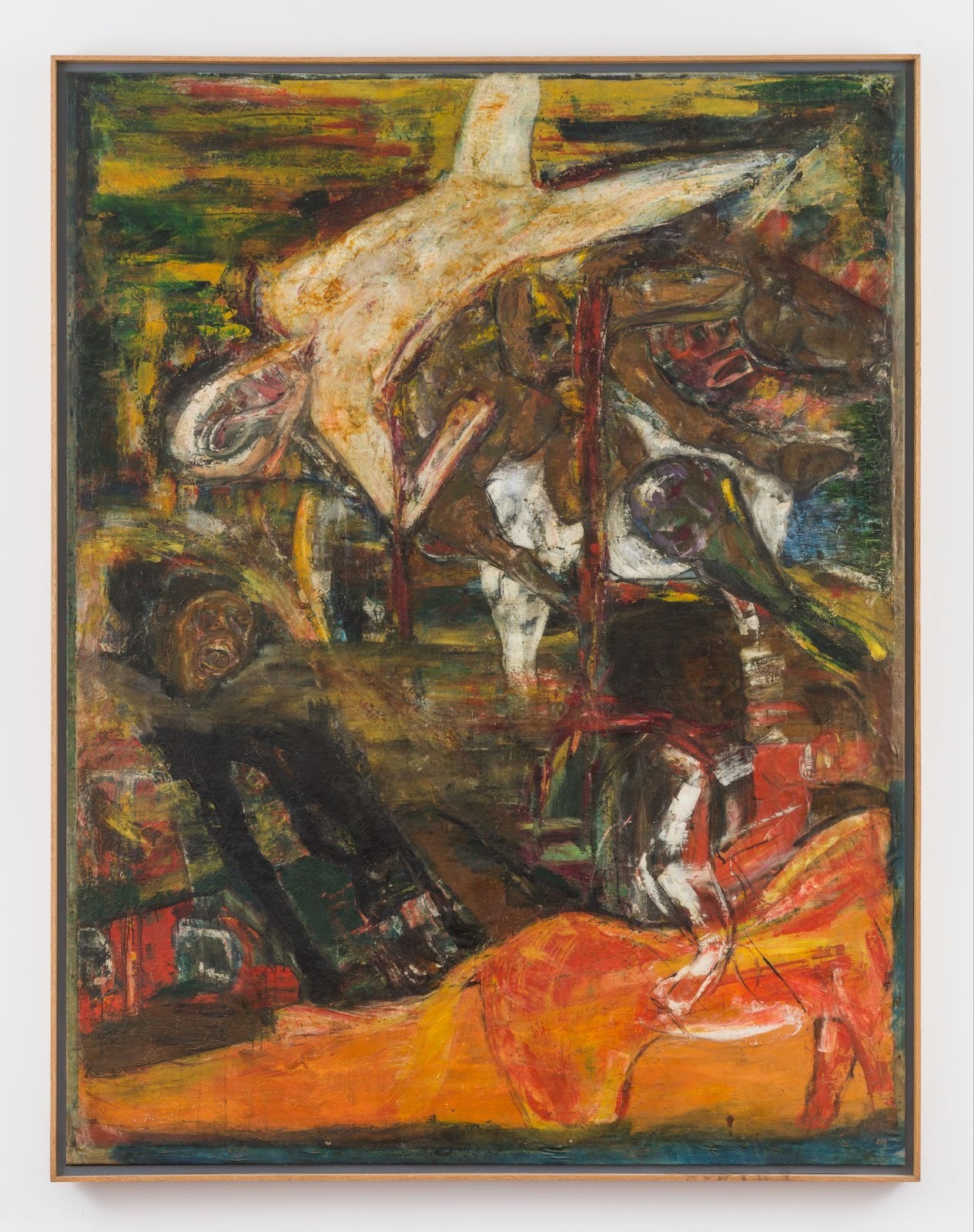
The show goes back to the 4 Horsemen of the Apocalypse, painted during your second year at the Royal College of Art in 1961. Has how you connect with that early work changed over time?
I don't see my earlier works much nowadays, except the ones that are on the walls at home, so they don't occur to me, they don't come into my conscious mind. Those paintings were figurative, and I sometimes miss them, but I don't think about them all the time. I'm very much looking forward to seeing the 4 Horsemen of the Apocalypse again. That painting came to me as a surprise, where the sword and the figure just came out of the blue. I didn't think I'd be able to do that when I was at art school, but it happened. Back then, there was a ghostliness of some of the things that I would see, but it's not something that's stayed.
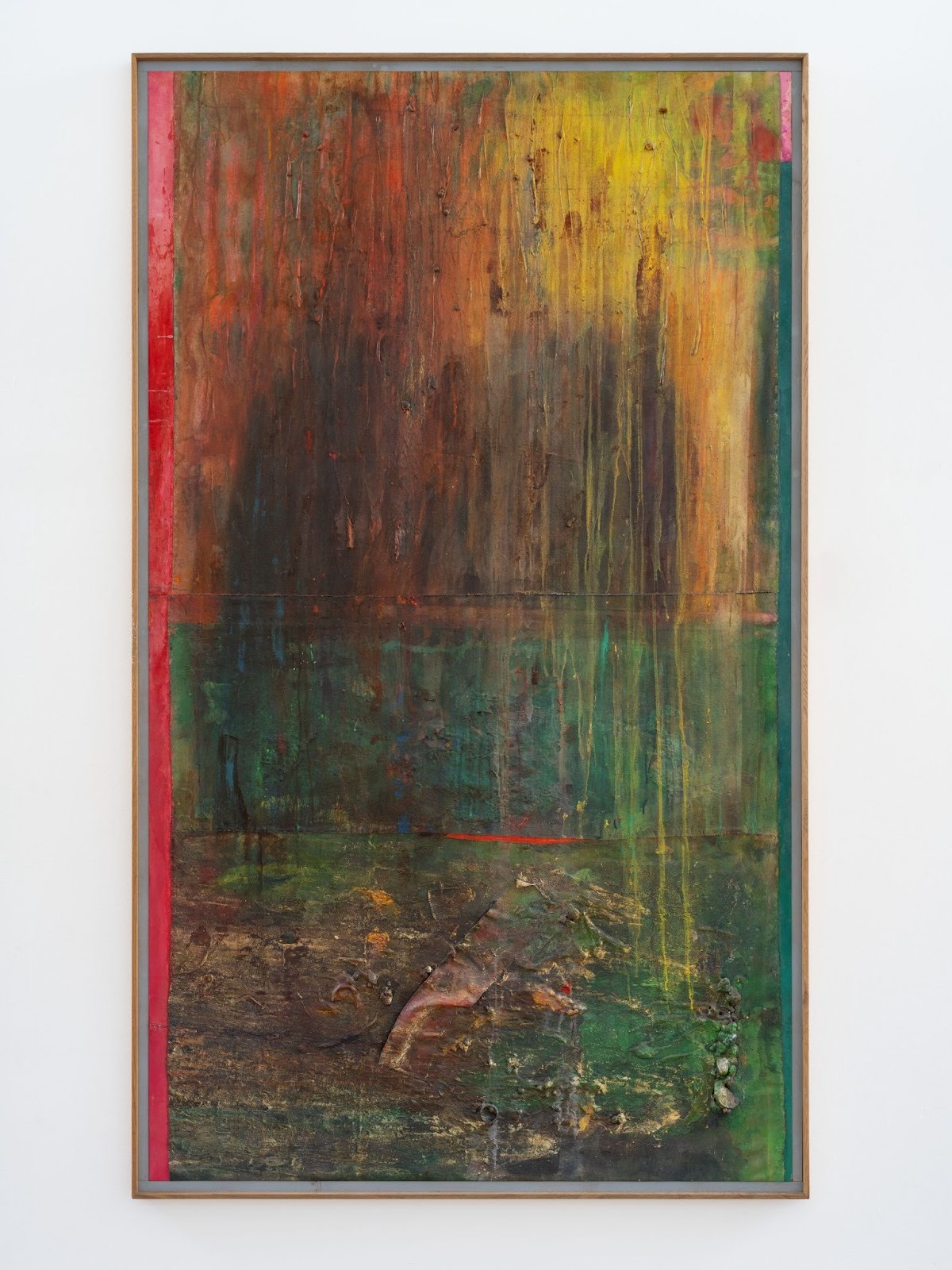
Pondlife (After Millais) directly responds to a painter in Fitzwilliam's own collection. What drew you to Millais?
I suppose because I'm reaching for something that I see in those artists. I feel this pulse that comes out of that. Pondlife (After Millais) is also to do with water, water and how it comes with earth. I feel water, water comes into my life and reality. This painting comes close to what I am trying to achieve, you know, there is something in the wateriness of it, that images appear in the work unbidden, unexpected.
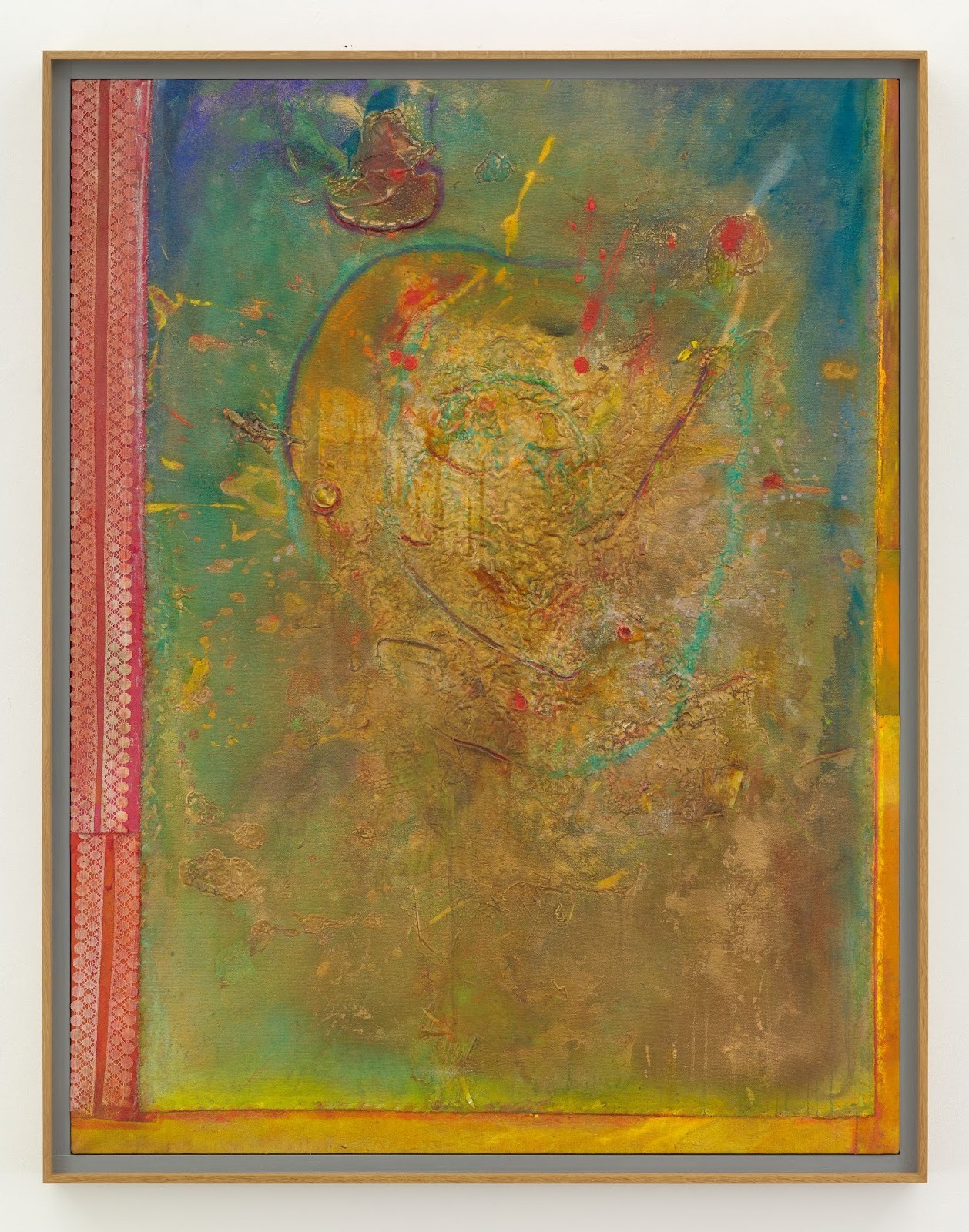
Tracey's Bouquet contains flowers Tracey Emin sent you in 2011, pressed into the canvas, which are still decomposing within the work. You've embedded car keys, plastic animals, household objects into your paintings over the years. What draws you to include these objects in the work?
With Tracey's Bouquet, it was the launch of Mel Gooding's book in 2011 at the Royal Academy, and Tracey was going to come, but there was a terrible thunderstorm, and wherever she was in London or Margate, it was just impossible for her to get there. The next day, I received this lovely bouquet of flowers from her, saying how sorry she was to miss it. I have a vivid memory of putting her flowers directly into the work after because I knew I couldn't paint them. Including objects in the work comes from experiencing the inadequacy of certain qualities in paint, for instance, when I went through a period when I tried to paint the nude, but I couldn't, so I'd rather put the person in there, in the painting, so to speak. I felt strongly that if the person was in there, if I could somehow have the individual who is inspiring me and this longing in the painting, then I'd still have that feeling in there. Of course, I also put silkscreen prints and sometimes stencils in my paintings, which was one of the ways of finding the solution to this, too. Putting objects in my paintings isn't exactly about linking them to my personal life. I try to live my life as I see it coming, and it can be very brutal, the shock of not being able to reap this life into the work, and time and time again, I'm facing this dilemma. The objects in the work tend either to be things that my family and friends bring me, bits of costume jewellery or beads and sequins, or offcuts of cloth from friends in Peacock Yard, or sometimes it's just the stuff that makes up the life of my studio, threads from the torn canvas, staples, scraps of newspaper, birthday candles, it's a bit like a diary of working in the studio.
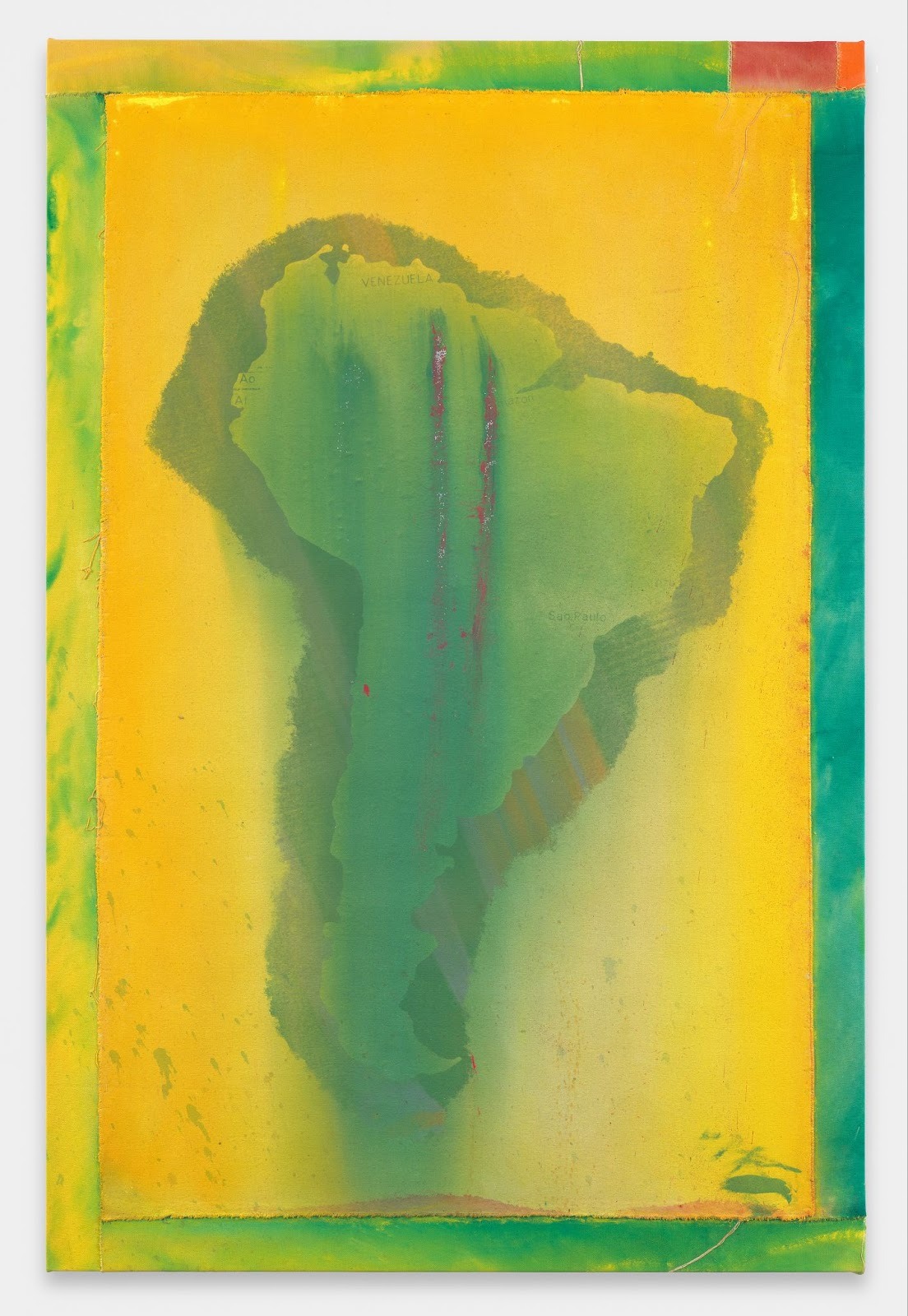
The show concludes with Yellow Map (2025), a significant new work shown publicly for the first time. Can you share any details about this work with us?
I decided to return to silkscreened maps last year because my work was going to Brazil to the São Paulo biennial, and when I looked again at the silkscreen of South America, I realised that São Paulo was the only city inscribed on the map. Growing up in Guyana, which borders Brazil, it's a city that I always wanted to visit, and I thought that I might have another look at the map figure and go at it in a new way. Ben Gooding, the artist, who teaches printmaking at Camberwell, remade the silkscreens. I was friendly with him, and he was pretty good at stretching my paintings over many years. He came to see me, and we talked about it, and I thought, let's give it a go. It's quite a nice turn of events because the original screens were made in the textile department at Camberwell back in the 1960s. They were kept in my archive, but I was told I shouldn't really use those because they were 60 years old! I don't know if I'll make more map paintings. I don't want to fall back on what I've been able to do in the past. My desire is always to make it new. I keep trying to get better all the time. Every now and then, I hate it, and I'm very cynical about it, I try and push back the old joy that comes with achieving what you want. I'd get fed up if I did the same set-up all the time. I'm always looking for newness, making something that has never been seen before. That's what drives me. The yellow map surprised me, because I was aiming for something, like something people were talking about in my work, and I think I got it. I guess that's for other people to judge.
"I'm always looking for newness, making something that has never been seen before. That's what drives me." Sir Frank Bowling
Your wonderful family, your sons, stepdaughters, grandchildren, a great-grandchild, all play a part in the studio. Your son Ben has described you directing them like an orchestra conductor. What does it mean to have them alongside you?
Haha! Ben is watching me closely, and I believe him with what he says there because he's a musician, his mother was a painter, and he must've picked up something because they were very close. When I'm leaving the studio, I'm surprised and gratified by having people around, but I always work on my own, really. My good friend, the art historian Mel Gooding, said that paintings are the product of the artist's mind, and in that sense, painting for me is a singular and solitary activity. I don't think that I confide in anybody in my family about my paintings, it's something I do on my own, or I don't share it with anybody except sometimes other painters who are also trying to get there, sometimes it's younger artists, confiding in one another what they're aiming for. And you know, for an awful lot of younger artists who have a feel about palette knives and brushes, special brushes, so a hint of a conversation like that, and you've suddenly lost yourself in the chat.
Frank Bowling: Seeking the Sublime Fitzwilliam Museum, Trumpington Street, Cambridge CB2 1RB 27 March 2026 to 17 January 2027 Tuesday to Saturday 10am to 5pm, Sunday and Bank Holidays 12 to 5pm Free entry
Don't forget to check in and leave your review in the gowithYamo app!


"The thing about the sublime is that it won't sit still for you." - Sir Frank Bowling
For over six decades, Sir Frank Bowling has given his life to a practice that boldly expands the possibilities and properties of paint. Born in British Guiana (now Guyana) in 1934, he arrived in London at nineteen. What followed was a career between London and New York that has resulted in paintings of unparalleled originality and power. He works every day in his South London studio, driven by his fascination with exploring the vast and radiant possibilities of paint. "I want to spin the paint and make magic out of it”, he told Lou.
Seeking the Sublime opens at the Fitzwilliam Museum, Cambridge on 27 March and brings together a lifetime of work, from the figurative 4 Horsemen of the Apocalypse (1961) to Yellow Map (2025), shown publicly for the first time. Visitors are invited to move between Bowling's paintings and Fitzwilliam's own Titian, Constable, Turner and Millais, tracing a shared pursuit of something beyond what paint alone should be able to do.
With special thanks to Ben, Iona, Evie, and the wonderful team at the Frank Bowling Studio for making this possible.
Sir Frank, thank you for taking the time. The show is called Seeking the Sublime; we'd love to hear about the title and how you approached the selection.
The title for the show emerged from discussions with the curators Martin Gayford and Habda Rashid at the Fitzwilliam, and they selected the works. I think their idea was to produce a kind of career survey in a dozen paintings, which would look good in the Octagon room at the Museum. They've gone for very early figurative works, some of the swan works, poured paintings from the 1970s, and then through the decades, including paintings right up to what I'm trying to do at the moment. The sublime is elusive, and it's hard to talk about. I'm even fumbling in my head to find the right words, but I know the experience of it! The thing about the sublime is that it won't sit still for you. You can talk around it, you can circle it, but it slips away the moment you try to pin it down. It's elusive. I think that in my work, it has to do with paint-colour-light, perhaps memory, a feeling that you've been there before without knowing when. I just keep on working at it, keep on moving liquid paint around on the carrier surface, and then the painting itself, as a thing, arrives unannounced. Suddenly it opens up, and you realise that it's doing something beyond you. You can't simply summon it up just because you want it. It comes of its own accord, so you keep working at it, you keep trying, and then every now and then, it appears.
Is there a moment in the making of a painting where the sublime reveals itself?
Sometimes the painting takes over, so no matter how hard you try, it doesn't matter how much you know. Your wrist is placed where it all takes place, and you hold a brush and take a spin at the paint, and it happens, but it doesn't happen all the time, which gets frustrating, and it makes you want to go on and on, and you may still not be getting it. A painting of mine, like Watermelon Bight, is a painting that's sublime. It's hard to describe the feeling, but perhaps I'd say that a painting like that happens without me really realising that I'm doing it, in the way that I use light in my paintings and that relationship to the sublime. Every time I go out to my studio, with the brush in my hand, I want to spin the paint and make magic out of it. If I sit and think about it, I guess magic does connect to the sublime. I want that in my work, and I sometimes see it, but not all the time; it gets there on its own. I can't do it like that all the time, I wish I did. It doesn't come very often, sometimes it's not the right brush! Sometimes it's just simply because I can't do it, I can't get there. I've never bothered to sit down and work out what I mean by magic, but I know it when I see it.
"I've never bothered to sit down and work out what I mean by magic, but I know it when I see it." Sir Frank Bowling
The Fitzwilliam has Titian, Millais, Constable on its walls, and the show invites visitors to move between their work and yours. What charges you about those painters?
Those painters, and Poussin and Rembrandt too, are the ones that I would choose. And of course, Turner. Those painters ‘paint like an angel' as they say, with colour, the colour is evoked, and I think therein lies the sublime for me in the work of all those artists to some extent. I was once interviewed by Martin Gayford about Titian's Death of Acteon, which I maintain is driven by experimenting with paint and how it moves across the surface of the canvas. I think abstraction begins at the edges of Old Masters paintings. I am trying to get that quality in painting. When I see the work of Poussin, the pulse, the heat, the stroke, it's sublime. He gets there. It's something that artists aim at.
"I think abstraction begins at the edges of Old Masters paintings." Sir Frank Bowling
The show goes back to the 4 Horsemen of the Apocalypse, painted during your second year at the Royal College of Art in 1961. Has how you connect with that early work changed over time?
I don't see my earlier works much nowadays, except the ones that are on the walls at home, so they don't occur to me, they don't come into my conscious mind. Those paintings were figurative, and I sometimes miss them, but I don't think about them all the time. I'm very much looking forward to seeing the 4 Horsemen of the Apocalypse again. That painting came to me as a surprise, where the sword and the figure just came out of the blue. I didn't think I'd be able to do that when I was at art school, but it happened. Back then, there was a ghostliness of some of the things that I would see, but it's not something that's stayed.
Pondlife (After Millais) directly responds to a painter in Fitzwilliam's own collection. What drew you to Millais?
I suppose because I'm reaching for something that I see in those artists. I feel this pulse that comes out of that. Pondlife (After Millais) is also to do with water, water and how it comes with earth. I feel water, water comes into my life and reality. This painting comes close to what I am trying to achieve, you know, there is something in the wateriness of it, that images appear in the work unbidden, unexpected.
Tracey's Bouquet contains flowers Tracey Emin sent you in 2011, pressed into the canvas, which are still decomposing within the work. You've embedded car keys, plastic animals, household objects into your paintings over the years. What draws you to include these objects in the work?
With Tracey's Bouquet, it was the launch of Mel Gooding's book in 2011 at the Royal Academy, and Tracey was going to come, but there was a terrible thunderstorm, and wherever she was in London or Margate, it was just impossible for her to get there. The next day, I received this lovely bouquet of flowers from her, saying how sorry she was to miss it. I have a vivid memory of putting her flowers directly into the work after because I knew I couldn't paint them. Including objects in the work comes from experiencing the inadequacy of certain qualities in paint, for instance, when I went through a period when I tried to paint the nude, but I couldn't, so I'd rather put the person in there, in the painting, so to speak. I felt strongly that if the person was in there, if I could somehow have the individual who is inspiring me and this longing in the painting, then I'd still have that feeling in there. Of course, I also put silkscreen prints and sometimes stencils in my paintings, which was one of the ways of finding the solution to this, too. Putting objects in my paintings isn't exactly about linking them to my personal life. I try to live my life as I see it coming, and it can be very brutal, the shock of not being able to reap this life into the work, and time and time again, I'm facing this dilemma. The objects in the work tend either to be things that my family and friends bring me, bits of costume jewellery or beads and sequins, or offcuts of cloth from friends in Peacock Yard, or sometimes it's just the stuff that makes up the life of my studio, threads from the torn canvas, staples, scraps of newspaper, birthday candles, it's a bit like a diary of working in the studio.
The show concludes with Yellow Map (2025), a significant new work shown publicly for the first time. Can you share any details about this work with us?
I decided to return to silkscreened maps last year because my work was going to Brazil to the São Paulo biennial, and when I looked again at the silkscreen of South America, I realised that São Paulo was the only city inscribed on the map. Growing up in Guyana, which borders Brazil, it's a city that I always wanted to visit, and I thought that I might have another look at the map figure and go at it in a new way. Ben Gooding, the artist, who teaches printmaking at Camberwell, remade the silkscreens. I was friendly with him, and he was pretty good at stretching my paintings over many years. He came to see me, and we talked about it, and I thought, let's give it a go. It's quite a nice turn of events because the original screens were made in the textile department at Camberwell back in the 1960s. They were kept in my archive, but I was told I shouldn't really use those because they were 60 years old! I don't know if I'll make more map paintings. I don't want to fall back on what I've been able to do in the past. My desire is always to make it new. I keep trying to get better all the time. Every now and then, I hate it, and I'm very cynical about it, I try and push back the old joy that comes with achieving what you want. I'd get fed up if I did the same set-up all the time. I'm always looking for newness, making something that has never been seen before. That's what drives me. The yellow map surprised me, because I was aiming for something, like something people were talking about in my work, and I think I got it. I guess that's for other people to judge.
"I'm always looking for newness, making something that has never been seen before. That's what drives me." Sir Frank Bowling
Your wonderful family, your sons, stepdaughters, grandchildren, a great-grandchild, all play a part in the studio. Your son Ben has described you directing them like an orchestra conductor. What does it mean to have them alongside you?
Haha! Ben is watching me closely, and I believe him with what he says there because he's a musician, his mother was a painter, and he must've picked up something because they were very close. When I'm leaving the studio, I'm surprised and gratified by having people around, but I always work on my own, really. My good friend, the art historian Mel Gooding, said that paintings are the product of the artist's mind, and in that sense, painting for me is a singular and solitary activity. I don't think that I confide in anybody in my family about my paintings, it's something I do on my own, or I don't share it with anybody except sometimes other painters who are also trying to get there, sometimes it's younger artists, confiding in one another what they're aiming for. And you know, for an awful lot of younger artists who have a feel about palette knives and brushes, special brushes, so a hint of a conversation like that, and you've suddenly lost yourself in the chat.
Frank Bowling: Seeking the Sublime Fitzwilliam Museum, Trumpington Street, Cambridge CB2 1RB 27 March 2026 to 17 January 2027 Tuesday to Saturday 10am to 5pm, Sunday and Bank Holidays 12 to 5pm Free entry
Don't forget to check in and leave your review in the gowithYamo app!
"The thing about the sublime is that it won't sit still for you." - Sir Frank Bowling
For over six decades, Sir Frank Bowling has given his life to a practice that boldly expands the possibilities and properties of paint. Born in British Guiana (now Guyana) in 1934, he arrived in London at nineteen. What followed was a career between London and New York that has resulted in paintings of unparalleled originality and power. He works every day in his South London studio, driven by his fascination with exploring the vast and radiant possibilities of paint. "I want to spin the paint and make magic out of it”, he told Lou.
Seeking the Sublime opens at the Fitzwilliam Museum, Cambridge on 27 March and brings together a lifetime of work, from the figurative 4 Horsemen of the Apocalypse (1961) to Yellow Map (2025), shown publicly for the first time. Visitors are invited to move between Bowling's paintings and Fitzwilliam's own Titian, Constable, Turner and Millais, tracing a shared pursuit of something beyond what paint alone should be able to do.
With special thanks to Ben, Iona, Evie, and the wonderful team at the Frank Bowling Studio for making this possible.
Sir Frank, thank you for taking the time. The show is called Seeking the Sublime; we'd love to hear about the title and how you approached the selection.
The title for the show emerged from discussions with the curators Martin Gayford and Habda Rashid at the Fitzwilliam, and they selected the works. I think their idea was to produce a kind of career survey in a dozen paintings, which would look good in the Octagon room at the Museum. They've gone for very early figurative works, some of the swan works, poured paintings from the 1970s, and then through the decades, including paintings right up to what I'm trying to do at the moment. The sublime is elusive, and it's hard to talk about. I'm even fumbling in my head to find the right words, but I know the experience of it! The thing about the sublime is that it won't sit still for you. You can talk around it, you can circle it, but it slips away the moment you try to pin it down. It's elusive. I think that in my work, it has to do with paint-colour-light, perhaps memory, a feeling that you've been there before without knowing when. I just keep on working at it, keep on moving liquid paint around on the carrier surface, and then the painting itself, as a thing, arrives unannounced. Suddenly it opens up, and you realise that it's doing something beyond you. You can't simply summon it up just because you want it. It comes of its own accord, so you keep working at it, you keep trying, and then every now and then, it appears.
Is there a moment in the making of a painting where the sublime reveals itself?
Sometimes the painting takes over, so no matter how hard you try, it doesn't matter how much you know. Your wrist is placed where it all takes place, and you hold a brush and take a spin at the paint, and it happens, but it doesn't happen all the time, which gets frustrating, and it makes you want to go on and on, and you may still not be getting it. A painting of mine, like Watermelon Bight, is a painting that's sublime. It's hard to describe the feeling, but perhaps I'd say that a painting like that happens without me really realising that I'm doing it, in the way that I use light in my paintings and that relationship to the sublime. Every time I go out to my studio, with the brush in my hand, I want to spin the paint and make magic out of it. If I sit and think about it, I guess magic does connect to the sublime. I want that in my work, and I sometimes see it, but not all the time; it gets there on its own. I can't do it like that all the time, I wish I did. It doesn't come very often, sometimes it's not the right brush! Sometimes it's just simply because I can't do it, I can't get there. I've never bothered to sit down and work out what I mean by magic, but I know it when I see it.
"I've never bothered to sit down and work out what I mean by magic, but I know it when I see it." Sir Frank Bowling
The Fitzwilliam has Titian, Millais, Constable on its walls, and the show invites visitors to move between their work and yours. What charges you about those painters?
Those painters, and Poussin and Rembrandt too, are the ones that I would choose. And of course, Turner. Those painters ‘paint like an angel' as they say, with colour, the colour is evoked, and I think therein lies the sublime for me in the work of all those artists to some extent. I was once interviewed by Martin Gayford about Titian's Death of Acteon, which I maintain is driven by experimenting with paint and how it moves across the surface of the canvas. I think abstraction begins at the edges of Old Masters paintings. I am trying to get that quality in painting. When I see the work of Poussin, the pulse, the heat, the stroke, it's sublime. He gets there. It's something that artists aim at.
"I think abstraction begins at the edges of Old Masters paintings." Sir Frank Bowling
The show goes back to the 4 Horsemen of the Apocalypse, painted during your second year at the Royal College of Art in 1961. Has how you connect with that early work changed over time?
I don't see my earlier works much nowadays, except the ones that are on the walls at home, so they don't occur to me, they don't come into my conscious mind. Those paintings were figurative, and I sometimes miss them, but I don't think about them all the time. I'm very much looking forward to seeing the 4 Horsemen of the Apocalypse again. That painting came to me as a surprise, where the sword and the figure just came out of the blue. I didn't think I'd be able to do that when I was at art school, but it happened. Back then, there was a ghostliness of some of the things that I would see, but it's not something that's stayed.
Pondlife (After Millais) directly responds to a painter in Fitzwilliam's own collection. What drew you to Millais?
I suppose because I'm reaching for something that I see in those artists. I feel this pulse that comes out of that. Pondlife (After Millais) is also to do with water, water and how it comes with earth. I feel water, water comes into my life and reality. This painting comes close to what I am trying to achieve, you know, there is something in the wateriness of it, that images appear in the work unbidden, unexpected.
Tracey's Bouquet contains flowers Tracey Emin sent you in 2011, pressed into the canvas, which are still decomposing within the work. You've embedded car keys, plastic animals, household objects into your paintings over the years. What draws you to include these objects in the work?
With Tracey's Bouquet, it was the launch of Mel Gooding's book in 2011 at the Royal Academy, and Tracey was going to come, but there was a terrible thunderstorm, and wherever she was in London or Margate, it was just impossible for her to get there. The next day, I received this lovely bouquet of flowers from her, saying how sorry she was to miss it. I have a vivid memory of putting her flowers directly into the work after because I knew I couldn't paint them. Including objects in the work comes from experiencing the inadequacy of certain qualities in paint, for instance, when I went through a period when I tried to paint the nude, but I couldn't, so I'd rather put the person in there, in the painting, so to speak. I felt strongly that if the person was in there, if I could somehow have the individual who is inspiring me and this longing in the painting, then I'd still have that feeling in there. Of course, I also put silkscreen prints and sometimes stencils in my paintings, which was one of the ways of finding the solution to this, too. Putting objects in my paintings isn't exactly about linking them to my personal life. I try to live my life as I see it coming, and it can be very brutal, the shock of not being able to reap this life into the work, and time and time again, I'm facing this dilemma. The objects in the work tend either to be things that my family and friends bring me, bits of costume jewellery or beads and sequins, or offcuts of cloth from friends in Peacock Yard, or sometimes it's just the stuff that makes up the life of my studio, threads from the torn canvas, staples, scraps of newspaper, birthday candles, it's a bit like a diary of working in the studio.
The show concludes with Yellow Map (2025), a significant new work shown publicly for the first time. Can you share any details about this work with us?
I decided to return to silkscreened maps last year because my work was going to Brazil to the São Paulo biennial, and when I looked again at the silkscreen of South America, I realised that São Paulo was the only city inscribed on the map. Growing up in Guyana, which borders Brazil, it's a city that I always wanted to visit, and I thought that I might have another look at the map figure and go at it in a new way. Ben Gooding, the artist, who teaches printmaking at Camberwell, remade the silkscreens. I was friendly with him, and he was pretty good at stretching my paintings over many years. He came to see me, and we talked about it, and I thought, let's give it a go. It's quite a nice turn of events because the original screens were made in the textile department at Camberwell back in the 1960s. They were kept in my archive, but I was told I shouldn't really use those because they were 60 years old! I don't know if I'll make more map paintings. I don't want to fall back on what I've been able to do in the past. My desire is always to make it new. I keep trying to get better all the time. Every now and then, I hate it, and I'm very cynical about it, I try and push back the old joy that comes with achieving what you want. I'd get fed up if I did the same set-up all the time. I'm always looking for newness, making something that has never been seen before. That's what drives me. The yellow map surprised me, because I was aiming for something, like something people were talking about in my work, and I think I got it. I guess that's for other people to judge.
"I'm always looking for newness, making something that has never been seen before. That's what drives me." Sir Frank Bowling
Your wonderful family, your sons, stepdaughters, grandchildren, a great-grandchild, all play a part in the studio. Your son Ben has described you directing them like an orchestra conductor. What does it mean to have them alongside you?
Haha! Ben is watching me closely, and I believe him with what he says there because he's a musician, his mother was a painter, and he must've picked up something because they were very close. When I'm leaving the studio, I'm surprised and gratified by having people around, but I always work on my own, really. My good friend, the art historian Mel Gooding, said that paintings are the product of the artist's mind, and in that sense, painting for me is a singular and solitary activity. I don't think that I confide in anybody in my family about my paintings, it's something I do on my own, or I don't share it with anybody except sometimes other painters who are also trying to get there, sometimes it's younger artists, confiding in one another what they're aiming for. And you know, for an awful lot of younger artists who have a feel about palette knives and brushes, special brushes, so a hint of a conversation like that, and you've suddenly lost yourself in the chat.
Frank Bowling: Seeking the Sublime Fitzwilliam Museum, Trumpington Street, Cambridge CB2 1RB 27 March 2026 to 17 January 2027 Tuesday to Saturday 10am to 5pm, Sunday and Bank Holidays 12 to 5pm Free entry
Don't forget to check in and leave your review in the gowithYamo app!
"The thing about the sublime is that it won't sit still for you." - Sir Frank Bowling
For over six decades, Sir Frank Bowling has given his life to a practice that boldly expands the possibilities and properties of paint. Born in British Guiana (now Guyana) in 1934, he arrived in London at nineteen. What followed was a career between London and New York that has resulted in paintings of unparalleled originality and power. He works every day in his South London studio, driven by his fascination with exploring the vast and radiant possibilities of paint. "I want to spin the paint and make magic out of it”, he told Lou.
Seeking the Sublime opens at the Fitzwilliam Museum, Cambridge on 27 March and brings together a lifetime of work, from the figurative 4 Horsemen of the Apocalypse (1961) to Yellow Map (2025), shown publicly for the first time. Visitors are invited to move between Bowling's paintings and Fitzwilliam's own Titian, Constable, Turner and Millais, tracing a shared pursuit of something beyond what paint alone should be able to do.
With special thanks to Ben, Iona, Evie, and the wonderful team at the Frank Bowling Studio for making this possible.
Sir Frank, thank you for taking the time. The show is called Seeking the Sublime; we'd love to hear about the title and how you approached the selection.
The title for the show emerged from discussions with the curators Martin Gayford and Habda Rashid at the Fitzwilliam, and they selected the works. I think their idea was to produce a kind of career survey in a dozen paintings, which would look good in the Octagon room at the Museum. They've gone for very early figurative works, some of the swan works, poured paintings from the 1970s, and then through the decades, including paintings right up to what I'm trying to do at the moment. The sublime is elusive, and it's hard to talk about. I'm even fumbling in my head to find the right words, but I know the experience of it! The thing about the sublime is that it won't sit still for you. You can talk around it, you can circle it, but it slips away the moment you try to pin it down. It's elusive. I think that in my work, it has to do with paint-colour-light, perhaps memory, a feeling that you've been there before without knowing when. I just keep on working at it, keep on moving liquid paint around on the carrier surface, and then the painting itself, as a thing, arrives unannounced. Suddenly it opens up, and you realise that it's doing something beyond you. You can't simply summon it up just because you want it. It comes of its own accord, so you keep working at it, you keep trying, and then every now and then, it appears.
Is there a moment in the making of a painting where the sublime reveals itself?
Sometimes the painting takes over, so no matter how hard you try, it doesn't matter how much you know. Your wrist is placed where it all takes place, and you hold a brush and take a spin at the paint, and it happens, but it doesn't happen all the time, which gets frustrating, and it makes you want to go on and on, and you may still not be getting it. A painting of mine, like Watermelon Bight, is a painting that's sublime. It's hard to describe the feeling, but perhaps I'd say that a painting like that happens without me really realising that I'm doing it, in the way that I use light in my paintings and that relationship to the sublime. Every time I go out to my studio, with the brush in my hand, I want to spin the paint and make magic out of it. If I sit and think about it, I guess magic does connect to the sublime. I want that in my work, and I sometimes see it, but not all the time; it gets there on its own. I can't do it like that all the time, I wish I did. It doesn't come very often, sometimes it's not the right brush! Sometimes it's just simply because I can't do it, I can't get there. I've never bothered to sit down and work out what I mean by magic, but I know it when I see it.
"I've never bothered to sit down and work out what I mean by magic, but I know it when I see it." Sir Frank Bowling
The Fitzwilliam has Titian, Millais, Constable on its walls, and the show invites visitors to move between their work and yours. What charges you about those painters?
Those painters, and Poussin and Rembrandt too, are the ones that I would choose. And of course, Turner. Those painters ‘paint like an angel' as they say, with colour, the colour is evoked, and I think therein lies the sublime for me in the work of all those artists to some extent. I was once interviewed by Martin Gayford about Titian's Death of Acteon, which I maintain is driven by experimenting with paint and how it moves across the surface of the canvas. I think abstraction begins at the edges of Old Masters paintings. I am trying to get that quality in painting. When I see the work of Poussin, the pulse, the heat, the stroke, it's sublime. He gets there. It's something that artists aim at.
"I think abstraction begins at the edges of Old Masters paintings." Sir Frank Bowling
The show goes back to the 4 Horsemen of the Apocalypse, painted during your second year at the Royal College of Art in 1961. Has how you connect with that early work changed over time?
I don't see my earlier works much nowadays, except the ones that are on the walls at home, so they don't occur to me, they don't come into my conscious mind. Those paintings were figurative, and I sometimes miss them, but I don't think about them all the time. I'm very much looking forward to seeing the 4 Horsemen of the Apocalypse again. That painting came to me as a surprise, where the sword and the figure just came out of the blue. I didn't think I'd be able to do that when I was at art school, but it happened. Back then, there was a ghostliness of some of the things that I would see, but it's not something that's stayed.
Pondlife (After Millais) directly responds to a painter in Fitzwilliam's own collection. What drew you to Millais?
I suppose because I'm reaching for something that I see in those artists. I feel this pulse that comes out of that. Pondlife (After Millais) is also to do with water, water and how it comes with earth. I feel water, water comes into my life and reality. This painting comes close to what I am trying to achieve, you know, there is something in the wateriness of it, that images appear in the work unbidden, unexpected.
Tracey's Bouquet contains flowers Tracey Emin sent you in 2011, pressed into the canvas, which are still decomposing within the work. You've embedded car keys, plastic animals, household objects into your paintings over the years. What draws you to include these objects in the work?
With Tracey's Bouquet, it was the launch of Mel Gooding's book in 2011 at the Royal Academy, and Tracey was going to come, but there was a terrible thunderstorm, and wherever she was in London or Margate, it was just impossible for her to get there. The next day, I received this lovely bouquet of flowers from her, saying how sorry she was to miss it. I have a vivid memory of putting her flowers directly into the work after because I knew I couldn't paint them. Including objects in the work comes from experiencing the inadequacy of certain qualities in paint, for instance, when I went through a period when I tried to paint the nude, but I couldn't, so I'd rather put the person in there, in the painting, so to speak. I felt strongly that if the person was in there, if I could somehow have the individual who is inspiring me and this longing in the painting, then I'd still have that feeling in there. Of course, I also put silkscreen prints and sometimes stencils in my paintings, which was one of the ways of finding the solution to this, too. Putting objects in my paintings isn't exactly about linking them to my personal life. I try to live my life as I see it coming, and it can be very brutal, the shock of not being able to reap this life into the work, and time and time again, I'm facing this dilemma. The objects in the work tend either to be things that my family and friends bring me, bits of costume jewellery or beads and sequins, or offcuts of cloth from friends in Peacock Yard, or sometimes it's just the stuff that makes up the life of my studio, threads from the torn canvas, staples, scraps of newspaper, birthday candles, it's a bit like a diary of working in the studio.
The show concludes with Yellow Map (2025), a significant new work shown publicly for the first time. Can you share any details about this work with us?
I decided to return to silkscreened maps last year because my work was going to Brazil to the São Paulo biennial, and when I looked again at the silkscreen of South America, I realised that São Paulo was the only city inscribed on the map. Growing up in Guyana, which borders Brazil, it's a city that I always wanted to visit, and I thought that I might have another look at the map figure and go at it in a new way. Ben Gooding, the artist, who teaches printmaking at Camberwell, remade the silkscreens. I was friendly with him, and he was pretty good at stretching my paintings over many years. He came to see me, and we talked about it, and I thought, let's give it a go. It's quite a nice turn of events because the original screens were made in the textile department at Camberwell back in the 1960s. They were kept in my archive, but I was told I shouldn't really use those because they were 60 years old! I don't know if I'll make more map paintings. I don't want to fall back on what I've been able to do in the past. My desire is always to make it new. I keep trying to get better all the time. Every now and then, I hate it, and I'm very cynical about it, I try and push back the old joy that comes with achieving what you want. I'd get fed up if I did the same set-up all the time. I'm always looking for newness, making something that has never been seen before. That's what drives me. The yellow map surprised me, because I was aiming for something, like something people were talking about in my work, and I think I got it. I guess that's for other people to judge.
"I'm always looking for newness, making something that has never been seen before. That's what drives me." Sir Frank Bowling
Your wonderful family, your sons, stepdaughters, grandchildren, a great-grandchild, all play a part in the studio. Your son Ben has described you directing them like an orchestra conductor. What does it mean to have them alongside you?
Haha! Ben is watching me closely, and I believe him with what he says there because he's a musician, his mother was a painter, and he must've picked up something because they were very close. When I'm leaving the studio, I'm surprised and gratified by having people around, but I always work on my own, really. My good friend, the art historian Mel Gooding, said that paintings are the product of the artist's mind, and in that sense, painting for me is a singular and solitary activity. I don't think that I confide in anybody in my family about my paintings, it's something I do on my own, or I don't share it with anybody except sometimes other painters who are also trying to get there, sometimes it's younger artists, confiding in one another what they're aiming for. And you know, for an awful lot of younger artists who have a feel about palette knives and brushes, special brushes, so a hint of a conversation like that, and you've suddenly lost yourself in the chat.
Frank Bowling: Seeking the Sublime Fitzwilliam Museum, Trumpington Street, Cambridge CB2 1RB 27 March 2026 to 17 January 2027 Tuesday to Saturday 10am to 5pm, Sunday and Bank Holidays 12 to 5pm Free entry
Don't forget to check in and leave your review in the gowithYamo app!
"The thing about the sublime is that it won't sit still for you." - Sir Frank Bowling
For over six decades, Sir Frank Bowling has given his life to a practice that boldly expands the possibilities and properties of paint. Born in British Guiana (now Guyana) in 1934, he arrived in London at nineteen. What followed was a career between London and New York that has resulted in paintings of unparalleled originality and power. He works every day in his South London studio, driven by his fascination with exploring the vast and radiant possibilities of paint. "I want to spin the paint and make magic out of it”, he told Lou.
Seeking the Sublime opens at the Fitzwilliam Museum, Cambridge on 27 March and brings together a lifetime of work, from the figurative 4 Horsemen of the Apocalypse (1961) to Yellow Map (2025), shown publicly for the first time. Visitors are invited to move between Bowling's paintings and Fitzwilliam's own Titian, Constable, Turner and Millais, tracing a shared pursuit of something beyond what paint alone should be able to do.
With special thanks to Ben, Iona, Evie, and the wonderful team at the Frank Bowling Studio for making this possible.
Sir Frank, thank you for taking the time. The show is called Seeking the Sublime; we'd love to hear about the title and how you approached the selection.
The title for the show emerged from discussions with the curators Martin Gayford and Habda Rashid at the Fitzwilliam, and they selected the works. I think their idea was to produce a kind of career survey in a dozen paintings, which would look good in the Octagon room at the Museum. They've gone for very early figurative works, some of the swan works, poured paintings from the 1970s, and then through the decades, including paintings right up to what I'm trying to do at the moment. The sublime is elusive, and it's hard to talk about. I'm even fumbling in my head to find the right words, but I know the experience of it! The thing about the sublime is that it won't sit still for you. You can talk around it, you can circle it, but it slips away the moment you try to pin it down. It's elusive. I think that in my work, it has to do with paint-colour-light, perhaps memory, a feeling that you've been there before without knowing when. I just keep on working at it, keep on moving liquid paint around on the carrier surface, and then the painting itself, as a thing, arrives unannounced. Suddenly it opens up, and you realise that it's doing something beyond you. You can't simply summon it up just because you want it. It comes of its own accord, so you keep working at it, you keep trying, and then every now and then, it appears.
Is there a moment in the making of a painting where the sublime reveals itself?
Sometimes the painting takes over, so no matter how hard you try, it doesn't matter how much you know. Your wrist is placed where it all takes place, and you hold a brush and take a spin at the paint, and it happens, but it doesn't happen all the time, which gets frustrating, and it makes you want to go on and on, and you may still not be getting it. A painting of mine, like Watermelon Bight, is a painting that's sublime. It's hard to describe the feeling, but perhaps I'd say that a painting like that happens without me really realising that I'm doing it, in the way that I use light in my paintings and that relationship to the sublime. Every time I go out to my studio, with the brush in my hand, I want to spin the paint and make magic out of it. If I sit and think about it, I guess magic does connect to the sublime. I want that in my work, and I sometimes see it, but not all the time; it gets there on its own. I can't do it like that all the time, I wish I did. It doesn't come very often, sometimes it's not the right brush! Sometimes it's just simply because I can't do it, I can't get there. I've never bothered to sit down and work out what I mean by magic, but I know it when I see it.
"I've never bothered to sit down and work out what I mean by magic, but I know it when I see it." Sir Frank Bowling
The Fitzwilliam has Titian, Millais, Constable on its walls, and the show invites visitors to move between their work and yours. What charges you about those painters?
Those painters, and Poussin and Rembrandt too, are the ones that I would choose. And of course, Turner. Those painters ‘paint like an angel' as they say, with colour, the colour is evoked, and I think therein lies the sublime for me in the work of all those artists to some extent. I was once interviewed by Martin Gayford about Titian's Death of Acteon, which I maintain is driven by experimenting with paint and how it moves across the surface of the canvas. I think abstraction begins at the edges of Old Masters paintings. I am trying to get that quality in painting. When I see the work of Poussin, the pulse, the heat, the stroke, it's sublime. He gets there. It's something that artists aim at.
"I think abstraction begins at the edges of Old Masters paintings." Sir Frank Bowling
The show goes back to the 4 Horsemen of the Apocalypse, painted during your second year at the Royal College of Art in 1961. Has how you connect with that early work changed over time?
I don't see my earlier works much nowadays, except the ones that are on the walls at home, so they don't occur to me, they don't come into my conscious mind. Those paintings were figurative, and I sometimes miss them, but I don't think about them all the time. I'm very much looking forward to seeing the 4 Horsemen of the Apocalypse again. That painting came to me as a surprise, where the sword and the figure just came out of the blue. I didn't think I'd be able to do that when I was at art school, but it happened. Back then, there was a ghostliness of some of the things that I would see, but it's not something that's stayed.
Pondlife (After Millais) directly responds to a painter in Fitzwilliam's own collection. What drew you to Millais?
I suppose because I'm reaching for something that I see in those artists. I feel this pulse that comes out of that. Pondlife (After Millais) is also to do with water, water and how it comes with earth. I feel water, water comes into my life and reality. This painting comes close to what I am trying to achieve, you know, there is something in the wateriness of it, that images appear in the work unbidden, unexpected.
Tracey's Bouquet contains flowers Tracey Emin sent you in 2011, pressed into the canvas, which are still decomposing within the work. You've embedded car keys, plastic animals, household objects into your paintings over the years. What draws you to include these objects in the work?
With Tracey's Bouquet, it was the launch of Mel Gooding's book in 2011 at the Royal Academy, and Tracey was going to come, but there was a terrible thunderstorm, and wherever she was in London or Margate, it was just impossible for her to get there. The next day, I received this lovely bouquet of flowers from her, saying how sorry she was to miss it. I have a vivid memory of putting her flowers directly into the work after because I knew I couldn't paint them. Including objects in the work comes from experiencing the inadequacy of certain qualities in paint, for instance, when I went through a period when I tried to paint the nude, but I couldn't, so I'd rather put the person in there, in the painting, so to speak. I felt strongly that if the person was in there, if I could somehow have the individual who is inspiring me and this longing in the painting, then I'd still have that feeling in there. Of course, I also put silkscreen prints and sometimes stencils in my paintings, which was one of the ways of finding the solution to this, too. Putting objects in my paintings isn't exactly about linking them to my personal life. I try to live my life as I see it coming, and it can be very brutal, the shock of not being able to reap this life into the work, and time and time again, I'm facing this dilemma. The objects in the work tend either to be things that my family and friends bring me, bits of costume jewellery or beads and sequins, or offcuts of cloth from friends in Peacock Yard, or sometimes it's just the stuff that makes up the life of my studio, threads from the torn canvas, staples, scraps of newspaper, birthday candles, it's a bit like a diary of working in the studio.
The show concludes with Yellow Map (2025), a significant new work shown publicly for the first time. Can you share any details about this work with us?
I decided to return to silkscreened maps last year because my work was going to Brazil to the São Paulo biennial, and when I looked again at the silkscreen of South America, I realised that São Paulo was the only city inscribed on the map. Growing up in Guyana, which borders Brazil, it's a city that I always wanted to visit, and I thought that I might have another look at the map figure and go at it in a new way. Ben Gooding, the artist, who teaches printmaking at Camberwell, remade the silkscreens. I was friendly with him, and he was pretty good at stretching my paintings over many years. He came to see me, and we talked about it, and I thought, let's give it a go. It's quite a nice turn of events because the original screens were made in the textile department at Camberwell back in the 1960s. They were kept in my archive, but I was told I shouldn't really use those because they were 60 years old! I don't know if I'll make more map paintings. I don't want to fall back on what I've been able to do in the past. My desire is always to make it new. I keep trying to get better all the time. Every now and then, I hate it, and I'm very cynical about it, I try and push back the old joy that comes with achieving what you want. I'd get fed up if I did the same set-up all the time. I'm always looking for newness, making something that has never been seen before. That's what drives me. The yellow map surprised me, because I was aiming for something, like something people were talking about in my work, and I think I got it. I guess that's for other people to judge.
"I'm always looking for newness, making something that has never been seen before. That's what drives me." Sir Frank Bowling
Your wonderful family, your sons, stepdaughters, grandchildren, a great-grandchild, all play a part in the studio. Your son Ben has described you directing them like an orchestra conductor. What does it mean to have them alongside you?
Haha! Ben is watching me closely, and I believe him with what he says there because he's a musician, his mother was a painter, and he must've picked up something because they were very close. When I'm leaving the studio, I'm surprised and gratified by having people around, but I always work on my own, really. My good friend, the art historian Mel Gooding, said that paintings are the product of the artist's mind, and in that sense, painting for me is a singular and solitary activity. I don't think that I confide in anybody in my family about my paintings, it's something I do on my own, or I don't share it with anybody except sometimes other painters who are also trying to get there, sometimes it's younger artists, confiding in one another what they're aiming for. And you know, for an awful lot of younger artists who have a feel about palette knives and brushes, special brushes, so a hint of a conversation like that, and you've suddenly lost yourself in the chat.
Frank Bowling: Seeking the Sublime Fitzwilliam Museum, Trumpington Street, Cambridge CB2 1RB 27 March 2026 to 17 January 2027 Tuesday to Saturday 10am to 5pm, Sunday and Bank Holidays 12 to 5pm Free entry
Don't forget to check in and leave your review in the gowithYamo app!
"The thing about the sublime is that it won't sit still for you." - Sir Frank Bowling
For over six decades, Sir Frank Bowling has given his life to a practice that boldly expands the possibilities and properties of paint. Born in British Guiana (now Guyana) in 1934, he arrived in London at nineteen. What followed was a career between London and New York that has resulted in paintings of unparalleled originality and power. He works every day in his South London studio, driven by his fascination with exploring the vast and radiant possibilities of paint. "I want to spin the paint and make magic out of it”, he told Lou.
Seeking the Sublime opens at the Fitzwilliam Museum, Cambridge on 27 March and brings together a lifetime of work, from the figurative 4 Horsemen of the Apocalypse (1961) to Yellow Map (2025), shown publicly for the first time. Visitors are invited to move between Bowling's paintings and Fitzwilliam's own Titian, Constable, Turner and Millais, tracing a shared pursuit of something beyond what paint alone should be able to do.
With special thanks to Ben, Iona, Evie, and the wonderful team at the Frank Bowling Studio for making this possible.
Sir Frank, thank you for taking the time. The show is called Seeking the Sublime; we'd love to hear about the title and how you approached the selection.
The title for the show emerged from discussions with the curators Martin Gayford and Habda Rashid at the Fitzwilliam, and they selected the works. I think their idea was to produce a kind of career survey in a dozen paintings, which would look good in the Octagon room at the Museum. They've gone for very early figurative works, some of the swan works, poured paintings from the 1970s, and then through the decades, including paintings right up to what I'm trying to do at the moment. The sublime is elusive, and it's hard to talk about. I'm even fumbling in my head to find the right words, but I know the experience of it! The thing about the sublime is that it won't sit still for you. You can talk around it, you can circle it, but it slips away the moment you try to pin it down. It's elusive. I think that in my work, it has to do with paint-colour-light, perhaps memory, a feeling that you've been there before without knowing when. I just keep on working at it, keep on moving liquid paint around on the carrier surface, and then the painting itself, as a thing, arrives unannounced. Suddenly it opens up, and you realise that it's doing something beyond you. You can't simply summon it up just because you want it. It comes of its own accord, so you keep working at it, you keep trying, and then every now and then, it appears.
Is there a moment in the making of a painting where the sublime reveals itself?
Sometimes the painting takes over, so no matter how hard you try, it doesn't matter how much you know. Your wrist is placed where it all takes place, and you hold a brush and take a spin at the paint, and it happens, but it doesn't happen all the time, which gets frustrating, and it makes you want to go on and on, and you may still not be getting it. A painting of mine, like Watermelon Bight, is a painting that's sublime. It's hard to describe the feeling, but perhaps I'd say that a painting like that happens without me really realising that I'm doing it, in the way that I use light in my paintings and that relationship to the sublime. Every time I go out to my studio, with the brush in my hand, I want to spin the paint and make magic out of it. If I sit and think about it, I guess magic does connect to the sublime. I want that in my work, and I sometimes see it, but not all the time; it gets there on its own. I can't do it like that all the time, I wish I did. It doesn't come very often, sometimes it's not the right brush! Sometimes it's just simply because I can't do it, I can't get there. I've never bothered to sit down and work out what I mean by magic, but I know it when I see it.
"I've never bothered to sit down and work out what I mean by magic, but I know it when I see it." Sir Frank Bowling
The Fitzwilliam has Titian, Millais, Constable on its walls, and the show invites visitors to move between their work and yours. What charges you about those painters?
Those painters, and Poussin and Rembrandt too, are the ones that I would choose. And of course, Turner. Those painters ‘paint like an angel' as they say, with colour, the colour is evoked, and I think therein lies the sublime for me in the work of all those artists to some extent. I was once interviewed by Martin Gayford about Titian's Death of Acteon, which I maintain is driven by experimenting with paint and how it moves across the surface of the canvas. I think abstraction begins at the edges of Old Masters paintings. I am trying to get that quality in painting. When I see the work of Poussin, the pulse, the heat, the stroke, it's sublime. He gets there. It's something that artists aim at.
"I think abstraction begins at the edges of Old Masters paintings." Sir Frank Bowling
The show goes back to the 4 Horsemen of the Apocalypse, painted during your second year at the Royal College of Art in 1961. Has how you connect with that early work changed over time?
I don't see my earlier works much nowadays, except the ones that are on the walls at home, so they don't occur to me, they don't come into my conscious mind. Those paintings were figurative, and I sometimes miss them, but I don't think about them all the time. I'm very much looking forward to seeing the 4 Horsemen of the Apocalypse again. That painting came to me as a surprise, where the sword and the figure just came out of the blue. I didn't think I'd be able to do that when I was at art school, but it happened. Back then, there was a ghostliness of some of the things that I would see, but it's not something that's stayed.
Pondlife (After Millais) directly responds to a painter in Fitzwilliam's own collection. What drew you to Millais?
I suppose because I'm reaching for something that I see in those artists. I feel this pulse that comes out of that. Pondlife (After Millais) is also to do with water, water and how it comes with earth. I feel water, water comes into my life and reality. This painting comes close to what I am trying to achieve, you know, there is something in the wateriness of it, that images appear in the work unbidden, unexpected.
Tracey's Bouquet contains flowers Tracey Emin sent you in 2011, pressed into the canvas, which are still decomposing within the work. You've embedded car keys, plastic animals, household objects into your paintings over the years. What draws you to include these objects in the work?
With Tracey's Bouquet, it was the launch of Mel Gooding's book in 2011 at the Royal Academy, and Tracey was going to come, but there was a terrible thunderstorm, and wherever she was in London or Margate, it was just impossible for her to get there. The next day, I received this lovely bouquet of flowers from her, saying how sorry she was to miss it. I have a vivid memory of putting her flowers directly into the work after because I knew I couldn't paint them. Including objects in the work comes from experiencing the inadequacy of certain qualities in paint, for instance, when I went through a period when I tried to paint the nude, but I couldn't, so I'd rather put the person in there, in the painting, so to speak. I felt strongly that if the person was in there, if I could somehow have the individual who is inspiring me and this longing in the painting, then I'd still have that feeling in there. Of course, I also put silkscreen prints and sometimes stencils in my paintings, which was one of the ways of finding the solution to this, too. Putting objects in my paintings isn't exactly about linking them to my personal life. I try to live my life as I see it coming, and it can be very brutal, the shock of not being able to reap this life into the work, and time and time again, I'm facing this dilemma. The objects in the work tend either to be things that my family and friends bring me, bits of costume jewellery or beads and sequins, or offcuts of cloth from friends in Peacock Yard, or sometimes it's just the stuff that makes up the life of my studio, threads from the torn canvas, staples, scraps of newspaper, birthday candles, it's a bit like a diary of working in the studio.
The show concludes with Yellow Map (2025), a significant new work shown publicly for the first time. Can you share any details about this work with us?
I decided to return to silkscreened maps last year because my work was going to Brazil to the São Paulo biennial, and when I looked again at the silkscreen of South America, I realised that São Paulo was the only city inscribed on the map. Growing up in Guyana, which borders Brazil, it's a city that I always wanted to visit, and I thought that I might have another look at the map figure and go at it in a new way. Ben Gooding, the artist, who teaches printmaking at Camberwell, remade the silkscreens. I was friendly with him, and he was pretty good at stretching my paintings over many years. He came to see me, and we talked about it, and I thought, let's give it a go. It's quite a nice turn of events because the original screens were made in the textile department at Camberwell back in the 1960s. They were kept in my archive, but I was told I shouldn't really use those because they were 60 years old! I don't know if I'll make more map paintings. I don't want to fall back on what I've been able to do in the past. My desire is always to make it new. I keep trying to get better all the time. Every now and then, I hate it, and I'm very cynical about it, I try and push back the old joy that comes with achieving what you want. I'd get fed up if I did the same set-up all the time. I'm always looking for newness, making something that has never been seen before. That's what drives me. The yellow map surprised me, because I was aiming for something, like something people were talking about in my work, and I think I got it. I guess that's for other people to judge.
"I'm always looking for newness, making something that has never been seen before. That's what drives me." Sir Frank Bowling
Your wonderful family, your sons, stepdaughters, grandchildren, a great-grandchild, all play a part in the studio. Your son Ben has described you directing them like an orchestra conductor. What does it mean to have them alongside you?
Haha! Ben is watching me closely, and I believe him with what he says there because he's a musician, his mother was a painter, and he must've picked up something because they were very close. When I'm leaving the studio, I'm surprised and gratified by having people around, but I always work on my own, really. My good friend, the art historian Mel Gooding, said that paintings are the product of the artist's mind, and in that sense, painting for me is a singular and solitary activity. I don't think that I confide in anybody in my family about my paintings, it's something I do on my own, or I don't share it with anybody except sometimes other painters who are also trying to get there, sometimes it's younger artists, confiding in one another what they're aiming for. And you know, for an awful lot of younger artists who have a feel about palette knives and brushes, special brushes, so a hint of a conversation like that, and you've suddenly lost yourself in the chat.
Frank Bowling: Seeking the Sublime Fitzwilliam Museum, Trumpington Street, Cambridge CB2 1RB 27 March 2026 to 17 January 2027 Tuesday to Saturday 10am to 5pm, Sunday and Bank Holidays 12 to 5pm Free entry
Don't forget to check in and leave your review in the gowithYamo app!
"The thing about the sublime is that it won't sit still for you." - Sir Frank Bowling
For over six decades, Sir Frank Bowling has given his life to a practice that boldly expands the possibilities and properties of paint. Born in British Guiana (now Guyana) in 1934, he arrived in London at nineteen. What followed was a career between London and New York that has resulted in paintings of unparalleled originality and power. He works every day in his South London studio, driven by his fascination with exploring the vast and radiant possibilities of paint. "I want to spin the paint and make magic out of it”, he told Lou.
Seeking the Sublime opens at the Fitzwilliam Museum, Cambridge on 27 March and brings together a lifetime of work, from the figurative 4 Horsemen of the Apocalypse (1961) to Yellow Map (2025), shown publicly for the first time. Visitors are invited to move between Bowling's paintings and Fitzwilliam's own Titian, Constable, Turner and Millais, tracing a shared pursuit of something beyond what paint alone should be able to do.
With special thanks to Ben, Iona, Evie, and the wonderful team at the Frank Bowling Studio for making this possible.
Sir Frank, thank you for taking the time. The show is called Seeking the Sublime; we'd love to hear about the title and how you approached the selection.
The title for the show emerged from discussions with the curators Martin Gayford and Habda Rashid at the Fitzwilliam, and they selected the works. I think their idea was to produce a kind of career survey in a dozen paintings, which would look good in the Octagon room at the Museum. They've gone for very early figurative works, some of the swan works, poured paintings from the 1970s, and then through the decades, including paintings right up to what I'm trying to do at the moment. The sublime is elusive, and it's hard to talk about. I'm even fumbling in my head to find the right words, but I know the experience of it! The thing about the sublime is that it won't sit still for you. You can talk around it, you can circle it, but it slips away the moment you try to pin it down. It's elusive. I think that in my work, it has to do with paint-colour-light, perhaps memory, a feeling that you've been there before without knowing when. I just keep on working at it, keep on moving liquid paint around on the carrier surface, and then the painting itself, as a thing, arrives unannounced. Suddenly it opens up, and you realise that it's doing something beyond you. You can't simply summon it up just because you want it. It comes of its own accord, so you keep working at it, you keep trying, and then every now and then, it appears.
Is there a moment in the making of a painting where the sublime reveals itself?
Sometimes the painting takes over, so no matter how hard you try, it doesn't matter how much you know. Your wrist is placed where it all takes place, and you hold a brush and take a spin at the paint, and it happens, but it doesn't happen all the time, which gets frustrating, and it makes you want to go on and on, and you may still not be getting it. A painting of mine, like Watermelon Bight, is a painting that's sublime. It's hard to describe the feeling, but perhaps I'd say that a painting like that happens without me really realising that I'm doing it, in the way that I use light in my paintings and that relationship to the sublime. Every time I go out to my studio, with the brush in my hand, I want to spin the paint and make magic out of it. If I sit and think about it, I guess magic does connect to the sublime. I want that in my work, and I sometimes see it, but not all the time; it gets there on its own. I can't do it like that all the time, I wish I did. It doesn't come very often, sometimes it's not the right brush! Sometimes it's just simply because I can't do it, I can't get there. I've never bothered to sit down and work out what I mean by magic, but I know it when I see it.
"I've never bothered to sit down and work out what I mean by magic, but I know it when I see it." Sir Frank Bowling
The Fitzwilliam has Titian, Millais, Constable on its walls, and the show invites visitors to move between their work and yours. What charges you about those painters?
Those painters, and Poussin and Rembrandt too, are the ones that I would choose. And of course, Turner. Those painters ‘paint like an angel' as they say, with colour, the colour is evoked, and I think therein lies the sublime for me in the work of all those artists to some extent. I was once interviewed by Martin Gayford about Titian's Death of Acteon, which I maintain is driven by experimenting with paint and how it moves across the surface of the canvas. I think abstraction begins at the edges of Old Masters paintings. I am trying to get that quality in painting. When I see the work of Poussin, the pulse, the heat, the stroke, it's sublime. He gets there. It's something that artists aim at.
"I think abstraction begins at the edges of Old Masters paintings." Sir Frank Bowling
The show goes back to the 4 Horsemen of the Apocalypse, painted during your second year at the Royal College of Art in 1961. Has how you connect with that early work changed over time?
I don't see my earlier works much nowadays, except the ones that are on the walls at home, so they don't occur to me, they don't come into my conscious mind. Those paintings were figurative, and I sometimes miss them, but I don't think about them all the time. I'm very much looking forward to seeing the 4 Horsemen of the Apocalypse again. That painting came to me as a surprise, where the sword and the figure just came out of the blue. I didn't think I'd be able to do that when I was at art school, but it happened. Back then, there was a ghostliness of some of the things that I would see, but it's not something that's stayed.
Pondlife (After Millais) directly responds to a painter in Fitzwilliam's own collection. What drew you to Millais?
I suppose because I'm reaching for something that I see in those artists. I feel this pulse that comes out of that. Pondlife (After Millais) is also to do with water, water and how it comes with earth. I feel water, water comes into my life and reality. This painting comes close to what I am trying to achieve, you know, there is something in the wateriness of it, that images appear in the work unbidden, unexpected.
Tracey's Bouquet contains flowers Tracey Emin sent you in 2011, pressed into the canvas, which are still decomposing within the work. You've embedded car keys, plastic animals, household objects into your paintings over the years. What draws you to include these objects in the work?
With Tracey's Bouquet, it was the launch of Mel Gooding's book in 2011 at the Royal Academy, and Tracey was going to come, but there was a terrible thunderstorm, and wherever she was in London or Margate, it was just impossible for her to get there. The next day, I received this lovely bouquet of flowers from her, saying how sorry she was to miss it. I have a vivid memory of putting her flowers directly into the work after because I knew I couldn't paint them. Including objects in the work comes from experiencing the inadequacy of certain qualities in paint, for instance, when I went through a period when I tried to paint the nude, but I couldn't, so I'd rather put the person in there, in the painting, so to speak. I felt strongly that if the person was in there, if I could somehow have the individual who is inspiring me and this longing in the painting, then I'd still have that feeling in there. Of course, I also put silkscreen prints and sometimes stencils in my paintings, which was one of the ways of finding the solution to this, too. Putting objects in my paintings isn't exactly about linking them to my personal life. I try to live my life as I see it coming, and it can be very brutal, the shock of not being able to reap this life into the work, and time and time again, I'm facing this dilemma. The objects in the work tend either to be things that my family and friends bring me, bits of costume jewellery or beads and sequins, or offcuts of cloth from friends in Peacock Yard, or sometimes it's just the stuff that makes up the life of my studio, threads from the torn canvas, staples, scraps of newspaper, birthday candles, it's a bit like a diary of working in the studio.
The show concludes with Yellow Map (2025), a significant new work shown publicly for the first time. Can you share any details about this work with us?
I decided to return to silkscreened maps last year because my work was going to Brazil to the São Paulo biennial, and when I looked again at the silkscreen of South America, I realised that São Paulo was the only city inscribed on the map. Growing up in Guyana, which borders Brazil, it's a city that I always wanted to visit, and I thought that I might have another look at the map figure and go at it in a new way. Ben Gooding, the artist, who teaches printmaking at Camberwell, remade the silkscreens. I was friendly with him, and he was pretty good at stretching my paintings over many years. He came to see me, and we talked about it, and I thought, let's give it a go. It's quite a nice turn of events because the original screens were made in the textile department at Camberwell back in the 1960s. They were kept in my archive, but I was told I shouldn't really use those because they were 60 years old! I don't know if I'll make more map paintings. I don't want to fall back on what I've been able to do in the past. My desire is always to make it new. I keep trying to get better all the time. Every now and then, I hate it, and I'm very cynical about it, I try and push back the old joy that comes with achieving what you want. I'd get fed up if I did the same set-up all the time. I'm always looking for newness, making something that has never been seen before. That's what drives me. The yellow map surprised me, because I was aiming for something, like something people were talking about in my work, and I think I got it. I guess that's for other people to judge.
"I'm always looking for newness, making something that has never been seen before. That's what drives me." Sir Frank Bowling
Your wonderful family, your sons, stepdaughters, grandchildren, a great-grandchild, all play a part in the studio. Your son Ben has described you directing them like an orchestra conductor. What does it mean to have them alongside you?
Haha! Ben is watching me closely, and I believe him with what he says there because he's a musician, his mother was a painter, and he must've picked up something because they were very close. When I'm leaving the studio, I'm surprised and gratified by having people around, but I always work on my own, really. My good friend, the art historian Mel Gooding, said that paintings are the product of the artist's mind, and in that sense, painting for me is a singular and solitary activity. I don't think that I confide in anybody in my family about my paintings, it's something I do on my own, or I don't share it with anybody except sometimes other painters who are also trying to get there, sometimes it's younger artists, confiding in one another what they're aiming for. And you know, for an awful lot of younger artists who have a feel about palette knives and brushes, special brushes, so a hint of a conversation like that, and you've suddenly lost yourself in the chat.
Frank Bowling: Seeking the Sublime Fitzwilliam Museum, Trumpington Street, Cambridge CB2 1RB 27 March 2026 to 17 January 2027 Tuesday to Saturday 10am to 5pm, Sunday and Bank Holidays 12 to 5pm Free entry
Don't forget to check in and leave your review in the gowithYamo app!
"The thing about the sublime is that it won't sit still for you." - Sir Frank Bowling
For over six decades, Sir Frank Bowling has given his life to a practice that boldly expands the possibilities and properties of paint. Born in British Guiana (now Guyana) in 1934, he arrived in London at nineteen. What followed was a career between London and New York that has resulted in paintings of unparalleled originality and power. He works every day in his South London studio, driven by his fascination with exploring the vast and radiant possibilities of paint. "I want to spin the paint and make magic out of it”, he told Lou.
Seeking the Sublime opens at the Fitzwilliam Museum, Cambridge on 27 March and brings together a lifetime of work, from the figurative 4 Horsemen of the Apocalypse (1961) to Yellow Map (2025), shown publicly for the first time. Visitors are invited to move between Bowling's paintings and Fitzwilliam's own Titian, Constable, Turner and Millais, tracing a shared pursuit of something beyond what paint alone should be able to do.
With special thanks to Ben, Iona, Evie, and the wonderful team at the Frank Bowling Studio for making this possible.
Sir Frank, thank you for taking the time. The show is called Seeking the Sublime; we'd love to hear about the title and how you approached the selection.
The title for the show emerged from discussions with the curators Martin Gayford and Habda Rashid at the Fitzwilliam, and they selected the works. I think their idea was to produce a kind of career survey in a dozen paintings, which would look good in the Octagon room at the Museum. They've gone for very early figurative works, some of the swan works, poured paintings from the 1970s, and then through the decades, including paintings right up to what I'm trying to do at the moment. The sublime is elusive, and it's hard to talk about. I'm even fumbling in my head to find the right words, but I know the experience of it! The thing about the sublime is that it won't sit still for you. You can talk around it, you can circle it, but it slips away the moment you try to pin it down. It's elusive. I think that in my work, it has to do with paint-colour-light, perhaps memory, a feeling that you've been there before without knowing when. I just keep on working at it, keep on moving liquid paint around on the carrier surface, and then the painting itself, as a thing, arrives unannounced. Suddenly it opens up, and you realise that it's doing something beyond you. You can't simply summon it up just because you want it. It comes of its own accord, so you keep working at it, you keep trying, and then every now and then, it appears.
Is there a moment in the making of a painting where the sublime reveals itself?
Sometimes the painting takes over, so no matter how hard you try, it doesn't matter how much you know. Your wrist is placed where it all takes place, and you hold a brush and take a spin at the paint, and it happens, but it doesn't happen all the time, which gets frustrating, and it makes you want to go on and on, and you may still not be getting it. A painting of mine, like Watermelon Bight, is a painting that's sublime. It's hard to describe the feeling, but perhaps I'd say that a painting like that happens without me really realising that I'm doing it, in the way that I use light in my paintings and that relationship to the sublime. Every time I go out to my studio, with the brush in my hand, I want to spin the paint and make magic out of it. If I sit and think about it, I guess magic does connect to the sublime. I want that in my work, and I sometimes see it, but not all the time; it gets there on its own. I can't do it like that all the time, I wish I did. It doesn't come very often, sometimes it's not the right brush! Sometimes it's just simply because I can't do it, I can't get there. I've never bothered to sit down and work out what I mean by magic, but I know it when I see it.
"I've never bothered to sit down and work out what I mean by magic, but I know it when I see it." Sir Frank Bowling
The Fitzwilliam has Titian, Millais, Constable on its walls, and the show invites visitors to move between their work and yours. What charges you about those painters?
Those painters, and Poussin and Rembrandt too, are the ones that I would choose. And of course, Turner. Those painters ‘paint like an angel' as they say, with colour, the colour is evoked, and I think therein lies the sublime for me in the work of all those artists to some extent. I was once interviewed by Martin Gayford about Titian's Death of Acteon, which I maintain is driven by experimenting with paint and how it moves across the surface of the canvas. I think abstraction begins at the edges of Old Masters paintings. I am trying to get that quality in painting. When I see the work of Poussin, the pulse, the heat, the stroke, it's sublime. He gets there. It's something that artists aim at.
"I think abstraction begins at the edges of Old Masters paintings." Sir Frank Bowling
The show goes back to the 4 Horsemen of the Apocalypse, painted during your second year at the Royal College of Art in 1961. Has how you connect with that early work changed over time?
I don't see my earlier works much nowadays, except the ones that are on the walls at home, so they don't occur to me, they don't come into my conscious mind. Those paintings were figurative, and I sometimes miss them, but I don't think about them all the time. I'm very much looking forward to seeing the 4 Horsemen of the Apocalypse again. That painting came to me as a surprise, where the sword and the figure just came out of the blue. I didn't think I'd be able to do that when I was at art school, but it happened. Back then, there was a ghostliness of some of the things that I would see, but it's not something that's stayed.
Pondlife (After Millais) directly responds to a painter in Fitzwilliam's own collection. What drew you to Millais?
I suppose because I'm reaching for something that I see in those artists. I feel this pulse that comes out of that. Pondlife (After Millais) is also to do with water, water and how it comes with earth. I feel water, water comes into my life and reality. This painting comes close to what I am trying to achieve, you know, there is something in the wateriness of it, that images appear in the work unbidden, unexpected.
Tracey's Bouquet contains flowers Tracey Emin sent you in 2011, pressed into the canvas, which are still decomposing within the work. You've embedded car keys, plastic animals, household objects into your paintings over the years. What draws you to include these objects in the work?
With Tracey's Bouquet, it was the launch of Mel Gooding's book in 2011 at the Royal Academy, and Tracey was going to come, but there was a terrible thunderstorm, and wherever she was in London or Margate, it was just impossible for her to get there. The next day, I received this lovely bouquet of flowers from her, saying how sorry she was to miss it. I have a vivid memory of putting her flowers directly into the work after because I knew I couldn't paint them. Including objects in the work comes from experiencing the inadequacy of certain qualities in paint, for instance, when I went through a period when I tried to paint the nude, but I couldn't, so I'd rather put the person in there, in the painting, so to speak. I felt strongly that if the person was in there, if I could somehow have the individual who is inspiring me and this longing in the painting, then I'd still have that feeling in there. Of course, I also put silkscreen prints and sometimes stencils in my paintings, which was one of the ways of finding the solution to this, too. Putting objects in my paintings isn't exactly about linking them to my personal life. I try to live my life as I see it coming, and it can be very brutal, the shock of not being able to reap this life into the work, and time and time again, I'm facing this dilemma. The objects in the work tend either to be things that my family and friends bring me, bits of costume jewellery or beads and sequins, or offcuts of cloth from friends in Peacock Yard, or sometimes it's just the stuff that makes up the life of my studio, threads from the torn canvas, staples, scraps of newspaper, birthday candles, it's a bit like a diary of working in the studio.
The show concludes with Yellow Map (2025), a significant new work shown publicly for the first time. Can you share any details about this work with us?
I decided to return to silkscreened maps last year because my work was going to Brazil to the São Paulo biennial, and when I looked again at the silkscreen of South America, I realised that São Paulo was the only city inscribed on the map. Growing up in Guyana, which borders Brazil, it's a city that I always wanted to visit, and I thought that I might have another look at the map figure and go at it in a new way. Ben Gooding, the artist, who teaches printmaking at Camberwell, remade the silkscreens. I was friendly with him, and he was pretty good at stretching my paintings over many years. He came to see me, and we talked about it, and I thought, let's give it a go. It's quite a nice turn of events because the original screens were made in the textile department at Camberwell back in the 1960s. They were kept in my archive, but I was told I shouldn't really use those because they were 60 years old! I don't know if I'll make more map paintings. I don't want to fall back on what I've been able to do in the past. My desire is always to make it new. I keep trying to get better all the time. Every now and then, I hate it, and I'm very cynical about it, I try and push back the old joy that comes with achieving what you want. I'd get fed up if I did the same set-up all the time. I'm always looking for newness, making something that has never been seen before. That's what drives me. The yellow map surprised me, because I was aiming for something, like something people were talking about in my work, and I think I got it. I guess that's for other people to judge.
"I'm always looking for newness, making something that has never been seen before. That's what drives me." Sir Frank Bowling
Your wonderful family, your sons, stepdaughters, grandchildren, a great-grandchild, all play a part in the studio. Your son Ben has described you directing them like an orchestra conductor. What does it mean to have them alongside you?
Haha! Ben is watching me closely, and I believe him with what he says there because he's a musician, his mother was a painter, and he must've picked up something because they were very close. When I'm leaving the studio, I'm surprised and gratified by having people around, but I always work on my own, really. My good friend, the art historian Mel Gooding, said that paintings are the product of the artist's mind, and in that sense, painting for me is a singular and solitary activity. I don't think that I confide in anybody in my family about my paintings, it's something I do on my own, or I don't share it with anybody except sometimes other painters who are also trying to get there, sometimes it's younger artists, confiding in one another what they're aiming for. And you know, for an awful lot of younger artists who have a feel about palette knives and brushes, special brushes, so a hint of a conversation like that, and you've suddenly lost yourself in the chat.
Frank Bowling: Seeking the Sublime Fitzwilliam Museum, Trumpington Street, Cambridge CB2 1RB 27 March 2026 to 17 January 2027 Tuesday to Saturday 10am to 5pm, Sunday and Bank Holidays 12 to 5pm Free entry
Don't forget to check in and leave your review in the gowithYamo app!
"The thing about the sublime is that it won't sit still for you." - Sir Frank Bowling
For over six decades, Sir Frank Bowling has given his life to a practice that boldly expands the possibilities and properties of paint. Born in British Guiana (now Guyana) in 1934, he arrived in London at nineteen. What followed was a career between London and New York that has resulted in paintings of unparalleled originality and power. He works every day in his South London studio, driven by his fascination with exploring the vast and radiant possibilities of paint. "I want to spin the paint and make magic out of it”, he told Lou.
Seeking the Sublime opens at the Fitzwilliam Museum, Cambridge on 27 March and brings together a lifetime of work, from the figurative 4 Horsemen of the Apocalypse (1961) to Yellow Map (2025), shown publicly for the first time. Visitors are invited to move between Bowling's paintings and Fitzwilliam's own Titian, Constable, Turner and Millais, tracing a shared pursuit of something beyond what paint alone should be able to do.
With special thanks to Ben, Iona, Evie, and the wonderful team at the Frank Bowling Studio for making this possible.
Sir Frank, thank you for taking the time. The show is called Seeking the Sublime; we'd love to hear about the title and how you approached the selection.
The title for the show emerged from discussions with the curators Martin Gayford and Habda Rashid at the Fitzwilliam, and they selected the works. I think their idea was to produce a kind of career survey in a dozen paintings, which would look good in the Octagon room at the Museum. They've gone for very early figurative works, some of the swan works, poured paintings from the 1970s, and then through the decades, including paintings right up to what I'm trying to do at the moment. The sublime is elusive, and it's hard to talk about. I'm even fumbling in my head to find the right words, but I know the experience of it! The thing about the sublime is that it won't sit still for you. You can talk around it, you can circle it, but it slips away the moment you try to pin it down. It's elusive. I think that in my work, it has to do with paint-colour-light, perhaps memory, a feeling that you've been there before without knowing when. I just keep on working at it, keep on moving liquid paint around on the carrier surface, and then the painting itself, as a thing, arrives unannounced. Suddenly it opens up, and you realise that it's doing something beyond you. You can't simply summon it up just because you want it. It comes of its own accord, so you keep working at it, you keep trying, and then every now and then, it appears.
Is there a moment in the making of a painting where the sublime reveals itself?
Sometimes the painting takes over, so no matter how hard you try, it doesn't matter how much you know. Your wrist is placed where it all takes place, and you hold a brush and take a spin at the paint, and it happens, but it doesn't happen all the time, which gets frustrating, and it makes you want to go on and on, and you may still not be getting it. A painting of mine, like Watermelon Bight, is a painting that's sublime. It's hard to describe the feeling, but perhaps I'd say that a painting like that happens without me really realising that I'm doing it, in the way that I use light in my paintings and that relationship to the sublime. Every time I go out to my studio, with the brush in my hand, I want to spin the paint and make magic out of it. If I sit and think about it, I guess magic does connect to the sublime. I want that in my work, and I sometimes see it, but not all the time; it gets there on its own. I can't do it like that all the time, I wish I did. It doesn't come very often, sometimes it's not the right brush! Sometimes it's just simply because I can't do it, I can't get there. I've never bothered to sit down and work out what I mean by magic, but I know it when I see it.
"I've never bothered to sit down and work out what I mean by magic, but I know it when I see it." Sir Frank Bowling
The Fitzwilliam has Titian, Millais, Constable on its walls, and the show invites visitors to move between their work and yours. What charges you about those painters?
Those painters, and Poussin and Rembrandt too, are the ones that I would choose. And of course, Turner. Those painters ‘paint like an angel' as they say, with colour, the colour is evoked, and I think therein lies the sublime for me in the work of all those artists to some extent. I was once interviewed by Martin Gayford about Titian's Death of Acteon, which I maintain is driven by experimenting with paint and how it moves across the surface of the canvas. I think abstraction begins at the edges of Old Masters paintings. I am trying to get that quality in painting. When I see the work of Poussin, the pulse, the heat, the stroke, it's sublime. He gets there. It's something that artists aim at.
"I think abstraction begins at the edges of Old Masters paintings." Sir Frank Bowling
The show goes back to the 4 Horsemen of the Apocalypse, painted during your second year at the Royal College of Art in 1961. Has how you connect with that early work changed over time?
I don't see my earlier works much nowadays, except the ones that are on the walls at home, so they don't occur to me, they don't come into my conscious mind. Those paintings were figurative, and I sometimes miss them, but I don't think about them all the time. I'm very much looking forward to seeing the 4 Horsemen of the Apocalypse again. That painting came to me as a surprise, where the sword and the figure just came out of the blue. I didn't think I'd be able to do that when I was at art school, but it happened. Back then, there was a ghostliness of some of the things that I would see, but it's not something that's stayed.
Pondlife (After Millais) directly responds to a painter in Fitzwilliam's own collection. What drew you to Millais?
I suppose because I'm reaching for something that I see in those artists. I feel this pulse that comes out of that. Pondlife (After Millais) is also to do with water, water and how it comes with earth. I feel water, water comes into my life and reality. This painting comes close to what I am trying to achieve, you know, there is something in the wateriness of it, that images appear in the work unbidden, unexpected.
Tracey's Bouquet contains flowers Tracey Emin sent you in 2011, pressed into the canvas, which are still decomposing within the work. You've embedded car keys, plastic animals, household objects into your paintings over the years. What draws you to include these objects in the work?
With Tracey's Bouquet, it was the launch of Mel Gooding's book in 2011 at the Royal Academy, and Tracey was going to come, but there was a terrible thunderstorm, and wherever she was in London or Margate, it was just impossible for her to get there. The next day, I received this lovely bouquet of flowers from her, saying how sorry she was to miss it. I have a vivid memory of putting her flowers directly into the work after because I knew I couldn't paint them. Including objects in the work comes from experiencing the inadequacy of certain qualities in paint, for instance, when I went through a period when I tried to paint the nude, but I couldn't, so I'd rather put the person in there, in the painting, so to speak. I felt strongly that if the person was in there, if I could somehow have the individual who is inspiring me and this longing in the painting, then I'd still have that feeling in there. Of course, I also put silkscreen prints and sometimes stencils in my paintings, which was one of the ways of finding the solution to this, too. Putting objects in my paintings isn't exactly about linking them to my personal life. I try to live my life as I see it coming, and it can be very brutal, the shock of not being able to reap this life into the work, and time and time again, I'm facing this dilemma. The objects in the work tend either to be things that my family and friends bring me, bits of costume jewellery or beads and sequins, or offcuts of cloth from friends in Peacock Yard, or sometimes it's just the stuff that makes up the life of my studio, threads from the torn canvas, staples, scraps of newspaper, birthday candles, it's a bit like a diary of working in the studio.
The show concludes with Yellow Map (2025), a significant new work shown publicly for the first time. Can you share any details about this work with us?
I decided to return to silkscreened maps last year because my work was going to Brazil to the São Paulo biennial, and when I looked again at the silkscreen of South America, I realised that São Paulo was the only city inscribed on the map. Growing up in Guyana, which borders Brazil, it's a city that I always wanted to visit, and I thought that I might have another look at the map figure and go at it in a new way. Ben Gooding, the artist, who teaches printmaking at Camberwell, remade the silkscreens. I was friendly with him, and he was pretty good at stretching my paintings over many years. He came to see me, and we talked about it, and I thought, let's give it a go. It's quite a nice turn of events because the original screens were made in the textile department at Camberwell back in the 1960s. They were kept in my archive, but I was told I shouldn't really use those because they were 60 years old! I don't know if I'll make more map paintings. I don't want to fall back on what I've been able to do in the past. My desire is always to make it new. I keep trying to get better all the time. Every now and then, I hate it, and I'm very cynical about it, I try and push back the old joy that comes with achieving what you want. I'd get fed up if I did the same set-up all the time. I'm always looking for newness, making something that has never been seen before. That's what drives me. The yellow map surprised me, because I was aiming for something, like something people were talking about in my work, and I think I got it. I guess that's for other people to judge.
"I'm always looking for newness, making something that has never been seen before. That's what drives me." Sir Frank Bowling
Your wonderful family, your sons, stepdaughters, grandchildren, a great-grandchild, all play a part in the studio. Your son Ben has described you directing them like an orchestra conductor. What does it mean to have them alongside you?
Haha! Ben is watching me closely, and I believe him with what he says there because he's a musician, his mother was a painter, and he must've picked up something because they were very close. When I'm leaving the studio, I'm surprised and gratified by having people around, but I always work on my own, really. My good friend, the art historian Mel Gooding, said that paintings are the product of the artist's mind, and in that sense, painting for me is a singular and solitary activity. I don't think that I confide in anybody in my family about my paintings, it's something I do on my own, or I don't share it with anybody except sometimes other painters who are also trying to get there, sometimes it's younger artists, confiding in one another what they're aiming for. And you know, for an awful lot of younger artists who have a feel about palette knives and brushes, special brushes, so a hint of a conversation like that, and you've suddenly lost yourself in the chat.
Frank Bowling: Seeking the Sublime Fitzwilliam Museum, Trumpington Street, Cambridge CB2 1RB 27 March 2026 to 17 January 2027 Tuesday to Saturday 10am to 5pm, Sunday and Bank Holidays 12 to 5pm Free entry
Don't forget to check in and leave your review in the gowithYamo app!
"The thing about the sublime is that it won't sit still for you." - Sir Frank Bowling
For over six decades, Sir Frank Bowling has given his life to a practice that boldly expands the possibilities and properties of paint. Born in British Guiana (now Guyana) in 1934, he arrived in London at nineteen. What followed was a career between London and New York that has resulted in paintings of unparalleled originality and power. He works every day in his South London studio, driven by his fascination with exploring the vast and radiant possibilities of paint. "I want to spin the paint and make magic out of it”, he told Lou.
Seeking the Sublime opens at the Fitzwilliam Museum, Cambridge on 27 March and brings together a lifetime of work, from the figurative 4 Horsemen of the Apocalypse (1961) to Yellow Map (2025), shown publicly for the first time. Visitors are invited to move between Bowling's paintings and Fitzwilliam's own Titian, Constable, Turner and Millais, tracing a shared pursuit of something beyond what paint alone should be able to do.
With special thanks to Ben, Iona, Evie, and the wonderful team at the Frank Bowling Studio for making this possible.
Sir Frank, thank you for taking the time. The show is called Seeking the Sublime; we'd love to hear about the title and how you approached the selection.
The title for the show emerged from discussions with the curators Martin Gayford and Habda Rashid at the Fitzwilliam, and they selected the works. I think their idea was to produce a kind of career survey in a dozen paintings, which would look good in the Octagon room at the Museum. They've gone for very early figurative works, some of the swan works, poured paintings from the 1970s, and then through the decades, including paintings right up to what I'm trying to do at the moment. The sublime is elusive, and it's hard to talk about. I'm even fumbling in my head to find the right words, but I know the experience of it! The thing about the sublime is that it won't sit still for you. You can talk around it, you can circle it, but it slips away the moment you try to pin it down. It's elusive. I think that in my work, it has to do with paint-colour-light, perhaps memory, a feeling that you've been there before without knowing when. I just keep on working at it, keep on moving liquid paint around on the carrier surface, and then the painting itself, as a thing, arrives unannounced. Suddenly it opens up, and you realise that it's doing something beyond you. You can't simply summon it up just because you want it. It comes of its own accord, so you keep working at it, you keep trying, and then every now and then, it appears.
Is there a moment in the making of a painting where the sublime reveals itself?
Sometimes the painting takes over, so no matter how hard you try, it doesn't matter how much you know. Your wrist is placed where it all takes place, and you hold a brush and take a spin at the paint, and it happens, but it doesn't happen all the time, which gets frustrating, and it makes you want to go on and on, and you may still not be getting it. A painting of mine, like Watermelon Bight, is a painting that's sublime. It's hard to describe the feeling, but perhaps I'd say that a painting like that happens without me really realising that I'm doing it, in the way that I use light in my paintings and that relationship to the sublime. Every time I go out to my studio, with the brush in my hand, I want to spin the paint and make magic out of it. If I sit and think about it, I guess magic does connect to the sublime. I want that in my work, and I sometimes see it, but not all the time; it gets there on its own. I can't do it like that all the time, I wish I did. It doesn't come very often, sometimes it's not the right brush! Sometimes it's just simply because I can't do it, I can't get there. I've never bothered to sit down and work out what I mean by magic, but I know it when I see it.
"I've never bothered to sit down and work out what I mean by magic, but I know it when I see it." Sir Frank Bowling
The Fitzwilliam has Titian, Millais, Constable on its walls, and the show invites visitors to move between their work and yours. What charges you about those painters?
Those painters, and Poussin and Rembrandt too, are the ones that I would choose. And of course, Turner. Those painters ‘paint like an angel' as they say, with colour, the colour is evoked, and I think therein lies the sublime for me in the work of all those artists to some extent. I was once interviewed by Martin Gayford about Titian's Death of Acteon, which I maintain is driven by experimenting with paint and how it moves across the surface of the canvas. I think abstraction begins at the edges of Old Masters paintings. I am trying to get that quality in painting. When I see the work of Poussin, the pulse, the heat, the stroke, it's sublime. He gets there. It's something that artists aim at.
"I think abstraction begins at the edges of Old Masters paintings." Sir Frank Bowling
The show goes back to the 4 Horsemen of the Apocalypse, painted during your second year at the Royal College of Art in 1961. Has how you connect with that early work changed over time?
I don't see my earlier works much nowadays, except the ones that are on the walls at home, so they don't occur to me, they don't come into my conscious mind. Those paintings were figurative, and I sometimes miss them, but I don't think about them all the time. I'm very much looking forward to seeing the 4 Horsemen of the Apocalypse again. That painting came to me as a surprise, where the sword and the figure just came out of the blue. I didn't think I'd be able to do that when I was at art school, but it happened. Back then, there was a ghostliness of some of the things that I would see, but it's not something that's stayed.
Pondlife (After Millais) directly responds to a painter in Fitzwilliam's own collection. What drew you to Millais?
I suppose because I'm reaching for something that I see in those artists. I feel this pulse that comes out of that. Pondlife (After Millais) is also to do with water, water and how it comes with earth. I feel water, water comes into my life and reality. This painting comes close to what I am trying to achieve, you know, there is something in the wateriness of it, that images appear in the work unbidden, unexpected.
Tracey's Bouquet contains flowers Tracey Emin sent you in 2011, pressed into the canvas, which are still decomposing within the work. You've embedded car keys, plastic animals, household objects into your paintings over the years. What draws you to include these objects in the work?
With Tracey's Bouquet, it was the launch of Mel Gooding's book in 2011 at the Royal Academy, and Tracey was going to come, but there was a terrible thunderstorm, and wherever she was in London or Margate, it was just impossible for her to get there. The next day, I received this lovely bouquet of flowers from her, saying how sorry she was to miss it. I have a vivid memory of putting her flowers directly into the work after because I knew I couldn't paint them. Including objects in the work comes from experiencing the inadequacy of certain qualities in paint, for instance, when I went through a period when I tried to paint the nude, but I couldn't, so I'd rather put the person in there, in the painting, so to speak. I felt strongly that if the person was in there, if I could somehow have the individual who is inspiring me and this longing in the painting, then I'd still have that feeling in there. Of course, I also put silkscreen prints and sometimes stencils in my paintings, which was one of the ways of finding the solution to this, too. Putting objects in my paintings isn't exactly about linking them to my personal life. I try to live my life as I see it coming, and it can be very brutal, the shock of not being able to reap this life into the work, and time and time again, I'm facing this dilemma. The objects in the work tend either to be things that my family and friends bring me, bits of costume jewellery or beads and sequins, or offcuts of cloth from friends in Peacock Yard, or sometimes it's just the stuff that makes up the life of my studio, threads from the torn canvas, staples, scraps of newspaper, birthday candles, it's a bit like a diary of working in the studio.
The show concludes with Yellow Map (2025), a significant new work shown publicly for the first time. Can you share any details about this work with us?
I decided to return to silkscreened maps last year because my work was going to Brazil to the São Paulo biennial, and when I looked again at the silkscreen of South America, I realised that São Paulo was the only city inscribed on the map. Growing up in Guyana, which borders Brazil, it's a city that I always wanted to visit, and I thought that I might have another look at the map figure and go at it in a new way. Ben Gooding, the artist, who teaches printmaking at Camberwell, remade the silkscreens. I was friendly with him, and he was pretty good at stretching my paintings over many years. He came to see me, and we talked about it, and I thought, let's give it a go. It's quite a nice turn of events because the original screens were made in the textile department at Camberwell back in the 1960s. They were kept in my archive, but I was told I shouldn't really use those because they were 60 years old! I don't know if I'll make more map paintings. I don't want to fall back on what I've been able to do in the past. My desire is always to make it new. I keep trying to get better all the time. Every now and then, I hate it, and I'm very cynical about it, I try and push back the old joy that comes with achieving what you want. I'd get fed up if I did the same set-up all the time. I'm always looking for newness, making something that has never been seen before. That's what drives me. The yellow map surprised me, because I was aiming for something, like something people were talking about in my work, and I think I got it. I guess that's for other people to judge.
"I'm always looking for newness, making something that has never been seen before. That's what drives me." Sir Frank Bowling
Your wonderful family, your sons, stepdaughters, grandchildren, a great-grandchild, all play a part in the studio. Your son Ben has described you directing them like an orchestra conductor. What does it mean to have them alongside you?
Haha! Ben is watching me closely, and I believe him with what he says there because he's a musician, his mother was a painter, and he must've picked up something because they were very close. When I'm leaving the studio, I'm surprised and gratified by having people around, but I always work on my own, really. My good friend, the art historian Mel Gooding, said that paintings are the product of the artist's mind, and in that sense, painting for me is a singular and solitary activity. I don't think that I confide in anybody in my family about my paintings, it's something I do on my own, or I don't share it with anybody except sometimes other painters who are also trying to get there, sometimes it's younger artists, confiding in one another what they're aiming for. And you know, for an awful lot of younger artists who have a feel about palette knives and brushes, special brushes, so a hint of a conversation like that, and you've suddenly lost yourself in the chat.
Frank Bowling: Seeking the Sublime Fitzwilliam Museum, Trumpington Street, Cambridge CB2 1RB 27 March 2026 to 17 January 2027 Tuesday to Saturday 10am to 5pm, Sunday and Bank Holidays 12 to 5pm Free entry
Don't forget to check in and leave your review in the gowithYamo app!
"The thing about the sublime is that it won't sit still for you." - Sir Frank Bowling
For over six decades, Sir Frank Bowling has given his life to a practice that boldly expands the possibilities and properties of paint. Born in British Guiana (now Guyana) in 1934, he arrived in London at nineteen. What followed was a career between London and New York that has resulted in paintings of unparalleled originality and power. He works every day in his South London studio, driven by his fascination with exploring the vast and radiant possibilities of paint. "I want to spin the paint and make magic out of it”, he told Lou.
Seeking the Sublime opens at the Fitzwilliam Museum, Cambridge on 27 March and brings together a lifetime of work, from the figurative 4 Horsemen of the Apocalypse (1961) to Yellow Map (2025), shown publicly for the first time. Visitors are invited to move between Bowling's paintings and Fitzwilliam's own Titian, Constable, Turner and Millais, tracing a shared pursuit of something beyond what paint alone should be able to do.
With special thanks to Ben, Iona, Evie, and the wonderful team at the Frank Bowling Studio for making this possible.
Sir Frank, thank you for taking the time. The show is called Seeking the Sublime; we'd love to hear about the title and how you approached the selection.
The title for the show emerged from discussions with the curators Martin Gayford and Habda Rashid at the Fitzwilliam, and they selected the works. I think their idea was to produce a kind of career survey in a dozen paintings, which would look good in the Octagon room at the Museum. They've gone for very early figurative works, some of the swan works, poured paintings from the 1970s, and then through the decades, including paintings right up to what I'm trying to do at the moment. The sublime is elusive, and it's hard to talk about. I'm even fumbling in my head to find the right words, but I know the experience of it! The thing about the sublime is that it won't sit still for you. You can talk around it, you can circle it, but it slips away the moment you try to pin it down. It's elusive. I think that in my work, it has to do with paint-colour-light, perhaps memory, a feeling that you've been there before without knowing when. I just keep on working at it, keep on moving liquid paint around on the carrier surface, and then the painting itself, as a thing, arrives unannounced. Suddenly it opens up, and you realise that it's doing something beyond you. You can't simply summon it up just because you want it. It comes of its own accord, so you keep working at it, you keep trying, and then every now and then, it appears.
Is there a moment in the making of a painting where the sublime reveals itself?
Sometimes the painting takes over, so no matter how hard you try, it doesn't matter how much you know. Your wrist is placed where it all takes place, and you hold a brush and take a spin at the paint, and it happens, but it doesn't happen all the time, which gets frustrating, and it makes you want to go on and on, and you may still not be getting it. A painting of mine, like Watermelon Bight, is a painting that's sublime. It's hard to describe the feeling, but perhaps I'd say that a painting like that happens without me really realising that I'm doing it, in the way that I use light in my paintings and that relationship to the sublime. Every time I go out to my studio, with the brush in my hand, I want to spin the paint and make magic out of it. If I sit and think about it, I guess magic does connect to the sublime. I want that in my work, and I sometimes see it, but not all the time; it gets there on its own. I can't do it like that all the time, I wish I did. It doesn't come very often, sometimes it's not the right brush! Sometimes it's just simply because I can't do it, I can't get there. I've never bothered to sit down and work out what I mean by magic, but I know it when I see it.
"I've never bothered to sit down and work out what I mean by magic, but I know it when I see it." Sir Frank Bowling
The Fitzwilliam has Titian, Millais, Constable on its walls, and the show invites visitors to move between their work and yours. What charges you about those painters?
Those painters, and Poussin and Rembrandt too, are the ones that I would choose. And of course, Turner. Those painters ‘paint like an angel' as they say, with colour, the colour is evoked, and I think therein lies the sublime for me in the work of all those artists to some extent. I was once interviewed by Martin Gayford about Titian's Death of Acteon, which I maintain is driven by experimenting with paint and how it moves across the surface of the canvas. I think abstraction begins at the edges of Old Masters paintings. I am trying to get that quality in painting. When I see the work of Poussin, the pulse, the heat, the stroke, it's sublime. He gets there. It's something that artists aim at.
"I think abstraction begins at the edges of Old Masters paintings." Sir Frank Bowling
The show goes back to the 4 Horsemen of the Apocalypse, painted during your second year at the Royal College of Art in 1961. Has how you connect with that early work changed over time?
I don't see my earlier works much nowadays, except the ones that are on the walls at home, so they don't occur to me, they don't come into my conscious mind. Those paintings were figurative, and I sometimes miss them, but I don't think about them all the time. I'm very much looking forward to seeing the 4 Horsemen of the Apocalypse again. That painting came to me as a surprise, where the sword and the figure just came out of the blue. I didn't think I'd be able to do that when I was at art school, but it happened. Back then, there was a ghostliness of some of the things that I would see, but it's not something that's stayed.
Pondlife (After Millais) directly responds to a painter in Fitzwilliam's own collection. What drew you to Millais?
I suppose because I'm reaching for something that I see in those artists. I feel this pulse that comes out of that. Pondlife (After Millais) is also to do with water, water and how it comes with earth. I feel water, water comes into my life and reality. This painting comes close to what I am trying to achieve, you know, there is something in the wateriness of it, that images appear in the work unbidden, unexpected.
Tracey's Bouquet contains flowers Tracey Emin sent you in 2011, pressed into the canvas, which are still decomposing within the work. You've embedded car keys, plastic animals, household objects into your paintings over the years. What draws you to include these objects in the work?
With Tracey's Bouquet, it was the launch of Mel Gooding's book in 2011 at the Royal Academy, and Tracey was going to come, but there was a terrible thunderstorm, and wherever she was in London or Margate, it was just impossible for her to get there. The next day, I received this lovely bouquet of flowers from her, saying how sorry she was to miss it. I have a vivid memory of putting her flowers directly into the work after because I knew I couldn't paint them. Including objects in the work comes from experiencing the inadequacy of certain qualities in paint, for instance, when I went through a period when I tried to paint the nude, but I couldn't, so I'd rather put the person in there, in the painting, so to speak. I felt strongly that if the person was in there, if I could somehow have the individual who is inspiring me and this longing in the painting, then I'd still have that feeling in there. Of course, I also put silkscreen prints and sometimes stencils in my paintings, which was one of the ways of finding the solution to this, too. Putting objects in my paintings isn't exactly about linking them to my personal life. I try to live my life as I see it coming, and it can be very brutal, the shock of not being able to reap this life into the work, and time and time again, I'm facing this dilemma. The objects in the work tend either to be things that my family and friends bring me, bits of costume jewellery or beads and sequins, or offcuts of cloth from friends in Peacock Yard, or sometimes it's just the stuff that makes up the life of my studio, threads from the torn canvas, staples, scraps of newspaper, birthday candles, it's a bit like a diary of working in the studio.
The show concludes with Yellow Map (2025), a significant new work shown publicly for the first time. Can you share any details about this work with us?
I decided to return to silkscreened maps last year because my work was going to Brazil to the São Paulo biennial, and when I looked again at the silkscreen of South America, I realised that São Paulo was the only city inscribed on the map. Growing up in Guyana, which borders Brazil, it's a city that I always wanted to visit, and I thought that I might have another look at the map figure and go at it in a new way. Ben Gooding, the artist, who teaches printmaking at Camberwell, remade the silkscreens. I was friendly with him, and he was pretty good at stretching my paintings over many years. He came to see me, and we talked about it, and I thought, let's give it a go. It's quite a nice turn of events because the original screens were made in the textile department at Camberwell back in the 1960s. They were kept in my archive, but I was told I shouldn't really use those because they were 60 years old! I don't know if I'll make more map paintings. I don't want to fall back on what I've been able to do in the past. My desire is always to make it new. I keep trying to get better all the time. Every now and then, I hate it, and I'm very cynical about it, I try and push back the old joy that comes with achieving what you want. I'd get fed up if I did the same set-up all the time. I'm always looking for newness, making something that has never been seen before. That's what drives me. The yellow map surprised me, because I was aiming for something, like something people were talking about in my work, and I think I got it. I guess that's for other people to judge.
"I'm always looking for newness, making something that has never been seen before. That's what drives me." Sir Frank Bowling
Your wonderful family, your sons, stepdaughters, grandchildren, a great-grandchild, all play a part in the studio. Your son Ben has described you directing them like an orchestra conductor. What does it mean to have them alongside you?
Haha! Ben is watching me closely, and I believe him with what he says there because he's a musician, his mother was a painter, and he must've picked up something because they were very close. When I'm leaving the studio, I'm surprised and gratified by having people around, but I always work on my own, really. My good friend, the art historian Mel Gooding, said that paintings are the product of the artist's mind, and in that sense, painting for me is a singular and solitary activity. I don't think that I confide in anybody in my family about my paintings, it's something I do on my own, or I don't share it with anybody except sometimes other painters who are also trying to get there, sometimes it's younger artists, confiding in one another what they're aiming for. And you know, for an awful lot of younger artists who have a feel about palette knives and brushes, special brushes, so a hint of a conversation like that, and you've suddenly lost yourself in the chat.
Frank Bowling: Seeking the Sublime Fitzwilliam Museum, Trumpington Street, Cambridge CB2 1RB 27 March 2026 to 17 January 2027 Tuesday to Saturday 10am to 5pm, Sunday and Bank Holidays 12 to 5pm Free entry
Don't forget to check in and leave your review in the gowithYamo app!


.png)


.svg)


