
Sholto Blissett's Orders of Magnitude at Pilar Corrias
How did you begin creating works for the show?
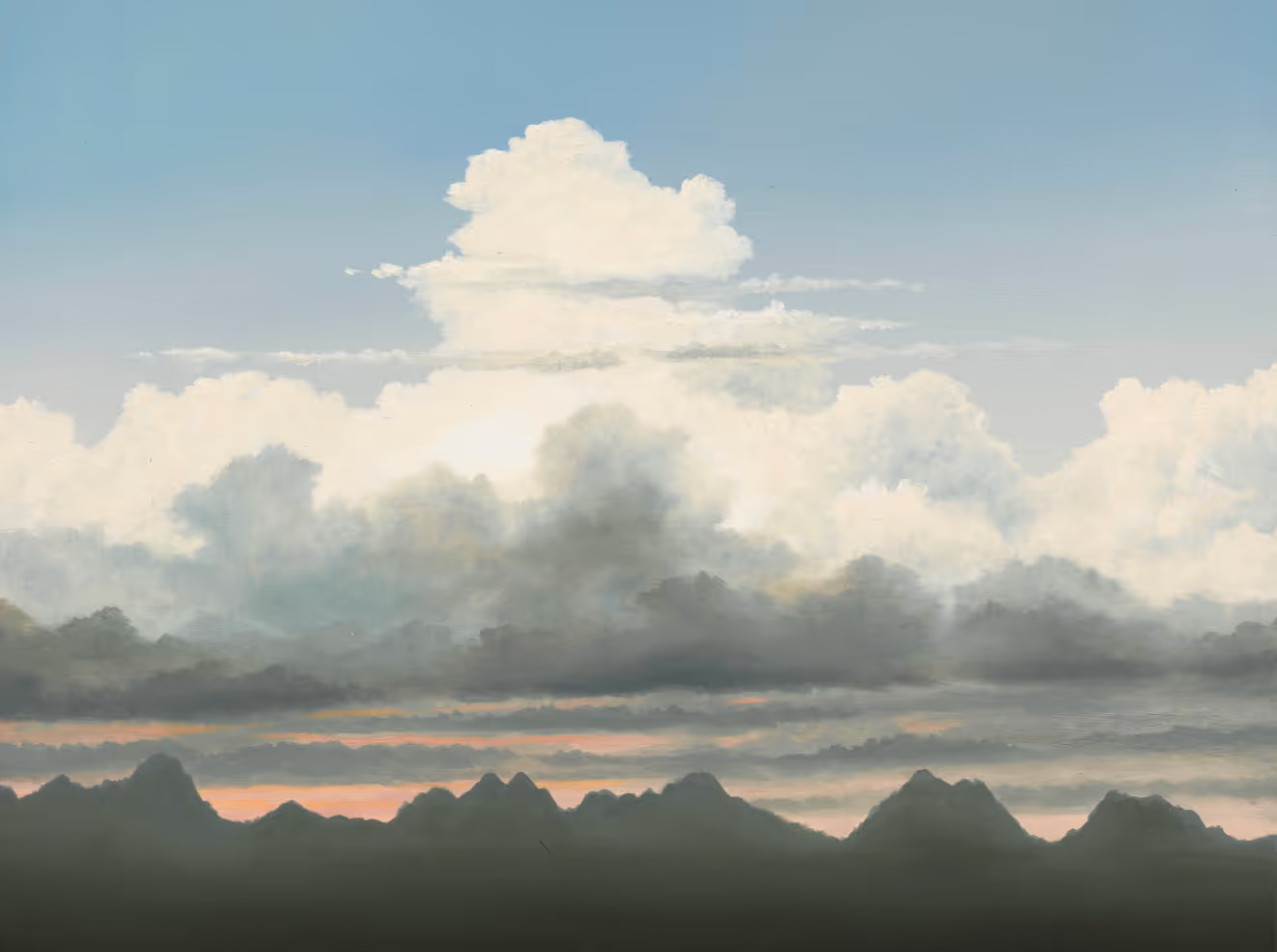
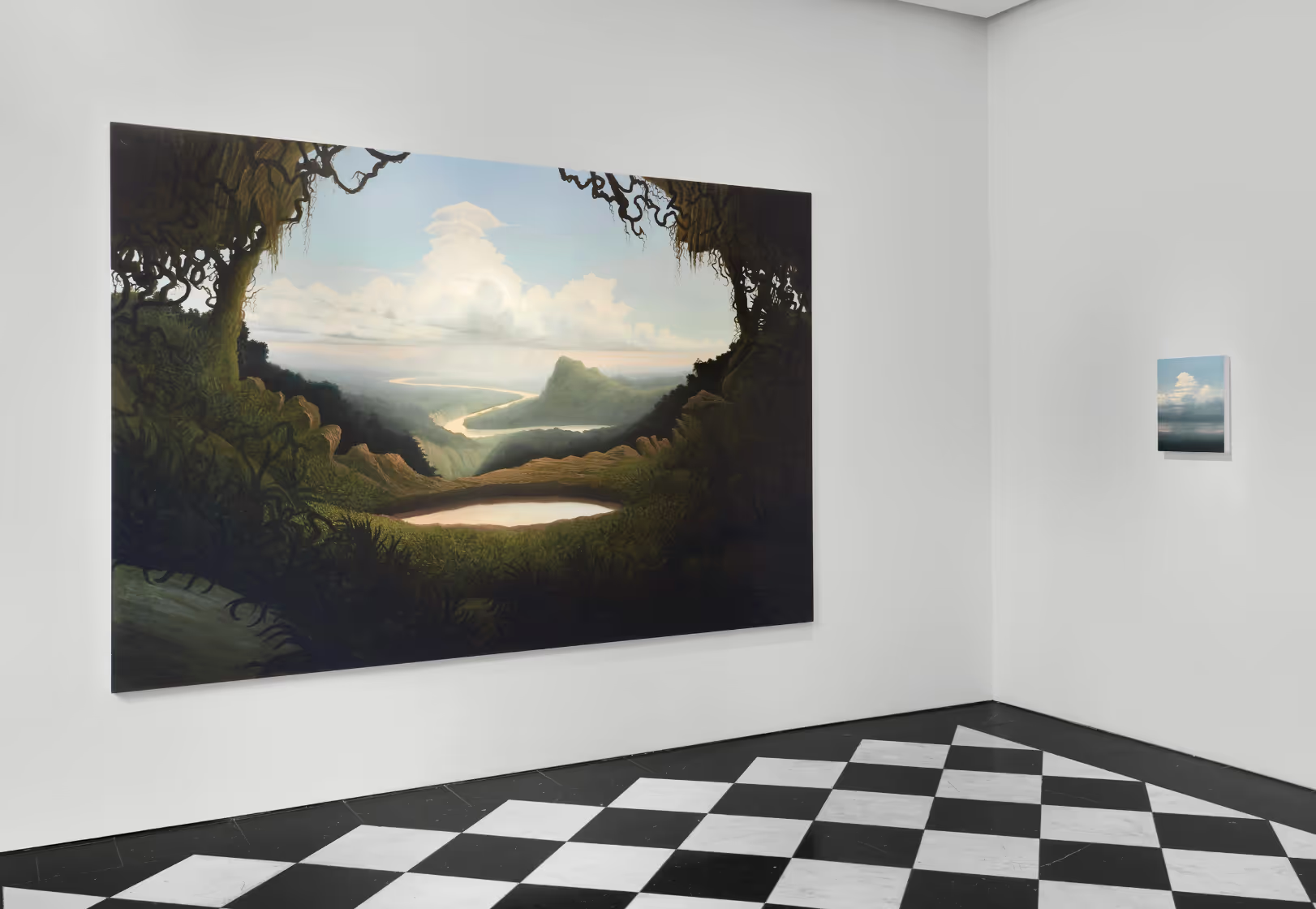
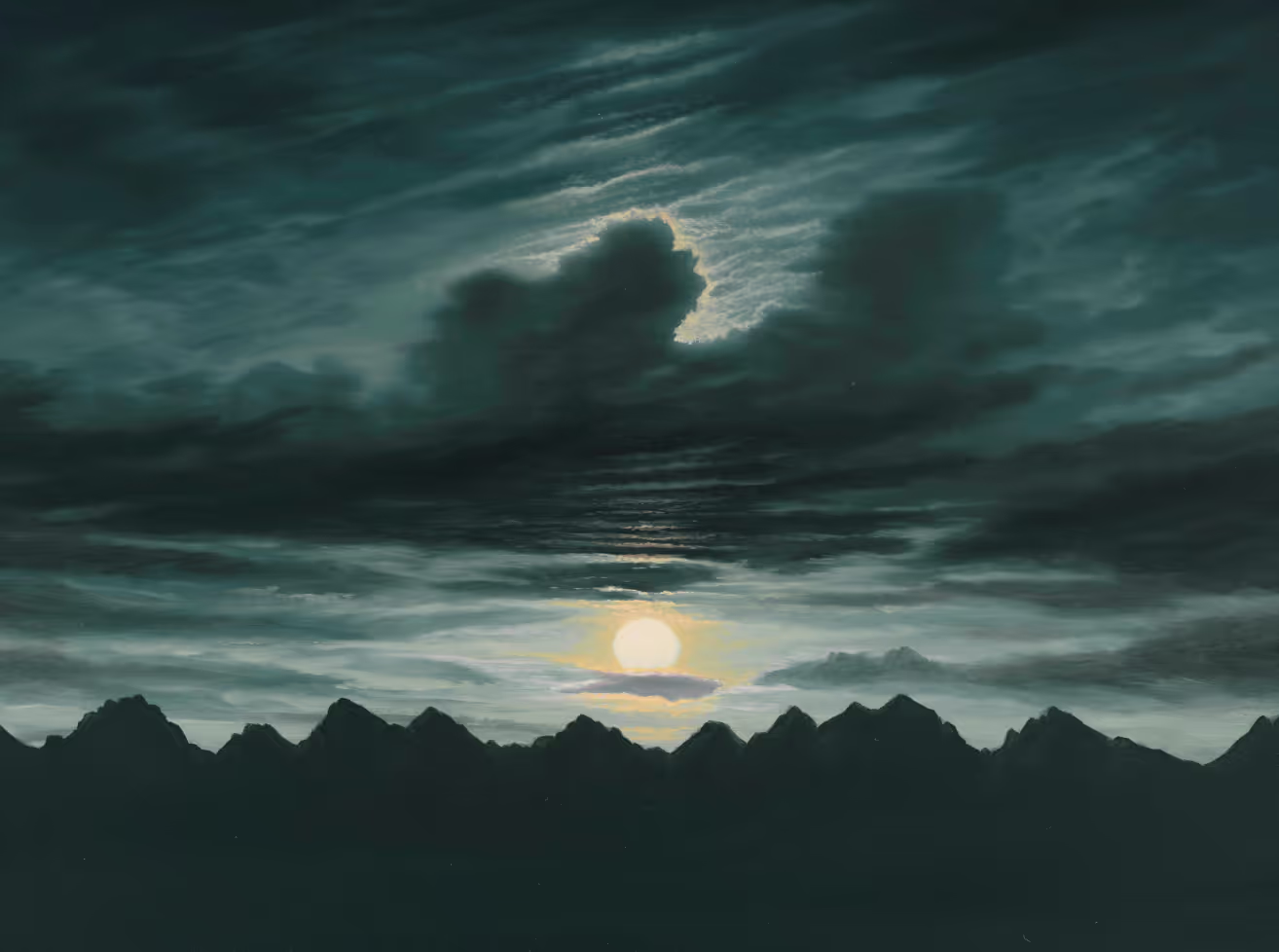
Each exhibition tends to focus on a different aspect of landscape, and for this one, the initial idea was around cloudscapes and the idea of the sky as part of the landscape, rather than simply being a backdrop. As I was making the work, it dawned on me that it was much more about how it affected the sense of scale, and how everything is understood in relation to something else. That sense of ascending scale, from foreground to distance to sky, or the sky above you, became central. “Orders of magnitude,” in its simplest form, refers to those differences of ascending scales across the landscape. As the work developed, I also became interested in different kinds of scale; not just physical scale, but illusory scale. That’s why reflection plays a large role in the work, in pools of water or puddles in the foreground. The mind reads them as quite mundane, but in their reflectivity, there is a surreal quality; they are both flat and glassy and deep at the same time. So there’s the idea of two different types of scale, like the scale of a physical world that is tangible, and then one that is an illusion, like a reflection.
The work seems to be motivated by philosophical ideas. What inspired this?
While making the work, I was reading about consciousness, and that helped connect these ideas. We experience two parallel worlds: the material world and the world as it is perceived through consciousness. They never fully meet in a direct way. There’s also what’s called the “hard problem” of consciousness; the question of how matter produces subjective experience. There’s still no clear explanation for how that gap is bridged, or where experience is located in the brain. So even something like a wall is not experienced directly - it is always filtered through perception. And then there’s imagination, which extends that further, into things that don’t exist at all. The “order of magnitude” is the internal scale of imagination and the ability to generate worlds that aren’t present. It’s something we take for granted, but it’s actually quite unusual.
Can you tell me about the title of the show?
I used to use quotes or explicit historical references, and I've moved away from that because I prefer the pithiness of sayings or phrases. I think they work well as show titles because everyone already knows what it means. People often don’t dwell on or even remember titles, but they can frame how you approach a show. “Orders of magnitude” felt appropriate because it is both descriptive and slightly open. It refers to scale quite directly, but also allows for these different registers of scale to sit within it.
You studied Geography at Durham University. How does that inform your work?
I was always really interested in landscape and how people make sense of the world around them. But Geography is a subject with a bit of an identity crisis. You start off broadly, and you essentially narrow down to someone else's subject. In large part, it’s also the product of empire and imperialism; its initial purpose was to understand the world in terms of how it could be useful. That side of it has now become redundant. But I studied the way in which landscape produces ideas in art, and art produces ideas in landscape, and how these feed off each other. I also studied the history of the idea of wilderness. It made me more conscious of why we experience landscape the way we do, rather than just purely focusing on the experience. Why we find things beautiful, what we used to appreciate that we don't now and vice versa and how our experience of landscape changes across different times and places. I always point to mountains being the classic example of this.
Tell me more about mountains.
They’re a really interesting way of charting the history of our changing appreciation of landscape. In the West - Britain and France in particular - when people did the Grand Tour in the 17th and 18th centuries, they would be blindfolded crossing the Simplon Pass in the Alps. Mountains were described as godless wastelands; they were these awful, undesirable places. Now, we see them as somewhere where, historically, people have gone to commune with God. There is a sublime quality people have increasingly bought into, of mountains as a place of scientific inquiry in the name of understanding and decoding God's riddles and genius. Gradually, this has morphed into appreciating mountains for their own sake, and now, they're seen as a playground of risk-taking and places of moral improvement, which is really bizarre.
Do you paint from imagined or real life?
My paintings tend to be quite temperate landscapes, a kind of uniform biome, relatively far north or far south, but not obviously tropical or Arctic. And they’re also not explicitly British or European landscapes. I grew up surrounded by stone circles, near Stonehenge. I drive past it all the time. I grew up in landscapes that are incredibly ritualised and sacralised, with Neolithic, Celtic and Norman layers, although I haven’t found the right way of expressing that yet. At the same time, I haven’t really painted landscapes that are completely alien to my experience, either, like deserts or tropical landscapes. So my internal imagination tends to sit in this temperate world. I haven’t gone too close to home, or too distant from the European tradition I’ve inherited. And I don’t know how to reconcile that yet.
Which artists have informed your painting practice?
When I was a child, the standout painter for me was Constable. I could immediately recognise those fields and trees and streams. He was profoundly nostalgic, mourning a rural Britain that was disappearing. Then I moved on to Turner, who is much more outward-looking and expansive. Claude Lorrain and Poussin, where I often look past the figures and focus on light, distance and composition. My favourite painting by Claude Lorrain is Echo and Narcissus. I couldn’t tell you much about the myth - I’m just looking at light and space. Later, it was the Hudson River School, and artists like Friedrich Edwin Church and Thomas Cole, who are interesting both aesthetically and politically, in terms of constructing American identity. Artists like John Piper, whose work I loved growing up. I used to paint in his style a lot as a child, and that fed into my own work. Increasingly, I’ve tried to be aware of these influences without being overly referential. I don’t see it as reverence. It’s more of a progression of landscape painting, taking elements but not replicating them.
You use a very selective colour palette, why is that?
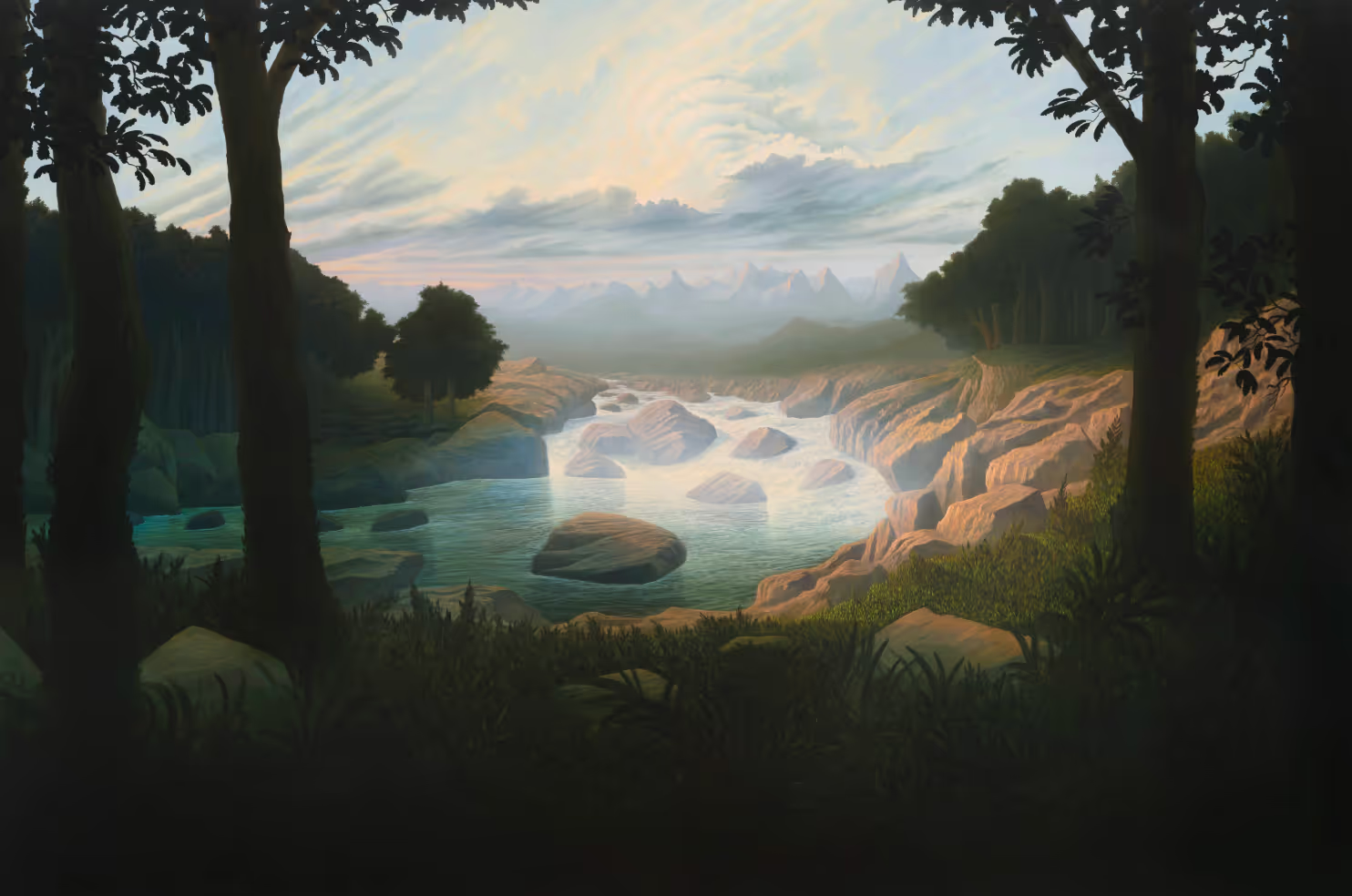
I guess with all landscape painting, there’s always a vein of nostalgia running through, a sense of people painting a lost golden age. I want there to be a sense of nostalgia in my paintings, but also a simultaneous sense of foreboding - these two competing forces pushing against one another. There’s often a golden, almost fulgent light, but also a sense of darkness and drama. You can have a painting with very gentle lighting and colour palette, but the subject matter itself has a starkness or abruptness. These two competing forces are always present because ultimately, they are two competing forces in landscape appreciation. In Western culture, especially, there’s this idea of wilderness as improving, virtuous and redemptive, but on the other hand, there’s the reality that if we were actually out there on our own, we’d be completely screwed. With lighting and colour palette, it reflects that sense of a gentle, almost naive quality alongside a feeling of foreboding and darkness.
What is your thought process around paint application?
It’s much more intuitive. I would say I’m often surprised at how cool or muted my paintings end up being. I might be working towards warmth, but they often drift towards coolness or desaturation. I think that’s slightly less true in this show, where there is a greater level of saturation. But generally, that’s the aim; this contrast between nostalgic warmth and harsh physical reality. In terms of technique, I’m always trying to grow and learn. I don’t really know beyond intuition and mood why I choose certain colours, other than that they feel right for the concept. It’s about that contrast between a sense of moral or aesthetic elevation and the harsh reality that nature is indifferent. It doesn’t care whether we exist or not. It’s completely unseeing and unknowing.
You live in London. How does that urban experience affect your practice?
I think the separation from what I paint is actually useful. I paint from imagination, and if I lived somewhere being constantly surrounded by landscape, I think it would change the quality of that imagination. Here, there’s a greater sense of yearning and almost fetishisation of what is outside the built environment. That distance heightens the imaginative aspect rather than diminishes it. The contrast is productive. And when I do go out into nature, I never go with the idea that it’s for my work. I go because I want to experience it. There are always inherited assumptions when you go to a place, and you can’t escape that. But I try to experience things on their own terms as much as possible.
Sholto Blissett's Orders of Magnitude is open at Pilar Corrias, Savile Row until 2 May. Don't forget to check-in on the gowithYamo app!