
Chronically Online with Giulia Crivellaro
In Chronically Online, we present the artists who are narrating what it means to inhabit today's online landscape, reflecting on this very present and imagining new alternatives.
Born in Bolzano in 1995 and currently based between Amsterdam and Rome, artist Giulia Crivellaro deploys moving images to investigate the links between temporality, visuality and identity. In her work, stretched, modified, reshaped, and pixelated images remind the viewer of what they’re allowed or not allowed to see: what we think is natural but is, after all, constructed, and the realities which are born every time a specific gaze casts upon an image. Exploring themes such as fragmented temporalities and new mythologies in contemporary visual culture, Giulia draws inspiration from social media imagery and online trends. In this new chapter of Chronically Online, we talked with her about her inspirations, her approach when first starting to work on a film, and her online habits.
We are fascinated by your use of audiovisual grammar to convey certain feelings shaped by a perception of the world filtered through the online. The zoom that reveals pixels and creates estrangement, the “stillness” that exposes a certain performance of suffering. Can you tell us more about this dimension of your practice?
I have a real passion for images and for suspended moments. Even when I watch a film or a show, what I love most are those instances when reality enters the narrative, sometimes awkwardly; I’m thinking of David Lynch in Twin Peaks, for example. In the series, the director repeatedly chooses to “stay with the image,” lingering on moments that, from a narrative standpoint, might appear as imperfections of the filmic apparatus or as excessively slow compared to the presumed rhythm of the story.
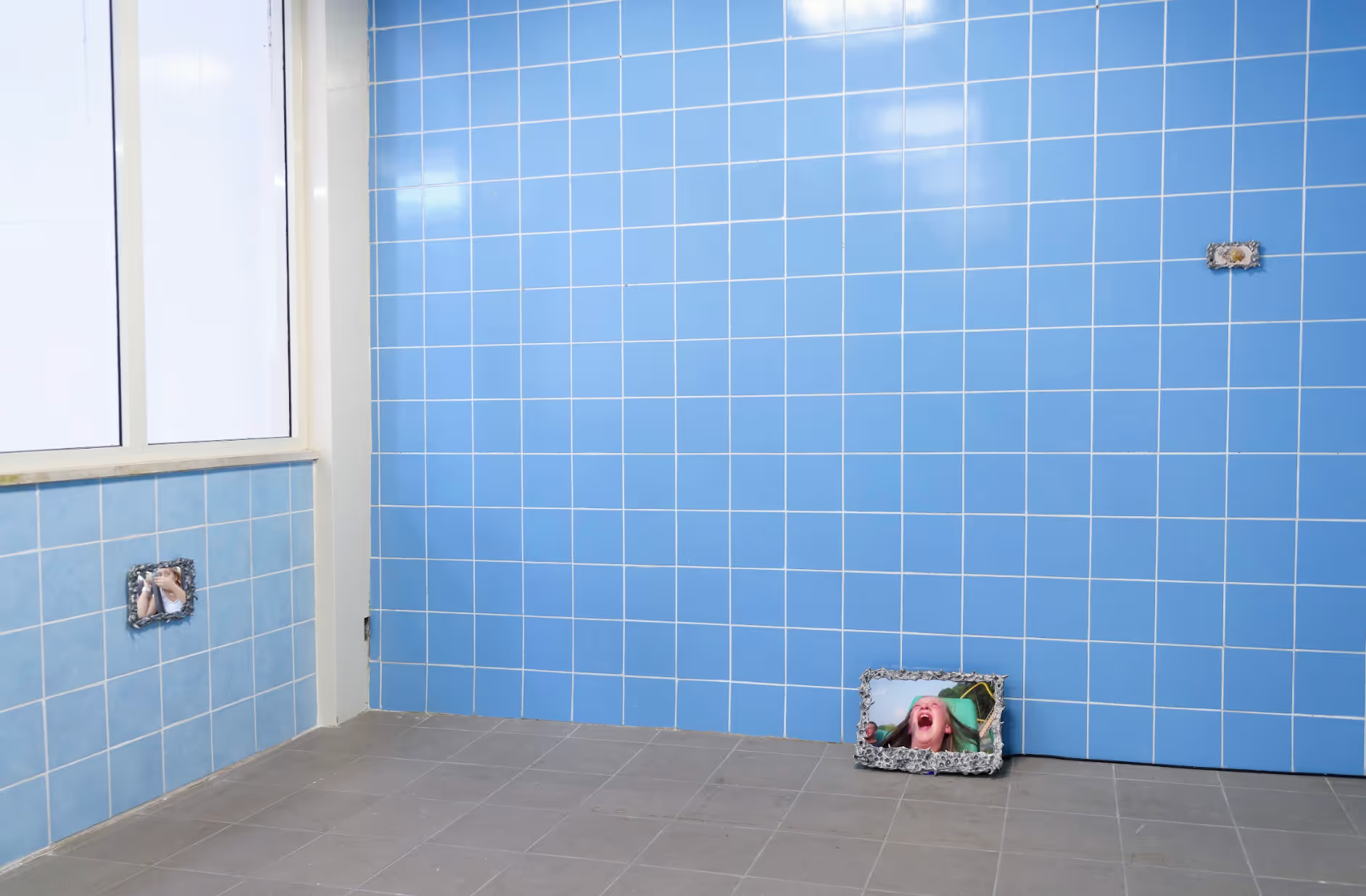
In my own research, I like to think I do something similar: deliberately choosing to stay with images, to stretch their time or form by enlarging and pixelating them, almost as if to enter into them. In a sense, I believe that the content of what I want to address in my work is already within the image, and that editing or temporal expansion serves more to reveal something than to create it from scratch. Pixelation and stillness, then, are not mere aesthetic choices, but the result of a process of expansion — both material and perceptual.
What is the relationship, if any, between your practice and audiovisual languages emerging from digital folklore such as ‘corecore’? Are you inspired by them, or would you say your work moves along different tracks?
There is certainly an influence of digital audiovisual language in my practice, although I see it more as a starting point than a point of arrival. Digital language interests me as a dimension of reality in which something can happen, take shape, and exist according to its own space-time: an alternative to tangible reality, yet no less present or detached from cultural constructions and power dynamics. What interests me is the dynamic relationship between the digital and material reality: dimensions I do not perceive as opposites, but as the construction of a territory where materials mix without hierarchy. What often emerges from this is more a question than a certainty. I would describe it as a way of looking at relationships rather than creating from scratch, and digital folklore, in this sense, is an important and heterogeneous landscape of cultural production that develops from its own means and structural characteristics. I think it is essential to remind ourselves, from time to time, that the world we create is shaped by the tools that produce it. In this sense, the digital is not just a tool, but an environment, a territory, a language, and a form of thought.
You work extensively with the juxtaposition of elements and images that seem irreconcilable, yet together they outline new sensations and describe specific feelings. It’s as if an excess of representation – a push toward extremes – were necessary to grasp certain nuances your work addresses. How do you approach your films during the writing phase?
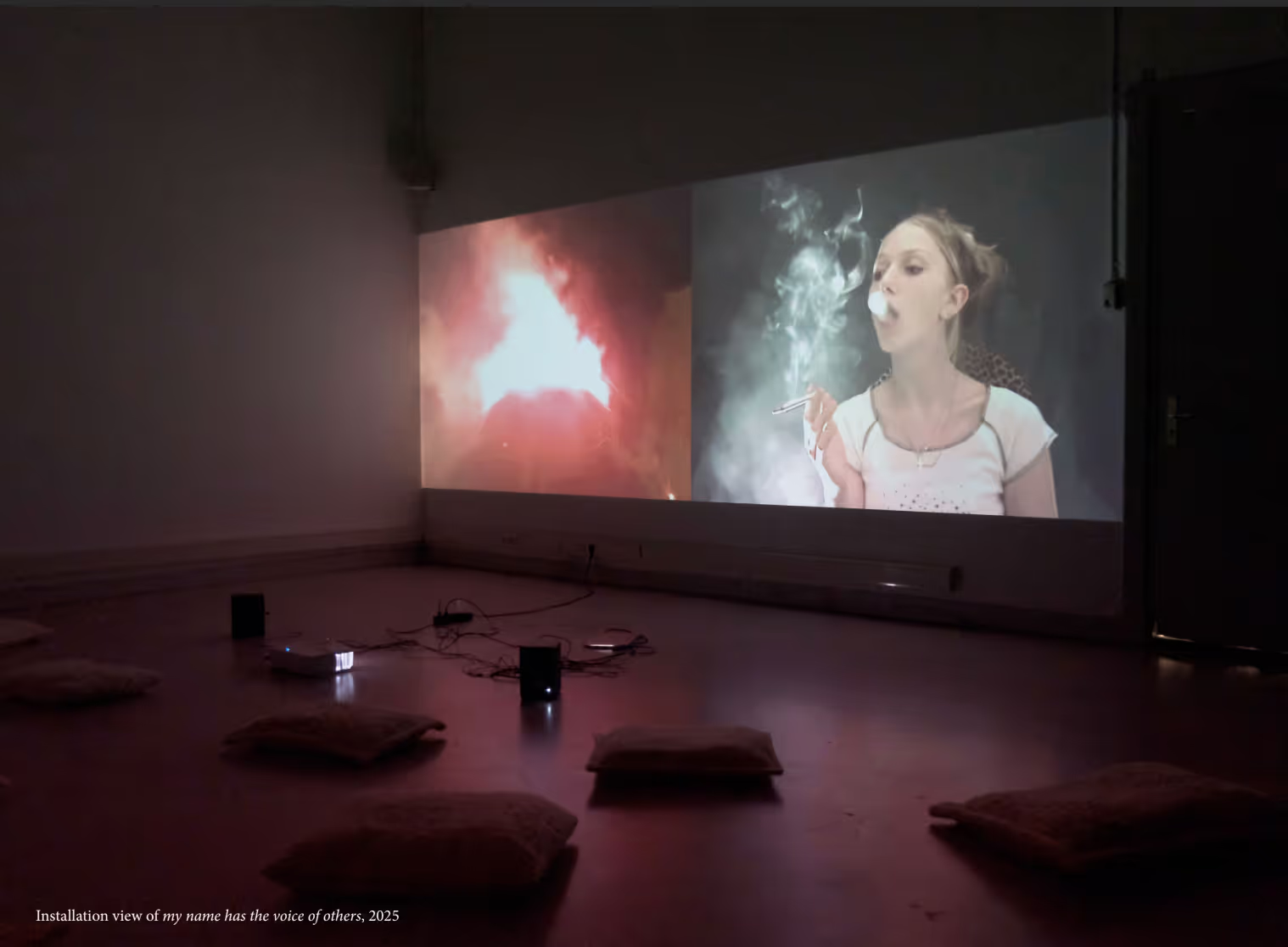
I believe that juxtaposition, as well as slowing down and fragmentation, simply allows something already potentially present in the images I select to emerge. Some are chosen for their singularity, others for their plurality, as part of a much broader flow. Bringing them into relation aims to activate them or make them collapse, but the premise of this movement is, for me, already embedded in their production or in their presence online.
So far, the production processes of my works have been very different. Some are the result of an intuition I decided to trust, while others involve much denser and more prolonged research. With the latter, I still struggle to let go at times. Everything has become even more complex since I began mixing found footage with original material. This has significantly reshaped the process, extending timelines while also increasing the precision and complexity of planning. Only recently have I started to find a sort of balance, and I am now working on different projects simultaneously. In this way, I more easily accept the much longer timelines of more complex and costly works, those requiring a written script, actors, or a production crew, while dedicating myself with less pressure and more enjoyment to smaller projects that I develop on my own.
Your work also engages deeply with contemporary mythologies, and ‘Smooth Threshold’ is one of the pieces that best exemplifies this. Could you tell us about this work and your thought process behind this particular film?
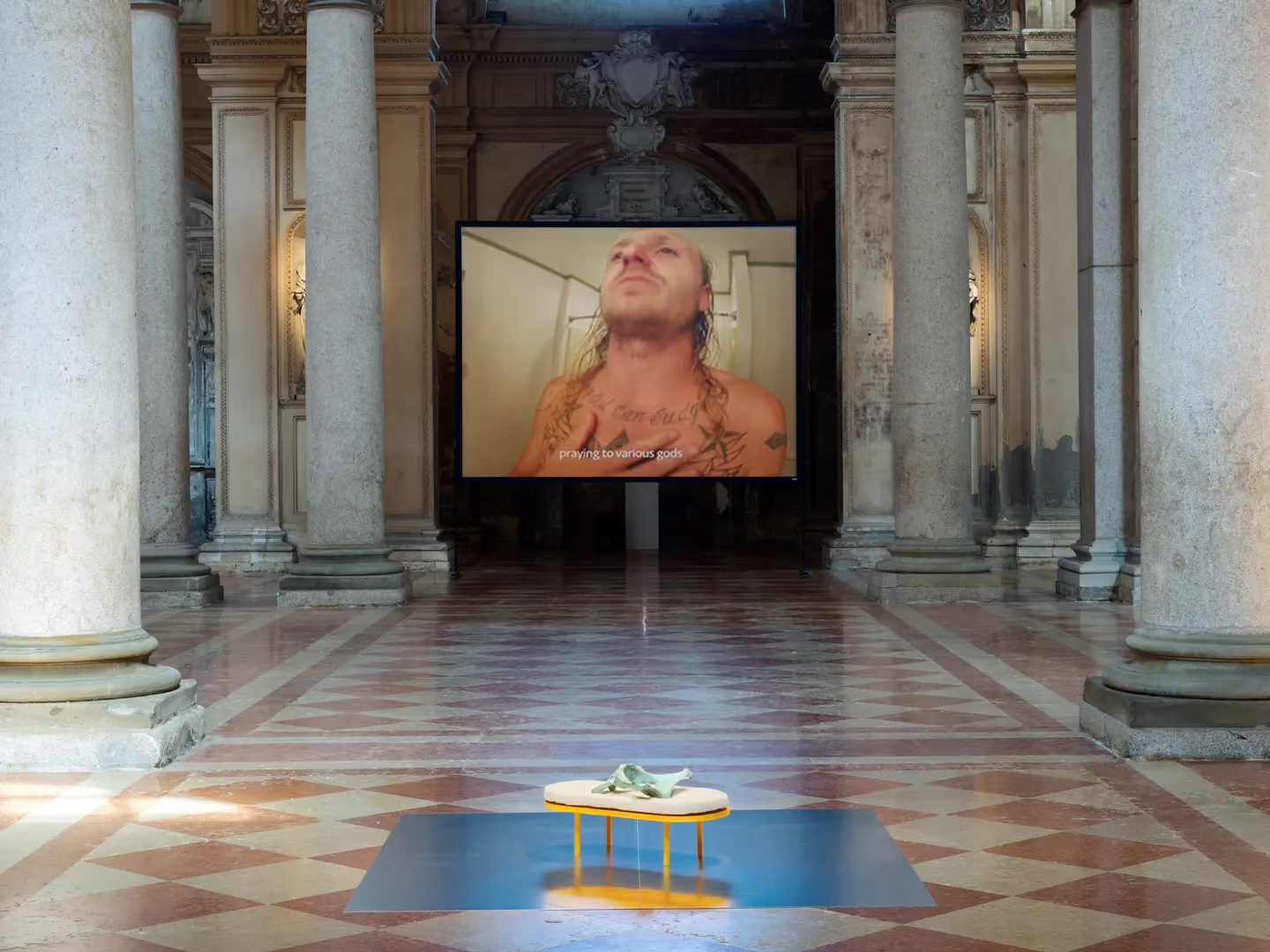
‘Smooth Threshold ‘is one of those works that begins with a simple intuition, and it is very dear to me because, beyond marking my discovery of moving images as my preferred poetic medium, it was also the project through which I began to recognise certain methodological continuities in my research. In this specific case, the initial intuition was very simple and concerned a temporal contraction of desire in contemporary society. What some might interpret as a negative disenchantment — the inability to believe spiritually in something after death — is instead presented here as a present and urgent incorporation. This does not mean that tension does not exist — on the contrary, it simply lives within a contracted time and in the living, present body. It becomes a way of reinterpreting the form and meaning of the tattoo as something tensional: an embodiment of desire, affection, or potential hope. However, all of this reflection actually came afterwards; the initial intuition was much simpler and revolved solely around a formal similarity between the hieroglyphs on certain Egyptian sarcophagi — marked with eagles, spells, or autobiographical notes — and some of the most common tattoos we see around us. It began as a playful association and only became serious once put into practice.
Last question, more personal but also related to the kinds of online environments that fascinate you and how you conduct your research: what kind of online user are you?
Honestly, I have to say that I would like to spend less time online, especially because I end up consuming many hours of my day there under the pretext of “doing research.” In general, I would describe myself as a quiet user: I watch, but I do not expose myself too much. I rarely post or intervene, but I enjoy observing.