
Richard Dadd at the Royal Academy
Fairies are not found prancing around in plain sight, but if you look carefully, you may see them. They exist in the cracks of consciousness. They skip into another realm, which we are not always invited to see. You will usually find them in an ancient forest or the part of the garden farthest from the house. Richard Dadd, for all his murderous foibles, knew that. It’s evident in The Fairy Feller’s Master-Stroke (1855 - 1864), the supernatural is not served up with a synthetic side of glitter and a sickly slice of cute, it’s secretly busying itself under daisies and between blades of grass. Dadd depicts supernatural creatures as convincingly as the flora around them with the realism of a Dutch master. And yet these beings were drawn directly from his mind during his near lifelong confinement in asylums.
The Fairy Feller’s Master-Stroke (1855 - 1864) is probably Dadd’s most well-known painting. Amongst fallen horse chestnuts, a whole throng of fairies is gathering to watch the master feller split a nut to repair Queen Mab’s carriage. Shakespeare’s Queen Mab is a fairy queen who goes around putting dreams in people's heads, and she seems to have broken down on a Gandalf-like figure's hat. The painting took ten years to complete and is full of detail, such that one could spend hours looking at it.

The Victorians were obsessed with fairies, inspired by Shakespeare and a revived interest in British folklore. Fairies were an escape from their rigid social norms to a more liberal and, at times, blithe realm. Naughty nymphs, salacious sprites and frolicking fauns plagued the mind of otherwise proprietous Victorians. The exhibition at the Royal Academy does not give this context to Dadd, it introduces him as the Academy’s star pupil of the 1830s. He attended the Royal Academy in his 20s and was awarded several prizes, described by his classmates as jovial, kind and funny. Fairy painting was a well-respected genre in the 1840s and 50s, and one that Dadd was successful in, alongside his painting, he was also commissioned to produce book illustrations. Critics described his work as of ‘an accomplished mind, and the result of matured thought and study’: he was the model Victorian artist.
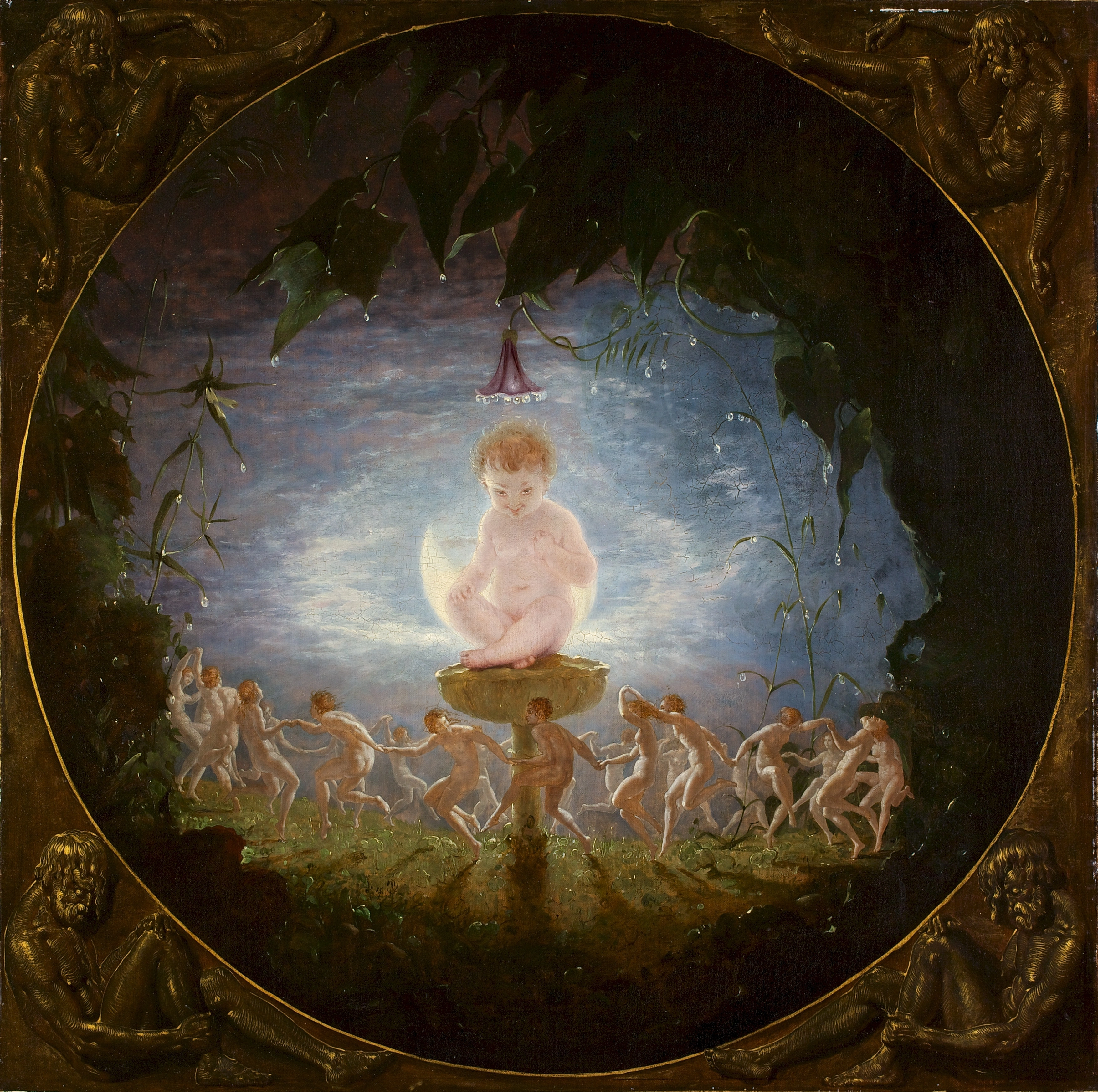
His canvases were relatively small, especially compared to Sir Joseph Paton, another well-known fairy painter. But when you are painting with a magnifying glass and using, at times, a brush, a single hair-thick large-scale work is not to be expected. The intricacy of the compositions is captivating: they have the cognitive stickiness of a Where’s Wally. We relish the opportunity to revert to a childlike state, exploring the undergrowth for mischief, stumbling upon vignettes acted out by a goblin with an oversized head and bulging eyes, deliciously inviting water nymphs… like sirens, or a beautiful pixie with a delicate neck and long eyelashes. Who are these creatures and what are they doing? It is entrancing to hunt for fairies.

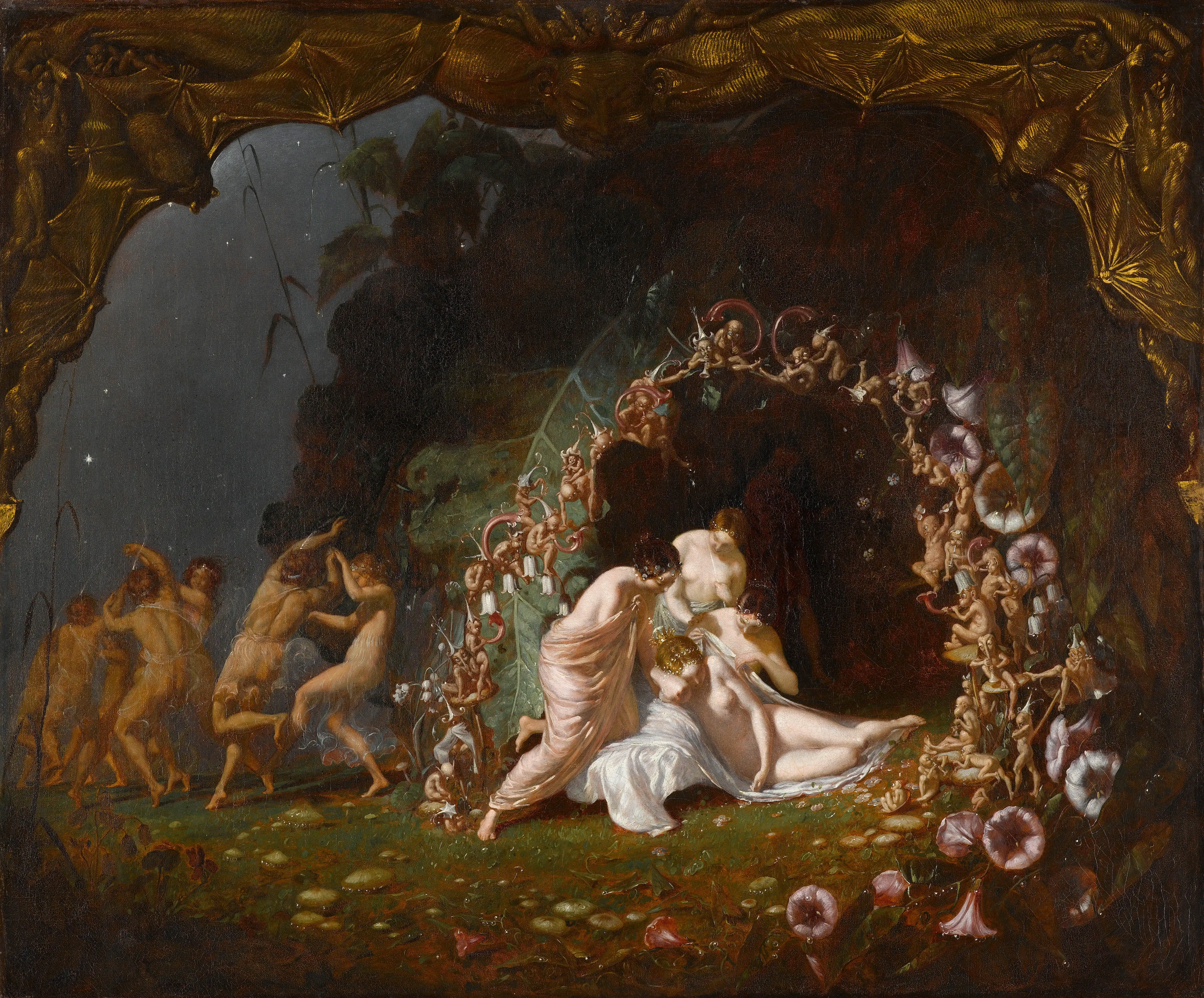
And yet, for all the jovial escapism the fairy world offers, it has always had a dark side. Titania Sleeping (1841), (a rare French acquisition of British painting) is bordered with a painted frame of bat wings. After all, these are not the mythological creatures of Walt Disney but the flawed characters of Shakespeare. There is a sinister air. The devil is in the details, and Dadd thought the devil, too, was in his father, Robert Dadd, he saw black devils crawling over him, particularly in his saliva. And on a walk in the woods, stabbed him, slit his throat and fled to France, where he was captured and extradited back to England. The diagnosis was psychosis, though the exhibition purposely circumvents any prolonged discussion of mental illness and directs those interested to the Museum of The Mind at Bethlem, Southwark, Dadd’s first asylum (in Britain – in France he was briefly held in an asylum in Fontainebleau).
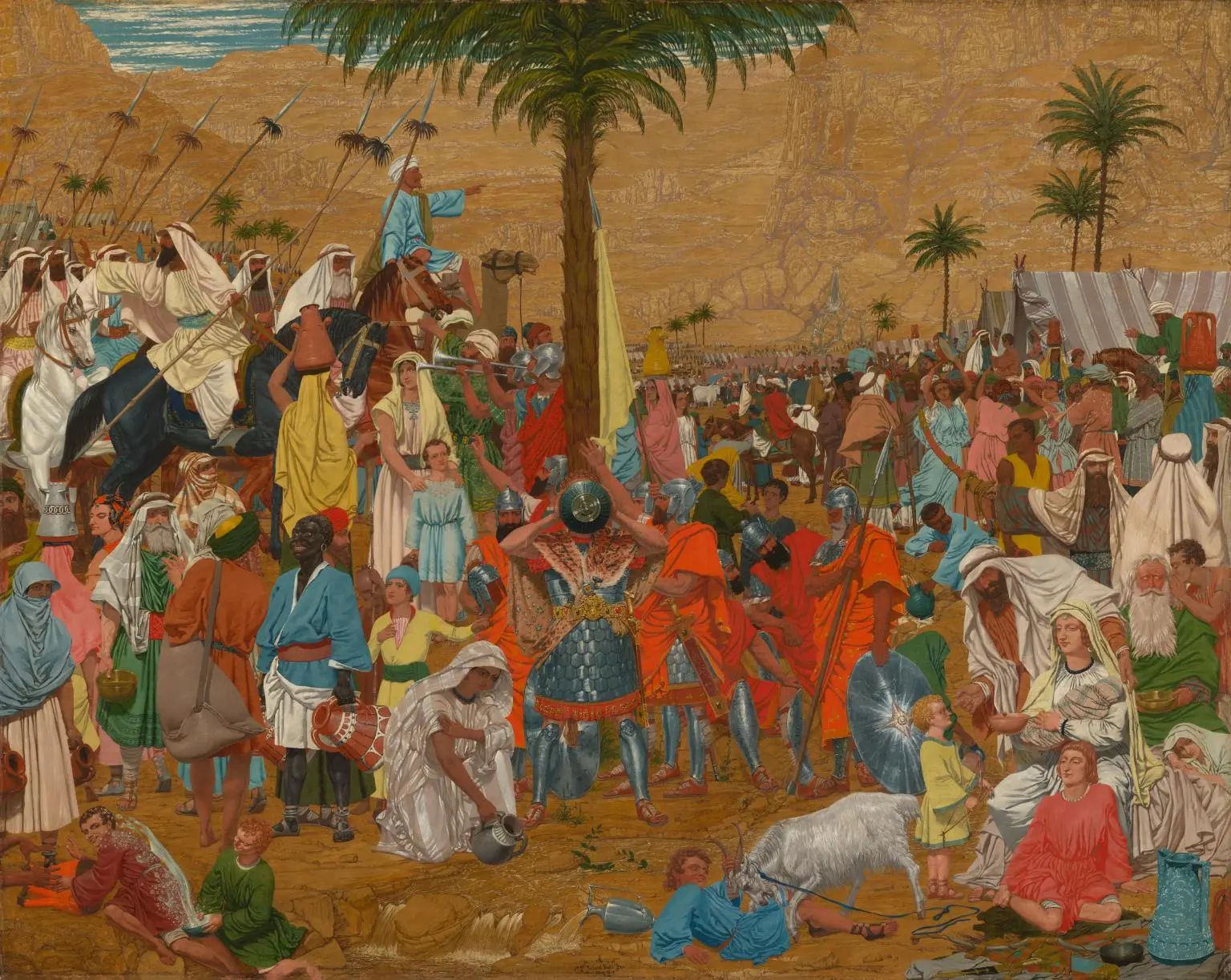
The first evidence of Dadd’s condition reared its head on an expedition in the Middle East. A trip that would prove giddily disorientating for Dadd, due to the combined effect of the onset of his illness, the heat and the exposure to so much novel visual stimulation. He cut the trip short and returned alone to England, writing to a friend, 'often I have lain down at night with my imagination so full of wild vagaries that I have really and truly doubted my own sanity’. His painting ‘The Flight out of Egypt’ (1849-50) illustrates the mania he must have been feeling. It is quite a disturbing composition, compiled of memories and observations from the expedition for which he was acting as draughtsman. The busy composition is in itself overstimulating and lacks the whimsy of both the later and earlier fairy paintings. A goat rams a boy, another boy throws a bowl of water over his friend. A disturbingly caricatureish depiction of a black man grins into space, feet rooted to the ground. All sorts of characters exchange glances with one another and with the viewer in a slightly harrowing scene.
Interestingly, despite being the RA’s star pupil and enjoying critical acclaim before his illness, during his confinement Dadd fell from the public eye, and a small watercolour exhibited in the final room of the exhibition was, until the 1970s, his most publicly known work: being in the collection of the British Museum. It was only after Siegfreid Sassoon decided to remove The Fairy Feller's Master-Stroke from auction and donate it to the Tate in memory of his friend, Dadd’s great-nephew, Julian, that public attention returned to Dadd’s work. His first major retrospective, which the current Royal Academy show now rivals, wasn’t until 1974.
‘Yes, some painters - the few, perhaps - achieve renown and substantial rewards, others lag behind.' – Richard Dadd
Richard Dadd: Beyond Bedlam is on 25 July - 25 October 2026 at The Jillian and Arthur M. Sackler Wing of Galleries | Burlington House
Don't forget to check in and leave your review on the gowithYamo app!