
Lou Mensah meets Ellen Gallagher on her Art on the Underground commission Fast-Fish and Loose-Fish
"Space in London has always struck me as liminal and in flux.”
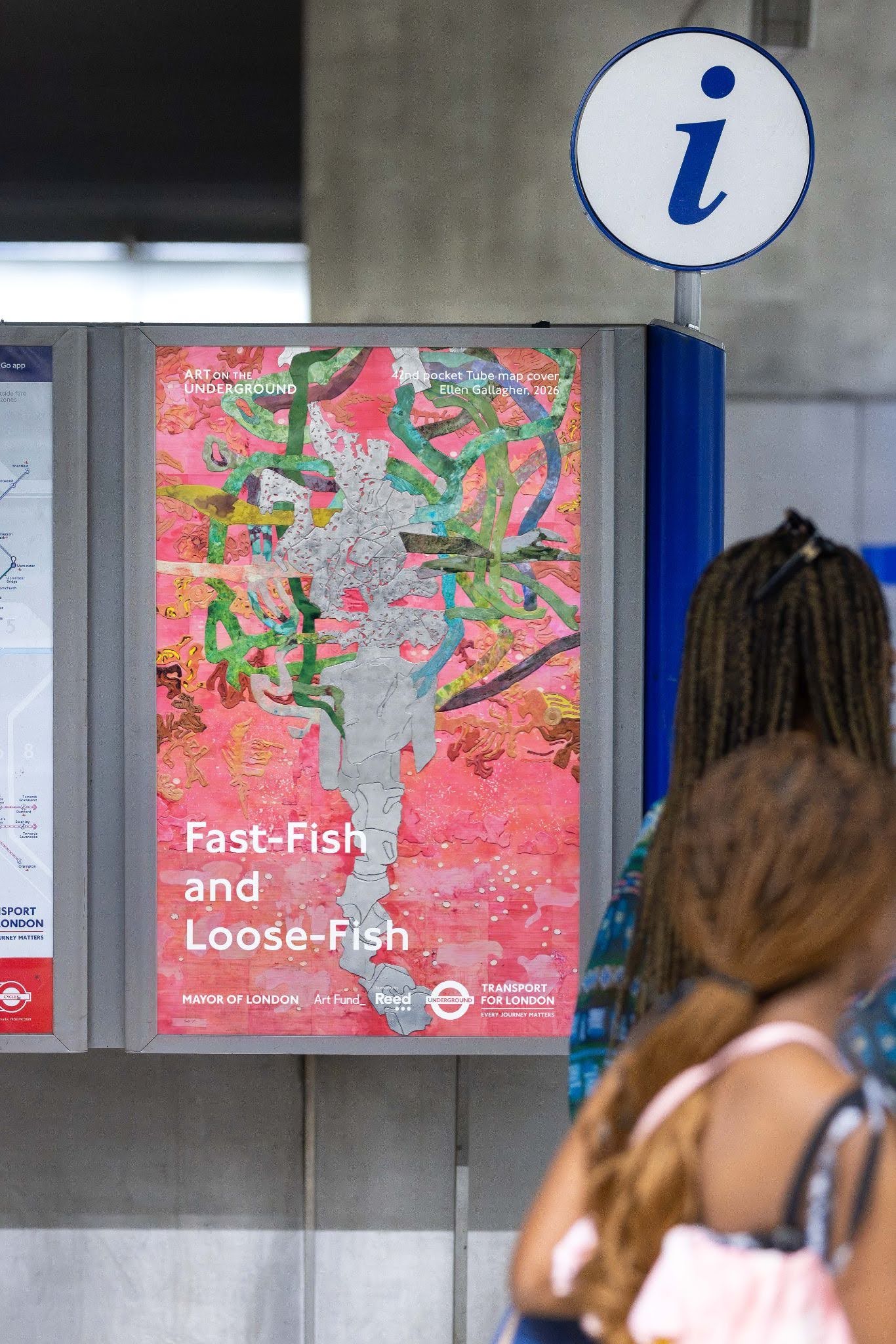
Ellen Gallagher's Fast-Fish and Loose-Fish is Art on the Underground's 42nd pocket Tube map cover, titled after a chapter in Herman Melville's Moby-Dick. The work draws on the waterways beneath London, where Fleet Street takes its name from the River Fleet, which still flows underground from Hampstead Heath to the Thames at Blackfriars, and Sadler's Wells is named after a medieval well discovered on the site in 1683. Gallagher, who lives and works between Rotterdam and New York, weaves these histories into her new commission. We spoke about Moby-Dick, the Fugitive Slave Law, London's buried rivers and dancing to jungle at 4 am.
Firstly, Ellen, I'm thrilled you're taking the time to talk with me; thank you. I have a fond memory of hearing you speak on A Brush With Podcast in 2021 about Melville and the ocean as a space of Black memory. I loved it so much I've re-listened, so I was delighted when you agreed to talk with me about this commission, which in a way relates to the themes in that conversation. These are clearly ideas you're deeply immersed in. How did Fast-Fish and Loose-Fish, titled after a chapter in Moby-Dick and your new pocket Tube map cover for Art on the Underground, come about?
Hi Lou, it’s a pleasure to speak with you. Thank you. Ben is such a generous and nuanced interviewer! As listeners, we are transported into the studio with all of these incredible artists. I was in the midst of this cycle of paintings, Fast-Fish and Loose-Fish, when Sasha Morse reached out to me about possibly making a future Tube map cover. Through previous commissions, I had a sense of the vastly different kinds of space the actual graphic object - the Tube map - could carry. Herman Melville’s metaphor is a direct assault on the Fugitive Slave Law of 1850, which allowed slaveholders and their agents to arrest Black “runaways” without warrants or due process, and enlisted federal agents to enforce the law. Thanks to Congress, there was no safe haven for Black people in the U.S. As Melville reminds us, these acts of cruelty and barbarity are sanctioned by law - a lesson in a time of mass detention and deportation.
You've referenced the River Fleet and the buried waterways that run alongside the Tube lines, connecting Clerkenwell and Sadler's Wells. How did London's own hidden geography feed into the work?
Some years ago, I had a studio on Brick Lane, and at the front door was this bustling metropolis, but from the back was a view of farmland in the distance. Space in London has always struck me as liminal and in flux. Reading through the city archives as I began this painting, I was struck by the way language held on to and also camouflaged or encrusted ‘sentient geographies’. That Fleet River once ran beneath Fleet Street – or, that Sadler’s Wells was a water source that existed from Roman times into the 20th century as healing bubbling up from below.
You've described liminal spaces as vital for holding a generosity towards one another in public space. What do you want commuters to feel when they unfold this map?
I like to have something to read, to look at, when I am in a public transit space. Fast- Fish and Loose-Fish incorporates precious metal (palladium) into the spine of the painting, where whale bone and Fang sculpture-inspired figures converge. There is a vantage shift from aerial view to a kind of verticality. In one sense, you’re seeing a “whale fall” - the remains of whale carcasses on the ocean floor - from above. You might then flip to a vertical view of a calcified Pip [from Melville’s Moby Dick], poised at the edge of a constantly shifting shoreline.
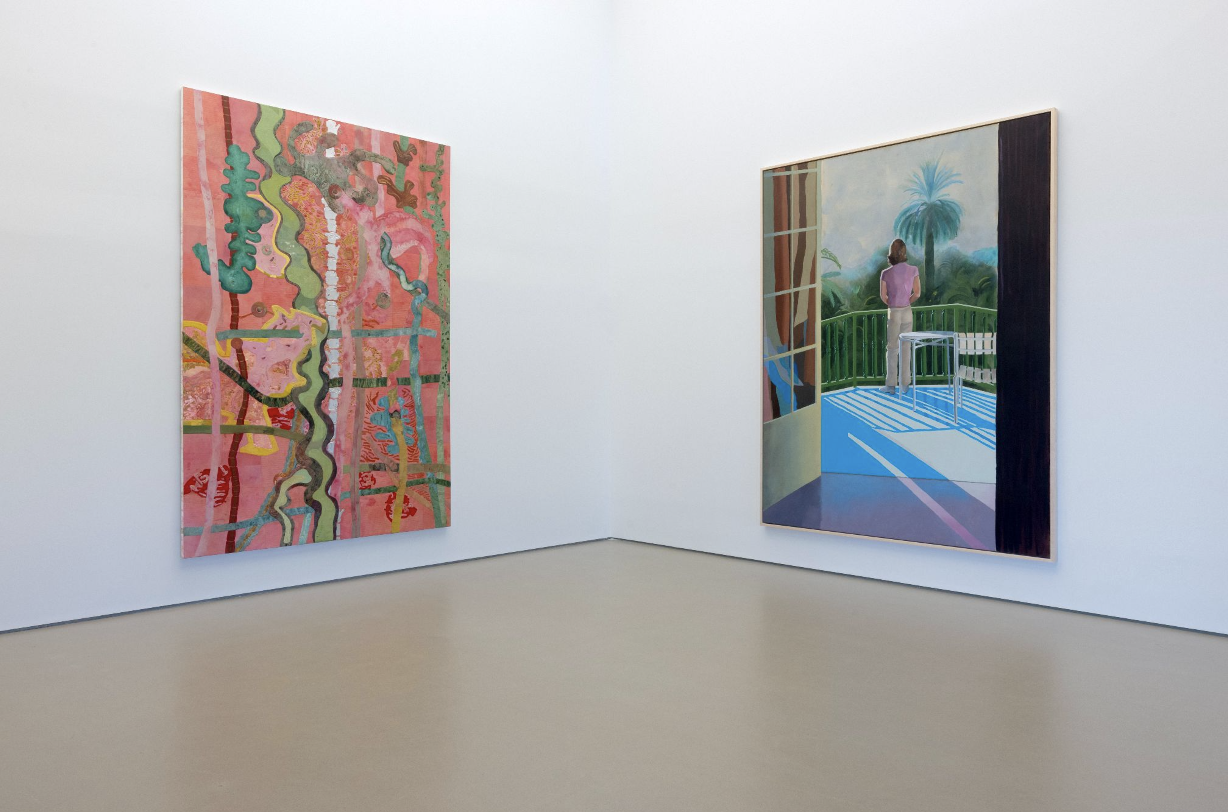
Two of the Fast-Fish and Loose-Fish paintings were in your show All of No Man's Land Is Ours at the Stedelijk in Amsterdam, and you showed three paintings from the cycle at Gagosian in Paris earlier this year. How does the work change when it moves from a gallery wall to a pocket Tube map that millions of people carry with them?
The printing of the London Tube Map is exquisitely well done. That was important - that the painting becomes something new - a graphic object in circulation.
You live and work between Rotterdam and New York. What is your relationship with London, and how did being outside the city shape how you saw it for this commission?
I first had work included in a group exhibition curated by Catherine de Zegher at Whitechapel Gallery in 1996, titled Inside the Visible. It was such an exciting time to be in London! Nobody had any money, and still everything seemed possible…not just in terms of visual art but going to small clubs and dancing all night to jungle. And I definitely found out how abstract that Harry Beck Tube map was when, at 4 am, I suddenly found myself at the edge of the city, with no public transport running. The Harry Beck floating Tube city is a stunning conceptual design. It hovers in space, optimistic, entwined. It’s a very different graphic than, for example, the NY subway graphic, which is physically mapped over the landscape.