
Donald Locke: Resistant Forms at Camden Art Centre

"It is likely that this will be the last opportunity to see such a significant presentation of Donald's work in the UK for several years to come."
Donald Locke: Resistant Forms at Camden Art Centre is the first comprehensive UK survey of Guyanese-British ceramicist, painter and sculptor Donald Locke (1930-2010), presenting over 80 works across five decades. A post-war artist of the Windrush generation, Locke moved between Guyana, the UK and the United States, making work that embedded the experience of colonialism into the language of sculpture and painting. This is the final stop of a tour from Spike Island in Bristol and Ikon Gallery in Birmingham.
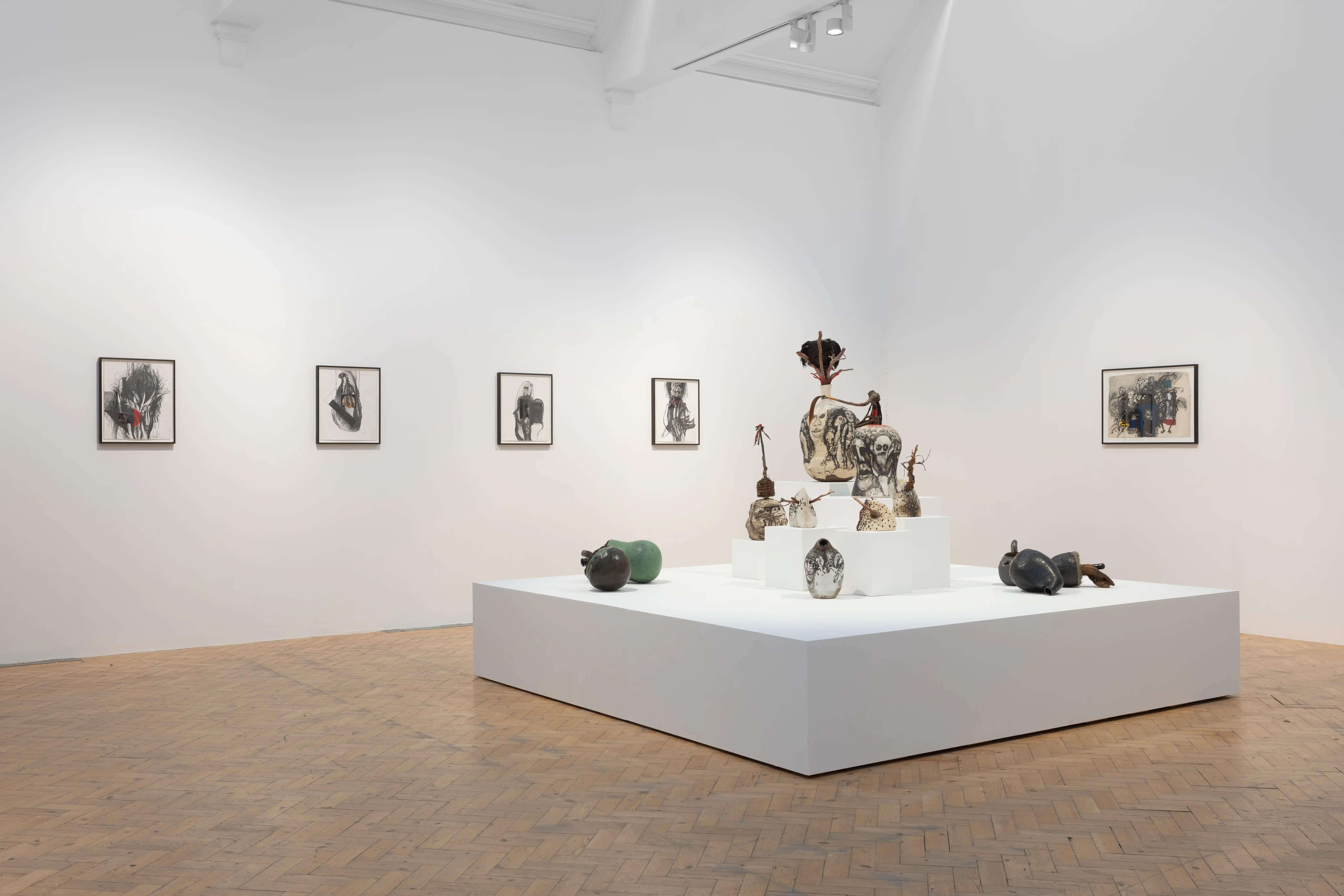
I recently interviewed Sir Frank Bowling for this column, so I have been thinking about his connection with Locke while preparing these questions for you. Both artists left Guyana for London within a year of each other in the 1950s. Interestingly, Locke included Bowling's work in an exhibition he organised in Edinburgh, travelling to London to pick up the painting himself (!) and both showed together in The Other Story at the Hayward in 1989. Bowling's name is widely known, but perhaps Locke's is less so, despite his work being presented internationally and informing conversations around colonialism that we're only beginning to acknowledge in the art world today. Why has it taken this long?
I think there are several reasons for this. It’s what Eddie Chambers describes as the ‘delayed exhibition and art historical presence’ of Donald’s work in Britain. Firstly, though Donald was a classically trained and talented craftsman, his work often flew in the face of orthodoxy. This is evident, for example, in the unusual materials he incorporated in his charged mixed media ceramics of the 1970s, or in his approach to making paintings during the 1990s ‘with a sculptor’s sensibility’, as Carl E. Hazelwood put it. Secondly, Donald moved many times during his life to access different opportunities, moving back and forth between Guyana and the UK for 25 years and then eventually settling in the United States. Though the different places he lived and people he met clearly inspired him – and he remained in touch with his old friends, including Frank Bowling, throughout his life – his itinerancy limited his visibility in the UK.
‘The Other Story’ is an interesting example because, though the exhibition was mounted in 1989, Donald’s contribution consisted entirely of works that he had made during the 1970s. At the time, he had been living in Arizona for a decade, primarily making bronzes that were quite different to the works on display in London. Following this presentation, his work was not shown again in the UK until 2005, when he was included in another important group show, ‘Back to Black: Art, Cinema and the Racial Imaginary’, at Whitechapel Gallery. His last exhibition here, ‘Pork Knocker Dreams’, took place in 2009, the year before his death, and was curated by Indra Khanna at New Art Exchange in Nottingham. In different ways, these exhibitions have all laid the groundwork for the positive reception of ‘Resistant Forms’ now.

Donald's son, the sculptor Hew Locke, reiterated this point during your conversation at Spike Island, that it's taken so long for people to really get this work. Did Hew say what getting it looks like? And what does getting it look like to you?
I don’t recall Hew saying what getting it looks like to him, but for me, it’s about understanding Donald’s commitment to art’s unknowability and his deeply experimental spirit. Though sadly I never met him, his friends and family always describe him as a great storyteller, and, as I understand it, the stories he would tell about his work would commonly shapeshift and change. This is why, though many pieces incorporate or reference highly loaded images, words, histories and materials, I don’t think we can decode them fully, nor do I think Donald would want us to.
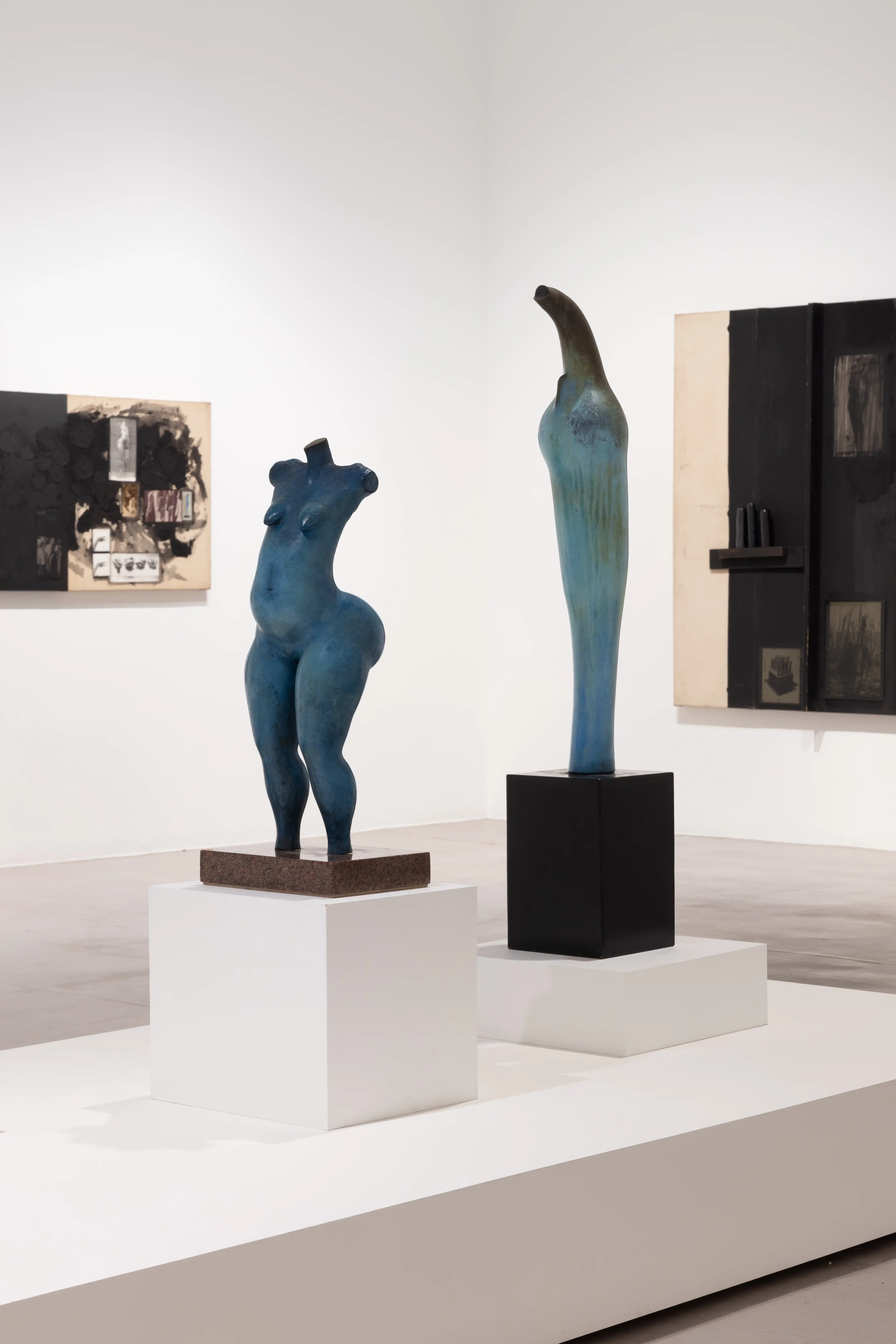
I felt this acutely when Sapo Kpade published a critical review of the Spike Island iteration of ‘Resistant Forms’ in Artforum, arguing that the show would have been stronger if it had centred around Donald’s 1985–86 sculpture Pomona Blue. This work, a small figurative sculpture with a blue patina that is something of an outlier in the context of Donald’s wider practice, represents a Sarah Baartman-like figure as Pomona, the Roman goddess of fruitful abundance and plenty. In his review, Kpade describes the work as a ‘profound act of reclamation’ but goes on to say that the ‘figure isn’t addressed sufficiently in the show’. While I appreciate the profound and dehumanising resonance of a Baartman-like figure, I think centring this emblematic figure of racism and exploitation, and orienting all of Donald’s other work around it, would have represented a fundamental misunderstanding of his practice and his belief in what Grace Aneiza Ali calls the ‘unknowable depth of diasporic experience’. In being a more open-ended exhibition that surveys the different chapters of his life and work, I think ‘Resistant Forms’ aligns more closely with Donald’s unique way of being in the world as an artist.
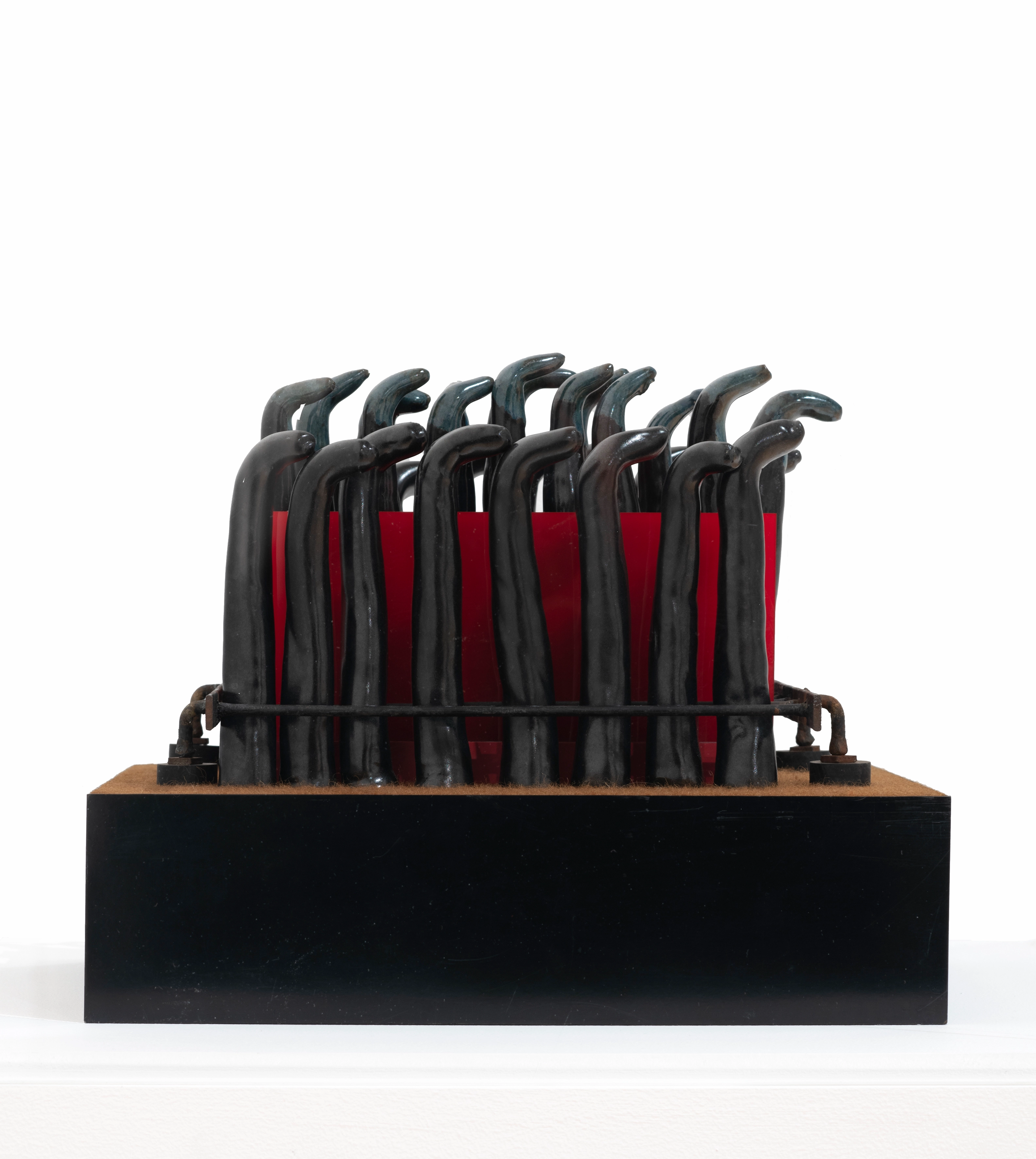
Locke initially rejected political readings of the Plantation Series, which is included in this show, insisting they were primarily exercises in form. It took years before he expressed what they were actually carrying. What have you learned about the distance between making and understanding that Locke experienced?
I think Donald’s commitment to formalism when he made the Plantation Series was tied up with him trying not to be confined by contemporaneous expectations of what Black art should be like, but I don’t think it is necessarily the case that he didn’t understand the work when he made it. From my perspective, it’s more that his understanding of this series, and the context in which it was made, changed over time. I would even argue that the constraints he placed upon himself – including his staunch refusal of socio-political readings and his commitment to art being ‘a function of plastic purposes’, as he put it – are an essential part of what makes these works so potent. They are beautiful and devastating in how they capture the traumatic histories of the plantation in form. For me, that Donald came to this realisation towards the end of his life reveals the subconscious magic that was at work when he made them.
When he moved to Atlanta in 1990 and encountered the work of Radcliffe Bailey, Lonnie Holley and Thornton Dial, something seemed to shift in his practice. Can you talk about that?
Despite moving from Guyana to Bath, Edinburgh, London and Arizona, it never ceases to amaze me that Donald described his relocation from Arizona to Atlanta as having the most profound effect on him. No doubt his encounters with these and other artists based in the American South were central to this lasting impression. Grace Anaeza Ali describes the work of Radcliffe Bailey and other Atlanta-based artists, such as Kevin Cole, Kevin Sipp and Larry Walker, as being ‘raw, intuitive and materially fearless’. Donald was already an intuitive artist, and so I think it was likely these artists’ fearlessness that he admired most and sought to emulate. They became friends and were in regular dialogue about each other’s work for many years. It is at this time that Donald began work on the mixed-media canvases that occupied him throughout the 1990s. In these paintings, centrifugal brushstrokes of black paint overlay found objects and images, including photocopies of his earlier sculptures. Though Donald develops a consistent visual language throughout the series, they carry a rather frantic energy and were often dismantled and reworked, connecting his own life experiences to the cultural history of the American South through layering and juxtaposition.
You've spent time with this work across three venues over two years. Has that time changed your relationship with the work?
More than anything, I would say that I have come to more fully appreciate different chapters of Donald’s life and work at each venue. I thought the 1990s paintings and extensive archive presentation worked well at Spike Island, for example, whereas at Ikon Gallery I had the impression that the ceramics, monochromatic paintings and mixed media sculptures of the 1960 and 70s came together better. At Camden Art Centre, I am drawn to how the 1980s sculptures look with the 1990s paintings as their backdrop, as it helps me to better understand their continuity.
When I first discovered Donald’s work, it was the Plantation Series and the monochromatic black paintings of the 1970s that captured me. It has taken me longer to appreciate what he was trying to do during the 1980s and 2000s, and how these works contribute to his overall trajectory. As the exhibition tour comes to an end, I am still struck by what an incredible artist, craftsperson and thinker Donald was, and by how much more work and study is necessary. At the recent ‘Edge of Spirit’ symposium at Camden Art Centre, for example, I was enthralled by Imani Mason Jordan’s reading of some of Donald’s poems. Though I had read many of them before in the archive at Emory University in Atlanta, Imani’s interpretation transformed them into something visceral and brilliant. It’s wonderful that ‘Resistant Forms’ has enabled a new generation of artists and audiences to engage so thoroughly with his work and legacy for the first time.

Camden Art Centre is the final stop for this retrospective, after Spike Island and Ikon Gallery. What will our readers experience during their visit?
The exhibition explores the development of Donald’s work across Guyana, the UK and the United States over five decades, from the late 1960s to the early 2000s. Audiences will encounter over 80 artworks that chart Donald’s unusual path as an artist. This includes early ceramics that evoke human and natural forms as well as mixed-media sculptures and monochromatic black paintings from the 1970s, such as works from the Plantation Series and his best-known work, ‘Trophies of Empire’ (1972-74). Also on display is the series of large-scale paintings he made in Atlanta during the 1990s and examples of his return to figuration in the last decade of his life in the form of carved wood sculptures, collages and painted vessels, all of which have never been shown in the UK before. Unfortunately, it is likely that this will be the last opportunity to see such a significant presentation of Donald’s work in the UK for several years to come, though hopefully a major museum retrospective here or elsewhere won’t be too long to follow!
Donald Locke: Resistant Forms is organised by Spike Island, Bristol; Ikon Gallery, Birmingham; and Camden Art Centre, London; with support from the Donald Locke Estate. The exhibitions at Spike Island and Ikon Gallery were curated by Robert Leckie, Director of Gasworks, London (and former Director of Spike Island). The exhibition at Camden Art Centre is curated by Martin Clark and Gina Buenfeld-Murley, in collaboration with Robert Leckie.
Donald Locke: Resistant Forms is on at the Camden Arts Centre until 30 August.
Don't forget to check in and leave your review on the gowithYamo app!