
Alyina Zaidi's Rewilding at Pilar Corrias
Through your paintings, you build fantastical, hopeful worlds. Do they exist outside this world?
They run parallel to this world. Whatever happens in this world informs the other. There are resemblances and moments of overlap, but it’s uncanny. There are no humans, but familiar elements. I often think: What if the sky were below us? Or if angels were real and made up of the earth? What if all the vegetables could talk and they were standing by like a chorus in a Greek tragedy? So it’s this world, but with a lot of “what ifs.” I started experimenting with taking worlds and looking at them through different perspectives, which happens in miniature paintings, and experimenting with bright colours, trying to get close in acrylic to those pigments in Pahari and Rajasthani styles.
Why did you choose the title “Rewilding” for your latest exhibition at Pilar Corrias?
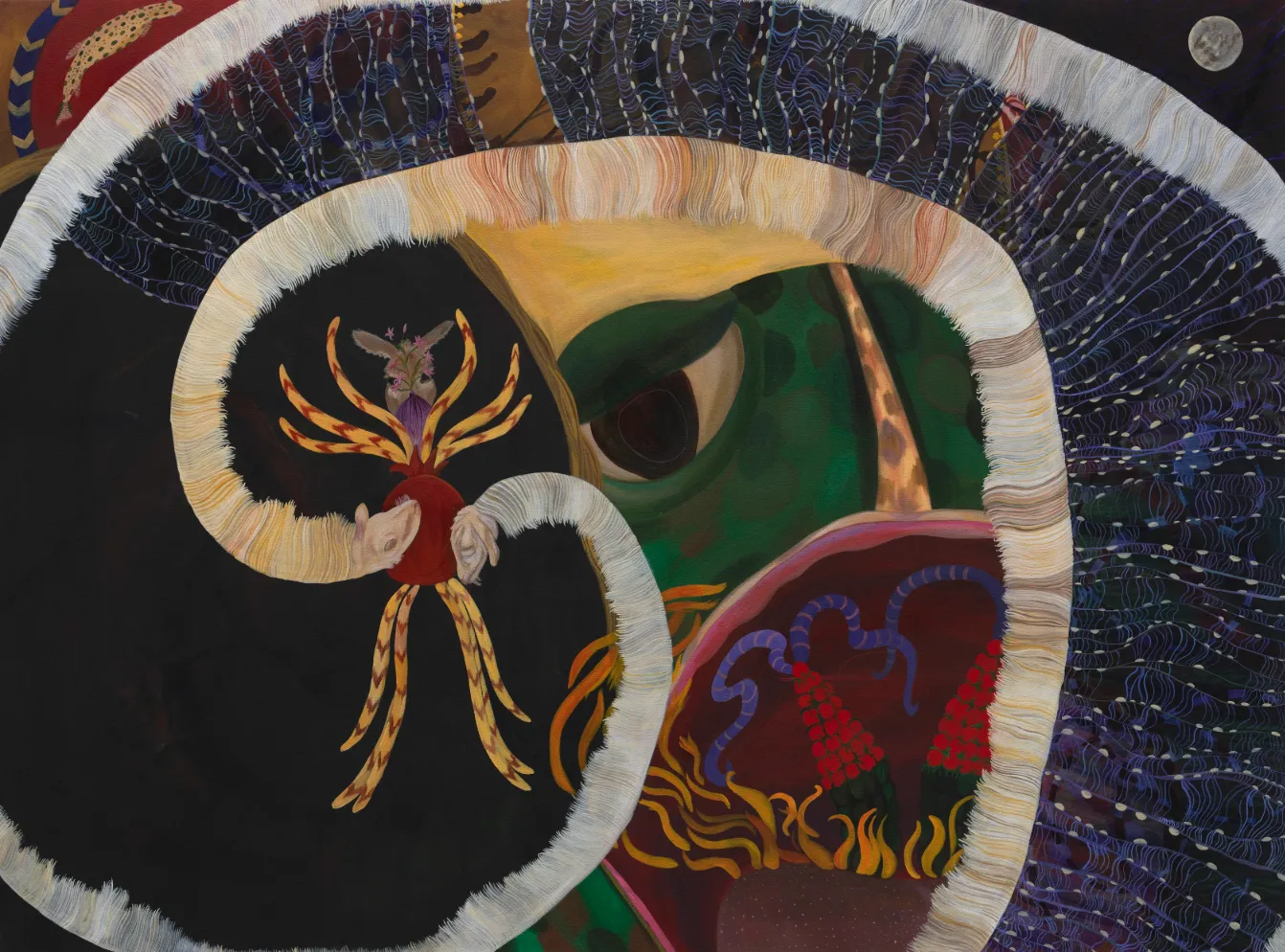
The title came from wanting to let loose from all of the order in my own world, and to introduce more movement and organic forms into the work. I juxtapose vertical man-made structures with organic, spiralling natural forms, inspired by the trout farms I saw growing up. In a way, it’s about nature fighting back against these manmade forms; a sense that the world will win in the end.

There is a palpable textiles influence in your work. Can you tell me about this?
Growing up in India between Delhi and Kashmir, I was exposed to a lot of textiles. The majority of art that should be in India is in museum collections in the West, so I would only see it when abroad. But in India, textiles were always there, like background noise, and you didn't really pay much attention to them. I came back to it much later. I now include veils and jewelled textiles in the works. The veils block sections of the landscape; I like the idea of the viewer never fully witnessing the scene as a whole. Also, Kalamkari - where you paint directly onto the cotton fabric - has inspired me to paint as smoothly and flatly as possible. I also play around with various textures, evoking the fibres of Kashmiri shawls.
You cite the Sienese school and Byzantine art as key influences. What appeals to you about these traditions?
I enjoy icon paintings from the Sienese school and how they play with perspective. People think perspective was learned in the Renaissance, but when I look at these paintings, that wasn’t what they were about. They were exploring landscapes, scenes, narratives, and depicting them in the best way possible - even if that meant shifting the world so the narrative could unfold. They feel more sacred and less representational. They’re not going for real life, but hinting at the divine - like the depiction of Christ’s transfiguration. That’s such an abstract phenomenon to depict, and their creativity and freedom in doing so is something I really enjoy. I’m also interested in the tail end of the Byzantium, which is a fascinating blend of East and West.
Are you also inspired by literature?
Lately, I have been going back and forth to the most recent translation of Arabian Nights by Yasmine Seale, the first woman to have translated the tales. It is a staple in my studio. There is a playfulness in the stories and a lot of “what ifs”. Also, The Decameron by Boccaccio; there are a lot of funny fables and crossovers with The Canterbury Tales. I’m interested in how stories travel across cultures and regions, such as from the Arab world, the Mediterranean and the UK. I’m currently on a residency in Treberfydd in Wales, and I’m looking at medieval Welsh folklore, which can be humorous at times, bordering on the absurd. Currently, I’m reading The Mabinogion, a small compendium of Welsh folktales. The more you read, the more you realise the similarities between traditions and places.
Before studying painting at the RCA in London, you studied physics at Mount Holyoke College in Massachusetts. What impact does this have on your artistic practice?
It affects how I approach a painting or series. I approach it like solving a physics problem: identifying independent variables, fixed variables, and constants across paintings. It’s methodical. You define constraints: what stays constant, what changes, and that gives you freedom within a framework. Instead of feeling lost, you focus and push specific areas. For example, if I decide no humans will be depicted, I have to find alternatives, which leads to forms like vegetal spirits or angels made of rocks. That restriction creates possibilities.
You regularly incorporate animals in your work. What is their significance?
Many come from childhood. My father once ordered frogs to control a slug infestation in our garden. They were being transported from the countryside in a clay pot on a train, but after seeing them, the train conductor threw them onto the tracks! As a child, that stuck with me, and so the frogs ended up in my paintings. The goats reference pashmina goats from the Himalayan mountains; they are a symbol of Kashmir and home. Birds recently entered the world - I have made reference to a nightingale we have back home that we call bulbul. Their tweets are believed to signal a guest arriving, and usually, they do! I was recently moved by a wild white horse I saw on a hike in Treberfydd, so there will likely be a white horse appearing soon.
Please can you elaborate on the titles Abyme and Nazar?
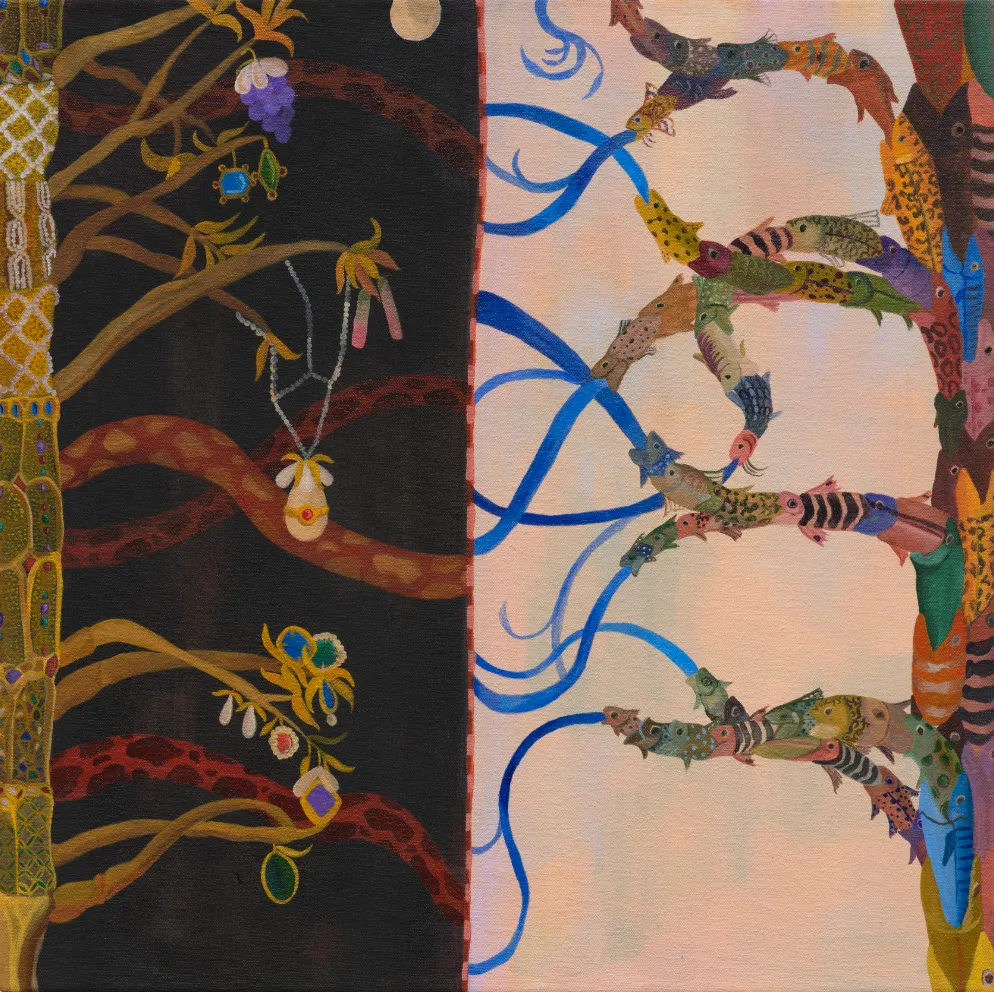
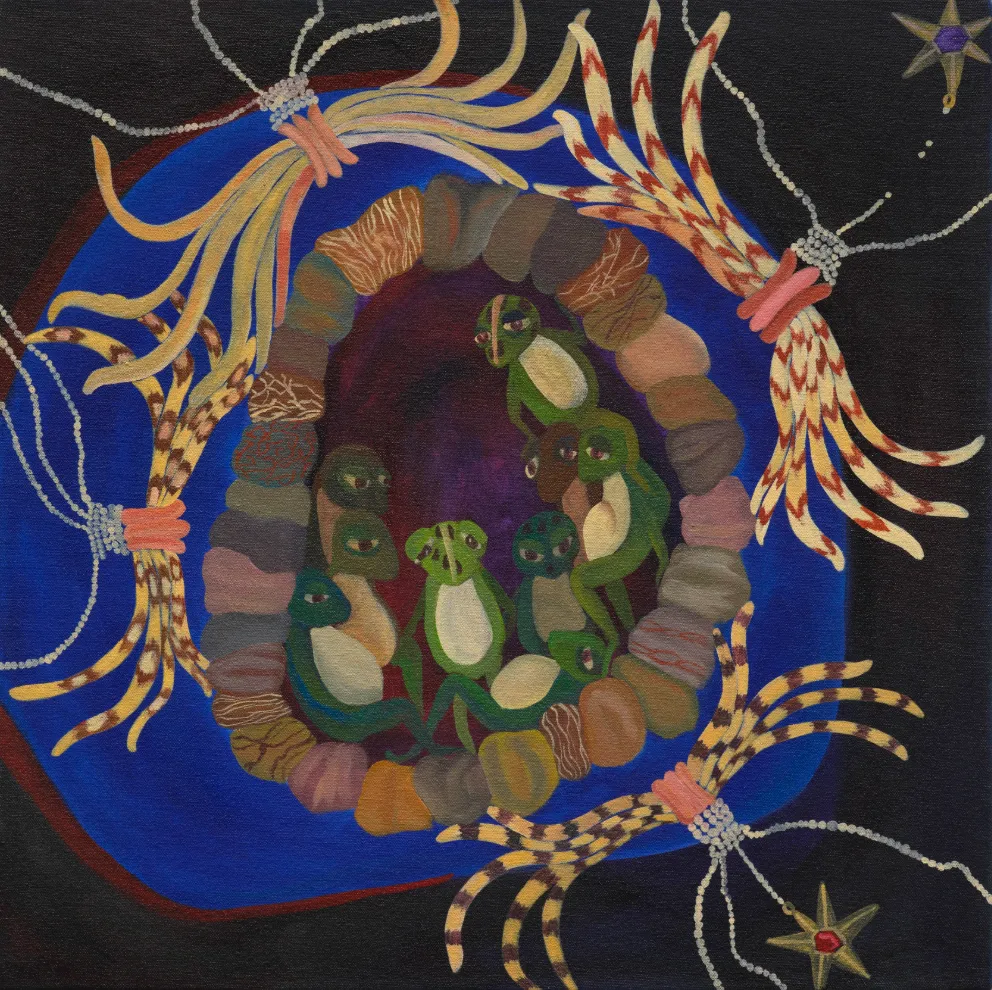
Abyme is a reference to the term mis en abyme. It’s a play on the idea of having stories within stories. In the work, there are two trees; each one is a tree, but one is made up of jewels on one side and fish on the other, and the fish spout water to form the smaller branches. Nazar means “to look,” but also “evil eye.” It refers to both - visually, it resembles the evil eye, but I’m also playing around with the idea of the frogs glancing at you. It’s really a painting about looking.
Would you say your work is political?
I think there’s politics in everything, and I’m responding to the world, so there is a political element, but in a subtle way. Fledgling is the most overtly political work in the show- a resistance painting at the gates of hell. It’s about life emerging amidst destruction.