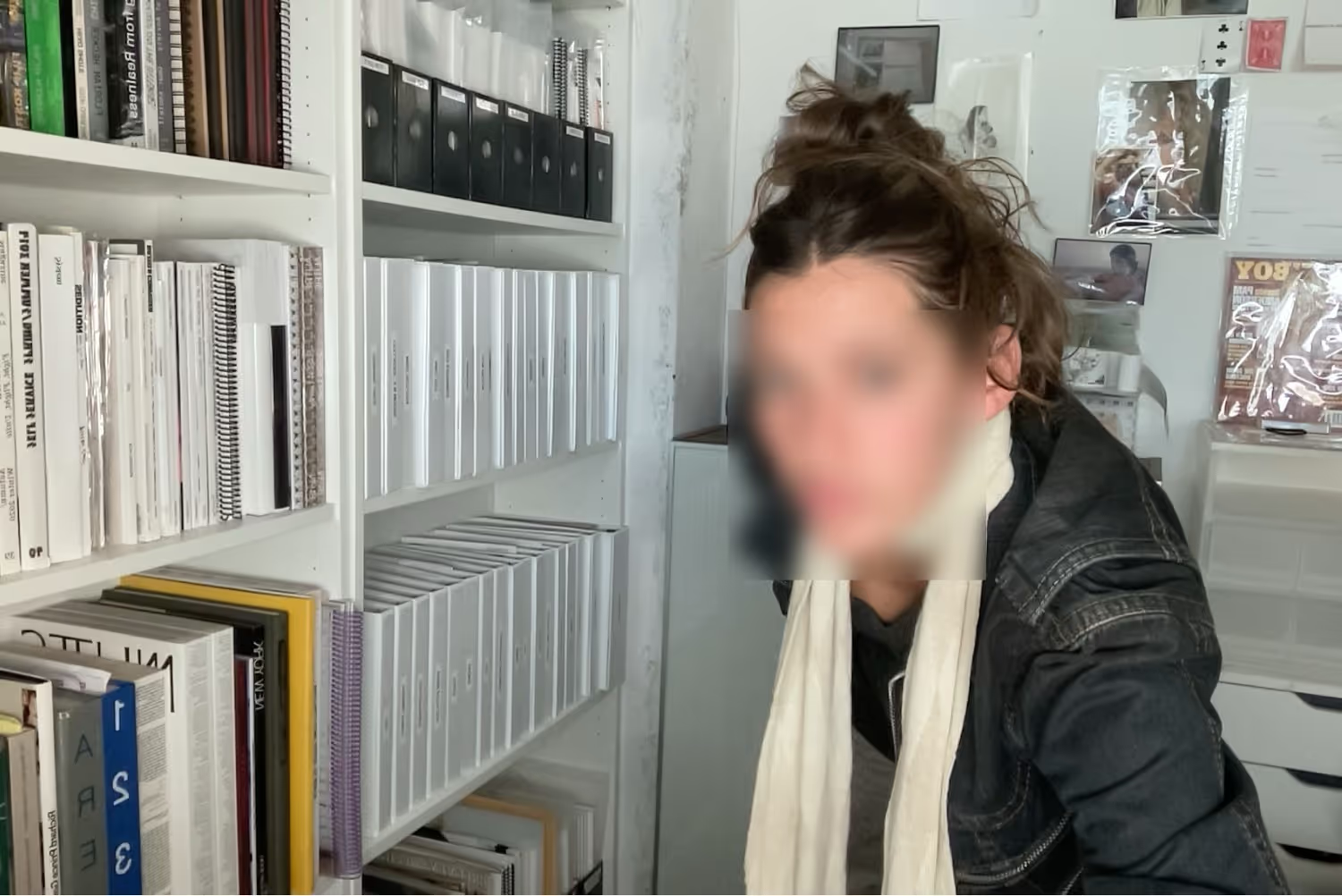
In Chronically Online, we present the artists who are narrating what it means to inhabit today's online landscape, reflecting on this very present and imagining new alternatives. In this first chapter, we talk to NY-born artist Zarina Nares, a lover of pixelated images, TikTok narratives and chaotic infographics. Here, she discusses screenshots, a work she dedicated to the Adam Levine cheating scandal, and her newborn online gallery TRIBECA.
A: Hi, Zarina, thank you for agreeing to do this interview. We’re interested in your relationship with screenshots and the idea of the archive. Screenshots are weird objects; they can be “digital junk” in your phone gallery, but they are also weird “broken” interfaces that replicate your own personal online world. Can you tell us more about your works focusing on screenshots?
Z: Screenshots are a form of photography to me, but shaped by attention rather than light. They’re an act of desire, of control, a way to hold onto something that tries to slip away. And yes, they’re incredibly personal. Even if you and I screenshot the same thing, there will always be differences: our interfaces, our timing, our battery percentage. I love that. They’re like sketches, honest and messy. They feel very human.
In my piece Seen Seen Seen (from Seen Seen Seen Seen Seen), I use screenshots as a material. The screenshot goes through a kind of physical process. I blow it up on my computer, photograph the screen with my phone, text it to a friend, screenshot it again, and keep going until I find something I like. I like how something digital starts to feel handled, how you can see it’s moved through different states of being.
.jpg)
A: A more general question: among the wide range of new feelings that have emerged through the merging of our life online with our culture — whether we talk about the algorithmic society, platform capitalism, the relationship with our self-image, the "corporativisation" of our online personas, etc, which one do you think is the most urgent to talk about, and why?
Z: I think it’s all one and the same. The algorithmic self, platform capitalism, self-image, the corporatisation of our personas, they’re all part of the same feedback loop. So I don’t think it matters where you start; if the conversation is honest, it inevitably leads to one another.
It’s not that we shouldn’t focus on specific issues, but I think what’s most urgent is learning to speak about them holistically, to understand how emotion, economics, technology, and identity are completely intertwined. It’s all the same organism.
A: What’s your modus operandi when you begin researching a topic? Is it more like digital ethnography, traditional reading, or how does that initial spark usually happen?
Z: The initial spark is usually visual. I see something in my head, and then it’s just a matter of following whatever I need to in order to materialise it. I don’t really start with research in a traditional sense. It’s usually something I’m personally preoccupied with: a feeling, a tension, something I’m trying to understand in myself, something I can’t stop thinking about. And then I look outward to see if that same impulse is reflected collectively, especially through social media, YouTube.
You could say it’s a process of trying not to feel alone lol. From there, I fall into a kind of digital ethnography by accident (as much as one’s algorithm can be an accident). But it’s not about finding information so much as tracing patterns of behaviour and emotion.
A: Which of your works are you most attached to, and why?
Z: Probably my video piece, How To Be THAT Girl, because it was truly so fun to make. It’s the first video piece I ever made, so I was working out all these things for the first time. Kind of like falling in love for the first time. It felt kind of psychedelic, and also really pure. It actually started as an album, and I feel the most free when I’m working on music. I can recognise the joy still in the editing. I think of it like dance. And, it reminds me not to take myself too seriously.
A: How would you describe yourself as an online user, and what are some of your typical habits online?
Z: I joke with my friend Flip that I have more social anxiety online than in person. I find DMing incredibly stressful. But I am on YouTube a lot.
A: Devirtualising online forms, images, feelings and transforming them into physical artworks is a very specific process that can be done in many ways and using many different approaches. How does it work for you specifically?
Z: I’m usually trying to give an online form time and space to exist differently. The digital is already physical; it’s just so tiny and speedy, and it often doesn’t match the emotional charge behind it. That mismatch can feel really disorienting. But I think when you try to mimic that, by blowing something up or slowing it down, everything compressed within it starts to expand. I’m trying to let it breathe, because then you can see what remains and what reveals itself. It’s a way of testing its emotional weight. I think of the digital and the physical as different states of the same world. The approach is about seeing how each state makes room for what the other can’t.
A: We really love your work I Disagree: it does a great job in magnifying a kind of interaction that we’ve become so accustomed to (whether we do it or watch other people doing it). Can you tell us a bit more about that work and your process while making it?
Z: Thank you!
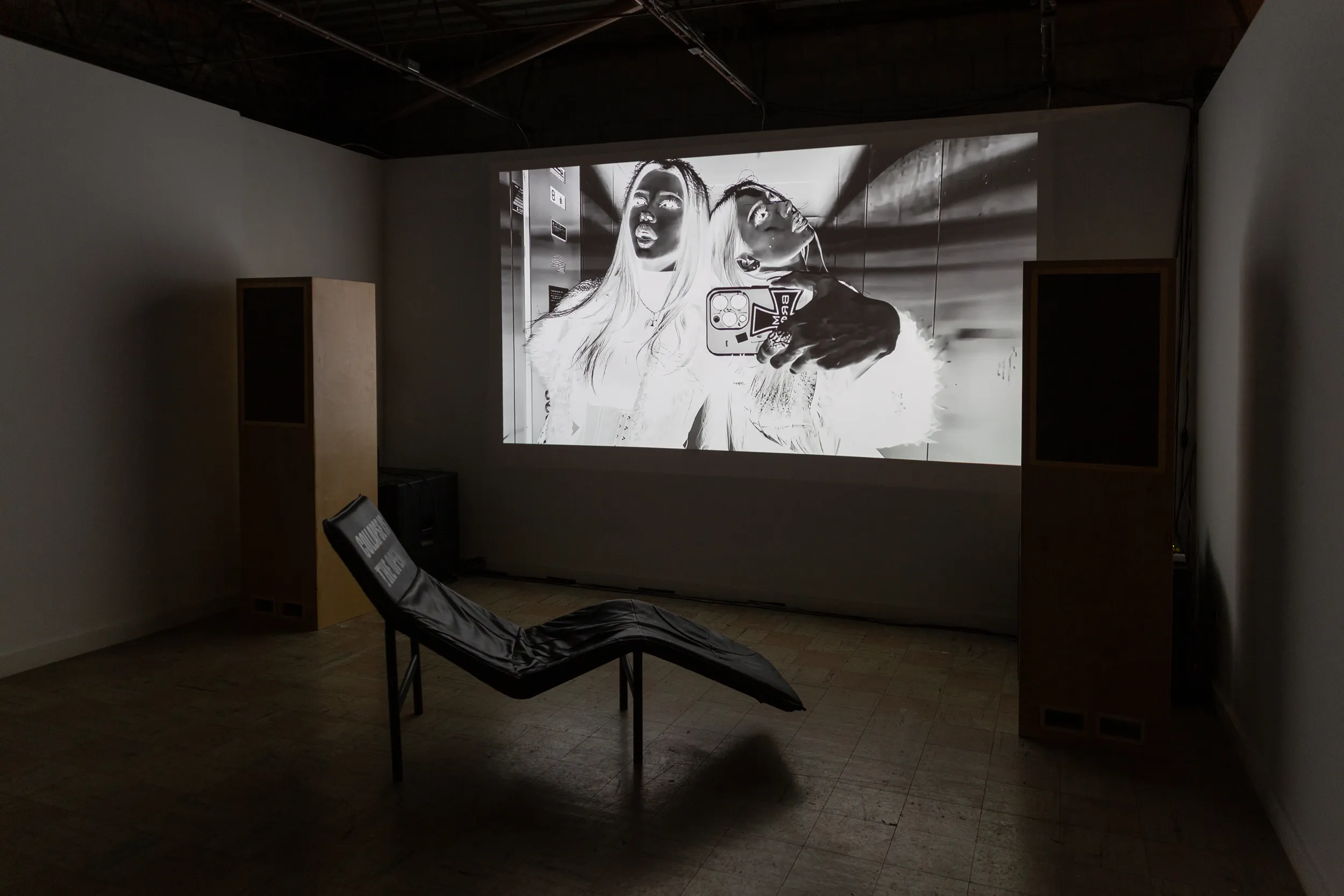
When the Adam Levine cheating story exploded on TikTok, I was doomscrolling through the flood of reactions women were posting. It was fascinating; the comments section had come to life. On the surface, it was celebrity gossip, but the way it played out online revealed so many layers: morality, gender, trust, power, desire, love. There were debates within debates. I wanted to stage a coherent argument out of that chaos. So I downloaded every TikTok I could find, every point that was made, and constructed the piece from there. I made it a two-channel work, so it felt like a back and forth, one claim followed by its opposite, then a kind of synthesis, like a dialectical scroll. The whole piece is a spiral; it loops.
What interested me most was whether the viewer, myself included, could begin to agree with contradictory takes, to hold multiple, opposing truths at once. To watch the piece, you inherently have to hold space for every argument. And I think it begins to reveal the ways moral outrage mirrors our own contradictions, projections, and self-judgment. And it’s kind of not about Adam Levine at all, which is nice.
.jpg)
A: In Slow Down, you present a reflection of the anxiety of eternal movement and the need for “stillness” in the digital age. Can you tell us more about this project?
Z: Slow Down began at a time when I was struggling with a deep sense of emptiness, something I think many of us have carried through 2024 and 2025. Around then, I came across the philosopher Keiji Nishitani, who critiques the West for having only a superficial experience of nihilism. He writes that nihilism is something you have to enter fully in order to move beyond it, because within the void, another ground of being begins to appear, where inherited meaning dissolves and re-emerges from within. I loved that, the idea that you can only transcend emptiness by inhabiting it, that by entering nihilism fully, it becomes the path beyond itself. The project became a kind of personal experiment in this, to sit inside the tension between meaning and nothingness.
The work itself takes the form of thirteen books, each isolating fragments of media, a scream, an endless tunnel, and Kylie Jenner, and all explore in their own ways what happens when you give something designed for speed too much time, when attention replaces motion. Many of the books translate video footage into still images, which turns a few seconds into hundreds of pages. And if you actually sit there and flip through every page, you see and feel things morph, distort, and invent things that weren’t there before. But they also begin to fall quiet, like hearing a word so many times it loses its meaning. I’m interested in what happens when you continue looking after, meaning has quieted.
A: Can you tell us more about your next project or what you’re working on right now?
Z: I’ve just started a Tumblr-based art gallery called TRIBECA GALLERY. It functions like a physical gallery in that it’s open Thursday through Sunday from 12 to 6 PM (EST), and otherwise closed (password-protected). Curating is new for me, so we’ll see how that goes. I’m a bit nervous. But I made it because I see so much incredible work being made around me, whether it’s a long-form video piece or an Instagram Reel, and I wanted to create a space that takes it all as seriously as I do (while also not taking itself too seriously) (but still very serious).
A: What’s one thing about our relationship with the internet that you think will change the course of human life, from this 21st century on?
Z: I don’t know if I can say how it’ll change the course of human life, but I think a lot about how it’s changing us now. I think it reveals a lot about the mess of being human, how paradox feels like a condition of being alive, and maybe that tension is what makes things real.
In Chronically Online, we present the artists who are narrating what it means to inhabit today's online landscape, reflecting on this very present and imagining new alternatives. In this first chapter, we talk to NY-born artist Zarina Nares, a lover of pixelated images, TikTok narratives and chaotic infographics. Here, she discusses screenshots, a work she dedicated to the Adam Levine cheating scandal, and her newborn online gallery TRIBECA.
A: Hi, Zarina, thank you for agreeing to do this interview. We’re interested in your relationship with screenshots and the idea of the archive. Screenshots are weird objects; they can be “digital junk” in your phone gallery, but they are also weird “broken” interfaces that replicate your own personal online world. Can you tell us more about your works focusing on screenshots?
Z: Screenshots are a form of photography to me, but shaped by attention rather than light. They’re an act of desire, of control, a way to hold onto something that tries to slip away. And yes, they’re incredibly personal. Even if you and I screenshot the same thing, there will always be differences: our interfaces, our timing, our battery percentage. I love that. They’re like sketches, honest and messy. They feel very human.
In my piece Seen Seen Seen (from Seen Seen Seen Seen Seen), I use screenshots as a material. The screenshot goes through a kind of physical process. I blow it up on my computer, photograph the screen with my phone, text it to a friend, screenshot it again, and keep going until I find something I like. I like how something digital starts to feel handled, how you can see it’s moved through different states of being.
.jpg)
A: A more general question: among the wide range of new feelings that have emerged through the merging of our life online with our culture — whether we talk about the algorithmic society, platform capitalism, the relationship with our self-image, the "corporativisation" of our online personas, etc, which one do you think is the most urgent to talk about, and why?
Z: I think it’s all one and the same. The algorithmic self, platform capitalism, self-image, the corporatisation of our personas, they’re all part of the same feedback loop. So I don’t think it matters where you start; if the conversation is honest, it inevitably leads to one another.
It’s not that we shouldn’t focus on specific issues, but I think what’s most urgent is learning to speak about them holistically, to understand how emotion, economics, technology, and identity are completely intertwined. It’s all the same organism.

A: What’s your modus operandi when you begin researching a topic? Is it more like digital ethnography, traditional reading, or how does that initial spark usually happen?
Z: The initial spark is usually visual. I see something in my head, and then it’s just a matter of following whatever I need to in order to materialise it. I don’t really start with research in a traditional sense. It’s usually something I’m personally preoccupied with: a feeling, a tension, something I’m trying to understand in myself, something I can’t stop thinking about. And then I look outward to see if that same impulse is reflected collectively, especially through social media, YouTube.
You could say it’s a process of trying not to feel alone lol. From there, I fall into a kind of digital ethnography by accident (as much as one’s algorithm can be an accident). But it’s not about finding information so much as tracing patterns of behaviour and emotion.
A: Which of your works are you most attached to, and why?
Z: Probably my video piece, How To Be THAT Girl, because it was truly so fun to make. It’s the first video piece I ever made, so I was working out all these things for the first time. Kind of like falling in love for the first time. It felt kind of psychedelic, and also really pure. It actually started as an album, and I feel the most free when I’m working on music. I can recognise the joy still in the editing. I think of it like dance. And, it reminds me not to take myself too seriously.
A: How would you describe yourself as an online user, and what are some of your typical habits online?
Z: I joke with my friend Flip that I have more social anxiety online than in person. I find DMing incredibly stressful. But I am on YouTube a lot.
A: Devirtualising online forms, images, feelings and transforming them into physical artworks is a very specific process that can be done in many ways and using many different approaches. How does it work for you specifically?
Z: I’m usually trying to give an online form time and space to exist differently. The digital is already physical; it’s just so tiny and speedy, and it often doesn’t match the emotional charge behind it. That mismatch can feel really disorienting. But I think when you try to mimic that, by blowing something up or slowing it down, everything compressed within it starts to expand. I’m trying to let it breathe, because then you can see what remains and what reveals itself. It’s a way of testing its emotional weight. I think of the digital and the physical as different states of the same world. The approach is about seeing how each state makes room for what the other can’t.
A: We really love your work I Disagree: it does a great job in magnifying a kind of interaction that we’ve become so accustomed to (whether we do it or watch other people doing it). Can you tell us a bit more about that work and your process while making it?
Z: Thank you!
When the Adam Levine cheating story exploded on TikTok, I was doomscrolling through the flood of reactions women were posting. It was fascinating; the comments section had come to life. On the surface, it was celebrity gossip, but the way it played out online revealed so many layers: morality, gender, trust, power, desire, love. There were debates within debates. I wanted to stage a coherent argument out of that chaos. So I downloaded every TikTok I could find, every point that was made, and constructed the piece from there. I made it a two-channel work, so it felt like a back and forth, one claim followed by its opposite, then a kind of synthesis, like a dialectical scroll. The whole piece is a spiral; it loops.
What interested me most was whether the viewer, myself included, could begin to agree with contradictory takes, to hold multiple, opposing truths at once. To watch the piece, you inherently have to hold space for every argument. And I think it begins to reveal the ways moral outrage mirrors our own contradictions, projections, and self-judgment. And it’s kind of not about Adam Levine at all, which is nice.
.jpg)
A: In Slow Down, you present a reflection of the anxiety of eternal movement and the need for “stillness” in the digital age. Can you tell us more about this project?
Z: Slow Down began at a time when I was struggling with a deep sense of emptiness, something I think many of us have carried through 2024 and 2025. Around then, I came across the philosopher Keiji Nishitani, who critiques the West for having only a superficial experience of nihilism. He writes that nihilism is something you have to enter fully in order to move beyond it, because within the void, another ground of being begins to appear, where inherited meaning dissolves and re-emerges from within. I loved that, the idea that you can only transcend emptiness by inhabiting it, that by entering nihilism fully, it becomes the path beyond itself. The project became a kind of personal experiment in this, to sit inside the tension between meaning and nothingness.
The work itself takes the form of thirteen books, each isolating fragments of media, a scream, an endless tunnel, and Kylie Jenner, and all explore in their own ways what happens when you give something designed for speed too much time, when attention replaces motion. Many of the books translate video footage into still images, which turns a few seconds into hundreds of pages. And if you actually sit there and flip through every page, you see and feel things morph, distort, and invent things that weren’t there before. But they also begin to fall quiet, like hearing a word so many times it loses its meaning. I’m interested in what happens when you continue looking after, meaning has quieted.
A: Can you tell us more about your next project or what you’re working on right now?
Z: I’ve just started a Tumblr-based art gallery called TRIBECA GALLERY. It functions like a physical gallery in that it’s open Thursday through Sunday from 12 to 6 PM (EST), and otherwise closed (password-protected). Curating is new for me, so we’ll see how that goes. I’m a bit nervous. But I made it because I see so much incredible work being made around me, whether it’s a long-form video piece or an Instagram Reel, and I wanted to create a space that takes it all as seriously as I do (while also not taking itself too seriously) (but still very serious).
A: What’s one thing about our relationship with the internet that you think will change the course of human life, from this 21st century on?
Z: I don’t know if I can say how it’ll change the course of human life, but I think a lot about how it’s changing us now. I think it reveals a lot about the mess of being human, how paradox feels like a condition of being alive, and maybe that tension is what makes things real.
In Chronically Online, we present the artists who are narrating what it means to inhabit today's online landscape, reflecting on this very present and imagining new alternatives. In this first chapter, we talk to NY-born artist Zarina Nares, a lover of pixelated images, TikTok narratives and chaotic infographics. Here, she discusses screenshots, a work she dedicated to the Adam Levine cheating scandal, and her newborn online gallery TRIBECA.
A: Hi, Zarina, thank you for agreeing to do this interview. We’re interested in your relationship with screenshots and the idea of the archive. Screenshots are weird objects; they can be “digital junk” in your phone gallery, but they are also weird “broken” interfaces that replicate your own personal online world. Can you tell us more about your works focusing on screenshots?
Z: Screenshots are a form of photography to me, but shaped by attention rather than light. They’re an act of desire, of control, a way to hold onto something that tries to slip away. And yes, they’re incredibly personal. Even if you and I screenshot the same thing, there will always be differences: our interfaces, our timing, our battery percentage. I love that. They’re like sketches, honest and messy. They feel very human.
In my piece Seen Seen Seen (from Seen Seen Seen Seen Seen), I use screenshots as a material. The screenshot goes through a kind of physical process. I blow it up on my computer, photograph the screen with my phone, text it to a friend, screenshot it again, and keep going until I find something I like. I like how something digital starts to feel handled, how you can see it’s moved through different states of being.
.jpg)
A: A more general question: among the wide range of new feelings that have emerged through the merging of our life online with our culture — whether we talk about the algorithmic society, platform capitalism, the relationship with our self-image, the "corporativisation" of our online personas, etc, which one do you think is the most urgent to talk about, and why?
Z: I think it’s all one and the same. The algorithmic self, platform capitalism, self-image, the corporatisation of our personas, they’re all part of the same feedback loop. So I don’t think it matters where you start; if the conversation is honest, it inevitably leads to one another.
It’s not that we shouldn’t focus on specific issues, but I think what’s most urgent is learning to speak about them holistically, to understand how emotion, economics, technology, and identity are completely intertwined. It’s all the same organism.

A: What’s your modus operandi when you begin researching a topic? Is it more like digital ethnography, traditional reading, or how does that initial spark usually happen?
Z: The initial spark is usually visual. I see something in my head, and then it’s just a matter of following whatever I need to in order to materialise it. I don’t really start with research in a traditional sense. It’s usually something I’m personally preoccupied with: a feeling, a tension, something I’m trying to understand in myself, something I can’t stop thinking about. And then I look outward to see if that same impulse is reflected collectively, especially through social media, YouTube.
You could say it’s a process of trying not to feel alone lol. From there, I fall into a kind of digital ethnography by accident (as much as one’s algorithm can be an accident). But it’s not about finding information so much as tracing patterns of behaviour and emotion.
A: Which of your works are you most attached to, and why?
Z: Probably my video piece, How To Be THAT Girl, because it was truly so fun to make. It’s the first video piece I ever made, so I was working out all these things for the first time. Kind of like falling in love for the first time. It felt kind of psychedelic, and also really pure. It actually started as an album, and I feel the most free when I’m working on music. I can recognise the joy still in the editing. I think of it like dance. And, it reminds me not to take myself too seriously.
A: How would you describe yourself as an online user, and what are some of your typical habits online?
Z: I joke with my friend Flip that I have more social anxiety online than in person. I find DMing incredibly stressful. But I am on YouTube a lot.
A: Devirtualising online forms, images, feelings and transforming them into physical artworks is a very specific process that can be done in many ways and using many different approaches. How does it work for you specifically?
Z: I’m usually trying to give an online form time and space to exist differently. The digital is already physical; it’s just so tiny and speedy, and it often doesn’t match the emotional charge behind it. That mismatch can feel really disorienting. But I think when you try to mimic that, by blowing something up or slowing it down, everything compressed within it starts to expand. I’m trying to let it breathe, because then you can see what remains and what reveals itself. It’s a way of testing its emotional weight. I think of the digital and the physical as different states of the same world. The approach is about seeing how each state makes room for what the other can’t.
A: We really love your work I Disagree: it does a great job in magnifying a kind of interaction that we’ve become so accustomed to (whether we do it or watch other people doing it). Can you tell us a bit more about that work and your process while making it?
Z: Thank you!
When the Adam Levine cheating story exploded on TikTok, I was doomscrolling through the flood of reactions women were posting. It was fascinating; the comments section had come to life. On the surface, it was celebrity gossip, but the way it played out online revealed so many layers: morality, gender, trust, power, desire, love. There were debates within debates. I wanted to stage a coherent argument out of that chaos. So I downloaded every TikTok I could find, every point that was made, and constructed the piece from there. I made it a two-channel work, so it felt like a back and forth, one claim followed by its opposite, then a kind of synthesis, like a dialectical scroll. The whole piece is a spiral; it loops.
What interested me most was whether the viewer, myself included, could begin to agree with contradictory takes, to hold multiple, opposing truths at once. To watch the piece, you inherently have to hold space for every argument. And I think it begins to reveal the ways moral outrage mirrors our own contradictions, projections, and self-judgment. And it’s kind of not about Adam Levine at all, which is nice.
.jpg)
A: In Slow Down, you present a reflection of the anxiety of eternal movement and the need for “stillness” in the digital age. Can you tell us more about this project?
Z: Slow Down began at a time when I was struggling with a deep sense of emptiness, something I think many of us have carried through 2024 and 2025. Around then, I came across the philosopher Keiji Nishitani, who critiques the West for having only a superficial experience of nihilism. He writes that nihilism is something you have to enter fully in order to move beyond it, because within the void, another ground of being begins to appear, where inherited meaning dissolves and re-emerges from within. I loved that, the idea that you can only transcend emptiness by inhabiting it, that by entering nihilism fully, it becomes the path beyond itself. The project became a kind of personal experiment in this, to sit inside the tension between meaning and nothingness.
The work itself takes the form of thirteen books, each isolating fragments of media, a scream, an endless tunnel, and Kylie Jenner, and all explore in their own ways what happens when you give something designed for speed too much time, when attention replaces motion. Many of the books translate video footage into still images, which turns a few seconds into hundreds of pages. And if you actually sit there and flip through every page, you see and feel things morph, distort, and invent things that weren’t there before. But they also begin to fall quiet, like hearing a word so many times it loses its meaning. I’m interested in what happens when you continue looking after, meaning has quieted.
A: Can you tell us more about your next project or what you’re working on right now?
Z: I’ve just started a Tumblr-based art gallery called TRIBECA GALLERY. It functions like a physical gallery in that it’s open Thursday through Sunday from 12 to 6 PM (EST), and otherwise closed (password-protected). Curating is new for me, so we’ll see how that goes. I’m a bit nervous. But I made it because I see so much incredible work being made around me, whether it’s a long-form video piece or an Instagram Reel, and I wanted to create a space that takes it all as seriously as I do (while also not taking itself too seriously) (but still very serious).
A: What’s one thing about our relationship with the internet that you think will change the course of human life, from this 21st century on?
Z: I don’t know if I can say how it’ll change the course of human life, but I think a lot about how it’s changing us now. I think it reveals a lot about the mess of being human, how paradox feels like a condition of being alive, and maybe that tension is what makes things real.
In Chronically Online, we present the artists who are narrating what it means to inhabit today's online landscape, reflecting on this very present and imagining new alternatives. In this first chapter, we talk to NY-born artist Zarina Nares, a lover of pixelated images, TikTok narratives and chaotic infographics. Here, she discusses screenshots, a work she dedicated to the Adam Levine cheating scandal, and her newborn online gallery TRIBECA.
A: Hi, Zarina, thank you for agreeing to do this interview. We’re interested in your relationship with screenshots and the idea of the archive. Screenshots are weird objects; they can be “digital junk” in your phone gallery, but they are also weird “broken” interfaces that replicate your own personal online world. Can you tell us more about your works focusing on screenshots?
Z: Screenshots are a form of photography to me, but shaped by attention rather than light. They’re an act of desire, of control, a way to hold onto something that tries to slip away. And yes, they’re incredibly personal. Even if you and I screenshot the same thing, there will always be differences: our interfaces, our timing, our battery percentage. I love that. They’re like sketches, honest and messy. They feel very human.
In my piece Seen Seen Seen (from Seen Seen Seen Seen Seen), I use screenshots as a material. The screenshot goes through a kind of physical process. I blow it up on my computer, photograph the screen with my phone, text it to a friend, screenshot it again, and keep going until I find something I like. I like how something digital starts to feel handled, how you can see it’s moved through different states of being.
.jpg)
A: A more general question: among the wide range of new feelings that have emerged through the merging of our life online with our culture — whether we talk about the algorithmic society, platform capitalism, the relationship with our self-image, the "corporativisation" of our online personas, etc, which one do you think is the most urgent to talk about, and why?
Z: I think it’s all one and the same. The algorithmic self, platform capitalism, self-image, the corporatisation of our personas, they’re all part of the same feedback loop. So I don’t think it matters where you start; if the conversation is honest, it inevitably leads to one another.
It’s not that we shouldn’t focus on specific issues, but I think what’s most urgent is learning to speak about them holistically, to understand how emotion, economics, technology, and identity are completely intertwined. It’s all the same organism.

A: What’s your modus operandi when you begin researching a topic? Is it more like digital ethnography, traditional reading, or how does that initial spark usually happen?
Z: The initial spark is usually visual. I see something in my head, and then it’s just a matter of following whatever I need to in order to materialise it. I don’t really start with research in a traditional sense. It’s usually something I’m personally preoccupied with: a feeling, a tension, something I’m trying to understand in myself, something I can’t stop thinking about. And then I look outward to see if that same impulse is reflected collectively, especially through social media, YouTube.
You could say it’s a process of trying not to feel alone lol. From there, I fall into a kind of digital ethnography by accident (as much as one’s algorithm can be an accident). But it’s not about finding information so much as tracing patterns of behaviour and emotion.
A: Which of your works are you most attached to, and why?
Z: Probably my video piece, How To Be THAT Girl, because it was truly so fun to make. It’s the first video piece I ever made, so I was working out all these things for the first time. Kind of like falling in love for the first time. It felt kind of psychedelic, and also really pure. It actually started as an album, and I feel the most free when I’m working on music. I can recognise the joy still in the editing. I think of it like dance. And, it reminds me not to take myself too seriously.
A: How would you describe yourself as an online user, and what are some of your typical habits online?
Z: I joke with my friend Flip that I have more social anxiety online than in person. I find DMing incredibly stressful. But I am on YouTube a lot.
A: Devirtualising online forms, images, feelings and transforming them into physical artworks is a very specific process that can be done in many ways and using many different approaches. How does it work for you specifically?
Z: I’m usually trying to give an online form time and space to exist differently. The digital is already physical; it’s just so tiny and speedy, and it often doesn’t match the emotional charge behind it. That mismatch can feel really disorienting. But I think when you try to mimic that, by blowing something up or slowing it down, everything compressed within it starts to expand. I’m trying to let it breathe, because then you can see what remains and what reveals itself. It’s a way of testing its emotional weight. I think of the digital and the physical as different states of the same world. The approach is about seeing how each state makes room for what the other can’t.
A: We really love your work I Disagree: it does a great job in magnifying a kind of interaction that we’ve become so accustomed to (whether we do it or watch other people doing it). Can you tell us a bit more about that work and your process while making it?
Z: Thank you!
When the Adam Levine cheating story exploded on TikTok, I was doomscrolling through the flood of reactions women were posting. It was fascinating; the comments section had come to life. On the surface, it was celebrity gossip, but the way it played out online revealed so many layers: morality, gender, trust, power, desire, love. There were debates within debates. I wanted to stage a coherent argument out of that chaos. So I downloaded every TikTok I could find, every point that was made, and constructed the piece from there. I made it a two-channel work, so it felt like a back and forth, one claim followed by its opposite, then a kind of synthesis, like a dialectical scroll. The whole piece is a spiral; it loops.
What interested me most was whether the viewer, myself included, could begin to agree with contradictory takes, to hold multiple, opposing truths at once. To watch the piece, you inherently have to hold space for every argument. And I think it begins to reveal the ways moral outrage mirrors our own contradictions, projections, and self-judgment. And it’s kind of not about Adam Levine at all, which is nice.
.jpg)
A: In Slow Down, you present a reflection of the anxiety of eternal movement and the need for “stillness” in the digital age. Can you tell us more about this project?
Z: Slow Down began at a time when I was struggling with a deep sense of emptiness, something I think many of us have carried through 2024 and 2025. Around then, I came across the philosopher Keiji Nishitani, who critiques the West for having only a superficial experience of nihilism. He writes that nihilism is something you have to enter fully in order to move beyond it, because within the void, another ground of being begins to appear, where inherited meaning dissolves and re-emerges from within. I loved that, the idea that you can only transcend emptiness by inhabiting it, that by entering nihilism fully, it becomes the path beyond itself. The project became a kind of personal experiment in this, to sit inside the tension between meaning and nothingness.
The work itself takes the form of thirteen books, each isolating fragments of media, a scream, an endless tunnel, and Kylie Jenner, and all explore in their own ways what happens when you give something designed for speed too much time, when attention replaces motion. Many of the books translate video footage into still images, which turns a few seconds into hundreds of pages. And if you actually sit there and flip through every page, you see and feel things morph, distort, and invent things that weren’t there before. But they also begin to fall quiet, like hearing a word so many times it loses its meaning. I’m interested in what happens when you continue looking after, meaning has quieted.
A: Can you tell us more about your next project or what you’re working on right now?
Z: I’ve just started a Tumblr-based art gallery called TRIBECA GALLERY. It functions like a physical gallery in that it’s open Thursday through Sunday from 12 to 6 PM (EST), and otherwise closed (password-protected). Curating is new for me, so we’ll see how that goes. I’m a bit nervous. But I made it because I see so much incredible work being made around me, whether it’s a long-form video piece or an Instagram Reel, and I wanted to create a space that takes it all as seriously as I do (while also not taking itself too seriously) (but still very serious).
A: What’s one thing about our relationship with the internet that you think will change the course of human life, from this 21st century on?
Z: I don’t know if I can say how it’ll change the course of human life, but I think a lot about how it’s changing us now. I think it reveals a lot about the mess of being human, how paradox feels like a condition of being alive, and maybe that tension is what makes things real.
In Chronically Online, we present the artists who are narrating what it means to inhabit today's online landscape, reflecting on this very present and imagining new alternatives. In this first chapter, we talk to NY-born artist Zarina Nares, a lover of pixelated images, TikTok narratives and chaotic infographics. Here, she discusses screenshots, a work she dedicated to the Adam Levine cheating scandal, and her newborn online gallery TRIBECA.
A: Hi, Zarina, thank you for agreeing to do this interview. We’re interested in your relationship with screenshots and the idea of the archive. Screenshots are weird objects; they can be “digital junk” in your phone gallery, but they are also weird “broken” interfaces that replicate your own personal online world. Can you tell us more about your works focusing on screenshots?
Z: Screenshots are a form of photography to me, but shaped by attention rather than light. They’re an act of desire, of control, a way to hold onto something that tries to slip away. And yes, they’re incredibly personal. Even if you and I screenshot the same thing, there will always be differences: our interfaces, our timing, our battery percentage. I love that. They’re like sketches, honest and messy. They feel very human.
In my piece Seen Seen Seen (from Seen Seen Seen Seen Seen), I use screenshots as a material. The screenshot goes through a kind of physical process. I blow it up on my computer, photograph the screen with my phone, text it to a friend, screenshot it again, and keep going until I find something I like. I like how something digital starts to feel handled, how you can see it’s moved through different states of being.
.jpg)
A: A more general question: among the wide range of new feelings that have emerged through the merging of our life online with our culture — whether we talk about the algorithmic society, platform capitalism, the relationship with our self-image, the "corporativisation" of our online personas, etc, which one do you think is the most urgent to talk about, and why?
Z: I think it’s all one and the same. The algorithmic self, platform capitalism, self-image, the corporatisation of our personas, they’re all part of the same feedback loop. So I don’t think it matters where you start; if the conversation is honest, it inevitably leads to one another.
It’s not that we shouldn’t focus on specific issues, but I think what’s most urgent is learning to speak about them holistically, to understand how emotion, economics, technology, and identity are completely intertwined. It’s all the same organism.

A: What’s your modus operandi when you begin researching a topic? Is it more like digital ethnography, traditional reading, or how does that initial spark usually happen?
Z: The initial spark is usually visual. I see something in my head, and then it’s just a matter of following whatever I need to in order to materialise it. I don’t really start with research in a traditional sense. It’s usually something I’m personally preoccupied with: a feeling, a tension, something I’m trying to understand in myself, something I can’t stop thinking about. And then I look outward to see if that same impulse is reflected collectively, especially through social media, YouTube.
You could say it’s a process of trying not to feel alone lol. From there, I fall into a kind of digital ethnography by accident (as much as one’s algorithm can be an accident). But it’s not about finding information so much as tracing patterns of behaviour and emotion.
A: Which of your works are you most attached to, and why?
Z: Probably my video piece, How To Be THAT Girl, because it was truly so fun to make. It’s the first video piece I ever made, so I was working out all these things for the first time. Kind of like falling in love for the first time. It felt kind of psychedelic, and also really pure. It actually started as an album, and I feel the most free when I’m working on music. I can recognise the joy still in the editing. I think of it like dance. And, it reminds me not to take myself too seriously.
A: How would you describe yourself as an online user, and what are some of your typical habits online?
Z: I joke with my friend Flip that I have more social anxiety online than in person. I find DMing incredibly stressful. But I am on YouTube a lot.
A: Devirtualising online forms, images, feelings and transforming them into physical artworks is a very specific process that can be done in many ways and using many different approaches. How does it work for you specifically?
Z: I’m usually trying to give an online form time and space to exist differently. The digital is already physical; it’s just so tiny and speedy, and it often doesn’t match the emotional charge behind it. That mismatch can feel really disorienting. But I think when you try to mimic that, by blowing something up or slowing it down, everything compressed within it starts to expand. I’m trying to let it breathe, because then you can see what remains and what reveals itself. It’s a way of testing its emotional weight. I think of the digital and the physical as different states of the same world. The approach is about seeing how each state makes room for what the other can’t.
A: We really love your work I Disagree: it does a great job in magnifying a kind of interaction that we’ve become so accustomed to (whether we do it or watch other people doing it). Can you tell us a bit more about that work and your process while making it?
Z: Thank you!
When the Adam Levine cheating story exploded on TikTok, I was doomscrolling through the flood of reactions women were posting. It was fascinating; the comments section had come to life. On the surface, it was celebrity gossip, but the way it played out online revealed so many layers: morality, gender, trust, power, desire, love. There were debates within debates. I wanted to stage a coherent argument out of that chaos. So I downloaded every TikTok I could find, every point that was made, and constructed the piece from there. I made it a two-channel work, so it felt like a back and forth, one claim followed by its opposite, then a kind of synthesis, like a dialectical scroll. The whole piece is a spiral; it loops.
What interested me most was whether the viewer, myself included, could begin to agree with contradictory takes, to hold multiple, opposing truths at once. To watch the piece, you inherently have to hold space for every argument. And I think it begins to reveal the ways moral outrage mirrors our own contradictions, projections, and self-judgment. And it’s kind of not about Adam Levine at all, which is nice.
.jpg)
A: In Slow Down, you present a reflection of the anxiety of eternal movement and the need for “stillness” in the digital age. Can you tell us more about this project?
Z: Slow Down began at a time when I was struggling with a deep sense of emptiness, something I think many of us have carried through 2024 and 2025. Around then, I came across the philosopher Keiji Nishitani, who critiques the West for having only a superficial experience of nihilism. He writes that nihilism is something you have to enter fully in order to move beyond it, because within the void, another ground of being begins to appear, where inherited meaning dissolves and re-emerges from within. I loved that, the idea that you can only transcend emptiness by inhabiting it, that by entering nihilism fully, it becomes the path beyond itself. The project became a kind of personal experiment in this, to sit inside the tension between meaning and nothingness.
The work itself takes the form of thirteen books, each isolating fragments of media, a scream, an endless tunnel, and Kylie Jenner, and all explore in their own ways what happens when you give something designed for speed too much time, when attention replaces motion. Many of the books translate video footage into still images, which turns a few seconds into hundreds of pages. And if you actually sit there and flip through every page, you see and feel things morph, distort, and invent things that weren’t there before. But they also begin to fall quiet, like hearing a word so many times it loses its meaning. I’m interested in what happens when you continue looking after, meaning has quieted.
A: Can you tell us more about your next project or what you’re working on right now?
Z: I’ve just started a Tumblr-based art gallery called TRIBECA GALLERY. It functions like a physical gallery in that it’s open Thursday through Sunday from 12 to 6 PM (EST), and otherwise closed (password-protected). Curating is new for me, so we’ll see how that goes. I’m a bit nervous. But I made it because I see so much incredible work being made around me, whether it’s a long-form video piece or an Instagram Reel, and I wanted to create a space that takes it all as seriously as I do (while also not taking itself too seriously) (but still very serious).
A: What’s one thing about our relationship with the internet that you think will change the course of human life, from this 21st century on?
Z: I don’t know if I can say how it’ll change the course of human life, but I think a lot about how it’s changing us now. I think it reveals a lot about the mess of being human, how paradox feels like a condition of being alive, and maybe that tension is what makes things real.
In Chronically Online, we present the artists who are narrating what it means to inhabit today's online landscape, reflecting on this very present and imagining new alternatives. In this first chapter, we talk to NY-born artist Zarina Nares, a lover of pixelated images, TikTok narratives and chaotic infographics. Here, she discusses screenshots, a work she dedicated to the Adam Levine cheating scandal, and her newborn online gallery TRIBECA.
A: Hi, Zarina, thank you for agreeing to do this interview. We’re interested in your relationship with screenshots and the idea of the archive. Screenshots are weird objects; they can be “digital junk” in your phone gallery, but they are also weird “broken” interfaces that replicate your own personal online world. Can you tell us more about your works focusing on screenshots?
Z: Screenshots are a form of photography to me, but shaped by attention rather than light. They’re an act of desire, of control, a way to hold onto something that tries to slip away. And yes, they’re incredibly personal. Even if you and I screenshot the same thing, there will always be differences: our interfaces, our timing, our battery percentage. I love that. They’re like sketches, honest and messy. They feel very human.
In my piece Seen Seen Seen (from Seen Seen Seen Seen Seen), I use screenshots as a material. The screenshot goes through a kind of physical process. I blow it up on my computer, photograph the screen with my phone, text it to a friend, screenshot it again, and keep going until I find something I like. I like how something digital starts to feel handled, how you can see it’s moved through different states of being.
.jpg)
A: A more general question: among the wide range of new feelings that have emerged through the merging of our life online with our culture — whether we talk about the algorithmic society, platform capitalism, the relationship with our self-image, the "corporativisation" of our online personas, etc, which one do you think is the most urgent to talk about, and why?
Z: I think it’s all one and the same. The algorithmic self, platform capitalism, self-image, the corporatisation of our personas, they’re all part of the same feedback loop. So I don’t think it matters where you start; if the conversation is honest, it inevitably leads to one another.
It’s not that we shouldn’t focus on specific issues, but I think what’s most urgent is learning to speak about them holistically, to understand how emotion, economics, technology, and identity are completely intertwined. It’s all the same organism.

A: What’s your modus operandi when you begin researching a topic? Is it more like digital ethnography, traditional reading, or how does that initial spark usually happen?
Z: The initial spark is usually visual. I see something in my head, and then it’s just a matter of following whatever I need to in order to materialise it. I don’t really start with research in a traditional sense. It’s usually something I’m personally preoccupied with: a feeling, a tension, something I’m trying to understand in myself, something I can’t stop thinking about. And then I look outward to see if that same impulse is reflected collectively, especially through social media, YouTube.
You could say it’s a process of trying not to feel alone lol. From there, I fall into a kind of digital ethnography by accident (as much as one’s algorithm can be an accident). But it’s not about finding information so much as tracing patterns of behaviour and emotion.
A: Which of your works are you most attached to, and why?
Z: Probably my video piece, How To Be THAT Girl, because it was truly so fun to make. It’s the first video piece I ever made, so I was working out all these things for the first time. Kind of like falling in love for the first time. It felt kind of psychedelic, and also really pure. It actually started as an album, and I feel the most free when I’m working on music. I can recognise the joy still in the editing. I think of it like dance. And, it reminds me not to take myself too seriously.
A: How would you describe yourself as an online user, and what are some of your typical habits online?
Z: I joke with my friend Flip that I have more social anxiety online than in person. I find DMing incredibly stressful. But I am on YouTube a lot.
A: Devirtualising online forms, images, feelings and transforming them into physical artworks is a very specific process that can be done in many ways and using many different approaches. How does it work for you specifically?
Z: I’m usually trying to give an online form time and space to exist differently. The digital is already physical; it’s just so tiny and speedy, and it often doesn’t match the emotional charge behind it. That mismatch can feel really disorienting. But I think when you try to mimic that, by blowing something up or slowing it down, everything compressed within it starts to expand. I’m trying to let it breathe, because then you can see what remains and what reveals itself. It’s a way of testing its emotional weight. I think of the digital and the physical as different states of the same world. The approach is about seeing how each state makes room for what the other can’t.
A: We really love your work I Disagree: it does a great job in magnifying a kind of interaction that we’ve become so accustomed to (whether we do it or watch other people doing it). Can you tell us a bit more about that work and your process while making it?
Z: Thank you!
When the Adam Levine cheating story exploded on TikTok, I was doomscrolling through the flood of reactions women were posting. It was fascinating; the comments section had come to life. On the surface, it was celebrity gossip, but the way it played out online revealed so many layers: morality, gender, trust, power, desire, love. There were debates within debates. I wanted to stage a coherent argument out of that chaos. So I downloaded every TikTok I could find, every point that was made, and constructed the piece from there. I made it a two-channel work, so it felt like a back and forth, one claim followed by its opposite, then a kind of synthesis, like a dialectical scroll. The whole piece is a spiral; it loops.
What interested me most was whether the viewer, myself included, could begin to agree with contradictory takes, to hold multiple, opposing truths at once. To watch the piece, you inherently have to hold space for every argument. And I think it begins to reveal the ways moral outrage mirrors our own contradictions, projections, and self-judgment. And it’s kind of not about Adam Levine at all, which is nice.
.jpg)
A: In Slow Down, you present a reflection of the anxiety of eternal movement and the need for “stillness” in the digital age. Can you tell us more about this project?
Z: Slow Down began at a time when I was struggling with a deep sense of emptiness, something I think many of us have carried through 2024 and 2025. Around then, I came across the philosopher Keiji Nishitani, who critiques the West for having only a superficial experience of nihilism. He writes that nihilism is something you have to enter fully in order to move beyond it, because within the void, another ground of being begins to appear, where inherited meaning dissolves and re-emerges from within. I loved that, the idea that you can only transcend emptiness by inhabiting it, that by entering nihilism fully, it becomes the path beyond itself. The project became a kind of personal experiment in this, to sit inside the tension between meaning and nothingness.
The work itself takes the form of thirteen books, each isolating fragments of media, a scream, an endless tunnel, and Kylie Jenner, and all explore in their own ways what happens when you give something designed for speed too much time, when attention replaces motion. Many of the books translate video footage into still images, which turns a few seconds into hundreds of pages. And if you actually sit there and flip through every page, you see and feel things morph, distort, and invent things that weren’t there before. But they also begin to fall quiet, like hearing a word so many times it loses its meaning. I’m interested in what happens when you continue looking after, meaning has quieted.
A: Can you tell us more about your next project or what you’re working on right now?
Z: I’ve just started a Tumblr-based art gallery called TRIBECA GALLERY. It functions like a physical gallery in that it’s open Thursday through Sunday from 12 to 6 PM (EST), and otherwise closed (password-protected). Curating is new for me, so we’ll see how that goes. I’m a bit nervous. But I made it because I see so much incredible work being made around me, whether it’s a long-form video piece or an Instagram Reel, and I wanted to create a space that takes it all as seriously as I do (while also not taking itself too seriously) (but still very serious).
A: What’s one thing about our relationship with the internet that you think will change the course of human life, from this 21st century on?
Z: I don’t know if I can say how it’ll change the course of human life, but I think a lot about how it’s changing us now. I think it reveals a lot about the mess of being human, how paradox feels like a condition of being alive, and maybe that tension is what makes things real.
In Chronically Online, we present the artists who are narrating what it means to inhabit today's online landscape, reflecting on this very present and imagining new alternatives. In this first chapter, we talk to NY-born artist Zarina Nares, a lover of pixelated images, TikTok narratives and chaotic infographics. Here, she discusses screenshots, a work she dedicated to the Adam Levine cheating scandal, and her newborn online gallery TRIBECA.
A: Hi, Zarina, thank you for agreeing to do this interview. We’re interested in your relationship with screenshots and the idea of the archive. Screenshots are weird objects; they can be “digital junk” in your phone gallery, but they are also weird “broken” interfaces that replicate your own personal online world. Can you tell us more about your works focusing on screenshots?
Z: Screenshots are a form of photography to me, but shaped by attention rather than light. They’re an act of desire, of control, a way to hold onto something that tries to slip away. And yes, they’re incredibly personal. Even if you and I screenshot the same thing, there will always be differences: our interfaces, our timing, our battery percentage. I love that. They’re like sketches, honest and messy. They feel very human.
In my piece Seen Seen Seen (from Seen Seen Seen Seen Seen), I use screenshots as a material. The screenshot goes through a kind of physical process. I blow it up on my computer, photograph the screen with my phone, text it to a friend, screenshot it again, and keep going until I find something I like. I like how something digital starts to feel handled, how you can see it’s moved through different states of being.
.jpg)
A: A more general question: among the wide range of new feelings that have emerged through the merging of our life online with our culture — whether we talk about the algorithmic society, platform capitalism, the relationship with our self-image, the "corporativisation" of our online personas, etc, which one do you think is the most urgent to talk about, and why?
Z: I think it’s all one and the same. The algorithmic self, platform capitalism, self-image, the corporatisation of our personas, they’re all part of the same feedback loop. So I don’t think it matters where you start; if the conversation is honest, it inevitably leads to one another.
It’s not that we shouldn’t focus on specific issues, but I think what’s most urgent is learning to speak about them holistically, to understand how emotion, economics, technology, and identity are completely intertwined. It’s all the same organism.

A: What’s your modus operandi when you begin researching a topic? Is it more like digital ethnography, traditional reading, or how does that initial spark usually happen?
Z: The initial spark is usually visual. I see something in my head, and then it’s just a matter of following whatever I need to in order to materialise it. I don’t really start with research in a traditional sense. It’s usually something I’m personally preoccupied with: a feeling, a tension, something I’m trying to understand in myself, something I can’t stop thinking about. And then I look outward to see if that same impulse is reflected collectively, especially through social media, YouTube.
You could say it’s a process of trying not to feel alone lol. From there, I fall into a kind of digital ethnography by accident (as much as one’s algorithm can be an accident). But it’s not about finding information so much as tracing patterns of behaviour and emotion.
A: Which of your works are you most attached to, and why?
Z: Probably my video piece, How To Be THAT Girl, because it was truly so fun to make. It’s the first video piece I ever made, so I was working out all these things for the first time. Kind of like falling in love for the first time. It felt kind of psychedelic, and also really pure. It actually started as an album, and I feel the most free when I’m working on music. I can recognise the joy still in the editing. I think of it like dance. And, it reminds me not to take myself too seriously.
A: How would you describe yourself as an online user, and what are some of your typical habits online?
Z: I joke with my friend Flip that I have more social anxiety online than in person. I find DMing incredibly stressful. But I am on YouTube a lot.
A: Devirtualising online forms, images, feelings and transforming them into physical artworks is a very specific process that can be done in many ways and using many different approaches. How does it work for you specifically?
Z: I’m usually trying to give an online form time and space to exist differently. The digital is already physical; it’s just so tiny and speedy, and it often doesn’t match the emotional charge behind it. That mismatch can feel really disorienting. But I think when you try to mimic that, by blowing something up or slowing it down, everything compressed within it starts to expand. I’m trying to let it breathe, because then you can see what remains and what reveals itself. It’s a way of testing its emotional weight. I think of the digital and the physical as different states of the same world. The approach is about seeing how each state makes room for what the other can’t.
A: We really love your work I Disagree: it does a great job in magnifying a kind of interaction that we’ve become so accustomed to (whether we do it or watch other people doing it). Can you tell us a bit more about that work and your process while making it?
Z: Thank you!
When the Adam Levine cheating story exploded on TikTok, I was doomscrolling through the flood of reactions women were posting. It was fascinating; the comments section had come to life. On the surface, it was celebrity gossip, but the way it played out online revealed so many layers: morality, gender, trust, power, desire, love. There were debates within debates. I wanted to stage a coherent argument out of that chaos. So I downloaded every TikTok I could find, every point that was made, and constructed the piece from there. I made it a two-channel work, so it felt like a back and forth, one claim followed by its opposite, then a kind of synthesis, like a dialectical scroll. The whole piece is a spiral; it loops.
What interested me most was whether the viewer, myself included, could begin to agree with contradictory takes, to hold multiple, opposing truths at once. To watch the piece, you inherently have to hold space for every argument. And I think it begins to reveal the ways moral outrage mirrors our own contradictions, projections, and self-judgment. And it’s kind of not about Adam Levine at all, which is nice.
.jpg)
A: In Slow Down, you present a reflection of the anxiety of eternal movement and the need for “stillness” in the digital age. Can you tell us more about this project?
Z: Slow Down began at a time when I was struggling with a deep sense of emptiness, something I think many of us have carried through 2024 and 2025. Around then, I came across the philosopher Keiji Nishitani, who critiques the West for having only a superficial experience of nihilism. He writes that nihilism is something you have to enter fully in order to move beyond it, because within the void, another ground of being begins to appear, where inherited meaning dissolves and re-emerges from within. I loved that, the idea that you can only transcend emptiness by inhabiting it, that by entering nihilism fully, it becomes the path beyond itself. The project became a kind of personal experiment in this, to sit inside the tension between meaning and nothingness.
The work itself takes the form of thirteen books, each isolating fragments of media, a scream, an endless tunnel, and Kylie Jenner, and all explore in their own ways what happens when you give something designed for speed too much time, when attention replaces motion. Many of the books translate video footage into still images, which turns a few seconds into hundreds of pages. And if you actually sit there and flip through every page, you see and feel things morph, distort, and invent things that weren’t there before. But they also begin to fall quiet, like hearing a word so many times it loses its meaning. I’m interested in what happens when you continue looking after, meaning has quieted.
A: Can you tell us more about your next project or what you’re working on right now?
Z: I’ve just started a Tumblr-based art gallery called TRIBECA GALLERY. It functions like a physical gallery in that it’s open Thursday through Sunday from 12 to 6 PM (EST), and otherwise closed (password-protected). Curating is new for me, so we’ll see how that goes. I’m a bit nervous. But I made it because I see so much incredible work being made around me, whether it’s a long-form video piece or an Instagram Reel, and I wanted to create a space that takes it all as seriously as I do (while also not taking itself too seriously) (but still very serious).
A: What’s one thing about our relationship with the internet that you think will change the course of human life, from this 21st century on?
Z: I don’t know if I can say how it’ll change the course of human life, but I think a lot about how it’s changing us now. I think it reveals a lot about the mess of being human, how paradox feels like a condition of being alive, and maybe that tension is what makes things real.
In Chronically Online, we present the artists who are narrating what it means to inhabit today's online landscape, reflecting on this very present and imagining new alternatives. In this first chapter, we talk to NY-born artist Zarina Nares, a lover of pixelated images, TikTok narratives and chaotic infographics. Here, she discusses screenshots, a work she dedicated to the Adam Levine cheating scandal, and her newborn online gallery TRIBECA.
A: Hi, Zarina, thank you for agreeing to do this interview. We’re interested in your relationship with screenshots and the idea of the archive. Screenshots are weird objects; they can be “digital junk” in your phone gallery, but they are also weird “broken” interfaces that replicate your own personal online world. Can you tell us more about your works focusing on screenshots?
Z: Screenshots are a form of photography to me, but shaped by attention rather than light. They’re an act of desire, of control, a way to hold onto something that tries to slip away. And yes, they’re incredibly personal. Even if you and I screenshot the same thing, there will always be differences: our interfaces, our timing, our battery percentage. I love that. They’re like sketches, honest and messy. They feel very human.
In my piece Seen Seen Seen (from Seen Seen Seen Seen Seen), I use screenshots as a material. The screenshot goes through a kind of physical process. I blow it up on my computer, photograph the screen with my phone, text it to a friend, screenshot it again, and keep going until I find something I like. I like how something digital starts to feel handled, how you can see it’s moved through different states of being.
.jpg)
A: A more general question: among the wide range of new feelings that have emerged through the merging of our life online with our culture — whether we talk about the algorithmic society, platform capitalism, the relationship with our self-image, the "corporativisation" of our online personas, etc, which one do you think is the most urgent to talk about, and why?
Z: I think it’s all one and the same. The algorithmic self, platform capitalism, self-image, the corporatisation of our personas, they’re all part of the same feedback loop. So I don’t think it matters where you start; if the conversation is honest, it inevitably leads to one another.
It’s not that we shouldn’t focus on specific issues, but I think what’s most urgent is learning to speak about them holistically, to understand how emotion, economics, technology, and identity are completely intertwined. It’s all the same organism.

A: What’s your modus operandi when you begin researching a topic? Is it more like digital ethnography, traditional reading, or how does that initial spark usually happen?
Z: The initial spark is usually visual. I see something in my head, and then it’s just a matter of following whatever I need to in order to materialise it. I don’t really start with research in a traditional sense. It’s usually something I’m personally preoccupied with: a feeling, a tension, something I’m trying to understand in myself, something I can’t stop thinking about. And then I look outward to see if that same impulse is reflected collectively, especially through social media, YouTube.
You could say it’s a process of trying not to feel alone lol. From there, I fall into a kind of digital ethnography by accident (as much as one’s algorithm can be an accident). But it’s not about finding information so much as tracing patterns of behaviour and emotion.
A: Which of your works are you most attached to, and why?
Z: Probably my video piece, How To Be THAT Girl, because it was truly so fun to make. It’s the first video piece I ever made, so I was working out all these things for the first time. Kind of like falling in love for the first time. It felt kind of psychedelic, and also really pure. It actually started as an album, and I feel the most free when I’m working on music. I can recognise the joy still in the editing. I think of it like dance. And, it reminds me not to take myself too seriously.
A: How would you describe yourself as an online user, and what are some of your typical habits online?
Z: I joke with my friend Flip that I have more social anxiety online than in person. I find DMing incredibly stressful. But I am on YouTube a lot.
A: Devirtualising online forms, images, feelings and transforming them into physical artworks is a very specific process that can be done in many ways and using many different approaches. How does it work for you specifically?
Z: I’m usually trying to give an online form time and space to exist differently. The digital is already physical; it’s just so tiny and speedy, and it often doesn’t match the emotional charge behind it. That mismatch can feel really disorienting. But I think when you try to mimic that, by blowing something up or slowing it down, everything compressed within it starts to expand. I’m trying to let it breathe, because then you can see what remains and what reveals itself. It’s a way of testing its emotional weight. I think of the digital and the physical as different states of the same world. The approach is about seeing how each state makes room for what the other can’t.
A: We really love your work I Disagree: it does a great job in magnifying a kind of interaction that we’ve become so accustomed to (whether we do it or watch other people doing it). Can you tell us a bit more about that work and your process while making it?
Z: Thank you!
When the Adam Levine cheating story exploded on TikTok, I was doomscrolling through the flood of reactions women were posting. It was fascinating; the comments section had come to life. On the surface, it was celebrity gossip, but the way it played out online revealed so many layers: morality, gender, trust, power, desire, love. There were debates within debates. I wanted to stage a coherent argument out of that chaos. So I downloaded every TikTok I could find, every point that was made, and constructed the piece from there. I made it a two-channel work, so it felt like a back and forth, one claim followed by its opposite, then a kind of synthesis, like a dialectical scroll. The whole piece is a spiral; it loops.
What interested me most was whether the viewer, myself included, could begin to agree with contradictory takes, to hold multiple, opposing truths at once. To watch the piece, you inherently have to hold space for every argument. And I think it begins to reveal the ways moral outrage mirrors our own contradictions, projections, and self-judgment. And it’s kind of not about Adam Levine at all, which is nice.
.jpg)
A: In Slow Down, you present a reflection of the anxiety of eternal movement and the need for “stillness” in the digital age. Can you tell us more about this project?
Z: Slow Down began at a time when I was struggling with a deep sense of emptiness, something I think many of us have carried through 2024 and 2025. Around then, I came across the philosopher Keiji Nishitani, who critiques the West for having only a superficial experience of nihilism. He writes that nihilism is something you have to enter fully in order to move beyond it, because within the void, another ground of being begins to appear, where inherited meaning dissolves and re-emerges from within. I loved that, the idea that you can only transcend emptiness by inhabiting it, that by entering nihilism fully, it becomes the path beyond itself. The project became a kind of personal experiment in this, to sit inside the tension between meaning and nothingness.
The work itself takes the form of thirteen books, each isolating fragments of media, a scream, an endless tunnel, and Kylie Jenner, and all explore in their own ways what happens when you give something designed for speed too much time, when attention replaces motion. Many of the books translate video footage into still images, which turns a few seconds into hundreds of pages. And if you actually sit there and flip through every page, you see and feel things morph, distort, and invent things that weren’t there before. But they also begin to fall quiet, like hearing a word so many times it loses its meaning. I’m interested in what happens when you continue looking after, meaning has quieted.
A: Can you tell us more about your next project or what you’re working on right now?
Z: I’ve just started a Tumblr-based art gallery called TRIBECA GALLERY. It functions like a physical gallery in that it’s open Thursday through Sunday from 12 to 6 PM (EST), and otherwise closed (password-protected). Curating is new for me, so we’ll see how that goes. I’m a bit nervous. But I made it because I see so much incredible work being made around me, whether it’s a long-form video piece or an Instagram Reel, and I wanted to create a space that takes it all as seriously as I do (while also not taking itself too seriously) (but still very serious).
A: What’s one thing about our relationship with the internet that you think will change the course of human life, from this 21st century on?
Z: I don’t know if I can say how it’ll change the course of human life, but I think a lot about how it’s changing us now. I think it reveals a lot about the mess of being human, how paradox feels like a condition of being alive, and maybe that tension is what makes things real.
In Chronically Online, we present the artists who are narrating what it means to inhabit today's online landscape, reflecting on this very present and imagining new alternatives. In this first chapter, we talk to NY-born artist Zarina Nares, a lover of pixelated images, TikTok narratives and chaotic infographics. Here, she discusses screenshots, a work she dedicated to the Adam Levine cheating scandal, and her newborn online gallery TRIBECA.
A: Hi, Zarina, thank you for agreeing to do this interview. We’re interested in your relationship with screenshots and the idea of the archive. Screenshots are weird objects; they can be “digital junk” in your phone gallery, but they are also weird “broken” interfaces that replicate your own personal online world. Can you tell us more about your works focusing on screenshots?
Z: Screenshots are a form of photography to me, but shaped by attention rather than light. They’re an act of desire, of control, a way to hold onto something that tries to slip away. And yes, they’re incredibly personal. Even if you and I screenshot the same thing, there will always be differences: our interfaces, our timing, our battery percentage. I love that. They’re like sketches, honest and messy. They feel very human.
In my piece Seen Seen Seen (from Seen Seen Seen Seen Seen), I use screenshots as a material. The screenshot goes through a kind of physical process. I blow it up on my computer, photograph the screen with my phone, text it to a friend, screenshot it again, and keep going until I find something I like. I like how something digital starts to feel handled, how you can see it’s moved through different states of being.
.jpg)
A: A more general question: among the wide range of new feelings that have emerged through the merging of our life online with our culture — whether we talk about the algorithmic society, platform capitalism, the relationship with our self-image, the "corporativisation" of our online personas, etc, which one do you think is the most urgent to talk about, and why?
Z: I think it’s all one and the same. The algorithmic self, platform capitalism, self-image, the corporatisation of our personas, they’re all part of the same feedback loop. So I don’t think it matters where you start; if the conversation is honest, it inevitably leads to one another.
It’s not that we shouldn’t focus on specific issues, but I think what’s most urgent is learning to speak about them holistically, to understand how emotion, economics, technology, and identity are completely intertwined. It’s all the same organism.

A: What’s your modus operandi when you begin researching a topic? Is it more like digital ethnography, traditional reading, or how does that initial spark usually happen?
Z: The initial spark is usually visual. I see something in my head, and then it’s just a matter of following whatever I need to in order to materialise it. I don’t really start with research in a traditional sense. It’s usually something I’m personally preoccupied with: a feeling, a tension, something I’m trying to understand in myself, something I can’t stop thinking about. And then I look outward to see if that same impulse is reflected collectively, especially through social media, YouTube.
You could say it’s a process of trying not to feel alone lol. From there, I fall into a kind of digital ethnography by accident (as much as one’s algorithm can be an accident). But it’s not about finding information so much as tracing patterns of behaviour and emotion.
A: Which of your works are you most attached to, and why?
Z: Probably my video piece, How To Be THAT Girl, because it was truly so fun to make. It’s the first video piece I ever made, so I was working out all these things for the first time. Kind of like falling in love for the first time. It felt kind of psychedelic, and also really pure. It actually started as an album, and I feel the most free when I’m working on music. I can recognise the joy still in the editing. I think of it like dance. And, it reminds me not to take myself too seriously.
A: How would you describe yourself as an online user, and what are some of your typical habits online?
Z: I joke with my friend Flip that I have more social anxiety online than in person. I find DMing incredibly stressful. But I am on YouTube a lot.
A: Devirtualising online forms, images, feelings and transforming them into physical artworks is a very specific process that can be done in many ways and using many different approaches. How does it work for you specifically?
Z: I’m usually trying to give an online form time and space to exist differently. The digital is already physical; it’s just so tiny and speedy, and it often doesn’t match the emotional charge behind it. That mismatch can feel really disorienting. But I think when you try to mimic that, by blowing something up or slowing it down, everything compressed within it starts to expand. I’m trying to let it breathe, because then you can see what remains and what reveals itself. It’s a way of testing its emotional weight. I think of the digital and the physical as different states of the same world. The approach is about seeing how each state makes room for what the other can’t.
A: We really love your work I Disagree: it does a great job in magnifying a kind of interaction that we’ve become so accustomed to (whether we do it or watch other people doing it). Can you tell us a bit more about that work and your process while making it?
Z: Thank you!
When the Adam Levine cheating story exploded on TikTok, I was doomscrolling through the flood of reactions women were posting. It was fascinating; the comments section had come to life. On the surface, it was celebrity gossip, but the way it played out online revealed so many layers: morality, gender, trust, power, desire, love. There were debates within debates. I wanted to stage a coherent argument out of that chaos. So I downloaded every TikTok I could find, every point that was made, and constructed the piece from there. I made it a two-channel work, so it felt like a back and forth, one claim followed by its opposite, then a kind of synthesis, like a dialectical scroll. The whole piece is a spiral; it loops.
What interested me most was whether the viewer, myself included, could begin to agree with contradictory takes, to hold multiple, opposing truths at once. To watch the piece, you inherently have to hold space for every argument. And I think it begins to reveal the ways moral outrage mirrors our own contradictions, projections, and self-judgment. And it’s kind of not about Adam Levine at all, which is nice.
.jpg)
A: In Slow Down, you present a reflection of the anxiety of eternal movement and the need for “stillness” in the digital age. Can you tell us more about this project?
Z: Slow Down began at a time when I was struggling with a deep sense of emptiness, something I think many of us have carried through 2024 and 2025. Around then, I came across the philosopher Keiji Nishitani, who critiques the West for having only a superficial experience of nihilism. He writes that nihilism is something you have to enter fully in order to move beyond it, because within the void, another ground of being begins to appear, where inherited meaning dissolves and re-emerges from within. I loved that, the idea that you can only transcend emptiness by inhabiting it, that by entering nihilism fully, it becomes the path beyond itself. The project became a kind of personal experiment in this, to sit inside the tension between meaning and nothingness.
The work itself takes the form of thirteen books, each isolating fragments of media, a scream, an endless tunnel, and Kylie Jenner, and all explore in their own ways what happens when you give something designed for speed too much time, when attention replaces motion. Many of the books translate video footage into still images, which turns a few seconds into hundreds of pages. And if you actually sit there and flip through every page, you see and feel things morph, distort, and invent things that weren’t there before. But they also begin to fall quiet, like hearing a word so many times it loses its meaning. I’m interested in what happens when you continue looking after, meaning has quieted.
A: Can you tell us more about your next project or what you’re working on right now?
Z: I’ve just started a Tumblr-based art gallery called TRIBECA GALLERY. It functions like a physical gallery in that it’s open Thursday through Sunday from 12 to 6 PM (EST), and otherwise closed (password-protected). Curating is new for me, so we’ll see how that goes. I’m a bit nervous. But I made it because I see so much incredible work being made around me, whether it’s a long-form video piece or an Instagram Reel, and I wanted to create a space that takes it all as seriously as I do (while also not taking itself too seriously) (but still very serious).
A: What’s one thing about our relationship with the internet that you think will change the course of human life, from this 21st century on?
Z: I don’t know if I can say how it’ll change the course of human life, but I think a lot about how it’s changing us now. I think it reveals a lot about the mess of being human, how paradox feels like a condition of being alive, and maybe that tension is what makes things real.
In Chronically Online, we present the artists who are narrating what it means to inhabit today's online landscape, reflecting on this very present and imagining new alternatives. In this first chapter, we talk to NY-born artist Zarina Nares, a lover of pixelated images, TikTok narratives and chaotic infographics. Here, she discusses screenshots, a work she dedicated to the Adam Levine cheating scandal, and her newborn online gallery TRIBECA.
A: Hi, Zarina, thank you for agreeing to do this interview. We’re interested in your relationship with screenshots and the idea of the archive. Screenshots are weird objects; they can be “digital junk” in your phone gallery, but they are also weird “broken” interfaces that replicate your own personal online world. Can you tell us more about your works focusing on screenshots?
Z: Screenshots are a form of photography to me, but shaped by attention rather than light. They’re an act of desire, of control, a way to hold onto something that tries to slip away. And yes, they’re incredibly personal. Even if you and I screenshot the same thing, there will always be differences: our interfaces, our timing, our battery percentage. I love that. They’re like sketches, honest and messy. They feel very human.
In my piece Seen Seen Seen (from Seen Seen Seen Seen Seen), I use screenshots as a material. The screenshot goes through a kind of physical process. I blow it up on my computer, photograph the screen with my phone, text it to a friend, screenshot it again, and keep going until I find something I like. I like how something digital starts to feel handled, how you can see it’s moved through different states of being.
.jpg)
A: A more general question: among the wide range of new feelings that have emerged through the merging of our life online with our culture — whether we talk about the algorithmic society, platform capitalism, the relationship with our self-image, the "corporativisation" of our online personas, etc, which one do you think is the most urgent to talk about, and why?
Z: I think it’s all one and the same. The algorithmic self, platform capitalism, self-image, the corporatisation of our personas, they’re all part of the same feedback loop. So I don’t think it matters where you start; if the conversation is honest, it inevitably leads to one another.
It’s not that we shouldn’t focus on specific issues, but I think what’s most urgent is learning to speak about them holistically, to understand how emotion, economics, technology, and identity are completely intertwined. It’s all the same organism.

A: What’s your modus operandi when you begin researching a topic? Is it more like digital ethnography, traditional reading, or how does that initial spark usually happen?
Z: The initial spark is usually visual. I see something in my head, and then it’s just a matter of following whatever I need to in order to materialise it. I don’t really start with research in a traditional sense. It’s usually something I’m personally preoccupied with: a feeling, a tension, something I’m trying to understand in myself, something I can’t stop thinking about. And then I look outward to see if that same impulse is reflected collectively, especially through social media, YouTube.
You could say it’s a process of trying not to feel alone lol. From there, I fall into a kind of digital ethnography by accident (as much as one’s algorithm can be an accident). But it’s not about finding information so much as tracing patterns of behaviour and emotion.
A: Which of your works are you most attached to, and why?
Z: Probably my video piece, How To Be THAT Girl, because it was truly so fun to make. It’s the first video piece I ever made, so I was working out all these things for the first time. Kind of like falling in love for the first time. It felt kind of psychedelic, and also really pure. It actually started as an album, and I feel the most free when I’m working on music. I can recognise the joy still in the editing. I think of it like dance. And, it reminds me not to take myself too seriously.
A: How would you describe yourself as an online user, and what are some of your typical habits online?
Z: I joke with my friend Flip that I have more social anxiety online than in person. I find DMing incredibly stressful. But I am on YouTube a lot.
A: Devirtualising online forms, images, feelings and transforming them into physical artworks is a very specific process that can be done in many ways and using many different approaches. How does it work for you specifically?
Z: I’m usually trying to give an online form time and space to exist differently. The digital is already physical; it’s just so tiny and speedy, and it often doesn’t match the emotional charge behind it. That mismatch can feel really disorienting. But I think when you try to mimic that, by blowing something up or slowing it down, everything compressed within it starts to expand. I’m trying to let it breathe, because then you can see what remains and what reveals itself. It’s a way of testing its emotional weight. I think of the digital and the physical as different states of the same world. The approach is about seeing how each state makes room for what the other can’t.
A: We really love your work I Disagree: it does a great job in magnifying a kind of interaction that we’ve become so accustomed to (whether we do it or watch other people doing it). Can you tell us a bit more about that work and your process while making it?
Z: Thank you!
When the Adam Levine cheating story exploded on TikTok, I was doomscrolling through the flood of reactions women were posting. It was fascinating; the comments section had come to life. On the surface, it was celebrity gossip, but the way it played out online revealed so many layers: morality, gender, trust, power, desire, love. There were debates within debates. I wanted to stage a coherent argument out of that chaos. So I downloaded every TikTok I could find, every point that was made, and constructed the piece from there. I made it a two-channel work, so it felt like a back and forth, one claim followed by its opposite, then a kind of synthesis, like a dialectical scroll. The whole piece is a spiral; it loops.
What interested me most was whether the viewer, myself included, could begin to agree with contradictory takes, to hold multiple, opposing truths at once. To watch the piece, you inherently have to hold space for every argument. And I think it begins to reveal the ways moral outrage mirrors our own contradictions, projections, and self-judgment. And it’s kind of not about Adam Levine at all, which is nice.
.jpg)
A: In Slow Down, you present a reflection of the anxiety of eternal movement and the need for “stillness” in the digital age. Can you tell us more about this project?
Z: Slow Down began at a time when I was struggling with a deep sense of emptiness, something I think many of us have carried through 2024 and 2025. Around then, I came across the philosopher Keiji Nishitani, who critiques the West for having only a superficial experience of nihilism. He writes that nihilism is something you have to enter fully in order to move beyond it, because within the void, another ground of being begins to appear, where inherited meaning dissolves and re-emerges from within. I loved that, the idea that you can only transcend emptiness by inhabiting it, that by entering nihilism fully, it becomes the path beyond itself. The project became a kind of personal experiment in this, to sit inside the tension between meaning and nothingness.
The work itself takes the form of thirteen books, each isolating fragments of media, a scream, an endless tunnel, and Kylie Jenner, and all explore in their own ways what happens when you give something designed for speed too much time, when attention replaces motion. Many of the books translate video footage into still images, which turns a few seconds into hundreds of pages. And if you actually sit there and flip through every page, you see and feel things morph, distort, and invent things that weren’t there before. But they also begin to fall quiet, like hearing a word so many times it loses its meaning. I’m interested in what happens when you continue looking after, meaning has quieted.
A: Can you tell us more about your next project or what you’re working on right now?
Z: I’ve just started a Tumblr-based art gallery called TRIBECA GALLERY. It functions like a physical gallery in that it’s open Thursday through Sunday from 12 to 6 PM (EST), and otherwise closed (password-protected). Curating is new for me, so we’ll see how that goes. I’m a bit nervous. But I made it because I see so much incredible work being made around me, whether it’s a long-form video piece or an Instagram Reel, and I wanted to create a space that takes it all as seriously as I do (while also not taking itself too seriously) (but still very serious).
A: What’s one thing about our relationship with the internet that you think will change the course of human life, from this 21st century on?
Z: I don’t know if I can say how it’ll change the course of human life, but I think a lot about how it’s changing us now. I think it reveals a lot about the mess of being human, how paradox feels like a condition of being alive, and maybe that tension is what makes things real.
In Chronically Online, we present the artists who are narrating what it means to inhabit today's online landscape, reflecting on this very present and imagining new alternatives. In this first chapter, we talk to NY-born artist Zarina Nares, a lover of pixelated images, TikTok narratives and chaotic infographics. Here, she discusses screenshots, a work she dedicated to the Adam Levine cheating scandal, and her newborn online gallery TRIBECA.
A: Hi, Zarina, thank you for agreeing to do this interview. We’re interested in your relationship with screenshots and the idea of the archive. Screenshots are weird objects; they can be “digital junk” in your phone gallery, but they are also weird “broken” interfaces that replicate your own personal online world. Can you tell us more about your works focusing on screenshots?
Z: Screenshots are a form of photography to me, but shaped by attention rather than light. They’re an act of desire, of control, a way to hold onto something that tries to slip away. And yes, they’re incredibly personal. Even if you and I screenshot the same thing, there will always be differences: our interfaces, our timing, our battery percentage. I love that. They’re like sketches, honest and messy. They feel very human.
In my piece Seen Seen Seen (from Seen Seen Seen Seen Seen), I use screenshots as a material. The screenshot goes through a kind of physical process. I blow it up on my computer, photograph the screen with my phone, text it to a friend, screenshot it again, and keep going until I find something I like. I like how something digital starts to feel handled, how you can see it’s moved through different states of being.
.jpg)
A: A more general question: among the wide range of new feelings that have emerged through the merging of our life online with our culture — whether we talk about the algorithmic society, platform capitalism, the relationship with our self-image, the "corporativisation" of our online personas, etc, which one do you think is the most urgent to talk about, and why?
Z: I think it’s all one and the same. The algorithmic self, platform capitalism, self-image, the corporatisation of our personas, they’re all part of the same feedback loop. So I don’t think it matters where you start; if the conversation is honest, it inevitably leads to one another.
It’s not that we shouldn’t focus on specific issues, but I think what’s most urgent is learning to speak about them holistically, to understand how emotion, economics, technology, and identity are completely intertwined. It’s all the same organism.

A: What’s your modus operandi when you begin researching a topic? Is it more like digital ethnography, traditional reading, or how does that initial spark usually happen?
Z: The initial spark is usually visual. I see something in my head, and then it’s just a matter of following whatever I need to in order to materialise it. I don’t really start with research in a traditional sense. It’s usually something I’m personally preoccupied with: a feeling, a tension, something I’m trying to understand in myself, something I can’t stop thinking about. And then I look outward to see if that same impulse is reflected collectively, especially through social media, YouTube.
You could say it’s a process of trying not to feel alone lol. From there, I fall into a kind of digital ethnography by accident (as much as one’s algorithm can be an accident). But it’s not about finding information so much as tracing patterns of behaviour and emotion.
A: Which of your works are you most attached to, and why?
Z: Probably my video piece, How To Be THAT Girl, because it was truly so fun to make. It’s the first video piece I ever made, so I was working out all these things for the first time. Kind of like falling in love for the first time. It felt kind of psychedelic, and also really pure. It actually started as an album, and I feel the most free when I’m working on music. I can recognise the joy still in the editing. I think of it like dance. And, it reminds me not to take myself too seriously.
A: How would you describe yourself as an online user, and what are some of your typical habits online?
Z: I joke with my friend Flip that I have more social anxiety online than in person. I find DMing incredibly stressful. But I am on YouTube a lot.
A: Devirtualising online forms, images, feelings and transforming them into physical artworks is a very specific process that can be done in many ways and using many different approaches. How does it work for you specifically?
Z: I’m usually trying to give an online form time and space to exist differently. The digital is already physical; it’s just so tiny and speedy, and it often doesn’t match the emotional charge behind it. That mismatch can feel really disorienting. But I think when you try to mimic that, by blowing something up or slowing it down, everything compressed within it starts to expand. I’m trying to let it breathe, because then you can see what remains and what reveals itself. It’s a way of testing its emotional weight. I think of the digital and the physical as different states of the same world. The approach is about seeing how each state makes room for what the other can’t.
A: We really love your work I Disagree: it does a great job in magnifying a kind of interaction that we’ve become so accustomed to (whether we do it or watch other people doing it). Can you tell us a bit more about that work and your process while making it?
Z: Thank you!
When the Adam Levine cheating story exploded on TikTok, I was doomscrolling through the flood of reactions women were posting. It was fascinating; the comments section had come to life. On the surface, it was celebrity gossip, but the way it played out online revealed so many layers: morality, gender, trust, power, desire, love. There were debates within debates. I wanted to stage a coherent argument out of that chaos. So I downloaded every TikTok I could find, every point that was made, and constructed the piece from there. I made it a two-channel work, so it felt like a back and forth, one claim followed by its opposite, then a kind of synthesis, like a dialectical scroll. The whole piece is a spiral; it loops.
What interested me most was whether the viewer, myself included, could begin to agree with contradictory takes, to hold multiple, opposing truths at once. To watch the piece, you inherently have to hold space for every argument. And I think it begins to reveal the ways moral outrage mirrors our own contradictions, projections, and self-judgment. And it’s kind of not about Adam Levine at all, which is nice.
.jpg)
A: In Slow Down, you present a reflection of the anxiety of eternal movement and the need for “stillness” in the digital age. Can you tell us more about this project?
Z: Slow Down began at a time when I was struggling with a deep sense of emptiness, something I think many of us have carried through 2024 and 2025. Around then, I came across the philosopher Keiji Nishitani, who critiques the West for having only a superficial experience of nihilism. He writes that nihilism is something you have to enter fully in order to move beyond it, because within the void, another ground of being begins to appear, where inherited meaning dissolves and re-emerges from within. I loved that, the idea that you can only transcend emptiness by inhabiting it, that by entering nihilism fully, it becomes the path beyond itself. The project became a kind of personal experiment in this, to sit inside the tension between meaning and nothingness.
The work itself takes the form of thirteen books, each isolating fragments of media, a scream, an endless tunnel, and Kylie Jenner, and all explore in their own ways what happens when you give something designed for speed too much time, when attention replaces motion. Many of the books translate video footage into still images, which turns a few seconds into hundreds of pages. And if you actually sit there and flip through every page, you see and feel things morph, distort, and invent things that weren’t there before. But they also begin to fall quiet, like hearing a word so many times it loses its meaning. I’m interested in what happens when you continue looking after, meaning has quieted.
A: Can you tell us more about your next project or what you’re working on right now?
Z: I’ve just started a Tumblr-based art gallery called TRIBECA GALLERY. It functions like a physical gallery in that it’s open Thursday through Sunday from 12 to 6 PM (EST), and otherwise closed (password-protected). Curating is new for me, so we’ll see how that goes. I’m a bit nervous. But I made it because I see so much incredible work being made around me, whether it’s a long-form video piece or an Instagram Reel, and I wanted to create a space that takes it all as seriously as I do (while also not taking itself too seriously) (but still very serious).
A: What’s one thing about our relationship with the internet that you think will change the course of human life, from this 21st century on?
Z: I don’t know if I can say how it’ll change the course of human life, but I think a lot about how it’s changing us now. I think it reveals a lot about the mess of being human, how paradox feels like a condition of being alive, and maybe that tension is what makes things real.