
The Mnemosyne: inside Estefanía Batista's curated moodbard
Inspired by Aby Warburg’s titanic visual atlas, – the oldest form of moodboard to date – The Mnemosyne: inside curated moodboards is where we ask artists to walk us through their artistic research with an archive of visual bits (archived images, camera roll pictures, book pages, videos), to contrast algorithmic feeds and restore the fun in personally-curated visual boards.
A graduate of the Master’s in Fine Arts at Goldsmiths, Estefanía B. Flores’ – originally from Santa Cruz de Tenerife – universe evokes a diffuse melancholy that harks back to the fragile beginnings of digital imaginaries: those proto-ecosystems glimpsed in early video game consoles, where minimal architectures of rudimentary graphics not only outlined levels or worlds, but also invited the player to inhabit an uncertain and, until then, unknown affective territory. The irony of translating virtual imaginaries into physical sculptures is a crucial aspect of the relevance of her work today. In this chapter of The Mnemosyne, she talks us through her inspirations and the hidden details behind her fairytale-like sculptures.
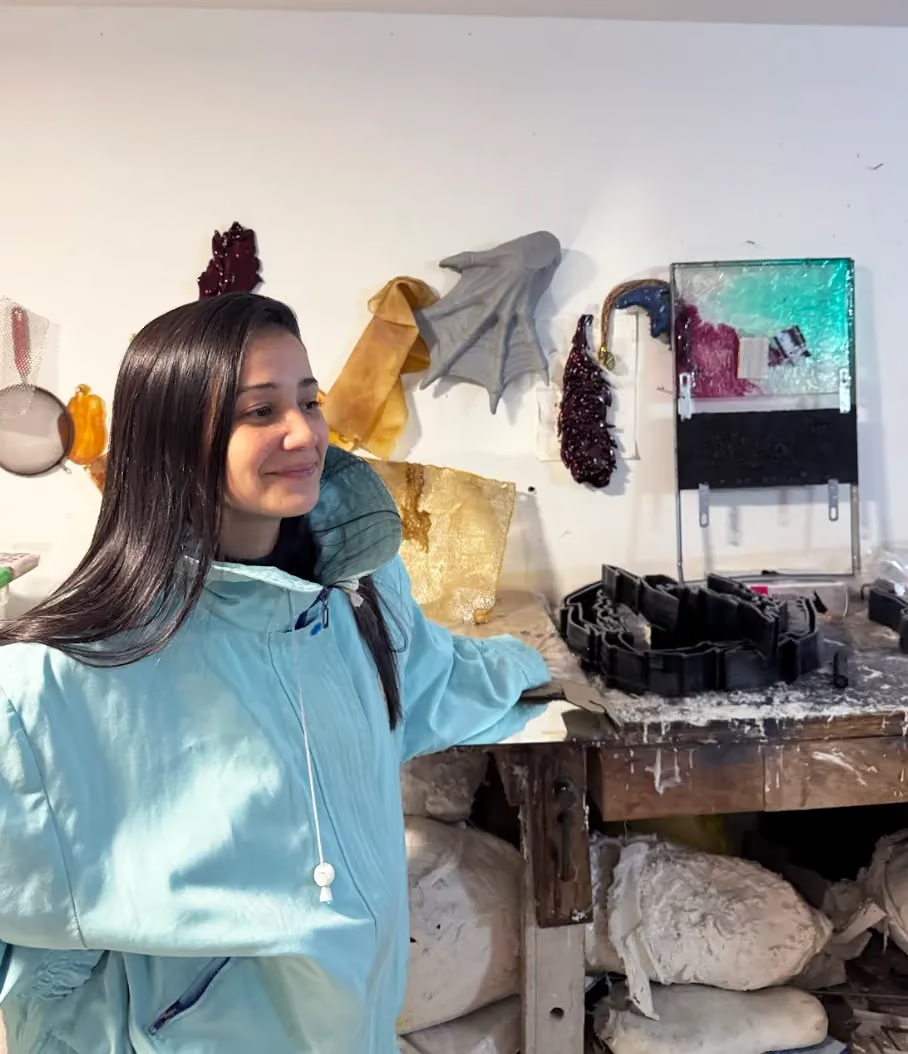
EB: It ALWAYS begins with something made for play. To me, toys present a reduced and controlled version of life — they often seem to come from something trivial, slightly ridiculous, already fake, yet difficult to dismiss. They are somehow objects that exist between function (for play) and fiction (to play), already carrying a simplified, coded form of reality. I’m drawn to them as forms that are already resolved, with fixed scale and detail, where nothing needs to be negotiated.
I love to cast a lot of the toys I encounter. Because stripped from their previous contexts & placed inside the sculptural space, these fragments take on multiple meanings and most importantly, they somehow develop a certain sincerity and depth. But the fun part is really interesting to me because I like to have fun with those translations and see what’s possible through playing with them, plus the play that they involve.

EB: A friend of mine once described these sculptures as resembling oversized candies.
These forms are highly saturated, almost excessive, to the point that their material presence becomes ambiguous. Their surfaces suggest something synthetic, possibly edible, while remaining dense and sculptural.
I’m deeply invested in experimentation. In my practice, I am constantly testing material behaviours and allowing things to happen, rather than producing closed objects. It’s about doing something that can surprise me as well.
In that sense, there is also a painterly element that becomes involved almost by accident as the material is being processed, and depending on which materials are available to fabricate whatever element I’m playing with.

EB: When we installed this work for the first time, Rachel said it reminded her of one of the characters from the Winx Club — Flora. That reading kind of reorganised the object. The side elements behave like wings, and the structure is clearly a figure. But it’s not just a character, a beast, or a hybrid being; it also works as an architectural element, something closer to a caryatid, where the figure is also structural. It holds itself up while remaining ornamental. It creates a temple & performs as a guardian.
What matters to me is not who they are (whether Flora, Techna or Stella), but how people respond to them, how people read them. Because characters only exist inside their stories or within the systems that sustain them. I’m interested in how these forms move towards that register without fully becoming representational, activating a familiar visual language that remains only partially resolved.
And a character is also something that can change. Much of my work is made up of multiple elements that can be disassembled and reassembled in different ways. In this case, it is a vertical structure assembled through repetition and stacking, where individual elements are aligned into a single axis. The work begins to operate as a system and as a modular construction that allows for variation. The sculptures remain flexible and spontaneous, both in installation and in their capacity to be reconfigured, producing different iterations and articulations.

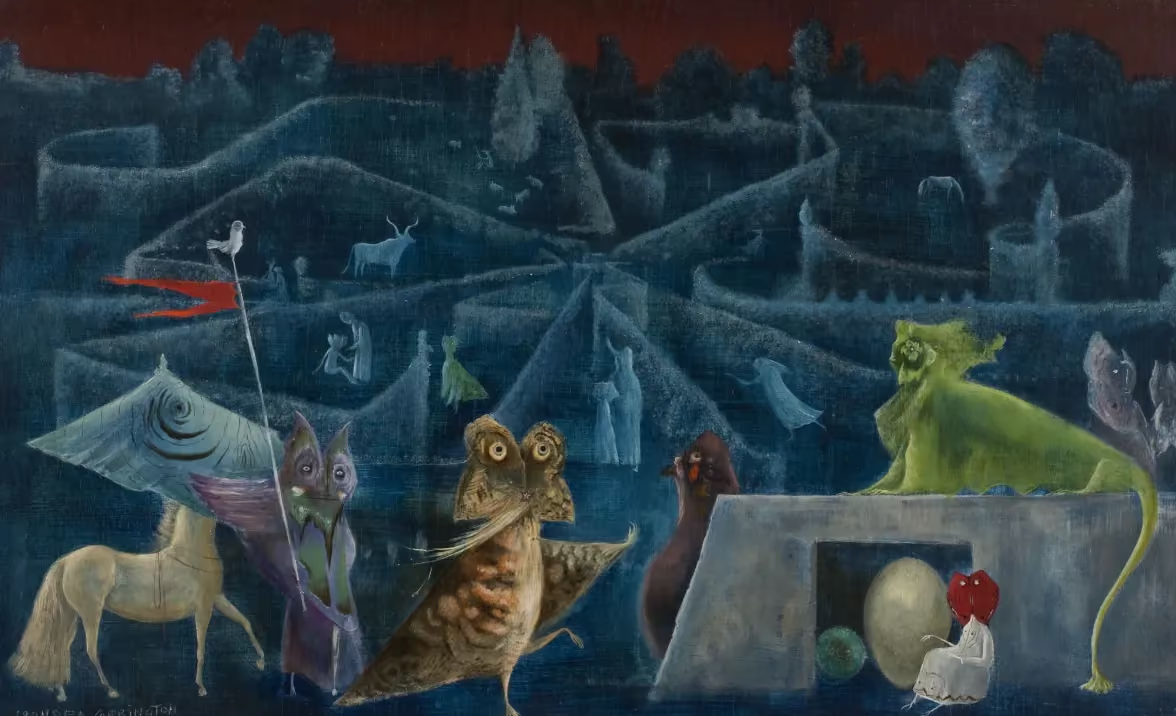
EB: I have been thinking a lot about Leonora Carrington’s work lately. I love the way different orders of reality coexist without hierarchy in her paintings. Figures, animals (or parts of them), objects, and architectures occupy the same space. There is a constant transformation, but it doesn’t read as disruption. It is a condition of the world itself - her world. Bodies are never fixed, identities remain unstable, and scale often shifts without a clear reason.
I try to work on the relationship between things that are normally kept separate: the human and the animal, the domestic and the ritual, the familiar and the uncanny. But they do not collide; instead, they coexist. And because I don't mind it to feel somehow arbitrary, I stop myself and resist the work to be ‘clearer’ and reduced to a single meaning.
What comes out of that is a space where narrative is present but never fully understandable; suggested rather than stated.
EB: This is volcanic ash from the La Palma volcano, produced by an eruption a few years ago. I am from the Canary Islands and familiar with the colours and shapes of volcanic landscapes, yet it remains striking to encounter it in such a pure, untouched state, as it was when it erupted in September 2021. I couldn’t resist taking a few kilos of it back to the studio.
It almost feels like a fictional material. It is natural, yet so intensely dark, slightly reflective, and faintly shiny that it takes on a synthetic quality. It absorbs and reflects light in a way that does not fully register as organic. I also like to think of it as new soil, new earth, something that cannot be artificially produced. There is something poetic in that. It exists both as residue and as ground, as something already formed but still in the process of forming. I am interested in that contradiction: a material that appears constructed while remaining entirely real. I love to work with it.

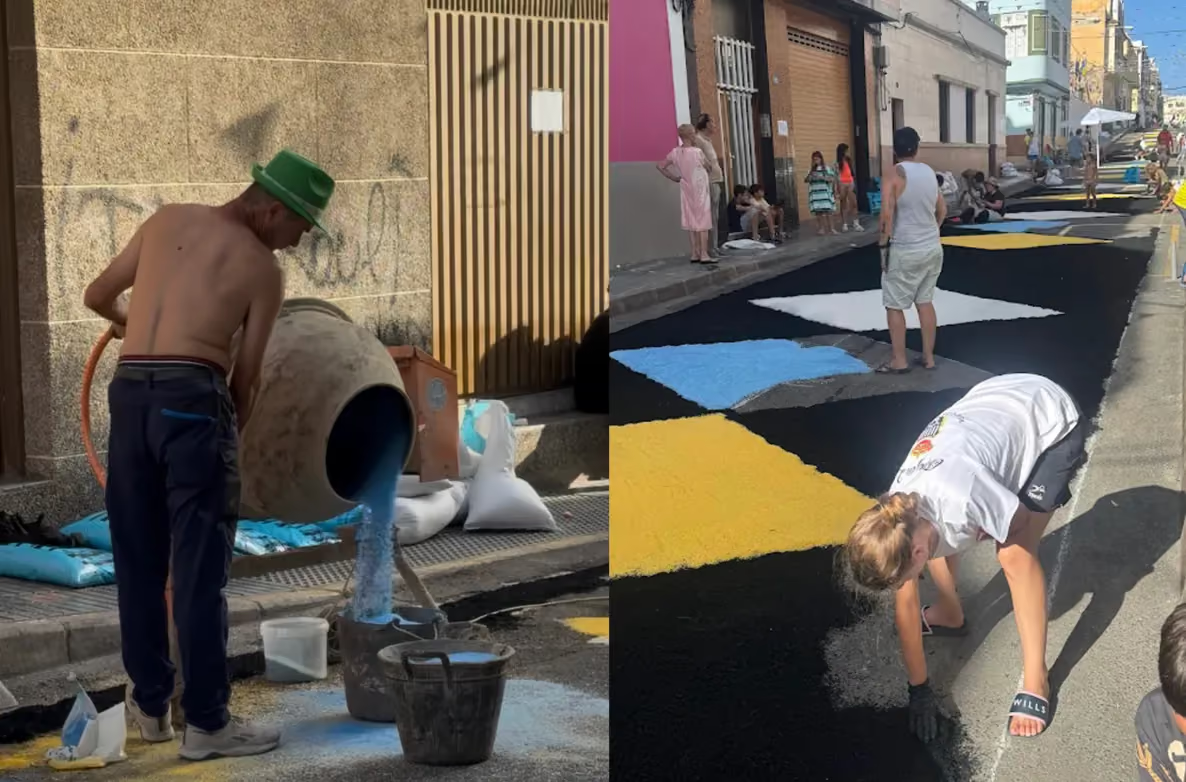
EB: There is an old tradition in the Canary Islands that comes from Corpus Christi celebrations, and it consists of producing carpets made from dyed salt as part of a processional route. It began as a floral offering that later developed into a wider tradition of decorative carpets. These salt carpets are a later local adaptation, closely connected to the island's salt production and maritime culture.
Using coloured salt, intricate ornamental and usually religious patterns and images are laid directly onto the ground, turning the street into a temporary surface of devotion and collective labour. After a few days of celebrations, all that colourful salt is removed and thrown away. Now, I make sculptures with dyed salt.