
Lou Mensah meets photographer Nhu Xuan Hua at her exhibition Of Walking on Fire, at Autograph
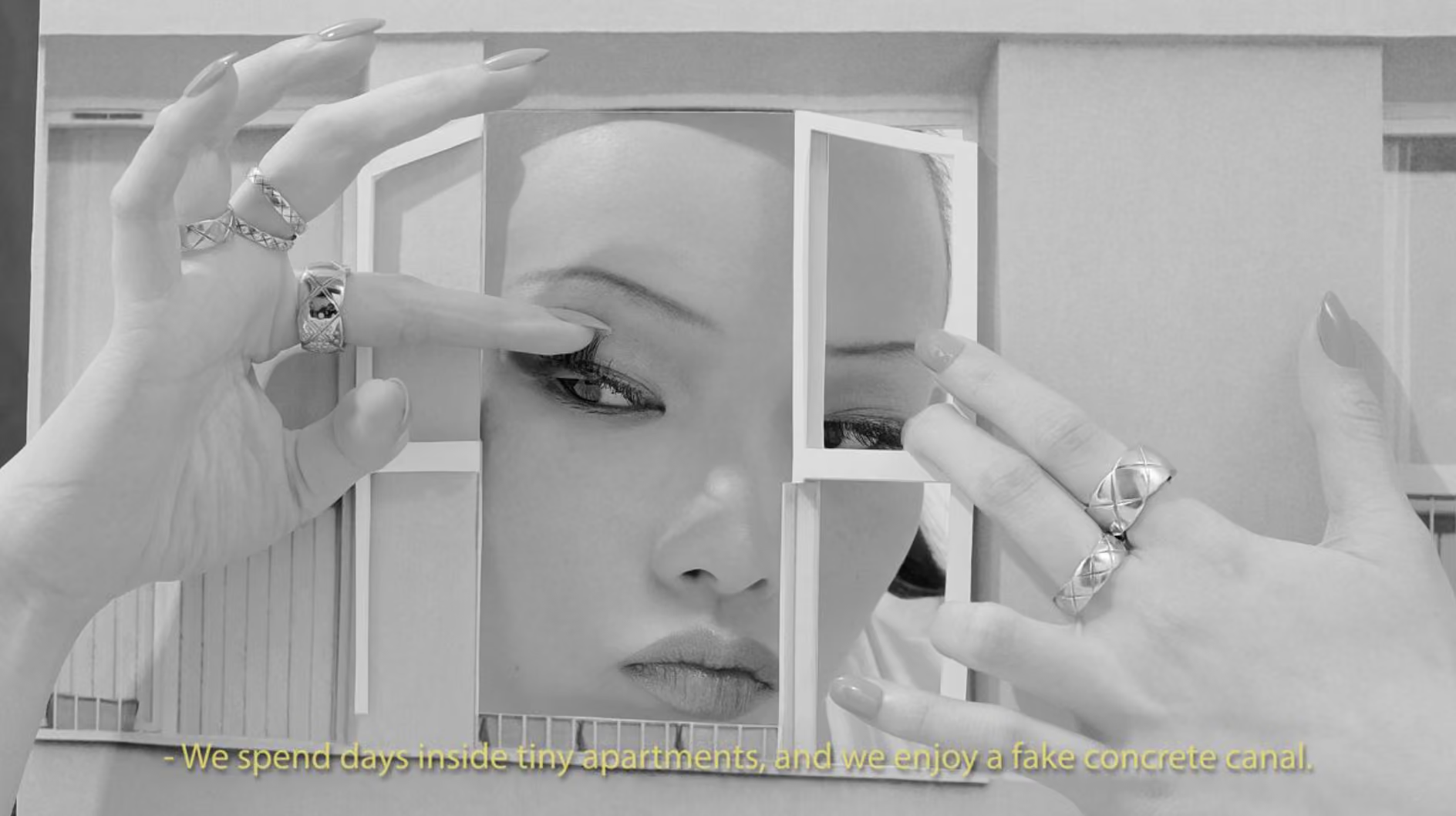
Nhu Xuan was raised in Paris in a Vietnamese immigrant family. Her father is oral-deaf and there was no shared language in the household. She tells us, "Communication had to become simple, direct and intuitive."
Of Walking on Fire is her first UK solo exhibition, showing at Autograph until 19 September. From a childhood in Paris shaped by silence and migration, Nhu Xuan has built a practice that reworks family photographs, exploring how memory fragments across generations of displacement.
Congratulations on this commission, Nhu Xuan! Your work, in part, explores what happens when a family doesn't share a common language, shaped by your father's deafness and the silences of migration. It resonated deeply with me, as someone from an immigrant family where we're also learning BSL and beginning to understand what it means to navigate different ways of communicating. This is your first UK solo show and an Autograph commission. How did the relationship with Autograph begin, and what did this space open up for you?
Thank you for your very kind words. It means a great deal to know that our stories can resonate in such a personal way and be shared emotionally. My encounter with Autograph began long before the show we did together. I lived in Shoreditch from 2012 til 2015 and used to walk past the gallery on a regular basis without daring to enter. I felt intimidated by the grandeur of the big windows and the heavy stories this place seemed to carry. Yet I'd walk past Autograph and dreamed that perhaps one day my work could be relevant enough to end up in this kind of space. Because Autograph sits in a narrow alley, whenever you look at the facade, your eyes and head rise, and you feel the grandeur. It's a grandeur my father wanted for his art, for his own stories. But the top felt so distant. He dreamt of a recognition he never received and blamed on the world's incapacity to deal with his otherness. Looking back, I realise that feeling wasn't only his. It echoed something I had inherited from him, but also was told I could not handle. Therefore, Art had to remain a distant dream for me too, and with that, Autograph remained a silent goal that would require a detour to access later. In 2016, I began questioning my family's history and the events that led to their departure from Vietnam. Those questions gradually became the foundation of my artistic practice and fashion work. Years later, I moved to Paris in 2021, and I met with Mark Sealy at Paris Photo in 2023. We spoke about the absence of second-generation Vietnamese narratives within contemporary discourses (especially in France) and about those conversations with people who share a common ground. Those conversations that started in 2016 for me have shaped me and changed me forever. The grown version of the seeds I then planted, cared for and nurtured for all those years. What Autograph offered me was far more than an exhibition space. It became a place where these questions around migration, inherited memory, feminism, resilience and language could unfold freely and be addressed with the complexity they required. Returning to a building I once walked past without daring to enter, not as a visitor but as an artist in 2026, felt less like another invitation to exhibit my work but more like a milestone closing a full circle.

You trained in fashion photography and have shot for Dior, Margiela, Vogue. The visual immediacy honed in your commercial career shows in this work, but has shifted as you tell your personal story. What did fashion teach you that you use in more personal work, and did you unlearn anything along the way?
The starting point is different, but the creative process remains somewhat similar. Editorial commissions begin with an existing framework, like a collection, a brand identity or a narrative. Rather than seeing that as a limitation, I've always found it stimulating. It creates a dialogue between someone else's world and my own visual language. My personal work, especially the ones using archives from my family, begins from a much more introspective place, but the starting point is also an existing object. It is slower, less predictable, voluntarily less prepared, but both are led by intuition or a need to react to a breaking event rather. Perhaps fashion photography taught me clarity. Commercial images need to communicate immediately while still carrying some sort of emotional depth. You are working to create an image toward that goal. Learning how to distil complex ideas into a single image has deeply influenced my artistic practice, yet.. Now that I think about it, I was trained to do this from my childhood and not just when I started fashion photography. It echoed a communication system that was familiar to me. Growing up in a family where we didn't share a common language, communication had to become simple, direct and intuitive. Whether I work on a fashion commission or a personal project, the final image is always the visible outcome of a much larger process made from research, writing, visual associations and resonances. The final frame is often a visual simplification of multiple pages of those researches, I think in a way it makes it lighter for me to carry emotionally also. As simple as an Image may look, it still resonates loudly. Empty areas inside my compositions allow more space for projections to circulate. After returning to Vietnam as an adult, I began to understand how much I had absorbed a Western idea of beauty. In my recent personal work, whether it's the series from Heaven and Hell in collaboration with Vimala Pons or my new self-portrait studies, I am trying to question the sense of self through those models we have observed growing up. Transforming ourselves into those new vessels is an attempt to reclaim our feminine image and rebuild our own lexicon.
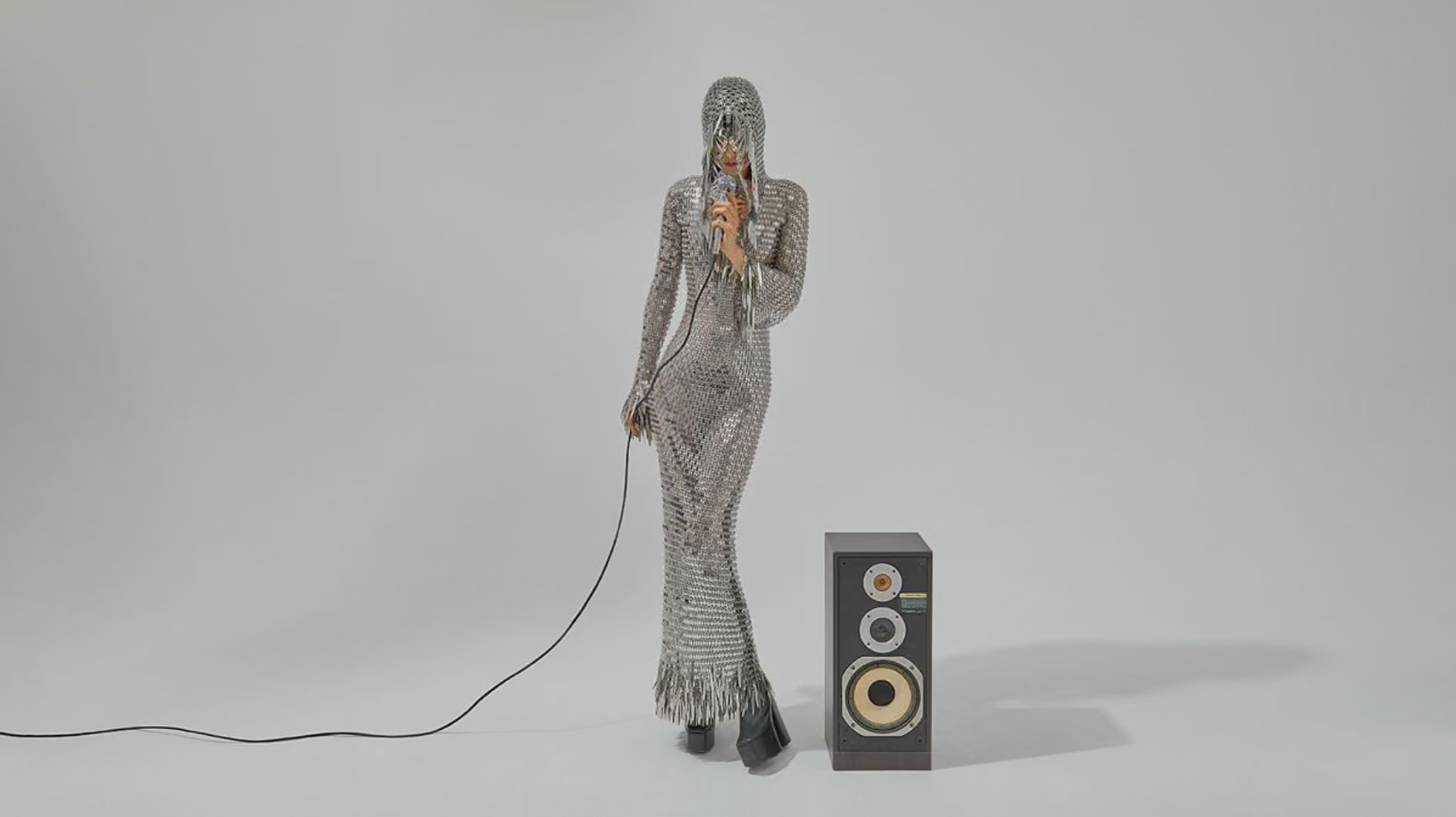
Gallery 2 draws on Đạo Mẫu, the Vietnamese tradition of Mother Goddess worship. Can you talk about what that spiritual framework brought to the work?
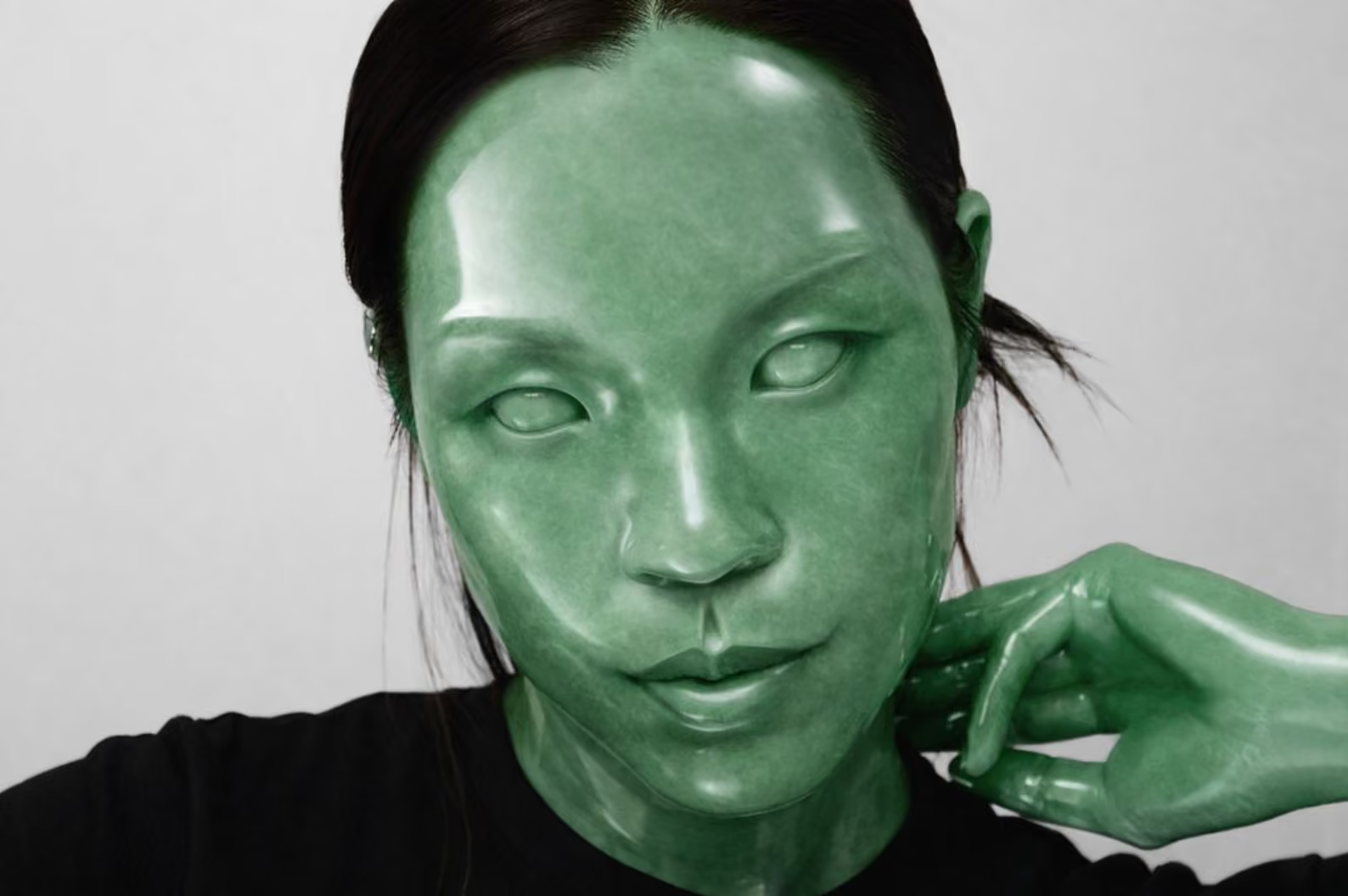
Studies about "Memory" have taught me that remembering also means acknowledging loss. Yet loss does not necessarily imply disappearance. It creates a new circulation where identity remains in movement rather than becoming fixed. Through my research and relation to a cosmovision, that idea naturally led me towards Đạo Mẫu: the Vietnamese spiritual tradition honouring the Mother Goddesses of Heaven, Earth, Water and the Mountains. Figures that are associated with protection, compassion and the nurturing power of feminine energy. What interested me was less the religious aspect but the way these figures embody protection, care and transformation. The energy runs through Gallery 2. The piece "Promise of Spring" (which is the translation for Hứa Như Xuân) took its roots from these beliefs. I was trying to reclaim that power I felt I was born with, the one of Rebirth. A power that can fade at times when challenges pile up in the physical world. I have become increasingly interested in how materials can function as extensions of the body, almost like protective skins. Jade, for example, carries powerful meanings across Vietnamese cultures: protection, resilience and spiritual balance. A jade bracelet is traditionally passed from mother to daughter, and there is a belief that if it breaks in 4, it has protected its wearer from danger. These symbolic materials allow me to think about femininity not as a fixed identity, but as something inherited, transformed and continually reimagined. The figures in my work are undergoing a sort of metamorphosis also in an attempt to resist reductive readings. Metaphors translate a feeling that couldn't find its way into spoken language. Through this dialogue between Reality and Supernatural elements, I'm also trying to ease the tensions between the two worlds in order to find peace. To accept what I cannot comprehend, battle or control. Throughout the exhibition, that spiritual framework remains essential. It allows the images to stay open rather than descriptive.
You rework family archive photographs digitally until figures merge and dissolve into one another. It is such a visually enticing method to draw in the viewer. As a technique, I wonder when the image feels resolved for you?
My work with family archives is a negotiation between what was inherited and what is imagined. The archive provides the bones of memory, while the present reshapes the liquid flesh around them. Each photograph becomes another translation of something that once existed but can never be fully recovered. Unlike my studio work, these images have no fixed timeline. They develop intuitively, almost like an ongoing conversation between myself and the archive. When I encounter a limitation, I don't try to overcome it directly, I take a detour. That is where fiction enters the work and where reality, memory and imagination begin to overlap. Growing up in a family where we did not share the same language made me rely on observation. Communication happened through gestures, looks, physical presence and forms of translation that were often non-verbal. That way of perceiving the world guides how I construct images today. An image feels resolved when it reaches a point of balance. Not because every question has been answered, but because the tensions it carries can coexist in harmony.
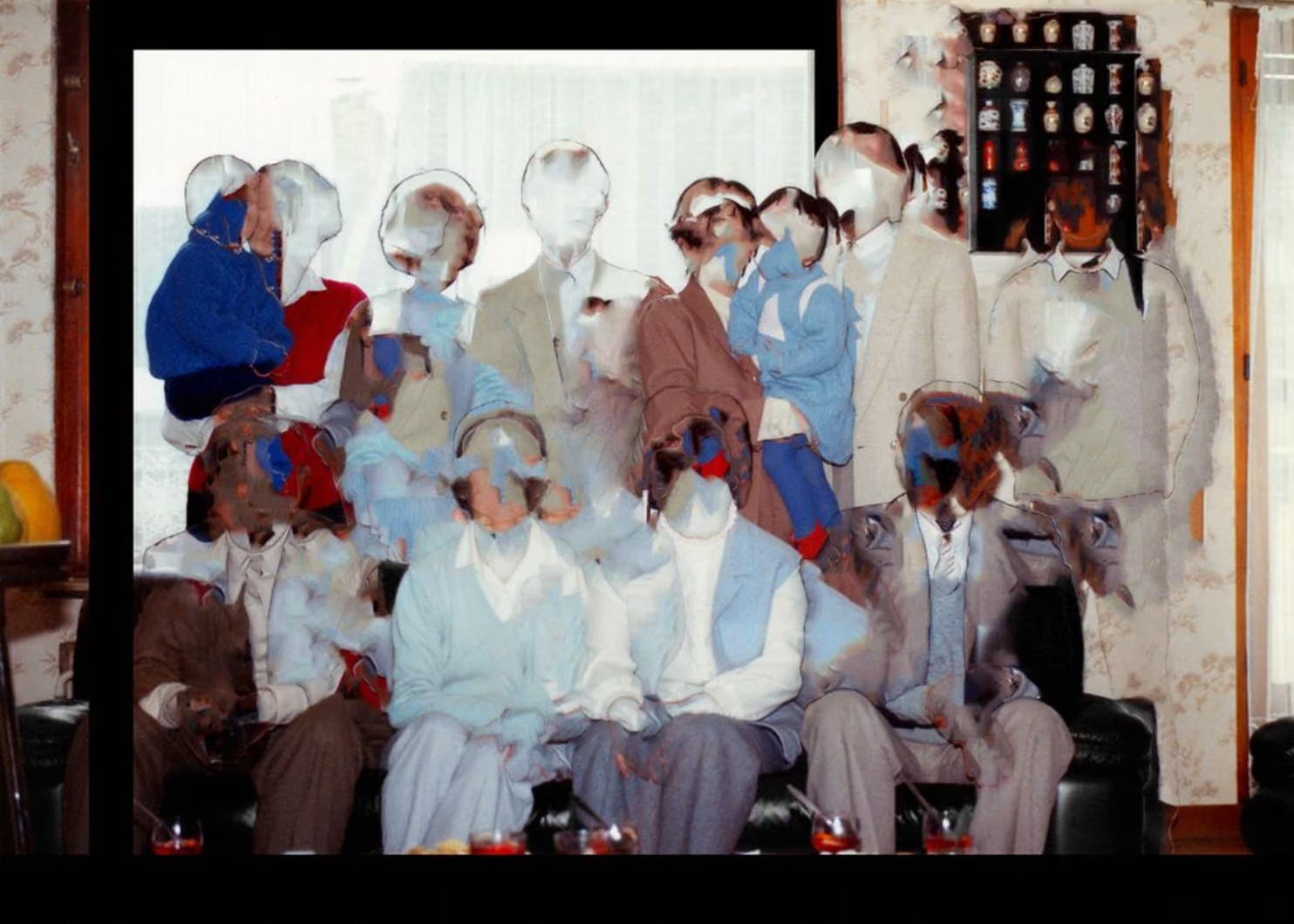
You reimagine archival photographs from your family's time in Vietnam and their early years in Europe. The compositions echo how memory within the diaspora can splinter, blur and slip from view. The work considers how the past continues to reverberate into the future and how silence can persist even in moments of gathering and togetherness. Is this a form of duty, or perhaps even a need, to carry those stories forward and be their steward for future generations?
A photograph is a silent witness to time. An archive is often perceived as something dormant, it anchors the work in a specific place and history, but for me, it is a point of departure, allowing new meanings to emerge through the present. To use it as a departure point is somehow to ensure that the foundation is rooted in a place, a time from which I can then climb up alone or collectively and create a sort of echo. There are moments when carrying these stories feels incredibly uplifting because I realise that the silences I inherited have finally found people willing to listen. At other times, the responsibility feels heavier. Over time, I have stopped trying to bridge every gap. Instead, I try to learn how to inhabit them. I often tell myself: "go to the gym, stretch your body, bend your spirit, distort your lens. Learn to move with uncertainty rather than against it. There can be as many languages as there are people. The only direction is forward." All living things are road makers. We are made of those experiences of displacement. In the show, each image carries traces of a gesture, a symbol or a presence, and together they form a constellation rather than a linear story. Sometimes images become quiet companions. They do not explain everything, but they stay with us. And perhaps that lingering presence is where meaning continues to grow.
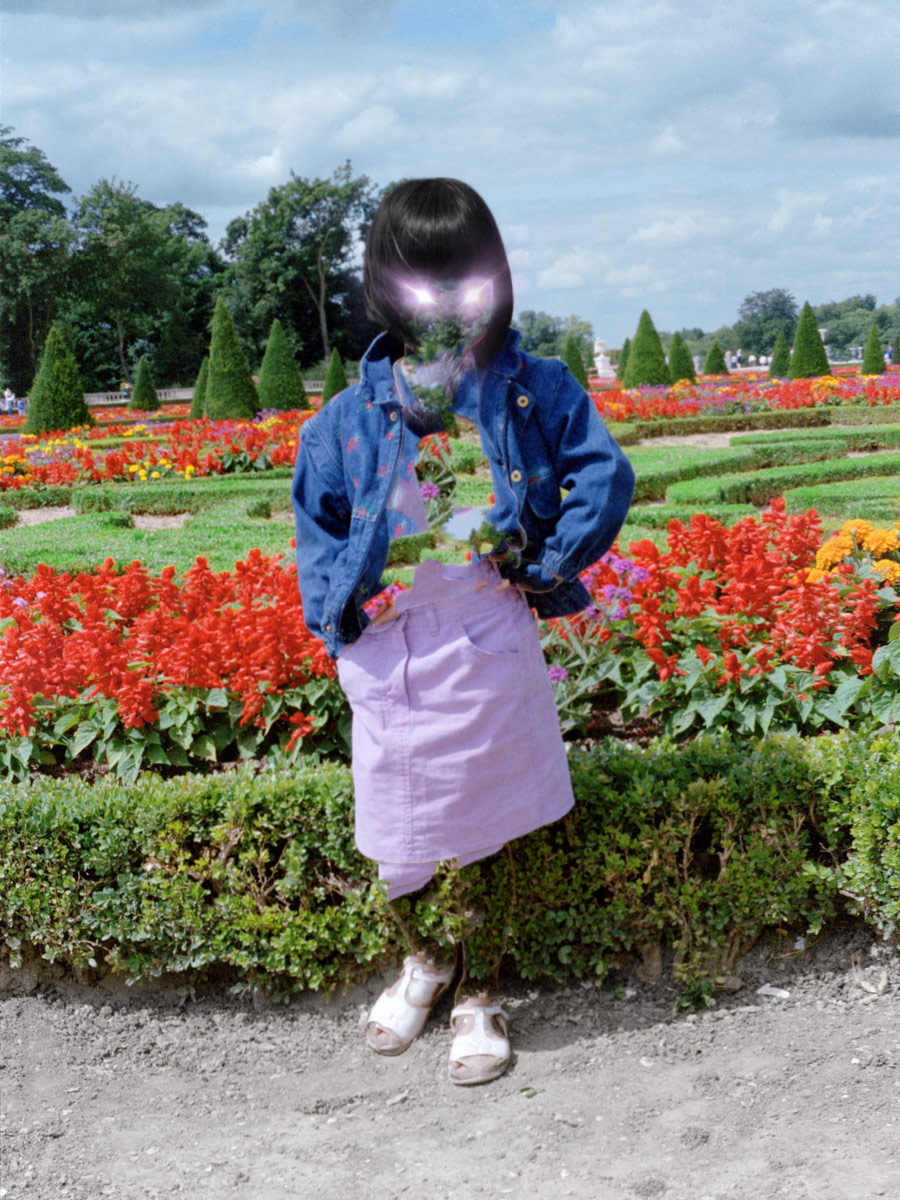
Nhu Xuan Hua: Of Walking on Fire, at Autograph is showing until 19 September 2026. Free entry. Information in the exhibition is also presented in British Sign Language.
Don't forget to check in and leave your review on the gowithYamo app!