

It’s 2026! God knows what fresh horrors and pleasures this year has in store for us all! So before the horrors begin in earnest (and who knows, by the time this article is uploaded, they may well already be upon us), let’s book ourselves in for some guaranteed pleasures: 10 visits to exceptional exhibitions outside of London. To make things more convenient, I have incidentally included four shows in West Yorkshire, so you only need to face the British railway system 7 times in total.
From woodcut prints to wheelie bins, here are 10 exhibitions to see this January, outside the capital.
Sainsbury Centre, Norfolk - Eyewitness - until 15 February
The Sainsbury Centre, in my opinion, is one of the UK’s absolute best arts spaces, partly because of their commitment to “living art” which means you’re allowed to give a Henry Moore sculpture a cuddle, there’s a great installation where you can basically just have a lie down, and they have a booklet that highly encourages you to chat to the artworks. It’s like a fever dream in there. They do their exhibitors in “seasons”, which poses a question to visitors, and ‘Eyewitness’ is part of their latest one: Can We Stop Killing Each Other? ‘Eyewitness’ explores why artists and viewers have always been drawn to images of violence, from biblical tragedies in medieval altarpieces to gratuitous violence in Hollywood flicks that are so OTT they’re practically masturbatorial on the part of the director (looking at you, Tarantino).

Cartwright Hall Art Gallery, West Yorkshire - Turner Prize 2025 - until 22 February
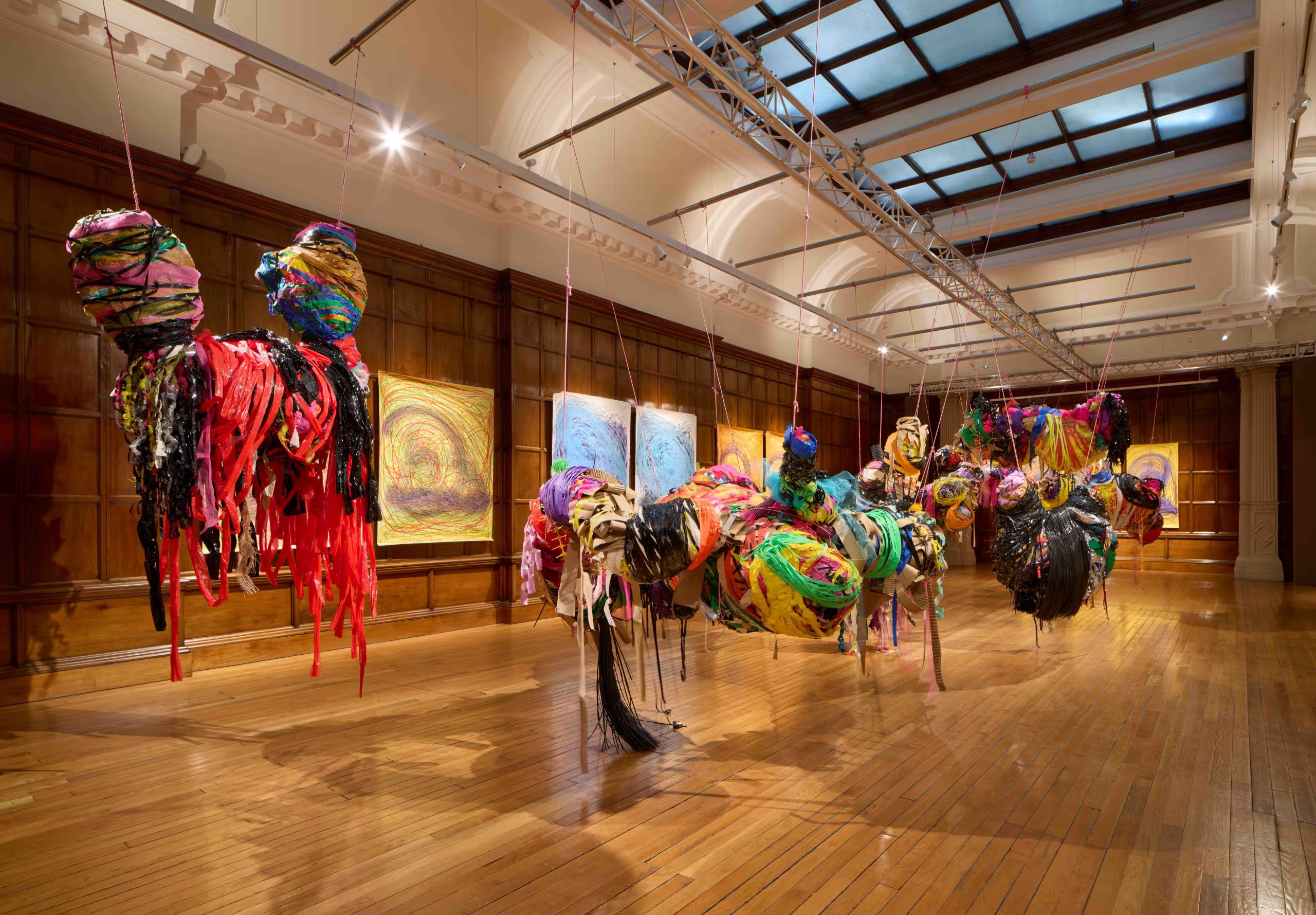
The Turner Prize (named after JMW Turner, who’s been living it large this year, celebrating his 250th birthday, hence an absolute deluge of Turner-themed exhibitions which have haunted the column this year like recurrent artistic thrush) has announced its winner, and there are still two months left for you to genuinely witness something truly historic. Nnena Kalu was crowned the prize’s 41st winner on December 9th, the first learning disabled artist ever to win the award. Kalu creates mixed media cocoon-like sculptures as well as hypnotic works on paper made from repeated swirls: a colourful feast to brighten up your January blues.
Derby Museum and Art Gallery, Derbyshire - Human Natures - until 22 February
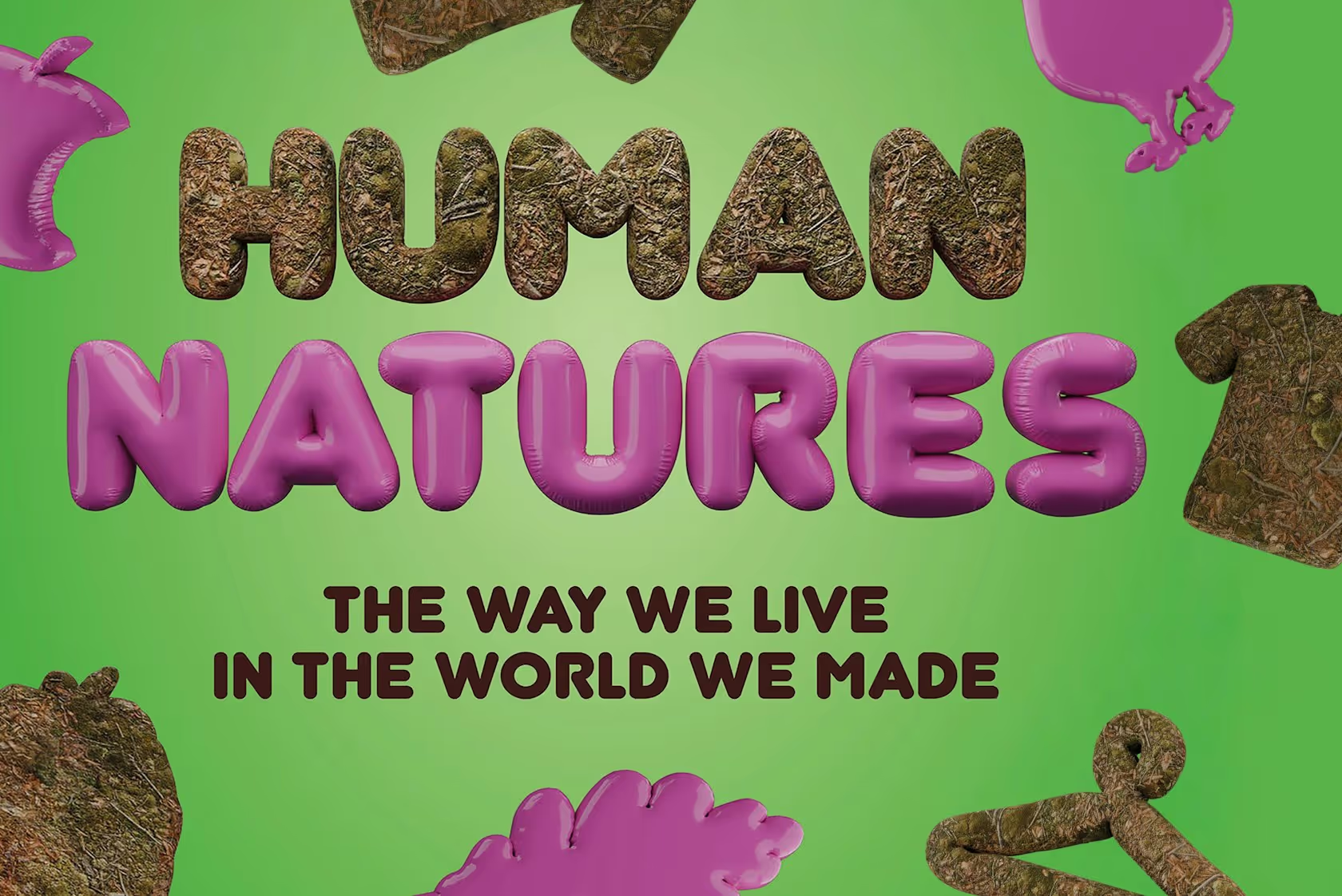
“Explore a world of chickens, cats, loo roll, bin bags, precious stones and fine old coats” reads the blurb for Derby Museum and Art Gallery’s ‘Human Natures’ (and the sign outside your great aunt’s house). ‘Human Natures’ is a show all about how humans have worked their way through the world, tussling with nature in order to develop our societies and to create the things within them. A mix of humanity’s success stories (saving certain animals from extinction) as well as our failures (dooming pretty much all of the rest of them to it instead) - this exhibition explores just how miraculous and disastrous it has been that humans have been able to uniquely command the world around us.
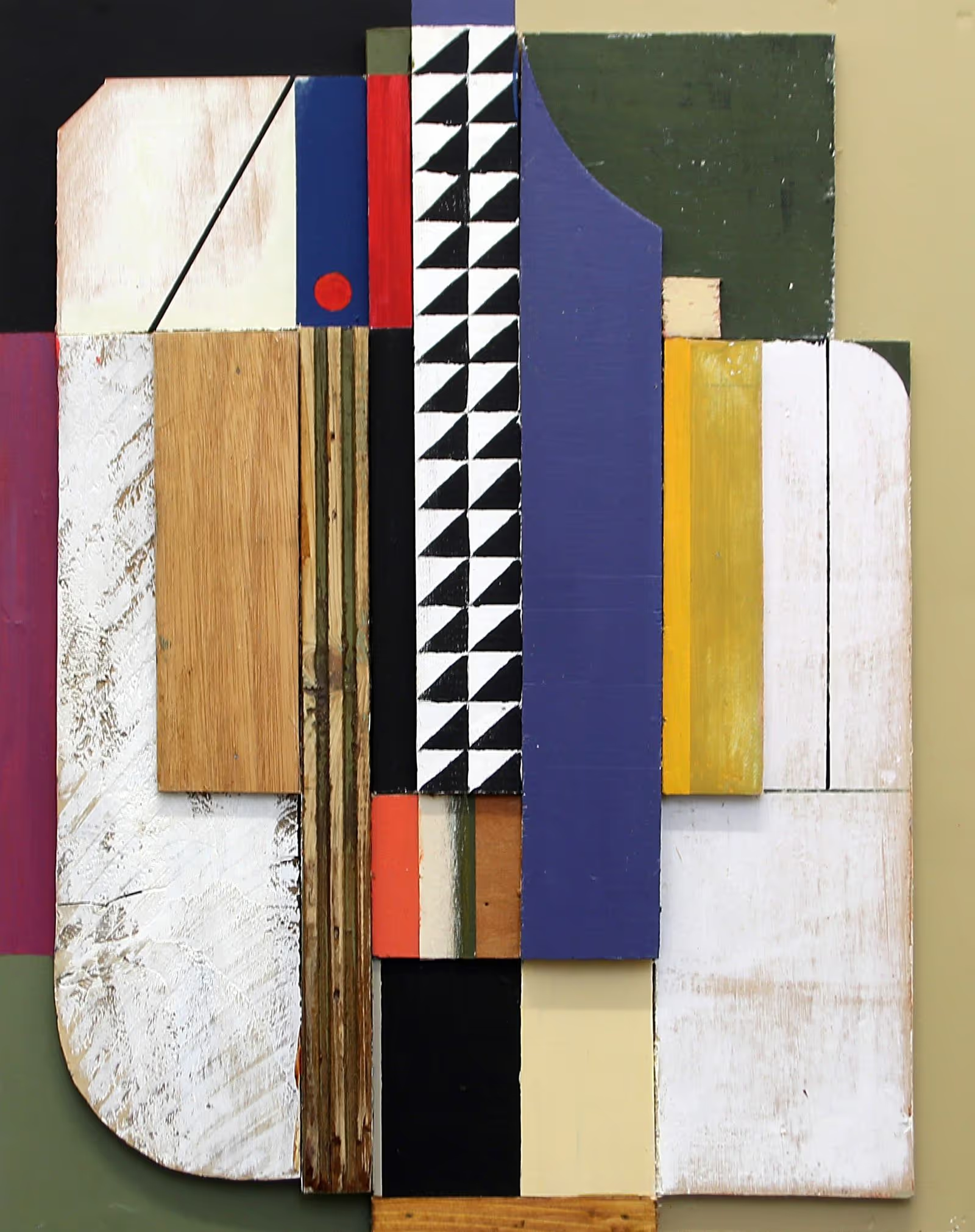
The Minories, Essex - Anglian Abstract - until 22 February
Margaret Mellis was born in China and raised in Scotland before making her name as an artist in St Ives, where two generations of well-to-do artists moved to enjoy the air, the light, and the not-being-in-London-during-the-Blitz. In Cornwall, she met the artists who would define the St Ives “school” - Barbara Hepworth (blobby sculptures), Ben Nicholson (blobby paintings), and Naum Gabo (blobby sculptures again, but Russian, so бесформенные скульптуры). ‘Anglian Abstract’, however, pulls us eastward along the south coast and up into East Anglia. Mellis’ Lilac Yellow (1970) is held in the Minories’ permanent collection and is the focal point of this exhibition celebrating all things Abstraction in East Anglia, showcasing a large lineup of local contemporary artists.
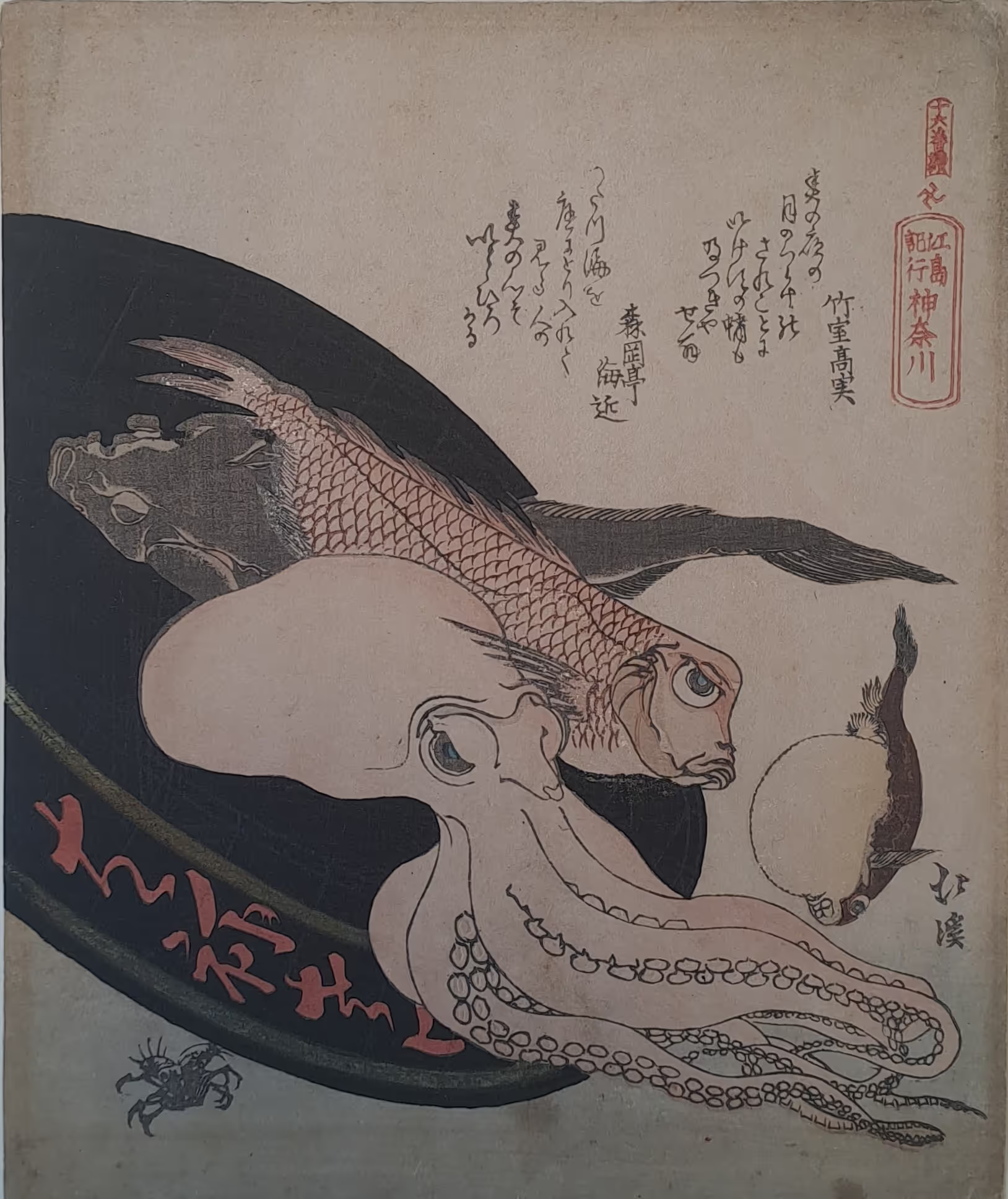
Cliffe Castle Museum, West Yorkshire - Ukiyo-e - until 01 March
Cliffe Castle, in Keighley, is a veritable Victorian wonderland, with permanent displays of beautiful 19th-century artworks and furnishings, with rooms lit through stained glass windows designed by Morris & Co. It is also, crucially, a brilliant shape (Google it). This Spring, they are celebrating the Japanese art of ukiyo-e - meaning “pictures of the floating world”, the genre depicted scenes from everyday Japanese life, and Victorian millionaires - like Henry Isaac Butterfield, for whom Cliffe Castle was originally built - were obsessed with it. The colourful woodblock prints, which were popular from the early 17th century into the late 19th century, were a huge inspiration for art history’s Big Dogs, who inevitably ended up taking much of the credit for the style. So, come to Cliffe Castle to celebrate the true pioneers.
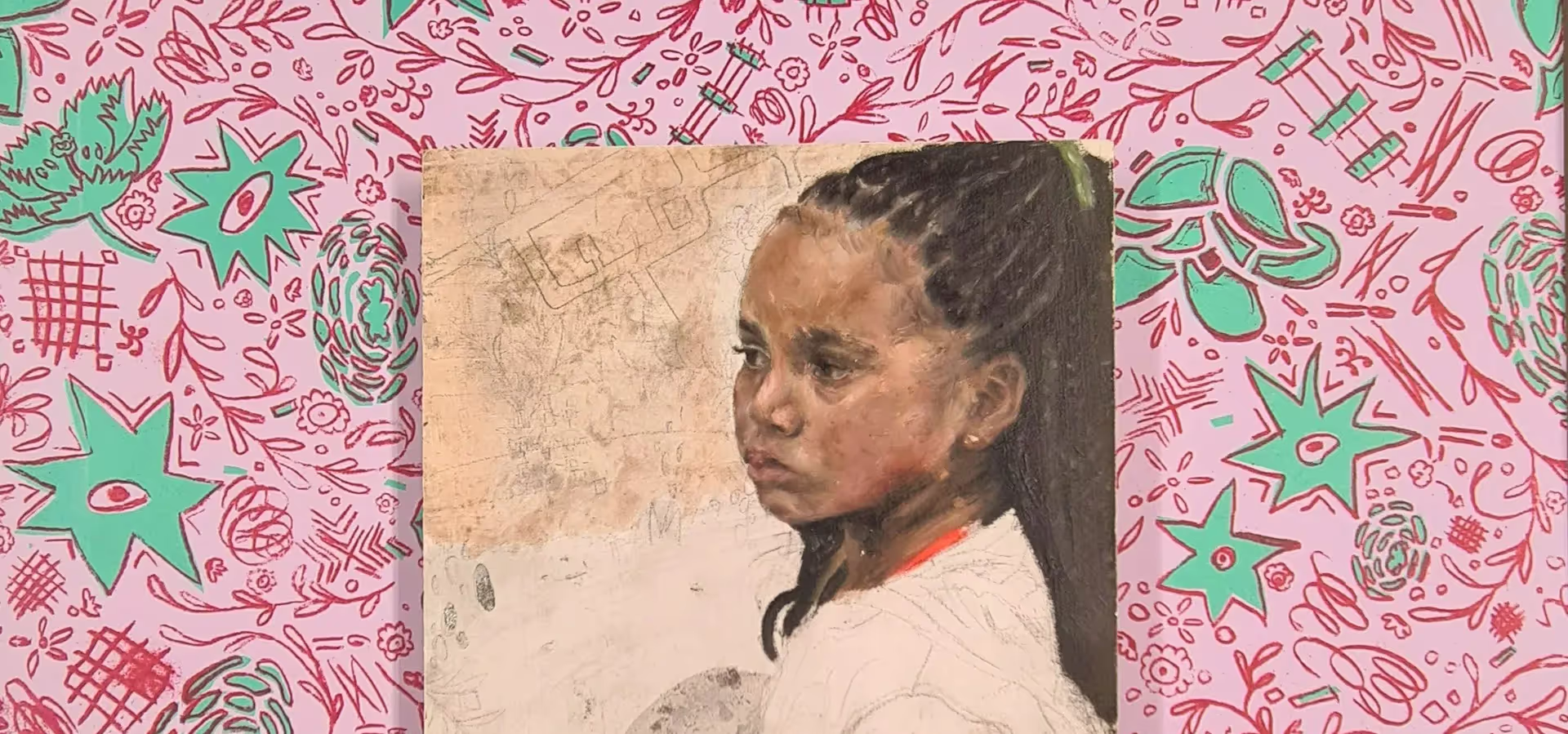
Leeds Art Gallery, West Yorkshire - Portrayals of Women - until 05 March
Let’s go, girls! Leeds Art Gallery have put together a new display from their collection of over 10,000 works on paper, dedicated to images of women, dating from 1450 to today. In an age when transphobic legislature wants us to start dictating who is or isn’t “woman enough” based on looks alone, why not take yourself to this exhibition, which shines a light on the diversity of women’s looks and lived experiences? Oh, and boycott the Girl Guides while you’re at it. “Be Prepared” to grow up a close-minded bigot, kiddies!
Warwick Arts Centre, Warwickshire - Takuro Kuwata, Tea Bowl Punk - until 15 March
I first saw Takuro Kuwata’s work at the Southbank Centre’s ‘Strange Clay’ in 2022, where a friend took a hot picture of me, so I’ll always have fond associations with it. Three years later, the Mead Gallery has opened the UK’s first solo show of Kuwata’s work. At the time of writing this column, a major trending audio has recently swept social media, in which the speaker explains that they like their [whatever it is they’re talking about], despite it being a “little off centre”, explaining, “it’s got wabi-sabi”. Wabi-sabi is a traditional Japanese aesthetic principle, based around finding beauty in “imperfection”, and Kuwata’s joyful work balances this beautifully - along with traditional Japanese ceramic techniques - with more modern, radical sculptural techniques.

Henry Moore Institute, West Yorkshire - Beyond the Visual - until 19 April
‘Beyond the Visual’ is the first major sculptural exhibition in the UK in which the majority of the participating contemporary artists are blind or partially blind, and the visually-impaired are truly at the heart of the show’s curatorial mission. And unlike almost all other exhibitions, you’re welcome to touch absolutely everything on display. The exhibition pushes us to engage with art beyond looking at it (and it’s been proven that we don’t even do that particularly well, spending on average just 27 seconds looking at the artwork in front of us in a gallery) and to have a more sensually grounded interaction with the art in front of us. As well as touch, the exhibition engages visitors’ sense of sound with audio descriptions and sound installations, and even smell gets its moment in the spotlight. It’s got all of the senses bar taste covered, but you never know what they might have in the gift shop.
%20(c)%20Rob%20Harris%20(5)%20.jpeg)
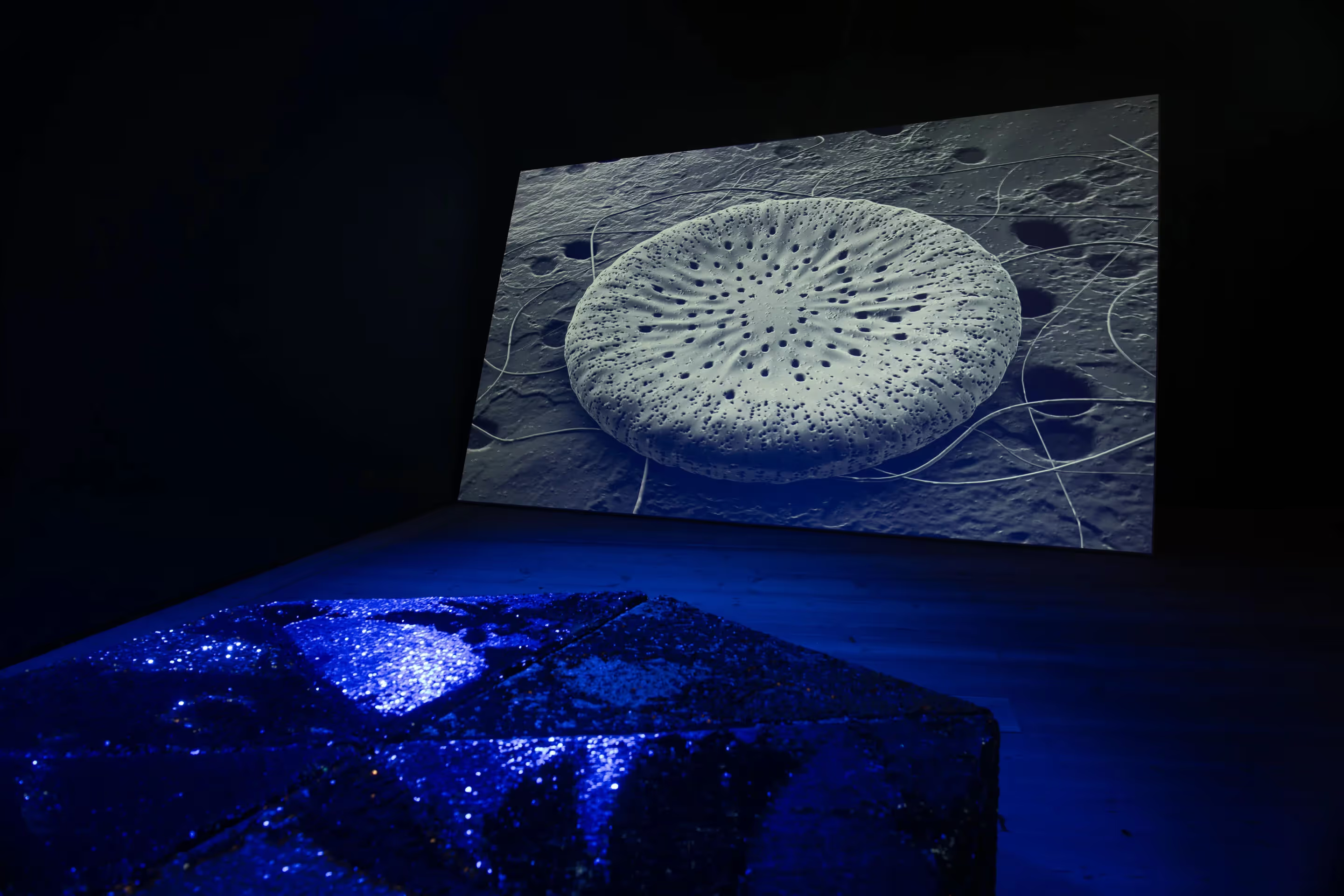
Baltic, Tyne and Wear - For All At Last Return - until 07 June
The Baltic is an incredible gallery space, and my visit to it in 2024 was only slightly dampened* by the fact I had travelled 6 hours up to Newcastle in order to not win a community radio award (* I will never return for as long as I live out of bitterness). The photos from ‘For All At Last Return’, however, might just be enough to lure me back. The gallery has been filled with luminescent works and sculptures from 13 contemporary artists addressing the ecological health of our oceans (spoiler alert: it’s not looking great). These works give the iconic building an aquarium vibe that always feels relaxing, despite the fact that there’s only ever screaming children and parents-on-the-edge there whenever you actually visit an aquarium.
Royal Albert Memorial Museum, Devon - A Feast for the Eyes - until 22 March
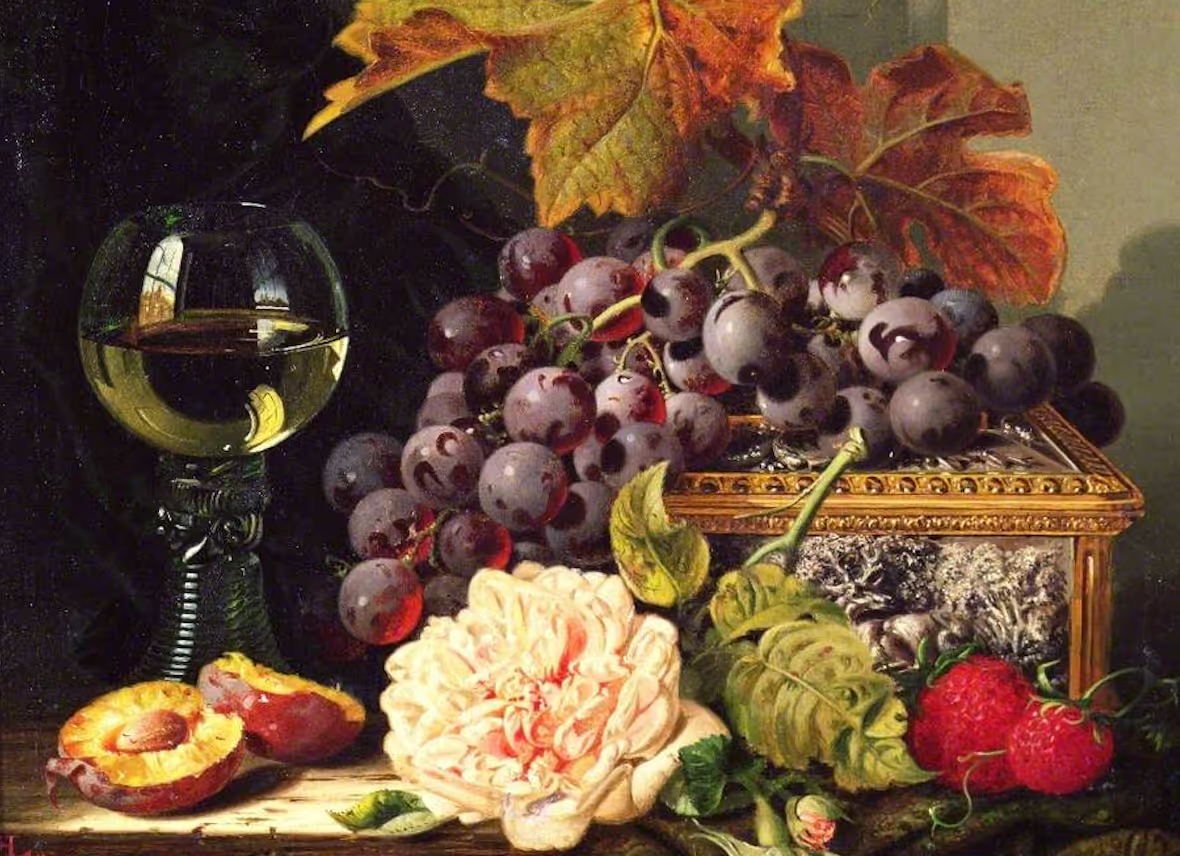
If the idea of a large quantity of food doesn’t make you feel sick after Christmas, then RAMM has the exhibition for you! Featuring work by artistic art historical A-listers like William Hogarth and Lucien Pissarro alongside work by local artists, the Royal Albert Memorial Museum are celebrating how food has inspired artists across the centuries, and the moral messages they have hidden in their fruit bowls (watch out for saucy figs!). Crucially, there’s also still time (until January 25th) to see their display all about staplers, which I gushed about in the August edition of Not London, so make haste, stapler-heads!
.%20.jpg)
It’s 2026! God knows what fresh horrors and pleasures this year has in store for us all! So before the horrors begin in earnest (and who knows, by the time this article is uploaded, they may well already be upon us), let’s book ourselves in for some guaranteed pleasures: 10 visits to exceptional exhibitions outside of London. To make things more convenient, I have incidentally included four shows in West Yorkshire, so you only need to face the British railway system 7 times in total.
From woodcut prints to wheelie bins, here are 10 exhibitions to see this January, outside the capital.
Sainsbury Centre, Norfolk - Eyewitness - until 15 February
The Sainsbury Centre, in my opinion, is one of the UK’s absolute best arts spaces, partly because of their commitment to “living art” which means you’re allowed to give a Henry Moore sculpture a cuddle, there’s a great installation where you can basically just have a lie down, and they have a booklet that highly encourages you to chat to the artworks. It’s like a fever dream in there. They do their exhibitors in “seasons”, which poses a question to visitors, and ‘Eyewitness’ is part of their latest one: Can We Stop Killing Each Other? ‘Eyewitness’ explores why artists and viewers have always been drawn to images of violence, from biblical tragedies in medieval altarpieces to gratuitous violence in Hollywood flicks that are so OTT they’re practically masturbatorial on the part of the director (looking at you, Tarantino).

Cartwright Hall Art Gallery, West Yorkshire - Turner Prize 2025 - until 22 February
The Turner Prize (named after JMW Turner, who’s been living it large this year, celebrating his 250th birthday, hence an absolute deluge of Turner-themed exhibitions which have haunted the column this year like recurrent artistic thrush) has announced its winner, and there are still two months left for you to genuinely witness something truly historic. Nnena Kalu was crowned the prize’s 41st winner on December 9th, the first learning disabled artist ever to win the award. Kalu creates mixed media cocoon-like sculptures as well as hypnotic works on paper made from repeated swirls: a colourful feast to brighten up your January blues.

Derby Museum and Art Gallery, Derbyshire - Human Natures - until 22 February
“Explore a world of chickens, cats, loo roll, bin bags, precious stones and fine old coats” reads the blurb for Derby Museum and Art Gallery’s ‘Human Natures’ (and the sign outside your great aunt’s house). ‘Human Natures’ is a show all about how humans have worked their way through the world, tussling with nature in order to develop our societies and to create the things within them. A mix of humanity’s success stories (saving certain animals from extinction) as well as our failures (dooming pretty much all of the rest of them to it instead) - this exhibition explores just how miraculous and disastrous it has been that humans have been able to uniquely command the world around us.

The Minories, Essex - Anglian Abstract - until 22 February
Margaret Mellis was born in China and raised in Scotland before making her name as an artist in St Ives, where two generations of well-to-do artists moved to enjoy the air, the light, and the not-being-in-London-during-the-Blitz. In Cornwall, she met the artists who would define the St Ives “school” - Barbara Hepworth (blobby sculptures), Ben Nicholson (blobby paintings), and Naum Gabo (blobby sculptures again, but Russian, so бесформенные скульптуры). ‘Anglian Abstract’, however, pulls us eastward along the south coast and up into East Anglia. Mellis’ Lilac Yellow (1970) is held in the Minories’ permanent collection and is the focal point of this exhibition celebrating all things Abstraction in East Anglia, showcasing a large lineup of local contemporary artists.

Cliffe Castle Museum, West Yorkshire - Ukiyo-e - until 01 March
Cliffe Castle, in Keighley, is a veritable Victorian wonderland, with permanent displays of beautiful 19th-century artworks and furnishings, with rooms lit through stained glass windows designed by Morris & Co. It is also, crucially, a brilliant shape (Google it). This Spring, they are celebrating the Japanese art of ukiyo-e - meaning “pictures of the floating world”, the genre depicted scenes from everyday Japanese life, and Victorian millionaires - like Henry Isaac Butterfield, for whom Cliffe Castle was originally built - were obsessed with it. The colourful woodblock prints, which were popular from the early 17th century into the late 19th century, were a huge inspiration for art history’s Big Dogs, who inevitably ended up taking much of the credit for the style. So, come to Cliffe Castle to celebrate the true pioneers.

Leeds Art Gallery, West Yorkshire - Portrayals of Women - until 05 March
Let’s go, girls! Leeds Art Gallery have put together a new display from their collection of over 10,000 works on paper, dedicated to images of women, dating from 1450 to today. In an age when transphobic legislature wants us to start dictating who is or isn’t “woman enough” based on looks alone, why not take yourself to this exhibition, which shines a light on the diversity of women’s looks and lived experiences? Oh, and boycott the Girl Guides while you’re at it. “Be Prepared” to grow up a close-minded bigot, kiddies!

Warwick Arts Centre, Warwickshire - Takuro Kuwata, Tea Bowl Punk - until 15 March
I first saw Takuro Kuwata’s work at the Southbank Centre’s ‘Strange Clay’ in 2022, where a friend took a hot picture of me, so I’ll always have fond associations with it. Three years later, the Mead Gallery has opened the UK’s first solo show of Kuwata’s work. At the time of writing this column, a major trending audio has recently swept social media, in which the speaker explains that they like their [whatever it is they’re talking about], despite it being a “little off centre”, explaining, “it’s got wabi-sabi”. Wabi-sabi is a traditional Japanese aesthetic principle, based around finding beauty in “imperfection”, and Kuwata’s joyful work balances this beautifully - along with traditional Japanese ceramic techniques - with more modern, radical sculptural techniques.

Henry Moore Institute, West Yorkshire - Beyond the Visual - until 19 April
‘Beyond the Visual’ is the first major sculptural exhibition in the UK in which the majority of the participating contemporary artists are blind or partially blind, and the visually-impaired are truly at the heart of the show’s curatorial mission. And unlike almost all other exhibitions, you’re welcome to touch absolutely everything on display. The exhibition pushes us to engage with art beyond looking at it (and it’s been proven that we don’t even do that particularly well, spending on average just 27 seconds looking at the artwork in front of us in a gallery) and to have a more sensually grounded interaction with the art in front of us. As well as touch, the exhibition engages visitors’ sense of sound with audio descriptions and sound installations, and even smell gets its moment in the spotlight. It’s got all of the senses bar taste covered, but you never know what they might have in the gift shop.
%20(c)%20Rob%20Harris%20(5)%20.jpeg)
Baltic, Tyne and Wear - For All At Last Return - until 07 June
The Baltic is an incredible gallery space, and my visit to it in 2024 was only slightly dampened* by the fact I had travelled 6 hours up to Newcastle in order to not win a community radio award (* I will never return for as long as I live out of bitterness). The photos from ‘For All At Last Return’, however, might just be enough to lure me back. The gallery has been filled with luminescent works and sculptures from 13 contemporary artists addressing the ecological health of our oceans (spoiler alert: it’s not looking great). These works give the iconic building an aquarium vibe that always feels relaxing, despite the fact that there’s only ever screaming children and parents-on-the-edge there whenever you actually visit an aquarium.

Royal Albert Memorial Museum, Devon - A Feast for the Eyes - until 22 March
If the idea of a large quantity of food doesn’t make you feel sick after Christmas, then RAMM has the exhibition for you! Featuring work by artistic art historical A-listers like William Hogarth and Lucien Pissarro alongside work by local artists, the Royal Albert Memorial Museum are celebrating how food has inspired artists across the centuries, and the moral messages they have hidden in their fruit bowls (watch out for saucy figs!). Crucially, there’s also still time (until January 25th) to see their display all about staplers, which I gushed about in the August edition of Not London, so make haste, stapler-heads!
.%20.jpg)
It’s 2026! God knows what fresh horrors and pleasures this year has in store for us all! So before the horrors begin in earnest (and who knows, by the time this article is uploaded, they may well already be upon us), let’s book ourselves in for some guaranteed pleasures: 10 visits to exceptional exhibitions outside of London. To make things more convenient, I have incidentally included four shows in West Yorkshire, so you only need to face the British railway system 7 times in total.
From woodcut prints to wheelie bins, here are 10 exhibitions to see this January, outside the capital.
Sainsbury Centre, Norfolk - Eyewitness - until 15 February
The Sainsbury Centre, in my opinion, is one of the UK’s absolute best arts spaces, partly because of their commitment to “living art” which means you’re allowed to give a Henry Moore sculpture a cuddle, there’s a great installation where you can basically just have a lie down, and they have a booklet that highly encourages you to chat to the artworks. It’s like a fever dream in there. They do their exhibitors in “seasons”, which poses a question to visitors, and ‘Eyewitness’ is part of their latest one: Can We Stop Killing Each Other? ‘Eyewitness’ explores why artists and viewers have always been drawn to images of violence, from biblical tragedies in medieval altarpieces to gratuitous violence in Hollywood flicks that are so OTT they’re practically masturbatorial on the part of the director (looking at you, Tarantino).

Cartwright Hall Art Gallery, West Yorkshire - Turner Prize 2025 - until 22 February
The Turner Prize (named after JMW Turner, who’s been living it large this year, celebrating his 250th birthday, hence an absolute deluge of Turner-themed exhibitions which have haunted the column this year like recurrent artistic thrush) has announced its winner, and there are still two months left for you to genuinely witness something truly historic. Nnena Kalu was crowned the prize’s 41st winner on December 9th, the first learning disabled artist ever to win the award. Kalu creates mixed media cocoon-like sculptures as well as hypnotic works on paper made from repeated swirls: a colourful feast to brighten up your January blues.

Derby Museum and Art Gallery, Derbyshire - Human Natures - until 22 February
“Explore a world of chickens, cats, loo roll, bin bags, precious stones and fine old coats” reads the blurb for Derby Museum and Art Gallery’s ‘Human Natures’ (and the sign outside your great aunt’s house). ‘Human Natures’ is a show all about how humans have worked their way through the world, tussling with nature in order to develop our societies and to create the things within them. A mix of humanity’s success stories (saving certain animals from extinction) as well as our failures (dooming pretty much all of the rest of them to it instead) - this exhibition explores just how miraculous and disastrous it has been that humans have been able to uniquely command the world around us.

The Minories, Essex - Anglian Abstract - until 22 February
Margaret Mellis was born in China and raised in Scotland before making her name as an artist in St Ives, where two generations of well-to-do artists moved to enjoy the air, the light, and the not-being-in-London-during-the-Blitz. In Cornwall, she met the artists who would define the St Ives “school” - Barbara Hepworth (blobby sculptures), Ben Nicholson (blobby paintings), and Naum Gabo (blobby sculptures again, but Russian, so бесформенные скульптуры). ‘Anglian Abstract’, however, pulls us eastward along the south coast and up into East Anglia. Mellis’ Lilac Yellow (1970) is held in the Minories’ permanent collection and is the focal point of this exhibition celebrating all things Abstraction in East Anglia, showcasing a large lineup of local contemporary artists.

Cliffe Castle Museum, West Yorkshire - Ukiyo-e - until 01 March
Cliffe Castle, in Keighley, is a veritable Victorian wonderland, with permanent displays of beautiful 19th-century artworks and furnishings, with rooms lit through stained glass windows designed by Morris & Co. It is also, crucially, a brilliant shape (Google it). This Spring, they are celebrating the Japanese art of ukiyo-e - meaning “pictures of the floating world”, the genre depicted scenes from everyday Japanese life, and Victorian millionaires - like Henry Isaac Butterfield, for whom Cliffe Castle was originally built - were obsessed with it. The colourful woodblock prints, which were popular from the early 17th century into the late 19th century, were a huge inspiration for art history’s Big Dogs, who inevitably ended up taking much of the credit for the style. So, come to Cliffe Castle to celebrate the true pioneers.

Leeds Art Gallery, West Yorkshire - Portrayals of Women - until 05 March
Let’s go, girls! Leeds Art Gallery have put together a new display from their collection of over 10,000 works on paper, dedicated to images of women, dating from 1450 to today. In an age when transphobic legislature wants us to start dictating who is or isn’t “woman enough” based on looks alone, why not take yourself to this exhibition, which shines a light on the diversity of women’s looks and lived experiences? Oh, and boycott the Girl Guides while you’re at it. “Be Prepared” to grow up a close-minded bigot, kiddies!

Warwick Arts Centre, Warwickshire - Takuro Kuwata, Tea Bowl Punk - until 15 March
I first saw Takuro Kuwata’s work at the Southbank Centre’s ‘Strange Clay’ in 2022, where a friend took a hot picture of me, so I’ll always have fond associations with it. Three years later, the Mead Gallery has opened the UK’s first solo show of Kuwata’s work. At the time of writing this column, a major trending audio has recently swept social media, in which the speaker explains that they like their [whatever it is they’re talking about], despite it being a “little off centre”, explaining, “it’s got wabi-sabi”. Wabi-sabi is a traditional Japanese aesthetic principle, based around finding beauty in “imperfection”, and Kuwata’s joyful work balances this beautifully - along with traditional Japanese ceramic techniques - with more modern, radical sculptural techniques.

Henry Moore Institute, West Yorkshire - Beyond the Visual - until 19 April
‘Beyond the Visual’ is the first major sculptural exhibition in the UK in which the majority of the participating contemporary artists are blind or partially blind, and the visually-impaired are truly at the heart of the show’s curatorial mission. And unlike almost all other exhibitions, you’re welcome to touch absolutely everything on display. The exhibition pushes us to engage with art beyond looking at it (and it’s been proven that we don’t even do that particularly well, spending on average just 27 seconds looking at the artwork in front of us in a gallery) and to have a more sensually grounded interaction with the art in front of us. As well as touch, the exhibition engages visitors’ sense of sound with audio descriptions and sound installations, and even smell gets its moment in the spotlight. It’s got all of the senses bar taste covered, but you never know what they might have in the gift shop.
%20(c)%20Rob%20Harris%20(5)%20.jpeg)
Baltic, Tyne and Wear - For All At Last Return - until 07 June
The Baltic is an incredible gallery space, and my visit to it in 2024 was only slightly dampened* by the fact I had travelled 6 hours up to Newcastle in order to not win a community radio award (* I will never return for as long as I live out of bitterness). The photos from ‘For All At Last Return’, however, might just be enough to lure me back. The gallery has been filled with luminescent works and sculptures from 13 contemporary artists addressing the ecological health of our oceans (spoiler alert: it’s not looking great). These works give the iconic building an aquarium vibe that always feels relaxing, despite the fact that there’s only ever screaming children and parents-on-the-edge there whenever you actually visit an aquarium.

Royal Albert Memorial Museum, Devon - A Feast for the Eyes - until 22 March
If the idea of a large quantity of food doesn’t make you feel sick after Christmas, then RAMM has the exhibition for you! Featuring work by artistic art historical A-listers like William Hogarth and Lucien Pissarro alongside work by local artists, the Royal Albert Memorial Museum are celebrating how food has inspired artists across the centuries, and the moral messages they have hidden in their fruit bowls (watch out for saucy figs!). Crucially, there’s also still time (until January 25th) to see their display all about staplers, which I gushed about in the August edition of Not London, so make haste, stapler-heads!
.%20.jpg)
It’s 2026! God knows what fresh horrors and pleasures this year has in store for us all! So before the horrors begin in earnest (and who knows, by the time this article is uploaded, they may well already be upon us), let’s book ourselves in for some guaranteed pleasures: 10 visits to exceptional exhibitions outside of London. To make things more convenient, I have incidentally included four shows in West Yorkshire, so you only need to face the British railway system 7 times in total.
From woodcut prints to wheelie bins, here are 10 exhibitions to see this January, outside the capital.
Sainsbury Centre, Norfolk - Eyewitness - until 15 February
The Sainsbury Centre, in my opinion, is one of the UK’s absolute best arts spaces, partly because of their commitment to “living art” which means you’re allowed to give a Henry Moore sculpture a cuddle, there’s a great installation where you can basically just have a lie down, and they have a booklet that highly encourages you to chat to the artworks. It’s like a fever dream in there. They do their exhibitors in “seasons”, which poses a question to visitors, and ‘Eyewitness’ is part of their latest one: Can We Stop Killing Each Other? ‘Eyewitness’ explores why artists and viewers have always been drawn to images of violence, from biblical tragedies in medieval altarpieces to gratuitous violence in Hollywood flicks that are so OTT they’re practically masturbatorial on the part of the director (looking at you, Tarantino).

Cartwright Hall Art Gallery, West Yorkshire - Turner Prize 2025 - until 22 February
The Turner Prize (named after JMW Turner, who’s been living it large this year, celebrating his 250th birthday, hence an absolute deluge of Turner-themed exhibitions which have haunted the column this year like recurrent artistic thrush) has announced its winner, and there are still two months left for you to genuinely witness something truly historic. Nnena Kalu was crowned the prize’s 41st winner on December 9th, the first learning disabled artist ever to win the award. Kalu creates mixed media cocoon-like sculptures as well as hypnotic works on paper made from repeated swirls: a colourful feast to brighten up your January blues.

Derby Museum and Art Gallery, Derbyshire - Human Natures - until 22 February
“Explore a world of chickens, cats, loo roll, bin bags, precious stones and fine old coats” reads the blurb for Derby Museum and Art Gallery’s ‘Human Natures’ (and the sign outside your great aunt’s house). ‘Human Natures’ is a show all about how humans have worked their way through the world, tussling with nature in order to develop our societies and to create the things within them. A mix of humanity’s success stories (saving certain animals from extinction) as well as our failures (dooming pretty much all of the rest of them to it instead) - this exhibition explores just how miraculous and disastrous it has been that humans have been able to uniquely command the world around us.

The Minories, Essex - Anglian Abstract - until 22 February
Margaret Mellis was born in China and raised in Scotland before making her name as an artist in St Ives, where two generations of well-to-do artists moved to enjoy the air, the light, and the not-being-in-London-during-the-Blitz. In Cornwall, she met the artists who would define the St Ives “school” - Barbara Hepworth (blobby sculptures), Ben Nicholson (blobby paintings), and Naum Gabo (blobby sculptures again, but Russian, so бесформенные скульптуры). ‘Anglian Abstract’, however, pulls us eastward along the south coast and up into East Anglia. Mellis’ Lilac Yellow (1970) is held in the Minories’ permanent collection and is the focal point of this exhibition celebrating all things Abstraction in East Anglia, showcasing a large lineup of local contemporary artists.

Cliffe Castle Museum, West Yorkshire - Ukiyo-e - until 01 March
Cliffe Castle, in Keighley, is a veritable Victorian wonderland, with permanent displays of beautiful 19th-century artworks and furnishings, with rooms lit through stained glass windows designed by Morris & Co. It is also, crucially, a brilliant shape (Google it). This Spring, they are celebrating the Japanese art of ukiyo-e - meaning “pictures of the floating world”, the genre depicted scenes from everyday Japanese life, and Victorian millionaires - like Henry Isaac Butterfield, for whom Cliffe Castle was originally built - were obsessed with it. The colourful woodblock prints, which were popular from the early 17th century into the late 19th century, were a huge inspiration for art history’s Big Dogs, who inevitably ended up taking much of the credit for the style. So, come to Cliffe Castle to celebrate the true pioneers.

Leeds Art Gallery, West Yorkshire - Portrayals of Women - until 05 March
Let’s go, girls! Leeds Art Gallery have put together a new display from their collection of over 10,000 works on paper, dedicated to images of women, dating from 1450 to today. In an age when transphobic legislature wants us to start dictating who is or isn’t “woman enough” based on looks alone, why not take yourself to this exhibition, which shines a light on the diversity of women’s looks and lived experiences? Oh, and boycott the Girl Guides while you’re at it. “Be Prepared” to grow up a close-minded bigot, kiddies!

Warwick Arts Centre, Warwickshire - Takuro Kuwata, Tea Bowl Punk - until 15 March
I first saw Takuro Kuwata’s work at the Southbank Centre’s ‘Strange Clay’ in 2022, where a friend took a hot picture of me, so I’ll always have fond associations with it. Three years later, the Mead Gallery has opened the UK’s first solo show of Kuwata’s work. At the time of writing this column, a major trending audio has recently swept social media, in which the speaker explains that they like their [whatever it is they’re talking about], despite it being a “little off centre”, explaining, “it’s got wabi-sabi”. Wabi-sabi is a traditional Japanese aesthetic principle, based around finding beauty in “imperfection”, and Kuwata’s joyful work balances this beautifully - along with traditional Japanese ceramic techniques - with more modern, radical sculptural techniques.

Henry Moore Institute, West Yorkshire - Beyond the Visual - until 19 April
‘Beyond the Visual’ is the first major sculptural exhibition in the UK in which the majority of the participating contemporary artists are blind or partially blind, and the visually-impaired are truly at the heart of the show’s curatorial mission. And unlike almost all other exhibitions, you’re welcome to touch absolutely everything on display. The exhibition pushes us to engage with art beyond looking at it (and it’s been proven that we don’t even do that particularly well, spending on average just 27 seconds looking at the artwork in front of us in a gallery) and to have a more sensually grounded interaction with the art in front of us. As well as touch, the exhibition engages visitors’ sense of sound with audio descriptions and sound installations, and even smell gets its moment in the spotlight. It’s got all of the senses bar taste covered, but you never know what they might have in the gift shop.
%20(c)%20Rob%20Harris%20(5)%20.jpeg)
Baltic, Tyne and Wear - For All At Last Return - until 07 June
The Baltic is an incredible gallery space, and my visit to it in 2024 was only slightly dampened* by the fact I had travelled 6 hours up to Newcastle in order to not win a community radio award (* I will never return for as long as I live out of bitterness). The photos from ‘For All At Last Return’, however, might just be enough to lure me back. The gallery has been filled with luminescent works and sculptures from 13 contemporary artists addressing the ecological health of our oceans (spoiler alert: it’s not looking great). These works give the iconic building an aquarium vibe that always feels relaxing, despite the fact that there’s only ever screaming children and parents-on-the-edge there whenever you actually visit an aquarium.

Royal Albert Memorial Museum, Devon - A Feast for the Eyes - until 22 March
If the idea of a large quantity of food doesn’t make you feel sick after Christmas, then RAMM has the exhibition for you! Featuring work by artistic art historical A-listers like William Hogarth and Lucien Pissarro alongside work by local artists, the Royal Albert Memorial Museum are celebrating how food has inspired artists across the centuries, and the moral messages they have hidden in their fruit bowls (watch out for saucy figs!). Crucially, there’s also still time (until January 25th) to see their display all about staplers, which I gushed about in the August edition of Not London, so make haste, stapler-heads!
.%20.jpg)
It’s 2026! God knows what fresh horrors and pleasures this year has in store for us all! So before the horrors begin in earnest (and who knows, by the time this article is uploaded, they may well already be upon us), let’s book ourselves in for some guaranteed pleasures: 10 visits to exceptional exhibitions outside of London. To make things more convenient, I have incidentally included four shows in West Yorkshire, so you only need to face the British railway system 7 times in total.
From woodcut prints to wheelie bins, here are 10 exhibitions to see this January, outside the capital.
Sainsbury Centre, Norfolk - Eyewitness - until 15 February
The Sainsbury Centre, in my opinion, is one of the UK’s absolute best arts spaces, partly because of their commitment to “living art” which means you’re allowed to give a Henry Moore sculpture a cuddle, there’s a great installation where you can basically just have a lie down, and they have a booklet that highly encourages you to chat to the artworks. It’s like a fever dream in there. They do their exhibitors in “seasons”, which poses a question to visitors, and ‘Eyewitness’ is part of their latest one: Can We Stop Killing Each Other? ‘Eyewitness’ explores why artists and viewers have always been drawn to images of violence, from biblical tragedies in medieval altarpieces to gratuitous violence in Hollywood flicks that are so OTT they’re practically masturbatorial on the part of the director (looking at you, Tarantino).

Cartwright Hall Art Gallery, West Yorkshire - Turner Prize 2025 - until 22 February
The Turner Prize (named after JMW Turner, who’s been living it large this year, celebrating his 250th birthday, hence an absolute deluge of Turner-themed exhibitions which have haunted the column this year like recurrent artistic thrush) has announced its winner, and there are still two months left for you to genuinely witness something truly historic. Nnena Kalu was crowned the prize’s 41st winner on December 9th, the first learning disabled artist ever to win the award. Kalu creates mixed media cocoon-like sculptures as well as hypnotic works on paper made from repeated swirls: a colourful feast to brighten up your January blues.

Derby Museum and Art Gallery, Derbyshire - Human Natures - until 22 February
“Explore a world of chickens, cats, loo roll, bin bags, precious stones and fine old coats” reads the blurb for Derby Museum and Art Gallery’s ‘Human Natures’ (and the sign outside your great aunt’s house). ‘Human Natures’ is a show all about how humans have worked their way through the world, tussling with nature in order to develop our societies and to create the things within them. A mix of humanity’s success stories (saving certain animals from extinction) as well as our failures (dooming pretty much all of the rest of them to it instead) - this exhibition explores just how miraculous and disastrous it has been that humans have been able to uniquely command the world around us.

The Minories, Essex - Anglian Abstract - until 22 February
Margaret Mellis was born in China and raised in Scotland before making her name as an artist in St Ives, where two generations of well-to-do artists moved to enjoy the air, the light, and the not-being-in-London-during-the-Blitz. In Cornwall, she met the artists who would define the St Ives “school” - Barbara Hepworth (blobby sculptures), Ben Nicholson (blobby paintings), and Naum Gabo (blobby sculptures again, but Russian, so бесформенные скульптуры). ‘Anglian Abstract’, however, pulls us eastward along the south coast and up into East Anglia. Mellis’ Lilac Yellow (1970) is held in the Minories’ permanent collection and is the focal point of this exhibition celebrating all things Abstraction in East Anglia, showcasing a large lineup of local contemporary artists.

Cliffe Castle Museum, West Yorkshire - Ukiyo-e - until 01 March
Cliffe Castle, in Keighley, is a veritable Victorian wonderland, with permanent displays of beautiful 19th-century artworks and furnishings, with rooms lit through stained glass windows designed by Morris & Co. It is also, crucially, a brilliant shape (Google it). This Spring, they are celebrating the Japanese art of ukiyo-e - meaning “pictures of the floating world”, the genre depicted scenes from everyday Japanese life, and Victorian millionaires - like Henry Isaac Butterfield, for whom Cliffe Castle was originally built - were obsessed with it. The colourful woodblock prints, which were popular from the early 17th century into the late 19th century, were a huge inspiration for art history’s Big Dogs, who inevitably ended up taking much of the credit for the style. So, come to Cliffe Castle to celebrate the true pioneers.

Leeds Art Gallery, West Yorkshire - Portrayals of Women - until 05 March
Let’s go, girls! Leeds Art Gallery have put together a new display from their collection of over 10,000 works on paper, dedicated to images of women, dating from 1450 to today. In an age when transphobic legislature wants us to start dictating who is or isn’t “woman enough” based on looks alone, why not take yourself to this exhibition, which shines a light on the diversity of women’s looks and lived experiences? Oh, and boycott the Girl Guides while you’re at it. “Be Prepared” to grow up a close-minded bigot, kiddies!

Warwick Arts Centre, Warwickshire - Takuro Kuwata, Tea Bowl Punk - until 15 March
I first saw Takuro Kuwata’s work at the Southbank Centre’s ‘Strange Clay’ in 2022, where a friend took a hot picture of me, so I’ll always have fond associations with it. Three years later, the Mead Gallery has opened the UK’s first solo show of Kuwata’s work. At the time of writing this column, a major trending audio has recently swept social media, in which the speaker explains that they like their [whatever it is they’re talking about], despite it being a “little off centre”, explaining, “it’s got wabi-sabi”. Wabi-sabi is a traditional Japanese aesthetic principle, based around finding beauty in “imperfection”, and Kuwata’s joyful work balances this beautifully - along with traditional Japanese ceramic techniques - with more modern, radical sculptural techniques.

Henry Moore Institute, West Yorkshire - Beyond the Visual - until 19 April
‘Beyond the Visual’ is the first major sculptural exhibition in the UK in which the majority of the participating contemporary artists are blind or partially blind, and the visually-impaired are truly at the heart of the show’s curatorial mission. And unlike almost all other exhibitions, you’re welcome to touch absolutely everything on display. The exhibition pushes us to engage with art beyond looking at it (and it’s been proven that we don’t even do that particularly well, spending on average just 27 seconds looking at the artwork in front of us in a gallery) and to have a more sensually grounded interaction with the art in front of us. As well as touch, the exhibition engages visitors’ sense of sound with audio descriptions and sound installations, and even smell gets its moment in the spotlight. It’s got all of the senses bar taste covered, but you never know what they might have in the gift shop.
%20(c)%20Rob%20Harris%20(5)%20.jpeg)
Baltic, Tyne and Wear - For All At Last Return - until 07 June
The Baltic is an incredible gallery space, and my visit to it in 2024 was only slightly dampened* by the fact I had travelled 6 hours up to Newcastle in order to not win a community radio award (* I will never return for as long as I live out of bitterness). The photos from ‘For All At Last Return’, however, might just be enough to lure me back. The gallery has been filled with luminescent works and sculptures from 13 contemporary artists addressing the ecological health of our oceans (spoiler alert: it’s not looking great). These works give the iconic building an aquarium vibe that always feels relaxing, despite the fact that there’s only ever screaming children and parents-on-the-edge there whenever you actually visit an aquarium.

Royal Albert Memorial Museum, Devon - A Feast for the Eyes - until 22 March
If the idea of a large quantity of food doesn’t make you feel sick after Christmas, then RAMM has the exhibition for you! Featuring work by artistic art historical A-listers like William Hogarth and Lucien Pissarro alongside work by local artists, the Royal Albert Memorial Museum are celebrating how food has inspired artists across the centuries, and the moral messages they have hidden in their fruit bowls (watch out for saucy figs!). Crucially, there’s also still time (until January 25th) to see their display all about staplers, which I gushed about in the August edition of Not London, so make haste, stapler-heads!
.%20.jpg)
It’s 2026! God knows what fresh horrors and pleasures this year has in store for us all! So before the horrors begin in earnest (and who knows, by the time this article is uploaded, they may well already be upon us), let’s book ourselves in for some guaranteed pleasures: 10 visits to exceptional exhibitions outside of London. To make things more convenient, I have incidentally included four shows in West Yorkshire, so you only need to face the British railway system 7 times in total.
From woodcut prints to wheelie bins, here are 10 exhibitions to see this January, outside the capital.
Sainsbury Centre, Norfolk - Eyewitness - until 15 February
The Sainsbury Centre, in my opinion, is one of the UK’s absolute best arts spaces, partly because of their commitment to “living art” which means you’re allowed to give a Henry Moore sculpture a cuddle, there’s a great installation where you can basically just have a lie down, and they have a booklet that highly encourages you to chat to the artworks. It’s like a fever dream in there. They do their exhibitors in “seasons”, which poses a question to visitors, and ‘Eyewitness’ is part of their latest one: Can We Stop Killing Each Other? ‘Eyewitness’ explores why artists and viewers have always been drawn to images of violence, from biblical tragedies in medieval altarpieces to gratuitous violence in Hollywood flicks that are so OTT they’re practically masturbatorial on the part of the director (looking at you, Tarantino).

Cartwright Hall Art Gallery, West Yorkshire - Turner Prize 2025 - until 22 February
The Turner Prize (named after JMW Turner, who’s been living it large this year, celebrating his 250th birthday, hence an absolute deluge of Turner-themed exhibitions which have haunted the column this year like recurrent artistic thrush) has announced its winner, and there are still two months left for you to genuinely witness something truly historic. Nnena Kalu was crowned the prize’s 41st winner on December 9th, the first learning disabled artist ever to win the award. Kalu creates mixed media cocoon-like sculptures as well as hypnotic works on paper made from repeated swirls: a colourful feast to brighten up your January blues.

Derby Museum and Art Gallery, Derbyshire - Human Natures - until 22 February
“Explore a world of chickens, cats, loo roll, bin bags, precious stones and fine old coats” reads the blurb for Derby Museum and Art Gallery’s ‘Human Natures’ (and the sign outside your great aunt’s house). ‘Human Natures’ is a show all about how humans have worked their way through the world, tussling with nature in order to develop our societies and to create the things within them. A mix of humanity’s success stories (saving certain animals from extinction) as well as our failures (dooming pretty much all of the rest of them to it instead) - this exhibition explores just how miraculous and disastrous it has been that humans have been able to uniquely command the world around us.

The Minories, Essex - Anglian Abstract - until 22 February
Margaret Mellis was born in China and raised in Scotland before making her name as an artist in St Ives, where two generations of well-to-do artists moved to enjoy the air, the light, and the not-being-in-London-during-the-Blitz. In Cornwall, she met the artists who would define the St Ives “school” - Barbara Hepworth (blobby sculptures), Ben Nicholson (blobby paintings), and Naum Gabo (blobby sculptures again, but Russian, so бесформенные скульптуры). ‘Anglian Abstract’, however, pulls us eastward along the south coast and up into East Anglia. Mellis’ Lilac Yellow (1970) is held in the Minories’ permanent collection and is the focal point of this exhibition celebrating all things Abstraction in East Anglia, showcasing a large lineup of local contemporary artists.

Cliffe Castle Museum, West Yorkshire - Ukiyo-e - until 01 March
Cliffe Castle, in Keighley, is a veritable Victorian wonderland, with permanent displays of beautiful 19th-century artworks and furnishings, with rooms lit through stained glass windows designed by Morris & Co. It is also, crucially, a brilliant shape (Google it). This Spring, they are celebrating the Japanese art of ukiyo-e - meaning “pictures of the floating world”, the genre depicted scenes from everyday Japanese life, and Victorian millionaires - like Henry Isaac Butterfield, for whom Cliffe Castle was originally built - were obsessed with it. The colourful woodblock prints, which were popular from the early 17th century into the late 19th century, were a huge inspiration for art history’s Big Dogs, who inevitably ended up taking much of the credit for the style. So, come to Cliffe Castle to celebrate the true pioneers.

Leeds Art Gallery, West Yorkshire - Portrayals of Women - until 05 March
Let’s go, girls! Leeds Art Gallery have put together a new display from their collection of over 10,000 works on paper, dedicated to images of women, dating from 1450 to today. In an age when transphobic legislature wants us to start dictating who is or isn’t “woman enough” based on looks alone, why not take yourself to this exhibition, which shines a light on the diversity of women’s looks and lived experiences? Oh, and boycott the Girl Guides while you’re at it. “Be Prepared” to grow up a close-minded bigot, kiddies!

Warwick Arts Centre, Warwickshire - Takuro Kuwata, Tea Bowl Punk - until 15 March
I first saw Takuro Kuwata’s work at the Southbank Centre’s ‘Strange Clay’ in 2022, where a friend took a hot picture of me, so I’ll always have fond associations with it. Three years later, the Mead Gallery has opened the UK’s first solo show of Kuwata’s work. At the time of writing this column, a major trending audio has recently swept social media, in which the speaker explains that they like their [whatever it is they’re talking about], despite it being a “little off centre”, explaining, “it’s got wabi-sabi”. Wabi-sabi is a traditional Japanese aesthetic principle, based around finding beauty in “imperfection”, and Kuwata’s joyful work balances this beautifully - along with traditional Japanese ceramic techniques - with more modern, radical sculptural techniques.

Henry Moore Institute, West Yorkshire - Beyond the Visual - until 19 April
‘Beyond the Visual’ is the first major sculptural exhibition in the UK in which the majority of the participating contemporary artists are blind or partially blind, and the visually-impaired are truly at the heart of the show’s curatorial mission. And unlike almost all other exhibitions, you’re welcome to touch absolutely everything on display. The exhibition pushes us to engage with art beyond looking at it (and it’s been proven that we don’t even do that particularly well, spending on average just 27 seconds looking at the artwork in front of us in a gallery) and to have a more sensually grounded interaction with the art in front of us. As well as touch, the exhibition engages visitors’ sense of sound with audio descriptions and sound installations, and even smell gets its moment in the spotlight. It’s got all of the senses bar taste covered, but you never know what they might have in the gift shop.
%20(c)%20Rob%20Harris%20(5)%20.jpeg)
Baltic, Tyne and Wear - For All At Last Return - until 07 June
The Baltic is an incredible gallery space, and my visit to it in 2024 was only slightly dampened* by the fact I had travelled 6 hours up to Newcastle in order to not win a community radio award (* I will never return for as long as I live out of bitterness). The photos from ‘For All At Last Return’, however, might just be enough to lure me back. The gallery has been filled with luminescent works and sculptures from 13 contemporary artists addressing the ecological health of our oceans (spoiler alert: it’s not looking great). These works give the iconic building an aquarium vibe that always feels relaxing, despite the fact that there’s only ever screaming children and parents-on-the-edge there whenever you actually visit an aquarium.

Royal Albert Memorial Museum, Devon - A Feast for the Eyes - until 22 March
If the idea of a large quantity of food doesn’t make you feel sick after Christmas, then RAMM has the exhibition for you! Featuring work by artistic art historical A-listers like William Hogarth and Lucien Pissarro alongside work by local artists, the Royal Albert Memorial Museum are celebrating how food has inspired artists across the centuries, and the moral messages they have hidden in their fruit bowls (watch out for saucy figs!). Crucially, there’s also still time (until January 25th) to see their display all about staplers, which I gushed about in the August edition of Not London, so make haste, stapler-heads!
.%20.jpg)
It’s 2026! God knows what fresh horrors and pleasures this year has in store for us all! So before the horrors begin in earnest (and who knows, by the time this article is uploaded, they may well already be upon us), let’s book ourselves in for some guaranteed pleasures: 10 visits to exceptional exhibitions outside of London. To make things more convenient, I have incidentally included four shows in West Yorkshire, so you only need to face the British railway system 7 times in total.
From woodcut prints to wheelie bins, here are 10 exhibitions to see this January, outside the capital.
Sainsbury Centre, Norfolk - Eyewitness - until 15 February
The Sainsbury Centre, in my opinion, is one of the UK’s absolute best arts spaces, partly because of their commitment to “living art” which means you’re allowed to give a Henry Moore sculpture a cuddle, there’s a great installation where you can basically just have a lie down, and they have a booklet that highly encourages you to chat to the artworks. It’s like a fever dream in there. They do their exhibitors in “seasons”, which poses a question to visitors, and ‘Eyewitness’ is part of their latest one: Can We Stop Killing Each Other? ‘Eyewitness’ explores why artists and viewers have always been drawn to images of violence, from biblical tragedies in medieval altarpieces to gratuitous violence in Hollywood flicks that are so OTT they’re practically masturbatorial on the part of the director (looking at you, Tarantino).

Cartwright Hall Art Gallery, West Yorkshire - Turner Prize 2025 - until 22 February
The Turner Prize (named after JMW Turner, who’s been living it large this year, celebrating his 250th birthday, hence an absolute deluge of Turner-themed exhibitions which have haunted the column this year like recurrent artistic thrush) has announced its winner, and there are still two months left for you to genuinely witness something truly historic. Nnena Kalu was crowned the prize’s 41st winner on December 9th, the first learning disabled artist ever to win the award. Kalu creates mixed media cocoon-like sculptures as well as hypnotic works on paper made from repeated swirls: a colourful feast to brighten up your January blues.

Derby Museum and Art Gallery, Derbyshire - Human Natures - until 22 February
“Explore a world of chickens, cats, loo roll, bin bags, precious stones and fine old coats” reads the blurb for Derby Museum and Art Gallery’s ‘Human Natures’ (and the sign outside your great aunt’s house). ‘Human Natures’ is a show all about how humans have worked their way through the world, tussling with nature in order to develop our societies and to create the things within them. A mix of humanity’s success stories (saving certain animals from extinction) as well as our failures (dooming pretty much all of the rest of them to it instead) - this exhibition explores just how miraculous and disastrous it has been that humans have been able to uniquely command the world around us.

The Minories, Essex - Anglian Abstract - until 22 February
Margaret Mellis was born in China and raised in Scotland before making her name as an artist in St Ives, where two generations of well-to-do artists moved to enjoy the air, the light, and the not-being-in-London-during-the-Blitz. In Cornwall, she met the artists who would define the St Ives “school” - Barbara Hepworth (blobby sculptures), Ben Nicholson (blobby paintings), and Naum Gabo (blobby sculptures again, but Russian, so бесформенные скульптуры). ‘Anglian Abstract’, however, pulls us eastward along the south coast and up into East Anglia. Mellis’ Lilac Yellow (1970) is held in the Minories’ permanent collection and is the focal point of this exhibition celebrating all things Abstraction in East Anglia, showcasing a large lineup of local contemporary artists.

Cliffe Castle Museum, West Yorkshire - Ukiyo-e - until 01 March
Cliffe Castle, in Keighley, is a veritable Victorian wonderland, with permanent displays of beautiful 19th-century artworks and furnishings, with rooms lit through stained glass windows designed by Morris & Co. It is also, crucially, a brilliant shape (Google it). This Spring, they are celebrating the Japanese art of ukiyo-e - meaning “pictures of the floating world”, the genre depicted scenes from everyday Japanese life, and Victorian millionaires - like Henry Isaac Butterfield, for whom Cliffe Castle was originally built - were obsessed with it. The colourful woodblock prints, which were popular from the early 17th century into the late 19th century, were a huge inspiration for art history’s Big Dogs, who inevitably ended up taking much of the credit for the style. So, come to Cliffe Castle to celebrate the true pioneers.

Leeds Art Gallery, West Yorkshire - Portrayals of Women - until 05 March
Let’s go, girls! Leeds Art Gallery have put together a new display from their collection of over 10,000 works on paper, dedicated to images of women, dating from 1450 to today. In an age when transphobic legislature wants us to start dictating who is or isn’t “woman enough” based on looks alone, why not take yourself to this exhibition, which shines a light on the diversity of women’s looks and lived experiences? Oh, and boycott the Girl Guides while you’re at it. “Be Prepared” to grow up a close-minded bigot, kiddies!

Warwick Arts Centre, Warwickshire - Takuro Kuwata, Tea Bowl Punk - until 15 March
I first saw Takuro Kuwata’s work at the Southbank Centre’s ‘Strange Clay’ in 2022, where a friend took a hot picture of me, so I’ll always have fond associations with it. Three years later, the Mead Gallery has opened the UK’s first solo show of Kuwata’s work. At the time of writing this column, a major trending audio has recently swept social media, in which the speaker explains that they like their [whatever it is they’re talking about], despite it being a “little off centre”, explaining, “it’s got wabi-sabi”. Wabi-sabi is a traditional Japanese aesthetic principle, based around finding beauty in “imperfection”, and Kuwata’s joyful work balances this beautifully - along with traditional Japanese ceramic techniques - with more modern, radical sculptural techniques.

Henry Moore Institute, West Yorkshire - Beyond the Visual - until 19 April
‘Beyond the Visual’ is the first major sculptural exhibition in the UK in which the majority of the participating contemporary artists are blind or partially blind, and the visually-impaired are truly at the heart of the show’s curatorial mission. And unlike almost all other exhibitions, you’re welcome to touch absolutely everything on display. The exhibition pushes us to engage with art beyond looking at it (and it’s been proven that we don’t even do that particularly well, spending on average just 27 seconds looking at the artwork in front of us in a gallery) and to have a more sensually grounded interaction with the art in front of us. As well as touch, the exhibition engages visitors’ sense of sound with audio descriptions and sound installations, and even smell gets its moment in the spotlight. It’s got all of the senses bar taste covered, but you never know what they might have in the gift shop.
%20(c)%20Rob%20Harris%20(5)%20.jpeg)
Baltic, Tyne and Wear - For All At Last Return - until 07 June
The Baltic is an incredible gallery space, and my visit to it in 2024 was only slightly dampened* by the fact I had travelled 6 hours up to Newcastle in order to not win a community radio award (* I will never return for as long as I live out of bitterness). The photos from ‘For All At Last Return’, however, might just be enough to lure me back. The gallery has been filled with luminescent works and sculptures from 13 contemporary artists addressing the ecological health of our oceans (spoiler alert: it’s not looking great). These works give the iconic building an aquarium vibe that always feels relaxing, despite the fact that there’s only ever screaming children and parents-on-the-edge there whenever you actually visit an aquarium.

Royal Albert Memorial Museum, Devon - A Feast for the Eyes - until 22 March
If the idea of a large quantity of food doesn’t make you feel sick after Christmas, then RAMM has the exhibition for you! Featuring work by artistic art historical A-listers like William Hogarth and Lucien Pissarro alongside work by local artists, the Royal Albert Memorial Museum are celebrating how food has inspired artists across the centuries, and the moral messages they have hidden in their fruit bowls (watch out for saucy figs!). Crucially, there’s also still time (until January 25th) to see their display all about staplers, which I gushed about in the August edition of Not London, so make haste, stapler-heads!
.%20.jpg)
It’s 2026! God knows what fresh horrors and pleasures this year has in store for us all! So before the horrors begin in earnest (and who knows, by the time this article is uploaded, they may well already be upon us), let’s book ourselves in for some guaranteed pleasures: 10 visits to exceptional exhibitions outside of London. To make things more convenient, I have incidentally included four shows in West Yorkshire, so you only need to face the British railway system 7 times in total.
From woodcut prints to wheelie bins, here are 10 exhibitions to see this January, outside the capital.
Sainsbury Centre, Norfolk - Eyewitness - until 15 February
The Sainsbury Centre, in my opinion, is one of the UK’s absolute best arts spaces, partly because of their commitment to “living art” which means you’re allowed to give a Henry Moore sculpture a cuddle, there’s a great installation where you can basically just have a lie down, and they have a booklet that highly encourages you to chat to the artworks. It’s like a fever dream in there. They do their exhibitors in “seasons”, which poses a question to visitors, and ‘Eyewitness’ is part of their latest one: Can We Stop Killing Each Other? ‘Eyewitness’ explores why artists and viewers have always been drawn to images of violence, from biblical tragedies in medieval altarpieces to gratuitous violence in Hollywood flicks that are so OTT they’re practically masturbatorial on the part of the director (looking at you, Tarantino).

Cartwright Hall Art Gallery, West Yorkshire - Turner Prize 2025 - until 22 February
The Turner Prize (named after JMW Turner, who’s been living it large this year, celebrating his 250th birthday, hence an absolute deluge of Turner-themed exhibitions which have haunted the column this year like recurrent artistic thrush) has announced its winner, and there are still two months left for you to genuinely witness something truly historic. Nnena Kalu was crowned the prize’s 41st winner on December 9th, the first learning disabled artist ever to win the award. Kalu creates mixed media cocoon-like sculptures as well as hypnotic works on paper made from repeated swirls: a colourful feast to brighten up your January blues.

Derby Museum and Art Gallery, Derbyshire - Human Natures - until 22 February
“Explore a world of chickens, cats, loo roll, bin bags, precious stones and fine old coats” reads the blurb for Derby Museum and Art Gallery’s ‘Human Natures’ (and the sign outside your great aunt’s house). ‘Human Natures’ is a show all about how humans have worked their way through the world, tussling with nature in order to develop our societies and to create the things within them. A mix of humanity’s success stories (saving certain animals from extinction) as well as our failures (dooming pretty much all of the rest of them to it instead) - this exhibition explores just how miraculous and disastrous it has been that humans have been able to uniquely command the world around us.

The Minories, Essex - Anglian Abstract - until 22 February
Margaret Mellis was born in China and raised in Scotland before making her name as an artist in St Ives, where two generations of well-to-do artists moved to enjoy the air, the light, and the not-being-in-London-during-the-Blitz. In Cornwall, she met the artists who would define the St Ives “school” - Barbara Hepworth (blobby sculptures), Ben Nicholson (blobby paintings), and Naum Gabo (blobby sculptures again, but Russian, so бесформенные скульптуры). ‘Anglian Abstract’, however, pulls us eastward along the south coast and up into East Anglia. Mellis’ Lilac Yellow (1970) is held in the Minories’ permanent collection and is the focal point of this exhibition celebrating all things Abstraction in East Anglia, showcasing a large lineup of local contemporary artists.

Cliffe Castle Museum, West Yorkshire - Ukiyo-e - until 01 March
Cliffe Castle, in Keighley, is a veritable Victorian wonderland, with permanent displays of beautiful 19th-century artworks and furnishings, with rooms lit through stained glass windows designed by Morris & Co. It is also, crucially, a brilliant shape (Google it). This Spring, they are celebrating the Japanese art of ukiyo-e - meaning “pictures of the floating world”, the genre depicted scenes from everyday Japanese life, and Victorian millionaires - like Henry Isaac Butterfield, for whom Cliffe Castle was originally built - were obsessed with it. The colourful woodblock prints, which were popular from the early 17th century into the late 19th century, were a huge inspiration for art history’s Big Dogs, who inevitably ended up taking much of the credit for the style. So, come to Cliffe Castle to celebrate the true pioneers.

Leeds Art Gallery, West Yorkshire - Portrayals of Women - until 05 March
Let’s go, girls! Leeds Art Gallery have put together a new display from their collection of over 10,000 works on paper, dedicated to images of women, dating from 1450 to today. In an age when transphobic legislature wants us to start dictating who is or isn’t “woman enough” based on looks alone, why not take yourself to this exhibition, which shines a light on the diversity of women’s looks and lived experiences? Oh, and boycott the Girl Guides while you’re at it. “Be Prepared” to grow up a close-minded bigot, kiddies!

Warwick Arts Centre, Warwickshire - Takuro Kuwata, Tea Bowl Punk - until 15 March
I first saw Takuro Kuwata’s work at the Southbank Centre’s ‘Strange Clay’ in 2022, where a friend took a hot picture of me, so I’ll always have fond associations with it. Three years later, the Mead Gallery has opened the UK’s first solo show of Kuwata’s work. At the time of writing this column, a major trending audio has recently swept social media, in which the speaker explains that they like their [whatever it is they’re talking about], despite it being a “little off centre”, explaining, “it’s got wabi-sabi”. Wabi-sabi is a traditional Japanese aesthetic principle, based around finding beauty in “imperfection”, and Kuwata’s joyful work balances this beautifully - along with traditional Japanese ceramic techniques - with more modern, radical sculptural techniques.

Henry Moore Institute, West Yorkshire - Beyond the Visual - until 19 April
‘Beyond the Visual’ is the first major sculptural exhibition in the UK in which the majority of the participating contemporary artists are blind or partially blind, and the visually-impaired are truly at the heart of the show’s curatorial mission. And unlike almost all other exhibitions, you’re welcome to touch absolutely everything on display. The exhibition pushes us to engage with art beyond looking at it (and it’s been proven that we don’t even do that particularly well, spending on average just 27 seconds looking at the artwork in front of us in a gallery) and to have a more sensually grounded interaction with the art in front of us. As well as touch, the exhibition engages visitors’ sense of sound with audio descriptions and sound installations, and even smell gets its moment in the spotlight. It’s got all of the senses bar taste covered, but you never know what they might have in the gift shop.
%20(c)%20Rob%20Harris%20(5)%20.jpeg)
Baltic, Tyne and Wear - For All At Last Return - until 07 June
The Baltic is an incredible gallery space, and my visit to it in 2024 was only slightly dampened* by the fact I had travelled 6 hours up to Newcastle in order to not win a community radio award (* I will never return for as long as I live out of bitterness). The photos from ‘For All At Last Return’, however, might just be enough to lure me back. The gallery has been filled with luminescent works and sculptures from 13 contemporary artists addressing the ecological health of our oceans (spoiler alert: it’s not looking great). These works give the iconic building an aquarium vibe that always feels relaxing, despite the fact that there’s only ever screaming children and parents-on-the-edge there whenever you actually visit an aquarium.

Royal Albert Memorial Museum, Devon - A Feast for the Eyes - until 22 March
If the idea of a large quantity of food doesn’t make you feel sick after Christmas, then RAMM has the exhibition for you! Featuring work by artistic art historical A-listers like William Hogarth and Lucien Pissarro alongside work by local artists, the Royal Albert Memorial Museum are celebrating how food has inspired artists across the centuries, and the moral messages they have hidden in their fruit bowls (watch out for saucy figs!). Crucially, there’s also still time (until January 25th) to see their display all about staplers, which I gushed about in the August edition of Not London, so make haste, stapler-heads!
.%20.jpg)
It’s 2026! God knows what fresh horrors and pleasures this year has in store for us all! So before the horrors begin in earnest (and who knows, by the time this article is uploaded, they may well already be upon us), let’s book ourselves in for some guaranteed pleasures: 10 visits to exceptional exhibitions outside of London. To make things more convenient, I have incidentally included four shows in West Yorkshire, so you only need to face the British railway system 7 times in total.
From woodcut prints to wheelie bins, here are 10 exhibitions to see this January, outside the capital.
Sainsbury Centre, Norfolk - Eyewitness - until 15 February
The Sainsbury Centre, in my opinion, is one of the UK’s absolute best arts spaces, partly because of their commitment to “living art” which means you’re allowed to give a Henry Moore sculpture a cuddle, there’s a great installation where you can basically just have a lie down, and they have a booklet that highly encourages you to chat to the artworks. It’s like a fever dream in there. They do their exhibitors in “seasons”, which poses a question to visitors, and ‘Eyewitness’ is part of their latest one: Can We Stop Killing Each Other? ‘Eyewitness’ explores why artists and viewers have always been drawn to images of violence, from biblical tragedies in medieval altarpieces to gratuitous violence in Hollywood flicks that are so OTT they’re practically masturbatorial on the part of the director (looking at you, Tarantino).

Cartwright Hall Art Gallery, West Yorkshire - Turner Prize 2025 - until 22 February
The Turner Prize (named after JMW Turner, who’s been living it large this year, celebrating his 250th birthday, hence an absolute deluge of Turner-themed exhibitions which have haunted the column this year like recurrent artistic thrush) has announced its winner, and there are still two months left for you to genuinely witness something truly historic. Nnena Kalu was crowned the prize’s 41st winner on December 9th, the first learning disabled artist ever to win the award. Kalu creates mixed media cocoon-like sculptures as well as hypnotic works on paper made from repeated swirls: a colourful feast to brighten up your January blues.

Derby Museum and Art Gallery, Derbyshire - Human Natures - until 22 February
“Explore a world of chickens, cats, loo roll, bin bags, precious stones and fine old coats” reads the blurb for Derby Museum and Art Gallery’s ‘Human Natures’ (and the sign outside your great aunt’s house). ‘Human Natures’ is a show all about how humans have worked their way through the world, tussling with nature in order to develop our societies and to create the things within them. A mix of humanity’s success stories (saving certain animals from extinction) as well as our failures (dooming pretty much all of the rest of them to it instead) - this exhibition explores just how miraculous and disastrous it has been that humans have been able to uniquely command the world around us.

The Minories, Essex - Anglian Abstract - until 22 February
Margaret Mellis was born in China and raised in Scotland before making her name as an artist in St Ives, where two generations of well-to-do artists moved to enjoy the air, the light, and the not-being-in-London-during-the-Blitz. In Cornwall, she met the artists who would define the St Ives “school” - Barbara Hepworth (blobby sculptures), Ben Nicholson (blobby paintings), and Naum Gabo (blobby sculptures again, but Russian, so бесформенные скульптуры). ‘Anglian Abstract’, however, pulls us eastward along the south coast and up into East Anglia. Mellis’ Lilac Yellow (1970) is held in the Minories’ permanent collection and is the focal point of this exhibition celebrating all things Abstraction in East Anglia, showcasing a large lineup of local contemporary artists.

Cliffe Castle Museum, West Yorkshire - Ukiyo-e - until 01 March
Cliffe Castle, in Keighley, is a veritable Victorian wonderland, with permanent displays of beautiful 19th-century artworks and furnishings, with rooms lit through stained glass windows designed by Morris & Co. It is also, crucially, a brilliant shape (Google it). This Spring, they are celebrating the Japanese art of ukiyo-e - meaning “pictures of the floating world”, the genre depicted scenes from everyday Japanese life, and Victorian millionaires - like Henry Isaac Butterfield, for whom Cliffe Castle was originally built - were obsessed with it. The colourful woodblock prints, which were popular from the early 17th century into the late 19th century, were a huge inspiration for art history’s Big Dogs, who inevitably ended up taking much of the credit for the style. So, come to Cliffe Castle to celebrate the true pioneers.

Leeds Art Gallery, West Yorkshire - Portrayals of Women - until 05 March
Let’s go, girls! Leeds Art Gallery have put together a new display from their collection of over 10,000 works on paper, dedicated to images of women, dating from 1450 to today. In an age when transphobic legislature wants us to start dictating who is or isn’t “woman enough” based on looks alone, why not take yourself to this exhibition, which shines a light on the diversity of women’s looks and lived experiences? Oh, and boycott the Girl Guides while you’re at it. “Be Prepared” to grow up a close-minded bigot, kiddies!

Warwick Arts Centre, Warwickshire - Takuro Kuwata, Tea Bowl Punk - until 15 March
I first saw Takuro Kuwata’s work at the Southbank Centre’s ‘Strange Clay’ in 2022, where a friend took a hot picture of me, so I’ll always have fond associations with it. Three years later, the Mead Gallery has opened the UK’s first solo show of Kuwata’s work. At the time of writing this column, a major trending audio has recently swept social media, in which the speaker explains that they like their [whatever it is they’re talking about], despite it being a “little off centre”, explaining, “it’s got wabi-sabi”. Wabi-sabi is a traditional Japanese aesthetic principle, based around finding beauty in “imperfection”, and Kuwata’s joyful work balances this beautifully - along with traditional Japanese ceramic techniques - with more modern, radical sculptural techniques.

Henry Moore Institute, West Yorkshire - Beyond the Visual - until 19 April
‘Beyond the Visual’ is the first major sculptural exhibition in the UK in which the majority of the participating contemporary artists are blind or partially blind, and the visually-impaired are truly at the heart of the show’s curatorial mission. And unlike almost all other exhibitions, you’re welcome to touch absolutely everything on display. The exhibition pushes us to engage with art beyond looking at it (and it’s been proven that we don’t even do that particularly well, spending on average just 27 seconds looking at the artwork in front of us in a gallery) and to have a more sensually grounded interaction with the art in front of us. As well as touch, the exhibition engages visitors’ sense of sound with audio descriptions and sound installations, and even smell gets its moment in the spotlight. It’s got all of the senses bar taste covered, but you never know what they might have in the gift shop.
%20(c)%20Rob%20Harris%20(5)%20.jpeg)
Baltic, Tyne and Wear - For All At Last Return - until 07 June
The Baltic is an incredible gallery space, and my visit to it in 2024 was only slightly dampened* by the fact I had travelled 6 hours up to Newcastle in order to not win a community radio award (* I will never return for as long as I live out of bitterness). The photos from ‘For All At Last Return’, however, might just be enough to lure me back. The gallery has been filled with luminescent works and sculptures from 13 contemporary artists addressing the ecological health of our oceans (spoiler alert: it’s not looking great). These works give the iconic building an aquarium vibe that always feels relaxing, despite the fact that there’s only ever screaming children and parents-on-the-edge there whenever you actually visit an aquarium.

Royal Albert Memorial Museum, Devon - A Feast for the Eyes - until 22 March
If the idea of a large quantity of food doesn’t make you feel sick after Christmas, then RAMM has the exhibition for you! Featuring work by artistic art historical A-listers like William Hogarth and Lucien Pissarro alongside work by local artists, the Royal Albert Memorial Museum are celebrating how food has inspired artists across the centuries, and the moral messages they have hidden in their fruit bowls (watch out for saucy figs!). Crucially, there’s also still time (until January 25th) to see their display all about staplers, which I gushed about in the August edition of Not London, so make haste, stapler-heads!
.%20.jpg)
It’s 2026! God knows what fresh horrors and pleasures this year has in store for us all! So before the horrors begin in earnest (and who knows, by the time this article is uploaded, they may well already be upon us), let’s book ourselves in for some guaranteed pleasures: 10 visits to exceptional exhibitions outside of London. To make things more convenient, I have incidentally included four shows in West Yorkshire, so you only need to face the British railway system 7 times in total.
From woodcut prints to wheelie bins, here are 10 exhibitions to see this January, outside the capital.
Sainsbury Centre, Norfolk - Eyewitness - until 15 February
The Sainsbury Centre, in my opinion, is one of the UK’s absolute best arts spaces, partly because of their commitment to “living art” which means you’re allowed to give a Henry Moore sculpture a cuddle, there’s a great installation where you can basically just have a lie down, and they have a booklet that highly encourages you to chat to the artworks. It’s like a fever dream in there. They do their exhibitors in “seasons”, which poses a question to visitors, and ‘Eyewitness’ is part of their latest one: Can We Stop Killing Each Other? ‘Eyewitness’ explores why artists and viewers have always been drawn to images of violence, from biblical tragedies in medieval altarpieces to gratuitous violence in Hollywood flicks that are so OTT they’re practically masturbatorial on the part of the director (looking at you, Tarantino).

Cartwright Hall Art Gallery, West Yorkshire - Turner Prize 2025 - until 22 February
The Turner Prize (named after JMW Turner, who’s been living it large this year, celebrating his 250th birthday, hence an absolute deluge of Turner-themed exhibitions which have haunted the column this year like recurrent artistic thrush) has announced its winner, and there are still two months left for you to genuinely witness something truly historic. Nnena Kalu was crowned the prize’s 41st winner on December 9th, the first learning disabled artist ever to win the award. Kalu creates mixed media cocoon-like sculptures as well as hypnotic works on paper made from repeated swirls: a colourful feast to brighten up your January blues.

Derby Museum and Art Gallery, Derbyshire - Human Natures - until 22 February
“Explore a world of chickens, cats, loo roll, bin bags, precious stones and fine old coats” reads the blurb for Derby Museum and Art Gallery’s ‘Human Natures’ (and the sign outside your great aunt’s house). ‘Human Natures’ is a show all about how humans have worked their way through the world, tussling with nature in order to develop our societies and to create the things within them. A mix of humanity’s success stories (saving certain animals from extinction) as well as our failures (dooming pretty much all of the rest of them to it instead) - this exhibition explores just how miraculous and disastrous it has been that humans have been able to uniquely command the world around us.

The Minories, Essex - Anglian Abstract - until 22 February
Margaret Mellis was born in China and raised in Scotland before making her name as an artist in St Ives, where two generations of well-to-do artists moved to enjoy the air, the light, and the not-being-in-London-during-the-Blitz. In Cornwall, she met the artists who would define the St Ives “school” - Barbara Hepworth (blobby sculptures), Ben Nicholson (blobby paintings), and Naum Gabo (blobby sculptures again, but Russian, so бесформенные скульптуры). ‘Anglian Abstract’, however, pulls us eastward along the south coast and up into East Anglia. Mellis’ Lilac Yellow (1970) is held in the Minories’ permanent collection and is the focal point of this exhibition celebrating all things Abstraction in East Anglia, showcasing a large lineup of local contemporary artists.

Cliffe Castle Museum, West Yorkshire - Ukiyo-e - until 01 March
Cliffe Castle, in Keighley, is a veritable Victorian wonderland, with permanent displays of beautiful 19th-century artworks and furnishings, with rooms lit through stained glass windows designed by Morris & Co. It is also, crucially, a brilliant shape (Google it). This Spring, they are celebrating the Japanese art of ukiyo-e - meaning “pictures of the floating world”, the genre depicted scenes from everyday Japanese life, and Victorian millionaires - like Henry Isaac Butterfield, for whom Cliffe Castle was originally built - were obsessed with it. The colourful woodblock prints, which were popular from the early 17th century into the late 19th century, were a huge inspiration for art history’s Big Dogs, who inevitably ended up taking much of the credit for the style. So, come to Cliffe Castle to celebrate the true pioneers.

Leeds Art Gallery, West Yorkshire - Portrayals of Women - until 05 March
Let’s go, girls! Leeds Art Gallery have put together a new display from their collection of over 10,000 works on paper, dedicated to images of women, dating from 1450 to today. In an age when transphobic legislature wants us to start dictating who is or isn’t “woman enough” based on looks alone, why not take yourself to this exhibition, which shines a light on the diversity of women’s looks and lived experiences? Oh, and boycott the Girl Guides while you’re at it. “Be Prepared” to grow up a close-minded bigot, kiddies!

Warwick Arts Centre, Warwickshire - Takuro Kuwata, Tea Bowl Punk - until 15 March
I first saw Takuro Kuwata’s work at the Southbank Centre’s ‘Strange Clay’ in 2022, where a friend took a hot picture of me, so I’ll always have fond associations with it. Three years later, the Mead Gallery has opened the UK’s first solo show of Kuwata’s work. At the time of writing this column, a major trending audio has recently swept social media, in which the speaker explains that they like their [whatever it is they’re talking about], despite it being a “little off centre”, explaining, “it’s got wabi-sabi”. Wabi-sabi is a traditional Japanese aesthetic principle, based around finding beauty in “imperfection”, and Kuwata’s joyful work balances this beautifully - along with traditional Japanese ceramic techniques - with more modern, radical sculptural techniques.

Henry Moore Institute, West Yorkshire - Beyond the Visual - until 19 April
‘Beyond the Visual’ is the first major sculptural exhibition in the UK in which the majority of the participating contemporary artists are blind or partially blind, and the visually-impaired are truly at the heart of the show’s curatorial mission. And unlike almost all other exhibitions, you’re welcome to touch absolutely everything on display. The exhibition pushes us to engage with art beyond looking at it (and it’s been proven that we don’t even do that particularly well, spending on average just 27 seconds looking at the artwork in front of us in a gallery) and to have a more sensually grounded interaction with the art in front of us. As well as touch, the exhibition engages visitors’ sense of sound with audio descriptions and sound installations, and even smell gets its moment in the spotlight. It’s got all of the senses bar taste covered, but you never know what they might have in the gift shop.
%20(c)%20Rob%20Harris%20(5)%20.jpeg)
Baltic, Tyne and Wear - For All At Last Return - until 07 June
The Baltic is an incredible gallery space, and my visit to it in 2024 was only slightly dampened* by the fact I had travelled 6 hours up to Newcastle in order to not win a community radio award (* I will never return for as long as I live out of bitterness). The photos from ‘For All At Last Return’, however, might just be enough to lure me back. The gallery has been filled with luminescent works and sculptures from 13 contemporary artists addressing the ecological health of our oceans (spoiler alert: it’s not looking great). These works give the iconic building an aquarium vibe that always feels relaxing, despite the fact that there’s only ever screaming children and parents-on-the-edge there whenever you actually visit an aquarium.

Royal Albert Memorial Museum, Devon - A Feast for the Eyes - until 22 March
If the idea of a large quantity of food doesn’t make you feel sick after Christmas, then RAMM has the exhibition for you! Featuring work by artistic art historical A-listers like William Hogarth and Lucien Pissarro alongside work by local artists, the Royal Albert Memorial Museum are celebrating how food has inspired artists across the centuries, and the moral messages they have hidden in their fruit bowls (watch out for saucy figs!). Crucially, there’s also still time (until January 25th) to see their display all about staplers, which I gushed about in the August edition of Not London, so make haste, stapler-heads!
.%20.jpg)
It’s 2026! God knows what fresh horrors and pleasures this year has in store for us all! So before the horrors begin in earnest (and who knows, by the time this article is uploaded, they may well already be upon us), let’s book ourselves in for some guaranteed pleasures: 10 visits to exceptional exhibitions outside of London. To make things more convenient, I have incidentally included four shows in West Yorkshire, so you only need to face the British railway system 7 times in total.
From woodcut prints to wheelie bins, here are 10 exhibitions to see this January, outside the capital.
Sainsbury Centre, Norfolk - Eyewitness - until 15 February
The Sainsbury Centre, in my opinion, is one of the UK’s absolute best arts spaces, partly because of their commitment to “living art” which means you’re allowed to give a Henry Moore sculpture a cuddle, there’s a great installation where you can basically just have a lie down, and they have a booklet that highly encourages you to chat to the artworks. It’s like a fever dream in there. They do their exhibitors in “seasons”, which poses a question to visitors, and ‘Eyewitness’ is part of their latest one: Can We Stop Killing Each Other? ‘Eyewitness’ explores why artists and viewers have always been drawn to images of violence, from biblical tragedies in medieval altarpieces to gratuitous violence in Hollywood flicks that are so OTT they’re practically masturbatorial on the part of the director (looking at you, Tarantino).

Cartwright Hall Art Gallery, West Yorkshire - Turner Prize 2025 - until 22 February
The Turner Prize (named after JMW Turner, who’s been living it large this year, celebrating his 250th birthday, hence an absolute deluge of Turner-themed exhibitions which have haunted the column this year like recurrent artistic thrush) has announced its winner, and there are still two months left for you to genuinely witness something truly historic. Nnena Kalu was crowned the prize’s 41st winner on December 9th, the first learning disabled artist ever to win the award. Kalu creates mixed media cocoon-like sculptures as well as hypnotic works on paper made from repeated swirls: a colourful feast to brighten up your January blues.

Derby Museum and Art Gallery, Derbyshire - Human Natures - until 22 February
“Explore a world of chickens, cats, loo roll, bin bags, precious stones and fine old coats” reads the blurb for Derby Museum and Art Gallery’s ‘Human Natures’ (and the sign outside your great aunt’s house). ‘Human Natures’ is a show all about how humans have worked their way through the world, tussling with nature in order to develop our societies and to create the things within them. A mix of humanity’s success stories (saving certain animals from extinction) as well as our failures (dooming pretty much all of the rest of them to it instead) - this exhibition explores just how miraculous and disastrous it has been that humans have been able to uniquely command the world around us.

The Minories, Essex - Anglian Abstract - until 22 February
Margaret Mellis was born in China and raised in Scotland before making her name as an artist in St Ives, where two generations of well-to-do artists moved to enjoy the air, the light, and the not-being-in-London-during-the-Blitz. In Cornwall, she met the artists who would define the St Ives “school” - Barbara Hepworth (blobby sculptures), Ben Nicholson (blobby paintings), and Naum Gabo (blobby sculptures again, but Russian, so бесформенные скульптуры). ‘Anglian Abstract’, however, pulls us eastward along the south coast and up into East Anglia. Mellis’ Lilac Yellow (1970) is held in the Minories’ permanent collection and is the focal point of this exhibition celebrating all things Abstraction in East Anglia, showcasing a large lineup of local contemporary artists.

Cliffe Castle Museum, West Yorkshire - Ukiyo-e - until 01 March
Cliffe Castle, in Keighley, is a veritable Victorian wonderland, with permanent displays of beautiful 19th-century artworks and furnishings, with rooms lit through stained glass windows designed by Morris & Co. It is also, crucially, a brilliant shape (Google it). This Spring, they are celebrating the Japanese art of ukiyo-e - meaning “pictures of the floating world”, the genre depicted scenes from everyday Japanese life, and Victorian millionaires - like Henry Isaac Butterfield, for whom Cliffe Castle was originally built - were obsessed with it. The colourful woodblock prints, which were popular from the early 17th century into the late 19th century, were a huge inspiration for art history’s Big Dogs, who inevitably ended up taking much of the credit for the style. So, come to Cliffe Castle to celebrate the true pioneers.

Leeds Art Gallery, West Yorkshire - Portrayals of Women - until 05 March
Let’s go, girls! Leeds Art Gallery have put together a new display from their collection of over 10,000 works on paper, dedicated to images of women, dating from 1450 to today. In an age when transphobic legislature wants us to start dictating who is or isn’t “woman enough” based on looks alone, why not take yourself to this exhibition, which shines a light on the diversity of women’s looks and lived experiences? Oh, and boycott the Girl Guides while you’re at it. “Be Prepared” to grow up a close-minded bigot, kiddies!

Warwick Arts Centre, Warwickshire - Takuro Kuwata, Tea Bowl Punk - until 15 March
I first saw Takuro Kuwata’s work at the Southbank Centre’s ‘Strange Clay’ in 2022, where a friend took a hot picture of me, so I’ll always have fond associations with it. Three years later, the Mead Gallery has opened the UK’s first solo show of Kuwata’s work. At the time of writing this column, a major trending audio has recently swept social media, in which the speaker explains that they like their [whatever it is they’re talking about], despite it being a “little off centre”, explaining, “it’s got wabi-sabi”. Wabi-sabi is a traditional Japanese aesthetic principle, based around finding beauty in “imperfection”, and Kuwata’s joyful work balances this beautifully - along with traditional Japanese ceramic techniques - with more modern, radical sculptural techniques.

Henry Moore Institute, West Yorkshire - Beyond the Visual - until 19 April
‘Beyond the Visual’ is the first major sculptural exhibition in the UK in which the majority of the participating contemporary artists are blind or partially blind, and the visually-impaired are truly at the heart of the show’s curatorial mission. And unlike almost all other exhibitions, you’re welcome to touch absolutely everything on display. The exhibition pushes us to engage with art beyond looking at it (and it’s been proven that we don’t even do that particularly well, spending on average just 27 seconds looking at the artwork in front of us in a gallery) and to have a more sensually grounded interaction with the art in front of us. As well as touch, the exhibition engages visitors’ sense of sound with audio descriptions and sound installations, and even smell gets its moment in the spotlight. It’s got all of the senses bar taste covered, but you never know what they might have in the gift shop.
%20(c)%20Rob%20Harris%20(5)%20.jpeg)
Baltic, Tyne and Wear - For All At Last Return - until 07 June
The Baltic is an incredible gallery space, and my visit to it in 2024 was only slightly dampened* by the fact I had travelled 6 hours up to Newcastle in order to not win a community radio award (* I will never return for as long as I live out of bitterness). The photos from ‘For All At Last Return’, however, might just be enough to lure me back. The gallery has been filled with luminescent works and sculptures from 13 contemporary artists addressing the ecological health of our oceans (spoiler alert: it’s not looking great). These works give the iconic building an aquarium vibe that always feels relaxing, despite the fact that there’s only ever screaming children and parents-on-the-edge there whenever you actually visit an aquarium.

Royal Albert Memorial Museum, Devon - A Feast for the Eyes - until 22 March
If the idea of a large quantity of food doesn’t make you feel sick after Christmas, then RAMM has the exhibition for you! Featuring work by artistic art historical A-listers like William Hogarth and Lucien Pissarro alongside work by local artists, the Royal Albert Memorial Museum are celebrating how food has inspired artists across the centuries, and the moral messages they have hidden in their fruit bowls (watch out for saucy figs!). Crucially, there’s also still time (until January 25th) to see their display all about staplers, which I gushed about in the August edition of Not London, so make haste, stapler-heads!
.%20.jpg)