
Visualising the Zodiac: Gemini
In this gowithYamo series, Visualising the Zodiac, we explore ways in which art and astrology meet in an unexpected cosmic crossover. Each month, art historian and writer Melissa Baksh pairs a zodiac sign with a work of art that embodies its essence through its artistic style and tone.
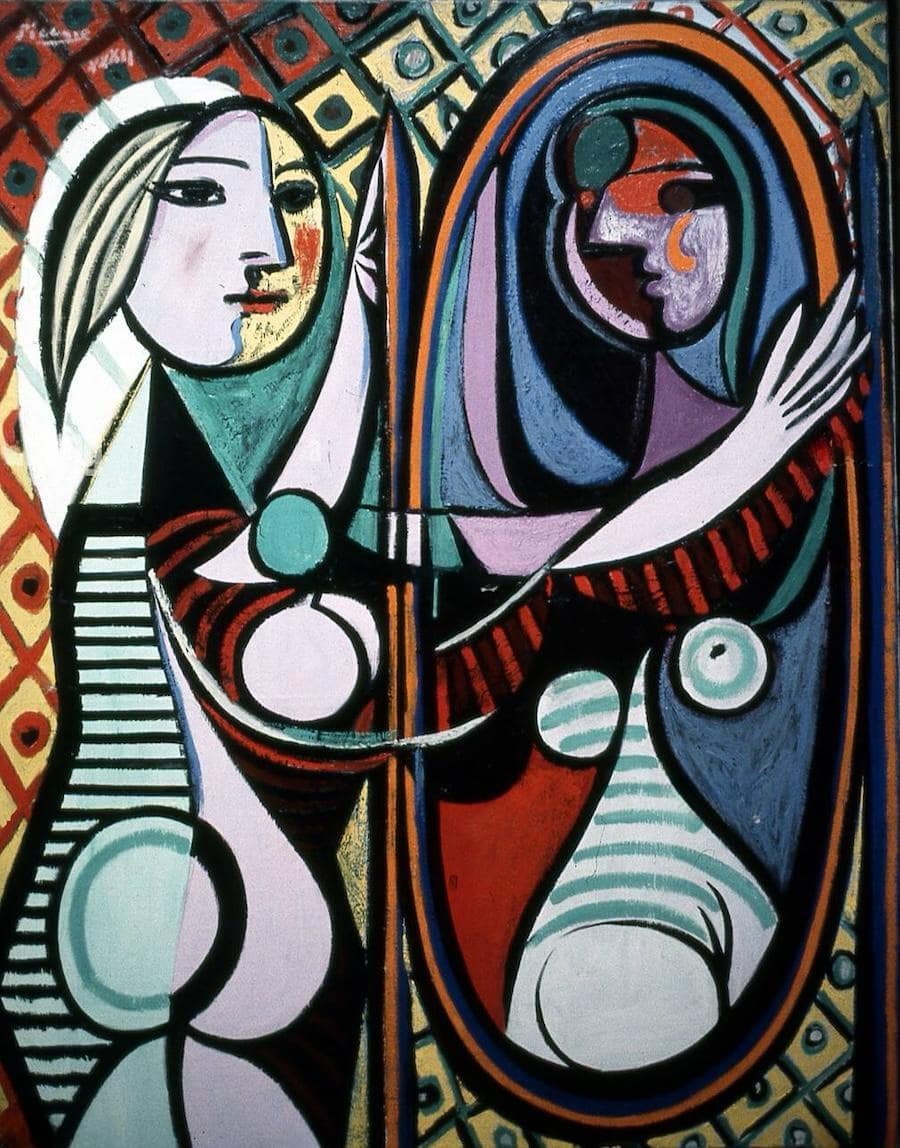
This month is devoted to Gemini, the third astrological sign of the Zodiac. An air sign represented by the celestial twins, Gemini, are sociable, highly adaptable creatures with a natural curiosity for the world around them. Notoriously bearing the brunt of criticism for being duplicitous and two-faced, there is much more to this sign than these reductive claims. An artwork that reflects Gemini’s misunderstood and complex nature is Pablo Picasso’s ‘Girl before a Mirror,’ 1932, which you can find in the Museum of Modern Art, New York.
‘Girl before a Mirror’ is one of Picasso’s most well-known paintings and belongs to the final phase of a major series he produced between 1931 and 1932. According to Alfred H. Barr Jr., Founding Director of MOMA, Picasso considered it his favourite among the series, a testament to the work’s extraordinary visual richness and layered meaning. It is widely interpreted as a psychological portrait of his muse and lover, Marie-Thérèse Walter.
Divided into two parts, this curious portrait revisits the artistic trope of a woman gazing into a mirror, but transforms it through a distinctly modern lens. Here, the woman and her reflection emerge like Gemini twins, two distinct yet inseparable versions of the self. Much like Gemini, the painting is rooted in duality, contrast, and the coexistence of multiple identities within one person. The mirror becomes more than a reflective surface; it acts as a symbolic threshold between outer appearance and inner emotion, consciousness and the shadow self.
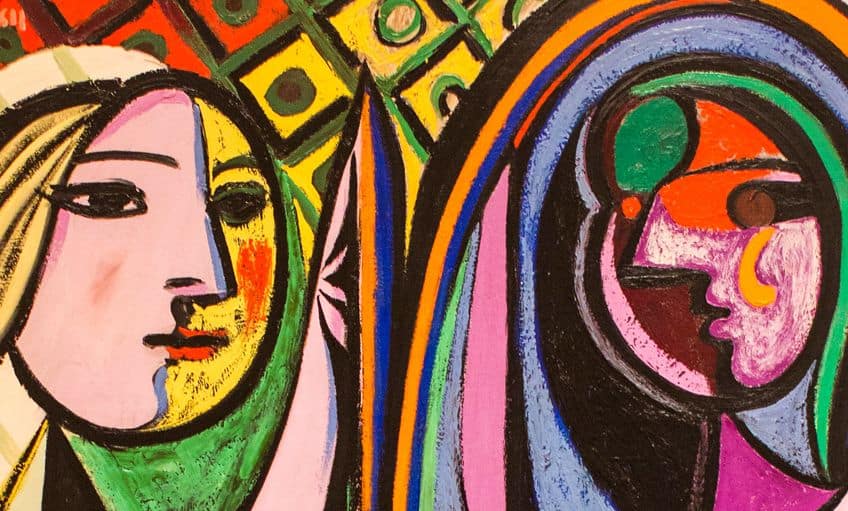
On the left, the figure’s softly rendered side profile, painted in muted yellow and lavender tones, radiates with warmth. This contrasts sharply with her darker and more distorted reflection, with the artist’s visible brushstrokes producing a decidedly rougher texture. This distinction explores pervasive cultural notions around identity, ageing, and mortality. With their youthful nature and playful curiosity, Geminis are often called the “Peter Pan of the Zodiac,” and so may resonate with the work’s preoccupation with youth.
Ruled by Mercury, the planet associated with communication and exchange, Gemini is closely tied to dialogue and duality, qualities that resonate strongly throughout the work. Influenced by both African art and Psychoanalysis, Picasso explores the concept of the “mask” - the hidden self, shaped and suppressed by societal expectations. Here, the subject appears to confront her masked side directly, with the painting’s mirrored structure intensifying this dialogue between inner and outer identity. As the woman reaches toward her reflection, the image becomes both strangely physical and intangible, reinforcing the Gemini-like tension between appearance and emotion, surface and subconscious. The composition’s strong symmetry heightens the notion of twinned existence, whilst the curving forms of the woman and her mirrored double seem to echo and respond to one another like parallel selves engaged in a conversation beyond words.
Picasso further heightens this sense of duality through visual ambiguity and puns. By incorporating both masculine and feminine imagery into the protagonist’s form, there is a fluid merging of gender, which echoes Gemini’s association with multiplicity, transformation, and the ability to embody contrasting energies simultaneously. Furthermore, in true Cubist style, Picasso fragments the woman’s face and body into different amorphic angles. Whilst the mirror image naturally suggests duality, the multivalent face on the left is also divided up into two parts: a side profile and a full-frontal profile. Aside from youth and old age, allusions to the sun and the moon - and subsequently light and dark - coexist within a singular face, realised through the circular and crescent forms.
In this work, meaning unfolds gradually, with shifting shapes and layered forms revealing themselves differently depending on the viewer’s perspective. This constant change reflects Gemini’s energy: sharp, versatile, and always in motion. Both our protagonist and her reflection refuse to remain fixed but instead dance between mood, colour and form. Much like Gemini, the painting embraces fluid identity that is not singular or stagnant but continually evolving and in flux.